
Dec. 3, 2025 - Full Show
12/3/2025 | 26m 47sVideo has Closed Captions
Watch the Dec. 3, 2025, full episode of "Chicago Tonight."
The Trump administration plans to exclude nursing as a professional degree — what that could mean for students. And the CDC is changing its longstanding stance on vaccines and autism.
Problems playing video? | Closed Captioning Feedback
Problems playing video? | Closed Captioning Feedback
Chicago Tonight is a local public television program presented by WTTW
WTTW video streaming support provided by members and sponsors.
Dec. 3, 2025 - Full Show
12/3/2025 | 26m 47sVideo has Closed Captions
The Trump administration plans to exclude nursing as a professional degree — what that could mean for students. And the CDC is changing its longstanding stance on vaccines and autism.
Problems playing video? | Closed Captioning Feedback
How to Watch Chicago Tonight
Chicago Tonight is available to stream on pbs.org and the free PBS App, available on iPhone, Apple TV, Android TV, Android smartphones, Amazon Fire TV, Amazon Fire Tablet, Roku, Samsung Smart TV, and Vizio.

WTTW News Explains
In this Emmy Award-winning series, WTTW News tackles your questions — big and small — about life in the Chicago area. Our video animations guide you through local government, city history, public utilities and everything in between.Providing Support for PBS.org
Learn Moreabout PBS online sponsorship>> thanks for joining us on Chicago tonight.
I'm Brandis Friedman.
Here's what we're looking at.
The Trump administration is planning to exclude nursing as a professional degree.
What that could mean as the country already faces a nursing shortage.
And new CDC guidelines suggest a link between vaccines and autism.
Alarming health professionals.
>> First off tonight, a coalition of advocates are speaking out today in support of the multi-million dollar deal.
Northwestern University has trunk struck with the Trump administration.
>> The resolution agreement between the federal government and Northwestern University marks accountability in the beginning of real change.
Above all, it recognizes the Jewish students at Northwestern.
We're not given the civil rights protections the day we're entitled to.
>> The coalition against Anti-Semitism at Northwestern or Con along with others say the 75 million dollar federal penalty.
The university agreed to pay is, quote, staggering and reflection.
They say of how deeply the university failed to protect students and the community.
>> The deal also requires university revoke an agreement with pro-Palestinian protesters, which it signed last year in exchange for the end of tent encampments on campus.
While some groups are praising the move that now really since millions in federal research dollars to the university, others are calling it extortion and say the university is bowing to government overreach.
Illinois is responding to a new fee.
The Transportation Security Administration is charging folks traveling without a real ID or other compliant document.
Yesterday the TSA announced a $45 fee to use an alternative identity verification system at airport security.
For those who don't have the ID or a passport.
>> Put this in perspective.
A one-way flight from Midway to Boston on Southwest alone can cost less.
Then this new penalty.
For a family of 4.
That fee could total $180.
And if the trip last more than 10 days, it could jump to $360 just to get through airport security.
>> In response, Secretary of state Alexi Giannoulias says his office is making it easier for folks to get the real ID by extending the lease on the real ID supercenter through the end of next year for faster service.
In addition to streamlining dedicated websites, he's also partnering with Cook County Clerk, Monica Gordon, to help folks get the correct documentation needed for the real ID like birth certificates and marriage licenses.
A key City council panel is advancing a proposal to ban the sale of intoxicating hemp products in Chicago.
The city's licensing Consumer Protection Department committee advanced the measure 10 to 6 which now heads to the full City Council to vote on next week.
It faces an uncertain future, though, as Mayor Brandon Johnson opposes a citywide ban and dozens of business owners have also pushed back on the plan.
The city's Department of Business Affairs and Consumer Protection says the proposal would threaten 200 businesses and is instead pushing for an alternative measure that would ban the sale of those products to people under 21 years old.
If you haven't had enough winter already prepare for more.
The National Weather Service says a blast of Arctic air will send temperatures plummeting into subzero territory over the next couple of days.
Tomorrow will be the coldest with lows in the negative single digits and wind chills.
-15 to -20 degrees.
>> Friday starts a pretty cold, too.
Been gradually warms up, but still not passed freezing.
Check out our website for Cold weather tips and where to find warming centers.
>> Up next, potential new financial hurdle facing nurses.
That's right after this.
>> Chicago tonight is made possible in part why the Alexandra and John Nichols family.
The Pope Brothers Foundation.
And the support of these donors.
>> The Trump administration is planning to remove nursing degrees among others from the professional degrees category.
Starting in July, the change would lower how much graduate nursing students can borrow for school.
The move sparked pushback from nurses nationwide who worry it could make degrees unaffordable and deepen.
An already severe nationwide nursing shortage.
Joining us to discuss the move, our Eileen Collins, dean of the University of Illinois, Chicago Nursing College.
Lorna Finnegan, dean of the nursing school at Loyola University.
Chicago and via Zoom Rocks and spur Lark chief nursing administrator and interim director of the DePaul University School of Nursing Nurses and Dean's and leaders of nursing schools.
Thanks to all of you for joining us.
Eileen, what is the professional categorization of degrees and what would it mean for nursing degrees to be out of that category?
So the Department of Education defines a professional degree as a profession.
>> It needs a graduate degree and generally needs a license.
So in a nursing nurse, practitioners need to graduate degree in order to be a nurse practitioner also CRA nays or nurses who do Anastasia also need a graduate degree and they also need to take a licensure exam after they're finished with their degree.
If that pushes, if the a month at a nurse can borrow to go to school, gets pushed to where they can't afford it.
It really creates shortages throughout not only the city of Chicago, but the state of Illinois.
So, for example, many counties in the state of Illinois do not have any anesthesia providers whatsoever.
So if you nurses nurses fill that gap and they work with anesthesiologists in all kinds of different settings, we don't have those nurses becoming.
becoming nurse practitioners in Sierra nays.
Then it will create worst shortage than what we already have.
>> How could this impact students who are currently enrolled in graduate nursing programs and they're relying on these loans to pay for education.
So it won't impact the nurses who are currently enrolled will impact those students who want to enroll after July.
1st.
So the students who are currently enrolled are grandfathered in.
But the ones who want to start next year, for example, in the next academic year, they won't be able to access those loans and a big concern is they will take out loans, but they'll be from predatory lenders and then they'll have these exorbitant interest rates and they may have to drop out eventually.
Roxanne during the pandemic.
Of course, we all know that nurses were described as heroes on anyone who's ever needed.
Some nurses in the hospital knows the work that they do.
>> In your opinion, does this change signal a shift in how the government views the importance of the profession?
>> Thank you for inviting me to the conversation in the short answer is yes.
The 22 years, the Gallup poll, he's right.
Nurses as the most trusted profession in this country.
And on top of that, nursing is the largest workforce in health care.
So when we think about these shifts, it, we have to think about it from the stance of where it happens now in acute care.
If we're looking at a shortage that is already in process and we are looking at nurses that are at retirement age in leaving during the pandemic because of other stressors.
We have to acknowledge there's a breakdown in the availability of nurses, which we already know.
It's being impacted, those nursing statements that would be produced with steel.
Stand A halt because we would not be able to produce those to in 2023.
It was noted that they would 19 1977 vacancies for individuals that will here to teach at the graduate level.
So if that were the case, means that we had to turn away somewhere around 60,000 nursing students were qualified intelligible to into this space.
So when we think about this acute care is definitely going to be impacted because of the quality and standards that we have to meet to be able to provide quality and safe care.
>> Lorna, the change we know won't affect undergraduate nursing students, but it will make it harder for students to pay for graduate programs.
As we've discussed, describe what some of those graduate programs are pleased and the jobs of those students can typically take on after graduation.
>> So typically they can become an advanced practice nurse.
And there are 4 categories of advanced practice nurses.
Nurse, practitioners diagnose prescribe and treat illnesses and certified registered nurse anesthetist deliver an official clinical nurse specialist over see really complex care and nurse midwives deliver babies.
So besides advanced practice, it also affects the future pipeline of nursing faculty because nursing faculty year-old graduate prepared, preferably with a doctoral degree and also nursing researchers.
So it really, really has a wide is this a slippery right now is about the money that a nursing student, undergraduate nursing student can borrow.
But could this lead to other?
>> Other ways that the profession is further diminished?
Well, yes, I mean, especially when you think about reducing the pipeline of nursing faculty that will reduce the pipeline of students who are entering the nursing profession because there won't be enough faculty to teach them.
So ultimately it will worsen a very bad nursing shortage as it is.
And it really it it's really about public health that's going to have a negative impact on public health >> nothing nothing gets better with fewer nurses, nothing.
>> Eileen, the under Secretary of Education, Nicholas, can't has argued that these changes are intended to pressure the schools, the universities to lower tuition costs for students to that they don't have to take out such large loans.
Do you think that will be the case?
Will nursing schools respond with just lowering the costs?
>> We can't afford to do that as a nursing school.
If you think about it, the healthcare environment is increasingly complex there for the complexity of teaching students goes up.
We require complex simulation laboratories.
We require faculty who are at the top of their game and you can't hire faculty at the top of their game at a very low price.
So we don't want to water down in to loot the polity of of health care that our students can provide.
Right now, the United States has one of the best health care systems in the world.
And we had there because students, whether they be nursing students or positions or dentists are educated by people who are the top of their fields.
We want to continue that to so that the United States, Chicago, the state of Illinois, continues to provide excellent health care.
>> Lorna, sorry, Roxanne, I know that you've emphasized a diversity and equity and inclusion.
Excuse me.
That's not right, Laura, this question is actually to you.
Youve emphasize diversity, equity and inclusion at the Loyola Nursing School.
What impact could this change have on diversity of enrollment?
What it what it will do is it will create 2 tiered system because under represented and minority students are more likely to take out loans.
>> generally come from less less generational wealth and they have less access to private loans.
So therefore, there will be less under represent minority students entering advanced practice, Les faculty.
It will ultimately then affects care and access to care and health equity because underrepresented students are also more likely to work in underserved communities and deliver culturally can cordoned care.
Where where they are delivering care to patients just like And ultimately it will reduce access, especially rural areas.
>> And behavioral health areas and it will reduce the number of underrepresented faculty.
We've we've worked really hard increased nursing workforce diversity, and it's just going to take us on a slow back down again.
So it's it's really can have a great impact, the rocks.
And we've also seen federal funding cuts to hospitals that could affect tuition reimbursement for nursing students.
>> You have a doctor of nursing practice degree.
That's one of the programs that may become harder for students to afford.
How important is it to have multiple avenues of financial assistance when pursuing a degree like that in about 45 seconds?
>> The short answer is it cannot be when we think about individuals who pulled the same type of credentials that I represents about one percent of the nation and in doing that, we have to want a healthier and more just future.
And if you want to provide for this, we are the ones who wear the put in front to address many of the shortages.
And we are not there, too, look at the areas where we're heading the shortages, the physicians, which is true, an in-game, thank if we cannot address these then the profession that has carried this country through crisis, goes.
>> We'll have to leave it there.
Best of luck to all of you.
Thank you for joining us.
Eileen Collins, learn offend again.
Roxanne Spurlock things, everyone.
Thank you having Up next, the possibility of major changes to childhood vaccination guidance.
A longstanding guidance on vaccines for children could soon be upended and advisory committee overseen by Health and Human Services Secretary Robert F Kennedy Junior's Vaccine Advisory Board will meet tomorrow to discuss the medical guidance of hepatitis B vaccine, which is currently given at birth the fall.
This follows the Centers for Disease Control and Prevention changing its stance on the unproven link between vaccines and autism.
The updated language on its website reads, quote, the statement, quote, Vaccines Do not cause autism is not an evidence-based claim.
Scientific studies have not ruled out the possibility that infant vaccines contribute to the to the development of autism.
However, this statement has historically been disseminated by the CDC and other federal health agencies within HHS to prevent vaccine hesitancy.
Joining us to dive more into died.
More in depth on this.
Our Dr Michelle Barnes, president of the Illinois chapter of the American Academy of Pediatrics and professor of clinical Pediatrics at UIC and you Eye Health.
Dr Max Brito, professor of infectious diseases at UIC and vice president of the Infectious Diseases, Society of America and Dr.
Robert Murphy, executive director of the Harvey Institute for Global Health and John Fair, professor of infectious diseases at Northwestern University.
Welcome back.
All you.
Thanks for joining us.
I think it's also important to note that on that same front page of the vaccine website for CDC, there is the sentence that reads vaccines do not cause autism asterisk.
And then you go further down.
They don't cause autism and you go further down and explained that they did not remove that sentence due to the agreement that the chair of the Senate Health Education, Labor and Pensions Committee made to keep that on the website.
Dr Brito was this new claim from CDC.
The vaccines can cause autism was alarming for you.
>> It is alarming.
Vaccines do not cause autism.
So the initial statement is right.
I mean, all of these links between autism and vaccines comes tolling study.
That was where the falsified data personal.
The author of the study falsified the data.
And since then there have been 16 it be the logical large-scale studies that have proving or have failed to prove that there is a link between autism vaccines very well designed studies more than almost 2 million kids have been data to a case have been examining and there's no link at there's no proof that vaccines cause Dr Murphy, given all of that, right?
There is no proof.
Is it hard to prove a negative?
And is that what this administration is relying Well, it's hard to say.
100%.
Absolutely sure that the no vaccine ever caused autism or cause autism.
>> You know that you can you can say that.
But we're talking like chances like one of the million or one in 10 million chance.
It almost is almost 0.
>> One of those studies that compare mention was 550,000 children.
About 80% have the vaccines and 20% did it and they looked at them and there was absolutely no difference between the development of autism.
It's the biggest study to date.
The epidemiologic study from Denmark.
So, you study after study after study and that's why Senator Cassidy made them keep that in there or he wasn't going to prove Secretary Kennedy to be Secretary Health and Human Services.
>> Good.
He did and they have to get because of with an asterisk which basically then the rest of the page kind what's the word?
I'm looking for it.
It it the Dr Burns.
What are you hearing from parents and caregivers?
Is there a growing vaccine?
Hesitancy?
There is going back seeing hesitancy and we've seen that over the last several years.
increasingly in the last year.
>> But, you know, we see it as an opportunity for us as pediatricians to be the trusted healthcare provider that we are for children.
Vaccines save lives.
They help children to stay in school and to be healthy.
And that's what we want for our patients.
Just as we know that some parents want for their kids.
And so what what we try to do when parents expressed hesitation about vaccines is really just to try to talk with them about what other concerns try to address their concerns and then really work with them to make sure that they make healthy and safe choices for their kids to remain Dr Brito.
So if be vaccine, if it ends up getting pushed back on the schedule, which it's currently within.
24 hours of delivery.
>> What could be the immediate and then the long-term impacts of that.
>> The long-term impact as many more cases of chronic Hepatitis B in kids in infants, which is a fully preventable disease.
And what that does to kids is increase the risk of developing cirrhosis, which is scarring of the liver or liver cancer later in life.
Why would you want that for your kid if you can prevent a with a shot?
What a birth.
There is absolutely no evidence of that causes any harm and they prevent a lot of morbidity in.
They were talking earlier.
would prevent continuing.
The program would prevent more than 100,000 cases this disease.
>> Dr Barnes.
If the recommendation does change and a happy if if they suggest delaying it, giving that vaccine later on, what could the impact be on insurance coverage?
Well, the impact on insurance coverage we don't know.
So across the federal government, I think that remains to be seen based on the relationship between a cip in the federal insurance company, assert federal insurance organizations such as Medicaid.
>> However, in Illinois, Governor Pritzker has really tried to ensure that we that our patients children, our families, will be able to.
Can you continue to get the vaccine regardless of what the changes are to the federal guidelines with the understanding that the New Illinois Advisory Committee on immunizations can make recommendations for Illinois INS and will ensure that they have access to the vaccine regardless of the type of insurance that they Okay.
we're gonna come back to that in a bit as well.
Dr Murphy.
>> So the Trump administration, they are studying the safety of aluminum in vaccines.
Why is there aluminum in some vaccines?
So aluminum is the most common metal on Earth is actually is 9% of all the metal and the entire earth.
The whole planet Earth.
It's everywhere.
It's in the water.
>> It's in all your food.
It's vegetables and fruits everything that's in the environment.
basically a ubiquitous subs substance.
They put it into the vaccine because it acts as an edge of it.
It actually makes the vaccine worked 10 100 or 1000 times better than without it.
So you can give less of the vaccine.
If you have just a little bit of aluminum, we're talking about one milligram, 2, one, 1000th of of of a gram or even less than that in in the vaccine, there is more aluminum baby formula in 2 doses of baby formula.
That in a vaccine.
So if you're worried about aluminum causing autism, you basically can't give it.
You can almost take it any of the foods out there, including formula that, you know, over 60% of kids take.
So where are we going to stop?
The reason why there?
They're saying aluminum cause it because aluminum is everywhere.
Works most aluminum all the time.
doesn't do it that that amount.
It does nothing.
It's kind of like with Tylenol everywhere, right?
Every state.
That's that's exactly.
>> Why is aluminum a concern?
I we're taking aluminum out of deodorants, for example.
Why is why is it bad to have a looming?
still a lot of deodorant, scene-stealing toothpaste and it's still in your food.
It's still in the food chain.
Is it?
You can't take aluminum basically out of the environment.
There's so much of it.
Governor JB Pritzker.
He signed a bill yesterday to safeguard against federal anti vaccine guidelines.
Here's what he had to say.
>> While RFK Junior and his QAnon uninspired colleagues spreading conspiracy theories and dangerous misinformation about vaccines are running around Washington.
Illinois is stepping up to protect the health of our people.
And while some other states are denying proven science to serve the MAGA Republican political agenda, Illinois is listening to the experts and making life-saving care more accessible.
>> Doctor burns, how can states respond to this?
In his Illinois doing the right things?
In my opinion?
Yes, Illinois is definitely doing the right thing.
I think we're so fortunate to have and have a governor that's really looking out for interests and needs of the and the health really of the children and families in Illinois by allowing us to make the decisions allow us to have the best health care possible for our our families, is it enough to prevent potential outbreaks?
Vaccines save lives and vaccines prevent illness vaccines prevent people from missing school missing work prevent allow them to do all the things that they should be doing.
Kids in particular.
And so by allowing by encouraging and enforcing that we will be have access to all of the recommended vaccines here in Illinois.
Governor Pritzker doing all he can to make sure that we have available to us.
Dr Brito few seconds left.
If the CDC's guidance may not be the most reliable anymore.
Where can folks turn to get the best information?
>> Well, they can turn to medical societies, for example, some of the medical societies that coming up with their own guidelines on their own recommendations.
There's big vaccine, integrity project that it's a parallel to government effort that is trying to put out sound scientific evidence to get parents to make the right decisions and parents should definitely vaccinate their kids, OK?
We'll have to leave it there.
Thanks to all of you for joining again.
Dr Michelle Barnes.
>> Dr Max Brito Dr.
Robert Murphy, thanks, everyone.
Thank you.
And that is our show for this Wednesday night.
Join us tomorrow night at 5, 30 10.
>> Then 9, 3 bears lead.
The NFC is a playoff run in sight.
We break down your chances with James Big Cat Williams.
>> No, no touchdowns.
just now for all of us here in Chicago tonight and bring us treatment.
Thank you for watching.
Stay healthy and safe and have a good night.
>> It captioned he's made possible by Robert a cliff.
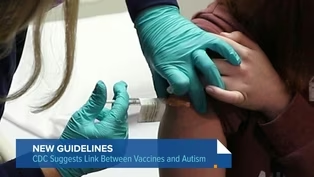
Health Officials Alarmed Over New CDC Guidance on Vaccines
Video has Closed Captions
Longstanding vaccine guidelines for babies and children could soon be upended. (9m 59s)
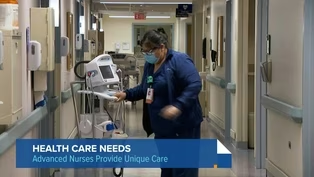
Trump Administration Plans to Exclude Nursing as Professional Degree
Video has Closed Captions
The move would lower how much money graduate nursing students can borrow for school. (9m 45s)
Providing Support for PBS.org
Learn Moreabout PBS online sponsorship
- News and Public Affairs

Top journalists deliver compelling original analysis of the hour's headlines.

- News and Public Affairs

FRONTLINE is investigative journalism that questions, explains and changes our world.












Support for PBS provided by:
Chicago Tonight is a local public television program presented by WTTW
WTTW video streaming support provided by members and sponsors.