
Dec. 9, 2024 - Full Show
12/9/2024 | 26m 47sVideo has Closed Captions
Watch the Dec. 9, 2024, full episode of "Chicago Tonight."
Alderpeople on where the city’s 2025 budget stands. And why some people responded with indifference to a CEO’s death.
Problems playing video? | Closed Captioning Feedback
Problems playing video? | Closed Captioning Feedback
Chicago Tonight is a local public television program presented by WTTW
WTTW video streaming support provided by members and sponsors.
Dec. 9, 2024 - Full Show
12/9/2024 | 26m 47sVideo has Closed Captions
Alderpeople on where the city’s 2025 budget stands. And why some people responded with indifference to a CEO’s death.
Problems playing video? | Closed Captioning Feedback
How to Watch Chicago Tonight
Chicago Tonight is available to stream on pbs.org and the free PBS App, available on iPhone, Apple TV, Android TV, Android smartphones, Amazon Fire TV, Amazon Fire Tablet, Roku, Samsung Smart TV, and Vizio.

WTTW News Explains
In this Emmy Award-winning series, WTTW News tackles your questions — big and small — about life in the Chicago area. Our video animations guide you through local government, city history, public utilities and everything in between.Providing Support for PBS.org
Learn Moreabout PBS online sponsorshipjoining us on Chicago tonight.
I'm Brandis Friedman.
Here's what we're looking at.
>> We're right playing for Chicago's that we invest in.
>> Chicago's budget is still up in the air panel of older people.
One, what next year's spending plan would look like.
And the man suspected of killing the United Healthcare CEO has been identified.
We dig into the public reaction to his death.
>> And now to some today's top stories despite being in a position to oversee the Chicago Police Department.
Even the president of the Community Commission for Public Safety and Accountability can't escape the department's traffic stop practices.
Anthony Driver tells W T Tw News that he's been pulled over by CPD officers 5 times in 2024 alone.
He says 2 of those stops were for an expired registration sticker.
And once for suspicion of making an unsafe lane change.
But driver says officers refused to give him a reason for the other 2 stops and it wasn't ticketed for any of them.
He tells us he believes his appearance as a 6 foot 3, 200 pound black man with locked here factored into those stops.
For more on driver's role in crafting rules to limit police traffic stops.
Please visit website.
70 on House Chicago men will have a new temporary home marking a new approach to homelessness in Chicago.
>> We know that we need not just warm safe and dry spaces, but trauma informed spaces with staff that are paid fair wages, right?
Who know what they're doing?
Who can work with our neighbors to help them figure out whatever barriers are in the way for them getting back out on their feet.
3.
>> 40th Ward Alderwoman Maria Hadden was one of several officials cut the ribbon at the New Northside Housing and Supportive Services Facility in Rogers Park.
The man who live at the facility will be able to stay there.
24 hours a day versus having to leave in the mornings.
They'll receive food, shelter, health care and other wrap-around services.
Nearly 70% of Chicagoans experiencing homelessness.
Are men yet only 22% of the city's shelter beds are available for single men.
This one will serve 250 men a year.
The Illinois State Police is touting its record of success.
The ISP says it obtained charges in 100% of 2023.
Chicago Area Expressway shooting homicides in all.
There were 5 Chicago Area Expressway killings in 2023.
State police say highway shootings this year are down.
32% compared to this time.
Last year.
And 51% compared to 2022.
71% compared to 2021.
Up next, an outpouring of anger at the health care system after an insurance company CEOs killing.
That's right after this.
>> Chicago tonight is made possible in part why the Alexander and John Nichols family.
The gym and K maybe family.
The Pope Brothers Foundation.
And the support of these donors.
>> New York police have named a suspect in the shooting death of United Healthcare CEO Brian Thompson in Manhattan last week.
Police say 26 year-old Luigi Manji only had a gun believed to be the one used in the killing as well as writing, suggesting his anger with corporate America last week, investigators shared that in munition found near Thompson's body was etched with the words delay, deny and oppose.
It's all led to a wave of public feelings like anger, resentment and frustration with the health care industry.
Joining us to discuss the range of feelings about health care or about health insurance are Mark Will Rowe president of a Safe Haven Foundation?
And Anthony Sasso a health care economist who is professor and chair of the economics department at DePaul University.
Thanks to both for joining us.
Mark Morrow lives.
Let's start with you, please.
There and I should also mention we also reached out to a number of health insurance.
They declined our invitation, though, the Illinois Life and Health Insurance Council also declined to join.
But they did provide a statement which we will share in a moment.
Again, thanks to the both of you for being here.
Marc Morial, let's start with you, please.
There was a barrage of social media posts from people showing some serious indifference to the death of Brian Thompson being murdered.
Some comments like, quote, thoughts and prayers are out of network, which is clearly very callous.
But why do you think this was the response from 70 people?
>> As you said, it's very callous response.
I think overall lot of people are frustrated with the cost of hired accessibility of it.
>> And they.
We're looking for a target.
And unfortunately, this poor man who was killed became a target of Those comments.
But it doesn't address what the situation is in the industry that costs are rising.
The access limited providers.
We're not compensate the way they should be.
And, you know, we have quality cost system.
That is it for an industrialized nation such as ours.
We're at the top of the industry.
But at the lower lines of health care and the consumers getting frustrated.
>> as you're speaking, of course, we're looking at some of the some of those tweets from some on your screen right now.
Anthony, let's also the words delayed tonight to pose and seeing different reports wasn't deny, defend pose, but we don't get the idea about those words etched on the ammunition, echoing words that are used by health insurance industry.
Critics.
What's your reaction to that detail?
>> terrible tragedy that individual.
Chose to.
Just a babe in this way to, you know, kill somebody over this issue.
So that I mean, you it's really a terrible tragedy for sure.
I do think that health insurance generally is one of these areas that it is always the focus of a lot of anger and frustration.
I'm not entirely convinced that all of it is justified.
I think that a lot of people don't quite understand exactly the fact that health insurers.
They do.
They do 2 things.
They try to protecting against these risks that we all face.
And that is undeniably a good thing.
We all benefit from that historically insurance has been one of the most amazing creations that humanity has done for itself.
But when you bring risk protection, what happens then is that you have the the flip side of that, which is that now people have an incentive to use more services.
Okay.
And it's and that's we call.
We call that in the industry.
Call it moral hazard.
And that is that's an issue.
It's a known issue.
Health insurers try to come up with ways to try to limit what we might call overconsumption of health care services.
gets even worse than that, though, because most individuals are gonna say I'm not going over consuming to do it.
My doctor tells your doctor knows that there is this built in moral hazard to get to use the jargon term in the health care and health insurance system.
Everybody, doctors, patients, they all want more care.
It's all expensive.
Okay.
So the insurer has the unenviable task of trying to judge what is worthwhile care?
What is less worthwhile care?
It is.
It is a terrible spot to be in.
But they are charged with that responsibility.
>> Mark, your organization, the safe haven, you will focus on providing assistance for suffering from complex economic challenges.
What sort of barriers to the people that you that you help or support?
What are they face when dealing with health care industries?
>> Well, I think well addition experiencing homelessness, their substance abuse, behavioral health care.
Issues.
There's trauma from poverty from living in areas that have a disparate health care.
One of our locations as pot.
6 blocks outside of the medical district.
But it's one of the lease or the city of Chicago.
So you see a lot of things that are coming into play said cause frustration and anger and you see a lot of the I think from the insurance standpoint, this is kind of the population that's often the last served.
gotten there left to the state and they're left to outside agencies to provide the gaps because our coverage, it's episodic coverage.
We'd rather treats somebody an emergency room then to preventative health.
rather treat somebody for a larger condition, which is higher reimbursement rate.
Then.
Teaching them how to maintain their health giving them the resources that they need to maintain health, housing, food making sure that they can afford to support their family.
That they have behavior, health care, all those things come into it and it becomes a bureaucracy of cost rather than a doctor making a decision with his patient or health care professional.
I think you were talking about up coating which it's a it's something of a very technical term.
look it.
That's kind of where, you know.
>> start out.
You keep building upon the insurance.
>> We'll start at the lowest level and build upon the testing, etcetera.
well, and I want to get to a statement.
I apologize.
But I as I mentioned, we did receive a statement from the Illinois Life and Health Insurance Council that reads, quote.
>> Violence is never the answer in the strongest terms possible.
We condemn any suggestion that threats made against anyone working in any industry in our country are ever, ever acceptable.
There's a time and place for further discussion.
But for now, let us not intermingle or conflate the justification of cold-blooded murder in broad daylight with policy discussions about the complexities of the United States health care system.
Anthony, to you first, while there is, as the statement said, there's never a justification for murder like this.
But could this discussion that comes out of it?
Could that lead to some changes or at the least a deeper examination into the practices of the industry?
Well, I guess I would hope that.
>> it's a good statement I think it's right points.
I would like to see, I think I'd like to see the insurance industry probably do a better job I think discussing why there are efforts at times.
Not always but to try to push back on what providers will often try to push on on patients again, not all providers, not all the time.
Both providers, of course, our try our have the patient's best interest in mind, but that every provider I know is human.
And and they respond to incentives to.
And so those incentives are to do more to do more invasive procedures.
Those are all costly.
And in the healthcare sector, as I think we all know at this point, there's a great deal of uncertainty about what works and what doesn't work and sometimes watchful waiting is the best thing to can bill for watchful waiting first is an invasive procedure.
>> 30 seconds left Mark Morrow.
Same question to you.
Do you think this could lead to this discussion could lead to a deeper examination into the health care industry?
I think it's sad that somebody has had to lose her life for us to have those discussions on how to effectively deliver health care in our system, especially a country as rich as ours.
I think there's a lot of challenging complex issues be addressed.
And we really can get that going through better utilization of our system, spare utilization of our resources are funding, but violence is never an answer Ok?
Lot to talk about here.
Not going to solve it all tonight.
My thanks to both of you for joining us.
Anthony was also in Michael Brown.
Thank you.
Thank you.
Thank you.
>> Up next, the latest on the city's fraught budget negotiations.
Stay with us.
Well, the Key City Council, many set said, I'm with a key City council committee set to vote on Mayor Brandon Johnson's latest budget proposal tomorrow will be 3rd time be the charm.
>> You know the vote.
The first step, of course, is tomorrow.
But I am tremendously grateful that there are so many members of City Council or who are open to this process and have provided great feedback so far, Judy, to get to the finish line by Friday.
I mean, that look work.
That is certainly the effort of my administration.
I said up, I'm going to do my job present a balanced budget.
Again, I'm grateful to the members of City council who have shown up with a great deal of ideas.
We just say that we have to continue make critical investments without cutting services in Lee.
People often think that support for the people of Chicago.
>> The spending plan comes after older people turned away to earlier pitches that included huge property tax hikes.
The countdown is on the city council has just over 2 weeks to pass a budget or face potential government shutdown.
The plan has sparked intense debate over tax increases, spending cuts and funding priorities.
Joining us now, our 28th Ward Alderman Jason Ervin, who represents neighborhoods including West Garfield Park Austin in North Lawndale 6 Ward Alderman William Hall representing communities like Chatham, Auburn, Gresham in Englewood.
15th Ward Alderman Raymond Lopez, whose constituents include Brighton Park Gage Park and back of the Yards and Alderman Andrea Vasquez from the 40th Ward representing neighborhoods like Andersonville Lincoln Square and Edgewater.
Full House tonight.
Gentlemen, thank you all for joining us.
let's start with you because you're the chair of the Budget Committee.
As we mentioned, the city council unanimously rejected that 300 million dollar property tax hike.
more quietly rejected the proposed 150 million Dollar property tax hike.
Will City Council approved one?
That is 68.5 million dollars.
A Blue City Council will approve the property tax increase.
>> Again, no one wants to cut services.
When you ask people about services.
No one wants to see reductions in services.
However, you also asking.
>> In a vacuum, hey, do you want a property tax increase course going to tell, you know, but again, the fact that people do not want service because these me to believe that we need to find revenue in order to keep the level of service that we All Lopez.
Mayor Johnson has called the budget process Collaborative.
Has that been your experience?
That has not been my experience nor the experience of many members of the City council.
>> Earlier in August, we got this document, which was the budget forecasts and we've had nearly 5 months where we could have talked about this in advance of coming to this point.
That hasn't been the case.
And I think that.
While many Chicagoans want us to continue providing desperately needed city services.
They don't want to feel as though they're being nickel and dimed at every turn or they don't want to see that there's patronage jobs needless management in that budget.
And I think we haven't gotten to the core of that.
The mayor came back with a 3 million dollar reduction in one department after we propose 560 million dollars to get back to 2020 spending levels so there's plenty of room to negotiate still, if the mayor and his team want to come back to the table and have an honest conversation, do you really want to go back to 2020?
Even a council?
It doesn't.
We have to do to show good faith.
Absolutely, OK, you know what?
I think the mayor's office should do that, too, because he's 5 million dollars more than we were back then.
I think people need understand just keep that in mind for a twenty-twenty spending levels levels.
Twenty-twenty spending levels.
I'm going ask as but it's more than 2 weeks overdue.
You're just 22 days until the deadline by state law.
What do you think went wrong here?
Yeah, I I do agree with my colleague as far as the president being collaborative, we ultimately found out.
>> What the budget proposals and be 30th.
I think the council is learning what it means to be a coequal branch.
So voting down one proposal unanimously moving things down.
Now works close to a 5th of what it was.
We just have to be empowered and understand how to actually have these process.
He's improved.
So that's something we're working to do that if you would have talked about this sooner, then it all these questions.
We wouldn't find ourselves crammed at the end of the quarter and figuring out with like 20 days to go how to solve a budget.
And I think people Chicago, one have confidence in city government.
I see this process has been transparent, but it doesn't feel like of the willing transparency.
It occurred because the council pushing back to try to solve this couple of votes expected this week.
Do you feel confident that will lead to budget passage in time for the December 31st?
Deadline?
>> I think I think that different a chairman have a better idea of how how confident want to feel.
But I do think a reality is a budget needs to be passed before the end of the year.
That if we fail to do that, it won't be about one The other people look at city government as a whole and say we're not serving them.
And think that's a place you want to be in alderman.
All you concerns that the city might see its credit downgrade, which would make, of course, borrowing more expensive.
What I'm concerned about his political tactics that end up taking us at this point.
At the end of the day, we passed a billion-dollar bond deal.
>> In the credit score has gone up.
We don't want to lose the train.
We don't want to lose.
The momentum is been a long time since we've done business selling the city in the process.
And so I think that stay in the course of making sure that we make the necessary payments to keep our credit score of the way it needs to be so that we can go to the future of necessary borrow.
I think that's pivotal to this is Bility of the city.
We know a bad credit score looks like matter of fact.
The one of the highest tax bills that we pay for going back.
Half of that money was used to pay bad deals angle.
So we know what it's like to have that credit score in that budget.
I think that we have to look forward to the future.
Isn't the fiscal responsibility but maintaining levels that lets us be a serious business partner in the market.
Although Lopez, as you mentioned, the mayor's latest budget proposal.
You feel that at nickel and dime Chicagoans with nearly half-a-dozen tax hikes, what would you propose instead?
What would you like to see?
>> Well, I think >> the real problem that we have Brandis is that we don't know what the true costs of government is correct.
We are not able to get a legitimate accounting for what we need to operate.
What we call the city of Chicago's government actually just texting so that we have money to spend as opposed to saying this is what exactly we need and then going from there and nowhere is that more evident in the fact that now 3 times we've seen this we forecast revenue projections to try to create a balanced budget.
You can't keep fudging the numbers just to get to end goal.
that's a timing.
When you estimate revenue in August.
It's one thing when you come back in September, October, more data.
>> You get, you know, sure data right now you're looking at something we're about to go into New Year.
So we would have the best numbers today for says 3, 4 months ago.
And that's essentially what you see.
But our revenue projections are based on a three-year period to say that that dramatically changed from September from October.
30th to the data is chance you're going to last.
You think?
And we want to get 450 million dollars from the state.
It was shorted almost 200 million dollars.
Also make a projection is based on what you have to make projections because it's all you have to walk free with your view as you get closer is not for Jeanne.
As you get closer to reality, you actually get to see what those numbers really are.
>> I think in many cases we're trying to put something together.
And at this point of the process we're talking about ultimately 40, 50 million dollars over 5 billion dollar budget area here.
And again, that generally falls into the corporate fun every year.
So find it difficult to believe that worsened over argued over counts change.
At the end of the day, when we look at this thing in its totality.
So we were hopeful that 100 million to one, 50 to 68, we could get down to 0.
But again, we've had to additional things we started.
We raise the PPL T tax up to 128 million dollars to make that happen.
We raise taxes on parking to make that happen.
So the this isn't this isn't anything new without fans to come up with new revenue do without cutting a single job.
without addressing of those other watching, this is what's happening.
You've got the last quarter.
You've got 2 months of people who have different views on how to solve a problem.
Right?
The mayor proposed one member said this wasn't what we were expecting, but you've got a body of 50 people looking at it differently.
So we don't set ourselves up for success when you're cramming that into a 2 month period.
But one thing we must take in consideration is this.
When you some words, code words like budget cuts, that means people lose their jobs.
>> And at the end of the day less, let me on kind of the some of those are making these proposals of cuts have to test school courage to go to door, say I'm taking your job.
know by the end of the day, those jobs can pay tax bills, you don't pay tax bills, you lose home.
I would so at at the end of the day, what we have to look at is a budget.
This bull fair indeed.
Again, no one's disagreeing on fiscal responsibility.
If a school management taking a different approach, it, but at the cost of people need jobs.
We have people that are trying to make a dollar to 15 says so.
We have administration to put forth budget proposal to keep jobs.
No one wants people to lose jobs.
And I find it very odd that people are proposing budgets that cause people to lose I would disagree with the assertion what I'm trying to find efficiencies budget cuts.
It's not just losing jobs.
They keep trying to frame it you want to get rid of firefighters not the case the mayor's office has.
has grown with taxes.
Payable I find is that taxes pay for cops Texas pay for roads.
You don't raise taxes.
You don't use it right down pay for the salaries.
How do you pay for the will have for the community's into today.
We have to respect the role that Texas plain waiter in a right bizarre as budget as the subcommittee chairman for revenue.
What did you come up with?
came up essentially number one with the system for people propose ideas.
His came its wings.
And what kinds other you asked me a question.
But as we know the answer, you up with nothing essentially weather.
it is going to jump in here because there there is something else that got cut their 90 million dollars in spending cuts being proposed, including reductions in funds for small businesses.
>> And basic income programs.
Alderman Urban, do you think these cuts undermine efforts to support economic recovery and particularly in underserved communities?
That's exactly what it is.
And every time we go back to the table with additional changes, we will >> impact the communities that are in need the most not go to mount.
want to go to Saucon has everything looks beautiful.
Everything looks great.
People are working.
Life is great.
When you go to Garfield Park when you go to Roseman, that's not the case.
Communities in Chicago have challenges.
And if we don't help communities meet the challenges, know, ultimately these these things lead greater problems.
So all the thing I will say is that every time we've come back, we may cuts to guess what those cuts have landed on the backs of people who can least All right.
We've got a minute left over and ask as and hopefully all hall as well.
Do you think this episode, this entire budgeting episode has sort of raised questions about the progressive ability to govern in Chicago.
I think even before the budget process, that's what people are at.
I think the one thing that is clear is that there's a lack of confidence in how the mayor has been moving as well as the progressive movement.
People says.
>> Potentially not being competent, moving certain directions.
And so what we do next, how we solve these problems we engage with each other.
It would change that narrative because there are plenty of people who are progressive who know how to figure out.
But it's we're trying to find efficiencies, try make sure that we all work government that addresses the needs of people that's possible.
And just because people see examples where it's not the case, does it mean to be for every I think that progressive equals people making sure they get jobs, people making work environments are correct.
And people making a living wage and not just an hourly rate.
And I think that that's what sustainable revenue looks like to the future is progressing to sustain neighborhoods.
95 people makes Chicago great.
You put them on our shoulders and we want best of luck to all this week.
Will love look forward to hearing which will come up with.
>> And we'll have to leave it there all done Irvine Hall.
Lopez investigates things everybody.
Thank you for And that is our show for this Monday night.
Join us tomorrow night at 5, 30 10, our spotlight politics team on the flap over a top mayoral aides residency.
And of course, the latest on the city budget and a longtime political insiders.
New book on the Reign of Merrill's Richard, him daily now for all of us here in Chicago tonight and Brandis Friedman, thank you for watching.
Stay healthy and safe and have a good night.
>> Closed caption was made possible by Robert a cliff and quickly a Chicago personal injury and wrongful death his
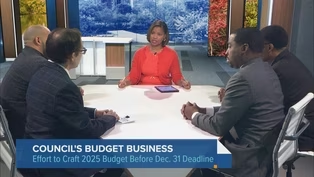
Alderpeople on Where Chicago's 2025 Budget Stands
Video has Closed Captions
Clip: 12/9/2024 | 11m 27s | The City Council rejected two previous plans that included huge property tax increases. (11m 27s)
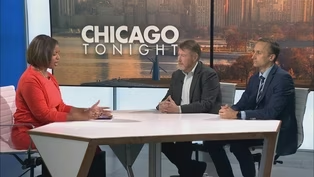
How the Public Reacted to Killing of UnitedHealthcare CEO
Video has Closed Captions
Clip: 12/9/2024 | 8m 51s | UnitedHealthcare CEO Brian Thompson was shot to death in Manhattan last week. (8m 51s)
Providing Support for PBS.org
Learn Moreabout PBS online sponsorship
- News and Public Affairs

Top journalists deliver compelling original analysis of the hour's headlines.

- News and Public Affairs

FRONTLINE is investigative journalism that questions, explains and changes our world.












Support for PBS provided by:
Chicago Tonight is a local public television program presented by WTTW
WTTW video streaming support provided by members and sponsors.