
December 12, 2024 - PBS News Hour full episode
12/12/2024 | 57m 46sVideo has Closed Captions
December 12, 2024 - PBS News Hour full episode
December 12, 2024 - PBS News Hour full episode
Problems playing video? | Closed Captioning Feedback
Problems playing video? | Closed Captioning Feedback
Major corporate funding for the PBS News Hour is provided by BDO, BNSF, Consumer Cellular, American Cruise Lines, and Raymond James. Funding for the PBS NewsHour Weekend is provided by...
December 12, 2024 - PBS News Hour full episode
12/12/2024 | 57m 46sVideo has Closed Captions
December 12, 2024 - PBS News Hour full episode
Problems playing video? | Closed Captioning Feedback
How to Watch PBS News Hour
PBS News Hour is available to stream on pbs.org and the free PBS App, available on iPhone, Apple TV, Android TV, Android smartphones, Amazon Fire TV, Amazon Fire Tablet, Roku, Samsung Smart TV, LG TV, and Vizio.
Providing Support for PBS.org
Learn Moreabout PBS online sponsorshipAMNA NAWAZ: Good evening.
I'm Amna Nawaz.
GEOFF BENNETT: And I'm Geoff Bennett.
On the "News Hour" tonight: President Biden makes history by commuting over 1,000 sentences and issuing dozens of pardons for nonviolent drug offenders.
AMNA NAWAZ: Daily life returns to Syria, where its new leaders must now figure out how to build a functioning government for the entire nation.
GEOFF BENNETT: And one Colorado community thrown into the political spotlight prepares for mass deportations under the incoming Trump administration.
GLADIS IBARRA, Colorado Immigrant Rights Coalition: If -- in case I am unable to be with my children, who will be in charge for them?
Deportations leave a lasting impact on our community.
GEOFF BENNETT: Welcome to the "News Hour."
President Biden announced today that he's commuting the prison sentences of some 1,500 people and issuing pardons to 39 others convicted of nonviolent crimes.
AMNA NAWAZ: That marks the largest number of commutations by a president in a single day.
KARINE JEAN-PIERRE, White House Press Secretary: As the president has said before, America was founded on the premise of second chances.
For far too long, our criminal justice system has closed doors of opportunity for too many people who should have the chance to once again participate in daily life and contribute to their communities.
AMNA NAWAZ: Lisa Desjardins has more on the clemencies.
LISA DESJARDINS: Amna and Geoff, most of the people affected by this grant have been serving sentences under home confinement, thanks to provision put in place during the COVID epidemic.
Now their sentences have been commuted.
In addition, 39 people have had their convictions fully pardoned, all for nonviolent offenses, including drug offenses.
The list includes Americans who served time for crimes committed in their teens or early 20s, and several are military veterans.
Until now, Biden has approved fewer clemencies than most recent presidents.
Mark Osler is a professor at the University of St. Thomas School of Law in Minneapolis, an expert on presidential clemency.
And he joins us now for a deeper dive.
Mark, thank you so much.
Clemency is a unique power of presidents.
And, to start, I just want to go over terms, remind our audience what we're talking about.
A pardon is something that forgives a crime and allows that person to regain some status, including the ability to vote.
Commutations reduce penalties, including jail time or sometimes fines, but they don't change their status.
You said this is a big day, including for one of your clients, who is one of those who was pardoned.
To help us understand this group, can you talk about her and what this pardon means?
MARK OSLER, Former Federal Prosecutor: So out of that smaller group of people who got a pardon, as opposed to a commutation, we saw Sarah Carlson.
Sarah Carlson is somebody who submitted her petition with the help of one of my students back in 2020 and has waited for years for this pardon.
She's someone who was involved in drugs, was addicted, had crimes that were associated with that, and then cleaned up and changed her life and devoted herself to helping other people, and certainly deserves this pardon.
LISA DESJARDINS: I want to also talk, of course, about the bigger group, the nearly 1,500 people with the sentences that were commuted here.
Now, these are folks who have been serving at home, as I said, because of COVID era law.
When you look at that group, what's your understanding of why they are receiving commutations of everyone in the federal system?
MARK OSLER: I think it's because they have proven themselves, that we're looking at people that have been out for at least a year who have clean records.
It's been a remarkable experiment in what happens when we release people early, when they have been carefully vetted.
With the Trump administration in place at that time, that's who did the vetting.
It was under Bill Barr.
And that group as a whole on home confinement has really done remarkable things in reentering society, becoming citizens and neighbors.
And because they were seen as safe, they were given a broad categorical grant.
LISA DESJARDINS: I noticed in the White House release on this that they mentioned these are folks who have also either continued education or they have already found employment in some way.
So there's additional vetting, I think, for this group.
But there are some Republicans specifically who are critical about this and have been.
For example, Senator Marsha Blackburn of Tennessee put out this tweet a year ago, saying that COVID was over.
And she thought this policy of home confinement should have ended.
How do you respond to that criticism that this is really a haphazard circumstance related to something outside the justice system, but instead to a pandemic, and, really, this isn't a group that should be considered in this way?
MARK OSLER: Well, it's also the nature of clemency that we're supposed to seek out the people who have rehabilitated themselves, who can live safely amongst us and contribute something.
The fact that COVID accelerated that process is all to the good.
There's no reason to have these people locked up.
And, frankly, they're a fraction of the group in whole who shouldn't be locked up.
LISA DESJARDINS: And let's talk about that, because you and I have talked before about this, that President Biden has had up until now fewer grants of clemency than most recent presidents.
He did grant a pardon to his son last week.
We talked about that.
After this, after today, where do you think Biden's legacy and record stands in this area?
Where are your expectations?
MARK OSLER: Yes, well, his legacy right now is that he's approached clemency in a way that's resulting grants that are wide, but shallow.
And by that, I mean, there's a lot of people, but they didn't get a huge amount of benefit.
You know, these are people who are already out.
And if you contrast that, for example, with what President Obama did, his was deep.
He was granting commutations of sentences to people who were doing life in prison without parole.
And so, right now, his legacy is someone who is skimming the easy cases off the surface.
But that can change.
There's still weeks left and there's a whole bunch of people who are deserving.
One thing that we have seen is that he's granting clemency to a lot of people who didn't petition for clemency, while largely ignoring the people who did.
Now, Sarah Carlson was someone who did in that handful of pardons today.
But there's hundreds and hundreds and hundreds of other people, and there's reason to think they have positive recommendations from the pardon attorney, who he could grant as well.
And he should.
LISA DESJARDINS: Mark Osler with the University of St. Thomas, thank you so much for joining us.
MARK OSLER: You're welcome.
GEOFF BENNETT: Turning now to the day's other headlines: White House officials tried to reassure the public today that mysterious drones reported over New Jersey and other states are neither a security issue nor a safety threat.
But state and local officials are pressing for more transparency.
And one Senator, Richard Blumenthal of Connecticut, went so far as to suggest shooting some down if necessary.
WOMAN: That is a drone.
That is not an airplane.
GEOFF BENNETT: All over social media.
MAN: There are literally dozens of drones flying around.
GEOFF BENNETT: Video after video showing mysterious drones flashing in the night sky.
New Jersey has been the epicenter of the drone sightings, with others reportedly spotted in New York, Pennsylvania and Maryland.
WOMAN: They're just pacing back and forth.
GEOFF BENNETT: Sometimes hovering in clusters.
They were first seen in November near a military facility in Morris County, New Jersey, and flying over president-elect Donald Trump's golf course in Bedminster.
Those sightings prompted the FBI to mount an investigation and the FAA to temporarily issue flight restrictions over those areas.
REP. TONY GONZALES (R-TX): It's concerning.
It's frustrating.
GEOFF BENNETT: And on Capitol Hill this week, outrage.
REP. TONY GONZALES: You're telling me we don't know what the hell these drones are in New Jersey are?
ROBERT WHEELER, FBI Criminal Incident Response Group: That's right.
REP. TONY GONZALES: It's crazy.
I mean, that's crazy.
GEOFF BENNETT: Republican lawmakers from the Jersey Shore area shared their own theories to FOX News.
REP. CHRIS SMITH (R-NJ): Not just suspicious, provocative, and this could be a foreign power.
REP. JEFF VAN DREW (R-NJ): Iran launched a mother ship probably about a month ago that contains these drones.
SABRINA SINGH, Pentagon Deputy Press Secretary: There is not any truth to that.
GEOFF BENNETT: The Pentagon quickly refuted those claims.
SABRINA SINGH: There's no so-called mother ship launching drones towards the United States.
GEOFF BENNETT: In a statement, the U.S. Northern Command, which oversees the Defense Department's homeland security efforts, said it had conducted a deliberate analysis of the events, but it had not been asked to assist with these events.
Today, some Democrats voiced their frustration.
SEN. CORY BOOKER (D-NJ): It's allowing a lot of potentially disinformation to spread or at least fear.
We should know what's going on over our skies.
GEOFF BENNETT: White House national security spokesman John Kirby: JOHN KIRBY, NSC Coordinator For Strategic Communications: We have no evidence at this time that the reported drone sightings pose a national security or a public safety threat or have a foreign nexus.
GEOFF BENNETT: That assurance echoed by New Jersey Governor Phil Murphy.
GOV.
PHIL MURPHY (D-NJ): Based on everything we know, there is no public safety risk that we're aware of.
On the other hand, is it frustrating to not have more answers?
Is it frustrating to not have a source for these things?
Yes.
GEOFF BENNETT: Kirby added that the reported sightings appear to be overstated, with drones often mistaken for lawfully operated aircraft.
KARINE JEAN-PIERRE, White House Press Secretary: OK.
Thank you so much.
JOHN KIRBY: Thank you, Karine.
QUESTION: Thank you, John.
GEOFF BENNETT: Also today, a report from the Justice Department inspector general's office found that there were no undercover FBI employees on the scene during the January 6 attack on the U.S. Capitol.
The findings knocked down a conspiracy theory advanced by some Republicans in Congress that the FBI played a role in the events of that day.
The review also found that the FBI should have done more to gather intelligence before the riot unfolded, though it acknowledges that the bureau did prepare for the possibility of violence.
The Justice Department, meantime, has reached a deal with the city of Louisville on a federal oversight plan to reform its police force following the fatal shooting of Breonna Taylor.
The consent decree, as it's known, follows a DOJ report from last year that found the police department violated the constitutional rights of Louisville's Black community.
Mayor Craig Greenberg said the agreement "will build upon and accelerate the transformational police reform we have already begun here in Louisville."
The deal comes more than four years after a Louisville police officer fatally shot the 26-year-old Taylor in her own home.
U.S. National Security Adviser Jake Sullivan expressed optimism that a deal may be close on a cease-fire in Gaza.
He said he hopes the parties can reach an agreement as early as this month.
Sullivan's comments followed a meeting today with Israeli Prime Minister Benjamin Netanyahu in Jerusalem.
Sullivan said he saw signs of a willingness to reach a deal from both the Israeli leader and Hamas due in part to Israel's recent cease-fire agreement with Hezbollah.
JAKE SULLIVAN, U.S. National Security Adviser: The surround sound of these negotiations is different today than it has been in the past.
We can't rest until it actually happens.
It might not happen, but I believe it can happen with political will on both sides.
The Israeli government has indicated, including the prime minister, they would like to see this done.
We see movement from Hamas.
GEOFF BENNETT: Just hours after Sullivan's optimistic comments, an Israeli airstrike hit the Nuseirat refugee camp in Central Gaza, killing at least 25 Palestinians and wounding dozens more.
That's according to Palestinian medics.
There was no immediate comment from Israel on the strike.
In Ukraine, officials say Russian forces are moving closer to the eastern city of Pokrovsk.
Ukraine's top military commander says fighting there is extremely intense and that the Russians are just a few miles from the key rail and road hub for Ukraine's army.
Meantime, in Brussels, NATO chief Mark Rutte said European nations need to shift to a wartime mind-set and boost their defense spending to address the threat from Russia.
MARK RUTTE, NATO Secretary-General: The security situation does not look good.
It's undoubtedly the worst in my lifetime and I suspect in yours too.
What is happening in Ukraine could happen here too.
And regardless of the outcome of this war, we will not be safe in the future unless we are prepared to deal with danger.
GEOFF BENNETT: His comments come amid broader uncertainty over how incoming President Donald Trump will approach the alliance and its commitment to Ukraine's war effort.
In South Korea, President Yoon Suk Yeol is doubling down on his martial law decree.
In a televised address today, he called his actions an act of governance against criminal groups and he vowed to fight to the end.
His comments come as the nation's Parliament passed motions today to impeach the national police chief and justice minister over their enforcement of the martial law order.
Meantime, hundreds of protesters clashed with police outside Yoon's residence.
They're calling for him to step down, a sentiment echoed by members of his own party.
HAN DONG-HOON, Leader, People Power Party (through translator): The president should be immediately excluded from state administration, including the military leadership.
As long as it has been confirmed that the president has no intention of stepping down early, an immediate suspension of his duties is required.
GEOFF BENNETT: South Korea's opposition parties have submitted a second impeachment motion against Yoon after he survived a similar measure last Saturday.
This latest effort is set to go to a floor vote this weekend.
The head of the Federal Aviation Administration, Mike Whitaker, says he will resign on January 20.
That's the day Donald Trump is inaugurated.
Whitaker took over the five-year role in late 2023 and has seen the agency through a difficult period, including a number of near-miss incidents in the fallout from Boeing's door panel blowout last January.
That's on top of staffing shortages and problems with delays and congestions across the nation's airports.
His departure clears the way for president-elect Trump to name his own pick to lead the agency.
In Southern California, cooler temperatures and calmer winds are expected to help efforts to rein in the Franklin Fire, which has been ravaging parts of Malibu this week.
Meteorologists have already dropped all red flag warnings related to dangerous fire and wind conditions.
Nearly 20,000 residents were still under evacuation orders.
As of Wednesday night, thousands had already fled their homes.
At last check, the Franklin Fire has burned some 4,000 acres and was about 20 percent contained.
On Wall Street today, stocks slipped after a report showed that wholesale inflation accelerated last month.
The Dow Jones industrial average lost more than 200 points, or about half-a-percent.
The Nasdaq fell back below the 20,000-point level.
The S&P 500 also ended lower on the day.
Still to come on the "News Hour": freed prisoners in Syria recount the horrors they faced under the Assad regime; the secretary of defense nominee's controversial religious views that could affect the U.S. military; and experts work to understand a considerable decrease in drug overdose deaths throughout the nation.
AMNA NAWAZ: Now to Syria.
Secretary of State Antony Blinken was in Jordan today and Turkey tonight meeting with leaders of two crucial Syrian neighbors.
And within Syria, an American was found as the prisons are emptied.
Many people initially thought he was journalist Austin Tice, believed to be held in Syria the last 12 years.
GEOFF BENNETT: Instead, we now know it is Travis Timmerman from Missouri, detained earlier this year by the former regime on what he called a religious pilgrimage for which he would later write a book.
Tice's whereabouts remain unknown.
Apart from the joy and relief the mundane, but vital work of making a country function is job number one for many.
Simona Foltyn reports now on that huge task and the mess the Assad family left behind.
SIMONA FOLTYN: Outside Syria's Central Bank, a new police unit is in charge.
Almost overnight, Syria's security institutions have melted away, from the feared intelligence agencies down to the traffic police.
Abbas Sheikh is from Idlib, the northern province from where the rebels launched their lightning offensive.
ABBAS SHEIKH, Traffic Police (through translator): The liberation happened Sunday morning.
We arrived from Idlib in the afternoon and immediately took over to protect the public and private facilities, to protect the people, to facilitate things and to receive the people's complaints.
SIMONA FOLTYN: Days after Bashar al-Assad's overthrow, the capital appears to be functioning.
Streets are getting busier by the day.
Shops and government institutions are slowly returning to work.
The opposition has taken over government institutions in the capital, Damascus, and has begun the task of governing the country, using its experience in Idlib as a blueprint.
But administrating a whole country, as opposed to a province, is quite a different matter, and it remains to be seen how easily it can be scaled.
In front of the municipality, Assad's picture lies on the floor for passersby to step on.
Fighters from the leading rebel faction, Hay'at Tahrir al-Sham, or HTS, guard the building.
Inside, we meet Syria's newly minted deputy minister of local administrations, in charge of providing services across the country.
Mohammed Yasser Ghazal is also the acting governor of Damascus province.
MOHAMMED YASSER GHAZAL, Deputy Minister, Local Administration: I'm Syrian from Aleppo.
I'm a civil engineer.
Then, I have worked in Saudi Arabia for two years.
Then, God bless me, I joined the revolution in 2014.
I traveled to Syria in 2014.
SIMONA FOLTYN: So, what is this government called now?
MOHAMMED YASSER GHAZAL (through translator): The government of the Syrian Arab Republic.
SIMONA FOLTYN: So no more HTS?
MOHAMMED YASSER GHAZAL (through translator): HTS was one of the factions that was part of the liberation.
And after liberation, no factions remain.
These were a tool for a certain period, and they won't remain.
We have transitioned from the revolutionary phase to the phase of statehood.
SIMONA FOLTYN: Do you that think you have the experience and capabilities to run a country?
MOHAMMED YASSER GHAZAL (through translator): Yes.
During the previous period, from 2018 from the formation of the salvation government until 2024, the date of the liberation, we have gained a lot of experience.
Before the revolution, Idlib was called the forgotten Idlib.
It was very poor.
We provided electricity.
Idlib, which has four million inhabitants, we are providing 24 hours of electricity, without any cuts.
Entire networks were built, thousands of kilometers of asphalt, infrastructure, sewage.
SIMONA FOLTYN: What are the challenges you face in scaling your work?
MOHAMMED YASSER GHAZAL (through translator): The challenges are immense.
Unfortunately, we only received the remnants of a state.
There was a ruling league or gang, and people of all sects and religions remained crushed.
SIMONA FOLTYN: Ghazal is holding daily meetings with the staff to get services up and running.
At first glance, it appears to be an inclusive approach, a drastic change compared to Assad's draconian rule.
Hala Halla has worked here for decades and is stunned by the transformation.
HALA HALLA, Syrian Civil Servant (through translator): I have been working here for 28 years, and I never entered the office of the governor.
Yesterday was the first time I entered.
I was amazed at the office, at the hall.
SIMONA FOLTYN: Under Assad's rule, the sole purpose of the state was to protect those in power.
Bureaucrats like Hala weren't given the authority or resources to serve the Syrian people.
HALA HALLA (through translator): We were receiving requests from the citizens, but we couldn't record them unless we got the approval from inside that office.
We would raise a problem.
Nobody would answer.
SIMONA FOLTYN: Now that he's gone, the full extent of Assad's corruption is coming to light.
State resources were stolen, siphoned off into the pockets of the ruling family and their loyalists.
Civil servants only earned around $20 per day, and even had to purchase their own supplies, creating fertile ground for petty corruption.
HALA HALLA (through translator): We didn't have papers.
We would have to even purchase our own pens.
The couriers delivering the post had to pay for their own transport.
This is what caused corruption, because the employees couldn't afford to pay rent or feed their children.
SIMONA FOLTYN: Hala has been told that salaries will be raised.
But it's too soon to tell if the new government will deliver on its many promises for this new Syria.
For the "PBS News Hour," I'm Simona Foltyn in Damascus, Syria.
GEOFF BENNETT: The Assad legacy is one of horror, hundreds of thousands dead, millions displaced or in exile.
But perhaps nothing illustrates the deep depravity more than the atrocious archipelago of prisons and torture centers where tens of thousands were killed by the regime.
AMNA NAWAZ: Special correspondent Leila Molana-Allen takes us inside some of these now-liberated hells on earth, as Syrians search for answers and for their loved ones.
And a warning: This story contains many images and accounts of violence.
LEILA MOLANA-ALLEN: The word that has struck terror into the hearts of every Syrian for decades, Sednaya, a black hole of pain and abuse where tens of thousands disappeared.
Few ever emerged again.
But now those who feared these walls have breached them, desperately searching for survivors of the deposed President Bashar al-Assad's nightmarish Damascus prison.
A sudden swarm.
They have heard a sound.
This group of family members and fighters have found a steel wall, and they think they can hear voices behind it.
They're searching now, trying to break through to see if there may be any prisoners behind it still alive.
Rescue crews have been searching the vast mountain compound for days following rumors of a network of hidden cells underground.
Pounding through layers of concrete, they found nothing.
But with tens of thousands more detainees still missing, these families are holding on to that fading hope, and everyone here is determined to leave no stone unturned.
Outside, more crowds and pleading faces.
Malak's 16-year-old son was taken seven years ago.
She never heard from him again, but the government told her he was alive in jail.
MALAK HILAL, Mother: What was his crime?
He was 17.
He missed out on his childhood, and I didn't get to see him grow up.
He is the sweetest young man.
LEILA MOLANA-ALLEN: Like so many here, she says her son did nothing to deserve this.
She was never told why he was imprisoned.
When Sednaya was broken open last weekend, she jumped on a bus from her home far in the north.
For three days, she has sat here in the freezing cold with other gathered mothers, waiting.
MALAK HILAL: I don't want anything except my son.
My heart is telling me that my son is here, like he is calling for me, mama.
LEILA MOLANA-ALLEN: Inside the prison's darkened walls, a trove of documents scattered across every floor.
Each contains precious details that could reveal news of a loved one.
Syrians scour through the crumpled pages by the light of their cell phones, looking desperately for a lead on a loved one.
Hurriedly abandoned documents list the names of women held underground, fingerprints of inmates, and every now and then signs of the children we now know were held here, a coloring book.
Kids as young as 13 were imprisoned here and some were born here, the horrifying legacy of the systematic rape of female inmates; 14-year-old Malik is helping his family search for his cousin.
He hopes he will never have to face what other boys his age have.
MALIK, Cousin (through translator): I hope now the oppression in this country will end and children will be free to go to school and not fear being arrested.
LEILA MOLANA-ALLEN: But hope for everyone here is turning to despair, as the evidence of Assad's torture chambers inside the walls of the prison becomes clear, a wall of death, nooses laid out for public hangings and, then the crusher.
MAN (through translator): They bring a prisoner and put him between these metal plates and crush him between them.
Then they scrape out the flesh and bones and throw it in a bag.
LEILA MOLANA-ALLEN: Human beings treated like waste.
With thousands of inmates crammed within these walls, prisoners say there were daily executions, sometimes just to make space.
In the bowels of the complex, more horrors await.
Many who were kept down here did not see daylight for years.
Prisoners say this hole was for daily humiliation.
The guards filled it with urine and feces and would force them into it.
On the walls, the fevered scratchings of those who tried to keep a sense of time and life outside.
For years, we have searched for evidence of what exactly was happening in this place they called the human slaughterhouse based on snippets of information that came from the few people who managed to make it out alive.
It's utterly haunting now to walk these halls and know that these tiny cells are where so many thousands of human beings endured unimaginable suffering.
The minds of the thousands who survived these torture chambers remain haunted.
MOHAMMAD DALEEL, Former Prisoner (through translator): The Assad regime considered us terrorists.
If you were married, they'd bring your wife and beat her and her friends.
They would torture, rape and humiliate them.
Some stayed in darkness all day.
Some would die from the torture.
We were constantly beaten.
I saw the cruelty for myself, and so many people died around me.
LEILA MOLANA-ALLEN: Mohammad was arrested at 17.
He spent three years in another prison.
He was finally released, only to be immediately conscripted into the army by force.
He defected as soon as he could, but the authorities tracked him down and threw him in Sednaya.
MOHAMMAD DALEEL (through translator): I was so terrified.
If we hadn't been saved by our brothers I would have gone insane.
Those that were with me had already gone insane.
LEILA MOLANA-ALLEN: Daily physical and psychological torture have taken their toll, but unimaginable just a few days ago, Mohammad is home.
Some of the thousands still searching are now forced to accept the horrifying truth, that a funeral shroud may be better than no news at all.
There is a box with bones, just bones.
Dozens of bodies were discovered at a military hospital next to Sednaya yesterday and were brought here to Damascus' Mujtahid public hospital, in various states of decay, many with limbs missing.
Some seem only to have been killed in the last few weeks, their emaciated bodies covered with the scars of torture and starvation, faces stretched in a rictus of pain.
MOHAMMAD TAYSEER: Medical Student: They have been crushed, burnt with acid.
They have been treated like -- sorry to say, but animals were - - animals were better than them in Sednaya.
LEILA MOLANA-ALLEN: All day, families have come to collect the bodies of loved ones they have identified.
MOHAMMAD TAYSEER: If you see there, there is a box that's filled with bones.
Their skins and meat was burnt in acid.
LEILA MOLANA-ALLEN: Room after room of the morgue is laden with corpses.
This man is searching for his son.
A doctor tries to help him find identifying features like teeth and eyebrows.
Sobbing mothers and shell-shocked fathers file through in anguish, barely able to bring themselves to look at the rows of young men, desperate not to see their children among them, but driven by desperation to discover their fates.
A young man rocks in the corner of the morgue, inconsolable.
For those too destroyed to be identified, DNA tests.
They died alone in an unimaginable hell.
These heartbroken families, faint hopes now gone, pray they can show them the respect they deserve in death.
Across Syria, thousands of grieving families may soon no longer be looking for mass prisons, but mass graves.
For the "PBS News Hour," I'm Leila Molana-Allen in Sednaya Prison, Damascus.
AMNA NAWAZ: President-elect Donald Trump's nominee for secretary of defense, Pete Hegseth, continued to press his case on Capitol Hill today, meeting with his first Democratic senator, Pennsylvania's John Fetterman.
GEOFF BENNETT: Hegseth has faced allegations of sexual misconduct, excessive drinking and financial mismanagement, which he denies.
Laura Barron-Lopez is here now to discuss something else that's drawn scrutiny, the influence of Hegseth's religious beliefs.
LAURA BARRON-LOPEZ: Pete Hegseth has said faith became real for him around 2018, years after his service in Iraq and Afghanistan.
He went on to write a number of books and has made frequent appearances on conservative podcasts and shows, in which he discusses his Christian ideology.
Those writings, comments, and even Hegseth's tattoos have gotten increased attention in the weeks since Trump's announcement.
For more on what's known about Hegseth's beliefs and how they may influence his leadership at the Pentagon, we're joined by Brad Onishi, who studies religious extremism and co-hosts the podcast "Straight White American Jesus."
Brad, thank you so much for joining the "News Hour."
Let's start with what Hegseth has said explicitly.
In his 2020 book, he wrote: "We don't want to fight, but like our fellow Christians 1,000 years ago, we must.
Our American crusade is not about literal swords, and our fight is not with guns yet."
What does this kind of language, along with Hegseth's writings and other comments, tell you about his beliefs?
BRAD ONISHI, Co-Host, "Straight White American Jesus": Well, Hegseth puts himself in the category of an American crusader, drawing inspiration from the Crusades in the medieval period.
But many Christians don't see the crusades as a high point in the Christian tradition.
What we do know is that those who don the crusader identity, those who use its symbology and its stories as inspiration, are often part of white nationalist and Christian nationalist movements and, in tragic cases, have waged holy war themselves.
Anders Breivik referenced the Knights Templar in his act of terrorism.
The Christchurch shooter emblazoned Crusader symbology on his weapons.
So the use of these symbols from any Christians is alarming, and yet these are the ones that Hegseth has chosen as his understanding of where Christians stand today.
LAURA BARRON-LOPEZ: Let's talk about some of those symbols.
A lot of attention has been paid to Hegseth's tattoos, a Deus Vult one that has been adopted by white supremacists, a Jerusalem cross tattoo.
And those were flagged by a fellow National Guardsman, which then led to Hegseth being pulled from protecting President Biden's inauguration in 2021.
Tell us about those tattoos and what they symbolize.
BRAD ONISHI: Well, those tattoos are, again, symbols that are used by white Christian nationalists.
Those who have adopted these Crusader images really see themselves as at war with those trying to take down American Christianity and Western civilization at large.
That means members of the LGBTQ community.
That means trans people.
That means those who don't see themselves as part of a Christian society.
There's a temptation, I think, to write off Hegseth's tattoos as just an expression of his faith or to say they're no big deal.
But we just talked about him as donning in a Crusader identity.
And as somebody who's a former minister, somebody who has been studying Christianity for two decades now as a scholar, I can tell you there are thousands of symbols and sayings and icons that Christian people use to express their spirituality on their bodies and their homes and in public.
There are expressions of faith and peace, of love and forgiveness, but those are clearly not the ones Hegseth has chosen.
LAURA BARRON-LOPEZ: President-elect Trump's transition team did not respond to requests for comment about Hegseth and his beliefs, but Hegseth and others have said that those tattoos are ones that a number of veterans have.
They have also argued that his Christian beliefs are not extremist.
How do you respond to that?
BRAD ONISHI: Well, what I would say is that the evidence shows us that those who don those tattoos are prone to take part in extremist communities.
It can be hard to pin intentionality on people, but when somebody says that they think we should fight like we're in a modern-day Crusade and then they Don the symbols of that Crusade, I think we should take them seriously.
LAURA BARRON-LOPEZ: I also want to ask you about the specific church that Hegseth has attended in Tennessee.
It's part of a denomination founded by Doug Wilson, a pastor in Moscow, Idaho.
What beliefs does that denomination promote and why are they significant?
BRAD ONISHI: Doug Wilson is a firebrand pastor and theologian.
He is somebody who reaches millions of people through his podcast, through his writings, through the schools that he's founded and the denomination of which Pete Hegseth's church is a part.
Wilson is known for radical beliefs about gender.
He doesn't believe that women should have any authority in the home or in society, much less the church.
He has said that the time of enslavement in this country was the time of harmony between the races.
If you don't share the same hymn book as Wilson, then you can't be mayor.
If you're a Hindu or Muslim, you simply can't hold any kind of authority in our public square.
Hegseth not only attends a church that is part of Wilson's denomination, but he's claimed Wilson as a kind of spiritual mentor.
So, if we have Wilson saying that non-Christians shouldn't hold positions of leadership, and Hegseth claiming him as a spiritual mentor, it makes me wonder that, if Hegseth is secretary of defense, can the non-Christian, the Muslim, the Hindu, the agnostic or the atheist in our armed services rise the ranks to positions of authority?
Can they be captain?
Can they be sergeant?
How will they be understood in the context of service under Hegseth's leadership?
LAURA BARRON-LOPEZ: On that big picture, if Hegseth is ultimately confirmed to lead the Pentagon, he's railed against diversity in the military.
But, taken all together, what do you think it means if he ultimately is atop the Department of Defense?
BRAD ONISHI: I think it means a lot.
I think that one thing we need to get straight is, our Armed Services are one of the most diverse institutions we have in the country.
And so to rail against diversity is to enter a context in which we have one of the most diverse services our nation has to offer.
But I think, additionally, Hegseth is symbolic.
Hegseth represents a U.S. military envisioned as a vehicle for holy war.
He's claimed to be a Christian Crusader, and that seems to be the kind of mentality he wants to implement as a leader.
I think, additionally, Hegseth is your pick if you want to radicalize our military.
Hegseth has said in his writings that he believes there are enemies within our own country, those who are trying to destroy the country from within our borders.
If you want to be the kind of president who uses the Insurrection Act, to call in the military against uprisings in American cities, to use military force against protesters, Hegseth is the man for the job.
And he will do so believing that he's not waging some kind of brutal criminal act, but instead a holy war against the infidels within America's city gates.
LAURA BARRON-LOPEZ: Brad Onishi, thank you for your time.
BRAD ONISHI: Thank you.
GEOFF BENNETT: Today, president-elect Donald Trump said he's willing to enlist the U.S. military to deport migrants and is open to creating new detention camps to facilitate those deportations.
The comments from an interview with "TIME" magazine are the latest from Mr. Trump on his key campaign pledge, mounting the largest deportation operation in American history.
Stephanie Sy reports from Colorado, a state with significant protections for undocumented immigrants that also found itself at the center of the immigration debate during the campaign.
STEPHANIE SY: In Northwest Aurora, groups of immigrant day laborers wait for work.
The reelection of a president promising mass deportations has not fazed some.
This young man immigrated from Guatemala nine years ago.
MAN (through translator): I don't think it's going to be anything.
He says he's only going to deport those who are carrying out crimes.
STEPHANIE SY: Others, like this man from Mauritania, say Trump's election has sparked his fears of deportation.
The recently arrived asylum-seeker asked to remain anonymous.
MAN (through translator): If we go back there, it's prison or death.
I am really scared.
It keeps me up at night.
If I'm returned, I don't know where I will go.
I know that I will be in trouble.
STEPHANIE SY: That's a sentiment Mateos Alvarez has heard a lot over the last month.
MATEOS ALVAREZ, Aurora Economic Opportunity Coalition: There is concern around mass deportation naturally, and especially for those in this community across the board, because it's very diverse here, lower income, lots of folks coming and living here now.
This is their second home from all over the world.
STEPHANIE SY: Alvarez runs the Aurora Economic Opportunity Coalition, one of several nonprofits that sprung into action in 2022 when tens of thousands of migrants began to arrive in Colorado.
MATEOS ALVAREZ: We are in a community that doesn't have a lot of resources, and it was very overwhelming for us in Aurora.
But we have done a great job to get folks moving into the different pathways, work authorization when it comes to asylee applications and on and on and on.
STEPHANIE SY: But in August, a video of armed men in an apartment complex in Aurora went viral.
WOMAN: Now there's been allegations that gangs have now completely taken this building over.
DANIELLE JURINSKY, Aurora, Colorado, City Councilwoman: Everybody has seen the viral video footage.
They have guns.
They have a lot of guns.
They are violent.
STEPHANIE SY: Aurora City Councilwoman Danielle Jurinsky helped make this video national news.
She says that the violent Venezuelan gang Tren de Aragua came with the recent wave of migrants to Aurora.
DANIELLE JURINSKY: It is so unfortunate that our immigration system became so broken.
STEPHANIE SY: The city of 400,000 residents became part of a frequent Trump attack line against Vice President Kamala Harris during the campaign.
DONALD TRUMP, Former President of the United States (R) and Current U.S. President-Elect: You look at Aurora in Colorado.
They are taking over the towns.
They're taking over buildings.
They're going in violently.
These are the people that she and Biden let into our country.
STEPHANIE SY: Aurora's Republican mayor and Jurinsky issued a statement saying Tren de Aragua has not taken over the city and the problem is limited to specific properties.
In recent months, Aurora police have arrested at least nine alleged members of the gang.
MATEOS ALVAREZ: It turned out to be 10 gang members.
People were scared, yes.
But what was stated and what was fact, it's somewhere in the middle, to be honest.
But, nationally, when all that was going on, it made things more stressful.
STEPHANIE SY: The apartment complex that made national news in Aurora is set to close.
But accounts of it being overrun by a violent Venezuelan gang continue to reverberate, making this diverse city a focus of national immigration policy, including President Trump's pledge to conduct mass deportations.
DONALD TRUMP: These towns have been conquered.
STEPHANIE SY: At a rally here in October, Trump announced Operation Aurora, a plan to use an obscure 18th century law to deport undocumented gang members, but that some critics argue could lead to detentions and deportations without judicial review.
DANIELLE JURINSKY: And let me tell you something else.
Aurora, Colorado, is not a sanctuary city.
STEPHANIE SY: Jurinsky, who spoke at the Trump rally, says her concern has always been on those breaking the law, not all immigrants.
DANIELLE JURINSKY: They have made very clear that they are coming for the criminals first.
In my opinion, that's a lot.
And I know it's been put out there that folks that have been here for 20, 30 years are going to be taken and families are going to be torn apart.
I just don't believe that.
I just don't.
I hope that I'm not proven to be wrong.
If I see some things like that, I potentially could be a speed bump.
STEPHANIE SY: How would you be a speed bump?
DANIELLE JURINSKY: I would certainly speak up and do anything that I could.
I certainly would not be OK with families being separated, folks being taken from our community that have grown roots here.
STEPHANIE SY: Aurora's immigrant population is not united on their feelings about deportations.
One longtime resident from Mexico told us anonymously that fellow Latin American immigrants that commit crimes deserve to be deported.
And Sandra Pitol, an undocumented migrant who came from Mexico more than 23 years ago, had this view: SANDRA PITOL, Migrant (through translator): If I have to leave this country, I will leave, because it's not my country, and I have always been aware that it's not my country.
Eight years ago, Donald Trump was also president and he was also saying that he was going to deport people, immigrants.
And really, well, nothing happened.
STEPHANIE SY: But Gladis Ibarra takes Trump at his word.
GLADIS IBARRA, Colorado Immigrant Rights Coalition: We hear these threats and these promises, and I don't think we should take them lightly.
STEPHANIE SY: Ibarra is the co-executive director of the Colorado Immigrant Rights Coalition and is herself a recipient of DACA, the Obama era program for those who were brought to the U.S. as children without documentation.
While Trump has recently said he would protect DACA recipients, he tried to shut it down in his first term.
GLADIS IBARRA: A lot of us, myself, I have children.
If something were to happen to me, what is the plan that I'm leaving behind?
And if -- in case I am unable to be with my children, who will be in charge for them?
Deportations leave a lasting impact on our community, and I'm thinking of the most common scenario, where we see a parent be separated, the trauma that that leaves for the child, and how that impacts their upbringing, but also the people around them.
STEPHANIE SY: The organization is holding know-your-rights trainings for immigrants.
It is also bracing for pushback to laws that protect immigrants in Colorado, like a 2019 measure that prohibits local and state police from helping federal authorities with civil immigration enforcement.
GLADIS IBARRA: We have worked tirelessly with our partners both on the ground and in the capitol to ensure that everyone in Colorado feels safe from federal government overreach.
But, every year, we have seen people that want to challenge our laws locally, right?
We see those efforts, and we have held the line thus far.
I think we have a fight ahead of us.
STEPHANIE SY: Back in Aurora, Mateos Alvarez says he's remained focused on getting migrants on the right track, while the uncertainty of president-elect Trump's mass deportation promise looms.
MATEOS ALVAREZ: Right now, we don't have much to go on, other than that kind of slogan.
But, for us, we are trying to be proactive and put people to work, become independent, follow the rules.
Doing that allows us to bring hope to the many who came here for whatever reason that they came here.
STEPHANIE SY: Hope that some fear will soon be out of reach.
For the "PBS News Hour," I'm Stephanie Sy in Aurora, Colorado.
AMNA NAWAZ: New data from the CDC this week shows a significant drop in drug overdose deaths, down nearly 17 percent year over year from approximately 113,000 to just over 94,000.
It's a rare bit of good news after decades of rising fatalities.
Nationwide, overdose deaths have nearly quadrupled since 2002, and spiked to record highs during the pandemic.
But the root causes of this decline are still unclear.
To unpack it all, we're joined now by Brian Mann, NPR's national addiction correspondent.
Brian, welcome back to the "News Hour."
Thanks for joining us.
So, these are encouraging numbers, for sure, but, for perspective, even with that drop, annual overdose deaths are still above 90,000.
That would be a record high any year before 2020.
So just remind us, how did those numbers get so high in the first place?
BRIAN MANN, National Addiction Correspondent, National Public Radio: Yes.
Yes.
So, we had this terrible double hit.
The COVID pandemic came and it disrupted addiction treatment and public health programs nationwide.
And at the same time, fentanyl landed, this very toxic, very powerful street opioid that comes from Mexico and China.
And those together, we saw in some years a 30 percent increase in deaths.
And so to see now this big shift to a 17 percent decline year over year, that's a big downward trend.
AMNA NAWAZ: So we know the Biden administration is taking partial credit for it, right?
And they point to their efforts to distribute naloxone, the medicine that can rapidly reverse an opioid overdose.
They also point to their success disrupting global drug trafficking networks.
Did that play a role in this decline?
Do we know what's behind it?
BRIAN MANN: So there is a mystery here.
I mean, this is such a huge decline.
It's unprecedented in the history of drug addiction in America to see a drop this fast.
But most of the researchers and front-line public health workers I talked to do think naloxone is reversing a lot of overdoses that would otherwise be fatal.
That's playing a role.
There has been an immense effort to target the cartels.
And there's some sign that the fentanyl reaching American streets may be weaker and may be a little bit less available.
So these are just some of the responses that the people I'm talking to say are really working, saving at this point tens of thousands of lives.
AMNA NAWAZ: There are some pockets of data that seem to be bucking the trend, though, right?
Where are we not seeing progress?
And why not?
BRIAN MANN: Yes, this is really -- again, I talked about this mystery.
And one of the things that we don't understand yet is why six states, mostly in the West, are still seeing dramatic increases.
Nevada and Alaska are particularly problematic.
They're up 25 to 40 percent in deaths.
Also, researchers are telling me that in Black communities and Native American communities, still a lot of vulnerability, a lot of people still dying.
So this recovery really does appear to be happening.
AMNA NAWAZ: So you mentioned this is a significant decline, unprecedented for what we have seen here in America.
But is it the beginning of a bigger downward trend?
I mean, where do we think the numbers will go from here?
BRIAN MANN: So what we have seen now is an eight-month-long sustained recovery.
That's a good sign, right?
This does not appear to just be a one-month statistical blip.
And another thing that really looks good here is that the rate of decline of drug deaths, that's growing month to month.
It seems to be accelerating.
One of the reasons that researchers are trying to understand the mystery of why this is happening is so they can sustain it and maybe build on it.
As you say, 94,000 deaths is still catastrophically high, right?
This is not good enough.
And if we begin to plateau here, everyone agrees that this is not going to be the place we want to stay.
So that is going to be the big question.
As we transition to the Trump administration, can they find ways to not only keep this going, but to build on it and to and to keep those deaths dropping month over month going on into the future?
AMNA NAWAZ: Brian, while I have got you, I want to ask about some other headlines that have gotten some attention.
There's been some controversy around the kind of harm reduction approach we have seen in some communities, Oregon, for example, decriminalizing personal drug possession in 2020, then recriminalizing it this year, Rhode Island now one of the only places to open a safe injection site in the country soon.
What do we know in terms of data and your reporting about how effective those kinds of efforts are?
BRIAN MANN: This is a really interesting thing about drug addiction is that sometimes harm reduction responses that do things like providing clean needles to people, in some cases, even giving people safe places to use drugs, where they're monitored by medical personnel, right, these are controversial, but there is a lot of data showing that they work.
They do save lives.
Here's the problem.
They also can lead to community problems.
There are places where people worry about crime.
They worry about people doing drugs in their neighborhoods.
And so one of the tensions that a lot of communities from Portland, Oregon, to Seattle, Washington, right across the country, what they're wrestling with is trying to find ways to provide those harm reduction services, which have a pretty good track record saving lives, but doing it in a way that also deals with that crime issue and with that public safety issue.
AMNA NAWAZ: That's Brian Mann, NPR's national addiction correspondent, joining us tonight.
Brian, thank you.
Good to speak with you.
BRIAN MANN: Thanks.
GEOFF BENNETT: And here's a little something for "News Hour" fans and their children.
The animated PBS kids series "Xavier Riddle and the Secret Museum" follows Xavier as he, his sister, and friend meet historical figures portrayed as children.
AMNA NAWAZ: And in a recent episode, they meet one person very dear to us.
ACTOR: So this is New York state in 1964.
Whoa, tall buildings.
Good afternoon.
ACTOR: Hi.
I'm Gwen Ifill.
ACTOR: Yes, we found Gwen Ifill.
ACTOR: Good afternoon.
ACTOR: Hi.
ACTOR: I'm Xavier.
ACTOR: I'm Yadina.
And this is Dr. Zoom.
ACTOR: I'm brad.
I get startled easily.
ACTOR: Nice to meet you.
Are you visiting?
ACTOR: How did you know?
ACTOR: I heard you say, so this is New York state in 1964, which doesn't sound like something a person who's from New York or 1964 would say.
But I didn't know, so I asked.
Asking questions is a great way to get information.
ACTOR: Excellent point.
Are you visiting too?
ACTOR: No, my family moved here a while ago.
We move around a lot.
So I like asking questions to learn more about each new place and about the new people I meet.
When I have a lot of questions, I write them down to remember later.
ACTOR: The cards from the Secret Museum.
ACTOR: OK, I got to ask, why does it say peas and gravy?
(LAUGHTER) ACTOR: I guess I was thinking about food.
ACTOR: New on the menu, rice pudding, free samples.
Come and try some.
ACTOR: Ooh.
Anyone else hungry?
ACTOR: Rice pudding?
What is that?
ACTOR: It sounds weird and looks weird.
It's no cheese and grape jelly sandwich, that's for sure.
ACTOR: It's no peas and gravy either.
But I am curious to learn more.
And asking questions is a great way to get information.
AMNA NAWAZ: Always asking questions.
Gwen, we miss you so.
Well, you can watch that full episode of "Xavier Riddle and the Secret Museum" right now.
That's on the PBS KIDS Video app or on your local PBS station.
Check your local listings.
And that is the "News Hour" for tonight.
I'm Amna Nawaz.
GEOFF BENNETT: And I'm Geoff Bennett.
For all of us here at the "PBS News Hour," thanks for spending part of your evening with us.

Colorado community braces for mass deportations under Trump
Video has Closed Captions
Colorado community braces for possible mass deportations under Trump (8m 17s)
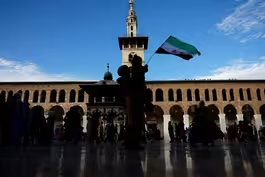
Daily life returning to Syria as new leaders build nation
Video has Closed Captions
Daily life in Syria begins to return as new leaders work on building a functioning nation (5m 47s)
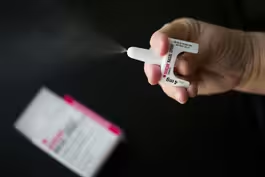
Experts working to understand why overdose deaths dropped
Video has Closed Captions
Drug overdose deaths dropped nationwide. Experts are working to understand why (5m 26s)
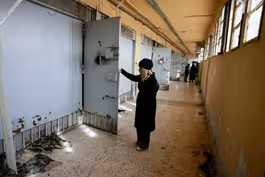
Freed Syrian prisoners describe the horrors they faced
Video has Closed Captions
Freed Syrian prisoners describe the horrors they faced under Assad (8m 20s)

Gwen Ifill featured in 'Xavier Riddle and the Secret Museum'
Video has Closed Captions
Gwen Ifill featured in PBS Kids series, 'Xavier Riddle and the Secret Museum' (2m 27s)
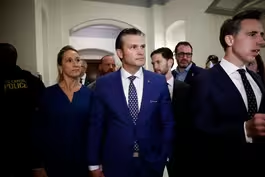
How Hegseth's religious views could affect U.S. military
Video has Closed Captions
How Hegseth's controversial religious views could affect military leadership (7m 17s)
Longtime court sketch artist Bill Hennessy Jr. dies
Video has Closed Captions
Longtime court sketch artist Bill Hennessy Jr. dies (1m 57s)
What Biden's commutations mean for non-violent offenders
Video has Closed Captions
What Biden's historic commutations mean for non-violent drug offenders (5m 56s)
Providing Support for PBS.org
Learn Moreabout PBS online sponsorship
- News and Public Affairs

FRONTLINE is investigative journalism that questions, explains and changes our world.

- News and Public Affairs

Each week, explore science, health, and technology headlines with leading experts.












Support for PBS provided by:
Major corporate funding for the PBS News Hour is provided by BDO, BNSF, Consumer Cellular, American Cruise Lines, and Raymond James. Funding for the PBS NewsHour Weekend is provided by...