
December 12, 2025
Season 4 Episode 120 | 26m 31sVideo has Closed Captions
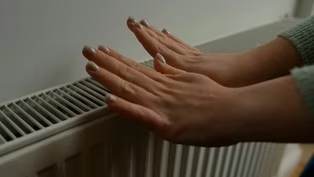
Advocates ask state leaders to help keep the heat on in Kentucky households this winter.
Working to keep the heat on in households this winter. Kentucky Youth Advocates releases its annual report on child well-being in the state. Small dairy farms turn to holiday agri-tourism to stay profitable. Hall of Fame jockey Pat Day gets his own space at the Kentucky Derby Museum.
Problems playing video? | Closed Captioning Feedback
Problems playing video? | Closed Captioning Feedback
Kentucky Edition is a local public television program presented by KET
December 12, 2025
Season 4 Episode 120 | 26m 31sVideo has Closed Captions
Working to keep the heat on in households this winter. Kentucky Youth Advocates releases its annual report on child well-being in the state. Small dairy farms turn to holiday agri-tourism to stay profitable. Hall of Fame jockey Pat Day gets his own space at the Kentucky Derby Museum.
Problems playing video? | Closed Captioning Feedback
How to Watch Kentucky Edition
Kentucky Edition is available to stream on pbs.org and the free PBS App, available on iPhone, Apple TV, Android TV, Android smartphones, Amazon Fire TV, Amazon Fire Tablet, Roku, Samsung Smart TV, and Vizio.
Providing Support for PBS.org
Learn Moreabout PBS online sponsorshiptheir resources together to access help.
>> Kentuckians who miss a gas or electric bill can wind up out in the cold.
>> There's good news, but there's bad news.
>> The Kids Count data report is out.
How are kids in the Commonwealth doing in areas like health and poverty?
>> We're due to to really build an integrated health innovation space.
We want to bring all of our health care programs under one roof.
>> And EKU president tells us what's on the way in Colonel Country.
>> Production of Kentucky edition is made possible in part by the KET Millennium Fund.
>> Good evening and welcome to Kentucky edition for this snowy Friday, December the 12th, I'm Renee Shaw and we thank you for kicking off your weekend with us.
Very cold weather is on the way.
It's already here.
Some would say it's a bad time to lose power, but nearly 50,000 Kentucky households had their power cut off last winter, according to records obtained by the Appalachian Citizens Law Center.
Advocates fear this winter even more could go without heat if state leaders don't intervene.
Our June Leffler has more.
>> Last month, 45 advocacy groups wrote to Governor Andy Beshear asking for a moratorium on utility disconnections this winter, housing, environmental and medical groups sent the letter.
>> A moratorium would not involve forgiveness of past due bills, that it still would require that people ultimately pay their bills, but it would give them time to pull their resources together to access help.
>> We have a mom who was scheduled to come with us and was just really, really upset in different ways around having her water disconnected just here recently.
It just got cut on Monday, all due to not having these moratoriums in place.
>> The government shut down and lapse in Snap benefits.
Pressed the issue.
>> When Snap benefits were paused.
Folks had to use their limited resources to buy food.
>> Though the federal government is running again a federal program that helped more than 70,000 households pay winter heating bills last year is under threat.
>> The federal government has said that they intend to end that program.
>> Beshear banned winter disconnections before, but that was during the pandemic.
Under his state of emergency powers.
His office said, quote, while other states have restrictions on service disconnections during colder months, the General Assembly has failed to pass similar efforts in Kentucky.
Kentucky is one of only eight states that doesn't have weather related utility protections baked into state law.
Utility companies have varying policies on winter disconnects.
LG and COO suspends disconnects during extreme temperatures, which are assessed daily.
Utility customers also have rights and resources.
Under state law, customers can negotiate partial payments to keep the lights on.
They can also file for a 30 day extension in cases of medical or financial hardship, and each utility must offer an assistance fund, sometimes known as winter care.
This organizer says utilities can do more for the customers that support them year round.
>> And so as we do, we are asking the people who keep our lights on, who keep our food fresh, who keep us warm, who also make sure that we have running clean water to be able to give us a support, just as we support them with the rate hikes, as we support them with the deposits, as we support them as consumers to be able to to support our business.
>> Governor Beshear has heard these concerns.
His office says he knows that many families across our commonwealth and country are struggling with the cost of groceries, utilities and other needs, and he invites our Kentucky families to tune in to his state of the Commonwealth Address on Wednesday, January 7th, where he will outline his plans to help for Kentucky Edition.
I'm June Leffler.
>> Thank you so much.
June.
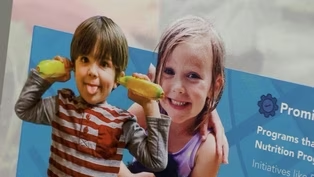
A new report from Kentucky Youth Advocates is giving us a picture of the well-being of children in Kentucky.
The Kids Count report looks at key areas like health, education, and economic security.
Our Mackenzie Spink breaks down where the state has improved and where advocates are calling for change.
>> The 2025 Kids Count report is a mixed bag, but Terry Brooks with Kentucky Youth Advocates says there are areas of improvement to celebrate, especially in the health arena.
>> Our track record on issues with kids being covered by health insurance, and a long term trend of declining teen birth rates, continue to improve in substantial and dramatic ways.
So those health data points need to be grabbed and celebrated, because that is good news and good news.
>> Child poverty rates have also decreased in 111 out of 120 counties in the state.
However, 20% of all children in the state continue to live in poverty, and the breakdown in eastern Kentucky is worse.
>> 40% of kids in eastern Kentucky are growing up in childhood.
Poverty and rates of poverty for black kids in Kentucky continue to be at an unacceptable, disproportionate rate in every corner of the state.
>> The worst scoring areas of child well-being in Kentucky hunger and nutrition.
>> When it comes to food, it seems as if we have a bad data point followed by a bad data point, followed by a bad data point.
119 out of Kentucky's 120 counties show that more kids are hungry today than a year ago.
>> According to the report, 20% of children in Kentucky are obese, while 21% of children in the state are considered food insecure.
While it may seem contradictory, Kentucky Youth Advocates data and research director says these data points are closely related.
>> Food insecurity in Kentucky can be very hidden in a lot trickier to identify, because it's often things like parents skipping meals to ensure that their kids have enough food at dinner, or families choosing between do I pay my utility bills this month?
Or do I buy groceries?
Or which is the connection to obesity?
Having to rely on cheap, ultra processed foods in order to make ends meet?
When it comes to their food budget, we know that whether it's because of poverty or a lack of grocery stores in their neighborhoods, many Kentucky kids simply do not have access to the foods they need to maintain a healthy weight.
>> According to Brooks, this data is critical when it comes to making policy decisions.
During the legislative session, he's calling on lawmakers to take action on behalf of children.
This January.
>> Kentucky's kids need Andy Beshear, David Osborne Robert Stivers and those other lawmakers to step up and become heroes once again.
For Kentucky's kids.
>> The Kids Count Data dashboard can be found online and includes 16 measures of well-being, broken down by county for Kentucky Edition.
I'm Makenzie Spink.
>> Thank you, Mackenzie, for that report.
The report shows the rate of children entering foster care decreasing and an increase in the number of foster children being united with their families.
Small family dairy farms are on the decline.
For many of them, production costs outpaced income and they're now turning to more profitable ventures.
Our Laura Rogers takes us to one of those family farms in Hardin County.
>> Our goats are probably our most popular farm animals that we have.
They're super funny and very hard to keep in the pen.
We also have sheep.
>> And calves, Ralph and Felix.
But these livestock aren't for producing commodities like milk or wool.
Rather, they are the welcoming committee for farm guests.
>> As things have evolved and changed here on the farm, we have also evolved and changed as well.
>> That evolution includes closing dairy operations in 2018, after more than 50 years of milking due to what Celia Thomas describes as instability in the dairy market.
>> Agritourism is is growing, I think, as a whole.
We had started some agritourism stuff actually, before we quit milking.
Being able to spend more time and focus more on that is kind of where we made that transition.
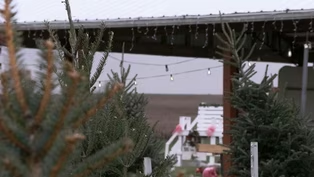
>> Thomas Dairy Farm and Market has expanded its agritourism efforts, offering summer and fall festivals.
And now, in its third year, a Christmas experience.
>> Basically, for us, it's bringing the community out to the farm.
So offering events, festivals, seasons, activities.
>> Families can get a fresh cut Christmas tree grown on a family farm in Michigan.
>> We actually have some future plans to hopefully plant some trees for you.
Cut opportunity.
>> For now, they focus on row crops like corn and soybeans and produce.
>> We grow 70 different varieties of pumpkins.
>> The Thomas family is one of the thousands of small family dairies closing or shifting operations due to economic challenges.
>> You'll hear a lot of stories of dairy farms that have kind of transitioned to agritourism.
>> The Thomas has owned 250 acres in Cecilia, near Elizabethtown city limits.
>> It is very important for us to keep our farm where it is.
We're so close to town with development kind of happening around us and growth.
>> She says.
Growth is good, but keeping this acreage in farmland gives those who may not otherwise experience farm life an opportunity to do so.
>> It is super special.
Just being able to share what we love our home, our livelihood.
>> Thomas estimates about 12,000 people visit their farm every year.
They also have a farm store with homemade jam, candy and salsa.
>> It's definitely a way for people to support local.
>> And to support the small family farm.
According to Kentucky Farm Bureau, in the last 20 years, Kentucky has lost 1.4 million acres of farmland and 17,000 farms.
>> It's definitely an opportunity for people to stay on the farm, keep the farms and their family.
>> For Kentucky Edition, I'm Laura Rogers.
>> Thank you.
Laura.
This evening and again on Saturday.
Thomas Dairy Farm and Market hosts its holiday light nights.
And they also offer some tips for tending to those life Christmas trees you might have at home.
Water them often and close nearby vents.
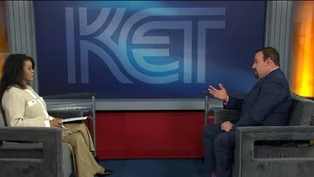
We continue part two of my conversation with Eastern Kentucky University President David McFadden, who says the colonels are making great strides in providing a higher education to students in the region and beyond.
We pick up the interview where I asked him about the hands on training, that the facility that they have is educating the next generation of professionals in several fields.
>> If we go back to 1906, all of our comprehensive universities in Kentucky, Eastern and Western, Murray, Morehead, we were all founded as teachers colleges, and all of us had lab schools.
Those were effectively the laboratory by which we trained those educators.
And over time, many of the institutions kind of transitioned away as we saw more student teaching taking place in the in the traditional public schools and other ways of delivering that education.
But we've really held on to that at EKU.
And so in some ways, it's almost been a restoration movement to to have that laboratory space where we're training that next generation of teacher, school psychiatrist, school law enforcement.
I mean, so it's really when we think about schools and, you know, kind of the connective tissue that schools are in every community.
There are so many professions that find themselves working in and around a school.
It's just a unique opportunity for us to have that laboratory setting to make sure that those graduates have been there, they've seen it, and they're ready to go out and transform it in a big way.
I joke I've got three kids who go there, but the school's not for those, you know, P through 12 kids.
They are the beneficiaries of it.
It is for our post-secondary students who are using that lab to really be the best at what they do.
>> Yeah.
Let's talk about the legislative session that is coming at us fast and furious.
Doctor McFadden, as we speak, we're just really a 2 or 3 weeks out from the start of the session, January 6th.
What are the asks from EKU and what maybe are you going to play some defense on?
>> Yeah.
You know, for us College of Osteopathic Medicine.
You know, we work through this process for a couple of years.
The legislature last year passed a a pathway for for schools like EKU to pursue post-baccalaureate degree.
So we will be moving forward with our Doctor of Osteopathic Medicine program.
That program comes with a bond issuance that has some escrow requirements.
And so we'll be working with the Commonwealth of Kentucky to help secure those funds as we go through the accreditation process.
Like any good university president, we do have some building needs.
We're looking at allied health, such a growth area for us, over 4000 of our students on campus are connected to the health care sector.
We do a great job in that space.
The EKU School of Nursing, as I said, year after year, 100% pass rate on the NCLEX.
We just celebrated 60 years of serving Kentucky and health care.
But but we've been doing it in the same building for those 60 years.
And so we're due to to really build an integrated health innovation space.
We want to bring all of our health care programs under one roof.
It will create a simulation experience for for our professionals that when they leave EKU, they will go into their, you know, into that job setting, better prepared to work with all of the other professionals who they're going to end up working with in that space.
And so that's our big ask as our health care innovation facility and our escrow for for our med school.
But really excited about that.
Thankful to to Speaker Meade, who has continued to help us and support us in so many others who have been such a big, big support of that, that program up to this point.
>> When do you expect to have the first graduating class of the School of Osteopathic Medicine?
>> Well, you know, with construction, we were just talking about the studio a little bit, and we're working on model lab.
Construction is a little slow these days.
I think best case scenario, our first incoming class would be the fall of 2030.
They would graduate 20 2034.
We may have a little give or take in that a year or so, but really we're we're geared up to to look at that.
And you know, as I look across Kentucky, you know, I'm a native of Johnson County, when 94% of our counties are underserved in primary care, when nearly half the counties in Kentucky have no pediatrician.
When we think about women's health, we have so many health care deserts across this state.
You know, the reason we've continued to look at this program is trying to solve some of those big problems.
And so we're eager to continue to move forward on that front and excited to to view this as a as a great investment for the Commonwealth and a solution to, to a big problem, but probably not something that's going to happen tomorrow.
>> Right?
Right.
Hold on for that.
Right.
Let's talk about the performance funding model for higher education and what that means for eastern and the impact it's having.
And is it working in your view or.
I know the answer, but maybe others may want to hear you say how are comprehensive universities really faring from this new performance model structure?
>> You know, for us, it's 2017 was the first year that we stepped into this.
And I was, you know, been at EKU the whole time that we've navigated this.
You know, unfortunately through the first four years, effectively of the model, it was either cuts or no money.
And so in some ways it was performance cutting for, for those early years.
And then we've seen a significant investment in higher ed the last several years.
And we're grateful to the legislature and for for their investment in higher ed.
I think as we've seen those dollars flow through the model, there are some things that that probably need some attention.
As we look at our institution, we've we've set record growth, record freshman classes, record retention rates.
However, the distribution of funds in the model probably have not been, you know, directly reflective of that success.
And so I think if you talk to to all the presidents, I think we all would say we have enough data now to start to make some informed decisions about how to shape this model in perhaps a more informed and more equitable way.
I think we would also say that across the board, all of our institutions are looking for for base resources as we think about just the inflationary costs that come with operating.
You know, if we think about our own household, there is nothing cheaper today than it was a year ago, two years ago, three years ago.
And and so I think to continue to be competitive in the higher education space.
And I really view our, our universities as economic engines and really job recruiters, the ability to to import talent to the state.
You know, we're going to have to continue to make those investments.
And so we're eager to continue to work with the Council on Post-secondary education to work with the other institutions.
But but to shape the model in a more intentional way that that is more reflective of the performance distributions.
And so what I would say is I think we're measuring the right things.
I'm just not sure we're measuring them the right way.
>> Right.
Let's talk about how you're engaging with the federal delegation in Washington, our Kentucky delegation.
What are the needs that you're petitioning them to to uphold for you?
>> Yeah, I think that federal financial aid is one of the top things.
And lots of conversation back in the summer about, you know, who was going to be eligible, what title four funds were going to look like.
Largely, we're not big changes in the undergraduate space to that.
And so we're grateful for Kentucky delegation.
Lots of conversation with them.
In fact, I'll be in D.C.
next week with CSL and working on a panel group.
So we want to continue to to make sure that that those funds are out there and available, because, of course, for our students, 50% of our students are eligible.
They're bringing Pell dollars to the table.
50% of our students are first generation college students.
We are serving the underserved in that way.
And so we want to make sure there's maximum resources available to them.
So so that conversation with our federal delegation critically important, we're continuing to engage in research activity and things that are really important for Kentucky.
And so as we step into this medical school space, you know, continuing to to really look at those, those grant opportunities to try to do meaningful research that addresses issues that are really important to Kentucky.
>> On Monday, president McFadden will share how eastern has dealt with policy changes already handed down from Frankfort when it comes to diversity, equity and inclusion policies.
And he'll talk a little bit more about what he hopes the Kentucky General Assembly will deliver for eastern and other regional universities in the upcoming lawmaking session that begins in less than a month.
That's Monday night on Kentucky Edition.
The Kentucky Derby Museum is honoring Hall of Fame jockey Pat day with a new exhibit and a lifetime achievement award.
The Pat day exhibit features his awards and even high school photos.
It was unveiled this week at the third annual Derby in December event, which kicks off the 2026 Derby Festival season.
Day is the all time leading rider at Churchill Downs with more than 8000 career wins.
He rode in the Kentucky Derby 22 times, winning the race aboard let in 1992.
>> You know, it's a tremendous honor, tremendous honor, and one that, you know, I could never have anticipated.
You know, being in a position like this or receiving an award like this, a lifetime achievement award, I believe, is indicative of a life well lived.
You know, the first 30 years of my life, I tried to self destruct.
But by the grace of God, the last half of my life has been decidedly good.
And subsequently, we've enjoyed a tremendously successful racing career that has culminated with a lifetime achievement award.
And, you know, it's just I continue to marvel at God's handiwork.
I rejoice in what he's done in me and through me, and the blessings he bestowed upon me.
And certainly an award like this.
Oh, the moment that's going to stand out without any doubt, is when I was fortunate enough to ride it to victory in the Kentucky Derby in 1992.
You know, I've been very fortunate to have ridden in the race a number of times, had ran second three years in a row and and come close.
And so I thought I had an idea of what that experience was going to feel like.
I was sorely mistaken if I thought that winning that race was going to be here.
It was turned out to be just a little bit north of the moon.
It was indescribable, and I've given a lot of thought to trying to come up with the words or expression that would adequately express the feelings that I experienced when I wrote under the finish line that day.
It was absolute highlight of my career.
>> What a grateful man.
Well, the Derby in December celebration is the first official event for the 2026 Derby season.
The Kentucky Derby Festival also unveiled the 2026 Pegasus pen.
Looking pretty sharp.
Brave the cold this weekend and enjoy the usual wealth of fun activities around Kentucky related to Christmas.
Our Toby Gibbs has details in this look at what's up around the Commonwealth.
>> Lexington is striking a chord with history this season.
The Alltech celebration of song marks its 20th anniversary and helps honor the city's 250th.
The program features popular Christmas music and traditional carols performed by dozens of vocalists, including singers from the UK Opera Theater and winners of the Alltech Vocal Scholarship Competition, all backed by a professional orchestra.
Audience members can also join in on classic favorites.
This milestone year takes listeners on a musical journey through time, with songs reflecting 1775, the year Lexington was founded, and every 50 years that followed right up to today.
It's an evening where holiday music meets Irish tradition, as the EKU center presents Celtic Woman's Symphony Christmas Tour.
The concert blends the Celtic woman's signature Irish sound with the sweep of a full symphony orchestra and features yuletide classics, fan favorites and plenty of traditional touches.
Santa replacing the cookies and milk for pancakes and orange juice at Oldham County Parks, and Recreation's breakfast with Santa, in addition to breakfast and free photos with Santa.
Enjoy holiday crafts and games and make your own candy cane, mustard Seed Hill is glowing with nostalgia this season.
Christmas at Mustard Seed Hill transforms the historic campus into an elaborate light display.
Take in the National Gingerbread exhibit, where bakers from across the country show off their handiwork.
Visitors can also browse the artisans market for handcrafted gifts, enjoy live music in the holiday Tent cafe, and sample festive bites from food trucks.
Music fans are getting a chance to shake it off and sing along in every swiftie era, a live band, not a DJ will perform the full catalog of Taylor Swift hits.
The night opens with a Paramore tribute set, setting the tone with some early 2000 nostalgia at this all ages event.
It's a Christmas celebration in the mountains as Billie Jean Osborne's Kentucky Opry returns to the Mountain Arts Center, the cast and crew will perform favorite Christmas classics old and new, along with a few surprises and twists.
The show runs through December 20th.
The Frazier History Museum is lighting the way this holiday season at its annual Lights On Main event, the museum is being transformed into a winter wonderland with three floors of trees decorated by local businesses, crafts, cupcake decorating, Hanukkah and Kwanzaa activities, a scavenger hunt and appearances by Santa and the Grinch are all part of the festivities.
And that's a look at what's happening around the Commonwealth.
I'm Toby Gibbs.
>> Thank you.
Toby Gibbs, the state's fourth largest school district, has taken security a step further this year, with a dedicated detective on staff.
>> People like detective in the schools, you know, I mean, where are they going to be investigating?
You know.
>> I kind of just take things a little bit deeper.
I can do the home visit, I can do the search warrants, I can analyze the data.
>> Monday on Kentucky edition, we'll look at how this school resource officer is handling in-depth investigations from safety threats to child neglect.
More about that on Monday.
We're about an hour away from Comment on Kentucky is Bill Bryant and a panel of Kentucky reporters discuss the events of the week.
That's coming up at 8:00 eastern, seven central, right here on KET.
So don't turn that dial.
Thank you so much for being with us all week here on Kentucky Edition.
We sure hope you have a great weekend and come back to us on Monday night at 630 eastern, 530 Central on Kentucky Edition, where we inform, connect and inspire.
You can connect with us all the ways you see on your screen, the social media channels listed there.
And plus, we always encourage you to send us a story idea by email to Public Affairs at ket.org and look for us on the PBS app that you can download on your phone and other smart devices.
Have a great, safe and warm weekend and I'll see you Monday night.
Take good care.
Efforts to Keep Kentucky Households Heated
Video has Closed Captions
Clip: S4 Ep120 | 3m 20s | Advocates ask state leaders to help keep the heat on in Kentucky households this winter. (3m 20s)
EKU President on New Programs Coming Online Soon
Video has Closed Captions
Clip: S4 Ep120 | 8m 14s | EKU president on new programs and his asks from Frankfort this upcoming session. (8m 14s)
Holiday Agritourism Keeping Small Farms Afloat
Video has Closed Captions
Clip: S4 Ep120 | 3m 18s | Some small Kentucky farms are turning to holiday agritourism to stay profitable. (3m 18s)
Report Released on Wellbeing of Kentucky's Children
Video has Closed Captions
Clip: S4 Ep120 | 3m 38s | Report show food insecurity and obesity rising among Kentucky's children. (3m 38s)
Providing Support for PBS.org
Learn Moreabout PBS online sponsorship
- News and Public Affairs

Top journalists deliver compelling original analysis of the hour's headlines.

- News and Public Affairs

FRONTLINE is investigative journalism that questions, explains and changes our world.












Support for PBS provided by:
Kentucky Edition is a local public television program presented by KET