Vermont This Week
December 12th, 2025
12/12/2025 | 26m 46sVideo has Closed Captions
Impact of Trump's Deportation Campaign on Vermont | And more!
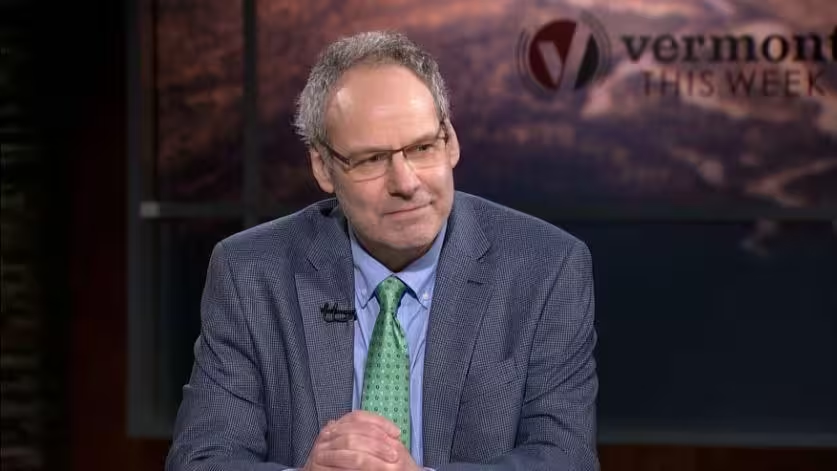
Impact of Trump's deportation campaign on Vermont | VT directs flood recovery funds to housing on higher ground | Amid an immigration crackdown, 23 new Vermonters become citizens | Panel: Mitch Wertlieb - Moderator; Peter Hirschfeld - Vermont Public; Carly Berlin - Vermont Public/VT Digger; Lucy Tompkins - Seven Days
Problems playing video? | Closed Captioning Feedback
Problems playing video? | Closed Captioning Feedback
Vermont This Week is a local public television program presented by Vermont Public
Sponsored in part by Lintilhac Foundation and Milne Travel.
Support provided by:


Vermont This Week
December 12th, 2025
12/12/2025 | 26m 46sVideo has Closed Captions
Impact of Trump's deportation campaign on Vermont | VT directs flood recovery funds to housing on higher ground | Amid an immigration crackdown, 23 new Vermonters become citizens | Panel: Mitch Wertlieb - Moderator; Peter Hirschfeld - Vermont Public; Carly Berlin - Vermont Public/VT Digger; Lucy Tompkins - Seven Days
Problems playing video? | Closed Captioning Feedback
How to Watch Vermont This Week
Vermont This Week is available to stream on pbs.org and the free PBS App, available on iPhone, Apple TV, Android TV, Android smartphones, Amazon Fire TV, Amazon Fire Tablet, Roku, Samsung Smart TV, and Vizio.
Support the crew
Help Mitch keep the conversations going as a member of Vermont Public. Join us today and support independent journalism.Providing Support for PBS.org
Learn Moreabout PBS online sponsorshipThe state of Vermont directs federal funding to higher ground with new construction for housing far from flood prone areas.
Plus investigative reporting over the last several months reveals the human impact of the Trump administration's mass deportation efforts in Vermont.
And even as fear tightens the grip on many immigrant communities.
More than 20 new Vermonters have become citizens of the United States.
All that and more ahead on Vermont This Week.
From the Vermont Public studio in Winooski.
This is Vermont this week, made possible in part by the Lintilhac Foundation and Milne Travel.
Here's moderator Mitch Wertlieb.
Good evening everyone.
I'm Mitch.
It's December 12th and joining us on the panel today, we have Lucy Tompkins with Seven Days.
Peter Hirschfeld from Vermont Public and Carly Berlin with Vermont Public and VTDigger.
Thank you all so much for being here today.
This is kind of a special show.
We're going to be taking a really deep dive into a couple of very important issues that are affecting Vermonters.
And, Carly, we're going to start with you.
You did some incredible reporting for Brave Little State, the podcast that asks people to ask questions.
And the reporters go and find out what, the answers to those questions are.
This was all about housing and specifically here, transitional housing in Vermont, which is in itself in transition.
One of the questions that was asked was, you know, why are there, such a such a dearth of halfway houses in Vermont?
Turns out that's not really the case.
But let's start with what is a halfway house is a term we don't hear that much anymore.
And what's the status of them in Vermont?
Right.
So this term has fallen out of favor a little bit like you said, Mitch.
But a halfway house is a place, a transitional home for someone who's leaving prison or leaving drug treatment, kind of, you know, a confined, supervised setting like that.
It's kind of a halfway stop from there to entering back into public life, into society and independence.
And, you know, have they worked over the years in a general sense?
And there's complications always.
Yeah, I think it depends on who you ask.
I mean, I did a big kind of archival deep dive for this podcast project.
Right.
And I found all of these newspaper stories from the 80s and early 90s in Burlington, where there was a huge outcrop of these halfway houses.
And that was in a response to an uptick in homelessness and, you know, drug use, too.
And over the years, some of these places closed because of budget issues or because of, you know, never a push back to to opening more of them, right?
So there's been this kind of back and forth over the decades and different approaches for how to how to kind of best help people who are in this transitional moment.
One of the most amazing things I thought in that piece was when you, pointed out that Bernie Sanders, then the mayor of Burlington back in the late 80s, you were saying it's like if you look back then it was kind of like holding up a mirror to now.
Very much the case.
I mean, there were just going back into some of these newspaper stories and public access TV videos of Mayor Bernie talking during that time.
So much of the focus is on rents rising quickly, on properties getting flipped on, you know, homelessness becoming more and more visible on business owners pushing back to that homelessness.
I mean, so much of the rhetoric from today.
Exactly.
You know, it's interesting too, because when you think about these problems, I don't want to get too much into a history lesson here.
But when you do go back to the 1980s, there were changes happening at the federal level.
And again, this may be reflected a little bit with what's happening now.
Ronald Reagan, president, back then, you know, maybe some of the funding that was supposed to go to some of this, like section eight housing, for example, that started to dry up, right?
Exactly.
I mean, just there was a quote on this podcast about, right, about the section eight voucher funding drying up in the 80s.
I've been reporting on that just in the last.
You know, you're here too.
So, so many echoes from the past to now and go ahead.
One of the things I found so interesting about the reporting is we, the the housing shortage is often talked about in terms of, you know, the solution is this quest for new units.
But I thought that one of the things that this brave little state episode did so effectively was to show that it's not just the number of units that you have, but you need a diversity of housing situations for people.
It seemed like everybody had their own unique story, their own unique needs in terms of how they were going to get back on track and the nature of the housing that they were either going to be able to access or not was going to be key to their trajectory.
Very much true.
And yeah, thanks for that.
That observation piece.
I mean, one of the things we get into in the reporting for this piece is that, there's a pretty recent shakeup, actually, kind of in the, in the universe of transitional housing in Vermont.
And that was back in 2021.
The Department of Corrections itself funds a bunch of transitional housing placements for people who are on furlough or probation, you know, leaving prison but still under supervision in the community.
And what the doc observed is that a lot of people who left prison and ended up in one of these halfway houses or group homes that had, you know, rules around staying sober would end up, you know, running afoul of those rules, often called the zero tolerance policies towards substance use.
They would get kicked out of the housing if they broke those rules, and then would end up right back in prison because of that.
It's kind of a one strike in, year out situation.
Exactly, exactly.
And so the doc was observing this cycle and said, you know, we're actually going to pull funding away from a lot of these sober houses and put that funding towards individual transitional apartments for people.
What then happened is a bunch of these group houses closed, you know, many of them were concentrated in Burlington.
And so the, the, you know, effect of that, those closures were felt most acutely there.
This sounds like a really tough conundrum because, well, what are housing advocates telling you?
Because I would imagine that many of them are saying, well, housing first, let's get a roof over.
Somebody said others may be saying, look, it's really important that these folks stay sober, especially when you're in a group setting.
It's true.
And I think the real conundrum here is what what can happen in these group settings is if someone is struggling to maintain their sobriety that affects everyone else in the house.
You can see these ripple effects of one person relapsing and then another housemate and then another housemate.
On the other hand, if you take that zero tolerance approach and have to leave the house and end up homeless or end up back incarcerated, that's not a great solution either.
So there's a lot of advocacy advocacy around creating more stabilization beds for these kind of remaining halfway houses, recovery homes, and sort of a new crop of them that have veered away from these zero tolerance rules and are trying to create kind of more almost like the halfway house to the halfway house having another backup option as people struggle there.
So there's there's efforts around that.
And then there's also a lot of emphasis on, you know, moving people directly into apartments that don't have a condition of sobriety attached to them.
But that's got to cost money, right?
It does.
Right?
Having an individual apartment is more expensive than, you know, grouping people together in a house.
So ultimately, you know, again, we're not necessarily using the term halfway houses, that much anymore.
But what is the state of transitional housing in Vermont, the way it stands now?
I mean, is it a good place?
It could be better.
You know, lots of people say that there should be more more of these kind of specialized recovery residences.
There's been, you know, there's this interesting shift where in 2021, so recently we saw the doc really shift away from from this approach of having group houses and then other kind of branches of state government have actually poured more money into opening these into recovery residences.
So there's almost, you know, not not a total unified approach over what we think the best route for people is.
But in any case, there are more of these new recovery residences, sort of the term of art.
Now, that have opened up that again, have, you know, that don't have that zero tolerance stance that are, you know, trying to build in more systems, to kind of catch people when they struggle.
And there are also lots of critics who say those systems need to be a lot more robust.
Yeah, so many complexities.
I do urge people to go listen to that brave Little State episode where you really get the deep dive into this.
I want to also ask you, Carly, about, some, which is this at the top, some federal money that the state is doling out to help move, housing to higher ground.
So it's out of these flood prone areas.
Where is this happening?
What can you tell us about that?
Exactly?
So this is some federal disaster aid money flowing to Vermont that got, appropriated by Congress, tied to the July 2023 flooding.
We've had so many floods since then.
But that's kind of the impetus for this, right?
You know, we've talked a lot about buyouts on this show, property buyouts for flooding.
That's where the government comes in, pays you for your risky property and then says no one can build anything here.
Again, what's sort of unique about this money that's now flowing to Vermont is that it's a lot more flexible.
You can build new housing on higher ground where it didn't exist before.
So we learned, I think, about a year ago that we were going to get this money.
And now finally, those grants are going out to municipalities and housing providers and developers.
So they're going to be new apartments coming online and Barre and Montpelier and Johnson.
Some of this money's also going towards, you know, infrastructure and flood mitigation.
It's not purely for housing, but the state, which kind of figured out its own plan for how, you know, where it wanted to prioritize these funds, really said housing is a key issue, and we want to devote the lion's share of the money toward it.
Okay.
That's great.
However, there are some areas, right, that are still not able to have that kind of recovery.
And I think buried downtown is one of those.
Right.
So there, you know, viewers might remember, you know, in the in the weeks following the flood in July of 2023, Governor Scott went home to Barry, to the city council and said, I have this big vision for how to redevelop the North End of town, which, as we all know, was hit particularly hard by the flooding in 23 and then again a year later.
You know, this was a really bold vision to to, you know, kind of remove housing that had been impacted right along the river and build housing a little bit further away from that really risky spot.
You know, the city had applied for a cut of this federal money to, to try to enact a version of, of that plan and didn't ultimately get money for it.
You know, the city did get money for, for other housing projects, but not for that really, you know, potentially, you know, transformative one.
Okay.
Well, I appreciate your updating on that reporting.
You can find that at Vermont public.org.
And just before we let you go off this topic, Carly, I know the new legislative legislative session is coming up in January.
Housing is going to be huge, obviously.
What are some things you're looking for?
You know, I think we're going to see a conversation revived around appeals for housing soon.
You know, situations where neighbors, you know, challenge a housing project in court and end up in kind of this drawn out legal battle.
There's been some focus on on how to curtail that was those, you know, sort of situations over the last few years.
And lawmakers haven't quite figured out the route they want to go.
So I'm expecting that conversation to get revived.
And I think another big one will be money, right?
I mean, we had so much federal Covid era funding flow into the housing system in the state.
All of that's been allocated and spent.
And, you know, especially for affordable housing builders, they're saying, you know, if you want to if you want us to, to keep building this subsidized housing that requires money.
So I think we're going to see some conversations revived around how exactly we might put money towards that kind of housing.
Yeah, we're going to have you back on it to be talking about that when it all, you know, rubber hits the road.
Peters Petersfield and Lucy Tompkins you both been reporting on immigration issues.
Obviously this is a nationwide issue at this point.
Everyone is aware of this.
But here in Vermont, Pete, I want to start with your series that you just did for Vermont Public, a four part series where you took several months of investigative reporting on this to find out about how many folks in Vermont have been affected by Ice raids or, you know, just, these immigration enforcements.
What did you find out about how many folks have been affected here?
And who are some of the people you met along the way?
Yeah.
I mean, I think the concept behind the reporting was that we have all had a lot of headlines about all these different, arrests and detentions and deportations that have been happening in Vermont.
At a much more frequent pace.
And we've seen in the past since, Donald Trump began his second term.
And but we hadn't had a lot of it.
Vermont public, at least, was who who are these individuals that are being targeted by this immigration crackdown?
So we sort of wanted to introduce people to, individuals who have been affected by this.
What are their life stories?
What is the impact been on them over the course of that reporting?
I was able to get some data from Immigration and Customs Enforcement related to the increase in arrests, and removals this year and what we found was that, between January 20th and December 2nd of 2024, last year, there were 933 removals conducted by Ice.
During that same time period.
This year, there have been 9987 removals conducted by.
So a more than ten fold increase, which really sort of validates and backs up some of this anecdotal evidence that we've been hearing from the immigrant community advocates and attorneys.
One, person, while many people that you followed, one was a family from Ecuador, they were fleeing persecution and their country started out going to Brooklyn, New York.
Had to leave there to come to Vermont.
Why did they leave Brooklyn?
To come to Vermont?
Too much heat in New York.
They felt, they had, friends that were part of the same indigenous community in Ecuador that they came from who were showing up for regularly scheduled check ins at immigration court or with Ice, who are also seeking asylum.
Like this family that you just referenced, that we that we profiled, and they were being arrested and detained and deported after that.
So they felt like they needed to get their family somewhere where there might be less scrutiny from federal immigration authorities.
Alex, the the man that we profiled, it's him and his wife and their ten year old son that now live in Vermont.
He had seen some pictures of Vermont, from Department of, the tourism department here that they had on the subway and, and in New York thought it looked beautiful and decided to, to check it out.
Yeah, right.
I had one follow up.
You mentioned this big increase in removals.
Could you say specifically what the sort of region was where where?
Yeah, thanks for the clarification.
So so we're not talking 9987 removals in Vermont.
We're that's that is in the region that, ice breaks down statistics by.
So that's called the Boston area of operation that that includes Vermont, Massachusetts, Connecticut, Rhode Island in Maine.
Now, one of the things so again, Alex comes here with his family, finds that Vermont is beautiful.
Yes, but not necessarily a safe haven.
Yeah.
Now, you know, he has since coming here, gone to an ice check in successfully and was allowed to leave.
So they've not yet experienced, sort of enforcement action that they fear.
But you can imagine that it's, unsettling for a family.
That's already experienced some, some anxiety around the, you know, the path to permanent legal status.
To be doing that in this moment of heightened enforcement.
It's an unnerving experience.
And that's something, Lucy Tompkins, that you've been writing about, because apparently there are a lot of folks here who work on farms, and they're hesitant to leave those farms, and because they're afraid.
So there are service workers now who are bringing what the food to them, medicine, other things.
Yeah, actually, a lot of this isn't new.
And didn't happen just because of the political moment that we're in.
But I think there has been a sort of growing demand for some of these services and systems that have been developed over the last 20 years or so.
Because Vermont's dairy industry relies really heavily on migrant farm workers, many of whom are undocumented, most of them come from Mexico, and especially in the northern part of the state, in Franklin County, which is right along the border, there's a really heavy border Patrol presence.
So leaving the farm is risky for these workers.
If they need to go grocery shopping or go to the doctor.
So there's mobile, health care workers that go to farms and sometimes bring like a vaccination clinics or things like that to them.
There are people who, charge for going to the grocery store or running other errands.
And then there's a priest who just recently started holding, mobile masses, and services on the farm as well, because, after, dairy farm was raided in April, a lot of the workers told him that they just didn't feel comfortable going to church.
So now he goes with Christmas approaching, that's even a bigger deal now.
Yeah.
Wow.
You know, but I want to ask both of you this question because we hear from immigration officials at the federal level.
Kristi Noem, you know, homeland safety, all that.
And they're saying, look, what we're going after is the people that are committing crimes to the bad people, and we're trying to deport them.
Pete, you wrote about a woman who does not seem to me to fit that profile, someone named Heidi Perez.
And this is one of the few people who gave her full name for your stories.
A lot of folks just gave first names, right?
Because they're afraid she came here to the US.
She's trying to learn English as a second language.
But she's running into her own problems here.
What is her story?
Yeah.
And before we get to Haiti, just to to put a point on what you were talking about on, people who have no criminal records being targeted by immigration enforcement authorities.
Almost half of the individuals that were being detained, as immigration detainees nationally, as of, I think, mid-to-late November, had no, criminal record.
And the the percent increase of people who are being detained who do not have a criminal record, it's up 20%.
So so far this year, 3000 persons.
Yeah.
So, so there are statistics that show that, the new enforcement posture by the federal administration right now, has abandoned historic norms across administrations, across party that tended to use, immigration enforcement resources on people that were perceived to pose a public safety risk.
So enter Haiti.
Perez, who, is one of the volunteer leaders that was helping deliver food to migrant farmworkers on farms in Vermont because they were afraid to leave.
She and her stepfather were pulled over in the van that they were driving because the Customs and Border Protection agent thought that they looked sketchy and suspicious.
They smashed the window of the car that they were driving in, arrested them both.
Katie Perez was detained for four weeks at Shit and Regional Correctional Facility in South Burlington.
She's 18 years old.
This is an 18 year old who who graduated from Milton High School just a few days before she was arrested and detained.
Yeah, that's astonishing to me.
She's speaking out, though she seems unafraid, or at least bold enough to say, look, I know what's happening to me is wrong.
I'm trying to be a good citizen here.
Yes.
And just began her first year at Castleton State University at, Vermont State University in Castleton, yeah.
The federal government is still pursuing her deportation, and there's a civil proceedings against her.
But she is committed to making a life in Vermont, graduating from Castleton.
Contemplating getting into law so she can maybe help people in her situation in the future, but very much so.
She she is she is one of the Vermont young Vermont residents that our statewide policymakers talk so much about needing more of that, that student that is going to get educated here and then continue to live, work, make a life here.
What is her status right now?
What is she waiting to find out?
The federal case against her is pending.
She was granted bond, so she'll be able to, continue to matriculate at Castleton while that goes on.
But, you know, we'll have upcoming court dates and see where it goes.
Okay.
That's one sad story.
There's another that I find quite shocking.
Lucy Tompkins, you reported on a second grader off from Winooski who's now currently in Texas being held by ice.
Yeah.
That's right.
Right after the Thanksgiving holiday, Winooski, School District announced that one of their students, a seven year old boy, was being held in Ice detention.
He wasn't detained at school, but he was traveling with his mother.
And it sounds like they, were detained at the Canadian border.
And now they're in a family detention facility in Texas.
They're still there.
And the school district has been trying to help.
They've gotten legal representation for the family.
But, yeah, this was shocking.
It's the first, student in the district that we know of that's been detained by by Ice or federal immigration authorities.
And, it was, I think, alarming for everyone in in the district.
The student is with his mother, though currently she she's with him.
Yeah.
For getting together.
So they're detained together.
It's interesting because in Winooski, this is the most diverse school district in the state of Vermont.
The superintendent of the Winooski School, they're just district, has had his own run ins with Ice.
Yeah.
That's right.
It's been a, busy year for them, to put it mildly.
Yeah.
And actually, the superintendent will march of area.
He's from Nicaragua.
But he's a US citizen.
Naturalized citizen since 2018.
He was just in DC earlier this week talking as part of a panel of, U.S.
citizens to, Congress members about being detained by federal immigration authorities.
So he shared his experience earlier this year in July, he was traveling back to the US from visiting his mother in Nicaragua, and he was detained and interrogated for about five hours at the airport, and eventually released.
But he's.
Yeah, he's been trying to, you know, still speak out about that and about the fact that even citizens are being swept up in this crackdown.
Yeah.
We were we had a reporter talking about this very story a few months ago, and that situation that that happened there, of course, the Winooski School District then made the decision to put up a Somali flag and a show of support.
And this was based on comments that, President Trump had made that were very derogatory toward the Somali community.
What happened after that?
Yeah.
So the district raised a Somali flag next to the American flag and the Vermont flag, last Friday.
And they posted a video of this online.
And the video was reposted by some, right wing social media accounts and ended up going viral.
And, the school district just started to receive a barrage of calls and threats and, to the point where they've shut down their website.
It's still shut down and they've disconnected phones.
So and that's, that's still shut down.
The I think they're keeping the flag up till today like they intended for a week to show support to their Somali students.
But yeah, it's been a hard week.
Well, then briefly, I'd like to try to end on some positive news, if we can.
And, you reported on this, 23 new Vermonters have become U.S.
citizens recently.
Yeah, yeah.
That ceremony or.
Yeah.
I went to a naturalization ceremony last week, at the federal courthouse in Burlington, which usually is a very somber, you know, place.
You can't bring in phones.
It's very strict.
But, on this day, it was very, celebratory.
There were people from there were 23 people, prepared to swear allegiance to the US and get their citizenship, certificates.
They came from 23 different countries.
India, the UK, Nepal.
I spoke with a Bosnian woman who came here as a refugee when she was nine years old.
And on this day, she was finally, becoming a citizen.
So even amid all of this, there's still some, perhaps some signs.
Yeah, yeah.
All right, well, I want to thank you for your reporting on that.
I urge folks to check out, seven days.
And, of course, Pete Hirschfeld, your reporting on that Vermont public.
I just want to end by letting folks know that Hanukkah begins on Sunday night for all those who celebrate Happy Hanukkah.
And, thanks to our panel, Lucy Tompkins from Seven Days, Pete Hirschfeld, Vermont Public, and Carly Berlin with Vermont Public and VTDigger.
I'm Mitch Wertlieb.
Thank you so much for watching.
I hope you join us next Friday as well for Vermont This Week.
Happy holidays to everyone in the meantime.

- News and Public Affairs

Top journalists deliver compelling original analysis of the hour's headlines.

- News and Public Affairs

FRONTLINE is investigative journalism that questions, explains and changes our world.












Support for PBS provided by:
Vermont This Week is a local public television program presented by Vermont Public
Sponsored in part by Lintilhac Foundation and Milne Travel.