
December 13, 2024 - PBS News Hour full episode
12/13/2024 | 57m 46sVideo has Closed Captions
December 13, 2024 - PBS News Hour full episode
Friday on the News Hour, we report from Aleppo in Syria’s north as the city comes back to life and Syrians return to their homes. With TikTok facing a potential ban in the U.S., we look at one billionaire's effort to buy the social media app and keep it up and running. Plus, we examine the widespread anger and distrust of the health insurance industry after the killing of UnitedHealthcare's CEO.
Problems playing video? | Closed Captioning Feedback
Problems playing video? | Closed Captioning Feedback
Major corporate funding for the PBS News Hour is provided by BDO, BNSF, Consumer Cellular, American Cruise Lines, and Raymond James. Funding for the PBS NewsHour Weekend is provided by...
Support provided by:

December 13, 2024 - PBS News Hour full episode
12/13/2024 | 57m 46sVideo has Closed Captions
Friday on the News Hour, we report from Aleppo in Syria’s north as the city comes back to life and Syrians return to their homes. With TikTok facing a potential ban in the U.S., we look at one billionaire's effort to buy the social media app and keep it up and running. Plus, we examine the widespread anger and distrust of the health insurance industry after the killing of UnitedHealthcare's CEO.
Problems playing video? | Closed Captioning Feedback
How to Watch PBS News Hour
PBS News Hour is available to stream on pbs.org and the free PBS App, available on iPhone, Apple TV, Android TV, Android smartphones, Amazon Fire TV, Amazon Fire Tablet, Roku, Samsung Smart TV, and Vizio.
Providing Support for PBS.org
Learn Moreabout PBS online sponsorshipGEOFF BENNETT: Good evening.
I'm Geoff Bennett.
AMNA NAWAZ: And I'm Amna Nawaz.
On the "News Hour" tonight: We report from Aleppo in Syria's north, as the city comes back to life and Syrians return to their homes.
GEOFF BENNETT: With TikTok facing a potential ban in the U.S., one billionaire's effort to buy the social media app and keep it up and running.
FRANK MCCOURT, Executive Chairman, McCourt Global: This idea that we're going to be subject to autocratic, centralized, surveillance-based technology, I think we need to move away from that, because it's doing a heck of a lot of damage.
AMNA NAWAZ: And we examine the widespread anger and distrust of the health insurance industry after the killing of UnitedHealthcare's CEO.
(BREAK) AMNA NAWAZ: Welcome to the "News Hour."
Barely a week after President Bashar al-Assad fled the country he destroyed, Syrians across the nation welcomed the first Friday prayers of the new Syria today.
GEOFF BENNETT: There are many unanswered questions about this new Syria, but one thing is for certain.
As Syrians return to their homes from displacement within Syria or abroad from the southern reaches of the nation to the ancient city of Aleppo in the north, there is unfettered jubilation.
And special correspondent Leila Molana-Allen joins us now from Aleppo.
Leila, you were in Homs and Aleppo today for the first Friday prayer since Assad fell.
What did you hear from the people you encountered?
LEILA MOLANA-ALLEN: It was quite astounding to be out on the streets and see the level of celebration, because, of course, the people who are out celebrating in both these cities are those who have been living in regime-held territory and those who have come home since they fell.
Aleppo was the first major city that HTS and the rebels took a week ago now, and it was an extraordinary fall, very fast.
The first couple of days were very difficult, because the Russians were bombing here, but that then stopped.
And now really there is a sense of huge freedom and optimism.
And, of course, Friday prayer is so important, brings many people together.
And many of the rebels, the vast majority, were Sunni Muslims, so they have been going to the mosques to give thanks, waving revolutionary free flags.
In Homs, there were HTS fighters wandering around, shaking hands with people, lifting up children, taking photographs, taking selfies with everyone.
They were taking selfies with Western reporters, so it was really a sense of anything goes, and this is the first Friday prayer of a new free Syria.
GEOFF BENNETT: And, as you mentioned, people are just now returning to homes that they fled years ago.
How is that going?
LEILA MOLANA-ALLEN: It's incredibly difficult.
There's a huge amount of joy as families reunite, but a huge amount of anguish as well as they come home and discover their homes in pieces.
Many of these people fled under heavy bombardment from the Assad regime, from across these areas, Homs, the countryside of Aleppo, the countryside of Damascus.
And I have been going through those areas in the last couple of days, meeting the families as they explore the remnants of their homes, remembering the family members they lost there, the terrifying experiences they had, and picking through the rubble to see if they might be able to bring their lives back.
Now, people are traveling across the country to do this, crossing borders that previously were uncrossable.
There are really powerful stories from people about when cities began to fall last week, people saying, oh, I can go home, and people would say, no, no, you can't cross there, you don't have the right I.D., and they would be told, no, it's over, there are no more I.D.s.
There are no more checkpoints.
It's open.
You can drive down the road.
Real shock, disbelief, and as I say, eventually, just overwhelming joy as people were able to go home and go back to the places that they fled so many years ago and had been separated from.
GEOFF BENNETT: Well, how is the international community, Leila, engaging with this major change in Syrian governance?
LEILA MOLANA-ALLEN: So, the international community, the Western governments, certainly, have essentially completely abandoned Syria.
Of course, since that red line that Barack Obama implemented in 2013, saying that if Assad used chemical weapons against his people, America would be forced to act, and then he used them several times, and nothing was done, there has really been very little action in Syria on the part of Western nations.
So people here feel very abandoned.
Now, of course, there is an opportunity for Western nations to get involved in potentially a new Syria.
There are three key issues here that condition their response.
The first is the terrorism listing.
Hay'at Tahrir al-Sham is currently on the terrorist list.
Secondly, sanctions and third, of course, Syrian refugees.
So in terms of that terrorism listing, there have already been suggestions from the U.N. special envoy that they should reconsider that because Hay'at Tahrir al-Sham has been trying to liberalize in recent years and is currently saying we will continue to be liberal here and we will embrace all minorities here in Syria.
It will be very difficult for them to run a government in Syria if they are still on that terrorism list.
Sanctions, similarly, Syria has suffered so much under these sanctions over the years.
The economy is in dire straits here.
People haven't been able to rebuild their homes.
No one has work.
Removing those sanctions would help the situation so much and bring prosperity quickly, which is the best chance of having peace here, because, when people have opportunity, of course, that's what they support, rather than being disgruntled and potentially those divisions rising up again.
However, the problem with sanctions is, it's not a switch.
They are incredibly complicated and they are within the U.S.
They are from the U.N.
They are from the E.U.
All different listings, all whether they're financial, whether they're to do with trade, whether they're to do with borders.
So lots of engagement and agreements potentially going on behind the scenes as people discuss that.
And, lastly, of course, the big motivator here, particularly for E.U.
countries and Turkey, is the refugees.
If they can create a peaceful situation in Syria that's moving towards a genuinely liberal government, where the economy can recover and people can live good lives, they will then be able to fairly send Syrian refugees back home knowing it's a safe place for them to live.
Many of them want to go home if it is a safe place for them to live.
So that's a huge motivator for those E.U.
nations.
GEOFF BENNETT: Special correspondent Leila Molana-Allen reporting tonight from Aleppo.
Leila, thank you.
LEILA MOLANA-ALLEN: Thank you.
AMNA NAWAZ: In the day's other headlines: The consulting firm McKinsey & Company will pay $650 million to settle a federal investigation into its work for the opioids maker Purdue Pharma.
McKinsey consultants worked with Purdue to improve sales, including a 2013 plan to -- quote -- "turbocharge" sales of the highly addictive painkiller OxyContin.
In a statement, the company apologized, saying that -- quote -- "Our past work for opioid manufacturers will always be a source of profound regret for our firm."
The U.S. attorney said the settlement should deter other consulting companies from contributing to such conduct.
CHRISTOPHER KAVANAUGH, U.S. Attorney for the Western District of Virginia: This was not hypothetical.
This was not just marketing.
It was a strategy.
It was executed.
And it worked.
McKinsey's strategy resulted in prescriptions for OxyContin that were unsafe, medically unnecessary and lacked a legitimate purpose and were often diverted.
AMNA NAWAZ: In addition to the payment, McKinsey has agreed to implement a compliance program to identify high-risk clients, and the company won't do any work on the sale, marketing, or promotion of controlled substances for a period of five years.
The state of Texas is suing a doctor in New York for mailing abortion pills to a patient in the Dallas area.
Texas Attorney General Ken Paxton alleges that the doctor violated state law by prescribing abortion-inducing drugs without being able to practice in Texas.
The lawsuit seeks thousands of dollars in damages, though no criminal charges are involved.
It marks one of the first challenges to so-called shield laws in states like New York designed to protect physicians who provide such prescriptions online or over the phone.
The number of abortions in the U.S. has increased slightly since state ban started taking effect after Roe v. Wade was overturned in 2022.
That's in part because of out-of-state telemedicine.
The U.S. military has brought an American who was imprisoned in Syria out of the country.
Two U.S. officials tell the Associated Press that Travis Timmerman has been flown to Jordan on a military helicopter.
He and other prisoners were freed earlier this week after rebel groups ousted the country's President Bashar al-Assad and began opening the country's infamous prisons.
The 29-year-old was detained seven months ago after crossing into Syria while on a Christian pilgrimage.
It's unclear at this stage where Timmerman may go next.
President Volodymyr Zelenskyy says that Russia launched a barrage today of 200 drones and nearly 100 cruise and ballistic missiles all across Ukraine.
He described it as one of the heaviest bombardments of the war, and the target was the country's energy sector.
Ukrainian defenses shot down most of the missiles, but others struck homes and apartment complexes.
In the capital city of Kyiv, people took refuge underground to escape the strikes, which have grown more frequent as Russia tries to cripple Ukraine's electrical grid as winter sets in.
Elsewhere, Russian forces have drawn even closer to the vital eastern hub of Pokrovsk.
The city lies in ruins and residents have been forced to flee, some with only the clothes on their backs.
SERGIY, Municipal Worker (through translator): How would one live here?
No power, no heating, no gas, no water, nothing good.
We will leave tomorrow while cargo taxis are still running.
The Russians have already positioned themselves behind our house in the forest.
AMNA NAWAZ: Pokrovsk is an important transportation and supply route for Ukraine's army.
Losing it to Russia would be the biggest military setback for Kyiv in months.
In France, President Emmanuel Macron has selected centrist ally Francois Bayrou as the country's new prime minister.
The 73-year-old has been tasked with forming a new government after a no-confidence vote in Parliament led to the resignation of the former prime minister last week.
That was prompted by fierce budget disputes and left France without a functioning government.
Bayrou has been in French politics for decades and was cleared of embezzlement charges over European Parliament funds earlier this year.
The drinkware brand Stanley has recalled some 2.5 million travel mugs sold in the U.S. after dozens of reports that their lids pose a burn hazard.
The recall includes the popular Switchback and Trigger Action models purchased in the last eight years.
The company says parts of their lids can shrink when exposed to heat, causing them to come off during use; 38 people worldwide reported burn injuries; 11 of them required medical attention.
Stanley advised customers to stop using the mugs immediately and to contact them for a free replacement lid.
On Wall Street today, stocks ended mixed to close out a sluggish week.
The Dow Jones industrial average slid for a seventh straight session.
That's its longest losing streak since 2020.
The Nasdaq managed to eke out a small gain, adding about 20 points.
The S&P 500 ended the day flat.
And the ancient artifact revered by many Christians as Jesus Christ's crown of thorns was returned to the Notre Dame Cathedral today.
It had been saved from the flames that nearly destroyed the cathedral in 2019.
The twisted band of branches is encased in a gilded golden tube.
And though its authenticity has never been proven with certainty, the crown has been a treasured artifact in France since King Louis IX brought it to Paris in the year 1239.
The public can view the crown again starting on January 10.
Still to come on the "News Hour": we examine the critical role Turkey and its neighbors could play in Syria's future.
David Brooks and Ruth Marcus weigh in on the week's political headlines; and the artist known for her portrait of Michelle Obama discusses how she approaches her work.
The fall of Bashar al-Assad is rippling throughout the Middle East.
Turkey announced today that it would reopen its embassy in Syria's capital, Damascus, tomorrow after closing it 12 years ago.
And Secretary of State Antony Blinken has been traveling in the region.
He visited Jordan and Turkey yesterday and stopped in Baghdad today.
And he reiterated what the U.S. hopes to see in Syria.
ANTONY BLINKEN, U.S. Secretary of State: In all of this, what's happening in Syria does have an important impact, and it's very significant that Iraq, along with many other countries in the region and beyond, will make best efforts to support the Syrian people as they emerge from the Assad years.
AMNA NAWAZ: For perspective on how the shifting situation in Syria impacts the greater Middle East, we turn to Ambassador James Jeffrey.
He previously served as U.S. ambassador to Turkey and Iraq and was a special representative for Syria engagement during the Trump administration.
He's now at the Wilson Center, a Washington, D.C., think tank.
Good to see you.
JAMES JEFFREY, Former U.S.
Ambassador to Turkey: Thanks for having me on.
AMNA NAWAZ: So the end of the Assad regime is not only about how Syria is reshaped, but the region more broadly as well.
Let's just start with some of Syria's neighbors, and Turkey specifically.
They actually helped those Sunni rebels who overthrew the Assad regime to do so.
So what does the end of the Assad regime mean for Turkey?
JAMES JEFFREY: What it means for Turkey, just like for the people of Syria, as we saw in Leila's report, and for everybody else around Syria, is a very good thing compared to the awful situation we had in the region and particularly in Syria before.
For Turkey, it shares with everybody else the desire to have the Islamic State elements still in Syria destroyed, to keep Iran that is now out, out for the long term, to diminish, to the extent possible, Russia's remaining influence.
But Turkey also wants, as we heard, to get the three-plus million Syrian refugees back once things stabilize.
It also wants -- and this is a complication with us -- to ensure that the PKK offshoot that is our ally against the Islamic State... AMNA NAWAZ: This is part of the Kurdish minority in the northeast.
JAMES JEFFREY: Right.
They don't want that group to form a state within a state beholden to the PKK and thus a threat to Turkey.
Beyond that, it's basically to secure their southern border.
AMNA NAWAZ: When it comes to the PKK and it comes to this Kurdish minority, as you mentioned, that is America's closest ally in Syria, was helping them and helped them to fight ISIS in the region, what's going to happen with the U.S. policy towards them now?
Will they be abandoned by the U.S.?
JAMES JEFFREY: I don't think they will be abandoned.
Jake Sullivan, the national security adviser, in Jerusalem today made it clear when this came up that we have a deep, and he used the word resolute, position on continuing to work with them, as long as, A, there is no effective central government and army in Syria, and, B, we need to fight against the Islamic State.
Beyond that, we never signed up -- and I was the guy delivering the message to the Kurds.
We never signed up for a Kurdish state beholden to the PKK in Northeast Syria.
They would have to work this out with the rest of Syria and with Turkey on their own.
We, however, will help them.
That's very clear.
AMNA NAWAZ: It is notable that Secretary Blinken made a surprise visit to Iraq as part of his Syrian diplomacy effort.
He met with the Iraqi prime minister, Mohammed Shia' Al Sudani.
He stressed that Syria should not become what he called a platform for terrorism.
Is there a model for Syria's future when you look at Iraq?
JAMES JEFFREY: There is.
First of all, technically, there's a U.N.
Resolution 2254 that Kerry negotiated with Russian Foreign Minister Lavrov in 2015.
It lays out exactly what Tony Blinken is saying, a hopefully democratic, inclusive, reconciled Syria with a new constitution that can live in peace.
Ironically, Iraq has largely achieved that through the efforts of their own people and help from us.
The problem is -- and this is where Iraq is so interesting right now -- Iraq is under pressure from Iran as part of its regional proxy network.
But now, with Syria no longer being on Iran's side, Iraq now has new options, and it will be very interesting to see how we work with the Iraqis and how the Iraqis react to this.
AMNA NAWAZ: Well, what about Iran?
If it's fair to say that Turkey has emerged as the big winner from this shakeup post-Assad in Syria, is it also fair to say that Iran is the big loser here?
They have been pouring money and military aid into Syria to back Assad for years.
How do you look at Iran now?
JAMES JEFFREY: I look at Iran as the loser in one of the biggest military revolutions in the Middle East in my lifetime, comparable to 1973 Yom Kippur War and the liberation of Kuwait in 1991.
It has not only lost in Syria.
It has lost in Gaza.
It has lost in Lebanon with the near destruction of Hezbollah and now a cease-fire, and it lost in its missile and air war with Israel dramatically.
Its only ally left that's still standing is the Houthis.
AMNA NAWAZ: You mentioned, obviously, Iran's weaknesses here revealed and their proxies that were fighting Israel through Hamas and through Hezbollah, the Houthis in the Red Sea.
What does all this mean for Israel in the region?
JAMES JEFFREY: Well, it means that Israel is in an extraordinarily secure place.
I think the first indication of that will be a rapid movement, if Hamas or what's left of Hamas will play along, on the hostages for a cease-fire, which we all need in Gaza, because Israel doesn't have to deal brutally anymore with Gaza, because it has five other wolves chasing its sled.
They're all dead or gone.
AMNA NAWAZ: All of this is going to be inherited by the incoming Trump administration in just a matter of weeks.
And I want to put to you something the president-elect tweeted just six days ago.
He wrote: "Syria is a mess, but it is not our friend.
And the United States should have nothing to do with it.
This is not our fight.
Let it play out.
Do not get involved."
You served in the Trump administration.
How do you take that message?
What does that mean?
JAMES JEFFREY: Well, first, I can't speak for the administration, and I'm hesitant to predict what Donald Trump, like most of us are hesitant, what he will do.
But I will say this.
That's not very different from his position when I was working with Secretary Pompeo on the Syria account and I would argue very productively.
I interpret that to be, first of all, we're going to stay out of it in the sense of not doing another Afghanistan, not do another Iraq, trillions of dollars of money spent, tens of thousands of casualties, hundreds of thousands of people.
AMNA NAWAZ: Not putting boots on the ground.
JAMES JEFFREY: Exactly, massive boots on the ground, because we have boots on the ground.
He twice decided we shouldn't be in Syria with the 900 troops we have, but he was persuaded by his advisers, no, in a transactional way, our costs are low and our interests are significant.
He kept those troops on.
The fact that those troops were there and the other policies from the Trump administration continued sometimes unenthusiastically by the Biden administration has helped produce the Syria and the collapse of Assad we're seeing today.
AMNA NAWAZ: Ambassador James Jeffrey, thank you so much for your time.
Always good to hear from you and your insights.
Thanks for being here.
JAMES JEFFREY: Thank you.
GEOFF BENNETT: Congressional lawmakers today told Apple and Google they must be ready to remove TikTok from their U.S. app stores on January 19.
Last week, a U.S. federal appeals court upheld a law requiring TikTok's parent company, ByteDance, to sell it in the U.S. or face a ban.
The app is used by 170 million Americans, and lawmakers argue that the Chinese government's relationship with TikTok's parent company threatens data privacy and national security.
As the deadline grows closer, there are lots of questions about what will happen to the app or who could buy it.
Joining us now to discuss that is Frank McCourt, who's leading a group of investors to try to buy the U.S. part of TikTok.
He's executive chairman of McCourt Global.
Thanks for being with us.
FRANK MCCOURT, Executive Chairman, McCourt Global: Hi, Geoff.
How are you?
GEOFF BENNETT: Doing well.
Thanks.
So TikTok's Chinese parent company, ByteDance, says it has no plans to sell the app and the Chinese government, as I understand it, is unlikely to approve the sale of TikTok's U.S. business.
So why do you see an opening here?
FRANK MCCOURT: Well, we have said all along that we believe the government's case would be upheld.
It was a week ago today.
And we believe, when push comes to shove, that the app will be sold.
It won't be sold, however, with the Chinese algorithm.
And I think that's really the key point.
China's made it clear that that's national intellectual property.
They're not selling it.
And we're one of the few, if not the only, bidder that is interested in buying U.S. TikTok without the algorithm.
We have a full, clean, made-in-America stack ready to go to migrate the user base over to it.
So we think a -- there's a high likelihood that there will be a sale.
We could be wrong and it may be shut down.
But I hope it's not shut down.
The user base of TikTok hopes it won't be shut down.
And, of course, president-elect Trump has said he doesn't want to see a ban either.
GEOFF BENNETT: What conversations have you had with the president-elect or members of his team about this?
FRANK MCCOURT: We're just opening up those lines of communication now, now that the judges made their ruling and the deadline is set.
And so we are -- we just want to make sure that the president-elect knows that there's an alternative here that's a real win-win.
And, by that, I mean that the Chinese government can win because they can keep their algorithm.
President-elect Trump can fulfill a desire and a commitment to stop the app from being banned.
The American citizens and America can be protected and we can remove the national security threat.
And, of course, the user base on TikTok can continue to enjoy the platform.
GEOFF BENNETT: Without that algorithm, that proprietary code that makes the app so effective at predicting what kinds of videos users want to see, without that special sauce, doesn't that make TikTok certainly less valuable, but also less desirable?
FRANK MCCOURT: Yes, that is a good point.
It does make it -- the U.S. TikTok less valuable.
And the algorithm is great.
But, as I say to people, so is democracy.
So is civil discourse.
So is an information ecosystem that gets us all smarter.
And so is protecting kids.
So the point here is, we want to move the user base of TikTok over to a new stack that is not driven by a top-down algorithm.
And what I mean by that is, the current tech architecture is one where we're all surveilled, our personal data is scraped and aggregated, algorithms are applied, and then we're -- we're manipulated, quite frankly.
And this is the national security threat that's become obvious now and why Congress moved so quickly.
We don't want the algorithm, nor do we need it.
We think the Internet should not be architected in that way and that there should be a new upgraded Internet, where each of us own and control our identity, our data, our relationships, and we get to curate our own algorithm.
GEOFF BENNETT: Another practical question about how this might work.
China changed its laws back in 2020, as you well know, allowing it to block the sale of Chinese technology to an American buyer.
How would you get around that?
Have you had any conversations with Chinese officials in Beijing?
FRANK MCCOURT: We have reached out for ByteDance.
We'd like to have a conversation with them.
But, again, we're not buying the back end here.
We're not interested in replicating a top-down technology that takes advantage of American citizens.
We're actually -- we'd like to stop the exploitation and empower American citizens.
We think this TikTok problem is a moment to turn it into an opportunity to actually use this moment to catalyze an alternative, upgraded Internet, and then let people choose.
They can choose an Internet where they're surveilled and their data is scraped and in exchange they get, what, a free app, or an Internet where they can be empowered, they can be in charge of themselves, reclaim their personhood, their data, and own it, control it, and actually receive value for it.
GEOFF BENNETT: So what might a user experience in this idealized version of TikTok that you're describing?
FRANK MCCOURT: Be a very, very similar experience in terms of what the app looks like and feels like and how it's used.
But the -- in this new version, let's call it TikTok 2.0, the user will be in charge of their data.
They will be able -- they will own their relationships.
They will be able to actually monetize their data.
Before we made this bid, I took a write out to Malibu, California, and had dinner with 20 of the biggest influencers and creators on TikTok.
I wanted to know what they thought about the app and how it might be improved.
And we learned from them a few things.
And what we learned is that they're not thrilled with how it works, because they don't understand why some of the content they put on TikTok goes viral and they become famous, and other very similar content that they put on TikTok doesn't go viral.
It's -- and because it's a black box algorithm, they have no idea what is working and why.
And, more importantly, they don't know who their community is.
GEOFF BENNETT: Well, this January deadline is fast approaching.
Frank McCourt, thank you for joining us this evening.
We appreciate it.
FRANK MCCOURT: And you're welcome.
Thank you.
GEOFF BENNETT: The murder of UnitedHealthcare CEO Brian Thompson has revealed a simmering anger with the American health care system.
William Brangham has more.
WILLIAM BRANGHAM: That's right, Geoff.
Today, in a New York Times op-ed, Andrew Witty, who is the CEO of UnitedHealthcare's parent company, acknowledged people's anger, saying, in part: "We know the health system does not work as well as it should, and we understand people's frustrations with it.
No one would design a system like the one we have."
But, of course, it is the system we have that so many people feel is rigged against them.
For some insight into all of this, we are joined now by Wendell Potter.
He spent decades working for the health insurance company Cigna before leaving and dedicating his career to reforming that industry.
Wendell Potter, so good to have you on the program.
We shouldn't have to stipulate this, but let me do so.
Murdering a health care executive is completely unacceptable.
The online discourse that has followed that murder is ghoulish and ghastly.
But I want to ask you, as someone who spent years working within that industry, what has your reaction been to seeing this cauldron of anger and fury reveal itself?
WENDELL POTTER, President, Center for Health and Democracy: You know, it really hasn't surprised me.
I thought it was just a matter of time before we would see something like this.
It's tragic that the circumstances are as they are, that someone was murdered.
But this has been building for a long time.
And I saw even when I was in the industry I knew that people were -- didn't like us, didn't like the work that we did, and for good reason, because we, as a matter of business, denied necessary care for years and years and years, and also made people pay a lot of money out of their own pockets in recent years before their coverage kicks in.
As a consequence, people are just not getting the care that they need and can afford, despite ever increasing premiums every single year.
And it is a system that these companies didn't create, but I can assure you they spent an enormous amount of money to keep it in place, because it is extraordinarily profitable and very rewarding for the shareholders that own these companies.
WILLIAM BRANGHAM: I mean, there have been some people, including some prominent Democrats, who have said, while they don't condone the shooting violence, they have argued that denial of claims and all of these financial impediments that you're describing that are put on customers is its own kind of violence, a different kind of violence.
What do you think of that?
Is that hyperbole or is there some truth to that?
WENDELL POTTER: There's truth to that.
I have said something comparable.
This was a violent act, but every day across America, and this has been the case for many, many years, I think -- I don't think it's hyperbole to say that these companies have acted with violence toward the people who are enrolled in their health plans, because they have -- through delays and denials, have shortened the lives of a lot of Americans.
They have made a lot of Americans suffer because of these delays.
I talk to patients all the time who've told me about having to try to get the treatments that their doctors know that they need, but they have been delayed for months and months in many cases, and, in many cases, this debilitating pain.
But these companies are able to keep a distance from that.
And, sadly, we're seeing a bubble over into rage that I have never seen before.
WILLIAM BRANGHAM: The suspect in this murder apparently was not a customer of UnitedHealthcare, but it is the nation's largest insurer and apparently has the nation's highest rate of denying claims, I think, ahead of the industry average.
That rate of denials has also been increasing.
Do you have a sense as to why that is?
WENDELL POTTER: The rate of denials has been increasing because of pressure from Wall Street.
It's notable that Brian Thompson was in New York to speak at his company's investor day, which is the most important day in an insurance company's existence if their stock is traded on the New York Stock Exchange, as is UnitedHealth.
So is Cigna's.
I used to plan those days when I was at Cigna, and it is an opportunity for the executives to tell their shareholders how they plan to continue the profitable growth and reward them with the profits that they have been achieving or hopefully - - hope to achieve in the future.
So that's what's most important.
And when you're trying to satisfy Wall Street's profit expectations, actually every three months, that means you have to take some actions that are going to result in people who are enrolling their health plans not getting medically necessary care.
They have one or two ways of controlling health care expenses.
One is to reduce or control the unit cost of goods and services.
Insurers over the years have done a lousy job of doing that.
So they focus on reducing our utilization or making it more difficult for us to get the care that we need.
WILLIAM BRANGHAM: Devil's advocate question, though.
We live in a capitalist society.
These are for-profit companies, as is our entire health care system.
Voters have been presented with single-payer Medicare-for-all options, and it's never taken on a groundswell of support, really.
So how do we go about enacting the change that you and many other advocates argue if we are having to operate in this for-profit system that we're operating in?
WENDELL POTTER: Yes, and one of the reasons why you see an erosion of support for a fairer health care system and one at which the government would play a more significant role in making sure that we're all covered is because these companies spend enormous amounts of money on propaganda campaigns to scare people away from any kind of reforms that the industry doesn't like.
I used to be a part of that.
I have often said that my title should have been vice president of propaganda.
They also spend enormous amounts of money on campaign contributions and lobbying to protect what is a very, very profitable status quo.
Now, it's important you keep in mind, though, that it hasn't been all that many years that we have had these big massive corporations controlling our access to care.
It's only been in more recent years that we have seen these gigantic corporations move into this space.
WILLIAM BRANGHAM: All right, Wendell Potter, health insurance reform advocate, great to speak with you.
Thank you very much.
WENDELL POTTER: Thank you, William.
AMNA NAWAZ: FBI Director Chris Wray's announcement that he will be stepping down early in his 10-year term and before Donald Trump returns to office in January has sparked debate over how he should have handled his departure.
On that and the other major news shaping the presidential transition, we turn to the analysis of Brooks and Marcus.
That is New York Times columnist David Brooks and Ruth Marcus, associate editor for The Washington Post.
Jonathan Capehart is away.
Great to see you both.
RUTH MARCUS, Associate Editor, The Washington Post: Hi.
AMNA NAWAZ: Let's start with Wray's decision.
And I want to just play for you a little bit of the comments that he made to the bureau in which he announced his decision to step down in January, before Donald Trump could fire him.
Take a listen.
CHRISTOPHER WRAY, FBI Director: In my view, this is the best way to avoid dragging the bureau deeper into the fray, while reinforcing the values and principles that are so important in how we do our work.
AMNA NAWAZ: David, how does leaving early in a 10-year term to avoid the incoming president firing you, how does that keep the bureau out of the political fray?
DAVID BROOKS: Beats me.
DAVID BROOKS: Somebody said he had -- Wray had no good options and he happened to choose the wrong one, the worst of all the options.
And so people have worked hard over decades to make the FBI reasonably nonpolitical.
And that's important, because the FBI is this tremendously powerful organization, which is easily abused as we saw in the era of J. Edgar Hoover.
And so that we have these 10-year terms.
And the idea is that FBI director does not turn over with the president, because we are building safeguards to depoliticize the agency.
And if Donald Trump wants to ruin that, then he should aggressively have to fire Wray, and we should have that fight.
And to basically open the door to what Donald Trump wants to do seems to me not the right way to keep our institutions normal.
AMNA NAWAZ: Ruth, as you probably saw, veteran reporter Jim Fallows, who writes a Substack on journalism and democracy, had this to say.
He wrote: "Eventually, Trump would have found a way to fire Wray.
OK, Wray should have made him do so rather than removing himself."
He said: "Wray has done great damage with his decision and deserves to be scorned."
In your column, you wrote this: "Protecting the bureau and protecting the country would be better achieved by standing up to Trump, not enabling him."
It seems like you agree with what David is saying.
RUTH MARCUS: I 100 percent agree with David on this one.
This is, should be and has been an apolitical job.
No one was fired, except for one person who was scorned by the Bush administration and then fired by the Clinton administration after an extensive finding of wrongdoing that might now look minor in comparison to some of the things that we have seen, until Donald Trump came along.
Now he has done it twice, but he hasn't had -- but Wray capitulated in advance.
He obeyed in advance.
And he allowed Donald Trump to shatter yet another norm without imposing any cost on him.
And that's separate and apart from the caliber of the person that Donald Trump wants to replace him with.
He could want to replace him with Bob -- bring Bob Mueller back, and I think both of us would have the same attitude, which is this is not an ordinary political appointment and it should not be transformed into one.
But here we are.
AMNA NAWAZ: So this does all but clear the path for Kash Patel, who is Trump's nominee to lead the FBI.
He has pledged to reform the bureau.
He has published a list of enemies in his book.
David, do you see anything standing in the way of Kash Patel's confirmation right now?
DAVID BROOKS: Probably not his confirmation.
The senators that he's met with -- he hasn't met with some of the swings, the key senators, Lisa Murkowski, Susan Collins, Mitch McConnell, but the ones he's met with, which is now in the teens, they seem fine.
And my own reading of the situation is that the Republicans, if there are dissenters, he's probably the third priority.
I imagine RFK and Pete Hegseth at Defense are probably higher priorities.
RUTH MARCUS: And Tulsi Gabbard.
DAVID BROOKS: And Tulsi Gabbard.
OK, I'm sorry.
I don't want to underestimate these things.
But -- so I imagine he will be there.
I think what I'm curious about, in a ghoulish way, is how effective he will be or how effective any of these people will be.
I once asked a president in his last week in office, what did you learn being president that you didn't know beforehand?
And he said, there's a lot of passive-aggressive behavior in government.
(LAUGHTER) DAVID BROOKS: I give an order, nothing happens.
And the bureaucracies have that ability to just do nothing happens.
Kash Patel wants to get rid of the headquarters of the FBI, he said, on day one.
AMNA NAWAZ: Yes.
DAVID BROOKS: Really?
You really think you will have the ability to do that?
So I don't think we're going to see much political opposition.
I'm just intensely curious how the agencies themselves respond when these sorts of people lead them.
AMNA NAWAZ: Well, Ruth, for this specific agency, when you take Wray stepping down early and Kash Patel potentially taking that job, what does that mean for the future of the bureau?
What does that look like under the next Trump administration?
RUTH MARCUS: Well, reed Kash Patel's book.
He has his handy-dandy enemies list in Appendix B.
He does make this crack about closing down the headquarters.
We shall see.
It is going to be very difficult and appropriately difficult, because the men and women of the FBI are professionals and sworn to uphold the standards of law enforcement, which means it can't be Kash Patel says, go investigate David Brooks, and they go investigate David Brooks.
They have to have a predicate to do that.
There are standards for what that predicate means.
But hoping that that -- those standards can hold up against a sustained political onslaught across the board is a very dicey situation.
And it's why, while I agree with David's grim prognosis about the likelihood of Kash Patel being confirmed, that is, he will be, probably will be confirmed, I think it's very unfortunate that we're here.
AMNA NAWAZ: I want to get both of your takes now on some new polling, because Americans are looking at some of Trump's nominations.
And about half of all U.S. adults in one poll say they're not at all confident in him of picking well-qualified people.
When they look -- when you look at his defense secretary pick of Pete Hegseth, some 17 percent said they approve of the pick, 36 percent disapprove, 11 percent say neither.
On his pick for Health and Human Services, that's RFK Jr., about 30 percent approve, 42 percent disapprove, 14 percent said neither.
David, what do you take away from those numbers?
DAVID BROOKS: Well, if you had 17 percent said Hegseth and RFK Jr. in the 30s, that means a lot of people who voted for Donald Trump are not on board with these guys.
And that to me is the big -- a big story to watch in the weeks ahead, which is -- my colleague David French put it this way.
There are 17 million Republicans who voted for Trump in the primaries.
But there are I think 74 now million people who voted for him in the general election.
There's a big difference between those 17 who were the hardcore MAGA and that 74.
And a lot of people in that larger group, they didn't vote for this.
They voted to get the -- back to the economy of 2019.
And so, to me, what will be interesting is, as Trump overreads his mandate, how much public outcry is there?
When he tries to deport people who have been living in this country for decades, how much outcry is there?
And I happen to think that the public opinion will serve as a break on Trump.
I think the bond markets and the stock markets will serve as a break on Trump when he does stuff that's not financially foolish.
But the bottom line is, there's going to be no internal resistance, which is unlike any other administration we have covered.
But I'm thinking there will be external resistance from people who didn't sign up for all this stuff.
AMNA NAWAZ: Ruth, what do you make of that?
RUTH MARCUS: Maybe some, and because I think for this reason.
People signed -- the Trump voters signed up for disruption, but I don't know if they signed up for this much disruption.
They signed up for disruption, but they didn't know it was going to be named Matt Gaetz and Tulsi Gabbard and RFK Jr. and Pete Hegseth, and I'm running out of breath as I'm going through the list of all of them.
And one thing that was striking in that poll was that includes Republicans.
I think two out of 10 Republicans said they had little to no confidence in Trump's choices.
And another two out of 10, so four out of 10, said they had little to no or only moderate confidence in Trump's choices.
And those are his voters.
AMNA NAWAZ: There's this other moment we're in that I want to ask you about.
You saw the conversation William just had on the heels of the UnitedHealthcare CEO Brian Thompson's murder.
We have now seen his alleged killer become sort of a folk hero of sorts online, and not in the dark corners of the Internet, out loud, in the open, in mainstream discourse.
I'm just curious what you make of that conversation and what you're thinking as you're watching it unfold, David.
DAVID BROOKS: Oh, it's reprehensible.
And saying UnitedHealthcare mistreats people is not an excuse.
This is beyond the bounds.
This is a time for clear message.
We don't kill people in this country.
I'm struck by the class dynamics of this thing, where the -- Brian Thompson was a kid who grew up, his mom worked in a -- has a beauty salon.
His dad worked for 40 years in a grain elevator.
He grows up, he goes to Ohio state -- or Iowa State.
Excuse me.
And so he comes from, like, a middle-class background.
And he's the elitist?
But the kid who grew up in a fancy real estate family, who went to a fancy prep school in Baltimore, who has two Ivy League degrees, that kid's the populist outsider?
It seems almost a cartoon of the way some of our politics have drifted with progressive elites on the very extremes going off the fringes.
And I will just say one thing about UnitedHealthcare.
I have had my family denied coverage by UnitedHealthcare.
I have no love for them.
But it is just a simple fact that their margin, their profit margin is 6 percent, which is low by any corporate standards.
Other people in that industry, they have margins of 1 percent.
The people who are driving up health care costs in this country are, frankly, not the insurance companies.
They're the providers.
It's the hospitals, the doctors.
And if you want to be mad at somebody for all these health care costs and the mess our system is, maybe spread some of the rage around.
AMNA NAWAZ: I know we could have a much longer conversation about this.
But, Ruth, I want to make sure we get your take on this as well.
RUTH MARCUS: Well, David said, spread some of the rage around.
One of the things that alarms me here is the degree of rage.
We have all had our moments of rage against the health care machine and our frustrations with coverage.
But I worry that the lionization of this obviously disturbed young man and the apparent glee with which some people are treating his behavior and this cold-blooded murder, apparently cold-blooded murder, is illustrative not just of anger at the health care system, but anger more broadly.
And we're kind of road rage nation.
And that should scare all of us.
AMNA NAWAZ: Ruth Marcus, David Brooks, always good to speak with you both.
Thank you so much.
GEOFF BENNETT: She has painted portraits of Michelle Obama and Breonna Taylor, but much of Amy Sherald's work is about filling in absent images of everyday Americans.
Senior arts correspondent Jeffrey Brown talks with the artist and takes us to the first major exhibition covering her career for our arts and culture series, Canvas.
JEFFREY BROWN: They look at us and we at them.
A young woman in a pink blouse with a bow.
A young man in stars and stripes and cowboy hat, paintings hung a little lower than usual, says artist Amy Sherald, directly at eye level.
AMY SHERALD, Artist: My figures are present.
They're not passively painted.
These aren't passive portraits.
They are standing there ready to be gazed upon, but also to gaze back at you.
And in that interaction, I think we should find our humanity in each other.
JEFFREY BROWN: The first major survey of Sherald's work is now at the San Francisco Museum of Modern Art.
Some show scenes at the beach or the playground.
Most are individuals in brightly colored clothing set against equally vivid background.
Sherald titled the exhibition American Sublime.
This word sublime... AMY SHERALD: Yes, excellence.
JEFFREY BROWN: Excellence.
AMY SHERALD: Yes, the excellence of what it is to be an everyday American, the people that make the world go round.
All of these individuals that are in my portraits stand up as archetypes for that, because we can think about all the big names in the big H of history, but the little H is what really makes everything, everything.
JEFFREY BROWN: We met Sherald recently at her studio in Jersey City, New Jersey, just across the river from New York.
Here, she mixes her paints to concoct her own signature varieties of color.
AMY SHERALD: So this is my happy place back here.
JEFFREY BROWN: All kept in a storage space ready for use.
AMY SHERALD: This is also one of my favorite colors here.
JEFFREY BROWN: What is it?
AMY SHERALD: It's called Eat Your Veggies, and it's a mint green.
JEFFREY BROWN: Oh, so you not only make them but you, of course, get to name them.
AMY SHERALD: Yes.
JEFFREY BROWN: I see.
AMY SHERALD: That's the fun part.
JEFFREY BROWN: And here is where she's created the works that have brought much renown, most prominently her portrait of Michelle Obama, captured in a moment of quiet contemplation, rather than official pose, the first Black first lady painted by the first Black woman to receive such a commission, and of Breonna Taylor, the medical worker shot and killed by Louisville police in 2020 in a botched raid on her apartment.
AMY SHERALD: What I wanted to bring out on that portrait was that she was an everyday American girl.
She was just living her life in the pursuit of the American dream, like everybody else.
JEFFREY BROWN: In fact, most of Sherald's work is of everyday people.
and though they can be called portraits, they're not intended as portraits of the specific individual she's painting.
Rather, they're characters she's imagining into existence, black Americans rarely the subjects of portrait painting.
You referred to them as archetypes.
I mean, these are real people, but you're not painting them as themselves.
AMY SHERALD: No, because -- because of that absence.
Like, they have to represent so much more than themselves.
JEFFREY BROWN: They have to?
AMY SHERALD: I think they do.
Yes, I think they have to.
The girl next door, the farmer, for example, they're standing in history to represent the stories of those that came before them and the stories of those that will come after them.
JEFFREY BROWN: You refer to yourself as an American realist.
AMY SHERALD: Yes.
For me, I was doing what American realists were doing, what Andy Wyeth does, what Edward Hopper was doing.
I'm painting everyday American moments.
And within that, there is the Black American identity.
JEFFREY BROWN: Which is not there for the most part.
AMY SHERALD: Which is not there for the most part.
You know, so the work does sit within our history as a corrective narrative, but it also sits in history as a celebration.
JEFFREY BROWN: Like a film director, Sherald casts people, some she meets in life, some from casting agencies, and dresses them in clothes she collects.
AMY SHERALD: This is my costume section.
These are items that I have either used in paintings or I potentially will use.
JEFFREY BROWN: She found this dress on eBay.
AMY SHERALD: I like the flowers.
I like the color.
I like the story that it could possibly tell.
JEFFREY BROWN: The story it could tell?
AMY SHERALD: Yes.
JEFFREY BROWN: Yes?
AMY SHERALD: The clothes tell a story in the painting, as well as the person.
JEFFREY BROWN: In several paintings, Sherald also made her own versions of iconic photographs, including Alfred Eisenstaedt's V.J.
Day kiss in Times Square from 1945, now two Black men in a work titled For Love and For the Country, everywhere, including backgrounds, rich colors.
Note especially the skin tones, which she starts from shades of gray.
AMY SHERALD: When I'm mixing the color of the complexion, it varies between like a darker gray to a lighter gray, if it's like a lighter-skinned person like myself.
I use warm colors, like Old Holland Yellow Light, and I mix that with the black so that it gives the skin warmth.
And I think that's why the skin kind of, like, glows and resonates as being alive.
JEFFREY BROWN: The result of all her aesthetic choices, recognizably Black people, but in a subtle, though, for her, crucial way, portraits that are not about race first.
AMY SHERALD: Maybe we don't have to start there.
Let's start with my humanity first.
There's one of a girl with a red wig.
She's kind of like a grunge girl.
Like, that was me when I was 22.
I saw her, but she inspired me to paint her, because she was living in her full authentic self.
And I think that's what's really important.
And so that's the universalism of it.
It's like people should be able to look at someone that may not look like them, but also fill their humanity at the same time.
JEFFREY BROWN: Amy Sherald's exhibition, American Sublime, is at San Francisco's Museum of Modern Art through March 9, before moving to New York's Whitney Museum and later the National Portrait Gallery in Washington, D.C. For the "PBS News Hour," I'm Jeffrey Brown in Jersey City, New Jersey.
GEOFF BENNETT: Be sure to watch "Washington Week With The Atlantic" tonight on PBS.
Our own Lisa Desjardins is at the desk, and she and her panel will discuss the emerging split among Republicans over how to pass Donald Trump's legislative agenda.
AMNA NAWAZ: And on "PBS News Weekend": how Hurricane Helene caused a shortage of I.V.
fluids still impacting hospitals nationwide.
GEOFF BENNETT: Finally tonight, before we go, we want to take a moment to honor someone very special to this broadcast.
Behind every camera cue, every smooth transition, every seamless moment, there's been one person working behind the scenes to make it all happen.
That's our stage manager and studio supervisor, Loretta Rodgers, who is retiring after 38 remarkable years with WETA and the "News Hour."
AMNA NAWAZ: Early in her career, Loretta was one of very few women of color working in television production in the country.
Over the years, she has set the standard for excellence here in a number of different roles, from this broadcast, dating back to its "MacNeil/Lehrer Report" days, to high-stakes political debates, from performances at the White House, to concerts at the U.S. Capitol, and much, much more.
Since 1992, she's also served as the production union shop steward fighting for their interests over the years.
GEOFF BENNETT: Loretta has been the steady hand guiding us in the studio through breaking news, historic moments, and big interviews, always with grace, always with precision, and a quiet strength that will forever inspire us.
AMNA NAWAZ: Loretta, we at the "News Hour" are who we are in large part because of you.
You care about the work, you care about this team, and that legacy will live on long after the lights dim tonight.
GEOFF BENNETT: On behalf of all of us here at the "News Hour," and the millions of viewers who have benefited from your professionalism and dedication, we thank you.
This program is stronger because of you, Loretta.
AMNA NAWAZ: Loretta, dear, we will miss you so much.
We wish you a retirement filled with relaxation, joy, and lots of new adventures.
Thank you, thank you.
GEOFF BENNETT: And that is the "News Hour" for tonight.
I'm Geoff Bennett.
AMNA NAWAZ: And I'm Amna Nawaz.
On behalf of the entire "News Hour" team, thank you for joining us.

Amy Sherald on the gaze and humanity of her portraits
Video has Closed Captions
Amy Sherald on the gaze and humanity of her portraits (6m 48s)
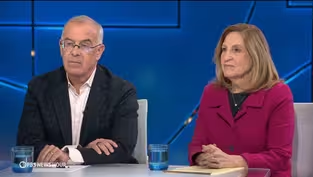
Brooks and Marcus on what's next for the FBI under Trump
Video has Closed Captions
Brooks and Marcus on Wray's resignation and what's next for the FBI (10m 58s)

Former ambassador outlines future role of Syria's neighbors
Video has Closed Captions
Former ambassador outlines role Syria's neighbors could play in its future (7m 29s)
Murder reveals simmering anger with U.S. health care system
Video has Closed Captions
CEO murder reveals simmering anger with American health care system (6m 47s)

Syrians jubilant in first Friday prayers after Assad
Video has Closed Captions
Syrians express jubilation during first Friday prayers since overthrow of Assad (5m 36s)

Why an investor thinks TikTok will be safer with U.S. owners
Video has Closed Captions
Investor explains why he thinks TikTok will be safer with U.S. ownership (6m 42s)
Providing Support for PBS.org
Learn Moreabout PBS online sponsorship
- News and Public Affairs

FRONTLINE is investigative journalism that questions, explains and changes our world.

- News and Public Affairs

Amanpour and Company features conversations with leaders and decision makers.












Support for PBS provided by:
Major corporate funding for the PBS News Hour is provided by BDO, BNSF, Consumer Cellular, American Cruise Lines, and Raymond James. Funding for the PBS NewsHour Weekend is provided by...