
December 14, 2024 - PBS News Weekend full episode
12/14/2024 | 26m 45sVideo has Closed Captions
December 14, 2024 - PBS News Weekend full episode
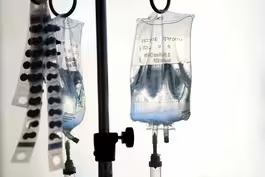
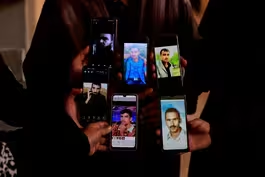
Saturday on PBS News Weekend, the search for the disappeared inside Syria goes on as former prisoners speak out about horrific conditions. Then, how Hurricane Helene caused a shortage of IV fluids affecting hospitals nationwide. Plus, an 18-year-old makes history at this year’s World Chess Championship.
Problems playing video? | Closed Captioning Feedback
Problems playing video? | Closed Captioning Feedback
Major corporate funding for the PBS News Hour is provided by BDO, BNSF, Consumer Cellular, American Cruise Lines, and Raymond James. Funding for the PBS NewsHour Weekend is provided by...
December 14, 2024 - PBS News Weekend full episode
12/14/2024 | 26m 45sVideo has Closed Captions
Saturday on PBS News Weekend, the search for the disappeared inside Syria goes on as former prisoners speak out about horrific conditions. Then, how Hurricane Helene caused a shortage of IV fluids affecting hospitals nationwide. Plus, an 18-year-old makes history at this year’s World Chess Championship.
Problems playing video? | Closed Captioning Feedback
How to Watch PBS News Hour
PBS News Hour is available to stream on pbs.org and the free PBS App, available on iPhone, Apple TV, Android TV, Android smartphones, Amazon Fire TV, Amazon Fire Tablet, Roku, Samsung Smart TV, and Vizio.
Providing Support for PBS.org
Learn Moreabout PBS online sponsorshipJOHN YANG: Tonight on PBS News Weekend, the search for the disappeared inside Syria goes on as former prisoners speak out about horrific conditions.
MAN (through translator): I thought I saw death in front of my eyes.
We didn't have hope we'd see the light again.
When I got out and saw the sun, I thought I had been reborn.
JOHN YANG: Then how Hurricane Helene caused a shortage of IV fluids affecting hospitals nationwide and history at this year's World chess championship, an 18-year-old becomes the youngest champion ever.
(BREAK) JOHN YANG: Good evening.
I'm John Yang.
What comes next in Syria, now that the Assad regime is history, was the topic at a meeting in Jordan today of top officials from the region, from the European Union and from the United States.
Secretary of State Antony Blinken outlined some of the principles they discussed.
ANTONOY BLINKEN, U.S. Secretary of State: The rights of all Syrians, including minorities and women, should be respected.
Humanitarian aid should be able to reach people who need it.
State institutions should deliver essential services to the Syrian people.
Syria should not be used as a base for terrorist groups or others who threatened Syria's people, its neighbors or the world.
JOHN YANG: Under the Assad regime, hundreds of thousands of Syrians were swept up by the security apparatus, never to be seen again.
Simona Foltyn gained access to one of the intelligence branches that orchestrated that brutal repression.
She tells us what she found.
SIMONA FOLTYN (voice-over): The search for the disappeared continues in Damascus.
At the Palestine branch of Assad's feared intelligence services, relatives pour over stacks of notebooks, sift through piles of passports taken from prisoners in hope of finding a trace of their loved ones.
Ibrahim and Hussain are each looking for their brothers who've been missing for years.
They don't know for sure if they passed through this particular prison.
They're flipping through a registry where guards recorded every new arrival.
IBRAHIM MOHOAMMED, Brother of Disappeared Person (through translator): Everyone who entered.
Their name is here, the date is here, what they confiscated, which day, what time.
SIMONA FOLTYN (voice-over): The Palestine branch was one of several security agencies that enforced Assad's tyrannical rule.
Each had its own prison where people were disappeared, tortured and killed.
HUSSAIN HAMOUD, Brother of Disappeared Person (through translator): The way it happened, they rotated them through four to five different branches, and each branch did their own investigation as they pleased.
SIMONA FOLTYN (voice-over): This is the second prison facility Ibrahim and Hussain have been to.
With each day, the hope of finding their brothers alive fades away.
HUSSAIN HAMOUD (through translator): God is generous.
We don't know if we'll find them, but God is generous.
They say that the cars took away the prisoners.
Where?
We don't know where.
They took them away Wednesday, Thursday and Friday, just before the liberation.
SIMONA FOLTYN (voice-over): Knowing the truth, at least, would provide some closure.
The one thing they do know is that justice must be served.
HUSSAIN HAMOUD (through translator): The person who used to run this branch, where is he today?
Where did he go?
He's here.
In this country, no matter who he was, the responsible authorities have to be brought to account for what they did to the people.
IBRAHIM MOHOAMMED (through translator): Every judge, officer, deputy officer, guard, anyone responsible must be brought to account.
HUSSAIN HAMOUD (through translator): Everyone who was loyal to them is one of them, whether he was the guard at the door or the head of the prison.
SIMONA FOLTYN (voice-over): Assad's government kept meticulous records of its own crimes.
That includes the names of his henchmen.
The rebel's offensive took them by surprise, and there was no time to destroy incriminating evidence.
In the main building, we found a register of rotations officers who worked at this branch.
SIMONA FOLTYN: What this book contains are the names of all the officers who worked here who might be responsible for some of the crimes that have been committed here.
So this is a really crucial piece of evidence.
The problem is there doesn't appear to be a process to safeguard these documents which will inevitably be really important for any future justice and accountability process.
SIMONA FOLTYN (voice-over): The rebels are now guarding the compound.
Ahmed Al Shibli was imprisoned for months inside Palestine Branch before joining the armed opposition.
This was the first time he returned.
AHMED AL-SHIBLI, Former Detainee (through translator): The cells are underground.
We can go down there.
I am shaking every time I remember this place.
SIMONA FOLTYN (voice-over): We proceed downstairs into the darkness where the prisoners were held.
AHMED AL-SHIBLI (through translator): There would be 50, 60 people here in this cell.
When they entered the cell, I'll show you how it was whenever they opened this window.
SIMONA FOLTYN (voice-over): Ahmed shows us the position he was forced to take when the guards entered.
AHMED AL-SHIBLI (through translator): If you don't stand like this, they'd start beating you with electric rods.
It shocks your brain, your heart, every part of your body.
So immediately you have to put your head against the wall.
You are not allowed to look.
Whoever looks will be taken out.
This means he could spend a day, two days or three days under torture.
SIMONA FOLTYN (voice-over): Ahmed was a former officer in the Syrian army.
He was arrested on suspicion of being sympathetic to the opposition alongside nine others.
Only three got out alive.
AHMED AL-SHIBLI (through translator): I thought I saw death in front of my eyes.
We didn't have hope we'd see the light again.
When I got out and saw the sun, I thought I had been reborn.
SIMONA FOLTYN (voice-over): Amid calls for justice, there's also a yearning for revenge.
AHMED AL-SHIBLI (through translator): In my opinion, we should put those who imprisoned us in the same conditions so that they live through the same suffering, so that they know God is just.
SIMONA FOLTYN (voice-over): The new government has yet to announce how it will deal with the perpetrators.
And what will happen to these prisons, the sites of so much injustice and pain.
For the relatives of those missing, there are more questions than answers.
SIMONA FOLTYN: And one of the main questions that remains is how many people exactly disappeared into Assad's prisons?
The United Nations estimates that number at above 100,000, a figure that may rise now that we have access to these institutions as well.
As the documents that have been found there.
John JOHN YANG: Simona, in your piece which was very compelling, you talked about a future justice and accountability process.
Does anyone have any idea what that's going to look like?
SIMONA FOLTYN: Well, we don't know much yet.
And one of the main questions is who exactly will be brought to account?
Will it only be the high ranking officers who issued the orders, or will a future justice and accountability process also include lower ranking officers and foot soldiers, which is certainly what some of the relatives that we spoke to were demanding.
The sheer undertaking of this is immense.
Let's remember, John, that in Assad, Syria, there were more than a dozen different security and intelligence institutions which employed thousands of people.
We don't know where these people are at the moment.
The institutions have been dismantled.
Presumably they're in hiding.
So it remains to be seen whether we're going to stay, start seeing mass arrests in the coming days and weeks, or whether it will be more of a targeted and selective process.
JOHN YANG: Simona, it's just been a week since we saw pictures of Syrians celebrating the fall of the regime.
Now one week on, how are they feeling?
SIMONA FOLTYN: Well, here in the capital, Damascus, we have seen a mix of joy and cautious optimism.
Syrians are certainly happy that Bashar al-Assad is gone.
They feel reassured by the statements that have been cut coming out from Abu Mohammed al-Jolani, the rebel leader turned new ruler of Syria, who has been reassuring Syrians that the new government will be an inclusive one and that there will be coexistence between Syria's different sects.
Now, according to the Constitution, there should be elections within 90 days of the presidential post becoming vacant, and we haven't heard any announcements with regard to that.
So while Syrians are very excited and they're certainly keen to play a role in rebuilding this new Syria, there is a question whether they will be given the space to do so or whether we will transition to a new, perhaps softer form of authoritarian rule.
JOHN YANG: Simona Foltyn in Damascus, Syria, thank you very much.
SIMONA FOLTYN: Thank you, John.
JOHN YANG: Elsewhere in the Middle East, teams in central Gaza are searching through rubble for survivors of an Israeli airstrike.
Medical teams say at least 10 people were killed at an open public market where displaced families often took shelter.
Israel says they were targeting gunmen operating from a shelter in the area.
And in Cairo today, there were more talks aimed at getting a ceasefire deal that could free some Israeli hostages still held in Gaza.
National Security Advisor Jake Sullivan represented the United States.
South Korean lawmakers voted today to impeach President Yoon Suk Yeol.
It was for his surprise and short lived declaration of martial law, which suspended most civil rights, including the right to protest and freedom of the press.
Following the vote, Yoon said impeachment is a temporary pause.
The prime minister now assumes presidential duties while South Korea's Constitutional Court decides whether to remove Yoon from office.
House Speaker Emeritus Nancy Pelosi underwent hip replacement surgery today at the U.S. Army Hospital in Landstuhl, Germany.
Pelosi, who's 84 years old, tripped and fell yesterday in Luxembourg.
She's in Europe as part of a bipartisan congressional delegation marking the 80th anniversary of World War II's Battle of the Bulge.
Pelosi's office says she's well on the mend.
ABC News has agreed to pay $15 million to the Trump Library to settle a defamation suit.
It stems from anchor George Stephanopoulos, incorrect description of the civil case involving Mr. Trump and writer E. Jean Carroll.
The network also is paying Mr. Trump's lawyer $1 million in legal fees.
In a statement, ABC News said it's pleased both parties were able to reach an agreement.
A somber holiday tradition today at Arlington National Cemetery and at cemeteries across the nation.
At Arlington, volunteers placed holiday wreaths at grave markers as part of National Wreaths Across America Day.
The tradition enlists volunteers to lay wreaths at gravesites to recognize the sacrifice of fallen American warriors.
About 400,000 veterans and their family members are buried at Arlington.
Up next on PBS News Weekend, how hospitals across the country are dealing with a shortage of IV fluids.
And a new era in chess begins with the youngest champion ever.
(BREAK) JOHN YANG: It's been about three months since Hurricane Helene pummeled the mountains of North Carolina, but the effects are still being felt well beyond the storm's path.
Ali Rogan explains.
ALI ROGIN: Whether you're dehydrated, undergoing surgery or receiving medicine intravenously, IV fluid is a staple in modern healthcare.
But this past September, the nation's supply of those critical fluids took a massive hit.
That's when Hurricane Helene struck North Carolina and flooded a manufacturing site owned by the Baxter Medical Technology Company.
That one plant produces about 60 percent of the country's IV fluid.
Suddenly, many hospitals felt the squeeze and were forced to delay some surgeries.
It caused administrators to start to rethink how they use and conserve this valuable commodity.
Jackie Fortier is a reporting fellow at KFF Health News and has been tracking this story.
Jackie, thank you so much for joining us.
Take us back to the moment when the hurricane hit.
Was this impact felt immediately by hospitals who received this company's IV fluids?
JACKIE FORTIER, KFF Health News: Absolutely.
I mean, Hurricane Helene struck North Carolina in late September, as you said, flooding the largest IV fluid factory in the US and I think everyone was surprised that Baxter facility, you know, produced 60 percent of the nation's supply of IV fluids.
You know, the medical folks that I talked to were all very surprised.
They didn't know.
So that factory shut down and the company began rationing its products because it was flooded.
And that caused a shortage of IV fluid products you know, throughout the healthcare facilities across the US that's continuing.
ALI ROGIN: It's been two months since that time.
I know that the facility has reopened, but is it back to full production yet?
JACKIE FORTIER: No, no.
The North Carolina Baxter factory is now making some IV fluid products, but the company hasn't announced a date when they'll be back to those, you know, pre hurricane production levels.
So the IV fluid shortage is continuing.
I talked to a hospital administrator in LA the other day, and they're still only getting 60 percent of their IV fluid order.
So they're still down 40 percent from what they normally get.
ALI ROGIN: And so in the meantime, how are hospitals, other facilities, dealing with these shortages?
JACKIE FORTIER: They're doing a lot to conserve IV fluids.
And to be clear, you know, the people who really needed IV fluids have always been getting them, you know, folks who aren't able to drink.
One hospital administrator in D.C. told me that they've slashed their IV fluid use by over half since the shortage began, you know, across all the hospitals that he's the administrator for.
So, you know, sometimes that means telling emergency room patients to drink, you know, Gatorade or Pedialyte instead of getting an IV.
Hospitals are switching patients from liquid medications to pills sooner than they normally would.
And they're also doing some kind of common sense stuff like using up the entire IV bag before starting another.
Hospitals are also giving some medications intravenously, but without a dedicated IV bag, which is known as a push medication.
When I talked to nurses about that, they said, you know, using push medications takes more time out of a nurse's already pretty hectic schedule because they need to monitor the patient.
The medicine isn't being titrated or given over time.
It's kind of being given all at once.
But, you know, the IV fluid shortage is ongoing and it could get worse as the end of the year comes up because people get sick with, you know, winter respiratory viruses.
We got flu, COVID that send more people to the hospital.
And then folks also schedule surgeries because their health plans usually reset in January with new deductibles.
ALI ROGIN: Right.
And I know this shortage, this was brought on by a natural disaster, but it has made hospital administrators rethink their strategies on stocking and using these IV fluids.
How might this crisis impact their decision making to make sure that something like this doesn't happen again?
JACKIE FORTIER: I think some of the conservation measures will stick around.
Some of the more kind of common sense practices, like using up an IV fluid bag before starting another.
Before the shortage, when a patient was moved to a different floor, or if they came in on an ambulance and they already had an IV, it was replaced when they got to the hospital.
Now they're keeping and using up that bag.
Another hospital administrator told me that they're interested in retooling electronic health records to question doctor's orders before letting them order another IV fluid bag for hydration.
So, you know, maybe a little pop up that says, does the patient really need the second bag?
How do they do with eating or drinking water or juice if they did well, you know, maybe they don't need that bag.
So these, you know, little kind of conservation mechanisms across multiple hospitals, you know, would make a significant dent and hospital administrators are really interested in conserving.
ALI ROGIN: How is this all affecting a patient's experience?
JACKIE FORTIER: Well, I talked to nurses and they say that, you know, initially folks were a lot more understanding because the hurricane was in the news.
And now that it's been a, you know, two and a half months, people don't really think about it as much.
It's difficult for nurses too, because it does take them more time to do these push medications.
People do ask for IV fluids if they've been, you know, in the hospital before.
They know that it can make them feel pretty good.
I have seen that people say that getting a push medication, again, that's without kind of the IV fluid piggyback can be painful in some cases.
So we haven't seen any indication that patients aren't getting medical care that they should be getting.
But it's difficult to get someone to drink a liter of fluid versus putting a liter of fluid in their arm through an IV.
ALI ROGIN: Jackie Fortier, reporting fellow at KFF Health News, thank you so much for joining us.
JACKIE FORTIER: Thank you.
JOHN YANG: There's a new chess world champion and he's the youngest ever.
18-year-old Gukesh Dommaraju defeated defending title holder Ding Liren of China at the World Championship in Singapore.
Dommaraju, who goes by Gukesh, has had a meteoric rise amid a surge in the game's popularity India.
This is what the chess based India's broadcast looked like when Ding made a blunder that opened the door to Gukesh's victory.
After the match, Gukesh talked about going bungee jumping.
Levy Rozman is known online as GothamChess, which is the name of his YouTube and Twitch channels.
He's also the author of "How to Win at Chess, the Ultimate Guide for Beginners and Beyond."
I want to ask you about what we just saw.
The move that Ding made, it was instantly recognizable to viewers and commentators that this was a big blunder.
First of all, what did he do?
In the simplest terms, what did he do?
And how can a player at that level make a move like that?
LEVY ROZMAN, Author, "How to Win at Chess": Yeah, I'm going to try to do my best here.
I can summarize this as a -- an interception in the Super bowl with 30 seconds remaining.
That turns into a touchdown.
That level of kind of turnaround for baseball fans, it's a, you know, walk off grand slam, bottom of the ninth World Series.
I'm a Yankee fan, so I'm still licking my wounds.
It was a shocking, shocking mistake.
And the reason why it was so shocking is Ding had very few pieces remaining and he was down one pawn, which is the least you can have kind of a difference.
And he liquidated the whole pieces, you know, the whole board, thinking that the game was going to end in a tie, in a draw.
And it just wasn't.
And he didn't have to do that.
So it was a self-induced error on the biggest stage, at the biggest moment.
JOHN YANG: Let's talk about Gukesh.
He was a grandmaster at 12.
This past summer, he won gold at the Chess Olympiad.
If you go to the World Chess Federation site, he's ranked as both an adult and a junior.
What's the significance of him now being World Champion?
LEVY ROZMAN: It's massive.
So for the last, let's say, 10 or 15 years, chess has had several stars, but one superstar.
Unlike, let's say tennis, which has the big three with Novak Djokovic, Roger Federer and Rafael Nadal.
We have Magnus Carlsen.
Before Magnus, we had a few very strong top players, including Viswanathan Anand from India, who started this whole chess boom India.
And before that, Kasparov.
Garry Kasparov, who some of the folks who are listening right now might know about.
But Gukesh is the next generation.
He's 18.
And we've been waiting for the next teenage superstar to break through.
And he basically completed chess in a year.
He won the Chess Olympiad with India.
He was a dominant force for them on the first board.
And he won the candidates tournament to qualify for the World Championship.
And now he's the World Champion.
So talk about solving the game.
JOHN YANG: You mentioned Magnus Carlsen, a former world champion.
He won his World Championship, the first one in 2013, by defeating the only previous Indian world champion, Vishya Anand.
It was in Chennai, which is Gukesh's hometown.
He was a spectator at that match and he said his dream of becoming world champion started then/ GUKESH DOMMARAJU, 2024 World Chess Champion: When Magnus won I thought, you know, I really want to be the one to bring back the title to India.
And this has this dream that I had like more than 10 years ago has been the single most important thing in my life so far.
JOHN YANG: What's this going to do to chess not only India, but around the world?
LEVY ROZMAN: It's going to be massive.
The first time that India had a world champion, it was their first ever Grandmaster, it was Vishy Anand.
They didn't have another one.
And now I believe they have 100 and I believe they are creating two or three new ones, meaning those players are qualifying for the title every month.
It's hard to understate how crazy this is going to get India.
It's going to be a hero's welcome of epic proportions.
All top cricketers, actors, musicians, politicians are going to congratulate Gukesh.
He might have to stay inside for a little while.
It's going to get a little rowdy.
Listen, I'm so happy for him and I hope this spreads around the world, to be honest with you.
When Ding became world champion, I hope there would be a similar boom in China.
It wasn't quite as strong.
So India's love for chess is unbelievable.
JOHN YANG: Let's talk a little bit more about Magnus Carlsen.
He decided not to defend his title in 2023.
He said he lacked motivation.
He is not competing in the World Championship series.
When Gukesh said he wanted to play Magnus, Magnus said, I'm not part of that circus anymore.
He's spending most of his time and energy on faster chess formats.
Speed chess.
What does that say about where chess is right now?
LEVY ROZMAN: It doesn't sound good to the average person.
Right.
We all have a sport we follow and that sport has a champion at the end of the year.
But most of those sports, it's then open.
It's not like the Kansas City Chiefs just wait for somebody to qualify to play against them.
And chess has that format.
We have that boxing system where we bring up a challenger to a champion.
It's to be determined if that's the best system.
But Magnus Carlsen was clearly not interested, like he said in his own words, participating in that circus anymore.
Can we have a reunification bout?
Maybe.
I would argue though that this is definitely not a great sign that the world champ is absent.
I will summarize this by saying it doesn't take anything away from Gukesh.
He's still the world champion.
JOHN YANG: So now we've got an 18-year-old world champion.
Speed chess is on the rise.
As you look forward to the future.
What excites you about the future of chess?
LEVY ROZMAN: What excites me the most is right now we've got a lot of innovators, we've got people coming in trying to speed the game up.
And the biggest problem that chess has is that it's not a TV product in a sports form.
I'm not saying we need 400 advertisements in the middle of the game and you miss a move.
But what I am saying is we need to make it digestible and understandable for people at home.
And I'm willing to bet, John, that most people that listen to me right now will agree with this and go, I don't follow chess on a day to day basis and sometimes I'm in a city where a big event is happening and people don't know what's happening, but they love chess.
That's our biggest problem.
That's what I'm most excited for us to tackle in the future.
JOHN YANG: Levy Rozman on the future of chess.
Thank you very much.
LEVY ROZMAN: Thank you.
JOHN YANG: And that is PBS News Weekend for this Saturday.
I'm John Yang.
For all of my colleagues, thanks for joining us.
See you tomorrow.

Gukesh Dommaraju becomes youngest world chess champion
Video has Closed Captions
New era in chess: Levy Rozman discusses Gukesh Dommaraju becoming youngest world champion (6m 44s)
How Hurricane Helene caused a nationwide IV fluid shortage
Video has Closed Captions
Hospitals nationwide grapple with IV fluid shortage caused by Hurricane Helene (5m 46s)
Search continues for Syrians who vanished under Assad regime
Video has Closed Captions
Search continues for missing Syrians imprisoned by Assad regime (8m 36s)
Providing Support for PBS.org
Learn Moreabout PBS online sponsorship
- News and Public Affairs

FRONTLINE is investigative journalism that questions, explains and changes our world.

- News and Public Affairs

Today's top journalists discuss Washington's current political events and public affairs.












Support for PBS provided by:
Major corporate funding for the PBS News Hour is provided by BDO, BNSF, Consumer Cellular, American Cruise Lines, and Raymond James. Funding for the PBS NewsHour Weekend is provided by...