
December 15, 2025
Season 4 Episode 121 | 26m 31sVideo has Closed Captions
Kentucky's Attorney General wants to do more to combat retail crime.
Kentucky continues to recommend Hepatitis B vaccines for infants, a new overdose alert system is launched, bird flu is detected in a backyard flock in Central Kentucky, and Sen. Rand Paul discusses hemp legislation and the U.S. government's role in Syria.
Problems playing video? | Closed Captioning Feedback
Problems playing video? | Closed Captioning Feedback
Kentucky Edition is a local public television program presented by KET
December 15, 2025
Season 4 Episode 121 | 26m 31sVideo has Closed Captions
Kentucky continues to recommend Hepatitis B vaccines for infants, a new overdose alert system is launched, bird flu is detected in a backyard flock in Central Kentucky, and Sen. Rand Paul discusses hemp legislation and the U.S. government's role in Syria.
Problems playing video? | Closed Captioning Feedback
How to Watch Kentucky Edition
Kentucky Edition is available to stream on pbs.org and the free PBS App, available on iPhone, Apple TV, Android TV, Android smartphones, Amazon Fire TV, Amazon Fire Tablet, Roku, Samsung Smart TV, and Vizio.
Providing Support for PBS.org
Learn Moreabout PBS online sponsorship>> And with chronic infection, we see inflammation of the liver, scarring, cirrhosis.
>> Kentucky has one of the highest rates of hepatitis B. This pediatrician says the vaccine is best for infants.
Despite debate at the CDC.
>> The value of that you can't put a price on it.
>> How a school district and county sheriff's office are expanding the role of a traditional school resource officer.
>> If you choose EKU, EKU chooses you.
>> The president of Eastern Kentucky University talks about helping students affected by the end of D-I programs.
>> Production of Kentucky edition is made possible in part by the KET Millennium Fund.
>> Good evening and welcome to Kentucky Edition for this brand new week.
It is Monday, December the 15th.
I'm Renee Shaw and we thank you for spending some of your Monday evening with us.
More big news tonight from Ford.
The company says it will convert vehicle battery plants in Kentucky, but not before workers are laid off.
The Courier Journal reports Ford is expected to let go all 1500 employees at one of its Blue Oval SK plants in Hardin County.
The news comes after SK On and Ford announced last week that they're ending their partnership.
Now, Ford says it will use the two Kentucky plants to make battery energy storage systems to help power data centers, among other things.
Ford says it plans to invest $2 billion over the next two years to scale the project.
According to the Courier Journal, Ford wants to hire more than 2000 workers.
They anticipate many of the workers being let go will reapply.
State lawmakers who represent the area have responded.
Republican State Senator Matt Dineen says Ford will support and assist employees impacted in the short term.
State Representative Samira Heffron and Steve Bradsher also issued a joint statement following today's announcement.
It reads in part, quote, we are optimistic about Ford Motor Company's decision to take over the Glendale facility and transition the project toward energy storage, particularly as initial plans for the project have faced significant challenges from the outset.
At the same time, optimism must be matched with both caution and accountability, and we will be watching closely to ensure commitments are met and honored.
End quote.
The holidays are a busy time for shoppers and thieves.
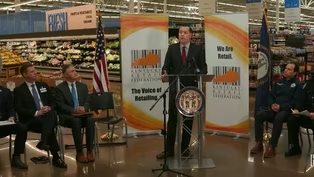
Kentucky Attorney General Russell Coleman says his team is going after these criminals by launching a new organized retail crime unit.
Now he wants to expand the unit, and he's asking state lawmakers to help.
>> We're not talking about shoplifting.
This ain't about shoplifting.
What we're talking about is organized crime.
What we're talking about is violence.
We're talking about violence to our families as we come in stores.
Violence to employees of great stores like this.
Violence to law enforcement as they intervene.
What we're talking about is higher prices for all of us.
And what we're talking about is closed stores in areas not only of Louisville but around the Commonwealth.
We're fighting organized crime.
We're asking the General Assembly to invest $2 million in our new organized retail crime unit.
This will involve hiring three more detectives.
This will involve two investigative analysts to help us connect the dots of all of the data involved in these major investigations, as well as a resource prosecutor, to work with our federal, state and local partners.
With the support of our General Assembly, we have seen a General Assembly who focuses on public safety.
If they give us the resources, we'll be the muscle to help get this done.
Working with our partners.
>> According to the Kentucky Retail Federation, organized retail crime cost Kentucky more than $2 billion in a year.
U.S.
Senator Rand Paul of Kentucky shared the stage today with a Louisville producer of THC and CBD infused gummies and drinks.
Cornbread hemp unveiled its expanded facility today, despite impending federal regulation that the owners and senators say would take these products off shelves, Kentucky's senior senator Mitch McConnell, supported the new rules.
>> If he sees an accomplishment destroying a multi-million, actually billion dollar industry, I don't see that as an accomplishment.
I don't know that we're going to change his mind, but I think he really has not been well informed on this.
He I don't think he understands the devastation this is going to bring, just the changing of the plant definition.
They thought it was a little tweak.
It makes every plant in the country illegal, because they've just changed it from a form of THC to total THC, but they left the number the same.
And so if the number is the same, all the plants that are created are illegal.
I'm sure you have to hybridize these plants and create the seeds.
Somebody is probably sitting on millions of dollars of seeds that at the end of the year will no longer be legal.
So I just don't know that he's thought through the issue.
He he sees the problem.
And here's the problem.
I agree with him with the problem.
I don't want kids.
I don't want 12, 15 year old kids getting 100 milligram gummies in the gas station.
Let's make that illegal.
It is illegal in Kentucky that was made illegal by the Kentucky law.
But here's the irony there is no federal age limit for hemp products.
So when he did this, he actually is over.
He's overturning Kentucky's law that actually has an age limit.
We have 300 and some days till the end of this deadline that that has been set for us by Congress.
But the real deadline is much sooner than that.
Our farmers need clarity now.
And in order to get planning for next year's crop, the the seeds go into the ground in mid-May, and lots of planning has to happen before those seeds go into the ground.
For instance, H-2a visa worker contracts have to be signed 90 days before workers arrive.
So.
So if we don't get something moving in the next few weeks, right around the, you know, inside the new year, all of the farming partners, all the hemp farmers in Kentucky are going to be on the back foot.
>> New rules are set to go into effect in less than a year.
Only products containing less than 0.4mg of THC would be compliant, Paul said.
A five milligram limit would be better, though still a compromise.
President Donald Trump is vowing to retaliate after two U.S.
service members and a civilian died in an attack in Syria.
Senator Paul talked about the attack yesterday on NBC's Meet the Press.
Paul questioned the entire U.S.
role in Syria.
>> Two U.S.
service members and one civilian interpreter were killed.
Three other troops wounded in an ambush by an ISIS gunman.
The president is threatening, quote, very serious retaliation for the attack.
You are a part of the Senate Foreign Relations Committee.
Do you support the president, the United States retaliating what happened in Syria, Senator?
>> Well, the soldiers who died are obviously heroes fighting for their country.
The purpose of whether or not they should be there or not is a big question.
In the first Trump administration, Trump proposed removing those troops and the neocons around him.
The traditional conservatives around him said, oh no, no, we won't let you.
They actually passed a law trying to prevent him from removing troops from Syria.
I was with the president in the first administration that a couple of hundred troops in Syria are more of a tripwire than a strategic asset.
I don't think they deter war.
I think they basically because Americans are targets and jihadists around the world think they can get great glory and provoke terrorism by killing an American, that they become potential targets in tripwires to more interaction.
Yes.
The people who killed our soldiers should be punished.
But really, we need to reassess whether or not we should have troops in Syria to begin with.
>> Senator Paul also talked about redistricting efforts across the country, as both parties look for an advantage in the 2026 midterm elections.
Paul said he fears anger over redistricting could lead to violence.
Last week, a CDC advisory panel voted to stop recommending the hepatitis B vaccine for newborns.
As the director of the CDC decides whether to approve such a change, a state agency and many local pediatricians will continue recommending the three dose vaccine starting at birth.
>> So hepatitis B is a virus that.
>> Can infect the liver.
Some people get sick and they get over it.
Other people develop a chronic infection, and with chronic infection, we see inflammation of the liver, scarring, cirrhosis.
There can be cancer of the liver and even death.
Getting infected as a baby is particularly dangerous because 90% of babies who are infected go on to carry the virus long term.
They have chronic infection, and 1 in 4 will develop serious health complications over their lifetime.
So the good news is hepatitis B is a vaccine preventable illness.
We have vaccines that have been extensively studied, hundreds of studies, and they're safe and they work really well to protect babies against this viral infection.
I will say that many, but not all pregnant women are tested for hepatitis B virus and the test is excellent when it happens.
But no test is 100%.
So even testing doesn't identify 100% of people who are infected.
The virus can live for seven days on a surface.
And so, you know, even if we're testing pregnant people, we're not testing everybody in the house, right?
So if a baby is born into a family where there's somebody who's infected with hepatitis B, maybe they don't even know it.
Vaccine at birth protects them to the universal birth.
Dose for hepatitis B has been recommended since 1991.
It is very safe, safety has been extensively studied, and it's been very effective.
A 99% decrease in infections in young children.
And there are no new data to suggest otherwise.
And so that's why the American Academy of Pediatrics and the Kentucky Department for Public Health continue to recommend a dose at birth, and then a three dose series.
>> Most recent data from the CDC says Kentucky has the third highest rate of acute hepatitis B infections, after West Virginia and Florida.
However, West Virginia's rate decreased in 2023, while Kentucky's increased.
We have more medical news tonight.
We've reported many times on Kentucky's often deadly drug problem to track spikes in drug overdoses across Kentucky.
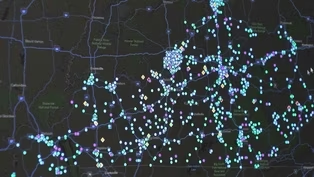
The Kentucky Injury Prevention and Research Center created a system that alerts local health departments and recovery groups.
>> So the Kentucky Injury Prevention and Research Center at the University of Kentucky, they are instrumental in providing data to health departments as well as to the CDC.
And so they have developed a Kentucky overdose alert system, which kind of is a hub for all of those systems, to kind of give them data so that we can really report what's going on in Kentucky.
>> It's a semi-automated system that essentially takes several different data streams.
So rapid hospital data, which is called essence, as well as EMS data through the bio spatial and map systems.
And essentially it's looking for unusual increases or upticks in overdoses.
And so usually that's by county, but it can also be by hospital.
And the the goal is essentially to find overdose spikes or clusters as quickly as possible and to get eyes on them and to notify the the localities where they're occurring.
>> Here at the health department, we work with participants who are using drugs, and we operate a syringe program.
And so when they come in, we're able to let them know about these clusters and that kind of thing.
We can see if it was a death.
We can see if Narcan was used.
We can see a whole lot of different information about overdoses that are happening.
We can break it down by zip code.
We can break it down by individuals.
>> Giving people warning that there's something going on with the drug supply, or that a drug that they normally take might be more dangerous or more potent than it normally is.
Without a system like this in place, those people will never have any way to prepare.
When an alert goes out.
Not only that county can can better respond, but neighboring counties can also be like, oh, we might want to get, you know, more, more naloxone prepared.
We might want to have we might want to modify our hours of our syringe service program.
We are currently in the process of talking to the Kentucky Board of Emergency Medical Services about potentially getting access to daily EMS data, which would allow us to essentially detect clusters at a much higher resolution so we could detect down to more like the neighborhood or like cross street level.
>> We're hoping that it will just be really robust in what it can provide us.
I'm thinking along the lines of gender, age, race, ethnicity, all the demographics that we could hit.
And when we put that on top of zip codes and locations and what drugs were used, and if the person survived, we can really get a good picture of what's happening in the street and in people's homes.
>> The university launched the alert system in 2023, in partnership with the Kentucky Department of Public Health.
What we're talking about financial health tonight as part of Ket's The Next Chapter initiative, focused on the rewards and challenges of growing older.
Tonight, we're talking about managing your money and your golden years, from Social Security and retirement benefits, to maximizing tax credits and doing wills and trusts.
It can be a daunting task.
So join me in a panel of financial advisors and elder law experts for financial planning for seniors.
Call in a Next Chapter forum.
That's tonight at 8:00 eastern, seven central, right here on KET.
State law requires school districts to have a school resource officer on campus in addition to those SROs.
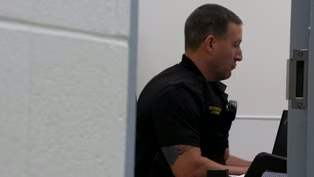
Warren County Public Schools now also has a detective on staff to investigate cases that need extra time and attention.
Our Laura Rogers has more about this from Bowling Green.
>> For school resource detective Josh Hughes.
These high fives and hugs are a welcome addition to his daily routine.
>> Some of these kids here at my school, I see every single day they stop by and talk to me every day.
>> Hughes came on board in July after a 24 year career in local law enforcement.
>> I start here most mornings.
I deal with the kids, interact with the kids just like any other SRO.
>> But unlike any other school resource, Officer Hughes will dive deeper into cases and crimes that threaten school safety, such as a troubling online post.
>> I'll go and get a search warrant for the social media.
I analyze the social media.
Anything that needs investigation outside of the school, they'll call me and I'll come in and help.
>> He'll also interview parents in cases of suspected abuse or neglect.
>> I can do the home visit.
I can do the search warrants.
I can analyze the data.
>> And that allows the districts couple dozen other school resource officers to stay on the job, monitoring safety and security at their assigned school.
>> We have a lot of years of experience in our SRO program, so a lot of that stuff, they can handle themselves and they really could handle all of it themselves.
It's just it makes it hard for them when they have to leave the schools.
>> I wanted to make sure that we always had somebody readily available for any major investigation within the school system.
>> Warren County Sheriff Brett Hightower got the idea for a school resource detective after a couple of major incidents last year.
>> We had several phones involved in both these cases that we needed to kind of download look into for the kind of forensic examination of.
>> Them, he says.
Having a dedicated detective on staff to handle those investigations adds to their multi-layer approach to school safety.
>> We want to make sure is that we do the most thorough investigations when it involves our students at our schools.
>> It's also about building relationships with students and their families.
>> We can't separate school and home, so if there's things going on inside of this kid's home, it will, of course affect their behavior.
Here at school, I'm able to sometimes connect the families to the resources and then hopefully do things that help improve the kid's home life, which then improves their ability to perform at school.
>> These efforts often help strengthen trust and local law enforcement.
>> It's interesting.
My first day here, I had a kid that told me my daddy told me not to talk to police officers, and now this same kid stops by and gives me a hug every single morning.
>> Being in a school setting can also bring levity.
After working a particularly hard case, as recently happened for Hughes.
>> And so I went out on the jungle gym and was climbing the jungle gym with the kids.
I was pushing kids on swings and, you know, it's hard to stay down when you feel that laughter and you see that innocence of these kids.
>> And innocence he's working to preserve and protect.
For Kentucky edition, I'm Laura Rogers.
>> Great story.
Laura Rogers Hughes is the first known school resource detective in the state.
Sheriff Hightower says other counties have expressed interest in hiring one as well.
He says it's a big help in a school district of 19,000 students.
Now turning to higher ed, a new state law reading state colleges and universities of Dei diversity, equity and inclusion positions and programs doesn't mean for one institution that they're abandoning their mission to serve underserved student populations.
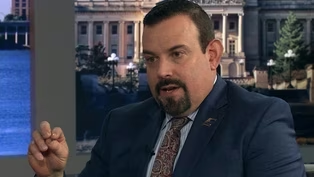
In the final installment of my interview with Eastern Kentucky University President David McFadden, we talk about that and possible legislation to ease the transfer, of course credits.
How has EKU had to pivot from that space, and how do you still serve the underrepresented populations as you mission to do?
>> You know, I think as I talk about, you know, so many first gen, so many students who are coming that are Pell eligible are low income student population.
I really have experienced and led by the notion that if you choose EKU, EKU chooses you.
And so when it comes to student support services and student success, you know, we have just doubled down on making sure that all students who are on our campus are getting the resources, the support, the education that they need to be successful.
And so, you know, as we've kind of navigated, you know, those changes as they've been very explicit in House Bill four and a few other things, I think that that's been, you know, kind of it's been, in some ways reassuring to us that as we think about serving all students, that we take a lot of pride in the fact that we felt like we were doing it really well.
And so as we talk to our students and engage with them, I think that my feel is that our students feel supported.
They feel like that campus is is a place that they feel engaged.
Just finished up a survey that was part of a House Bill four that came out.
And I think that early preliminary results show that students feel like that, that they have the opportunity to express themselves and that they feel welcome on their campus and that that EKU their second home or in some cases, their first home.
And so we're proud of that and eager to continue to move forward and and serve students and meet them where they're at.
>> Finally, just yesterday, I believe it was.
And Frankfort representative Vanessa Grasso, who serves the Lexington and Fayette County Scott County area, is expected to file legislation.
And she talked about this bill in committee to make it easier for college students to transfer course credits between Kentucky's public universities, which many would say, I thought they already did that.
It's called the Post-secondary Credit Alignment Plan.
Why is that even needed?
Isn't that already happening?
And what could be done better?
>> Yeah, I think for us, and I think we're engaged in this conversation right now with the council, with with Representative Grosso.
I'm excited to to to really better understand kind of, you know, some of the things that she's trying to accomplish, perhaps be able to share some, some, some data that shows, you know, where we've made some strides.
And I would say this, you know, having been a part of this for now, over 15 years, we are so much better today in in that credit articulation and making sure that those credits are going toward the degree requirement than ever before.
Advising has got so much better.
But, you know, I do think we still have the instances where a student thought they wanted to be a health care professional and then said, hey, maybe I want to be an architect.
And sometimes that just comes with, you know, some, some opportunity costs in that experience.
But I would largely say that for us, we're Kentucky's number one transfer institution.
We transfer more credit from Kctcs than any other institution.
I think we're we're doing a lot of good work in that space.
Could we get better?
I would say we absolutely could.
We're looking forward to working with Representative Grossell to to better kind of refine, you know, where those those key areas are that we feel like that there's some stumbling blocks for students continue to identify those, eliminate those roadblocks and help students, you know, navigate that transfer in the most seamless way.
But I will say that, you know, I commend, you know, President Quarles.
I think he's got agreements with every one of our institutions.
We're doing joint advising with those students.
I think the key is while they're whether they're in high school or whether they're a community college or whether they're going from four year to four year, the advising is so important.
And so just being intentional about, you know, making sure students know that they know exactly where they want to get to and laying out that pathway is important.
So eager to engage with Representative Grossell to to better understand that.
But I will say, I do think we if we look at the data, we've gotten tremendously better at transfer credit.
There's always the opportunity to get to get better each and every day.
And we're committed to doing that.
>> You can see the other interview segments with Eastern Kentucky University President David McFadden online at ket.org.
Amanda Mays Bledsoe Kentucky Edition.
UK volleyball team is headed to the Final Four.
More in tonight's look at sports news.
Top seeded Kentucky beat Creighton in three sets over the weekend in Lexington.
With the win, Kentucky moves on to play Wisconsin and Kansas City, Missouri on Thursday.
If the cats win that game, they would move on to the finals Sunday, also in Kansas City.
This is Kentucky's second Final Four appearance, and its first since it won the volleyball championship back in 2020.
Go cats, a Kentuckian invented flavored chewing gum.
And what's the story behind Kentucky's state seal?
Our Toby Gibbs tells us about both and much more in tonight's look back at This Week in Kentucky history.
>> Kentucky's seal and motto have been around a while.
On December 20th, 1792, the General Assembly passed an act authorizing a state seal showing two friends embracing and the words United we stand, divided we fall.
The first of several earthquakes occurred at the New Madrid Fault, where Kentucky and Missouri meet on December 16th, 1811.
The quakes strength is estimated at, being between 7.2 and 8.2.
There would be 86 more shocks in the following weeks, followed by more powerful earthquakes into 1812.
Happy birthday to John Colgan, born December 18th, 1840, Colgan was a Louisville druggist credited with inventing flavored chewing gum in the late 1860s when he added balsam, tolu extract and powdered sugar to chicle.
Confederate and Union forces fought the Battle of Rowlett's Station in Hart County on December 17th, 1861.
The objective was an iron railroad bridge over the green River.
When the battle ended, the Union side still controlled the bridge.
Colonel Harland Sanders, founder of Kentucky Fried Chicken, died in Louisville on December 16th, 1980.
He was 90 years old.
At the time of his death, there were 6000 KFC restaurants in 48 countries.
The EKU Colonels won the Division one AA football title on December 15th, 1979, beating Lehigh 30 to 7, in Orlando, Florida.
And those are a few of the big events this week in Kentucky history.
I'm Toby Gibbs.
>> Thank you, Toby Gibbs.
And we've got a big event coming up at 8:00 tonight.
We'll have financial planning for seniors.
And we want to take your questions.
So call in.
That number will be there for you at 8:00.
We're back on the air here at KET.
Until then, take really good care.
See you soon.
Attorney General Targeting Organized Retail Crime
Video has Closed Captions
Clip: S4 Ep121 | 1m 36s | AG Coleman is asking the state legislature for more money for a new organized retail crime unit. (1m 36s)
EKU's President Discusses Transfer Credits
Video has Closed Captions
Clip: S4 Ep121 | 4m 31s | McFaddin says EKU has made great strides when it comes to easing the transfer of course credits. (4m 31s)

Ford Shifting Focus of Battery Plants in Kentucky
Video has Closed Captions
Clip: S4 Ep121 | 1m 31s | Ford is laying off all of the 1,500 employees at the Hardin County plant. (1m 31s)

Local Pediatrician Still Recommending Hepatitis B Vaccine
Video has Closed Captions
Clip: S4 Ep121 | 3m 8s | The move is in contrast with a new recommendation from a CDC advisory panel. (3m 8s)
Meet Kentucky's First School Resource Detective
Video has Closed Captions
Clip: S4 Ep121 | 3m 16s | Warren County Public Schools is adding to its SRO roster. (3m 16s)
New Alert System Tracking Overdoses
Video has Closed Captions
Clip: S4 Ep121 | 3m 12s | The system is designed to alert local health departments and recovery groups. (3m 12s)
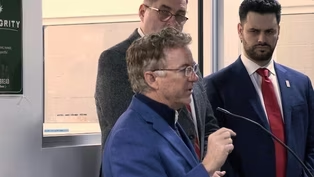
Sen. Paul Shows Support for Kentucky Hemp Business
Video has Closed Captions
Clip: S4 Ep121 | 2m 36s | Cornbread Hemp unveiled its expanded facility in Louisville on Monday. (2m 36s)
Providing Support for PBS.org
Learn Moreabout PBS online sponsorship
- News and Public Affairs

Top journalists deliver compelling original analysis of the hour's headlines.

- News and Public Affairs

FRONTLINE is investigative journalism that questions, explains and changes our world.












Support for PBS provided by:
Kentucky Edition is a local public television program presented by KET