
December 16, 2025
Season 4 Episode 122 | 26m 31sVideo has Closed Captions
A special election is underway to select Kentucky's newest state senator.
Kentucky's newest state senator will be selected in a special election, a case of bird flu is detected in a backyard flock in Central Kentucky, and learn about what's being called a roadmap for increasing jobs and improving the quality of life in nine Kentucky counties.
Problems playing video? | Closed Captioning Feedback
Problems playing video? | Closed Captioning Feedback
Kentucky Edition is a local public television program presented by KET
December 16, 2025
Season 4 Episode 122 | 26m 31sVideo has Closed Captions
Kentucky's newest state senator will be selected in a special election, a case of bird flu is detected in a backyard flock in Central Kentucky, and learn about what's being called a roadmap for increasing jobs and improving the quality of life in nine Kentucky counties.
Problems playing video? | Closed Captioning Feedback
How to Watch Kentucky Edition
Kentucky Edition is available to stream on pbs.org and the free PBS App, available on iPhone, Apple TV, Android TV, Android smartphones, Amazon Fire TV, Amazon Fire Tablet, Roku, Samsung Smart TV, and Vizio.
Providing Support for PBS.org
Learn Moreabout PBS online sponsorship>> There's a wide range of resources that are out there now and available to folks.
>> Learn about wills, estate planning, social security and retirement from our panel of experts.
>> You almost have to schedule the self care in order to get what you need.
>> A program helps give caregivers some time to care for themselves.
>> UK such a more fulfilling place than sitting in a classroom, and I think it's such a more important way for people to learn.
>> Whenever and high school students are exploring careers using more than just textbooks.
>> Production of Kentucky edition is made possible in part by the KET Millennium Fund.
>> Good evening and welcome to Kentucky edition for this Tuesday, December the 16th, I'm Renee Shaw and we thank you for spending some of your Tuesday night with us.
The polls are now closed in a special election in Louisville, Democrat Gary Clemmons, Republican Calvin Leach and Libertarian Wendy Higdon are vying to be the next state senator in district number 37.
Clemmons is a veteran of the Army Reserves and president of the United Steelworkers Local 1693.
Leach is also an Army Reserve veteran and interns with Kentucky Refugee Ministries.
Higdon is a foster parent and founder of the Louisville Tea Party.
They are seeking to replace Democrat David Yates, who resigned from office earlier this year after being named interim Jefferson County clerk.
Investigators have confirmed a case of bird flu and a flock of backyard chickens in central Kentucky.
The Kentucky Department of Agriculture says it was alerted about increased deaths among the Jessamine County flock.
On December the 6th, the population was quarantined and chickens were euthanized days later.
It's not clear how many chickens were involved.
In a statement, Agriculture Commissioner Jonathan Schell said, quote, protecting the health of livestock and poultry in the Commonwealth is a top priority of the Kentucky Department of Agriculture.
End quote.
Local governments around the state have been reviewing backyard chicken ordinances in recent months.
Some advocates are calling on the Kentucky General Assembly to pass a law ensuring backyard chickens can be kept across the state.
Could you end up paying more on your electric bill?
And how many Kentuckians donated to GoFundMe causes this year?
Our Toby Gibbs has details in tonight's headlines around Kentucky.
>> Kentucky is headed toward unaffordable electricity, according to a new report from the Kentucky Resource Council, Earthjustice, the Mountain Association and the Metropolitan Housing Council, according to Weku.
The report says it's because Kentucky gets 67% of its electricity.
Tricity from fossil fuels and fossil fuels are becoming more expensive.
The report says Kentuckians could save more than $2.5 billion by 2050 if Kentucky turned to more renewables and battery storage.
The Army Corps of Engineers says some lake levels will drop this week because of colder weather and the increased need for hydroelectric power.
The Commonwealth Journal says the Corps of Engineers will release water at Lake Cumberland, Laurel River, Lake Dale, Hollow Lake and others.
The Hoptown Chronicle reports.
Hundreds of people gathered Friday at Gander Memorial Park in Hopkinsville to honor 248 Fort Campbell soldiers killed December 12th, 1985, when their chartered jet crashed in Newfoundland.
Families gathered in front of a stone marker etched with the names of those killed.
A report on GoFundMe giving in 2025 reveals Kentuckians made 180,000 donations to people and non-profits this year, the Advocate Messenger reports.
Some of the fundraisers this year involving Kentuckians include giving to tornado victims and people affected by the UPS plane crash in Louisville last month.
With headlines around Kentucky.
I'm Toby Gibbs.
>> Thank you.
Toby Gibbs.
You know, it's never too early to think about Wills, estate planning and your retirement.
We took an in-depth look at those topics last night on KET Financial Planning for seniors call in a Next Chapter forum.
It's part of our ongoing series, The Next Chapter, that's focused on the rewards and challenges of growing older.
Among the topics, actions you can take as you think ahead to retirement.
>> I would probably suggest when you're 50, you're probably still working and starting to begin to think about retirement.
So that's where you start looking at where you want to live.
Where are you going to live?
Close to your children?
Are you going to live or move somewhere where the cost of living is not as much?
And then as 60 as you start thinking about, when are we going to start pulling out of Social Security?
Are we going to have early Social Security retirement based off of our particular living situation, our life expectancy?
You know, whether we're married, whether we're having unexpected costs come up?
Are we going to take early Social Security retirement?
Are we going to take full Social Security retirement?
Are we going to wait until 70?
And then at 80 years old, you're just trying to enjoy those those decisions you've made up.
>> Until you've made the right decisions.
>> At that point, hopefully you've made the right decision, and you've talked with professionals who advised you appropriately, and you're just trying to enjoy that time of your life.
>> I think a big thing in your 60s, if you're retiring before age 65, when your Medicare kicks in for insurance, if you're not covered by your company's retiree benefits on insurance, that marketplace plan, you really need to think about extra costs.
Those are quite expensive big health care costs in retirement.
>> As you get older into your 50s, there's additional contributions you can make.
So if your traditional IRA, you can contribute up to $23,500, you can make an extra $1,000 deduction based off your age.
So making sure you're taking advantage of those extra deductions while they're there and available that you weren't able to take advantage of in your 40s.
>> You can watch the entire program.
A lot of helpful information there online and on demand at KET dot.
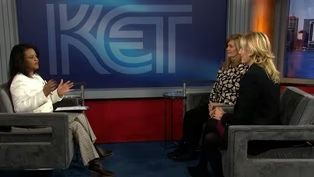
It's been called a roadmap to increase Jobs and improve quality of life in nine central Kentucky counties.
Commerce Lexington, a local chamber of commerce organization, has coalesced a brain trust of public and private sector leaders to come up with key initiatives and approaches to grow the economy and lift up communities.
I talked with leaders with Commerce Lexington last week about the regional Competitiveness plan that is centered around three main pillars economic development, workforce and policy.
More in tonight's Business Beat segment.
Andy Johnson, who was chief policy officer and director of regional engagement for Commerce, Lexington.
And General Greathouse, who was Commerce Lexington's executive vice president of economic development.
Thank you, ladies, for being with us.
>> Thanks for having us.
>> So I know this is your jam economic development.
Let's talk about regional collaboration, which has been an emphasis of the Commerce Lexington for a long time.
But now you have this new 2025 Regional Competitiveness Plan.
How is this different than previous iterations and what are the main goals of it?
>> Well, we have been working together regionally for a long time.
Jen and her team, the economic development professionals in the region, have been working regionally for over 30 years.
Really, since Toyota has been in the region, we've been focused on through the chambers of commerce, through leadership development, public policy, economic development, really just trying to figure out how we can leverage our advantages together to attract more jobs and people to the region.
But what we started noticing, really, you know, around the time of the pandemic, is that the cities and the regions with the most momentum that were attracting jobs and attracting people were really thinking about regionalism on an elevated level.
They were having intentional plans to market themselves as a region to better compete for those people and jobs.
So three years ago, we did a strategic planning process.
We brought together leaders from all nine counties.
So our nine county economic development region includes Fayette County and the surrounding counties that touch us, including Franklin and Montgomery.
And so we worked through a process to look at our strengths and our challenges, our weaknesses.
What did what did we want to be in five years from now?
And we came up with a strategic, intentional plan.
It's the first time we've really put a plan on paper to say, what are some things that, if we work on these things together, could be mutually beneficial for all communities?
When it came to attracting jobs and people?
And that is the regional competitiveness plan.
It's a five year plan for about halfway through it now, and we've really seen some success in what we've been doing to just get more awareness of this nine county region as a place to live and to work.
>> Well, if we think about what Lexington is, which is more of an urban center, as opposed to maybe Montgomery County or the other counties that can be more rural, are there different considerations based on the populations and what those populations represent?
>> So what we're finding is that we are more successful in terms of attracting people and jobs if we market our assets as a unit.
So when you look at the region as a whole, we've got more housing opportunities, more job sites, more educational opportunities, more quality of place.
We're stronger when we message all of those assets together than if we each individually try to tell our story.
So some people may be looking for a more rural environment.
Some people may may be more looking for that downtown urban feel.
So if we market those assets together, we're giving people more options and we're more attractive to more people.
>> Yeah.
So what does this mean for you, Jenna, and someone who's been doing a lot of job recruitment and company recruitment for, what, 30 years now?
At least?
>> At least.
At least.
>> Yeah.
What do you hope to get from this and what kind of industries or key sectors of our economy do you really think you can recruit?
>> We're focusing.
So we have a focus for Fayette County and the surrounding counties on growing our biotech industry, advanced manufacturing, business and professional services, marketing, logistics, and IT.
And so right now, after the third year, we third or two and a half.
>> This is what we're starting the third year.
So we finished two.
>> After two years.
We've seen our biotech industry jobs grow 52%.
So I think that's very impressive given the quality of the companies that are here and that are growing and expanding.
And now we're participating in quite a few events and educational summits where we're out meeting with consultants, learning from what the trends are, what we need to be doing to be a better region for biotech, advanced manufacturing.
And it's working.
So this year, our team touched 135 consultants.
Some of them were multiple touches at different events, but we're there telling them what greater Lex and Lex can be.
>> Well, and look at the all of the higher ed institutions you have right in this area that can really build the case for you've got a natural talent pipeline.
Is that part of the recruitment pitch?
>> Yes, that's part of the recruitment pitch.
There's ten colleges and universities within about a 30 mile radius.
And interestingly enough, we did some research last week.
There's actually 26 colleges of engineering within 200 mile radius.
So we're able to go out there and promote.
We want you to get our students from the University of Kentucky.
But if we can't find as many as you need, let's talk to the colleges and universities within 200 mile radius.
>> Yes.
And so I'm sure they're loving that in order for them to recruit those prospects into to their universities, well, what's the path to get there?
Right.
When you talk about a strategic plan, it's sometimes it's easier to put those goals on paper than it is to get there.
And even to know like that, you're doing it right.
So what's the path, Andy?
>> So at a high level, the the strategy is about trying to increase the workforce here in the nine county region for all of the communities in the region to increase jobs and our GDP and our wages.
Those are those high level benchmarks that we're watching year over year to see if they're moving in the right direction.
But at a tactical level, the regional leaders identified seven specific action items that they felt if we worked on these things as a region, we could really see momentum in, every community could benefit.
And so we break those into three buckets.
So one area is talent attraction and retention.
And so for the first time ever, we have created a regional brand, a new talent attraction website.
Look at com that really provides a digital entry point into the nine county region.
It's a one stop shop for live work, play resources so that anybody that's thinking about Greater Lex as a place to live or work can find information in one place.
So if you're a student or you're alumni or you're a visitor, we want you to look there.
And so the first phase of this is a digital marketing campaign to get more eyeballs on the website.
And so we've started with warm audiences.
And what that means is we're targeting visitors that have come to the region or are thinking about visiting the region.
Students.
Alumni of the ten colleges and universities serving them, with content about Greater Lex as a place to live and work, with hopes of keeping them here or attracting them back home.
Because what we found is that through the data that people just do not know about the job opportunities in the greater Lex region, they do know about quality of place.
Our tourism partners have done an excellent job of sharing that message, but we really just need to lean in to both of those assets because we've got a tremendous story and message to share.
Just more people need to know about it.
>> Yeah.
Anything you want to add on that, Jenna?
>> Yeah, I mean, we're doing we've redone our website.
So if you go to locate in lex.com, it pairs very well with look at Lex.
We have elevated our website in addition to our marketing.
So right now what we're doing is spending our time and focus on more digital marketing.
So we started in in March and as of December 9th which was yesterday, we have 29 million impressions.
Wow.
Between all three different arms that were going through LinkedIn, social media and others.
And it's serving a much different audience.
So we're targeting C-suite decision makers.
So we will use will geofence a conference and get the data from the people who are there and then serve them a unique group of ads and advertisements.
And they're very unique and fun.
So, yeah, so we're doing it a little different.
Our talent team is looking at to bring people here.
We're looking to bring businesses here.
But it all ties together.
>> Yeah.
>> And we just finished the first year of the the talent attraction, the digital campaign.
And so over 14 million impressions hitting those warm audiences, 6 million unique people have received an ad about the Great Lakes region.
And that's resulted in over 60,000 people visiting the Greater Lex website.
The look@lex.com.
And so the next phase is trying to learn more about those 60,000 people that have been on the site to try to to translate them into potentially moving or relocating.
>> It's all about the conversion, the conversion, the conversion.
That's the result.
It's to get those impressions, to get to actually people who are moving and doing the action you want them to do.
So what does success look like when you look at the end of the five years or even ten years down the road?
Like, how do you know that you've done it right?
>> You want to.
>> Go, you go ahead.
Okay.
>> Like I said before, for us, it's we want to increase the jobs that are coming here in those in all those sectors.
So biotech was by far the largest.
And even when you go all the way down to the others, they're all over 20% increase in the number of jobs.
Success for me would be let's see another biotech company locate in our region.
So whether it's Lexington or Clark County or Frankfort Kentucky, we would love to see growth in those in that market there.
>> Yeah, yeah.
What does it look like for you?
>> I think success, of course, those big metrics are we helping grow our workforce, the right kind of workers that meet our industry needs?
Are we growing jobs?
Are we raising awareness about this region as a place to live and work through those marketing metrics?
I think the other piece we haven't talked about is just the internal collaboration of what we've seen.
This effort is supported 2 to 1 business to government, over $1 million investment in the private sector behind this type of united marketing initiative.
But we've also got investment from our local governments within the nine county region.
And so that's been tremendous to see those leaders come to the table and see value in marketing ourselves as a unit, as opposed to each individual community and looking beyond those county lines, because that's really how businesses and people see us.
They see us as a region, not necessarily individual communities.
So just continuing to have that level of collaboration internally within the region is also something that I think would be a metric of success.
>> Yeah.
Well, thank you so much, Andy Johnson and Jenna Greathouse.
It's good to have both of you.
Thanks so much.
Thank you.
Continue to better together.
>> That's our mantra.
>> Better together.
That's it.
>> That's it.
We're better together.
>> That's a good one.
Thank you ladies.
Thank you.
And health related news.
Respite care provides short term relief for primary caregivers, which can give them time to recharge and take care of themselves.
In Northern Kentucky, one organization provides financial support to make respite care possible.
Our Emily Sisk stopped by the Area Development District's annual caregiver appreciation event to learn more about the program.
>> Kathy Nafus is the caregiver for her sister, who has a disability and her 94 year old mother.
>> My mom is not supposed to be alone.
She has mobility issues and so you can't just go away and leave her without somebody to look in on her.
>> Nafas has help from other family members, but she takes care of grocery shopping, laundry, doctor's appointments, and more for her mother and sister.
>> You almost have to schedule the self-care in order to get what you need.
And I have two other sisters that help, and with three of us trying to take care of two people, it's very stressful.
>> And Shirley Hudgins, who also lives in Northern Kentucky, cares for her husband, who has Parkinson's.
>> Every day we, you know, work on trying to keep him from falling.
That's the biggest thing.
I'm very fortunate that, you know, I don't have any ailments of my own.
>> So what resources are available to help caregivers like these women?
The Northern Kentucky Area Development District is one example.
They participate in the National Family Caregiver Support Program.
Through this program, caregivers can find another family member or friend to provide respite care.
Then that individual can receive pay for up to 16 hours a month.
>> That gives me freedom to do what I want to do.
And then the friend will fill out a little time sheet and mail it in, and they get paid a certain amount.
For helping out.
>> For Shirley Hudgins and her husband, they chose to get help from a family member.
>> At this point, my husband only allows my granddaughter to come and do that.
He's comfortable with her.
>> Heather Hardin, who manages the caregiver programs for the Area Development District, said it can be difficult for caregivers to find time for themselves.
Having an additional family member or friend to step in, even for a few hours can be a big relief.
>> Often they don't want to leave their loved one alone and go do something that they want to do.
They're not going to be able to continue caregiving for their loved ones if they are burnt out, unhappy, depressed, just worn and broken down.
We got to make sure they're taking their breaks, and when they take their breaks, they're doing something they like to do, or at least benefiting them in some way, whether it's going to the doctors or grocery store.
If they like to do it, let them do it.
>> Sometimes it's just going shopping by myself, just to have time to look around and do what I want to do without having to hurry back for a doctor's appointment or something.
>> As long as I, you know, have some outlets where I can go out with friends or, you know, go play cards or go to a meeting or something that gets me through the week, you know?
>> Hardin said as time goes on, resources like respite care are becoming more and more essential.
>> Our population is increasing with older adults, and it's just going to be more of a common occurrence, is everyone's going to either be caring for somebody at some time.
We're all going to need more caregivers, whether they're family, caregivers or professional.
We're all going to need more.
>> While this respite care program only provides pay for 16 hours a month, many caregivers like Cathy Nafas rely on that break.
>> You'll take anything you can get.
>> For KET.
I'm Emily Sisk.
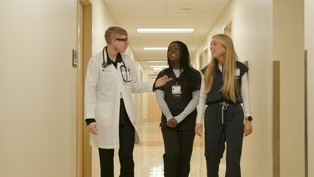
>> Students from high schools in central Kentucky can explore careers in the medical field at the University of Kentucky.
UK Careers in Health Care Internship program allows students to spend time with clinical teams all year round.
>> So what we've realized is that students know they want a career in health care, but they're not necessarily sure what exactly what they want to do.
So this is all about early career exploration, helping them to know what they enjoy, maybe what they don't enjoy, and just to explore their their interests and to find out the myriad of professional opportunities that are out there.
>> We have a variety of rotations every semester.
Sometimes you have a physician or I've had nurses, nurse practitioners, but all areas of the field, and essentially they will just take you through their day and you get to just shadow and look and see what being in that field is like.
Working in that area of medicine is like, and how they operate in their career.
>> I started in the cardiovascular ICU.
I followed a PT around there.
She was amazing.
She kind of explained to me how it all works applying to PT school what her regular day looks like.
I also followed outpatient PT, and that was a really cool opportunity to see what a slower PT environment works like compared to the ICU, where it's more critical wire management outpatient is more getting to know the person you form a relationship, and it was just really cool to be able to understand now as a high school student, what that looks like.
>> There's so many interdisciplinary needs, so many different kind of facets for students to be exposed of, and this is an outstanding opportunity for young individuals to to see the way healthcare is expanding for the future as well, and how many options they have to exercise, any interest they have within healthcare itself.
>> One of the most interesting things that I think was unintended or unexpected, I guess I should say, were the soft skills the students are learning from watching professionals interact with our patients.
They're learning just how to speak to a patient.
They're learning the importance of listening and empathy and encouragement.
>> My most favorite rotation has definitely been outpatient psychiatry.
The reason being is I've known for a while that I wanted to be a clinical psychiatrist, and doing this internship and being able to experience what the career is like during that rotation just really reaffirmed how much I can see myself in that career.
>> It's really cool to be able to kind of experience what those healthcare workers.
I mean, I'm getting on the bus with nurses from ages 20 to 60, and it's just like, kind of cool to see what their day looks like being UK such a more fulfilling place than sitting in a classroom.
And I think it's such a more important way for people to learn.
And I think that's just as valuable as money.
>> This is long overdue for the state of Kentucky, and I think the exposure for high school students to look at the demands of healthcare and the needs for healthcare is an untapped resource that will really.
Help fill a void for healthcare in Kentucky.
>> Ten students participate in the program twice a week.
Officials hope to recruit ten more students next school year.
Now this is Sidney Newton, the English, the English language arts teacher at Taylor County High School, is the only Kentuckian to be recognized with this year's Milken Education Award.
More about her and today's surprise announcement tomorrow on Kentucky Edition.
You don't want to miss that story and much more.
We may be far from those Broadway lights, but there are still some shining stars on a small Kentucky stage.
>> We try to give everybody an opportunity.
It's like, hey, you know, be on a stage.
You want to play a great role.
You want to hear that applause from the audience.
>> Watch Christmas Time.
>> Tomorrow on Kentucky Edition.
How a community theater group has entertained audiences for two decades in a historic venue in downtown Glasgow.
Got a lot of good stories to share with you tomorrow night at 630 eastern, 530 Central on Kentucky Edition, where we inform, connect and inspire.
We hope that you'll connect with us all the ways you see on your screen through the social media channels you see.
Facebook, Instagram and X. And we always encourage you to send us a story idea by email to Public Affairs at ket.org, and look for us on the PBS app that you can download on your phone and other smart devices.
Thank you so much for being with us tonight.
I'm Renee Shaw and I look forward to seeing you right back here again tomorrow night.
Take really good care.
Central Kentucky's Regional Competitiveness Plan
Video has Closed Captions
Clip: S4 Ep122 | 11m 2s | Commerce Lexington is spearheading a brain trust of public and private sector leaders. (11m 2s)
Giving Students a Peak Into the Medical Field
Video has Closed Captions
Clip: S4 Ep122 | 3m 14s | A UK internship program allows students to spend time with clinical teams all year. (3m 14s)
Providing Support for PBS.org
Learn Moreabout PBS online sponsorship
- News and Public Affairs

Top journalists deliver compelling original analysis of the hour's headlines.

- News and Public Affairs

FRONTLINE is investigative journalism that questions, explains and changes our world.












Support for PBS provided by:
Kentucky Edition is a local public television program presented by KET