
December 19, 2023 - PBS NewsHour full episode
12/19/2023 | 57m 46sVideo has Closed Captions
December 19, 2023 - PBS NewsHour full episode
December 19, 2023 - PBS NewsHour full episode
Problems playing video? | Closed Captioning Feedback
Problems playing video? | Closed Captioning Feedback
Major corporate funding for the PBS News Hour is provided by BDO, BNSF, Consumer Cellular, American Cruise Lines, and Raymond James. Funding for the PBS NewsHour Weekend is provided by...
Support provided by:

December 19, 2023 - PBS NewsHour full episode
12/19/2023 | 57m 46sVideo has Closed Captions
December 19, 2023 - PBS NewsHour full episode
Problems playing video? | Closed Captioning Feedback
How to Watch PBS News Hour
PBS News Hour is available to stream on pbs.org and the free PBS App, available on iPhone, Apple TV, Android TV, Android smartphones, Amazon Fire TV, Amazon Fire Tablet, Roku, Samsung Smart TV, and Vizio.
Providing Support for PBS.org
Learn Moreabout PBS online sponsorshipGEOFF BENNETT: Good evening.
I'm Geoff Bennett.
Amna Nawaz is away.
On the "NewsHour" tonight: The Israel-Hamas war spills over into the Red Sea, where Houthi rebels are attacking commercial ships and disrupting global trade.
Immigrant rights groups sue over a new Texas law that empowers local police to arrest people suspected of entering the U.S. illegally.
Will the measure hold up in court?
And Ukraine races to shore up its power systems in anticipation of Russian attacks on the energy grid in the heart of winter.
OLEKSANDR, Power Plant Shift Manager (through translator): We are preparing physically.
We are preparing equipment.
We are preparing mentally.
It's scary.
Of course, it's scary.
But electricity is the lifeblood of the economy.
We have to maintain it.
(BREAK) GEOFF BENNETT: Welcome to the "NewsHour."
Israel's campaign in Gaza continues tonight with deadly effect, as diplomats work to secure another deal to pause fighting to release hostages held by Hamas in return for Palestinian detainees in Israeli custody.
Meantime, an attempt at the United Nations to secure even a vote in the Security Council on a cease-fire was delayed at least one more day.
William Brangham reports.
WILLIAM BRANGHAM: Rafah, the very area where Israel told displaced Palestinians to seek shelter, has become a battle zone.
MOHAMMED ABU ZURUB, Gaza City Resident (through translator): We have never seen such weapons.
I witnessed the 1956 war, and there was not anything like this.
I witnessed the 1967 war, and there was not something like this.
This is a barbarian act.
Israel is the biggest criminal.
WILLIAM BRANGHAM: Excavators comb through the rubble of what was once a home.
It was flattened by Israeli airstrikes overnight.
Some two dozen people died, including a newborn baby and her 2-year-old brother.
Their injured father, in a hospital bed, grieves his dead children.
MOHAMMED ZOUGHROUB, Gaza City Resident (through translator): We were sleeping.
We were buried while sleeping.
WILLIAM BRANGHAM: Relatives preparing to bury the dead prayed over their shrouded bodies.
Sarah Kraeem lost her sister in the strike.
SARAH KRAEEM, Gaza City Resident (through translator): My feeling is indescribable.
Imagine that, yesterday, I was combing her hair and making her a sandwich for dinner, then tucking her into sleep.
We woke up in the morning, and there is no Fatima.
Fatima is gone.
WILLIAM BRANGHAM: Tens of thousands of Palestinians have packed into Rafah to escape the intense bombing farther north.
But Southern Gaza has repeatedly come under attack in recent days.
Israel insists it's going after just militant targets.
In Central Gaza, scenes of chaos after a bombing at Nuseirat refugee camp.
Locals rushed to help the wounded, as health workers carried the dead away in body bags, a boy, barefoot and bewildered, pulled from the rubble and carried away.
ABO AYMAN ABO EL-GHOSS, Gaza City Resident (through translator): I was in my store, and the kids around me were playing.
People were coming and going, and they were having a good time.
And then this aggressive bombing came.
I don't know what they think we have in our houses for us to deserve all this bombing.
This is enough.
Enough of the bombing of children and women and displacing people from their homes.
WILLIAM BRANGHAM: Fierce battles also raged for another day in the north.
Israeli forces raided Al-Ahli Baptist Hospital in Gaza City overnight, one of the last functioning hospitals in Northern Gaza.
They detained most of the hospitals staff, leaving only two doctors and four nurses to tend to over a hundred seriously injured patients, all without water and electricity.
In Geneva, World Health Organization officials denounced recent Israeli strikes on hospitals.
DR. MARGARET HARRIS, World Health Organization: The people in the hospitals, yes, they need everything.
They need medical supplies, but what they ask for first is food and water, the very basics.
They do not have them.
One of my colleagues described people lying on the floor in severe pain, in agony, but they weren't asking for pain relief.
They were asking for water.
But it's beyond belief that the world is allowing this to continue.
WILLIAM BRANGHAM: Meanwhile, scores of hostages are still being held by Hamas in Gaza.
Israeli President Isaac Herzog said he hopes more will be released soon.
ISAAC HERZOG, Israeli President: Israel is ready for another humanitarian pause and additional humanitarian aid in order to enable the release of hostages.
And the responsibility lies fully with Sinwar and the leadership of Hamas.
WILLIAM BRANGHAM: But Hamas has insisted it won't comply until there is a cease-fire.
Meantime, the armed wing of the Palestinian Islamic Jihad movement, known as the Al-Quds Brigades posted video on their Telegram account showing two Israeli hostages, seen here in a screenshot, pleading for their release.
All this comes as tensions are intensifying in the broader region.
Yemen's Houthi rebels, backed by Iran, have attacked a string of commercial ships in the Red Sea with missiles and drones.
The strikes have prompted some of the world's largest shipping and oil companies to reroute to avoid the Suez Canal.
U.S. Defense Secretary Lloyd Austin, who was in Qatar today, said the U.S. and it's allies have formed an international coalition to respond to the Houthi attacks.
For the "PBS NewsHour," I'm William Brangham.
GEOFF BENNETT: In the day's other headlines: Senate leaders say they don't expect a deal on financial aid for Ukraine and tougher border security until after the holiday break.
Negotiations continued, with the White House warning that current aid for Ukraine will run out at the year's end.
But Republicans are pressing for border policy changes, and that remains the sticking point.
SEN. MITCH MCCONNELL (R-KY): No question, this package is extremely important.
The most complicated part of it actually is the border.
I think we haven't passed a significant immigration bill since Reagan's second term.
And so this is not easy.
SEN. CHUCK SCHUMER (D-NY): Both Democrats and Republicans understand that there's more work to do to pass legislation protecting America's security and the security of the Western world.
GEOFF BENNETT: Meantime, in Kyiv, Ukraine's President Zelenskyy said he is confident the U.S. will not let his country down.
He also said he's considering whether to mobilize half-a-million more troops, on top of the 800,000 already fighting.
In Northwestern China, an overnight earthquake shook rural Gansu province, killing at least 127 people.
It was the country's deadliest quake in nearly a decade.
State television showed crews searching the wreckage of destroyed homes.
Landslides had buried some of them in several feet of mud.
Thousands of people were left to shelter in tents in subfreezing conditions.
Bushfires in Australia made the air quality in Sydney among the worst in the world today, a rarity in the famed harbor city.
Smoke drifted in from fires burning in a forest some 260 miles to the north.
The burn was so large, it created its own thunderstorm, but firefighters said winds could help dispel the smog over Sydney this evening.
The U.S. Forest Service is calling for cuts in logging to conserve old-growth forests in the face of climate change.
The proposal today would sharply limit harvesting older trees.
The agency says they store large amounts of carbon and provide crucial habitat for wildlife.
Timber interests say the change will increase fire dangers for communities near forests.
Family and friends of the late Sandra Day O'Connor paid final tributes today at her funeral at the Washington National Cathedral.
Beneath the vaulted ceilings, President Biden eulogized the first woman on the Supreme Court as a pioneer in her own right.
Chief Justice John Roberts and one of O'Connor's sons paid tribute to her public and private legacies.
JOHN ROBERTS, Chief Justice of the U.S. Supreme Court: Her leadership shaped the legal profession, making it obvious that judges are both women and men.
The time when women were not on the bench seems so far away because Justice O'Connor was so good when she was on the bench.
JAY O'CONNOR, Son of Sandra Day O'Connor: Don't hit your brother was the first lesson in her own philosophy that she taught us over time, to not lash out at anyone, even your opponent, and to treat everyone with kindness and respect.
This approach allowed her to navigate every situation with grace and goodwill.
GEOFF BENNETT: O'Connor died on December 1 in Phoenix.
She was 93 years old.
Google will pay $700 million to the states to settle allegations that it's android App Store stifles competition.
Federal court documents say the deal was reached in September.
Most of the money goes to compensate about 100 million customers.
Just a week ago, Google lost a similar case that went to trial.
And on Wall Street, stocks advanced after Japan's Central Bank opted to keep interest rates low.
The Dow Jones industrial average gained 252 points to close at 37578.
The Nasdaq rose 98 points.
The S&P 500 added 27.
Still to come on the "NewsHour": an entire town in Iceland is threatened by an erupting volcano; how media organizations are facing the task of covering former President Trump; and the first handwritten and illustrated Bible since the printing press celebrates its 25th anniversary.
We return now to the conflict in the Middle East, and rising tensions in the Red Sea, where about 12 percent of the world's global trade passes through and where Houthi militias in Yemen have been attacking ships.
The Houthis say their attacks are in support of the Palestinians.
Yesterday, U.S. Defense Secretary Austin announced a new multinational effort to protect ships in the region.
But what how will it work?
For that, we turn to the former commander of U.S. forces in the Middle East retired General Frank McKenzie.
He's now the executive director of the Global and National Security Institute at the University of South Florida.
Thanks for being with us, sir.
And help our audience understand first, who are the Houthis and why exactly are they attacking commercial ships?
GEN. FRANK MCKENZIE (RET.
), Former Commander, U.S. Central Command: The Houthis are a proxy of Iran, and they seized government control in a coup in Yemen several years ago.
They have been largely responsible for the mass starvation in the country.
And, with Iran, they pursue a policy for the destruction of Israel.
They're not completely under the direct control of Iran, but Iran provides their equipment, provides their resourcing and all their supplies.
But they're not directly at the beck and call of Iran in this matter.
The Houthis have wanted to attack Israel.
It's very hard for them to range Israel proper.
So, they have settled on instead trying to cut off communication of maritime shipping in the Bab-el-Mandeb area, down at the southern end of the Red Sea.
GEOFF BENNETT: And, as we mentioned, the U.S. announced this creation of this multinational task force to protect commercial traffic through the Red Sea.
How exactly will that work?
And, in your estimation, will it be enough to deter future attacks?
GEN. FRANK MCKENZIE: The ships will be important.
We will provide ships.
Our friends and partners will provide ships.
And those warships that will be out there shepherding the merchant vessels through will be very important.
But what will be equally important will be the intelligence architecture that we put over the Bab-el-Mandeb.
You need to see what's going on.
You do that through manned patrol aircraft, unmanned aircraft, drones, all kinds of other intelligence gathering systems to actually see what the Houthis are up to.
And this also has another effect we know from many years of dealing with Iran.
They don't like to be observed.
It can have a deterring effect.
In 2019, our heavy use of ISR, intelligence, surveillance, and reconnaissance, assets around the Strait of Hormuz prevented the Iranians from carrying out nefarious attacks.
May or may not be enough with the Houthis.
They tend to be very aggressive.
I think at some point we're probably going to have to consider striking some of these Houthi launch sites, command-and-control posts, radar outposts, those things that make their attacks possible.
The Houthis will respect that.
They will understand.
And, frankly, I think the odds of an escalatory spiral coming from a self-defense strike down in Yemen, those odds are very small.
GEOFF BENNETT: BP is now the latest company to announce it's going to be pausing shipments through the Red Sea.
As we mentioned, with so much global trade going through that area, what does that mean for the future of big business?
GEN. FRANK MCKENZIE: Well, I think if we're unable to reestablish and reassert the right of free passage here and keep the Houthis from making these attacks, everything's going to slow down.
It's 14 more days to go around Africa to come up either east or west.
And that will tend to exert greater pressure on the market, probably the energy market first, but other markets as well.
So it's in everyone's interest.
Every nation that moves on the global commons actually has an interest in ensuring that the Bab-el-Mandeb is going to be open for the right of free passage of ships.
GEOFF BENNETT: As you mentioned, the Houthis are an Iranian proxy.
What does all of this suggest about the potential for Israel's war against Hamas to escalate into a wider regional conflict?
GEN. FRANK MCKENZIE: So, I think the odds of the escalation beyond Gaza are actually fairly small right now.
Lebanese Hezbollah has not chosen to enter the fray, despite the fact they're exchanging low levels of fire with Israel on its northern border.
Iran has not chosen to directly attack Israel.
Those are important things that have perhaps been overlooked.
Hamas is not getting a lot of support from those two entities.
Now, the Houthis are.
But, again, as I said, the Houthis have limited ability actually to strike Israel.
They're reduced to carrying out attacks down around the Bab-el-Mandeb, and they are doing that.
But I believe that's a problem we can solve.
We may need to be a little more aggressive about it than we have been today, but I believe that's a solvable problem.
But the larger issue is, I don't think it leads to escalation.
GEOFF BENNETT: Retired General Frank McKenzie, thanks, as always, for your insights.
GEN. FRANK MCKENZIE: Thank you.
GEOFF BENNETT: With migrant encounters along the Southwest border at near record numbers, both Democrats and Republicans agree something needs to be done to fix the U.S. immigration system.
A bipartisan group in the Senate continues to negotiate on a border security bill, while border state governors are grappling with the on-the-ground impact.
Last week, Arizona's Democratic Governor Katie Hobbs dispatched the National Guard to the border.
And, yesterday, Texas Republican Governor Greg Abbott signed a controversial new law aimed at curbing illegal immigration.
That, as Stephanie Sy explains, will likely set up a battle with the federal government.
STEPHANIE SY: The new Texas law makes it a state crime to illegally cross the border from Mexico into Texas.
Offenders could face up to six months in jail, but state judges can also drop the charges if a migrant agrees to return to the country they entered from.
While the Biden administration has implemented policies to beef up personnel on the border and expedite removals, Governor Abbott believes it hasn't done enough.
GOV.
GREG ABBOTT (R-TX): Biden's deliberate inaction has left Texas to fend for itself.
STEPHANIE SY: In the past, courts have ruled that only the federal government has the right to enforce immigration laws.
The American Civil Liberties Union and the Texas Civil Rights Project have already filed a lawsuit challenging the law.
Texas Republican State Representative David Spiller sponsored this bill and joins us now.
Representative, thank you so much for your time.
A lot of legal experts are saying this law is unconstitutional.
A group of 30 former immigration judges, in fact, issued a statement recently saying that the legislation would -- quote -- "allow a state court magistrate judge to issue a removal order.
That is not lawful.
Immigration is plainly a federal function."
Sir, they question the point of this law.
And I guess I have the same question.
STATE REP. DAVID SPILLER (R-TX): Well, the point of the law is, the law has become necessary because the Biden administration has failed and refused to secure our border and enforce federal immigration law.
That's the purpose of the bill.
Were it not for that, we wouldn't be dealing with this.
I would be dealing with other issues and I wouldn't be spending my time dealing with securing our border and dealing with immigration law.
But because of that failure, then Texans have to protect Texas.
And that's what S.B.4 does.
And I believe -- I respectfully disagree with what some of these so-called experts say.
I believe it's completely constitutional for several reasons.
STEPHANIE SY: What makes you say it's constitutional, given that the last time the Supreme Court looked at this was in the Arizona v. U.S. case, in which they struck down most of Arizona's argument that local law enforcement can enforce immigration law?
STATE REP. DAVID SPILLER: Well, that's a fair question.
S.B.4 is what we have passed here in Texas.
I believe it is constitutional for several reasons.
First, it's not in conflict with that Arizona v. U.S. case.
The things that Arizona tried to do in 2010 that's the subject of that case were completely different than what we have done here.
We have tried to stay away from those problem areas.
And the problem areas that Arizona dealt with were areas that had already been preempted.
So, we have stayed away from that.
We're also not preempted in here federal law, because, again, preemption is kind of a tricky process.
But preemption -- the presumption under the Arizona case is that something is not preempted unless the burden of proof can be met to show that it is.
And so we have stayed away from those areas that have been preempted.
STEPHANIE SY: Some would say that the Texas law actually goes beyond Arizona's law, because, in the Arizona case, those that were apprehended would be turned over to federal authorities.
Critics of this law say that what you're establishing in Texas is your own deportation system, that you're giving magistrates, Texas magistrates, the authority to deport potentially asylum seekers.
STATE REP. DAVID SPILLER: We're not.
First of all, there's a distinction.
We're not deporting anyone.
We're ordering them to return.
And it's not unfair to ask someone to go back to where they came from if they got here illegally.
And so there's a distinction there.
And I think there's a legal distinction.
We're not getting into deportation.
Actually, if you look at the U.S. Constitution, the word immigration and giving Congress the authority to regulate immigration is not in there.
You can look long and hard.
It talks about naturalization, but it doesn't talk about immigration, two different things entirely.
So I believe that we have the ability to do that.
STEPHANIE SY: How does a local or state policeman practically enforce this law?
If it's not a "show me your papers" kind of enforcement, how will they know who to apprehend, unless they are literally seen crossing the border illegally?
STATE REP. DAVID SPILLER: Well, I think most of them will be literally seeing crossing the border illegally.
I think -- I believe and I have said that I thought that 95 percent of the enforcement for illegal entry will occur within 50 miles of the border.
That's not to say that people in Texarkana or Dallas or Houston or up in the Panhandle may not -- there may be circumstances where they can ascertain or law enforcement can determine that they have crossed illegally, where they somehow know who crossed, when they crossed, where they crossed.
And bear in mind, it's a misdemeanor.
The statute of limitation for all misdemeanors in Texas is two years.
So we're not looking at rounding people up, what Arizona tried to do, rounding people up that have been here for years.
We're not looking to put someone's grandmother in jail or deport her that's been here for 50 years.
That's not what S.B.4 does.
STEPHANIE SY: Critics say this law is going to mean anyone that looks Latino or Black has a higher risk of being accosted by law enforcement.
How are you going to address that concern, especially given that 40 percent of your state is Latino?
STATE REP. DAVID SPILLER: Well, I think that shows how silly that argument is, quite frankly.
And, quite frankly, it's offensive.
How can you -- we are a country of immigrants.
How can you tell by looking at anyone whether they crossed here illegally or when they did so or where they crossed?
You can't.
And law enforcement can't determine that.
There are things that law enforcement can determine.
But there are things that not -- so what Arizona did was, show me your papers.
There's no requirement to show any papers whatsoever.
The question is, can the law enforcement officer prove and prosecutors prove beyond a reasonable doubt that each and every element of that offense for illegal entry has been proven?
And, if so, fine, they can be prosecuted for that.
But, otherwise, there is no probable cause to believe that someone just, because they may look different or -- the other thing is, we're getting people, I mean, crossing illegally into Texas from over 100 countries around the world.
This is not about Hispanic people.
It's not about Black people.
It's about people entering our country illegally.
And we are trying to do our best to address the problem.
And we're having to address the problem because the federal government refuses to do so.
STEPHANIE SY: Representative David Spiller, thank you so much for joining the "NewsHour."
STATE REP. DAVID SPILLER: Stephanie, thank you for having me.
I appreciate it.
GEOFF BENNETT: Iceland appears to have so far escaped the worst-case scenario after a volcano erupted overnight about 50 miles from the capital, Reykjavik.
The lava flow is moving away from important infrastructure, including a fishing port where 4,000 people had been moved waiting for just this moment.
Special correspondent Malcolm Brabant has the story.
MALCOLM BRABANT: After two months of intense earthquakes southwest of Iceland's capital, the volcano finally erupted.
This Webcam captured the moment, but not the roar of Mother Nature, as molten rock lit up the night sky.
Once the earth's crust had been breached, the lava flow quickly spread along three miles of fissures that had been formed by thousands of earthquakes.
As scientists had predicted and hoped, the eruptions took place north of a small fishing town called Grindavik, abandoned by its 4,000 residents in October, when the their homes were first threatened.
The Icelandic authorities dispatched a helicopter crew to assess the potential damage.
They were concerned that the rivers of lava might jeopardize a geothermal power station and the world-famous Blue Lagoon thermal baths.
On the ground, police officer Thorir Thorsteinsson was working to enforce the exclusion zone.
THORIR THORSTEINSSON, Grindavik, Iceland, Police Officer: We're clearing the town and the area, and now we're just securing the area and closing every road to the area.
Then we're just trying to manage the situation here.
MALCOLM BRABANT: Some thrill seekers managed to get close to the action, among them, American tourist Robert Forrester.
ROBERT FORRESTER, Tourist: I'm very excited to be here in this place.
And this is just fascinating to see just nature in action.
I just -- it's just like something from a movie.
MALCOLM BRABANT: But the first concerns of French tour guide Ael Kermarec were for the people worried about losing their homes.
AEL KERMAREC, Tour Guide: The town involved, which might end up under the under the lava that is flowing behind us, so, yes, that's kind of mixed feelings.
It's still amazing to see, but that's kind of a bittersweet feeling at the moment.
MALCOLM BRABANT: As night gave way to day, the eruptions above Grindavik had diminished by two-thirds.
RIKKE PEDERSEN, Iceland University: The location of this erupting fissure is optimal.
If we were absolutely to have an eruption within this volcanic system, it is quite favorable towards being as far from infrastructure as possible.
MALCOLM BRABANT: Rikke Pedersen leads the Nordic Volcanological Center at the University of Iceland.
So do you think this is it?
Is this as bad as it's going to get?
RIKKE PEDERSEN: Well, that is very difficult to say.
This is the typical behavior of a fissure eruption.
It starts quite vigorously, and it also often has an exponential decay.
But the extent, the duration of it, we can't say anything about.
It doesn't mean that it's over in two days.
It could be, but it can also continue with low effusion rates for weeks to months.
It's simply not possible to say.
MALCOLM BRABANT: What about the threat to the geothermal power station and also to the Blue Lagoon?
RIKKE PEDERSEN: So, both the Blue Lagoon and the geothermal power plant has now been fenced off with some big dikes.
So that's been constructed during these 40 days that we have had since the first dike was intruded.
MALCOLM BRABANT: Compared to other eruptions around the world, this is pretty small.
But I had a question for professor Dougal Jerram, a volcanologist at Oslo University.
Is this particular volcano likely to kick-start other ones within the chain in Iceland?
DOUGAL JERRAM, Oslo University: That's not necessarily the case.
One of the great things about Iceland is it's very well monitored.
And one of the reasons why we have been able to sort of focus in on this region, they have been able to successfully evacuate people and minimize all the risks associated with the eruption is because Iceland monitors the ground very, very well.
So they would be looking at a number of different places in Iceland where they have good seismic ground monitoring and also satellite data which monitors whether the ground is kind of expanding or contracting.
So any changes in the volcanic system, they should be able to pick up.
MALCOLM BRABANT: The people watching most keenly of all are the people of Grindavik.
They will be hoping that the volcano goes back to sleep, so they can return to their homes.
For the "PBS NewsHour," I'm Malcolm Brabant.
GEOFF BENNETT: Responding to a reporters question, Ukrainian President Zelenskyy dismissed the idea that Ukraine might lose the war to Russia.
But his country is waiting on more support from the U.S. and the European Union, and that aid is crucial for Ukraine's air defense, which is becoming more important as Russia begins what appears to be another winter-long campaign of strikes on Ukraine's infrastructure.
Nick Schifrin and Eric O'Connor report from Central Ukraine.
NICK SCHIFRIN: It was the winter of Ukraine's disconnect.
A Russian campaign targeted Ukraine's critical infrastructure and left this power plant burned out and gutted.
Russia hoped to engineer a humanitarian crisis and sap Ukraine's will to fight.
It failed.
But attacks on this plant alone left more than 18,000 people without power or heat, and they almost killed shift manager Oleksandr.
OLEKSANDR, Power Plant Shift Manager (through translator): We heard the sound of a missile.
I only managed to shout to my partner "Get down" before we heard the first explosion.
The windows blew out and parts of the ceiling fell.
Then, we started hearing more explosions.
NICK SCHIFRIN: His dedication to the plant goes back decades.
His father was an engineer here in the '80s and '90s.
Last winter, Russian missiles and suicide drones hit the plant three times.
They caused catastrophic damage, including to the units that create power and distribute it.
Attacks like this caused $10 billion of damage and affected 12 million Ukrainians.
And U.S. and Ukrainian officials believe winter is coming again.
OLEKSANDR (through translator): We are preparing physically.
We are preparing equipment.
We are preparing mentally.
It's scary.
Of course, it's scary.
But electricity is the lifeblood of the economy.
We have to maintain it.
NICK SCHIFRIN: In the last few weeks, Russia has launched drones and ballistic missiles that targeted Ukrainian critical infrastructure.
The threat is now constant.
Almost every night, the air raid sirens sound, the spotlights hunt, and Ukraine's air defense engages.
Heavy machine guns target an Iranian-designed Shahed drone.
On this front, Ukraine claims widespread success.
Last week, it said it shot down 104 out of 112 Shahed drones.
Outside of Kyiv, Mykyta shows the remnants of shot-down Shahed drones.
Each can carry 100 pounds of explosives.
He says his air defense unit is getting better, but so are Russian drones.
MYKYTA, Ukrainian Commander (through translator): Before, when Shaheds were first used, they were less maneuverable, easier to see and louder.
Their thermal footprint was also larger.
Now the heat footprint is much smaller, they have become quieter, and it has become harder to see them on radar.
NICK SCHIFRIN: Ukraine has long relied on Soviet-produced air defense.
But the missiles aren't made in the West, and, earlier this year, Ukraine started running out.
So Ukraine's air defense is now a melting pot of Western munitions that the Ukrainian air force shows off in online videos.
They include the German IRIS-T, American Patriots that have hit some of Russia's most advanced missiles, and the U.S. Norwegian Advanced Surface to Air Missile System, or NASAM.
It protects Washington, D.C., and is the system that Mykyta fires.
Why do you have to use the expensive NASAM system against a relatively cheap drone?
MYKYTA (through translator): We have no choice.
Despite the fact that these drones are very cheap, they cause a lot of pain.
And they are also a means to exhaust our air defense.
NICK SCHIFRIN: Do you have enough?
Do you have enough weapons systems and missiles in order to do your job?
MYKYTA (through translator): We don't have enough weapons or ammunition.
Our enemy is launching attacks on our country nonstop.
Our enemy doesn't hit twice in the same spot.
The enemy is changing its tactics.
And the only way to counter that is to increase our anti-missile capabilities.
JOE BIDEN, President of the United States: We will continue to supply Ukraine with critical weapons and equipment as long as we can.
NICK SCHIFRIN: But U.S. and Ukrainian officials are worried that funding impasses in Congress and in the European Union could mean Ukraine runs out of air defense munitions.
VOLODYMYR ZELENSKYY, Ukrainian President: Who controls the skies controls the war's duration.
NICK SCHIFRIN: Ukrainian officials say they will have to increasingly rely on their own ingenuity and mobility.
This mobile unit says it survives Russian attempts to destroy Ukrainian air defense because it's never in the same place twice.
The mobile units complement the large Western air defense to create what's known as defense in depth.
Around Kyiv, the various systems are coordinated by Colonel Serhii Yaremenko, who says, this winter, they are applying lessons learned from last winter.
COL. SERHII YAREMENKO, Ukrainian Brigade Commander (through translator): We are stronger.
We have more experience.
We know the main flight routes of their cruise missiles.
We are taking preventive measures in order to effectively counteract the intentions and mission of the enemy.
NICK SCHIFRIN: Back at the power plant, workers are trying to repair the plant as quickly as possible.
It may not look like it, but they have repaired enough to once again power the local community.
For Oleksandr, that success isn't only about continuing his father's legacy.
It's also about lighting his family's future.
That's his daughter, 24-year-old Daria, the plant's press officer.
DARIA, Power Plant Shift Manager: They work in really rough conditions, but they do, and they do their best.
NICK SCHIFRIN: They still have a lot of repairs.
And they know the winter will be long.
But they feel resilient, and they're determined that this plant will provide rays of hope, no matter what this winter brings.
DARIA: We have a project which is called (SPEAKING IN FOREIGN LANGUAGE).
It's kind of like the brave ones who bring the light, because that's what they actually do.
That's our future.
We want to be free.
Our people, when they are united, they are a strong force.
NICK SCHIFRIN: Her father echoes her determination.
She translates.
DARIA: No matter what, we are going to stay strong, and yes, just do what we do, yes.
NICK SCHIFRIN: And so, after a break, it's back to work.
As the sign says, "If we got through this winter, we can get through anything."
For the "PBS NewsHour," I'm Nick Schifrin in Central Ukraine.
GEOFF BENNETT: The 2024 election is shaping up to be unlike any other in modern history.
Late today, the Colorado Supreme Court decided to disqualify former President Donald Trump from the state's election ballot because of his involvement in the January 6 insurrection.
The ruling has been put on hold pending an appeal.
How to cover the former president's campaign presents one of the greatest challenges that journalists are facing.
Laura Barron-Lopez has this conversation she recorded earlier today.
LAURA BARRON-LOPEZ: In the span of one week, former President Donald Trump, who's the overwhelming front-runner for the GOP presidential nomination, said he'd be a dictator for one day and echoed the anti-immigrant words of Adolf Hitler.
DONALD TRUMP, Former President of the United States (R) and Current U.S. Presidential Candidate: They're poisoning the blood of our country.
We will root out the communists, Marxists, fascists, and the radical left thugs that live like vermin within the confines of our country, that lie and steal and cheat on elections.
It's so bad, and people are coming in with disease.
People are coming in with every possible thing that you could have.
LAURA BARRON-LOPEZ: This isn't new.
It dates back to 2015.
DONALD TRUMP: When Mexico sends its people, they're not sending their best.
They're bringing drugs.
They're bringing crime.
They're rapists.
LAURA BARRON-LOPEZ: Historians of fascism and veteran reporters warn that the GOP is poised to nominate a candidate, in Trump, who is anti-democracy.
Since launching his campaign, Trump has called for terminating the Constitution, lied about America's election system, and has vowed to use the prosecutorial power of the Justice Department as his personal tool for revenge.
How will the press cover Trump in the coming year?
To discuss, I'm joined by Jeffrey Goldberg, editor in chief of the Atlantic and moderator of "Washington Week," and Jay Rosen, professor of journalism at New York University.
Jay and Jeff, thanks so much for joining.
Jeff, I want to start with you.
"The Atlantic"'s final edition of this year is from front to back all about the stakes of a second Trump term.
Why did you decide to do that?
JEFFREY GOLDBERG, Moderator, "Washington Week With The Atlantic": Because I don't want to participate in the normalization of extremism.
And I thought it would be important before the primary season starts to put in one place, one package, a reminder to people of all of the different manifestations of Trump ideology and Trumpism as a kind of a warning.
And what I did was, we asked a whole group of our writers, many of whom have been covering Trump since 2015, at least, I asked them to simply, tell me what you think will happen the second time around, right?
It's not totally predictive, because Trump says things out loud.
He's telling us that he is an authoritarian.
He's telling us that he's going to have a revenge -- he's telling us all these things.
And he says it so often that we tend to ignore it.
It's kind of a -- it's a seeming contradiction, right, that he's saying to us so frequently that he's going to be a dictator now that it just becomes background noise.
And I think there's a big danger in that.
LAURA BARRON-LOPEZ: It becomes normalized.
JEFFREY GOLDBERG: It becomes normalized, yes.
LAURA BARRON-LOPEZ: We become desensitized.
JEFFREY GOLDBERG: Yes.
LAURA BARRON-LOPEZ: Jay, how would you grade press coverage so far since January 6?
And do you think that the press has an obligation to protect democracy?
JAY ROSEN, NYU School of Journalism: Well, I think it started out as business as usual, where the horse race perspective on politics was alive and well.
And it's shifted recently to something that is a lot more productive.
I call it not the odds, but the stakes, in which journalists are, as "The Atlantic" did, trying to be very clear about what could and probably will happen if he is reelected.
And I think the reason why this has spread is first that the horse race among Republican candidates is not very interesting this year.
Most of Trump's challengers are not interested in criticizing him.
So this is a very kind of favorable environment for skipping to what matters a lot more than the horse race, which is the stakes.
The odds, as I have called them, are a gambling term.
They gamify the election, but this election is not a game.
You simply cannot compare Donald Trump as a candidate to any other candidate.
And in American journalism, the practices of political reporters and editors rest on a kind of mental image of the political system in which you have two major parties that operate in roughly the same way, but they have a different ideology, different priorities.
And that hidden sort of structure is now completely bankrupt, and the two parties don't resemble each other at all.
And you simply can't use the tools from the long period in American politics where you had two roughly similar parties.
Now you don't.
LAURA BARRON-LOPEZ: Jeff, speaking of the stakes, some of the comments that the former president makes, like how he'd be a dictator for a day, for day one, get a lot of attention.
But John Dickerson of CBS News called that - - quote -- "bait," that Trump says these on purpose so then that way they will be replayed and will narrow the focus of what he'd do if he's elected again.
Dickerson says we should focus on the specifics of Trump's actual plans, comments like this.
DONALD TRUMP: I will direct a completely overhauled DOJ to investigate every radical out-of-control prosecutor in America for their illegal, racist and reverse enforcement of the law.
(CHEERING AND APPLAUSE) LAURA BARRON-LOPEZ: Do you agree with Dickerson?
I mean, how should the press cover Trump's rhetoric versus his actual plans?
JEFFREY GOLDBERG: I mean, it's yes/and.
We can do two things at once.
We can cover the outrageous authoritarian language, which, of course, leads you to the policy, right?
I mean, when he says he wants to be a dictator, he's saying because he wants to build the wall, right?
And he's going to destroy the federal bureaucracy.
And he's promised to sort of undo 100 years of civil service, among other things.
And so I think you take the language.
I understand the point.
It's like there's the carnival aspect and then there's the bureaucratic aspect.
I think we can cover both at the same time.
When he says "I want to be a dictator," that should be the headline across every wire service, every newspaper, every Web site.
That should be it.
He's a former president of the United States and the presumptive nominee of one of the two major parties.
That is axiomatically newsworthy.
Then I think you should look at what he's saying.
And we did this in this issue.
We have a whole piece on what he would do to the Department of Justice should he come back into power.
LAURA BARRON-LOPEZ: Jay, you often talk to national and local journalists about changing their standards, about adapting to the current environment.
And you're currently encouraging a lot of news outlets to -- quote -- "demote the horse race."
What does that look like in practice?
JAY ROSEN: Well, the horse race in practice starts with who's going to win.
And an alternative model for election coverage, which is called the citizens' agenda, starts in a completely different place.
And this model has been around since the 1990s prior to the Internet.
Instead of starting with the candidates, saying who's going to win and who's got the smart strategy, you start with the people you are trying to inform.
And you ask them a very simple question, which is, what do you want the candidates to be talking about when they compete for votes?
And if you can ask that question, not just once or twice, but thousands of times, patterns will emerge in their responses.
And you can synthesize from those patterns a kind of agenda or priority list, and then use that priority list to structure your coverage, so you know where to put your reporting resources in.
And that brings journalists back in touch with the publics that they're supposed to inform.
Then we will have a better chance of serving democracy.
LAURA BARRON-LOPEZ: Jeff, at least two dozen former Cabinet and administration officials who served under Trump, including two former defense secretaries, James Mattis and Mark Esper, and his former Attorney General Bill Barr, say he's not fit to be president.
But, still, in a recent FOX News poll, three in 10, 30 percent of Trump 2020 supporters said a president breaking some rules and laws is justified to set things right.
How is it that a sizable portion of the public doesn't view Trump the way a significant number of the people who worked with him, who knew him well do?
JEFFREY GOLDBERG: If I had the answer to that, I'd be a political consultant, and not a magazine editor.
I don't know.
It's incredibly disturbing.
Remember, the disturbing or destabilizing aspect of the Trump period in American history is that the normal laws of political physics don't seem to apply within the Trump ecosystem, right?
Like, if two dozen of a former president's top aides say that he's unfit for leadership, that would destroy a normal candidate's chances of coming back into politics, right?
But, for that matter, in 2015, when Trump said that John McCain -- he didn't admire John McCain because he likes people who weren't captured, in the Republican base, you ask anybody in 2014 if a candidate could survive saying that, the answer is no.
But there we have it.
I think what what's happening is there's a distrust of elites, and anyone who has been in the Cabinet is axiomatically elite in the mind of a voter.
There's a mistrust of general authority.
There's a mistrust -- and, by the way, this is fomented very much on purpose.
It's not like it grew organically.
This is created, this paranoia.
And there's an exploitation of resentment.
For a lot of people, it's -- Donald Trump, he vibrates to their resentments, and he understands that and he articulates them.
And he says he wants to be their retribution and their revenge.
LAURA BARRON-LOPEZ: Jeffrey Goldberg of "The Atlantic," Jay Rosen of New York University, thank you so much for your time.
JEFFREY GOLDBERG: Thank you.
GEOFF BENNETT: When the printing press was invented nearly 600 years ago, it put an end to centuries of handwritten manuscripts in which scribes, mostly in monasteries, tediously wrote and illustrated sacred texts, such as the Bible.
Fred de Sam Lazaro one monastery that brought back that tradition just once, and, in the process, is helping bridge divides.
It's part of our arts and culture series, Canvas.
FRED DE SAM LAZARO: It was a ceremony rife with symbolism, held in a 13th century chapel called The Crypt in London's Lambeth Palace.
MOST.
REV.
JUSTIN WELBY, Archbishop of Canterbury: Father Abbot, let's have a go.
FRED DE SAM LAZARO: A special edition of the Saint John's Bible, commissioned by an American Catholic monastery, was gifted to the head of the Church of England, who, alongside the American abbot, John Klassen, burnished a tiny gold dot on the dedication page.
MAN: It's perfect.
MOST.
REV.
JUSTIN WELBY: His glistens more than mine.
(LAUGHTER) FRED DE SAM LAZARO: Joking aside, Justin Welby, the archbishop of Canterbury, had high praise for a glistening addition to the palace library.
MOST.
REV.
JUSTIN WELBY: This is something of great preciousness as a book.
It isn't just a collection of ancient documents.
The beauty of the illustrations, I mean, the facing page to Genesis Chapter 1 is breathtaking.
FRED DE SAM LAZARO: The Genesis of the Saint John's Bible took place nearly three decades ago in a Welsh village, where Donald Jackson, a noted calligrapher and scribe to the queen, dreamed up his own Sistine Chapel project, a handwritten illuminated Bible.
He then brought the idea to the monks at Saint John's Abbey and University in Minnesota.
ABBOT JOHN KLASSEN, Saint John's Abbey: The initial reaction was one of, really?
In a world that's going digital, is this a good thing to do?
FRED DE SAM LAZARO: Not to most people, perhaps.
But these are Benedictine monks.
ABBOT JOHN KLASSEN: Historically, writing the word, scribing it, illuminating it, it's deeply woven into monastic DNA.
So we moved steadily toward it.
FRED DE SAM LAZARO: After agreeing to raise several million dollars the effort would cost, the monastery and scriptorium began collaborating, a Minnesota committee of scholars weighing in, informing the art and layout for Jackson and his team of illustrators and scribes.
WOMAN: I'm satisfied with the image itself, but not so much with the position and scale.
FRED DE SAM LAZARO: Over fax machines and snail mail, long before FaceTime or Zoom, it took nearly 15 years to complete the 160 illuminations across 1,120 pages of handwritten script, all of it faithful to the ancient methods, quills from feathers, natural inks, and vellum, or calfskin, not paper.
The text came from the revised standard version of the Bible accepted by most Christian denominations.
MAN: It represents a tree of life.
We are all connected.
FRED DE SAM LAZARO: It's in the illuminations that the Saint John's Bible shows its distinctiveness and a sensibility to the modern times.
This one, for example, called the Genealogy of Christ, is a menorah-shaped family tree, with Hebrew text alongside Latin, also a nod to the third branch of Abrahamic faiths.
MAN: I just added the name of Hagar, whose son Ishmael was the ancestor of Mohammed.
So, I put her name in Arabic.
FRED DE SAM LAZARO: The pages and artwork of the original Saint John's Bible have been exhibited on tours across the United States and even Great Britain.
But their permanent home is here at Saint John's in Collegeville, Minnesota.
TIM TERNES, Director, The Saint John's Bible: This was never meant to be a museum piece.
It was meant to be shared, but, in reality, it does need care.
FRED DE SAM LAZARO: That's Tim Ternes job, as director, or, as he puts it, keeper of the pages, which, along with the sketches and raw elements that preceded all the finished art, are meticulously cataloged and stored in a temperature- and light-controlled environment.
In a time of so much polarization, Ternes says, these pages have had something for everyone who's visited the exhibits.
TIM TERNES: We have people who are non-believers, who are people who are staunch believers, people who are fairly liberal, people who are fairly conservative, and they all come together.
And so it does what it's intended to do.
For me, the most surprising thing is how truly communal the Bible really is.
ABBOT JOHN KLASSEN: The Bible has often been used as a weapon to justify violence against other people.
FRED DE SAM LAZARO: Abbot Klassen says a key goal of the project is to heal religious divides.
And this was an apt place to begin, the very place where, in the 16th century, the Church of England declared its independence from the pope and professed its loyalty to King Henry VIII.
Henry also ordered monasteries confiscated or destroyed amid the bloody break and the Protestant Reformation.
ABBOT JOHN KLASSEN: We are just aware of the enormous wrenching pain from the most awful, awful conflicts between the Roman Catholic Church and the Anglican Church and, frankly, the loss of the Benedictine world in some respects here in England.
So, to be burnishing this together with the archbishop here, we would hope that it would lead to other kinds of communion.
FRED DE SAM LAZARO: In that spirit, the Anglican archbishop of Canterbury invited his Catholic guest to co-lead an evening prayer service, the new Bible at its center.
In the front pew, the scribe Donald Jackson.
Looking back, he says even as events of our time influenced the artwork, the words themselves influenced the artists.
On September 11, 2001, for instance, he happened to be working on an illumination of the prodigal son, the parable of a father's enduring love and forgiveness toward a wayward son.
DONALD JACKSON, Artistic Director, The Saint John's Bible: Bam.
The Twin Towers, it was happening there before my eyes.
We were stunned, like everybody else in the world FRED DE SAM LAZARO: The Twin Towers are now part of this biblical illumination.
DONALD JACKSON: As I was burnishing the gold leaf on those two tower blocks, which I inserted into the background of the view of the father reaching out to the prodigal son, I realized - - because I was feeling hatred, but I realized I can't hate my way out of this.
I have to somehow or other find what God was, Jesus was telling us.
We have to love our way out of this.
FRED DE SAM LAZARO: This so-called apostles addition, one of a handful of fine art facsimiles printed on high-quality paper, is dedicated to the late Queen Elizabeth II.
It is on display at London's Lambeth Palace Library, where her son King Charles III recently popped in for a visit.
For the "PBS NewsHour," I'm Fred de Sam Lazaro in London.
GEOFF BENNETT: A reminder to tune in to our special, "America at a Crossroads With Judy Woodruff," which explores the country's divisions as we head into 2024.
JUDY WOODRUFF: A nation at odds.
MAN: The country is more divided, certainly along partisan lines.
WOMAN: The divide is much more about our feelings about each other.
We are angry at one another.
MAN: The hyperpartisanship, the culture war stuff is breaking up our ability to go together.
JUDY WOODRUFF: We explore what's driving our conflicts... WOMAN: How many of you believe that the election was stolen?
JUDY WOODRUFF: ... and whether we can come together.
GEOFF BENNETT: That's airing at 9:00 Eastern/8:00 Central on PBS and streaming online at PBS.org/NewsHour.
And you can also read more online.
Judy reflects on her last year of reporting on divisions across the country and what's ahead.
That's also at our Web site.
And that is the "NewsHour" for tonight.
I'm Geoff Bennett.Thanks for joining us.
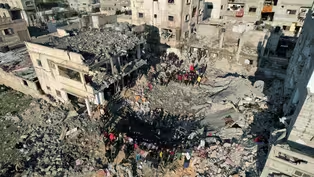
Area where Palestinians found shelter becomes battle zone
Video has Closed Captions
Clip: 12/19/2023 | 4m 50s | Area in Gaza where Israel told displaced Palestinians to seek shelter becomes battle zone (4m 50s)

Church leader hopes hand-written Bible can heal divides
Video has Closed Captions
Clip: 12/19/2023 | 7m 45s | Church leader hopes hand-written and illustrated Bible can heal religious divides (7m 45s)

How the media is covering Trump's anti-democratic rhetoric
Video has Closed Captions
Clip: 12/19/2023 | 10m 55s | How media organizations are facing the task of covering Trump's anti-democratic rhetoric (10m 55s)

How the U.S. plans to protect ships from attacks in Red Sea
Video has Closed Captions
Clip: 12/19/2023 | 4m 32s | How the U.S. and allies plan to protect ships from Houthi attacks in Red Sea (4m 32s)
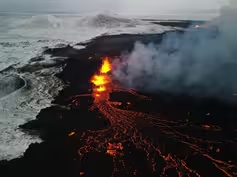
Iceland escapes worst-case scenario from volcanic eruption
Video has Closed Captions
Clip: 12/19/2023 | 4m 55s | Iceland escapes worst-case scenario as lava from volcano flows away from important areas (4m 55s)
News Wrap: Deal on Ukraine aid not expected before holidays
Video has Closed Captions
Clip: 12/19/2023 | 4m 22s | News Wrap: Senate deal on Ukraine aid, border security not expected before holiday break (4m 22s)
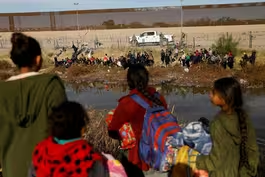
Texas legislator on law targeting illegal border crossings
Video has Closed Captions
Clip: 12/19/2023 | 7m 20s | Texas legislator defends new law allowing police to arrest migrants who entered illegally (7m 20s)
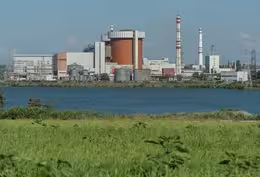
Ukraine prepares for Russian attacks on energy grid
Video has Closed Captions
Clip: 12/19/2023 | 6m 52s | Ukraine prepares for another round of Russia's winter attacks on energy grid (6m 52s)
Providing Support for PBS.org
Learn Moreabout PBS online sponsorship
- News and Public Affairs

FRONTLINE is investigative journalism that questions, explains and changes our world.

- News and Public Affairs

Amanpour and Company features conversations with leaders and decision makers.












Support for PBS provided by:
Major corporate funding for the PBS News Hour is provided by BDO, BNSF, Consumer Cellular, American Cruise Lines, and Raymond James. Funding for the PBS NewsHour Weekend is provided by...