
December 19, 2024 - PBS News Hour full episode
12/19/2024 | 57m 46sVideo has Closed Captions
December 19, 2024 - PBS News Hour full episode
December 19, 2024 - PBS News Hour full episode
Problems playing video? | Closed Captioning Feedback
Problems playing video? | Closed Captioning Feedback
Major corporate funding for the PBS News Hour is provided by BDO, BNSF, Consumer Cellular, American Cruise Lines, and Raymond James. Funding for the PBS NewsHour Weekend is provided by...
Support provided by:

December 19, 2024 - PBS News Hour full episode
12/19/2024 | 57m 46sVideo has Closed Captions
December 19, 2024 - PBS News Hour full episode
Problems playing video? | Closed Captioning Feedback
How to Watch PBS News Hour
PBS News Hour is available to stream on pbs.org and the free PBS App, available on iPhone, Apple TV, Android TV, Android smartphones, Amazon Fire TV, Amazon Fire Tablet, Roku, Samsung Smart TV, and Vizio.
Providing Support for PBS.org
Learn Moreabout PBS online sponsorshipGEOFF BENNETT: Good evening.
I'm Geoff Bennett.
Amna Nawaz is away.
On the "News Hour" tonight: Chances of a government shutdown fester, as partisan politics and influence from president-elect Trump hamper budget negotiations in Congress.
Veteran Republican Congressman Patrick McHenry weighs in on the state of play on Capitol Hill as he departs Washington.
REP. PATRICK MCHENRY (R-NC): Frankly, we're in a situation where basic governance that is like turning the light switch on in the morning is complicated.
GEOFF BENNETT: And the spread of the bird flu raises safety concerns among dairy farmers and their work force.
GEOFF BENNETT: Welcome to the "News Hour."
House Republicans are pushing a new proposal tonight to avoid a government shutdown in an effort to meet president-elect Donald Trump's last-minute spending demands.
It's all unfolding after Mr. Trump rejected the original bill earlier this week, with billionaire Elon Musk leading the charge against it online.
Our Lisa Desjardins has the latest and joins us now.
Lisa, it's good to see you.
So what did Republicans change in this last-minute revision?
LISA DESJARDINS: This has been another whirlwind of a day here on Capitol Hill, and a pivotal one both for government function itself and also for Speaker Mike Johnson.
Let me go over the bill that Speaker Johnson and House Republicans unveiled just over an hour or so ago.
Here's what's in it.
It would extend government funding for another three months.
It would add billions in funding, about $100 billion in funding for disasters, including recent hurricanes.
Now, this is new.
It would extend the debt ceiling for two additional years.
The debt ceiling is likely to hit in the spring of next year in the Trump administration.
It would also extend the farm bill for one year.
That debt ceiling extension was something specifically that president-elect Donald Trump and vice president-elect Vance had asked for, and it was not on the negotiating table until president-elect Trump brought it up.
Today, president-elect Trump posted on social media that he, in fact, does support this new version of the bill.
As you see there, he wrote: "All Republicans and even Democrats should do what is best for our country and vote yes."
Now, as details were emerging, as I say just in the last couple of hours, Geoff, members and the press, we were all trying to get our hands around what was happening.
And some of the members who were skeptical about the original continuing resolution, the funding deal, said they were waiting eagerly and they were still deciding, as they were hearing these first details, about the bill itself and also about Speaker Johnson.
Listen.
REP. RICH MCCORMICK (R-GA): How he handles it will define who he is, if he's a serious leader and if he's going to survive this leadership vote, quite frankly.
LISA DESJARDINS: Now, that's Congressman Rich McCormick.
And I have an important update.
As I said, that was just over an hour ago or so that I talked to him.
And just in the past few minutes, our producer Kyle Midura spoke to Rich McCormick again after he heard Speaker Johnson sort of plea about this bill.
McCormick says he is a hard no on Speaker Johnson's bill.
He is furious about it and he seems to have a problem with Speaker Johnson as well.
We are hearing other Republicans who have concerns about it.
They don't like the debt ceiling extension that President Trump personally campaigned for in this.
GEOFF BENNETT: So what's the whip count looking like overall?
I mean, the House is voting on it this evening.
Is this expected to pass?
LISA DESJARDINS: All right.
So Speaker Johnson is using a special technique here to call up this vote quickly.
He's going to have to go around the rules.
To do that, he needs two-thirds of the entire House.
Some math on, that's about 286 votes.
So he clearly is going to need Republicans.
He does have some problem -- or -- sorry -- I mean, he's going to need Democrats, rather.
He does have problems with some of his Republicans.
Democrats, they are hard-nosed.
They say that this is a matter of Johnson and Republicans breaking their word.
They also say this is billionaires trying to control Congress.
Now, they feel, as I spoke to you - - or as we heard from Rosa DeLauro, the chairwoman of the Appropriations Committee, they want to stick with the original deal that they negotiated with Speaker Johnson.
Here's what she said earlier.
REP. ROSA DELAURO (D-CT): I support the current bill that we have.
I support that bill.
I don't know what we're talking about.
I support what we did.
I worked very, very hard, very hard, as the other appropriators did, in terms of creating this agreement.
We lost some.
They lost some.
But we put together a good agreement that people could support.
And we were there to support it, but for, but for President Musk.
LISA DESJARDINS: Now, where are we then, Geoff, at this moment?
By my understanding, I don't see how this bill has two-thirds.
I'm not quite sure it has a majority to pass the House.
So with one day to go until a government shutdown, that means that either Johnson would have to fall back to some other vehicle that Democrats would agree with, or indeed we are seeming to get closer and closer to a likely at least weekend or possibly holiday government shutdown.
GEOFF BENNETT: And what might this mean for Speaker Johnson's leadership, Lisa?
LISA DESJARDINS: Yes, at this moment, it's not good, but we just have to wait in coming hours to see how he handles this.
But I think what this means, more importantly, to Americans is very significant.
If this disaster funding can't pass, those are millions of Americans around this country that are still recovering.
I spoke to one of them, Asheville's Mayor Esther Manheimer, earlier today.
She says people in Asheville, North Carolina, are still homeless, waiting for SBA loans.
As the SBA is out of money, waiting for this money right now.
She says Congress needs to act immediately.
ESTHER MANHEIMER, Mayor of Asheville, North Carolina: I feel like we're collateral damage all over again in a fight that has nothing to do with us, but has every bit a part of tearing us down.
You have seen the devastation and.
i know you know what the right thing is to do.
And I need you all to come across the aisle, to compromise, to work with your fellow congresspeople and pass a bill right before this Christmas holiday that will help Western North Carolina be able to manage itself through the storm and be as whole as possible several months from now.
LISA DESJARDINS: Geoff, back to you.
GEOFF BENNETT: Well, look, this chaos has a real impact, Lisa, and I know you have spoken to someone who has a unique perspective on that.
Tell us about it.
LISA DESJARDINS: I spoke earlier this week to Patrick McHenry, congressman of North Carolina.
He's been here 20 years and he is retiring.
He knows all about this kind of chaos.
Remember, he was the one who stepped in as acting speaker when Kevin McCarthy was ousted.
And that was, again, also over fiscal discontent by some Republicans.
As an example, earlier this week, he told me he thought Speaker Johnson had no problems.
Today, I talked to him and he indicated things may have changed.
I talked to him about Congress, about the Republican Party, and my first question to him was about this fiscal mess that we have right here now and why is it that Congress can't do basic things?
REP. PATRICK MCHENRY (R-NC): Frankly, we're in a situation where basic governance that is like turning the light switch on in the morning is complicated, and I think speaks to the dysfunction within our agencies of government between the branches and a lack of muscle memory on making these normal things happen, so really complicated.
And I don't see it quickly changing until we have systemic reform for how we fund the government.
LISA DESJARDINS: In general, do you think Congress is broken, or no?
REP. PATRICK MCHENRY: Well, I think Congress is fundamentally a great place to get the people's business done.
I think we're at low ebb of functionality.
And I think we're on the edge of really active legislating next Congress.
I think the reform we need to -- is to once again allow members of the House to be here in D.C. with their families.
The best relationships I have from across the aisle are because of my kids and because of my wife and those normal interactions we have.
LISA DESJARDINS: The House Republican dysfunction we have seen this week is not new, as McHenry knows too well.
All right, now, you probably know what I'm going to show you, but I can't resist the opportunity.
So, the moment.
REP. PATRICK MCHENRY: Oh, yes.
LISA DESJARDINS: Last fall, a small group of rebels reacting to spending and debt deals then-Speaker Kevin McCarthy negotiated sparked near-fights on the floor and ousted him.
McHenry was named as acting speaker.
The moment he took the gavel became iconic.
Remember this, though?
REP. PATRICK MCHENRY: 12-A of Rule 1, the chair declares the House and recess subject to the call of the chair.
It's been played a lot.
LISA DESJARDINS: What were you thinking then and how significant does that feel now looking back on it?
REP. PATRICK MCHENRY: It's like I'm looking at someone else.
Those minutes were like an out-of-body experience for me.
First, my friend was just deposed from the speaker show.
We had a Republican side with all the Democratic members.
I understand why the Democrats voted the way they do, but the eight selfish Republicans, that was a particular -- that really built anger, the wellspring of anger, which was the representation with the gavel.
LISA DESJARDINS: You still think you still feel something?
REP. PATRICK MCHENRY: Yes, I still feel it.
And I'm trying to get to that moment and trying to put words to that moment.
But it was anger, anger at the situation, anger what these selfish eight Republicans dead to a speaker who had only been successful.
Every engagement we had, for opening day, through all those grueling votes, to the negotiation, the debt ceiling and the deficit reduction and reforms we got attached to the debt ceiling, the success in passing the government funding bill.
LISA DESJARDINS: And those were hard lifts, all of them.
REP. PATRICK MCHENRY: Those were huge lifts for Speaker McCarthy.
And for him to be successful, and to be punished for that success, it was not fitting.
I didn't have any other way to put words to it.
I didn't want to be in that position.
I didn't want the House to be in this position.
And I thought this is the dumbest moment for the House that I have experienced.
And there have been some pretty dumb moments.
LISA DESJARDINS: President-elect Trump, himself and some of his allies are putting a lot of pressure on senators right now to confirm his nominees.
And there's a real conversation on the Senate side that you need to go along with what president-elect Trump wants.
Are you concerned?
There's been a clear shift from congressional to executive power over the course of several presidencies.
REP. PATRICK MCHENRY: Well, it's Congress' will to weaken Congress' power, and they do so in a very shortsighted way if we hand over power.
But in the case of the next president, he comes in with wide popularity in a significantly different position than eight years ago, with deep support among the Republican Party and with the American electorate.
I think there's a misunderstanding of President Trump.
He will listen to people that tell him hard things.
He does.
And so you have people that don't understand him and try to sort of be sycophants for him.
He doesn't like that.
But to stand up for the rightful powers of the Congress, that should be a bipartisan issue, and that should be the case no matter who the president is.
LISA DESJARDINS: What do Republicans stand for right now?
REP. PATRICK MCHENRY: A strong economy and traditional American ways of life.
And is there a tinge of populism that's part of this stew?
Yes, that's the case.
LISA DESJARDINS: You are chairman of a powerful committee.
Next session, 17 standing committees, House Republicans are leading them, and they will all be led by men.
Does that matter that no women will be chairing committees next Congress?
REP. PATRICK MCHENRY: You do need a diverse set of inputs.
That was what the founding fathers intended for the nature of the House.
And for us to have no women chairs of committees is a huge mistake and really an unfortunate thing, because we have powerful, smart, capable, tenacious Republican women that are capable of leading big committees and doing major things.
That doesn't -- it's not... LISA DESJARDINS: So what's going on here?
REP. PATRICK MCHENRY: It's an unfortunate set of things, set of circumstances.
I'm leaving Congress.
So... LISA DESJARDINS: So, you can tell me, yes.
Put it out there.
(CROSSTALK) LISA DESJARDINS: Is there still sexism within the Republican Party that needs to be dealt with?
REP. PATRICK MCHENRY: We have a process through the Steering Committee.
The Steering Committee produced these results, and that is for Republican members that made these decisions to answer for.
LISA DESJARDINS: You entered Congress at the ripe old age of 29.
How changed do you feel as a person?
REP. PATRICK MCHENRY: Oh, I love this institution.
I leave it with no remorse, no regret, but just gratitude, enormous gratitude.
To be hitched to this great thing of the United States and what it means, not just to us here at home, but what it means around the globe, to be hitched to that even for a moment, to serve our government, to serve our country, it's just been a great gift.
LISA DESJARDINS: The bow ties happened here too.
REP. PATRICK MCHENRY: They did.
They did.
So I get to be quirky and weird, and I have had a great run and really enjoyed everything about it.
LISA DESJARDINS: Congressman Patrick McHenry, thank you so much for talking with me.
REP. PATRICK MCHENRY: Thank you, Lisa.
GEOFF BENNETT: The day's other headlines begin in Russia, where President Vladimir Putin held his annual year-end press conference.
During the marathon session, more than four hours this year, Putin reaffirmed his commitment to continuing the war in Ukraine and hedged on the question of a potential arms race with the U.S. Stephanie Sy reports.
STEPHANIE SY: An annual glimpse into the mind of Russia's strongman, complete with Cold War-era missile threats and denials that any of his policies have failed, including in Syria.
That's despite the recent ouster of Syrian President Bashar al-Assad, who Putin backed during the 14-year civil war and who was forced to flee to Russia.
Putin said he has yet to meet with Assad.
With Moscow's influence in the region sharplycurtailed and the future of its two military bases in Syria unknown, Putin dismissed any notion of defeat to an NBC reporter.
VLADIMIR PUTIN, Russian President (through translator): You and those who pay your salaries would like to present everything that is happening in Syria as some kind of failure, a defeat for Russia.
I assure you it is not true.
We maintain relations with all the groups that control the situation there, with all the countries in the region.
The overwhelming majority of them tells us that they would be interested in keeping our military bases in Syria.
I don't know.
We will have to think about it.
STEPHANIE SY: The Russian president also vowed to continue the war in Ukraine, agreeing to come to the negotiating table only if Ukraine submits to concessions.
VLADIMIR PUTIN (through translator): We are ready to negotiate, but the other side needs to be ready for both negotiations and compromises.
STEPHANIE SY: Russia has captured over 26,000 square miles of Ukrainian territory since the launch of its full-scale offensive nearly three years ago.
Ukraine has struggled to keep up with Russia's onslaught of manpower.
Today, Ukraine launched six U.S.-made ATACMS and four British Storm Shadow missiles into Russia's Rostov region, almost all of which Russia said were shot down.
Putin also alluded to turning up the heat in an arms race with the U.S., claiming that the new hypersonic Oreshnik missile recently used on the Ukrainian city of Dnipro cannot be intercepted by Western air defenses, despite analysts' claims to the contrary.
He suggested a missile duel might be in order.
VLADIMIR PUTIN (through translator): How about they propose to us to conduct some kind of technological experiment, a high-tech duel of the 21st century?
Let them name some object, let's say, in Kyiv, concentrate all their air defense and missile defense forces there, and we will hit it with Oreshnik and see what happens.
We are ready for such an experiment.
STEPHANIE SY: With president-elect Trump set to take office in less than a month and promising to make a deal to end the war, Putin denied he would be in a weaker position when and if they do meet and said they had not spoken in four years.
For the "PBS News Hour," I'm Stephanie Sy.
GEOFF BENNETT: Also today, the man accused of killing UnitedHealthcare CEO Brian Thompson returned to New York as he faces additional federal murder charges.
It came just after suspect Luigi Mangione waived extradition in a court in Pennsylvania.
That's where he was arrested while on the run earlier this month.
Mangione was flown back to New York City this afternoon, where he'd already been indicted on state charges.
He was taken to a federal court to face charges, including two counts of stalking, one count of murder, plus a firearms offense.
Manhattan's district attorney said that the state and federal cases could proceed simultaneously.
ALVIN BRAGG, Manhattan District Attorney: As we allege, the defendant in that case brazenly shot Mr. Thompson twice in Midtown Manhattan.
It was targeted, premeditated, and meant to sow terror.
Speaking generally, we have had state prosecutions and federal prosecutions proceed as parallel matters, and we're in conversations with our law enforcement counterparts.
GEOFF BENNETT: One of Mangione's federal charges, murder by firearm, includes the possibility of the death penalty.
Prosecutors have not said whether they'd seek that punishment.
In Madison, Wisconsin, new details are emerging about the shooting this week at Abundant Life Christian School.
Authorities say the 15-year-old suspect who's accused of shooting and killing two people before shooting herself brought two handguns with her to school that day.
The individual had also been in contact with a man in California who authorities say was plotting a separate shooting at a government building.
And we're learning the identities of the victims.
They are 14-year-old Rubi Patricia Vergara, who had attended Abundant Life since kindergarten, and 42-year-old Erin Michelle West, a teacher at the school.
Two other students are still in critical condition.
Amazon workers at seven facilities across the nation walked off the job this morning.
They're aiming to pressure the retailer into contract negotiations during this busy holiday rush.
The strikes are taking place at seven Amazon warehouses in California, Illinois, New York and Georgia.
PROTESTERS: Worker!
PROTESTERS: Power!
PROTESTERS: Worker!
PROTESTERS: Power!
GEOFF BENNETT: Workers were out well before the sun came up forming picket lines by the dozens.
They're demanding higher pay, better benefits and safer working conditions.
And they acknowledge that the timing could affect customers.
JOSH BLACK, Amazon Warehouse Associate: We don't want this to be something that makes the customer suffer.
We want everybody to have a great Christmas.
But we feel like Amazon has forced us into this, so whatever impacts we have, whatever packages are late, I just want everyone out there to remember that this is because Amazon's refusing to come to the bargaining table.
GEOFF BENNETT: Amazon says the strikes will not affect its operations during the holiday period.
Nearly 200 tons of food, water and other aid arrived by Navy ship today to the devastated islands of Mayotte five days after a massive tropical cyclone tore through the French territory.
The deliveries coincided with a visit from French President Emmanuel Macron.
At least 31 people are confirmed dead and more than 200 critically injured, but authorities fear the death toll is actually much higher.
Reactions to Macron's visit were mixed, with some demanding more help.
ABDOU HOUMADOU, Mayotte Resident (through translator): Mayotte doesn't necessarily need your presence, but what Mayotte needs is your help, your support.
What you spent in coming here from Paris to Mayotte would be better if you had used it to help the population.
GEOFF BENNETT: Meanwhile, dramatic new footage has emerged of frantic scenes in the Pacific island nation of Vanuatu.
People had to rush to safety after a 7.3-magnitude earthquake struck its capital on Tuesday.
At least 10 people have been confirmed dead so far.
That number is expected to rise as search crews from Australia, New Zealand and France search through the rubble.
The U.N. says nearly 1,000 people have been displaced.
On Wall Street today, stocks ended mostly unchanged after yesterday's sell-off.
The Dow Jones industrial average just barely managed to end in positive territory, adding 15 points.
The Nasdaq slipped by nearly 20 points.
The S&P 500 was little changed on the day.
And we have a follow-up to a story we brought you last week.
The oldest known complete stone tablet of the Ten Commandments has sold at auction for more than $5 million.
The auction house Sotheby's had expected more like $1 million to $2 million.
The 155-pound marble slab is inscribed with the commandments in Paleo-Hebrew script and is believed to be about 1,500 years old.
The buyer, who remained anonymous, plans to donate it to an Israeli institution.
Still to come on the "News Hour": Georgia's district attorney is disqualified from the Trump election interference case; the legal tactics president-elect Trump is using against media outlets; and how researchers are trying to get people to rethink addiction as a brain disorder.
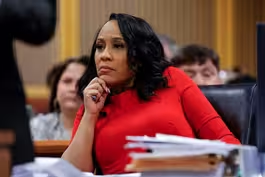
A Georgia appeals court has disqualified the top prosecutor overseeing an election interference case against president-elect Donald Trump and his allies, a decision that could upend the case.
Fulton County district attorney Fani Willis was disqualified because she had a romantic relationship with an attorney she hired to help run the investigation.
The decision overturns a lower court ruling earlier this year that said Willis could continue in the role.
Our William Brangham has been following the legal cases against Mr. Trump and joins us now.
So, William, what was the appeals court's argument in removing Fani Willis from this case?
WILLIAM BRANGHAM: Their argument -- and I should say, this came as a bit of a surprise, because the presiding judge, as you said, Scott McAfee, who is a conservative appointed by Republican Governor Brian Kemp, had criticized Willis' relationship and said it created this appearance of impropriety, but said, if you get rid of the man you're having a relationship with, you can stay on the case.
She did that.
This appeals court comes in and, while agreeing that this was really just about an appearance of impropriety, they said that this case was so rare and so unusual that it -- quote -- "that disqualification was mandated."
Now, they have been criticized a fair amount for this ruling.
It was a 2-1 decision, but that's the ruling.
And she's off the case.
GEOFF BENNETT: The underlying case, though, hasn't been dismissed.
Could it be prosecuted by someone else potentially?
WILLIAM BRANGHAM: Potentially.
Fani Willis' office is appealing to the Georgia Supreme Court to overthrow this so she could get back in the driver's seat.
Unclear if that's going to happen.
If she loses that, then there's this Republican-led Council of Prosecutors in Georgia, and they will be the ones to decide, drop the case, continue the case, and then assign a new prosecutor to that.
Unclear if that's going to happen or not.
Hanging over all of this, though, is also this Department of Justice Office of Legal Counsel policy, which says that no sitting president can be prosecuted.
Now, Department of Justice, that's usually thought of as covering just federal cases, not state and local, but the belief among many legal experts is, is that state and local prosecutors would have to honor this as well.
And so the other cases against Mark Meadows and Rudy Giuliani, other people involved in this case, could go forward, but there's just nobody really believes that a judge in Georgia would allow a case to go against Donald Trump when he's back in the White House.
So... GEOFF BENNETT: So, looking at the landscape of all of the cases that existed, I guess I use the past tense, existed... WILLIAM BRANGHAM: That's the right tense.
GEOFF BENNETT: That's right, yes.
I mean, which ones remain?
Any of them?
WILLIAM BRANGHAM: No.
The two federal cases against Donald Trump, we know Jack Smith has wound those down.
The other one was dismissed, this case in Georgia really in limbo.
The only one that still has some legal maneuvers going on is the Stormy Daniels case, 34 felony convictions against Donald Trump in New York City.
The judge just threw out Trump's attempt to say, hey, the Supreme Court just granted me immunity.
I ought to be able to throw this case out.
He said, no, no, no, not so fast.
But he has postponed sentencing, perhaps not until Donald Trump is out of the White House.
GEOFF BENNETT: William Brangham, our thanks to you, as always.
WILLIAM BRANGHAM: Thanks, Geoff.
GEOFF BENNETT: We're going to shift our focus now to Donald Trump following through on his threats of legal action against the news media.
Earlier this week, as we have reported, ABC News agreed to pay $15 million to settle a defamation lawsuit brought by Mr. Trump, and the president-elect announced more was to come.
DONALD TRUMP, Former President of the United States (R) and Current U.S. President-Elect: I feel I have to do this.
I shouldn't really be the one to do it.
It should have been the Justice Department or somebody else, but I have to do it.
It costs a lot of money to do it, but we have to straighten out the press.
Our press is very corrupt.
GEOFF BENNETT: Following those comments, his legal team filed a lawsuit against Iowa pollster Ann Selzer and The Des Moines Register for a poll released three days before the election showing Vice President Kamala Harris leading by three points.
Mr. Trump won the state by 13.
His lawsuit called the poll election-interfering fiction.
Clay Calvert is a professor emeritus of law at the University of Florida and a nonresident senior fellow at the American Enterprise Institute.
Thanks for being with us.
CLAY CALVERT, American Enterprise Institute: Thanks for having me.
I appreciate it.
GEOFF BENNETT: So, let's start with this Iowa lawsuit, because unlike the now-settled ABC News lawsuit, this is not about defamation, but about an accusation of consumer fraud under Iowa law.
Help us understand this fairly novel approach.
CLAY CALVERT: Sure.
It's definitely a novel approach.
Typically, we would think of a defamation lawsuit filed by somebody who's been slandered, defamed.
So what Trump is using here, it's a novel technique.
He's using consumer fraud, consumer protection statutes that target unfair and deceptive business practices.
And so what he essentially is suggesting that Ann Selzer's polls here were fraudulently conducted, they were designed to harm his campaign.
So it's a totally different use.
Typically, we think of consumer protection laws as about products that you would buy at the store or the supermarket.
Now we're talking about information and news.
So, regardless of his theory here, the First Amendment is certainly going to come into play as a constitutional overlay that would lend protection to The Des Moines Register, who is one of the defendants in this case.
GEOFF BENNETT: And The Des Moines Register responded to the lawsuit in a statement, part of which reads this way.
It says: "We stand by our reporting on the matter and believe this lawsuit is without merit."
And Ann Selzer spoke about this accusation before the lawsuit was filed in an interview with Iowa PBS.
Here she is.
J. ANN SELZER, Selzer & Company, Inc.: The idea that I intentionally set up to deliver this response, when I have never done that before -- I have had plenty of opportunities to do it.
It's not my ethic.
But to suggest without a single shred of evidence that I was in cahoots with somebody, I was being paid by somebody, it's all just kind of -- it's hard to pay too much attention to it, except that they're accusing me of a crime.
GEOFF BENNETT: In your view, is winning in court the real goal of this suit or something else to play here?
CLAY CALVERT: It's absolutely not to win in court.
The real goal here is to chill the press, to have the news media engage in what we call self-censorship, to pull back their stories.
So, instead of playing a watchdog role, as typically we think of the fourth estate plane when it comes to the government, what I think Trump is really trying to do is make the press be a lapdog, turn it into something that's not going to bark at him when he takes office again in 2025.
So, really, the goal here is to chill the press, to try to scare them off from criticizing him.
That's the larger purpose.
It's what we would think of sometimes as a strategic lawsuit against public participation or a SLAPP suit, strategic lawsuit against public participation.
The whole purpose here is designed to chill the press from participating in criticizing him.
GEOFF BENNETT: Does the ABC News settlement, does it embolden more of these types of lawsuits?
Or is it potentially a way to protect press freedom because the thinking is had it gone all the way up to the Supreme Court, the conservative majority on the court might have overturned the long existing protections that were established under The New York Times v. Sullivan case back from 1964?
CLAY CALVERT: Well, certainly, Justice Thomas has an appetite, as does Justice Gorsuch, for overruling the actual malice standard.
So you wouldn't want to tee up a case to give the justices a crack at overruling the actual malice standard.
I think one of the more interesting things with the Disney-ABC settlement is particularly that.
You have a news division at ABC, but you also have this overlord by Walt Disney, an entertainment company.
And so there's a real tension there when a news organization is controlled by a company that has other interests in the entertainment industry.
And so I think that friction is very important.
So a number of the officials at ABC News certainly didn't want that settlement to happen.
But on the other hand, they're dictated and controlled by Disney.
GEOFF BENNETT: At the moment, Donald Trump is still a private citizen, but in a couple of months' time, he will be president again.
He will have control of the full weight and power of the Department of Justice.
How should news organizations prepare?
CLAY CALVERT: I think they are preparing now.
I'm a member of several different organizations where the media attorneys are members of that.
And I know that they certainly are thinking about these issues.
I think one of the other things we need to think about is the FCC, the Federal Communications Commission, and Brendan Carr taking the chair position there, because Trump has threatened to revoke the licenses of stations that he believes engage in fake news, deceptive news commentary.
So we have got frontal attacks in terms of lawsuits, but also I'd watch out for the FCC and its actions in the future in terms of broadcast journalism.
GEOFF BENNETT: Clay Calvert, nonresident senior fellow at the American Enterprise Institute, thanks for your time this evening.
We appreciate it.
CLAY CALVERT: Thank you for having me.
GEOFF BENNETT: In France today, a panel of judges found dozens of men guilty of raping a woman whose then-husband had drugged her unconscious over the course of a decade.
Ali Rogin has more.
And a warning: The following conversation is graphic in its language.
ALI ROGIN: Gisele Pelicot waived her right to a private trial in solidarity with other victims of sexual assault, whom she says go unrecognized.
GISELE PELICOT, Rape Survivor (through translator): By opening the doors to this trial, I wished for society to join in the debates that were held.
I never regretted this decision.
ALI ROGIN: For three months, she has had to sit through videos of her abuse in court taken by her then-husband while dozens of men he recruited online assaulted her.
A majority of these men said they didn't know it was rape, but all of them were found guilty in one way or another.
The scale and brutality of Pelicot's abuse prompted thousands to take to the streets and has sparked a nationwide conversation about consent.
Catherine Porter has been covering the trial for The New York Times.
Catherine, thank you so much for joining us.
What does this verdict mean for the country and for Madame Pelicot?
CATHERINE PORTER, The New York Times: Well, for Madame Pelicot, it was the verdict she was looking for.
But more than the verdict, she wanted to spark a large conversation in France about rape, the prevalence of rape, how the country treats rape victims.
And, by that measure, she's clearly succeeded.
Her trial and her decision to make it public and force the country to look rape in the face by watching these videos of her comatose body being probed and penetrated by strangers has really started a national conversation about relationships between men and women, about consent, about rape culture.
These type of conversations that were much more common in North America and after MeToo, but never really cracked here in France, are now fully taking place.
ALI ROGIN: You have been at the court in Avignon since the beginning.
What has the scene been like?
CATHERINE PORTER: The response to the verdicts -- so, her husband -- or ex-husband, Dominique Pelicot, was found guilty of the maximum, 20 years in prison.
The other men were all convicted mostly of rape, but they were given sentences that were more lenient.
On average, most of them were between six and nine years in prison, and six of them walked free today because they already spent enough time in prison during the trial or before the trial that they had no more prison time.
That infuriated quite a few of the feminists who have been following this case, and very closely, in Avignon.
They said to me that they felt like the message was, you can get away with rape.
ALI ROGIN: Why has this particular case resonated so deeply, not just within France, but really all around the world?
CATHERINE PORTER: I think it's just an extraordinary case for so many reasons.
This was a mass rape trial with 51 men, almost all of whom charged with rape, and all but one for raping the same woman.
In fact, these were people's next-door neighbors.
They range in age between 26 and 72.
The French press were calling them (SPEAKING IN FOREIGN LANGUAGE) Mr. Everyman.
And then there's Madame Pelicot's, frankly, courageous decision to cast a massive spotlight on her own intimate horror.
She not only insisted that the trial be made public because she wanted to launch this conversation, but she then insisted that these videos her husband had taken -- more than 20,000 of them were found by police -- be aired in court, so people could see them.
As her lawyer said, she wanted France and the world to look rape in the eye.
ALI ROGIN: There were so many striking moments during this trial.
What was the response to Madame Pelicot's testimony?
CATHERINE PORTER: Madame Pelicot took the stand early and then frequently throughout the trial, three times.
She was incredibly poised every time, calm.
She said that she thought shame should change sides.
And, truly, she embodied that notion.
She came in each day with her head held high, never cracked emotionally, and answered questions calmly and directly.
And every time one of the lawyers would say, well, you could see how he might have thought, and she said, well, the instant came into the room and he saw my body and heard my snores, he should have known to ask Madame Pelicot.
And he should have turned around and left and called the police.
And not one of these 50 men phoned the police.
ALI ROGIN: A stunning trial, with the verdict coming today.
Catherine Porter, who's been covering it since the beginning, thank you so much for joining us.
CATHERINE PORTER: Thank you for having me.
GEOFF BENNETT: California Governor Gavin Newsom declared a state of emergency yesterday in response to bird flu that's spreading among that state's dairy cows.
The virus has already caused the deaths of more than 120 million birds across the country since 2022.
Stephanie Sy reports now on the news from Colorado on efforts to keep the dairy work force safe, given concerns that, the more the virus spreads, the greater the possibility that it mutates to allow spread among humans.
STEPHANIE SY: In this stretch of rural Colorado, Soraya Leon is a lifeline for many agricultural workers.
SORAYA LEON, Community Health Worker, Project Protect: The farmworkers and dairy workers, it's very hard.
It's very hard to survive.
STEPHANIE SY: She's a community health worker with Project Protect, part of a statewide nonprofit.
Her regular visits and food deliveries to farmworkers in need now includes a bag full of face shields and masks, the equipment that protects them from bird flu.
Since the spring, avian influenza has been spreading in dairy cattle and has infected about 60 farmworkers nationwide.
Despite the risks, this worker said he's gotten little information from his employer.
MAN (through translator): The owner, we never see him.
They're not interested in us.
STEPHANIE SY: Speaking to us anonymously because he is undocumented, he told us earlier this year he was ill and had conjunctivitis.
Commonly known as pink eye, the symptom is a sign of possible infection from this strain of bird flu.
SORAYA LEON: On a statistic, we don't have too much people sick from this fever.
But on the reality, many people got sick, but they never know, because they never had information about what the symptoms are or how they feel.
STEPHANIE SY: Leon is part of a network of so-called promotoras established during COVID to help spread critical information to Colorado's many Hispanic farmworkers.
Lately, the promotora network has shifted to addressing the threat from bird flu.
Did workers get enough information when bird flu started circulating in this area over the summer?
SORAYA LEON: Not really.
The government response was too late.
They know they have the sickness because the symptoms, the eyes, and the cows.
So now they know they got this sickness, but only because we provide information later, not before.
STEPHANIE SY: In addition to groups like Project Protect, a federally funded agricultural health and safety center at Colorado State University has been using social media to provide information to workers.
While the virus, known as H5N1, has killed more than 100 million poultry birds and tens of thousands of Marine mammals, in cows, it has been less deadly, with most recovering after experiencing a drop in milk production.
While at least one person has been hospitalized with bird flu, this recent strain of the virus circulating in cows has been relatively mild in humans, and the risk to the public remains low.
But Colorado state veterinarian Maggie Baldwin and state epidemiologist Rachel Herlihy are watching the changes in the pathogen closely.
DR. MAGGIE BALDWIN, Colorado State Veterinarian: We have seen this virus move from species to species before.
We have seen spillover of this virus from wild birds and from poultry to mammals, and particularly that's been wild mammals in the past.
What's concerning is the mammal-to-mammal transmission of the virus right now.
STEPHANIE SY: While pasteurization has been shown to kill the virus in milk and dairy products, workers coming into contact with raw milk are at risk.
DR. RACHEL HERLIHY, Colorado State Epidemiologist: We know that the more opportunities that we give this virus to be exposed to people, the more opportunities it has to adapt potentially and then gain that ability to potentially spread from person to person.
And that's, of course, what we want to prevent.
STEPHANIE SY: Since July, Colorado has mandated weekly bird flu testing of bulk milk samples from its licensed dairies.
DR. MAGGIE BALDWIN: Every week, we have seen fewer and fewer positives, which is fantastic news.
But we really don't know what the long-term impact of this virus looks like.
We know that, yes, the dairy cows do seem to build some level of an immune response, but we don't know if an infected herd could become reinfected.
And dairy herds are constantly bringing in new replacement animals all the time.
STEPHANIE SY: Over the summer, more than half of the dairy herds in Colorado tested positive for avian influenza.
While there hasn't been a positive case since August, there's still concern about dairy farmworkers, many of whom are undocumented immigrants.
MAN (through translator): There really is very little support.
STEPHANIE SY: At a Mexican restaurant, we met one longtime dairy worker who also wanted to remain anonymous because of his immigration status.
Have companies given the right protections to farmworkers to keep them safe?
MAN (through translator): There really weren't any measures taken.
The only measure to avoid infection was when they washed the tires of the trailer trucks that arrived to drop off the feed.
But as far as the personnel, I never saw them wearing any protective gear to avoid infection.
STEPHANIE SY: He described a friend who got sick and said the lack of paid sick leave makes workers hesitant to report their illnesses.
MAN (through translator): From the moment a worker gets sick and stops working, he doesn't get anything.
STEPHANIE SY: Community health worker Soraya Leon says there are also issues with access to clinics and the cost of care.
Immigration status also plays a role in workers not getting tested.
SORAYA LEON: Undocumented people, they don't say anything because they are afraid all the time.
STEPHANIE SY: Zach Riley with the Colorado Livestock Association says the industry has been a crucial partner with state officials in protecting animal and worker health.
ZACH RILEY, Colorado Livestock Association: There's been multiple free resources provided by the state and by employers to try to make sure that you are protected.
I would say you would be hard-pressed to find somebody not doing it.
STEPHANIE SY: I mean, we did speak to some farmworkers who said, without the help of these nonprofit organizations, might not have had the information or the PPE at their disposal.
ZACH RILEY: I would venture to guess that's a very limited case and very limited number of those.
Any one of our producers would gladly tell you they're offering a whole treasure trove of things to their employees.
STEPHANIE SY: But despite efforts to reach out to several different cattle organizations, including Riley's, we couldn't find a Colorado dairy farmer to speak with us, some citing concerns around the potential spread of bird flu.
In November, research from Colorado and Michigan confirmed what many people suspected.
Antibody tests showed more farmworkers had signs of previous bird flu infections.
DR. RACHEL HERLIHY: That is not uncommon when it comes to infectious diseases, because not everyone gets tested.
But it does tell us that we still have work to do to protect humans from exposure.
STEPHANIE SY: Back at El Centenario Mexican restaurant, this dairy worker agreed that more support is needed.
MAN (through translator): Most people who work on dairy farms.
Most of us lack someone to tell us what guarantees we have.
We are really lacking information.
STEPHANIE SY: While there haven't been recent cases of bird flu in Colorado, dairy herds, the virus is continuing to spread widely in California cows.
Earlier this month, federal ag regulators took Colorado's lead and announced mandatory milk testing for the first time, an acknowledgement that we are still a long ways from getting a handle on the spread of this disease.
For the "PBS News Hour," I'm Stephanie Sy in Weld County, Colorado.
GEOFF BENNETT: This week, we have been reporting on some promising treatments for two of the deadliest drugs in America, opioids and alcohol.
William Brangham is back now with a conversation with one of the nation's leading researchers who is studying America's addictions and how we can better address them.
WILLIAM BRANGHAM: My next guest is one of the researchers who helped establish that addiction is in fact a brain disorder, that taking certain drugs over time can change how our brains actually work.
Dr. Nora Volkow is the head of the National Institute on Drug Abuse, which is part of the NIH and is one of the world's biggest funders of research into drug abuse and addiction.
Dr. Volkow, so good to have you on the program.
We have been reporting on a few of the medications that show effectiveness for treating opioids and alcohol abuse disorders, and I wonder that, from your long research on this topic, what role do you see medications playing in helping people address their addictions?
DR. NORA VOLKOW, Director, National Institute on Drug Abuse: In the case of opioid use disorders, they are -- they have been crucial and they have been lifesaving.
And, again, it's one of the drivers that is now reducing the number of people that are dying.
So, in the case of opioid addiction, we have very effective medications.
The problems are, number one, that only a small percentage of people that would benefit from them, approximately 25 percent, will get prescribed this medication.
Second problem is, they start taking them and that protects them from overdosing.
But at six months, 50 percent of them will stop taking their medications.
So -- and we only have three, buprenorphine, methadone, and naltrexone.
So we need a wider variety of medications and we need alternatives so that people that don't respond to one medication can have options that go beyond two -- those three medications and, importantly, combinations of medications that may make it easier for patients to stay in treatment, because that's crucial for someone to have the long-lasting preventing effects of the medication treatments.
WILLIAM BRANGHAM: Why do we have so few medications?
I mean, when you think about other disorders, we have a million blood pressure drugs and hypertension drugs, but so few for such a huge public health crisis.
DR. NORA VOLKOW: This is not for the lack of not understanding and scientific developments.
It is due to the level of interest, the lack of interest that the pharmaceutical industry has had overall, typically, on the development of these medications.
What are the issues why there has been limited interest?
Number one, stigma.
Addiction is a stigmatized disorder.
How do we see it?
In general, people feel comfortable with people that are addicted.
But it's also stigmatized in that, when you come to reimbursement, as a physician, you are paid less if you take care of someone with an addiction than if you take care of someone with a depression.
So there is discrimination on the way that we actually incentivize the willingness of a provider to participate in the process.
So, these are two extreme, big barriers that have made it very difficult for industry to say, OK, I'm going to go after that.
And then the third element, it is very difficult to get these medications if they show a signal, get approved by overall, because what is required for a medication to be approved by the FDA for addiction is that you achieve abstinence.
And abstinence is an incredibly difficult goal to achieve.
It's like say, OK, I'm not going to approve you a medication unless you show that the pain is completely gone or that depression is completely gone.
But for these diseases, we approve medications if they reduce the magnitude.
WILLIAM BRANGHAM: As you know, there is a strong sentiment also in the recovery community that drugs are not the right use for drug addictions, that they believe this is what got us into the problem, let's not use them to get out of the problem.
They argue abstinence is the only approach.
What do you say to that argument?
DR. NORA VOLKOW: Well, it's another factor that has made it much harder for certain individuals to get the treatment that could have saved their lives.
We can be very categorical in the field of addiction.
It's either this or that.
And my perspective is, many of these help groups that actually have done a lot of good, but are very intolerant of the use of medications, actually are curtailing the ability to actually have someone that can benefit from the medication and from the treatment support that these groups offer.
We are -- the way that we think about addiction is very different from the way that we think about other disorders, because we account the person responsible for their acts, and, as a result of that, we tend to be much more demanding of what they should do in order to actually achieve recovery.
WILLIAM BRANGHAM: On a different note, you have done some of the initial investigations into these widely popular drugs to treat obesity and diabetes, the Ozempics and Wegovys, the GLP-1 drugs, as they are called.
Those are also showing some promise in treating people's drug and alcohol use.
How promising do you think those drugs really are?
DR. NORA VOLKOW: Well, the data looks like they could potentially be quite transformative.
So, whether you are looking at the data from experiments in laboratory animals -- for example, in grad, we have been funding research and they have actually shown consistently across different types of drugs they prevent the animals from escalating into compulsive drug-taking.
They prevent them from relapsing.
And we're seeing the anecdotal reports from people saying, I don't have the same desire of drinking or smoking or taking cocaine.
So it looks very promising.
There are now ongoing randomized clinical trials, which are the gold standards for determining, in fact, what is the level of efficacy and to bring them to the next level, which is to ultimately get the data that will result in an approval by the FDA of these as an indication for the treatment of addiction.
That work is ongoing.
But the preliminary findings overall look very promising.
WILLIAM BRANGHAM: All right, Dr. Nora Volkow of the National Institute on Drug Abuse, thank you so much for your time.
DR. NORA VOLKOW: Thanks for having me.
GEOFF BENNETT: And we have an update to our lead story.
House lawmakers are now voting on the stopgap spending measure that would avoid a partial government shutdown tomorrow night.
It's clear the vote will not reach the two-thirds majority needed to pass, as more than 30 Republicans joined Democrats in voting no.
President-elect Donald Trump urged Republicans to support this measure after his opposition to an earlier deal caused it to fall apart.
It's unclear what the next steps will be.
Remember, there's a lot more online, including a remembrance of a very special Santa Claus known as Santa Blair, who brought a lot of Christmas cheer to Oklahoma City and beyond.
That's at PBS.org/NewsHour.
And that is the "News Hour" for tonight.
I'm Geoff Bennett.
For all of us here at the "PBS News Hour," thanks for spending part of your evening with us.

Farms face calls to protect workers as virus spreads in cows
Video has Closed Captions
Clip: 12/19/2024 | 8m 29s | Colorado dairy farms face calls to keep workers safe as bird flu spreads among cows (8m 29s)

High-profile rape case sparks conversation in France
Video has Closed Captions
Clip: 12/19/2024 | 5m 16s | Scale and brutality of French rape case sparks nationwide conversation (5m 16s)

Leading researcher on viewing addiction as a brain disorder
Video has Closed Captions
Clip: 12/19/2024 | 6m 41s | Leading researcher explains how viewing addiction as a brain disorder improves treatments (6m 41s)

A look at legal tactics Trump is using against media outlets
Video has Closed Captions
Clip: 12/19/2024 | 5m 58s | A look at the legal tactics Trump is using against media outlets (5m 58s)

Rep. McHenry on Washington dysfunction as he leaves Congress
Video has Closed Captions
Clip: 12/19/2024 | 7m 17s | GOP Rep. McHenry gauges Capitol Hill dysfunction as he leaves Congress after 20 years (7m 17s)

What was in the rejected GOP proposal to avoid a shutdown
Video has Closed Captions
Clip: 12/19/2024 | 5m 52s | What was in the rejected GOP proposal to avoid a government shutdown (5m 52s)
Willis disqualified from Trump's Georgia interference case
Video has Closed Captions
Clip: 12/19/2024 | 3m 58s | Prosecutor Fani Willis disqualified from Trump election interference case in Georgia (3m 58s)
Providing Support for PBS.org
Learn Moreabout PBS online sponsorship
- News and Public Affairs

FRONTLINE is investigative journalism that questions, explains and changes our world.

- News and Public Affairs

Amanpour and Company features conversations with leaders and decision makers.











Support for PBS provided by:
Major corporate funding for the PBS News Hour is provided by BDO, BNSF, Consumer Cellular, American Cruise Lines, and Raymond James. Funding for the PBS NewsHour Weekend is provided by...