Vermont This Week
December 19th, 2025
12/19/2025 | 26m 46sVideo has Closed Captions
VT Air National Guard deploys to the Caribbean | Scott’s plan to avoid 11.9% property tax hike
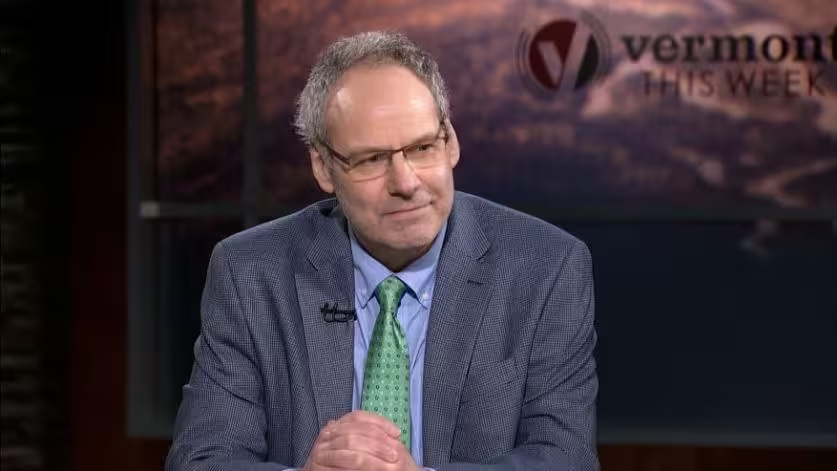
VT Air National Guard deploys to the Caribbean | Scott’s plan to avoid 11.9% property tax hike | Jason Eaton found competent to stand trial | Panel: Mitch Wertlieb - Moderator; Alicia Freese - Vermont Public; Liam Elder-Connors - Vermont Public; Calvin Cutler - WCAX
Problems playing video? | Closed Captioning Feedback
Problems playing video? | Closed Captioning Feedback
Vermont This Week is a local public television program presented by Vermont Public
Sponsored in part by Lintilhac Foundation and Milne Travel.
Support provided by:


Vermont This Week
December 19th, 2025
12/19/2025 | 26m 46sVideo has Closed Captions
VT Air National Guard deploys to the Caribbean | Scott’s plan to avoid 11.9% property tax hike | Jason Eaton found competent to stand trial | Panel: Mitch Wertlieb - Moderator; Alicia Freese - Vermont Public; Liam Elder-Connors - Vermont Public; Calvin Cutler - WCAX
Problems playing video? | Closed Captioning Feedback
How to Watch Vermont This Week
Vermont This Week is available to stream on pbs.org and the free PBS App, available on iPhone, Apple TV, Android TV, Android smartphones, Amazon Fire TV, Amazon Fire Tablet, Roku, Samsung Smart TV, and Vizio.
Support the crew
Help Mitch keep the conversations going as a member of Vermont Public. Join us today and support independent journalism.Providing Support for PBS.org
Learn Moreabout PBS online sponsorshipThe Vermont Air National Guard heads to the Caribbean as the state's delegation condemns the deployment.
Plus, Governor Phil Scott lays out a plan to help lower taxes as Vermonters are poised to face a 12% property tax hike next year.
And stemming from an incident two years ago that made headlines far beyond Vermont.
A man accused of shooting a group of Palestinian students in Burlington has been found competent to stand trial.
All that and more ahead on Vermont This Week.
From the Vermont public studio in Winooski.
This is Vermont This Week, made possible in part by the Lintilhac Foundation and Millne Travel.
Here's moderator Mitch Wertlieb.
Good evening everyone.
It's Friday, December 19th, I'm Mitch Wertlieb, and joining us on the panel is Calvin Cutler with Liam Elder-Connors and editor Alicia Freese, both with Vermont Public.
Thank you all so much for being here today.
We've got a lot to talk about as usual.
And I want to start.
Callvin, with a story that has made national news here, because of some fears of war with Venezuela and the Caribbean, what have you.
The Vermont Air National Guard has been deployed to the Caribbean.
What do we know about that deployment and the reaction here in Vermont?
Well, Mitch, we don't know a lot.
We did get some news that, the 158th wing of the Vermont National Guard that operates the F-35s out of South Burlington, we got news that they would be deploying and but really, officially, there were not a lot of details when, where, etc.
there was a national military publication that, published some inside information saying that they'd be stationed in Puerto Rico.
Nobody necessarily confirmed nor denied it.
So that's kind of common knowledge.
That's sort of, you know, but they're positioning themselves near Venezuela.
Of course, this comes amid the Trump administration really galvanizing and gathering, you know, military forces off the coast there, who knows exactly what what the, the end goal is.
But our congressional delegation, has really come out swinging against this.
You know, number one, concerns about a military buildup.
You know, nation building, potentially even, getting involved in foreign conflicts.
But also, I think the biggest concern that we've heard from all three of our delegates is sort of the separation of powers here, you know, in the War Powers Act and, the administration having the responsibility and the duty to come to Congress if we are going to war.
And that is really kind of where the devil's in the details here.
You look at, you know, both Republicans and Democrats on Capitol Hill are searching for answers from the Trump administration of, are we going to war?
There's been some classified briefings.
We don't know.
But but certainly, you know, that's kind of the fine line here and not too surprising that Vermont's congressional delegation is very much against this, but at least for freeze, a governor, Phil Scott, has also come out with some serious concerns about this.
What is he said?
He's also said that, if the Trump administration is indeed going to war in Venezuela, then, it would need to go to Congress for that permission.
Which is not necessarily an uncontroversial, opinion.
But, you know, I think it's interesting that both Scott and the delegation have said we don't have any information about this either.
And if you ask the delegation, at least they would say that's that's pretty, unusual.
And so, yeah, everybody is is waiting for answers.
And I think pretty deeply concerned in the meantime.
And the way this story was reported too is weird.
Yeah.
I mean, as I mentioned, I mean, you know, we got confirmation that they were being deployed, but so much of it has been speculation and or, anonymous sources, you know, published in sort of national or sort of trade a trade, but, you know, insider sort of military information publications and online.
And so we just really as, as the press, as Vermonters, we just really do not have a lot of, clarity into the situation here.
Is that related to the changing access of press, information at the Pentagon?
Is that just how, you know, the Trump administration is dealing with, you know, this specific, military intervention?
Again, we don't know, but it really is, you know, fascinating to see, you know, Vermonters here, you know, from Vermont and the F-35 potentially playing a really big role on on the national stage.
You know, I would ask you how many of the Vermont National Guard are going and how long they're going to be there.
But as you said, we just don't know.
The type of detail here is kind of stunning.
Yeah.
The one thing that we do know were that was reported but hasn't been denied, was that they are going to Puerto Rico and that there was a military base that's been shuttered, shuttered for a few decades, I think since oh four, forget the name of it, but that they'll be sort of stationed there at this, this military base that, the feds are bringing back online.
So again, I think there's a lot of frustration, you know, both from our congressional delegation, but there's Republicans on Capitol Hill that are looking for answers, too.
So we'll have to see.
All right, closer to home, Alicia.
Freeze.
Governor Scott has been talking about property tax hikes for a while now.
This is an issue that comes up every year, it seems.
Now, there is a plan now to avoid this 12% property tax rate hike.
What is the plan?
What do we know about that?
Yeah.
So the governor has come out and proposed essentially buying down that rate using one time, surplus money, $75 million worth of, surplus money to buy that down a few percentage points.
This is becoming a bit of an annual tradition in Vermont.
It's happened each of the last two years.
And his administration officials brought this proposal to the House Appropriations Committee.
And you saw some early skepticism from some Democratic lawmakers on that committee.
These are not necessarily new arguments.
But I would say the primary criticism is this is kicking the can down the road.
You're not actually reducing spending, education spending.
You're temporarily, holding down these rates.
And in fact, the of the 12%, predicted, average property tax rate increase, half of that is a result of the legislature and the governor's decision to do the very same thing, last year, which was about a $118 million buy down, I think, be.
Yeah, yeah.
And I think it's interesting too, because we're heading into an election year.
So I think both sides are going to be very cognizant of, how their arguments are playing with the electorate.
And, you know, you've got Democrats starting to make this fiscal responsibility argument.
Then you've got Scott saying, hey, I'm going to keep money, more money in your pocket.
I have to imagine that while people like fiscal responsibility, if you compare fiscal responsibility to money in your pocket, money in your pocket might win out.
But just a guess, and you know, as you were alluding to, this is a kick the can sort of approach here.
There's the money coming from the general fund, $75 million, 118 last year that that money it's not there's not an infinite supply I guess is the problem.
Right, right.
And I think there are indications that, yeah, we won't be seeing that those kinds of surpluses into, into the future.
But and I'll throw this out there to, to everyone.
What are the Democrats said about a possible alternative to Scott's plan, if anything?
Well, I'll say, as of right now, it appears that House Speaker Jill Kruczynski, Senate President Pro Tem Phil Brown, and the governor on the surface right now seem lockstep in the fact that we need to move forward, although not necessarily buying down the rates this year.
The speaker did have some some reservations about that when we last spoke to her.
But in terms of the broader education reform, you know, moving forward with, you know, redistricting, potential consolidation, a foundation formula, a new tiered property tax structure, you know, these big sort of, concepts that were agreed to in, you know, the bipartisan bill last year.
It appears as though, you know, leadership is really on the same page.
And to Alicia's point, though, what is going to happen electorally in an election year?
You know, I can only imagine that rank and file Democrats and Republicans are hearing from their communities in a huge way.
And I think that, you know, leadership can tell you one thing.
We're seeing this in DC right now, too, right?
Leadership has one vision or one sort of policy mandate.
But at the end of the day, you know, lawmakers, you vote your party, you vote your conscience, and you vote your constituents as well.
And sometimes this could be one of those votes like, we've seen with civil unions or the Clean Heat standard that really don't follow along party lines and that people really are, you know, their political future might depend on it.
So not to drone on, but I, I've talked with dozens of people, you know, off session here about leading up to the weeks of the session.
I ask, what's going to happen, what?
You know, what what do you think's going to happen?
And people say we have no idea.
So it is is very unclear what what sort of the path forward will look like this year.
I just think with the last election being so much about affordability and the red wave that we saw that was based around this idea of Vermont not being affordable enough, coming in and having another double digit, property tax hike.
That's not something that the Democrats are going to stand for.
If they don't want to see a repeat of the last election.
And so I think we have seen this over the years to where there's always a hesitancy.
We can't keep kicking the can down the road, but some form of buying this down ends up happening because it is just a not a palatable thing to to have these tax hikes keep happening.
And that's a great point too, because this is 75 million that we're talking about right now in the budget Adjustment Act.
There is still a long way to go until we pass the yield bill at the end of the session.
You know, we still we only have projections of two thirds of school budgets.
You know, we're going to have another revenue check in with the emergency board when the legislature comes back in January.
I think it's January 15th or 16th.
Economists are going to say, here's how state coffers are doing in terms of tax collections.
You know, there's this is just with budget adjustment when it comes to how, you know, the state is doing financially.
We'll see.
And that kind of gets to those broader macroeconomic trends.
We talk about this bifurcated economy or the k-shaped economy.
You know, how is that going to play out in tax collections for the state?
What will that mean for our ability to tackle, you know, rising taxes this year?
Who knows?
This session, like you said, it's going to be fascinating and unpredictable, which is what you're hearing.
Unpredictable.
Exactly.
Yeah.
Liam, elder Congress, let me turn to you because there's a story that's being revisited now, a really sad one from a couple of years ago around Thanksgiving time, 2023, when, a person in Burlington, allegedly shot three Palestine and students, wounding one of them very severely.
I believe he was paralyzed from from the shooting.
He is now been found competent to stand trial and not for the first time.
What can you update us on about this story?
Yeah, in some ways, this is a little bit of a, a little bit of a turn of the screw sort of situation.
Competency evaluations happen regularly.
It's essentially making sure that a person is able to understand the criminal justice system process.
Jason Eaton is accused of shooting three, Palestinians students two years ago, like you mentioned.
And he was found competent earlier in the year, through the court process.
But he made some concerning comments that raised some questions about his mental state during an open hearing in court.
And so, another hearing or another competency evaluation was ordered.
And that took a couple that took a while to get that done.
And recently that, evaluation found that he was competent to stand trial again.
So the trial is set.
For this summer, potentially.
But again, we still there's still a lot of process to work out.
Jason Eaton's defense attorneys are have hired their own expert to do a competency evaluation because they disagree with what the court appointed evaluation found that he was competent, which, again, this is a pretty standard thing that the defense is going to want to try to dispute, a competency, finding like this.
So we have to wait for that, another competency evaluation to get done.
Probably in the next 2 or 3 months.
We'll have better clarity on that and what the next steps are.
And if they're going to stay on track for trial.
Such a strange story in a lot of ways, because this came against the backdrop two years ago, of course, in the war in Gaza.
And a lot of people at first sort of assumed that this was, the shooting was a reaction to these students being, Palestinian descent.
But, you know, there's no proof of that.
We really don't know what happened here.
It's hard.
I mean, whenever, things like this happen, there's always a desire to find the motive, know and often.
Right.
The criminal justice system is about what actually happened and the motive can be a part of the narrative that is important in a trial.
But it's it's not necessarily something that we can always know.
And for hate crimes, the motive and the making, the comments or having hard evidence of the bias playing a role in the action is really important and necessary.
And so far, law enforcement and prosecutors haven't been able to find enough evidence to bring those hate crime enhancements in this case, doesn't mean it couldn't happen, but so far we have not seen that evidence turn up.
Okay, I appreciate the update on that.
Very sad story.
I want to stick with you, Liam, because there's another story.
This goes back also to an older case, having to do with the Addison County State's Attorney, who has received a six month deferred sentence for a DUI.
Is that right?
Yeah.
That's right.
Police say that she showed up at a crime scene and appeared to, be slurring her speech and smelling of alcohol, and so, she was arrested.
She refused to do a field sobriety test.
And this resolution, is one in which the the the charge could be wiped from her record as long as she follows the terms of her probation.
She pleaded no contest, which essentially means she's not admitting guilt, but it allows the court to impose a sentence.
What's kind of interesting about this is that the attorney general's office who is prosecuting the case, they objected to this resolution, which isn't something that I've seen too often.
Especially with the the no contest plea where, even they cost the attorney, the state's attorney and Addison County isn't admitting to guilt.
And the attorney general's office was saying that she hadn't adequately taken responsibility for her actions in this case.
Does this have the feel of, you know, favorable treatment?
Is that what some of the prosecutors are upset about here?
You know, it's a I think it's an interesting question.
I mean, most people that, get our first DUI that have a similar record to this, I think could see a similar resolution.
And so it's not a completely out of nowhere resolution to a case like this, but I think the attorney General's office has argued that, an elected state official, you know, who's in charge of prosecuting cases should be held to a higher standard.
And it's a pretty serious case to have that individual showing up to a what ended up being a murder investigation scene, potentially being intoxicated.
And it's interesting to marking this point, I'll say, in the saga of the state attorney because, you know, separately, we've seen, on separate concerns, you know, from the Vermont Democratic Party, Governor Phil Scott, there has been others that have called for her resignation.
I believe it was the entire Addison County delegation at one point called for, or almost the entire delegation called for her to step down, which she hasn't.
And, you know, the broader sort of state House policy discussion here, I don't know if you remember, after the, the incidents, the impeachment trials of, John Kerry's Moore and, state Attorney John LaVoy up in Franklin County, a couple of years ago that sparked this discussion about oversight and accountability of county level officials, which by and large, their elected by by the voters they served a number of years.
But from state law, there really weren't a lot of mechanisms to hold them accountable or to have oversight of them.
And so there was this county governance study committee that's been sort of working in the background over the past few years.
And just recently, I think it was about a month or two ago, you know, they met and they said, we don't really have any recommendations.
We're going to put this on the back burner.
And for now that that effort has has fizzled out.
So there is this this case moving forward with, state attorney echoes.
But the broader sort of where and what kind of oversight and how do we deal with, you know, public officials, on the county level, whether it's the state attorney, sheriff, whoever, that might be, you know, acting poorly or or, you know, have lost public confidence or public trust, in the voters, that that broader sort of framework of how do we get at that has is still yet to come to fruition, though elections are a form of accountability.
I think that's that's like one part of it.
Right.
You know, if the voters decide, not to vote again for, a county official, they have that authority.
So that's it's not an argument against needing additional oversight, but it is something that when I've talked with people about, like, what kind of oversight do we have about county officials?
It's like, well, ultimately, actually, the voters, provide a role of accountability, and they don't have to reelect someone if they don't want to.
Was it the Griswold case, Liam, in which to your point, the official was reelected?
Well, he was he was elected.
So John Moore is the sheriff of Franklin County, and there was a video that showed him kicking a handcuffed and shackled man, before he was sheriff, and he was already on the ballot and there was no one else running against him.
And so his his opponents were it was a write in candidacy, right?
In candidacies are very hard.
So you don't you know, we can't necessarily read everything into that.
He was the only person on the ballot in a race that people don't usually pay attention to.
Interesting.
Interesting stuff.
Alicia, freeze, I want to move to you now on this story that, has a recommendation.
The Washington Central, School Board has recommended the closure of a couple of schools.
What schools are we talking about here?
And what practical effect does this have, if any?
Yeah.
So these are two small elementary schools, one in Kalis and one in Worcester.
And, there has been talk for quite a while about, closing at least the, the Worcester school.
And just on Wednesday night, I believe, after a marathon, meeting that went well into the night, the board did ultimately vote to recommend closing both of these schools.
And, I say recommend because the decision making power actually rests with the voters.
So they've set up for February 1 town wide votes in each of these communities.
And it will be interesting to see what happens, because this is a school district that's under a lot of financial pressure.
And these are quite, quite small schools, a fewer than 100 kids in each case.
But they are beloved schools.
You know, attempts in the past have failed, to, to close these.
So, and we saw at this Wednesday meeting again, a lot of really, really strong support for the for these schools, which is why imagine the meeting went well into the night because of the passion about these small schools and, you know, the way people feel about them except to say, yeah, that's that's fair to say.
There are also some logistical complications that that the board is going to have to tackle in terms of finalizing its budget actually ahead of this vote.
And I think, you know, the district could be facing some severe programing cuts, as well, just because of the, the budgetary strain that it's under.
Yeah.
It's amazing.
We talked about this.
It seems like every week and this is going to be a topic that is just going to continue on as as we get into these schools, consolidation issues, everything around act 73.
But I really appreciate the update on that one.
In other news, state regulators have signed off on a mid-year budget adjustment that will allow Northwestern Medical Center in Saint Albans to bring in some extra money this year, even as they rejected the hospital's proposal to raise their rates with commercial insurers.
The Green Mountain Care Board's unanimous decision on this allows the medical provider to reap an additional $1.6 million in new business from expanded marketing efforts.
Now, regulators don't typically encourage hospitals to increase patient traffic.
But Calvin Cutler, what can you tell us about this case?
Yeah, a little bit unusual.
This is a little unusual.
And I think it does kind of mark a little bit of a sea change or a new precedent about how regulators are thinking about how money is distributed and flows through our health care system.
As you mentioned, they don't have the go ahead to charge more or to make more money, but they are allowed to by increasing prices, that is, but they are allowed to go out and help market or try to bring more customers into northwest.
And part of that is, you know, what other hospital, is, you know, in the northwest part of the state that has a lot of money and a lot of patient volume.
UVM Medical Center in Berlin.
Exactly.
The big one, the big one.
And so, you know what what this is, is in some ways, it's an acknowledgment and it's sort of, acknowledge from regulators that we want money to flow more equally and equitably through the system.
You know, we talk about UVM has a ton of resources.
You know, that's where most of the dollars in the system flow, because they are our academic research medical center.
Yet you have hospitals in other parts of the state that are struggling to meet their bottom line.
I think it's 7 or 8 hospitals.
I think last year ended in the red.
I don't know exactly.
Northwest's their, their financial situation.
They did ask for a 3% increase and they say they still need that from regulators.
But I think at the end of the day, this, you know, the Green Mountain Care Board saying that they're allowed to advertise, to try to bring in more patient volume and to bring in more revenue, really does kind of, you know, tack with what we're seeing with act 173.
I think it is it's that broad hospital transformation bill of, you know, how do we get the right resources in the right communities, at the right hospital, at the right time?
Kind of like what we're talking about with, you know, education finance reform and school governance, but that similar conversations happening with hospitals as well.
And this is just one more piece of how can we make money flow to more rural hospitals, from from UVM.
So the idea here being that maybe they can they can advertise, they can market their services to people that they may otherwise have gone to UVM Medical Center, say, look, I'm going to see in Albany instead.
Yeah, exactly.
Let's just say you have somebody that lives in Milton or you live up in Fairfax, right?
And you might, you know, get a procedure done down in UVM.
Well, we know also, one thing I should have mentioned is that northwest is is one of the cheapest hospitals.
They are very affordable.
And so if they can, you know, say, hey, maybe you can save a few hundred dollars on this procedure by coming to Saint Albans rather than to Burlington.
That might help sort of drive more patient volume and revenue to northwest.
So it's a little wonky, but it really does, I think, Mark some somewhat of a sea change, or at least it's worth noting about how, you know, regulators are thinking about how money flows through the system.
Calvin Cutler, let me stick with you, because Data Technologies, which has made a ton of news, going public finally, you know, there's this big aircraft, concern here in Vermont.
They're reaffirming their commitment to the state.
What do they say?
Yeah, well, one thing what's interesting about data being a publicly traded company is we now are able to sort of take a look under the hood.
And how are they doing with finances and, you know, dream.
It's it's really pretty remarkable.
We heard that they have about a $3.5 billion backlog of, of, of companies and contractors and people that want their either planes or their software.
And if 5 billion.
Did I hear you right, I, I that's that's what I yeah I believe so yeah of of of technology that they have sort of in the pipeline and so there's and to be they have not received FAA approval yet, which is, you know, another big piece to all of this.
But, you know, data is is gearing up to expand in a really big way here in Vermont.
And Kyle Clark spoke with reporters.
And basically he said, you know, we've had job fairs, you know, over the next 18 months, we're looking to hire about a thousand people.
And as we've talked so much about, these are skilled jobs, well-paying jobs.
And so this would be huge for for the state of Vermont.
And I think a lot of people are really bullish on it.
But there's the question, you know, we always come back to with our demographics and affordability, housing, right.
If you're going to bring in a thousand employees, you know, let's just say to the Chittenden County area or maybe summer over in Plattsburgh, where they also have a facility, where do you house them?
Where do you find childcare?
Do we have sort of the social infrastructure set up to support this job growth?
So I think that's one one really important piece.
But you know, it is significant that beta is saying that we're looking to scale up operations in such a big way, here in Vermont.
So we'll see.
But again, everybody still has their eyes on that potential, you know, FAA certification.
Will the planes actually get, be able to fly?
There's just so much unknown with the actual product that they're designing to.
And the whole industry of electric aviation, I think is is very tumultuous right now as well.
And so, I mean, it could be a great thing for Vermont and it has been so far, but it is also, I think, far from a sure thing to say that, that the company is going to, deliver on what it is promised.
And I think the public offering does allow us like a really good look at kind of what progress they are making.
So it's important and I think it's going to be something we're going to be really tracking for the next year here.
Yeah, it's it's true.
I mean, and that's I couldn't have said it better myself.
That's always one of the big questions that we have when we have a big company like this, like IBM or like a Global Foundries or like a, Green Mountain Coffee Roasters, you know, we, we have companies that come in and set up.
But like, what is the state's capacity to be able to to play host to these businesses and to support them?
If they make it to that, that stage.
So we'll, we'll see.
A lot of eyes are on what's happening at data technologies for sure.
And we'll keep on with your reporting on that as well.
Thank you very much for that update.
Finally, I want to talk about, Vermont once again, home to national champions.
It's just fantastic being able to say this.
The UVM men's rugby team won the D2 national championship.
Now, this is not NCAA because UVM does not, play that as a varsity sport.
But more than 100 teams competed around the country.
UVM absolutely crushed the University of Chicago, 71 to 5, in the final to take on the national championship.
So a year ago, we had the UVM men's soccer team winning it all now the UVM men's rugby team.
Hey, we're a bastion of sports here in Vermont.
I want to thank our panel, Calvin Cutler WCAX, Liam Elder-Connors and Alicia Freese from Vermont Public.
I'm Mitch Wertlieb, thank you so much for watching.
Join you again next Friday for Vermont this week.

- News and Public Affairs

Top journalists deliver compelling original analysis of the hour's headlines.

- News and Public Affairs

FRONTLINE is investigative journalism that questions, explains and changes our world.












Support for PBS provided by:
Vermont This Week is a local public television program presented by Vermont Public
Sponsored in part by Lintilhac Foundation and Milne Travel.