
December 2, 2023 - PBS News Weekend full episode
12/2/2023 | 24m 9sVideo has Closed Captions
December 2, 2023 - PBS News Weekend full episode
Saturday on PBS News Weekend, Israel’s offensive turns to southern Gaza, raising the death toll as hopes for a renewed cease-fire dwindle. Then, what a new methane deal reached at the United Nations COP28 summit means for the future of climate change. Plus, how abortion restrictions are affecting the care doctors can give patients in Wisconsin.
Problems playing video? | Closed Captioning Feedback
Problems playing video? | Closed Captioning Feedback
Major corporate funding for the PBS News Hour is provided by BDO, BNSF, Consumer Cellular, American Cruise Lines, and Raymond James. Funding for the PBS NewsHour Weekend is provided by...
December 2, 2023 - PBS News Weekend full episode
12/2/2023 | 24m 9sVideo has Closed Captions
Saturday on PBS News Weekend, Israel’s offensive turns to southern Gaza, raising the death toll as hopes for a renewed cease-fire dwindle. Then, what a new methane deal reached at the United Nations COP28 summit means for the future of climate change. Plus, how abortion restrictions are affecting the care doctors can give patients in Wisconsin.
Problems playing video? | Closed Captioning Feedback
How to Watch PBS News Hour
PBS News Hour is available to stream on pbs.org and the free PBS App, available on iPhone, Apple TV, Android TV, Android smartphones, Amazon Fire TV, Amazon Fire Tablet, Roku, Samsung Smart TV, LG TV, and Vizio.
Providing Support for PBS.org
Learn Moreabout PBS online sponsorshipJOHN YANG: Tonight on PBS News Weekend, Israel's# offensive turns to southern Gaza raising the death## toll as hopes for a renewed ceasefire window.# Then what a new methane deal reached at the## UN's climate summit today means for the future of# climate change, and how doctors are navigating the## new abortion landscape almost a year and a half# after the Supreme Court dismantled Roe vs. Wade.
WOMAN: It becomes clear that they're# leaning towards a termination I have## to say unfortunately, this is illegal# in the state of Wisconsin.
And it feels## like I'm abandoning my patients and saying that.
(BREAK) JOHN YANG: Good evening, I'm John Yang.
Tonight,# hopes for another pause in the fighting in Gaza## anytime soon have dimmed considerably.# Israeli Prime Minister Benjamin Netanyahu## ordered his negotiators home from Qatar,# saying the talks there had hit a dead end.
Since fighting resumed at least 200 Palestinians# have been killed bringing the death toll## since October 7 that's more than 15,200.
Those# numbers from the Hamas run Gaza health ministry.
Meanwhile, the focus of Israel's renewed aerial# bombardment of Gaza has shifted from the north.
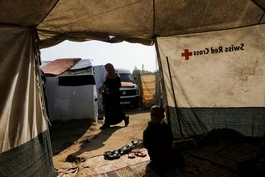
JOHN YANG (voice-over): In the southern Gaza# City of Khan Younis, the streets are engulfed## in smoke.
The Israeli military has dropped# leaflets urging residents of the city and the## surrounding area to evacuate further south but# beleaguered Gaza and say there's nowhere to go.
They seek refuge wherever they can find it like# this makeshift camp outside Al-Nasr hospital.
NIHAD ABU HABEL, Displaced Gaza Resident# (through translator): We fled the North## before comin ABU WAEL NASRALLAH, Displaced Gaza Resident# (through translator): Our houses are gone.## Our property is gone.
Our money is g What is left to cry for and then they# tell us we will get aid.
Where is it?
JOHN YANG (voice-over): As the wounded fill# Al Nasr hospital today that aid 50 trucks full## according to the Palestine Red Crescent# Society enter through the Rafah crossing## along the Egyptian border.
The first relief# since the ceasefire ended Friday.
Yesterday,## Israel had blocked me from getting into Gaza.
Since the fighting resumed the Israeli# Defense Forces says it has th an 400 Hamas targets across Gaza.# Israeli Prime Minister Benjamin## Netanyahu said the fighting would not# stop until Israel meets its objectives.
BENJAMIN NETANYAHU, Israeli Prime Minister# (through translator): We will continue the## war until we without the ground operation.
The ground# operation was necessary to bring the## results until now and it is necessary# to bring the results moving forward.
JOHN YANG (voice-over): With hopes of a renewed# ceasefire dissipating, Vice President Kamala## Harris spoke with reporters in Dubai, laying# out the Biden administration's vision for KAMALA HARRIS, U.S. Vice President:# Five principles guide our approach for## post conflict.
No forcible displacement,# no reduction in territory and no use# of Gaza as a platform for terrorism.
We want to see a unified Gaza and West# Bank under the Palestinian Authority and## Palestinian voices and aspirations# must be at the center of this work.
JOHN YANG (voice-over): Mark Regev, a# top adviser to Netanyahu says Israel## wants a security buffer zone inside# Gaza to further separate it from## Israel to ensure they will never be# a repeat of the October 7 slaughter.
MAR REGEV, Senior Adviser to Prime# Minister Netanyahu: You won't have a## situat directly on the border position just to# cross over and kill our people.
Again,## there will have to be security arrangements# on the ground to prevent that JOHN YANG (voice-over): In Tel Aviv and across# Israel, thousands rallied demanding the release## of the 136 hostages Israel says are still being# held by Hamas.
But Hamas leaders told Al Jazeera## today that there would be no more hostages# exchanged with Israel until the war is over.
JOHN YANG: At the United Nations# COP28 climate conference in Dubai,## Vice President Harris pledged $3 billion# toward a global fund to help poor nations## adapt to climate change.
The United States# also committed to doubling energy efficiency## and tripling the use of renewable energy by# 2030.
Harris said the time for action is now.
KAMALA HARRIS: The urgency of this# moment is clear.
The clock is no## longer just ticking.
It is banking, and# we must make up for lost time.
And we## must treat the climate crisis as the# existential threat that it truly is.
JOHN YANG: Officials also announced a# major new initiative aimed at getting## methane emission to near zero by 2030.
In Atlanta,## a protester is in critical condition# tonight after setting themselves on## fire outside the Israeli consulate.
A security# guard who tried to intervene was al Police said they found a Palestinian# flag of the scene and called it an## act of extreme political protest.
And a# Bavarian Blizzard has dropped record snow## amounts on much of Germany, Austria,# the Czech Republic and Switzerland.
The storm knocked out power to thousands# installed travel across the region,## grounding flights burying highways# and forcing mass transit to close.
Still to come on PBS News Weekend, a new pledge# to reduce methane emissions around the world and## how abortion restrictions are affecting the# care doctors can give patients in Wisconsin.
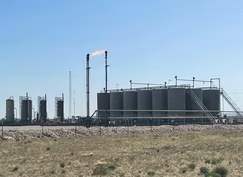
(BREAK) JOHN YANG: At the COP28 summit in Dubai today,## 50 oil and gas companies representing# about pledged to reduce methane emissions to near# zero by 2030.
Methane is a byproduct of oil## and gas production that can trap 80 times as# much heat as carbon dioxide in the short term.
The companies including industry# giants like Exxon Mobil, Shell and## BP say they'll achieve this by plugging leaks# at their facilities and ending th of burning off excess gas with flares.
The# same time the Biden administration announced## new rules to enforce major elements# of that agreement in this country.
Earlier, I spoke with Fred Krupp the# president of the Environmental Defense## Fund, who was at COP28.
I asked him# what makes this deal so important.
FRED KRUPP, President, Environmental# Defense Fund: John, I've been at this## for a lo I don't think we've ever had as good# a day for the climate as we had today.
First, we had the U.S. EPA announcing the# strongest methane rules for the oil and gas## sector on the planet.
Second, we had 50 companies# representing 40 percent of global oil production,## pledging to virtually eliminate their# methane pollution.
And then third,## we saw an announcement from the# U.S. and China that they've agreed## to incorporate methane in the future# into their pledges internationally.
And methane, John, is 80 times more powerful# as a greenhouse gas than carbon dioxide pound## for pound in those first 20 years.
And so# reductions now that will happen as a result## of these three actions mean that storms will be# less ferocious temperatures will be lower than## they would otherwise be over the next 10 years.# Thanks to the actions that were pledged today.
JOHN YANG: Is this a long term solution to the# problem is just a sort of short term quick fix.
FRED KRUPP: Well, we have to both do# methane to reduce temperatures in the## short term and we cannot stop working.# In fact, we have to accelerate our work## on eliminating carbon dioxide.
The oil# and gas industry took this one step.
But they have to do a lot more than this.# We have to move away from reliance or## dependency on fossil fuels as quickly as# we can.
But while we're still you them,## we have to eliminate this very# powerful greenhouse gas methane.
JOHN YANG: This agreement is voluntary.
The oil# companies have to do what they what they promised## to do.
And a lot of environmental groups don't# like that.
They say there's no accountability## mechanism or guarantee the companies will# follow through.
What do you say to that?
FRED KRUPP: Well, I think it's good to be# skeptical of pledges at the COP.
A lot of## pledges that have been made at this# Conference of the Parties year after## year aren't delivered on.
In this particular# pledge, we structured it to have built in.
So the oil and gas companies# are agreeing to report their emissions## by monitoring them and then sending them to# an international independent third party.
In addition to that, the Bloomberg Philanthropies# today announced a major $25 million gift to not## only the Environmental Defense Fund, but it will# stand up an accountability partnership, that will## make data transparent.
And so we'll be able to see# exactly who is meeting this pledge, and who's not.
JOHN YANG: But there's really# no teeth in that they sort of,## you're relying on public shaming, to just sort# of publicize that they're FR ED KRUPP: It turns out that oil companies in# order to stay in business, like other businesses## need public support a license to operate.
But# there is some more teeth than that.
Just a couple## of weeks ago, the European Union pass new methane# regulations that anticipate within a few years,## they will put in place import standards that# require companies to meet this sort of cleanup.
And the sort of cleanup we're talking about, John,# is not incremental.
The average company that has## signed up will have to reduce their methane# pollution by 80 to 90 percent, and not by## some faraway date of 2050 but by 2030.
There'll# be giving these measurements to an independent## international third party and methane sat an# Environmental Defense Fund project that we'll## be able to look at 80 percent of the oil and gas# infrastructure worldwide, multiple times a week.
And that's how we will know whether companies are# meeting the standards.
And then the purchasers## like the European Union, and maybe a few years# later Japan will be able to enforce that.
JOHN YANG: Today, of course,# the Biden administration,## the EPA also announced new rules on# methane.
How are these two work FR ED KRUPP: Well, the Biden administration# rules are the strongest on the planet,## that will not only help clean up the United# States, but here at the COP, I've been meeting## with oil companies from developing nations.
And# most of the questions they've asked me have been,## what's that EPA regulation coming out?# What are the monitoring requirements.
And so because the United States is the biggest# oil and gas producer in the world, other countries## and companies look to our regulations to kind of# set the bar for their practices, it's plugging## leaks, it's when the compressor seals were# out and the compressor is leaking methane,## you'll have to replace them periodically.
You'll# have to regularly go look for and fix leaks.
This isn't rocket science.
This is something the# oil company should already be doing.
But an 80,## 90 percent reduction, that's a very big deal.
JOHN YANG: Is the agreement to reach the lower# levels to essentially bring it to n 2030.
Or just the grid also due to specific things# of plugging methane leaks and stopping ven FRED KRUPP: The agreement is performance oriented.# So we know now that these companies are leaking## two or sometimes 3 percent of the methane, they# take it out of the ground natural gases, methane,## we can two or 3 percent.
And the agreement# requires near zero defined as 0.2 percent.
So going from 2 to 0.2, that's where you get that# 80 to 90 percent reduction.
The reductions in this## pollutant mean will actually reduce pollution in# the next 10 years that we'll be able to feel that## benefit will be able to reduce temperatures# from what we would otherwise experience.
JOHN YANG: Do you think this year's# summit will be the time that they## finally address fossil fuels and deal# with fossil fuels?
Either an ag to reduce them or an agreement to# eventually eliminate their use?
FRED KRUPP: Well, I don't know that# that will happen.
This year there's## been an agreement by many countries# over 100 countries to triple the## construction of renewable energy and# to double energy efficiency by 2030.
So we need that those things in order# to be able to rapidly get away from## fossil fuel.
But I don't know that the# language of do we face it out or do we## get out of it completely by when will# be agreed on I don't think that's likely JOHN YANG: Fred Krupp of the Environmental Defense# Fund at the COP28 summit.
Thank you very much.
FRED KRUPP: Thank you, John.
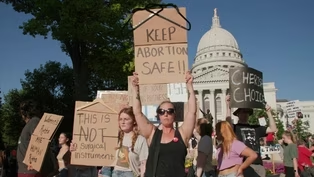
JOHN YANG: While the number of legal abortions# has gone up nationwide since the Supreme Court## overturned Roe vs. Wade, a recent report from# a group that supports Reproductive Rights sa there have been sharp declines in states that# impose new restrictions on abortion access.
One of those states Wisconsin saw# around 7,000 fewer abortions in the## year following the court's decision than the# state's annual average.
Marisa Wojcik of PBS## Wisconsin spoke with doctors there about the# effect on their work and on their patients.
JENN VOLLSTEDT, Former Labor and# Delivery Nurse: When I got the results,## I knew what I MARISA WOJCIK (voice-over): Jenn Vollstedt# is a former labor and delivery nurse in## Milwaukee.
At 12 weeks pregnant, Volstead# was told something weeks pregnant, she found out she# and her unborn child were at risk.
JENN VOLLSTEDT: I knew that if I carried that# pregnancy to term I was putting my own health## at risk.
And I also knew that my baby if# she survived a term would only suffer.
MARISA WOJCIK (voice-over): Jenn Vollstedt# made her decision while abortion was still## legal.
The cascade of events following the# U.S. Supreme Court's ruling ov constitutional right to an abortion# hit states like Wisconsin the hardest## creating a near total abortion# ban in the state one year ago.
CHRISTOPHER FORD, Emergency Medicine: We have yet## to see wha MARISA WOJCIK (voice-over): Healthcare# providers like Christopher Ford,## a Milwaukee based emergency medicine# physician found when the default legal standing reverted# back to a law from 1849.
It says destroying## the life of an unborn child is a felony,# except to save the life of the mother.
CHRISTOPHER FORD: We are in a situation where that## interpretation of a law from# 1849 is really a KRISTIN LYERLY, Obstetrician-Gynecologist: We# didn't even know that germs cause disease in 1849.
MARISA WOJCIK (voice-over): Before Roe v.# Wade was overturned, Dr. Kristen Lyerly,## an OB/GYN from Green Bay, counseled patients# at one of the few Planned Parenthood clinics in Wisconsin that provided abortions following the# decision she Dr. Ford and Dr. Jenn Jury McIntosh,## a maternal fetal medicine physician in Milwaukee,# joined a lawsuit challenging the 1849 law.
JENN JURY MCINTOSH, Maternal Fetal Medicine: Now# we're operating this narrow channel of providing## the best care not committing malpractice,# and being careful not to break a law.
These## pregnant people either have high risk conditions# themselves, so medical complications.
But on the## flip side, we also take care of fetuses.
So it's# the most Family Centered Outcome that we can.
MARISA WOJCIK (voice-over): Prior to the# Supreme Court's ruling, Wisconsin patients## and physicians had more options when it came to# making decisions KRISTIN LYERLY: We would have conversations# about what all their options were.
We would## talk about everything.
Sometimes we would# connect them with pr we would connect them with adoption services.# Sometimes they would go home and think about## it.
And they just wouldn't return for# that second visit.
But often they did.
MARISA WOJCIK (voice-over): Now these doctors# are managing a much different reality.
JENN JURY MCINTOSH: If it becomes clear# that they're leaning towards a termination, I have to say, unfortunately, this is# illegal in the state of Wisconsin.
And## if this is what you choose to pursue, then# we'll have to give you information on how to## pursue this out of state.
And it feels like# I'm abandoning my patients and saying that.
MARISA WOJCIK (voice-over):# Some physicians like Dr. Lyerly,## left Wisconsin so they can continue to provid KRISTIN LYERLY: I have the joy of working# in rural Minnesota and Northern Arizona on## the Navajo Reservation.
So in a way, it's very# satisfying.
But the truth is, I want to be home.
MARISA WOJCIK (voice-over): For# those who stayed they must now## navigate a law that many doctors feel i JENN JURY MCINTOSH: It's intrinsically vague,# which then causes physicians to potentially# second guess like is this risky enough?# Because everyone who practices medicine## knows that it can be very gray for a while# and then become very black and white.
And## you the longer you wait to intervene.# The worst outcomes are in general.
CHRISTOPHER FORD: We've heard reports, you know,## in other states that have very strict a you know, we've had patients that have# been told to wait in the car until they## become even more unstable in order to# present to the emergency department So at that point in time, they can do# something about it.
Now, of course,## that's an egregious example.
And that's# something that we do that is someone's interpretation of the law.
KRISTIN LYERLY: There was a time when I# sh e was bleeding, she was 21 weeks pregnant# with a desire pregnancy, but she wa so much that she had to go to the operating room# right away, and I had to perform an abortion.
And I couldn't help but to think to myself,# if this was happening to be in Wisconsin,## I would be terrified about what the# next steps would be about what the## implications for my future my career would be.
MARISA WOJCIK (voice-over): Physicians worry,## not only about the CH RISTOPHER FORD: What I'm seeing over and# over and over again, is this getting worse## over time.
And a lot of it has to do with the# access of health care, with the access of care## to Obstetrics and Gynecology, and a lot of the# voices that are at the table right now.
Don't see## these patients, and they don't have any medical# background, but they're making these decisions.
JENN JURY MCINTOSH: I just want to# do my job.
So the fact that politics## are trying to be present in my exam# room, present in the back of my mind,## as I'm looking at a patient and talking to that# patient and their family, that it's impacting## that at all feels crazy to me.
Because really,# we should just be providing the best evidence## based medical care that we can that's right# for that patient and right for their family.
MARISA WOJCIK (voice-over): And for Jenn# Vollstedt, she hopes in the future Wisconsinites## will be able to navigate these difficult# decisions without the barriers in p JENN VOLLSTEDT: Now, when I look back, I feel# so recovered and healed.
I also wouldn't have## my son if I didn't have this abortion because# of the timing if I had to carry it in term.
Julian, he is -- he just turned six# and he is one of the most joyful and## curious people I've ever met,# the more we try to focus on,## is that right or wrong?
Or is that okay?
The more# we're focused on making choices for other people,## when we're not involved in their health# care, and we're not medical professionals.
MARISA WOJCIK (voice-over): For PBS News Weekend,# I'm Marisa Wojcik, in Milwaukee, Wisconsin.
JOHN YANG: Now online, CDC data shows# life expense expectancy went up for## the first time since the pandemic,# but it's still lagging where it was## before COVID.
You can find all that and# more on our website pbs.org/newshour.
And that is PBS News Weekend for this Saturday.## I'm John Yang.
For all of my colleagues,# thanks for joining us.
See you tomorrow.
How abortion restrictions affect patient care in Wisconsin
Video has Closed Captions
How abortion restrictions affect the care Wisconsin doctors can give patients (7m 24s)
Israel pounds southern Gaza as hopes of reviving truce fade
Video has Closed Captions
Israeli offensive turns to southern Gaza as hopes of reviving truce dwindle (3m 39s)
What to know about the COP28 deal to cut methane emissions
Video has Closed Captions
What to know about the COP28 deal and new U.S. rules to cut methane emissions (7m 47s)
Providing Support for PBS.org
Learn Moreabout PBS online sponsorship
- News and Public Affairs

Today's top journalists discuss Washington's current political events and public affairs.

- News and Public Affairs

FRONTLINE is investigative journalism that questions, explains and changes our world.

 New Episode






 New Episode
 New Episode
 New Episode
Support for PBS provided by:
Major corporate funding for the PBS News Hour is provided by BDO, BNSF, Consumer Cellular, American Cruise Lines, and Raymond James. Funding for the PBS NewsHour Weekend is provided by...