
December 2, 2025
Season 4 Episode 112 | 26m 29sVideo has Closed Captions
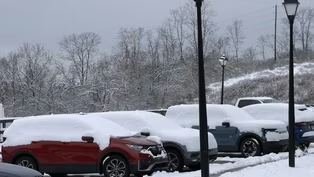
Snow blankets much of Kentucky, breaking records for some areas.
Northern Kentucky sees record-breaking snowfall to start December, how a new flu strain could impact Kentucky, UK receives its largest donation in history, and a Kentucky native is the new football coach at Kentucky.
Problems playing video? | Closed Captioning Feedback
Problems playing video? | Closed Captioning Feedback
Kentucky Edition is a local public television program presented by KET
December 2, 2025
Season 4 Episode 112 | 26m 29sVideo has Closed Captions
Northern Kentucky sees record-breaking snowfall to start December, how a new flu strain could impact Kentucky, UK receives its largest donation in history, and a Kentucky native is the new football coach at Kentucky.
Problems playing video? | Closed Captioning Feedback
How to Watch Kentucky Edition
Kentucky Edition is available to stream on pbs.org and the free PBS App, available on iPhone, Apple TV, Android TV, Android smartphones, Amazon Fire TV, Amazon Fire Tablet, Roku, Samsung Smart TV, and Vizio.
Providing Support for PBS.org
Learn Moreabout PBS online sponsorship*MUSIC* WE REPORTED BACK IN ABOUT midnight and were out plowing and treating all through the course of the night.
>> It's the first major snowfall of the season.
How are road crews keeping up?
>> This year's flu vaccine is not a terrific match with that particular strain of flu.
>> A new strain of influenza found in the Southern hemisphere.
What it means for flu season in Kentucky and the Wilstein era begins at Kentucky, as the Wildcats look to Oregon for their new football coach.
>> Production of Kentucky edition is made possible in part by the KET Millennium Fund.
>> Good evening and welcome to Kentucky edition for this snowy Tuesday, December the 2nd.
I'm Renee Shaw.
We thank you for spending some of your Tuesday night with us.
Well, snow is the story for today.
As much of the state saw accumulation early this morning.
School was canceled in several counties across the state, including in Kentucky's two largest school districts.
But it was northern Kentucky that saw the most snowfall, enough to break a record.
Our Emily Sisk has more on that and tells us how Boone County crews are getting the roads, the roads rather ready for travelers.
Details in tonight's weather coverage.
This is the.
>> Snowiest December 2nd Northern Kentucky has ever seen.
Just over four inches were recorded today in Covington and at the CVG International Airport.
Both Boone and Kenton counties were under a level one emergency today to alert residents of hazardous road conditions.
>> Our crews really got started yesterday preparing with things, getting all the trucks ready and salt loaded and vehicles and everything, and even the ones some spot pretreatment and stuff here in certain locations.
Then we reported back in about midnight, and we're out plowing and treating all through the course of the night.
We have 40 trucks here in Boone County that we were able to put out last night, and we cover about 500 miles of roadway.
>> Boone County Engineer Robert Frank said the majority of snowfall came between midnight and 5 a.m.
Boone County recorded between 4 and 5in of snow.
>> The majority of the hard, hard work started about 5 a.m.
when the when the snowfall actually stopped.
And of course, that's when traffic generally starts to pick up, too.
>> Frank said the 40 plus truck driver crew focused on primary roads and highways, then began clearing secondary roads this afternoon.
He gave credit to drivers in Boone County, saying most people stayed off the road and allowed the work to get done, and he was confident that despite the record breaking snowfall, most county roads should now be passable.
>> For the most part.
You just see wet pavement with the occasional slushy area and stuff like that.
Obviously shoulders and curbs and gutters and things like that.
We'll still see some some accumulation of slush and whatnot there, but for the most part everything is very, very passable.
>> As freezing temperatures persist in the coming days, road crews will keep an eye out for icy roads.
>> We'll have crews that are consistently watching for refreezing areas and slick spots and things like that.
>> And the Boone County engineer had a word of advice for travelers who are braving the cold.
>> When you do see plow trucks around or salt trucks, give them some extra space.
The the crew has been working quite, quite some hours, right?
I mean, they work a full day yesterday and then report back in at midnight.
So certainly those those folks are seeing some challenges of fatigue and whatnot.
So give them as much space as possible.
>> Boone, Kenton and Campbell County Public Schools were all out today due to inclement weather.
No word yet if they'll be closed again tomorrow for Kentucky edition, I'm Emily Sisk.
>> Thank you, Emily, the Boone County engineer, said for a snowstorm like today's, the Public Works Department will use around 300 tons of road salt.
A new flu strain was found in the Southern hemisphere this summer, and it could impact Kentucky's flu season.
What to expect from the flu this year and tonight's medical news.
>> This year's flu season.
>> Looks a lot like last year's flu season.
We started to see an uptick in cases in the middle of November, which was maybe a week or two earlier than last year, but not substantially different.
It's too soon to predict what the season will be like, but we can take some hints from what has been happening in other countries.
So at the end of the flu season in the southern hemisphere, so late summer, a new strain of influenza H3n2 emerged.
This was a drifted strain that had several mutations.
It's called subclade K. And what we know is that strain of influenza A, H3n2, presented itself after the vaccine was already made.
And so this year's flu vaccine is not a terrific match with that particular strain of flu.
I can tell you locally, we are seeing influenza A three N2 circulating, and that's what we're seeing most commonly.
I can't tell you if it's the drifted strain because we don't test for that locally.
Even when there is a imperfect match between one of the circulating flu strains and the vaccine, the vaccine still protects against severe outcomes like hospitalization and death.
So I don't want people to get the idea that flu vaccine isn't effective.
Remember, we also have three strains of flu that are circulating and and and so the vaccine is the very best protection.
Last year the flu season was severe for people of all ages.
And one factor that likely played into that is that influenza immunization rates were low.
And so this year it appears that vaccination is is still lagging a bit.
Last year in the US we had 280 children die of complications related to the flu.
About half of those, just under half of those were previously healthy children who did not have underlying health conditions.
89% of them were unimmunized.
So flu is a vaccine preventable illness, and there is still time to protect yourself and your family from influenza.
>> Doctor Bryant says that though the flu is caused by a virus, there is medication that can help those most at risk for complications if caught early.
She encourages those who test positive for the flu to talk to their doctor and see if antiviral medicine is right for them.
A new law on the books will help people recovering from substance abuse.
The bill, signed by President Donald Trump, includes a provision introduced by U.S.
Senator Mitch McConnell of Kentucky.
McConnell added the comprehensive Addiction Recovery Through Effective Employment and Reentry Act of 2025, also known for short as career.
It will fund stable transitional housing and other support for people trying to get and keep a job while recovering from substance use disorders.
This reauthorizes the Career Act passed in 2018.
Since then, Kentucky has received more than $12 million in federal funding.
Senator McConnell said this quote In Kentucky, this crisis has taken lives at an alarming rate, impacting not only families and communities, but also our workforce.
That's why I'm proud to continue leading efforts to combat the epidemic's devastating impact on American workers and our economy.
End quote.
Kentucky woman is again working to overturn Kentucky's abortion ban and clarify the state's in vitro fertilization law.
The Kentucky Lantern reports.
Lawyers for Jessica Kolb argued before Jefferson Circuit Court Judge Brian Edwards yesterday.
They argued Kentucky has a patchwork of laws that could complicate Forbes ability to safely continue with the IVF process.
She has fine frozen embryos and says she doesn't know how to proceed with the IVF process.
Under Kentucky's laws on abortion and definition of life, the attorney General's office says the IVF procedure is protected in state law.
An attorney representing the attorney general said that in vitro fertilization assists with pregnancy instead of terminating it, and does not violate the Human Life Protection Act.
And that is five embryos, as I mentioned before.
The Trump administration is proposing changes to the federal student loan system that would put a cap on how much some students can borrow.
The cap would impact nursing, physical therapy, dental hygiene and other fields that the Department of Education no longer defines as professional programs.
The plan is still being finalized.
Leslie Sizemore is with the Kentucky Council on Postsecondary Education that oversees the state's colleges and universities.
Earlier today, I asked her about the message this change could send to colleges and universities in the state.
>> It changes the structure for federal loans is what it does.
So if you are not categorized in that professional category that that existed beforehand, then the loan limitations are put in place.
So you'll you'll be able to borrow less money.
It's more of an issue with our very expensive degrees like dentistry and medicine and those degrees that cost really a lot of money to get out.
So that's the concern.
When they categorize other fields like nursing into those and say they're not a professional program, it's not really saying that nursing isn't a professional program.
It's just saying that they don't fit that that category.
To borrow the extreme amounts of money.
So I think it is a concern for higher education.
But we know that in order to be viable in the future, we have to keep the cost of education down.
So it's something that I know Doctor Thompson is very concerned about.
And all of our institutions in the state are public institutions, are very concerned about is keeping that cost down.
>> Right.
But also about the the how their programs are able to survive, if perhaps there's going to be some cap or capacity at which you can borrow money in these critical areas, that may deter folks from that field of study altogether.
And then there are a lot of programs that are built up, academic programs built up around that.
So it it is it has systemic reverberations, right.
>> It's a message to the higher education institutions for sure.
So we are concerned about that.
And we're continuing continuing to monitor that.
So, you know, that's why it's so important to have our federal lobby and for people to really stay informed about those situations.
You know, our smaller institutions are of greatest risk.
And some of our public institutions that really put out a lot of our health care folks, you know, I mean, they are really very critically at risk here.
I think, with some of these federal legislative moves.
>> Yeah.
And it could also discourage those who are in certain socio economic strata to not pursue these fields, those who can afford to take on more debt will be able to do it, but those who can't may have to look elsewhere to other opportunities and career or work.
>> That's exactly right.
I think one of the things that this administration struggles with is understanding that workforce is not just your blue collar, you know, HVAC, electrical, plumbing, those are the the fields that they're really encouraging.
And we need those U.S.
desperately across our state and across our nation.
But our professional fields are also in crisis for workforce.
And so we need to to not forget that workforce means a great spectrum of professions, not just those more technical fields.
>> More higher ed news.
The University of Kentucky just received its largest donation in history.
The Bill Gates Foundation is giving UK $150 million to create an arts district.
President Eli Capilouto says plans include relocating and constructing a new College of Fine arts, building a new theater for dance, music and theater performances, and a pavilion with a park connecting several blocks of campus near South Broadway and Bolivar Street.
Bill Gatton and his foundation have now given more than $350 million to his alma mater.
Construction on the new Arts District will require legislative approval.
In a statement, Kentucky Senate President Robert Stivers said he's anxious to sign off on the project.
Quote, this expansion may be the impetus for more students pursuing a fine arts degree and perhaps working in the film industry, a growing industry made possible by Senate Bill one of the 2025 session.
End quote.
Former Kentucky Secretary of State Ken Harper has died.
Harper was also an eight term Republican state representative from northern Kentucky.
He first served in the House from 1964 to 1968, and again from 82 to 94.
He was Secretary of State from 1971 to 72.
Harper was also a graduate of the Kentucky Military Institute, and was a U.S.
Air Force veteran of the Korean War.
One of his many accomplishments includes legislation that created Northern Kentucky State College, which would later become Northern Kentucky University.
Mr.
Ken Harper was 94 years old.
There was another notable death in Northern Kentucky this week.
Mr.
Oakley Ferris died yesterday at the age of 101.
The businessman and philanthropist was born in southern Kentucky, but moved to Covington after serving in the Army during World War two.
The Northern Kentucky Tribune says Ferris was, quote, celebrated for his generous support of the arts.
Funeral arrangements for Oakley Ferris are pending.
There are concerns that cuts to a federal housing program will mean more homeless Kentuckians, and an animal advocate wants tougher cat and dog breeding laws in Paducah.
Our Toby Gibbs tells us more in this look at headlines around Kentucky.
>> Trump Administration's Department of Housing and Urban Development, or HUD, is capping funding for Long-Term Housing Programs.
Louisville Public Media reports that has homeless service providers worried.
Catherine Mcqueeny, communications director for the coalition for the Homeless in Louisville, says 1000 of the 1600 people in a Long-Term Housing program could end up back on the streets.
And the Kentucky Housing Corporation says the HUD plan would eliminate rental assistance for 2600 Kentuckians with disabilities.
The Springfield Sun reports Marion County will pay $1.6 million, and the city of Lebanon will pay $412,000 to resolve a wrongful death lawsuit with the family of Joseph Joey Martin.
Martin died in the custody of Marion County sheriff's deputies almost three years ago.
The sun says deputies arrested Martin for waving a gun at his wife.
Deputies tased, pepper sprayed and hit Martin after he broke out the rear window of a sheriff's vehicle.
His death was ruled a homicide by asphyxia due to law enforcement use of force.
Animal advocate Kimberly Yates is urging Paducah to create an ordinance to regulate puppy and kitten breeding.
According to the Paducah Sun, a proposed ordinance would require breeders to have a license, limit the number of animal litters and include spay and neuter requirements.
City Commissioner John Thomas says the goal is to crack down on puppy mills.
The legislation's future is unclear.
Country music star Tyler Childers popped up at the Paintsville Walmart on Black Friday.
According to the Murray Ledger, Paintsville police say he stopped by their booth as police, firefighters and EMTs raise money for their Helping Heroes campaign, which provides for children in Paintsville and Johnson County over the holidays.
Police would not say if Childers made a donation, though he's known for his charity work in eastern Kentucky.
With headlines around Kentucky, I'm Toby Gibbs.
>> The University of Kentucky has a new football coach.
More about that in today's sports news.
Will Stein was the offensive coordinator at Oregon.
He's a Louisville native who won three Kentucky high school titles at Trinity and walked on as a quarterback at U of L. His father, Matt, played for Kentucky, and Stein grew up cheering for the cats.
This is the 36 year old's first head coaching job.
Not bad.
Stein takes over the program from Mark Stoops, who was the longest tenured coach with 13 seasons at Kentucky before he was fired yesterday.
Stein arrived on campus today and will be officially introduced at a news conference tomorrow at 4 p.m.
Eastern time.
Here's a statement from Coach Stein says, quote, I'm honored and excited to become the next head coach at Kentucky.
Growing up in Kentucky and sitting in the stands at UK games as a kid, I could only dream of one day leading the Wildcats and this is truly a dream come true.
My goal is to lead with purpose and help young men grow on and off the field.
Quote.
Christmas traditions abound this time of year for many families in this Kentucky life.
Extra.
Our Chip Polston takes a look at how some of these beloved activities first started right here in the Commonwealth.
>> Thanks much.
It's good to be with you again.
From decorating the tree to hanging stockings or mistletoe, Kentucky history is rich with holiday customs.
But where did they originate?
We took a journey across the Commonwealth and across time to Christmas past to learn about some familiar traditions and some not so familiar.
In the 1700s, Kentucky was at the edge of the frontier, wild, untamed and full of promise.
Among the first settlements stood Fort Boonesborough, built by Daniel Boone and his companions in 1775.
Life was harsh, but at Christmas families celebrated quietly in their cabins, sharing simple meals, music and moments of gratitude that kept hope alive.
Today, Fort Boonesborough keeps those traditions alive by inviting visitors to experience Christmas, as the settlers once did.
>> We began with just a few volunteers, and we started by having different cultures that would have been represented on the frontier.
Represented in each of the cabins German, Dutch, English.
Irish.
Scottish.
Because the immigrants that came here would have brought their Christmas customs with them.
>> One such German tradition, now mostly forgotten, can be seen here.
This reenactor may look like Santa at first, but he's actually Krampus who came for naughty children.
Half goat and half demon.
Krampus rattled chains and carried switches to warn misbehaving children.
Though the custom has faded, echoes of Krampus still appear in festivals, a reminder that Christmas once held both light and shadow.
>> Christmas was not celebrated in the same way we do today.
It wasn't very public, and so people did their personal celebrations in their own homes.
There's very little documentation of Christmas celebrations on the frontier.
One thing that they did do around that time was make mincemeat pies, which was a form of food preservation.
It was a way to save meat.
They would chop that up with dried fruits and berries and nuts, and then bathe it in rum and let it ferment and then bake it into a pie.
But tonight we have various frontier foods represented that would have been left over from harvest or preserved for later in the year.
We don't know for sure if people gathered together, but we feel like that the early settlers would have pooled their resources, maybe to have a special meal.
>> Moving forward to the Victorian era of the 1800s.
Our first stop is my old Kentucky home state park in Bardstown, once home to the Rowan family and visited by distant cousin Stephen Foster.
It's believed to have helped inspire foster in the writing of Our State song.
>> Our Christmas exhibit, which is called Merry and Bright, runs from mid-November through the beginning of January, and it focuses on Christmas traditions at the Rowan family would have celebrated here at Federal Hill.
We have trees in just about every room in the house, which is something the Rowan family never would have had.
They would have had one tree in the house, probably after the mid 1840s, which is when they became popular and it would have been a small tabletop type of fir tree.
We have one of those in the parlor, which is decorated with glass ornaments, hand knitted or tatted ornaments, as well as candles which would have been lit only on Christmas Eve or Christmas Day for a very few minutes, and there would have been buckets of sand and water standing by, because those candles were the source of untold thousands of house fires.
The way that the Rowan family would have decorated their home during Christmas wouldn't have varied a whole lot from the way that the ordinary families, who were perhaps less well off, would have decorated theirs.
Because most of the things that you'll see around the house are things that come from outside a tree.
Pieces of holly, ivy, magnolia leaves, things that stay green for most of the year.
The idea of celebrating Christmas is something that everyone in Kentucky could have done on quite a slim budget.
>> Our final stop is Riverview at Hobson Grove, a historic mansion in Bowling Green.
Construction began on this estate in 1857, but was paused during the Civil War when Confederate forces used the basement for munitions.
It was later completed in 1872 and now preserves the elegance of the Victorian era.
Today, visitors can experience that history and the warmth and charm of a Victorian Christmas.
>> A lot of people are surprised when they come to not see a full sized Christmas tree, and we have a tabletop tree in our front parlor from the Victorian period.
Prince Albert, who was married to Queen Victoria, was of German heritage and he actually introduced the Christmas tree.
There's a very famous rendering of Queen Victoria and Prince Albert in Godey's Lady's book, with their table top Christmas tree.
We have a lot of the Hobson's original pieces on the table.
We have gilded walnuts on the table as well.
That was something the Victorians did.
They would either paint or gild walnuts, and those could be scattered across the table, or they would hang those on the tree as ornaments.
And in the nursery upstairs, we actually have what's called a cobweb party set up, since there weren't as many gifts.
To make it a little more exciting, they would usually tie a piece of string to a present, and then create a web with the strings, and you would give the child the ball of yarn at the end, and they would have to follow that to find their present in the room.
>> Whether in frontier cabins or grand Victorian homes, Christmas has always been a time to come together, sharing stories, meals and joy.
The heart of Christmas remains of hope, love and togetherness that transcends time.
Great stories like this one come your way on our show each Saturday night at eight eastern, seven central, right here on KET.
We wish you a merry Christmas and the happiest of holidays as we continue to cherish this great Kentucky life.
Back to you.
>> Thank you Chip and happy.
Merry Christmas to you too, friend.
That is it for us

Video has Closed Captions
Clip: S4 Ep112 | 3m 29s | What new strain of flu found in Southern Hemisphere could mean for Kentucky. (3m 29s)
Kentucky Gets First Major Snowfall of Season
Video has Closed Captions
Clip: S4 Ep112 | 3m 17s | Road crews out in force after first major snowfall of the season. (3m 17s)

Loan Cap Proposal Raises Concerns for Health Programs
Video has Closed Captions
Clip: S4 Ep112 | 3m 43s | Impact proposed loan cap could have on nursing, therapy programs in Kentucky. (3m 43s)
Providing Support for PBS.org
Learn Moreabout PBS online sponsorship
- News and Public Affairs

Top journalists deliver compelling original analysis of the hour's headlines.

- News and Public Affairs

FRONTLINE is investigative journalism that questions, explains and changes our world.












Support for PBS provided by:
Kentucky Edition is a local public television program presented by KET