
December 20, 2024 - Rep. Abraham Aiyash (D) | OFF THE RECORD
Season 54 Episode 25 | 27m 45sVideo has Closed Captions
Topic: Lame duck session draws to stalemate. Guest: Rep. Abraham Aiyash, (D) House Floor Leader.
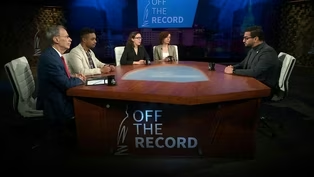
This week the panel discusses the Democrats at odds with each other and Republicans take a hike in the Michigan House as the lame duck session draws to a stalemate. The guest is House democratic floor leader Abraham Aiyash. Colin Jackson, Clara Hendrickson and Jordyn Hermani join senior capitol correspondent Tim Skubick.
Problems playing video? | Closed Captioning Feedback
Problems playing video? | Closed Captioning Feedback
Off the Record is a local public television program presented by WKAR
Support for Off the Record is provided by Bellwether Public Relations.
December 20, 2024 - Rep. Abraham Aiyash (D) | OFF THE RECORD
Season 54 Episode 25 | 27m 45sVideo has Closed Captions
This week the panel discusses the Democrats at odds with each other and Republicans take a hike in the Michigan House as the lame duck session draws to a stalemate. The guest is House democratic floor leader Abraham Aiyash. Colin Jackson, Clara Hendrickson and Jordyn Hermani join senior capitol correspondent Tim Skubick.
Problems playing video? | Closed Captioning Feedback
How to Watch Off the Record
Off the Record is available to stream on pbs.org and the free PBS App, available on iPhone, Apple TV, Android TV, Android smartphones, Amazon Fire TV, Amazon Fire Tablet, Roku, Samsung Smart TV, and Vizio.
Providing Support for PBS.org
Learn Moreabout PBS online sponsorshipIn the queue is House Democratic floor leader from Hamtramck, Representative Abraham Aiyash.
Democrats at odds with each other and Republican has take a hike in the Michigan House.
The lame duck session falls apart.
Joining in the conversation, Colin Jackson, Clar Hendrickson and Jordan Hermami sit in with us as we get the inside out.
Off the record.
Production of Off the Record is made possible in par by bellwether public relations, a full servic strategic communications agency partnering with clients through public relations, digital marketing and issue advocacy.
Learn more at bellwetherpr.com And now this edition of Off the Record with Tim Skubick.
Thank you very much.
Welcome to the lame duck edition of Off the Record.
We have a quorum, everybody.
You know what I'm saying?
This has been quite a week in our town and the whole thin kind of fell apart, didn't it?
Yeah, absolutely.
I mean, we haven't been.
Wednesday and Thursday, you haven't had a full Democratic courtroom or a full quorum in the House to even start to hold a vote.
You know, Wednesday when they adjourn, we were told that there weren't ther wasn't even a session to adjourn becaus they never actually gaveled in.
They never move past the attendance.
Friday, the 13th day when lawmakers usually are in Lansing, you saw House lawmakers trying to pass bills and then Republicans walked out in the first vote, said they were going to come back unless they got road funding, tipped wages and sick leave policie passed, even just shell bills.
And that didn't happen.
They never came bac until the very end when we saw Matt Hall, speaker elec Matt Hall coming on to the floor to come and talk to reporters Tuesday.
Yesterday and today they held press conferences kind of flaunting that and.
Yeah, yeah, well, here's a set up of what it looked like.
If you're the eternal optimist, you could look at these new development under the dome to be good news.
Detroit Democrat Sylvia Santana boycotted yesterday's Senate session, but today she showed up, giving the Democrat a chance to pass legislation and move it to the Michigan House.
But that action would have been meaningless.
That's because over in the House, it was day three of a stalemate, with Republicans still refusin to sit in their seats and vote and the Democrats, well, still unable to muster enough votes to vote on anything.
Detroit Representative Karen Whitsett boycotted the House session yesterday.
She actually showed up in the Capitol today.
That was the good news.
But that, too, was meaningless because instead of moving to the House floor to give the Democrats 56 votes to start moving their agenda, she holed up in the office of the House Republican leader Matt Hall.
That's right, the House Republican leader.
You can't make this stuff up, folks.
From there, she reportedly sent signals that she would be there on the floor to vote yes, but then she said no and it went back and forth between the two choices.
And finally she landed on a fat N-O.
So while having he show up for work was a positive, it really meant nothing since she would not vote unable to muster those bodies to vote.
A frustrated House Democratic Speaker, Joe Tate, told everybody to go home for the holidays and don't bother to come back tomorrow or even next week.
Instead, he advised everybody to come back on New Year's Eve, December 31st.
Apparently not to pop any corks on the champagne bottles, but to vote on the Democratic agenda for the last time i the Republicans will be popping their champagne bottles as they take over control of the House in the new year.
So what does all this mean to you?
If you wanted a permanent fix for the roads, it's on hold.
An economic tax credit package to create more jobs.
It's on hold.
And about 70 other bills in the same category, including a ban on bump stocks and ghost guns.
Come December 31st or sooner, it is clea the Capitol dome will be there.
But who's under it to do the people's business?
Not nearly as clear.
In fact, it's a little fuzzy.
In fact, it's a little more than fuzzy.
Well, I think it's pretty clear what the plan is now.
They kept kickin the can down the road each day, maybe thinking they'd get a quorum.
But the plan is to adjourn for the year on the 31st.
They're not going to vote on any legislation.
Everything that the Senat stayed up overnight last week to pass is dead in the House, including expanding the Freedom of Information Act to cover the governor in the state legislature, a bipartisan initiative.
It's all it's all dead in the House.
Yeah, I mean, what is going on right now, though, is that the Senate is now approaching at least as the time of recording this morning, a 24 hour marathon session.
They opened at 10 a.m. on Thursday.
It's now just a little after nine on on Friday.
And they're moving and shak and trying to push out all that they can regarding House.
Already House passed legislation that they could realistically then go on and sign to the governor that includes expanding hate crime legislation, that includes tamping down on youth labor related laws.
That means there's just all sorts of things that they're trying to push through.
And I'm struggling to remember at this point because I've been staying in the Senate.
I mean, you heard trade.
Is another.
Big.
Yeah, you heard Colin this morning.
We've been trying to cover this all we can, but the long and the short of this is it didn't have to be this way.
It didn't have to be this way at all.
And where it came down to was it's seemingly a communication breakdown on priorities and on who was willing to back those priorities.
You have Whitsett finger pointing, saying, well, I was misled by leadership in talks.
You have some folks in leadership saying, well, we told you one thing and maybe what you heard is something different.
Then you have other Hous lawmakers who are saying, hey, I have no interest in backing some of this stuff either.
Peter Herzberg of Westland is another name that will probably be hearing later on in the show who was unwilling to back Karen Whitsett one big one of her big priorities were the water affordability bill.
He was a guaranteed no vote on that, from my understanding.
We can talk t the representatives after this.
But yeah, I mean, it just seemed like it was a group of peopl who wanted my way or the highway and they chose the highway.
Here's the problem for Speaker Tate with all of his members.
Each one is a mini speaker.
Each one had the power to drag the system down.
And that's exactly what happened, right?
Yeah, exactly.
And we when we talk about legislatures, this legislativ class of Democrats came in with, I believe about half of their caucus knew never having served in the legislature before.
So you have a bunch of people come into Lansing thinking, I'm going to be the on that makes all the difference.
That's going to get all the wins for my district.
And yes, you know, everyone has this expectation that you're going to have to compromise or something like that.
But I don't think people really recognize what the job's going to be until you get there.
You start learning.
You start learning about th different pressures on the job.
And if you're a speaker, you have to keep all these people together, you know, and I've heard different criticisms of him and his leadership style from various points of the caucus, not just new members, but that is still a very big hurdle to go to overcome when you're leading a new caucus that has a lot of expectations for this big fanfare, the first Democratic trifecta in 40 years.
And you saw House Democrat try to make that point earlier in this week, there was a very small about six Democrats gathered a bunch of us press into a room and said, hey, listen, we understand we have a lot of new members.
Not a lot of the are willing to be team players.
They don't really know how to play on a team.
But that message was really undercut when at the end of the day and at the end of the term, we go back to, you know, they do sort o like a last day of school photo in front of the rostrum, Joe Tate absent.
Karen Whitsett, absent Joe Tate, in fact, didn't scrum at all with any media, as far as I'm aware, at any point this week.
He was very difficult to find.
He was shutting doors in reporters faces when they tried to track him down in the Capitol.
I don't know how you lead if you're unwilling to even be willing to talk to the folks that you're supposed to be accountable to in the first place.
And to boot off.
So well, we always knew that Democrats were going to have this razor thin majority, both in the state House and the state Senate.
And remarkably, they stayed together at the beginning of this trifecta.
And I think that's in large part because they were all on the same page about what the agenda was, all of these pent up priorities that had stalled under GOP control.
They got it all done very quickly.
And now this trifecta has totally collapsed at the very end.
And I mean, this is the first lame duck that I've covered, and I was expecting a little bit more cohesion around what the agend would be in the plan going in.
And they went out.
They never had a plan that you talked to.
Winnie Brinks, you talk to Joe Tate, Governor Whitmer, three different sets of wishlists and so, you know, at that poin you get basically 76 Democratic members running their own lame duck simultaneously.
Led the boycott by Mr. Hall.
Did it work?
I mean, if you ask him, yeah.
He was the only person I saw today that looked happy around the Capitol.
So, I mean, that says it all.
You know, And I mean, from the moment that when Republicans walked out Friday, one of the comm people came by the press desk, I believe the term he used was, we're going to try something fun and exciting.
Next thing we know, everyone that's sitting around the press desk, all the reporters, even the ones that are normally there, that are there for lame duck are all funneling down the skinny hallway following Speaker elect Hall into the main hallway, the first floor of the Capitol where they had set up a podium with all 54 members of 53 other members behind them.
How holding a press conference did it again Wednesday morning at the Nuthouse in Lansing.
And then Thursday he was able to have these press conferences around the state, you know, not even not even pretending like his members were willing to come in to Lansing if the priorities were to get on the table.
So he got what he wanted.
The Democrats didn't.
Everything that was in the House, as Jordy said earlier, died in the House.
For the optics.
The Democrats see the optics.
Look at lawmakers.
We pay you to sit in your seats and vote.
Even if you don't want their support, our staff show up to work.
Well, and so they have a point.
I will absolutely give them that.
I do think it's ridiculous.
I don't know another job where you can just decide not to show up and still get paid.
I'd be fired.
That being said, it is a heck of a lot easier to wrangle getting one person to Lansing than it is to get 54 other bodies to Lansing.
And when we did that call of the house, which when we were asking around, well, I'll go back and say, call the house.
When you have to force lawmakers to return to the chamber, you lock them in and you say, well, you're here.
You can't force them to vote, but you can force them to be in the chamber.
Questions about whether or not that would be called last week was a big thing that got called basically at the 11th hour and was one of the big things that Karen Whitsett said.
That was my my breaking point.
I'm not going to negotiate any further.
But to that point with Republicans, they were all over the state yesterday.
They were they were in restaurants trying to again, stomp on this tipped wage stuff.
You're not going to get House Sergeants to come and get all however many folks.
Regardless of who's seen in Mr.
Halls office, the sergeant goe in and comes out empty handed.
Right.
I mean, one thing that has been weighing on me and I haven't really been able to figure out like what has Matt Hall's leverage.
But, you know, the demand is I want to see tipped wages on the board.
If Democrats vote for that, they're going to be angering some of their closest political allies in the labor movement.
And he's about to be House speaker next year.
I mean, Republicans can vote on it.
They can own it.
And I think that it' about the policy demand for Hall But it was also about showing a stunning having a stunning display of Republican unity and then the contrast of Democratic dysfunction.
If Republicans walk out on Friday, that's a golden opportunit for Democrats to pass everything that they want on a party line.
They coulda put FOIA on the board and had no Republican votes on that.
That's only if they had the Democratic votes.
I don' I don't know if they did, but, you know, the fact that it's basically just become a contrast of a caucus that is plagued with infighting and a caucus that fell in line behind their leader.
So what could g what could the speaker have done to get her on board?
The Detroit Democrat who gobbled up the works through some people say.
You know, that's the hard thing, right?
Because you have both sides saying the other side was negotiating in bad faith and one that really should show.
She.
wanted more money for local districts.
Yeah, she wanted more money for local districts.
And some of those bill are before the Senate, though.
So those weren't even in the speaker's hands at this point, you know, And there were some other bills that she alluded to in various interviews with Congress and some other news sources, I believe, where she talked about feeling like the speake hadn't done enough to make sure that there was support for priorities, water affordability being one of them.
You know, and that's something where if you have members that are just straight no's how do you get those members on board?
You mentioned Representative Herzberg earlier, who was a potential straight no.
So I'm not quite sure what more the speaker could have done.
I don't think it's something he could have done this week, I think is something that he could have been doing throughout the entire session to bring more unity to the Democratic caucus.
And that's something tha I haven't talked to many people within the Democratic caucus who felt like he did a great job of that.
I mean, that's exactly right.
And we talked about it at the top of this, where there was an understoo agenda at the top of the year.
There was a bunch of things on abortion, a bunch of things on LGBTQ.
There was repealing the right to work, the ITC, any number of things right out the gate.
We tackled the most sought after 40 years build up priority rather than shaking it out throughout your term, using these as bargaining and incentive chips.
Maybe there was.
Maybe I and maybe I'm talking and I'm not privy at all to behind the scenes conversations here, but it seemed lik where this all fell apart to me at least, was that we had an agreement.
We really couldn't see past the bills that we really wanted to get done at the start of this year.
And then when it came time to actually moving on legislation, there wasn't any more bargaining chips, there wasn't any more real movement that we could offer and say, Well, if you want this, let's get that going.
Not to mention the fact we completely squandered this year as a legislature in the House because they met basically, what, one time before the election and then a handful of times afterwards.
Again going back to the old precedent of you can't not show up to work and expect to get paid, That goes back to that and to that goes back to not calling session days.
I don't know who that falls on, but it's not something that we could have fixed in one day to get with that on board.
In my opinion, it's something that was a systemic issue through.
Let's not lose here in this cacophony of all the internal politics that the people are sitting at home wondering what.
Well, what's next?
I mean, I'm sure there are a lot of Democratic voters who are wondering, when are we going to get another Democrat Democratic trifecta an what will we expect from that?
I'm seeing a lot of profound disappointment from advocacy groups, civil rights groups, voting rights, gun safety.
So there's a lot of frustration.
All right.
Let's talk about frustration with the gentleman who's about to walk in who is in the middle of all of this.
Representative, please.
And representative, Representative, welcome to Off the Record.
It's good to see you've had a heck of a week.
One could say that.
All right.
Let me ask you, is there any possible loyalty of calling people back before December 31 to snatch victory from the jaws of defeat?
You know, that' something that I would hope for.
But I think the the the appetite has waned.
And I would imagine that all the priorities that were on the agenda this week have have now died.
So it's a dead duck.
Sure.
Well, why can't it be resurrected?
You know, ultimately this is the speaker's decision.
But as you saw over the last week, we had difficulty getting quorum with the Democratic caucus.
And I'm not sure what can change over the next ten days or so to make a shift happen.
And the logistics of sort of getting everyone together and coming to a deal is proving to be very difficult.
So not to lie to the people.
The state of Michigan, I don't see a pathway where that would happen.
Claire Well, first of all, I just Claire Well, first of all, I just I really want to thank you for being here.
I know everyone's been pretty exhausted in the midst of lame duck.
An appreciate you taking the time.
I mean, I guess I just want t ask your thoughts on, you know, what what do you think could have gone differently this yea to have avoided this situation and collapse at the finish line?
You know, I think what would have been helpful and what we've heard consistently from members of our caucus is had there been a laid out plan of what could have been done and how consensus could hav been reached on certain issues and those conversations were happening amongst colleagues, we may have been able to reach a poin where we could have negotiated.
I mean, as you know, I've been in talks all week with several of my colleagues that made it clear what their expectations were in order to sort of come to the table.
There needed to be more of that, I think, a little bit earlier on.
What is it that what are the things that you want to see get done and then what are the things that are responsible things to do to allow us to show the people of Michiga that we deserve to be in power and that we can continu to push an agenda that advances social, economi and environmental justice.
And, you know, it was always going to be difficult.
One vote majority in the House.
I would always tell my colleagues, any one of you can be Jo Manchin or Kyrsten Sinema, and it was not easy to sort of bring people together and say all 56 can come to an agreement on one particular issue.
But there should have bee a little bit more engagement on, you know, here's a priorit that we want to advance for you that's important to you and your district and your community.
But also think about the broade expectation that people across the state would have.
And there's things that overal are net positive for the state that we could have gotten done, things like legislation on black maternal health that is now in the House and unfortunately will not be moving forward.
Consumer protections legislation, tobacco free for our for our kids.
I mean, you can run through the gamut of legislation that is a is a positive.
And unfortunately, just does not move.
You know, we also dealt with legislators that came in just this year with very little experience understanding what that trifecta had in the first year.
And one of them not really understandin even how the process had worked on negotiations or reading the bill that that they had concerns about around water affordability.
Representative Herzberg Yeah.
Yeah.
You know that's an example of a colleague that asked for something that was already in the bill but was not serious about engaging.
So if someone is unwilling to come to the table and have discussions, then it just doesn't make any sense.
To that point, one of the pieces, packages of legislation that won't be making it out of the House Freedom of Information Act reform, opening up the governmen to greater transparency efforts.
The House has almost always been the starting point for that, getting it out.
What happened there?
I mean, you guys were sent that bill before the summer and it sat and it waited and waited and now it's dead.
After years of Democrats saying that they wanted it, what happened?
You know, there was never a clear explanation as to why we couldn't move it sooner.
It was certainly top of mind for plenty of colleagues.
I'm sure you've seen something on Twitter from one of my Democratic caucus members.
So there was an appetite to get that done.
Why we wouldn't move it before the election is is still not clear to me.
It's unfortunate.
The final what does that come down to?
Speaker Tate, who I suppose is the final gap between getting something on the floor and and getting it up for a vote.
I mean, as you all know, the Speaker of the House sets the agenda and decides what can and cannot move.
I will not say that he was the one blocking it.
I'm just not sure.
I can't answer that particular question.
On why FOIA was not moved earlier, but I know there is appetit amongst my caucus to get it done and I will sa that my Republican counterparts, even in the negotiation I've had in the last week with with my own colleagues in my caucus have expressed to me they're not giving us a single vote on any priority, even if they agreed with it.
So it's hard to move things along when you have Democrats that are unclear on what they want in people like Representative Herzberg and don't even understand the bills that he's trying to negotiate.
And then you have my Republican counterparts that are not coming to the table on things that they allegedly support.
So gridlock, coupled with a lot of unskilled legislators made it very difficult to try to ge things across the finish line.
I'm curious your version of events from last Friday till now, because like what Clara said earlier when Republicans did walk away, it felt like an opportunity for Democrats to get down their agenda uninterrupted without having to worry abou speeches or other distractions.
And for a little bit there it seemed like it was working.
You know, a vote will go on the board.
You have 56 votes.
Next bill goe on, the board is 56 votes, etc..
There was a few hiccups with like the Homeless Bill of Rights and a few others.
I'm curious, where do you feel like How did you experience last Friday till now, and how do we get to this point where Democrats were seeming like they finally got their act together to last night?
You know, I'll say again, going back to the point, we have colleagues that wer choosing to be obstructionists.
I will tell you that Representative Herzberg, at one point with no on every single bill and then a one vote majority, if one member chooses to block an entire agenda, there's no way to get done, you know, to rep, which that's credit.
And everyone' talking about her in the media, but she came with a list of requests and said, I can come to the table if these things are met.
And I appreciated the willingness to say these are the things that I would like to get done and these are the thing that would bring me to the table to move to move the ball forward.
You didn't see that with what some of the other colleagues, namely Rep Herzberg, which is incredibly disappointing.
Someone who hadn't been there for even a full year is now choosing to just say no to everything without any sound explanation.
So trying to move that conversation forward was was incredibly difficult.
But over the weekend, obviously, I'm sure you guys are the ones that reported most of that unfortunate commentary about some of our leadership.
But I did everything I coul to sort of keep the conversation moving forward despite the noise and despite the frustrations.
We still have the powe and we could still set an agenda and move the agenda before the end of the year.
I know the Senate was committed to doing it.
Certainly many of my caucus members were willing to do it and we wanted to do that work.
But you guys saw what happened when.
You concede that the image now of House Democrats is a bunch of dysfunctional politicians.
I will say I think there are some House Democrats that are unserious about the job.
Are not serious about the job.
Correct.
What are they serious about?
You know, you'd have to ask them.
I mean, I.
So you.
Asked them.
I did.
Right.
I'll give you the example on on the question of water affordability, which was the sticking point for Representative Whitsett one of them, rather, when we had talked to Rep Herzberg, for example, at one point he said if Joe Tate offered me a $50 million appropriation, I still would be a no on the bill.
Despite it benefiting the city of Westland supporting his district.
I mean, you can't move a conversation forward when you have that level of foolishness coming from someone who who's elected.
So in the good old days, what would have happened is the Speaker of the House would have made a not thinly veiled threat to that representative.
You want your office staff, blah, blah, blah, blah, blah.
You know wher I'm going with this.
Okay.
Yeah.
Those cards were never played, right.
Well.
To your point, the speaker had two mor months of power and we knew that there was an incoming speaker.
So that dynamic obviously played into the conversation.
Folks said, well, come January, it's an entirely different assessment.
So any attempt to leverage things would be moot come January 1st.
So some of my colleague think that this is going to be a calculation that they want to take.
I would tell them, you know, good luck having served in the minority in a quote unquote safe district.
They're going to have to realize quickly what that what that entails.
But do you object to the term dysfunctional?
I think there are several Democrats that are dysfunctional, yes.
But not the body as a whole.
I think a lot of us and the majorit of of our caucus were committed to moving an agenda forward, which is why you saw folks coming in and not agreeing to adjourn early.
We did everything we coul to expend as much of the power we could to leverag a negotiation to strike a deal.
The majority of my caucus members were willing and wanted to get representative Whitsett to the table to to bring over a deal and move some bills forward.
And I will tell you, Representative Whitsett came and said, I'm willing to get some of this done.
So to her credit, she tried to get us to the table.
She tried to make some some movements.
We just had som colleagues that were obstacles when they didn't have to b because they didn't have an ask.
And I think that's the frustrating part.
I will tell you, Karen Whitsett had asks and place them as before the table.
Some of them we just couldn't get done.
Some of them were out of reach, sure.
But she still came to the table with questions and demands.
They weren't good enough for a colleague who did not.
Have a quick overtime.
Got a quick question here.
Just what is the legacy of this historic Democratic trifecta and your response to voters who feel disappointed with how this all played out?
I'm disappointed too, but I think when you look at the alternative, we did a lot of good things.
When you look at the historic legislation we passed to restore workers rights, expanding UIA benefits, that will be generational for many, many families, expanding rights for al communities, restoring women's reproductive health care, of establishing clean energy legislation.
There are so many things that we can be proud of, but there's always an appetite to to do to do more.
And I will say the majority of our caucus knows that that's the thing that they want to try to come back to do.
And it is disappointing.
I mean, there's there's no other way around it.
All right We'll take a quick break here.
We'll come back to a short over time is that okay with you.
All right.
Go wkar.org for more of our conversation with the good floor leader.
Production of Off the Record is made possible in par by Bellwether Public Relations, a full servic strategic communications agency partnering with clients through public relations, digital and issue advocacy.
Learn more at bellwetherpr.com.
For more off the record, visit WKAR.org Michigan Public Television stations have contributed to the production costs of off the record.
Dec. 20, 2024 - Rep. Abraham Aiyash (D) | OTR OVERTIME
Video has Closed Captions
Clip: S54 Ep25 | 9m 49s | Guest: Rep. Abraham Aiyash, (D) House Floor Leader. (9m 49s)
Providing Support for PBS.org
Learn Moreabout PBS online sponsorship
- News and Public Affairs

Top journalists deliver compelling original analysis of the hour's headlines.

- News and Public Affairs

FRONTLINE is investigative journalism that questions, explains and changes our world.












Support for PBS provided by:
Off the Record is a local public television program presented by WKAR
Support for Off the Record is provided by Bellwether Public Relations.