Vermont This Week
December 20, 2024
12/20/2024 | 26m 46sVideo has Closed Captions
Legislative committee recommends changes for Vermont farmworkers
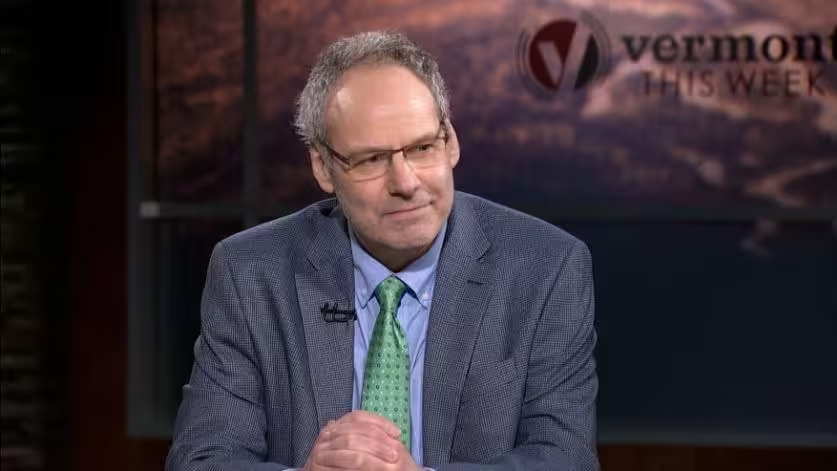
Legislative committee recommends changes for Vt. farmworkers | Push to delay ‘Raise the Age’ for fourth year in a row | Health care in Lamoille County | Panel: Mitch Wertlieb - Moderator, Vermont Public; Calvin Cutler - WCAX; Elodie Reed - Vermont Public; Aaron Calvin - Stowe Reporter/News & Citizen.
Problems playing video? | Closed Captioning Feedback
Problems playing video? | Closed Captioning Feedback
Vermont This Week is a local public television program presented by Vermont Public
Sponsored in part by Lintilhac Foundation and Milne Travel.
Support provided by:


Vermont This Week
December 20, 2024
12/20/2024 | 26m 46sVideo has Closed Captions
Legislative committee recommends changes for Vt. farmworkers | Push to delay ‘Raise the Age’ for fourth year in a row | Health care in Lamoille County | Panel: Mitch Wertlieb - Moderator, Vermont Public; Calvin Cutler - WCAX; Elodie Reed - Vermont Public; Aaron Calvin - Stowe Reporter/News & Citizen.
Problems playing video? | Closed Captioning Feedback
How to Watch Vermont This Week
Vermont This Week is available to stream on pbs.org and the free PBS App, available on iPhone, Apple TV, Android TV, Android smartphones, Amazon Fire TV, Amazon Fire Tablet, Roku, Samsung Smart TV, and Vizio.
Support the crew
Help Mitch keep the conversations going as a member of Vermont Public. Join us today and support independent journalism.Providing Support for PBS.org
Learn Moreabout PBS online sponsorshipIt's.
With Vermont's 2025 legislative session just weeks away, lawmakers consider minimum wage recommendations for agricultural workers.
Plus, the Scott administration plans a push to delay raise the age juvenile justice reforms for the fourth year in a row and a look at health care in the Royal County.
That, and more ahead on Vermont this Week.
From the Vermont public studio in Winooski.
This is Vermont this Week, made possible in part by the Lintilhac Foundation and Milne Travel.
Here's moderator Mitch Wertlieb.
Thanks so much for being with us.
I'm Mitch Wertlieb.
It's Friday, December 20th and joining us on the panel today.
We have Calvin Cutler from WCAX Aaron Calvin from The Snow Reporter, News and Citizen and Elodie Reed from Vermont Public.
Thank you all so much for being here.
Lot to talk about as we wrap up 2024 and start to move into 2025.
Do you want to start with you?
Because, there is a legislative committee recommendation for some changes that are designed to help or at least protect farmworkers working in Vermont, at least economically.
What can you tell us about that?
That's right.
Yeah.
So this committee just wrapped up its work last week, and their goal was to look at how Vermont's state labor and employer laws, protect agricultural workers here in the state.
And, there's a history behind this.
Back when our federal laws around, labor protections were made, they explicitly left out agricultural workers, scholars say that was on a racist basis because most of the agricultural workers at the time were black.
And that legacy continues.
And a lot of states, the federal law has since been updated so that in a lot of cases, farmworkers, for instance, get minimum wage.
But in a place like Vermont, our state law still hasn't been updated.
And so farmworkers here, while they might have a right to say 725 an hour, that's a minimum wage that hasn't been updated in 15 years.
In Vermont, they don't have a right to the minimum wage of, what's going to be $14 in a cent on the year 2025?
Does it seem like there's, some support for this going into the next legislative session?
Yeah.
And this committee, did vote to recommend that farmworkers do, get state minimum wage.
And they also voted to recommend that they get paid overtime for working 60 hours in a week.
This committee also was tasked with looking at whether farmworkers should get collective bargaining rights so they have the right to unionize.
This committee decided to not make a recommendation around that.
Right.
And so that's kind of the kind of pushed off.
Okay.
Thanks for the update on that story.
Kevin, I want to turn to you because there's also been this recommendation now for a while to, raise the age for, juvenile defenders.
I kind of want you to explain what raise the Age is all about.
And why is it potentially being delayed yet again for a fourth year in a row?
Yeah, there's a lot of history to this issue, but it really goes back to this concept, based on the science, brain science that, you know, young people, that their brains aren't fully developed until you're in your early to mid 20s.
And so Vermont and thinking, you was about maybe ten years ago, Senator Dick Sears actually led the charge of, you know, we need to start rethinking about juvenile justice and maybe trying to rehabilitate people while they're still young.
And so what the raise the age does is, except for the big 12 crimes murder, assault, etc., it would take a lot of these, these, lower level crimes and treat that person in, in family court.
So right now, 18 year olds are under that lens.
And the intention is to bring it all the way up to I believe it's 21 years old.
Is the intention of the law.
But the past few years, the Scott administration has, continually pushed it back and asked lawmakers to delay implementation of of raise the age for a number of factors.
You know, staffing within DCF caseworkers.
You know, the opioid crisis is hitting many families, many small towns, very hard.
Lots of kids are sort of getting caught up in, in drugs and violence.
And so there's a lot of headwinds that are facing the youth criminal justice system and the state.
There has been a concern from the Scott administration of moving forward with these reforms and biting off more than they can chew, so to speak.
So they are once again asking state legislators this year, they have to make a decision by April, but they're asking them to once again pause raising the age.
But this did face some pushback from Senate President Pro Tem Phil Berreth, who sits on the Judiciary Committee.
You know, he said that at this point, four years into this pushing it back, he said that this seems intentional from the governor and his team that they are choosing, actively choosing not to implement this, this law, which is on the books.
So we'll have to see.
But it really it's, it's a fascinating one that really intertwines lots of issues about, you know, criminal justice.
What is the age of majority making sure that young people are best treated in the system.
And I guess the last piece I I'd be remiss if I didn't mention we don't have a secure facility.
There's a temporary one in Middlesex right now, but a secure, facility to house justice involved youth.
We don't have Woodside anymore.
And the one in, for gens is still a few years out, so the other thing, too, is that it's kind of a big deal if it goes through.
Because let's say you are 20, 21 years old.
If this law was on the books, you could have, something that goes to family court.
It wouldn't follow you, let's say, when you're trying to get employment later in life, that kind of thing.
Exactly.
Yeah.
I remember talking with former Senator Jeanette White about this, and she was, a real big advocate in terms of making sure that, you know, when you do something that you're young, when you're young, a mistake that you might have made, maybe you're caught up with the wrong people or you you do something dumb that, you know, a news article or coverage of that event won't follow you and hinder you later in life because, you know, there's the actual crime and the conviction, but part of it, too, is having these criminal proceedings or civil or any of these proceedings playing out in the news, and that can also hamper people later in life.
So that's the intention of, of the law.
But again, we'll see.
Lawmakers have until April 2nd to make a decision whether to proceed or not.
That is a fascinating issue of questions of like, you know, when are you an adult and when are you responsible, that kind of thing.
I do want to stick with you, Calvin, on this next thing, because Vermont is facing its first a lawsuit related to the anti global warming law.
What's going on there.
Yeah.
This one also goes back to 2020.
The Global Warming Solutions Act, sets strict benchmarks of carbon pollution reduction into state law.
And if the state misses those benchmarks, then we can face a civil lawsuit, to spur action from, from from a court.
There's been a disagreement of whether Vermont is or isn't on track to meet its 2025 deadline.
The Conservation Law Foundation had previously threatened a lawsuit saying that, we intend to sue the state of Vermont.
We believe they are not on track to meet this this target.
And earlier this week, in front of the Vermont Climate Council, they explained their data, their modeling, their rationale as to why they think, we are not on track.
So this will now go to a, Superior Court judge.
They'll make a determination in one way or the other.
But it's certainly a significant benchmark because these are very, these are high benchmarks to, to meet in terms of knocking down our carbon pollution, but also at the same time, while that lawsuit is, is going on, the new balance of power in Montpelier has spurred some political, change and has spurred, you know, some lawmakers, the, minority leader, Patty McCoy in the House and incoming senator elect Scott back in the, Senate.
They say they plan to introduce legislation which will, move back some of the global warming solutions, benchmarks and also remove the private right of action so the state won't be able to be sued.
So certainly, you know, it's again, it's with these things it's a disagreement over not necessarily achieving our carbon reduction goals or wants to do that, but making sure that they can do it at the pace that they can afford.
That's the the rub here.
That's so interesting with the changing nature of the legislature.
Now, those big gains by Republicans, it's a different story.
It totally is.
And this was a big priority four years ago.
And here we are.
It's Yeah, it's fascinating.
We're going to move into some things about health care now.
And I want to start with you on this one, because there's some good news for folks who want to get access to colorectal cancer screenings.
Right?
That's right.
Yeah.
So starting in the new year, a new a new law will go into effect.
That essentially expands the number of people.
Both based on age and their risk for colorectal cancer.
And whether they can be covered by health insurance for that screening.
So this law, basically brings Vermont, statute into, alignment with the the latest recommendations on who should be able to get screening covered by health insurance.
So, before in Vermont, it was if you were 50 or at high risk for colorectal cancer.
Now it's if you are 45 or older and if you're an average risk.
All right.
That's that's really good to know.
And getting a little more hyper local now on health care issues.
Erin, I want to talk about what's going on in the Royal County because there is some tension, I believe, between Memorial Health Partners and Copley Hospital.
Let's start with what's going on there.
Yeah.
So basically, Memorial Health Partners is a federally qualified health center that oversees a lot of different components of health care access in the Royal County.
It's one of 11 in the state.
They provide dental care.
Including a mobile dental vehicle that they recently, unveiled that has been servicing going out in rural areas and servicing people, doctors, they just purchased the a clinic in Cambridge, you know, kind of moving into the western part of the county.
So since 21, since their former CEO, Stuart May took over, they were overseeing a period of ambitious expansion where they were acquiring things.
They stepped in in 2022 to acquire the Morrisville Community Center, which, they saw as a key component, of the health, you know, overall health care of the community as far as a place where, older kids could go after school, a place, you know, kind of a third place where they could go, the board of the Moral Health Partners sort of woke up in October and realized they were in big trouble.
They were facing a financial crisis.
And this crisis was, as told by board chair Susan Bartlett, has two factors to it, one of which was a ongoing battle between the federal government and pharmaceutical companies left them without a half million in, pharmaceutical rebates that they usually count on.
Plus the retreat of that Covid era money, the early pandemic era money that allowed any, saw a lot of these health centers sort of flush with cash that allowed them to operate more freely than they had previously.
It was told to me that they determined that Mae was not the right man for the for seeing them forward.
He was fine when they were in this period of expansion.
But now it's time to tighten the belt.
They immediately moved to announce the closure of that Morrisville Community Center, unfortunately, and to eliminate another high risk position or a high ranking position immediately.
And then they also turned to Copley Hospital, who may during his tenure had been somewhat open about not really wanting to work with.
And Copley CEO Joe Wooden and the board of directors there, have embraced the return of the model health partners to their sort of working relationship.
Bartlett has told me that they're hoping this relationship they have a study going on right now, a sort of feasibility study, to see how best they can work together.
Bartlett has told me that they're going to take this final project on project basis and that, you know, thoughts of a merger are overblown.
But in a memo to Copley, staff sent out by wouldn't he the word merger was in there.
And, copley's executives definitely seemed more interested in a merger than the royal health partners.
But the Royal Hall Partners, you know, remains to be seen.
How much, you know, leverage they'll have in the matter.
I know that the hospital is certainly, interested in it.
And then we're hearing, too, that, you know, there's all these recommendations from this health care consultant report that came out about the need to cut back the need to scale services back.
And this is cropping up as well, because folks in Liberal County are concerned about the possible closure of a birthing center.
Right?
Right.
Yeah.
I mean, the Wyman report that came out fairly recently that was commissioned by the legislature in 22, that caused a lot of backlash from hospitals across the state, especially the smaller hospitals that were, you know, that there was a focus on them closing, possibly.
A lot of people are upset about it.
A lot of people have criticized that data that led to its findings.
Joe Wooden, the CEO of Copley Hospital, has actually embraced it and has you know, Copley is in this interesting place where, they're not getting the level of commercial insurer reimbursements that they like from the Green Mountain Health Care Board.
But wouldn't you know, is is searching for solutions and efficiencies.
And this week in, the news and citizen newspaper in the snow.
Reporter.
An open letter to the public has been signed by over 60 midwives and nurses who are concerned and see very strong signs that wouldn't in Copley, our considering the closure of the birthing center, which, you know, does fairly low volume, but the midwives are, adamant that, you know, they lead, a midwife led treatment there or, you know, plans when it comes to birth that people not just in the Royal County but throughout the region, seek them out to find and are very clear that the closure of that birthing center will lead to people having to travel farther distances and could cause further pregnancy, problems in a country that already has a maternal health care crisis.
So, you know, it's like Calvin and I were discussing this before the show.
Health care is, is everywhere as a problem.
The rising cost of health care is a problem everywhere in Laurel County, in Vermont, across the country.
You know, everybody's concern about property taxes, education costs are driving that up.
What's the one thing that educators are saying are driving up those costs?
Health care costs?
It's everywhere.
The support staff at Copley recently unionized for the first time, citing that they were upset that they were receiving a lower quality health care plan than their, their Co parts.
The connections here are unbelievable.
You're seeing that I mean, according to you.
Right.
Exactly.
I mean, that's the thing is there's been so much attention to that's been placed on the University of Vermont Health Network and these cuts that they've had to make because of the budget order from the Green Mountain Care Board.
And, you know, that's one piece of the conversation.
But really, I mean, it's sort of we're seeing this, this restructuring of this right sizing, if you will, of our health care system here in Vermont and nationally to.
Yeah.
And to Erin's point, I mean, it's so interconnected with, you know, our demographics and housing and affordability.
And it's it's tough not to look at it sometimes and just feel a little despondent.
Or how do we how do we get our way out of this?
What's the solution?
It becomes like a cyclical thing.
It seems that you just the danger you just mentioned housing.
That's another thing that seems to always come back and connect things here.
And there is a little bit of good news in Newport, right?
There's a $22 million project that's aiming to increase housing.
What can you tell us about that?
Yeah.
You bet this IT project is a long time coming and it's a huge deal for the community.
The Sacred Heart School.
You ask anybody in Orleans County, many people have gone there.
It was a Catholic school, I believe, and a beautiful campus overlooking Lake men from a Gog.
And it's been abandoned for at least the last ten years, maybe more.
Although the lights have been on, the heat's been on.
It's been taken care of, but it hasn't been used.
And so Rural Edge, has been essentially putting together different, partners from the Vermont Housing Conservation Board.
Aqd.
They've been pulling together a lot of different, funding mechanisms, and they've raised about $22 million in capital that they're going to turn this into, dozens of units of housing, both at the school.
But there's also a further term, vision to build, standalone, like, duplexes and or condos up there on the hill as well.
So it's a really big deal for, for Newport where, you know, even though, you know, the town has fallen on, you know, tough times, you know, in recent decades.
But this is a really big investment for housing, which is still, you ask anybody, no matter where you are in the state, it's pretty scarce.
So it's a really big deal for Newport.
Is it going to do anything to help with the pit?
And what I'm talking about here is, we've got, Senator Russ Ingles talking about that.
It's where he has to say about it.
We're a long way from nowhere.
We're, So, you know, it has to be a plan that somebody if they're going to, have, private equity, it needs to turn.
They spent ten years and, it would be a crying shame if it went another ten years.
Yeah.
I don't mean to make light of this at all, but there are a lot of communities around Vermont that seem to have these areas where there used to be a big structure.
There's nothing there now.
And Senator Ingles, they're talking about ten years of this.
What is the pit.
What's going on.
But yeah I there's a lot of history I keep saying that a lot of history to this.
But of course as you remember the Eb5 scandal, there was the, the proposed biotech facility that was supposed to be built in downtown Newport, turned out to be a fraud.
Landed several people in jail.
Largest fraud case in Vermont history.
This was a key downtown block.
It was residential.
It was commercial.
And for the past ten years, it's been sitting vacant.
There just hasn't been any movement on it.
There's been ideas that have been floated.
People have tried to bring together capital and investors and things like that.
But nothing is has really stuck.
The city of Newport, like every town is, is working on its ten year strategic plan, I believe, actually, the city council recently voted on it.
And it lays out, you know, areas for growth and development right there on your screen.
That's sort of this long term vision of, you know, if we close our eyes and think, what could the downtown, that downtown look like?
You know, there's some some sketches for it.
And so that's why I think in some ways, this project from Rural Edge is important, because having people that are living within walking distance of your downtown, you know, that's really that was a key finding in this, this, this, ten year strategic plan is we want people living, working, etc.
in the downtown.
So, you know, there's no immediate plans for the pit in downtown Newport.
But I think, you know, given the strategic plan, there's new businesses that are opening up.
You know, there's this big housing project up on the hill.
You know, there is some, some optimism in town.
And there's a there's a lot of good things in Newport that are happening.
It's pretty exciting, actually.
That's good to hear.
And structures are important.
And that moves me to the next story here, because I remember in the summer of 2023, the terrible flooding that happened, I went up to, Johnson to talk to folks about the sterling market getting flooded out.
I have never heard so many people talk so passionately about a supermarket.
It was like this, this local place that was so important to them.
Aaron.
It has not been replaced.
Sterling market to this point.
What is going on there?
Is there any plan to bring back a supermarket where people centrally located can get essential food?
Unfortunately, it seems like there were no closer to seeing a supermarket in that building, than we were.
Since the aftermath of that flood.
Now, that location sits right at the confluence of the Lamoille and Guymon rivers.
So it is a perennial site of flooding.
Even minor flooding in Johnson tends to get into that building.
And the building is owned by, real estate magnate Ernie Palmer Pomerleau.
He has been committed to having a grocery store in that building.
There was a previous grocery store there before the Sterling Market.
It, was flooded the same year as, Tropical Storm Irene and some spring flooding of that year.
It did not return the town worked with Pomerleau over an extensive process to bring the sterling market into there, which was originally owned by a private owner before it was bought out by, the, United Grocers of New England.
And, after, you know, the flooding, the, the, the co-op said we're coming back.
Well, the, proprietor of that area shouldn't have spoken so soon because as a co-op, that was up to the board.
And they decided, unfortunately, there was a too high risk situation.
So, parallel was searching around for another person to get in there.
Shaw's grocers, who have locations in Stowe and other places nearby and throughout Vermont, were interested on the condition that, some federal funding be used through FEMA to sort of harden the building, to add further flood mitigation, if possible, to that building.
The town of Johnson was taking the lead on trying to secure that grant.
Whether that grant is secured or not, Shaw's has decided that they're not going to to come down.
And they recently announced.
So, that leaves us without that location having a grocer in Johnson.
However, there is a ray of light here.
A local entrepreneur who has previously owned running a food truck is going to open a general store soon.
And a place that historically has housed a deli, on, Lower Main Street in Johnson.
He has secured a loan from the village of Johnson from the revolving loan fund to help towards the effort.
He has more of a background in, food service and, and stuff like that.
But because he participated in this process called Reimagine Johnson, that was put on by the Vermont Council for, Rural Development.
He learned that people are really interested in having groceries back in Johnson.
So he's committed to, bringing food access back to Johnson.
Good.
And I want some more good news on the food front.
So we're loading.
Read.
I'm going to turn to you here.
How is growing food connecting new American communities in Vermont?
Yeah.
So I don't know how often you all frequent the inner veil, but, it's been a while, but it's a wonderful place to visit.
Yeah.
It is.
Yeah.
Well, as you enter, you might see something new.
There's a new shipping container and a driveway or a parking lot, and, it's actually a farm.
And so inside, it's called village hydroponics.
Inside, Noor on C, he's the executive director of this project is growing so many vegetables.
And it's an outgrowth of this other project called the People's Farm Stand.
It's a free mutual aid food program.
It's based, in Burlington, and it looks to, serve new American communities not only by by giving food, but also like the people participate in growing the food as well.
So people are feeding each other, helping each other.
That's like the idea of mutual aid is everyone contributes what they can.
And, I got a chance to tour a village hydroponics recently.
Smells really good.
It smells like cilantro.
Oh, nice.
Noor, has been doing weekly harvests.
It's.
Yeah, it's it's a nice bright spot.
And I have to imagine that people in and around the interval are really welcoming this and learning about new foods and etc.
to and connecting people.
It is.
Yeah.
And I mean Noor made a point that, you know, it's not just the food, it's it's this reconnection with food that's familiar to people who, are not here by choice necessarily.
They're not this is not their original home.
And so he he does make a point.
Him and his, colleagues make a point to grow culturally relevant, produce, in a way, to reconnect people to something that's familiar.
A food can be comforting in so many ways.
I want to finish with something that I just got me so incredibly excited at Omni Sports fans we have around the table here, but the University of Vermont men's soccer team winning the NCAA Division one championship.
Unbelievable.
They call them the Cardiac Cats.
Here's what one UVM soccer fan had to say whenever they went down a goal.
It just felt like they were never out of it.
And that's what happened tonight.
You just saw their fight and their well and their desires.
The way they represented the state of Vermont, where it made us really proud.
I mean, when they came back, I went to, Patrick Gymnasium, last week.
And you can see there there's throngs of people.
They got a police escort from the airport.
They come in, they were so tired.
You could tell.
I mean, there they are.
Everybody flooding into the lobby of Patrick Gymnasium.
Coach Rob Dow had a raspy voice, and he was talking about what the team did, and we beat the 12 seed, and we beat the two seed.
And he couldn't remember that.
The entire crowd said, and you beat the three seed.
You know, it was just such a wonderful thing to have.
Vermont had the first ever, NCAA championship.
Other than skiing, you know, in a major team sport.
Okay, so the way they did it, they certainly earned that title.
Cardiac cancer at the very end with that goal.
Indeed they did.
It came late.
And it was a wonderful thing to see.
And that's where we're going to leave it for today.
I want to thank our wonderful panel, Calvin Cutler from WCAX, Aaron Calvin from the Stowe Reporter News and Citizen, and Elodie Reed from Vermont Public.
Thank you everyone for being here.
Thank you so much for watching at home.
I will see you next week on Vermont this Week.

- News and Public Affairs

Top journalists deliver compelling original analysis of the hour's headlines.

- News and Public Affairs

FRONTLINE is investigative journalism that questions, explains and changes our world.












Support for PBS provided by:
Vermont This Week is a local public television program presented by Vermont Public
Sponsored in part by Lintilhac Foundation and Milne Travel.