Northwest Profiles
December 2021
Season 35 Episode 3502 | 29m 2sVideo has Closed Captions
The Bard in the Park, Welcome to Cricket, Spokane Sketchers, Father Christmas
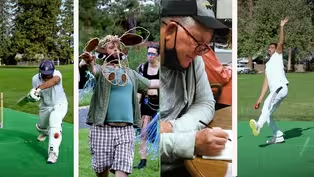
The Spokane Shakespeare Society bring A Midsummer Night’s Dream to Riverfront Park • Local artists enjoy having the texture and history of Spokane to inspire their work, and the company of "Spokane Sketchers" to do it with • We take a swing at learning why Cricket is the second-most popular game in the world • And revisit a workshop where Father Christmas lives all year round.
Problems playing video? | Closed Captioning Feedback
Problems playing video? | Closed Captioning Feedback
Northwest Profiles is a local public television program presented by KSPS PBS
Funding for Northwest Profiles is provided by Idaho Central Credit Union, with additional funding from the Friends of KSPS.
Support provided by:

Northwest Profiles
December 2021
Season 35 Episode 3502 | 29m 2sVideo has Closed Captions
The Spokane Shakespeare Society bring A Midsummer Night’s Dream to Riverfront Park • Local artists enjoy having the texture and history of Spokane to inspire their work, and the company of "Spokane Sketchers" to do it with • We take a swing at learning why Cricket is the second-most popular game in the world • And revisit a workshop where Father Christmas lives all year round.
Problems playing video? | Closed Captioning Feedback
How to Watch Northwest Profiles
Northwest Profiles is available to stream on pbs.org and the free PBS App, available on iPhone, Apple TV, Android TV, Android smartphones, Amazon Fire TV, Amazon Fire Tablet, Roku, Samsung Smart TV, and Vizio.
Providing Support for PBS.org
Learn Moreabout PBS online sponsorship♪ Hello and welcome to this edition of Northwest Profiles I'm your host Lynn Veltrie we're always pleased when the calendar creates an opportunity to have a show like this one that lands in the middle of the holiday season it's a wonderous time of year not only for receiving but more importantly for giving and we'd like to give you some new stories about real people doing extraordinary things stories about fascinating places and community events that express our pride in the place we call home We have a wonderful assortment of stories including a taste of Shakespeare on a hot summer's night, some insight into one of the most popular sports in the world, the fun and art of sketching on the run, and finally, we check in on a local elf busy in her workshop.
So, with all that ahead I believe it's time to jump in the sleigh and get this party started.
For our first story ponder this, to be or not to be in the park?
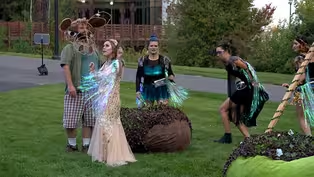
The Spokane Shakespeare society had its maiden voyage in the summer of 2021.
It wasn't easy, given the slings and arrows of outrageous heat, smoke and other misfortunes while performing in the outdoors.
However, through it all the society took up arms against a sea of troubles and in the end brought Shakespeare in the park to Spokane.
Amanda Cantrell: We produce professional level Shakespeare plays.
And we do them in the parks without the barrier of a ticket cost.
So all of our shows are free to the public.
We want to make sure that professional level theater is accessible to everyone in Spokane.
Amanda: Spokane actually has a higher per capita amount of arts patrons than any other national city.
So the national average is 2% and Spokane has 14% amount of the population that identifies as arts patrons.
So we have the people here who want and love and thrive on the arts.
And there really wasn't a company that was producing outdoor theater regularly.
And so I said, "I can do that".
And so we started one and it was a huge success this summer.
NARR: Dr. Amanda Cantrell is cofounder and executive director of the Spokane Shakespeare Society.
With this newly formed company, Amanda combines some of her main passions.
Amanda: Professional theater and non-profit business had been in my blood and in my entire professional career.
It's really important to me that do something to give back to the community.
I started as an actor.
I'm also a master marionettist.
I've done set design.
I've spent time in education where I've built theater departments in public schools.
I've run the gamut.
And I really love theater and what it does because theater has a place for everyone.
No matter what they want to do, there's a spot for you in theater.
NARR: With a solid business plan in place, and partnerships with the City of Spokane, Stage Left Theater and others, the society was poised to put Shakespeare In The Park in 2021.
Amanda and company could commence finding directors and stage crew, and auditioning actors.
Amanda: We did Zoom for the first part.
And then we did call-backs in the park to make sure that our actors could project and be heard, and things like that.
"He thrusts his fist against the post and still insists he sees the ghost."
Amanda: In June we did casting.
We had rehearsals through the summer.
It was a intense summer where there was smoke and fire and extreme heat, and all sorts of things.
But the cast and all the artists in the community really rose up to the occasion.
And so we produced A Midsummer Night's Dream for eight performances in August.
And we also produced The Complete Works of William Shakespeare Abridged for eight performances, as well in September and October.
Amanda: We cast people from all sorts of theater backgrounds.
We had a couple of actresses who had never done any theater before but they always thought it was going to be fun, all the way up to people who had spent their life studying Shakespeare and his academic and performance art.
Wooo.
Thank you.
Alright.
NARR: The cast and crew did not have the usual pleasantries like indoor dressing rooms, running water, etc., but they reveled in the chance to let the play be the thing.
Amanda: Producing in Riverfront Park was an experience.
It was a collaborative one.
It was a lot of trial and error, a whole lot of patience and a little bit of guessing.
Sometimes we were right, sometimes we were wrong.
You have to get used to projecting while there's geese and cars and people skateboarding or bike riding through, or whatever.
The sound is going to be different.
The audience is going to be different.
The entire feel is going to be vastly different.
So, it was really important to me that they get that, from the very beginning they start that experience.
So, we held our all our rehearsals where it was safe to do so outdoors.
There were some times where we had rehearsals that we couldn't do outside because of the smoke.
And so, Stage Left was gracious enough to let us borrow their basement to hold some rehearsals in on those days.
And then there were some days where we just had to cancel because it wasn't safe for people to even just drive around in it.
We ended up canceling our tech week for Midsummer which, (sigh) threw a whole lot of wrenches into our production because we couldn't test any of our sound or lights or things like that until our opening night.
Which then, the wind knocked out our sound system.
And so, you know we had so many stumbling blocks that I'm really proud of what we did.
And again, the community really responded.
We had about fifteen to seventeen hundred people come and see Midsummer over the course of the eight shows.
NARR: A Midsummer Night's Dream features a song that's performed by fairies.
In this production, that song's melody and harmony were written by Spokane harpist and composer Kathlyn Kinney.
♪ NARR: The Spokane Shakespeare Society brings The Bard to the community in other ways, like this Halloween presentation in Professor Monica Stenzel's class at Spokane Falls Community College.
Amanda: And she said 'hey, could you do something spooky and kind of scary and mystical for Halloween that has to do with Shakespeare?'
and I was like 'Sure.'
Amanda: We did a call for actors and asked all the actors, like what's your favorite death scene, what's a character you've always wanted to play?
And from those, I patched together snippets and scenes from various Shakespeare,s plays on all of their deaths and murders, and things like that.
And we did a reader's theater performance at Spokane Falls Community College for their Halloween program.
Amanda off camera: And there you have it.
Amanda: The community response has been really good.
We had several emails from people saying that they loved it and they had so much fun.
We had people come up to us while we were at the park.
I remember one couple asked us what we were doing and they were like 'you're the reason Spokane is great.'
And 'thank you, that's so sweet.'
You know, we really just wanted to make sure that we were part of the community and that we're giving back.
And so the community response has been amazing.
We're super excited to produce such a big show and, that the audience really responded to and our actors really grew.
Several people who it was their first time are now in other shows at other theaters around the community including Spokane Civic Theater and Stage Left.
So we're really excited to have been their introduction to the professional theater world.
Puck: And here the maiden... Amanda: It's a wonderful exercise in the arts community coming together to present the very best for Spokane.
(Applause) The Spokane Shakespeare society will continue to perform in riverfront park, and hopes to be in other parks as well, to bring the bard closer to neighborhoods around the city.
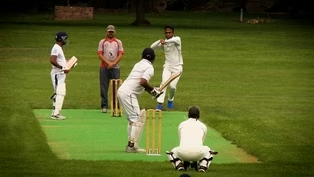
On the way next, we exit stage left and on to the fields of play in this case the sport of choice is cricket watched by billions of fans across 180 countries cricket today is the second most popular sport in the world so, the question is why?
Especially when matches can last over 5 days and sometimes without a winner!
For some answers we hooked up with Spokane's very own cricket team for their take on the sport.
(group of children chattering) (melodic flute music) - [Sai] When I started playing in my childhood, we'd just go to any open space, just take a wooden, a stick or something, basically.
If someone pitch us the ball, just you hit it, basically.
(traditional Indian music) - [Manoj] Kids all over in India or other countries, in Commonwealth countries, they play on streets every day.
They just walk in the streets.
They play.
(traditional Indian music) (energetic Indian music) (cricket bat strikes ball) (crowd cheers) (energetic Indian music continues) - [Announcer] There he bowls.
Oh, well struck.
That's going over.
- [Interviewee] It's entertaining to the people other side of the world, India, Pakistan, South Africa, in all Commonwealth and British Commonwealth countries.
- [Announcer] Finger goes up, (crowd roars) will there be a review?
Yes, there will.
(players and crowd cheer) (announcer speaking faintly) (slow-paced hip music) [Manoj] It's not like a slow game or something, or the Americans think like that.
But it is actually a fun game.
(slow-paced hip music) It's long, but it's means that you have so much time to watch and enjoy it.
And the game comes with a lot of joy.
It's not just, you are sitting there for a long time, but we are technically enjoying it.
(slow-paced hip music) (crowd cheers) (baseball bat strikes ball) - [Announcer] The pitch is hit in the air.
Deep to right!
That ball is gone!
- [Sai] Similar to baseball, just hit the ball and run, basically.
(bat strikes ball) You can score a home run by hitting it out of the ground if you score six.
- [Announcer] There's that sweep.
This time he nails it all the way for six.
- [Sai] If the pitch is inside the ground and goes outside the ground, it's four.
- [Announcer] No problems there.
(energetic percussion music) - [Manoj] You can hit it any side of the park.
You can just hit it on the backside, or anywhere you want on the ground, basically.
That's the advantage if you compare with baseball.
That's one thing.
- [Announcer] Straight away, the reverse sweep, and straight away the boundary for Jason Roy.
- [Manoj] Similar to baseball, you can hit in the air and get caught and out.
- [Announcer] It's nicely patched to backward point.
Travis Head.
England lose their eighth.
- [Manoj] When I compare to baseball, it's very interesting to me.
For example, we don't have like many innings like baseball, but in cricket we have one innings.
And the two team plays, and each team has 11 players.
And also we have two bases.
The concept is pretty much similar, but if you compare it like that, and then probably you're able to understand better.
(somewhat muted Indian music) (Indian music increases) (cricket bat strikes ball) (cricket players chatter indistinctly) (bell dings) (Indian music continues) (bell dings) (Indian music continues) - [Announcer] (indistinct) direct hit, direct hit.
[Manoj] Any fielder on the ground can hit the base before the batsman reaches the other end.
If the batsman is short by a couple of inches and the fielder hits the base, you're out, the batsman is out.
- [Announcer] It's only a single.
Oh he's coming back on other end.
Finn.
Oh, he's gone!
- [Commentator] Oh, he's gone.
He's gone and he knows he's gone.
- [Manoj] In cricket, you get unlimited number of pitches.
As long as you don't get out, you can stay.
You can miss the ball, you can swing it, you miss, it doesn't matter.
As long as the pitch doesn't hit the wicket and you don't get caught, you're not out.
[Sai] It's easy to get it, and you have to be there to enjoy it.
- [Sai] You can compare it to chess as well, right?
You make one move, and then I bowl the ball, and he misses, that's my move.
[Manoj] The pitcher is always trying to outsmart, you think what you're going to do next, and the batsman is thinking the same thing, okay, what is the pitcher going to do?
It's like a back and forth chess game.
As a bowler, I usually use a technique how to pitch the ball.
And this ball is made out of leather, and it's a cork inside.
And when I bowl, I usually hold the ball like this.
And if I want the ball to pitch and curve in and out, that's when the batsmen miss the ball, that's all I wanted, and either to make him miss, or I'm going to hit the stumps.
So my target is the stumps, or wicket.
(ball hits wicket with a distorted boom) It is really hard for the batsman to predict and play.
[Sai] It's difficult to see the hand of the pitcher, right?
Like, you're working from there to the other end, basically.
So, difficult to pick what he's trying to do, basically.
But you're focusing so much on his hand, and you have to make that adjustment in a millisecond, basically, because pitcher is coming fast.
You have to make the adjustment, you have to see which way it's going.
You cannot keep playing straight.
'Cause you are going to get caught.
So that is a lot to think about when you are batting.
(energetic music ends) (traditional Indian music) [Sai] We have had a baseball guy come in, right?
He was hitting out of the park.
Anywhere below that, just lifting his bat like this.
I am not playing this.
[Manoj] Yes!
Once the ball pitches, you have no idea.
Good baseball player who can hit outside the park and have him to play cricket just for fun, if you pitch the ball and see what happens, it's really complicated.
(laughs) [Manoj] I actually played with a kid who has taught me to play baseball in exchange for him to teach him cricket.
And he really enjoyed it.
He have no idea about cricket before.
He loved it.
- [Sai] Kids can love it.
I think anybody can, This is a good way to connect and share cultures too.
[Manoj] Other part of the world is really enjoying this game and it's very popular.
And I will tell the other part of the world, hey, look at that, you know, there's something going on.
At least for fun.
Then you can share your games and compare and learn from each other.
I think it's a good way to connect.
(Indian music crescendos and ends) The Spokane team is part of a league that stretches across the northwest.
Cricket is played in just about every major city in North America wonder if their highlights were featured on SportsCenter if interest in the sport might grow.
Up next, we dash off to meet up with a group of artists that have found their avocation takes on a new dimension when they do it together.
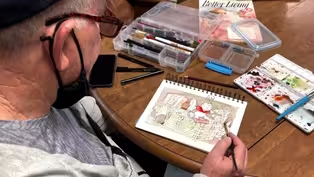
Drawing Free hand is a skill that most people can accomplish to varying degrees, but to a group of Spokane individuals armed with a pen or pencil and paper... drawing is an endeavor that is celebrated.
Meeting periodically to draw and converse and drink copious amounts of coffee, the Spokane sketchers group takes this act of expression to various locales and brings together multiple degrees of talent that love to get together and share ideas and techniques.
Gathered in the basement of B&B Junk Company in Northeast Spokane's Hillyard neighborhood, a handful of the group's artists draw from a cornucopia of choices in front of them.
Spokane Sketchers organizer and retired artist, Donald Walls started the group nearly 10 years ago Don Walls: There's no requirements and there's a lot of encouragement.
We've been keeping it a small group.
I think the biggest we've ever had is like 25 sketchers, but it's always great to see what else people are doing and learn techniques.
>>Most people who are drawn to a group like the Spokane sketchers, get fulfillment from meeting like minded individuals that share in a love for drawing.
One such person is highly talented sketch artist Steven Charem, a transplant from Las Vegas who worked in the electrical sign industry and has since chosen to spend his retirement years in Spokane.
Steven Charem: I had the background of architecture and media and drawing and painting.
It's been a rewarding career and I retired from that, moved here a little over two years ago and just completely fell in love with the with everything here.
but as far as painting and drawing, it's just been marvelous for me to kind of remake, renew myself, because for many, many years I was on a computer and doing two-dimensional three-dimensional design.
And I Kind of puts you in a box to a certain extent.
Steve Charem and Don Walls are like many in the sketchers group, who choose to fill their time with a passion they have in their lives and to expand and explore their talents.
For these two artists, it comes from a vocation they chose many years ago.
Charem: Donald Walls used to be with the Spokane Review back in the day.
He has always had some amazing stories to tell.
And at the same time, he's a very talented artist.
Walls: I keep on thinking I've been drawing, you know, just as a profession since 1980.
And my other conclusion, you think I'd be better than better now?
But there's just something about drawing and then painting and textures and stuff that is really an important thing to me.
Computer to the hand drawing again has been tough at my age because it's like, you know, it's like riding a bike, if you don't do it for a while, you kind of lose touch you're a you're a little wobbly.
So about two years ago, two and a half years ago, right before I moved, I started to do these little these old paintings and drawings and trying to loosen up.
Charem: Some of the artwork and the artists here are just phenomenal, and I'm very impressed with the arts here.
I've seen some gorgeous work come out of these people.
And like I said, somewhere more in a more learning mode.
They're novices and other ones are professionals.
>>Steve Charem like most retirees, wants to grow in his endeavor in his senior years, and has discovered a life in a group in Spokane that cherishes sketching as much as he does.
It's keeping the old noodle going and staying engaged But like I say, it's a labor of love.
So, I have that enjoyment now where I can do what I love to do.
I like to be productive.
I've still got that in me from the from the other previous things that I did we were always on a timeline so I work really quickly.
Albeit the Sketchers, we work within two hours, two to two and a half hours, knock out at least a preliminary drawing, and then we'll finish it later, sometimes add some watercolor on site or do it later we don't do a lot of critique, but at the same time, we acknowledge each other's love of it.
And at the same time, if somebody asks, what how'd you do that or this, it's always freely given.
So, if anybody is of a mind to join a good group, it's nonjudgmental and very creative and love to drink coffee and talk.
We're the group for you.
I think Steve and Don would both agree that sketching and painting in their retirement years is both rewarding and important for their continued growth as artists, not to mention the dividends they receive in the form of cookies and coffee.
Now for our final story, in light of the season, let's visit a festive holiday workshop here in Spokane, where a jolly little lady spends her time creating old world Christmas magic ♪ Elizabeth Raol: I enjoy sculpting faces because I believe faces are kind of a road map.
When you look at elderly faces, they're a road map to that person's life.
♪♪ I've never had any formal training in sculpting.
When I started out, they were very bad.
But they've gotten better over the years.
Christmas is something that is very important in our family, handmade things, especially.
This was established when my family... when I was young, growing up.
And we liked to exchange handmade gifts.
And so that was just something that I thought would be fun for each of my children.
A lot of times you'll see the Father Christmases designed on a dowel.
And they typically have a robe.
They're very straight.
I like my heads to tilt.
I like them to have a little personality.
I did develop, with the help of my husband Pradyuman, an armature that is wood and wire.
And that gives them a little more personality.
And that's what I love.
It's that personality that evolves.
I work in a medium by the name of polymer clay.
And, it's a very forgivable medium to work with.
It can be baked at home in your home oven.
My Father Christmases do tend to be more "Old World", hence I don't refer to them as Santa Claus who is usually red and white.
I've only made one of those in my time.
♪♪ A lot of times people will donate fur coats from their grandmother or I pick up old coats.
And those are the things that enable me to give them that Old World appearance.
I enjoy dressing them.
They are so much fun to dress, and designing for them, and accumulating the toys and the things that will accompany them.
♪♪ Some of them are more rustic, whimsical.
They vary.
A lot of times people will request keels, fishing keels, and also the fishing poles that go with them.
We've done golf clubs, they've been in canoes, sleighs, several different situations.
After you apply their beard, they just pop.
Their little personality comes out and each one is individual.
There are no two of a kind.
I don't use any molds.
They're all one of a kind.
They've been in a number of various places, The Davenport Hotel, some of the other shops around town.
They have also been carried in shops in New York and Vail, Colorado.
A lot of the work I do is commission pieces.
In 2000, I was approached by a tree designer, Michael Bagley, who's well-known for Christmas Tree Elegance.
And he said, "Oh, Elizabeth, you need to get involved in this".
So I became a tree decorator at that time.
Starting about ten years ago, I started donating a Father Christmas each year.
They varied in height and kind over the years, and they are one of the raffle pieces for the event.
The proceeds from Christmas Tree Elegance are donated to the Spokane Symphony, and that's a very worthwhile project to support in our community.
In 2000 someone took an article that had appeared locally in the Spokesman Review and sent it in to Better Homes and Gardens.
And as result of that, I appeared in the Santa Claus book at that time, which was thrilling for me, to say the least.
♪♪ Over the years, I've sold well over 250 of them of various heights.
And they've gone to, I hope, loving homes.
♪♪ They're all signed and numbered.
So I have a complete history on the number of them that have gone out.
I like to think that they are going to add to the heritage of Christmas to the families that take them in.
♪♪ Father Christmas may be able to suspend time for a night, but that's all the time we have in this program.
But rest assured there's more ahead next time on Northwest Profiles until then this is Lynn Veltrie saying so long and keep in mind living in the Inland Northwest and western Canada there's adventure around every corner if you're looking for it so mosey out and when you do, do it safely and as always take time to enjoy the view.
Video has Closed Captions
Clip: S35 Ep3502 | 7m 34s | The Spokane Shakespeare Society brings The Bard to the great outdoors. (7m 34s)
Preview: S35 Ep3502 | 1m 33s | Shakespeare in the Park, Cricket Demystified, Sketchy artists, Father Christmas (1m 33s)
Video has Closed Captions
Clip: S35 Ep3502 | 5m 23s | Meet some Spokane artists drawn to sketch together. (5m 23s)
Video has Closed Captions
Clip: S35 Ep3502 | 6m 51s | An introduction to Cricket, hugely popular almost everywhere but America. (6m 51s)
Providing Support for PBS.org
Learn Moreabout PBS online sponsorship













Support for PBS provided by:
Northwest Profiles is a local public television program presented by KSPS PBS
Funding for Northwest Profiles is provided by Idaho Central Credit Union, with additional funding from the Friends of KSPS.