State of the Arts
December 2021
Season 40 Episode 3 | 26m 46sVideo has Closed Captions
Night Forms, Jazz Advocate Dorthaan Kirk, Doll Maker Kimberly Camp and Painter Robert Beck
Go behind the scenes of Night Forms, an immersive after-hours experience at Grounds for Sculpture created by Philadelphia-based Klip Collective that has to be seen to be believed. NEA honoree, Jazz Advocate Dorthaan Kirk and her long history in Newark, NJ. Robert Beck paints his community in the Lambertville/New Hope area and in Maine. Plus, artist Kimberly Camp on why she makes dolls.
Problems playing video? | Closed Captioning Feedback
Problems playing video? | Closed Captioning Feedback
State of the Arts is a local public television program presented by NJ PBS
State of the Arts
December 2021
Season 40 Episode 3 | 26m 46sVideo has Closed Captions
Go behind the scenes of Night Forms, an immersive after-hours experience at Grounds for Sculpture created by Philadelphia-based Klip Collective that has to be seen to be believed. NEA honoree, Jazz Advocate Dorthaan Kirk and her long history in Newark, NJ. Robert Beck paints his community in the Lambertville/New Hope area and in Maine. Plus, artist Kimberly Camp on why she makes dolls.
Problems playing video? | Closed Captioning Feedback
How to Watch State of the Arts
State of the Arts is available to stream on pbs.org and the free PBS App, available on iPhone, Apple TV, Android TV, Android smartphones, Amazon Fire TV, Amazon Fire Tablet, Roku, Samsung Smart TV, and Vizio.
Providing Support for PBS.org
Learn Moreabout PBS online sponsorshipMale Narrator: Jazz innovator Rahsaan Roland Kirk died young.
In the years that followed, his wife, Dorthaan Kirk, became a driving force in the jazz world.
Female Narrator: Artist Robert Beck documents the world around him, including the 30 years he spent in the Lambertville/New Hope area.
[ Music plays ] Male Narrator: Painter, museum director, arts advocate, and dollmaker Kimberly Camp in her Collingswood gallery.
Female Narrator: And an after-dark, immersive exhibition of digital light and music transforms Grounds For Sculpture into a landscape that has to be seen to be believed.
[ Music plays ] Male Narrator: "State of the Arts" going on location with the most creative people in New Jersey.
[ Music plays ] Announcer: The New Jersey State Council on the Arts, encouraging excellence and public engagement in the arts since 1966, is proud to co-produce "State of the Arts" with Stockton University.
Additional support is provided by the Geraldine R. Dodge Foundation and these Friends of "State of the Arts."
[ Jazz music plays ] Ottenhoff: Over the years, she probably dealt with every jazz luminary who performed in the '70s and the '80s and the '90s, It's a who's who of the music world.
Male Narrator: In 2020, Dorthaan Kirk, often described as Newark's First Lady of Jazz, received one of America's highest honors, the NEA Jazz Masters Fellowship for Advocacy.
Williams: Well, you know, she's always been an advocate, but an active advocate.
I mean, she's with WBGO.
You know, she really promoted the music.
I remember seeing her at concerts all the time.
Anderson: I always say it's not whose number you have.
It's who will pick up the phone when you call.
and everybody will pick up the phone for Dorthaan Kirk.
Kirk: ...wonderful, but my favorite one...
Male Narrator: Dorthaan married the legendary jazz multi-instrumentalist Rahsaan Roland Kirk in 1971.
She spent eight years with him, often touring on the road, before he died at the age of 42.
Kirk: He was unique because he played three instruments simultaneously, in harmony.
[ Jazz music plays ] And that was pretty much unheard of.
But he always said it was a gift from God because he dreamed about those instruments.
And he went out to an antique store and actually found them.
Schreiber: Rahsaan Roland Kirk was a multi-instrumentalist, really one of the great modern jazz artists of the last century.
He died too young.
Nobody sounded quite like him.
Kirk: I think I first met Chick Corea, Benny Carter, Art Blakey, and some others, because they all had the same agent Rahsaan had.
[ Jazz music plays ] Anderson: It was a love story.
A great partnership Male Narrator: When Rahsaan died, Dorthaan was still in her 30s with three children and without a career.
Bob Ottenhoff hired her to help start Newark's WBGO jazz radio station, now considered one of the world's best.
Ottenhoff: Dorthaan was our ambassador to the music world.
So she could call her musician and say, "Hey, there's this brand-new station.
You haven't heard of him before, but would you come over and do an interview?"
Chestnut: She's one that truly looks out for you.
Any place you play on the scene, you know, "Hey, baby, how you doin'?"
You know?
[ Piano plays ] Kirk: I knew all the musicians.
I knew all the record company people.
In my head, I had no idea.
"What does all this have to do with radio?"
But later, I learned.
Williams: I think that WBGO would not have existed, certainly in the way that it exists today, had it not been for Dorthaan's persistence and passion and energy for WBGO.
She was a catalyst.
Anderson: WBGO 883 FM.
WBGO.org.
And on your mobile device.
I'm Sheila Anderson.
This is "Weekend Jazz After Hours," and we're about to hear "Dorthaans Walk" from Rahsaan Roland Kirk's recording "A Standing Light."
And Dorthaan Kirk is one of the founders of WBGO, who we call, fondly call, Mother Kirk.
So take a listen to "Dorthaans Walk."
[ Rahsaan Roland Kirk's "Dorthaans Walk" plays ] Kirk: Rahsaan died before his last album was released.
And on that album, he recorded the tune he wrote for me, "Dorthaans Walk."
And so his real creative producer, Joel Dorn, he called me up one day and said he wanted to record my footsteps.
And if you have a really, really good stereo system, you can hear them quietly at the very end of their composition.
It's kind of... eerie for me.
[ Footsteps ] Male Narrator: Dorthaan has organized monthly jazz concerts at her church, Bethany Baptist, for the past 20 years.
The great bassist Buster Williams recently played there.
Buster performed on Rahsaan Roland Kirk's 1976 album "The Return of the 5000 Lb.
Man."
But this was his first appearance at Bethany.
[ Jazz music plays ] Kirk: He performed with Dakota Staton, Benny Carter, Sarah Vaughan, Chick Corea, Herbie Hancock and a multitude of others.
Please welcome Buster Williams.
Williams: She called me on the telephone and asked me, "Could we do this?"
And without hesitation, I said, of course, because of who she is, you know?
And because it's about time.
It's been going on for 20 years, and I'm just now getting here.
You know, I'll have some words with her.
[ Laughs ] [ Jazz music plays ] NJPAC's John Schreiber enlisted Dorthaan to produce jazz brunch concerts at the Performing Arts Center's James Moody Festival.
She's done it for the past 10 years.
Kirk: He is one of the nicest people I've ever met.
He was one of the first people to perform at this brunch in 2012.
So please welcome Cyrus Chestnut.
[ Applause ] Schreiber: I've known Dorthaan for 45 years.
She is always looking for ways to advance the music because she believes and understands that it is a music of joy and a music of cooperation and great fun.
[ Jazz music plays ] [ Jazz music plays ] Female Narrator: Later in the show, dolls made by an artist.
But first, Klip Collective transforms Grounds for Sculpture.
Rivera: What we do is site specific.
That's really our nature.
We don't make it in a room and then show it to the world.
We make it in the space.
We use the space.
We use the sculpture.
we use what we're looking at to inform the content and the vision.
And that's kind of the puzzle we kind of create and put together.
[ Music plays ] Through projection mapping on the surface of these works, McClellan: We're creating this really unique dialog between the work of the collective and the sculptures in the collection.
Female Narrator: Grounds for Sculpture in Hamilton, New Jersey, has 42 acres open to explore in the daytime year-round.
Night Forms, a special exhibition by Klip Collective, is open after hours.
It's a magical new way to experience the art.
[ Music plays ] McClellan: The idea for trying to activate the grounds at night started with our founder, Seward Johnson, who was really interested in trying to find a way to engage visitors in the nighttime experience at Grounds for Sculpture.
So he presented that challenge to us.
And after a few years of research, we kept coming back to Klip Collective.
[ Whirring ] [ Music plays ] Female Narrator: Philadelphia-based Klip Collective has created digital events for commercial brands and immersive environments at places like Longwood Gardens in Pennsylvania and Desert Botanical Garden in Arizona.
But Grounds for Sculpture offered a different kind of opportunity.
Rivera: One of the coolest things we do is project on plants and illuminate nature in interesting ways.
But I'm looking around here, and I'm like, "Man, I really want to projection map these sculptures."
I remember when I saw Bruce Beasley's "Dorion," I kind of lost my mind.
And I was like, "Oh, my God.
I know exactly what to do with this."
There's so much movement inherent to it just sitting there, and it has the scale and the angles and the sharpness and the shininess.
[ Music plays ] So much of the inspiration comes from the actual work.
[ Music plays ] Female Narrator: Bruce Beasley and other artists were asked if their sculptures could be used as a kind of canvas for Ricardo's digital art.
They all said yes.
Then the Klip Collective team got to work.
Rivera: I have trouble even just saying that I'm an artist sometimes 'cause I'm more of, like, a director.
And it's my vision, of course, but there's so many people that are on this team that we're bringing in from all over.
Female Narrator: One of Ricardo's longtime collaborators is Julian Grefe.
Julian is the music director in charge of all aspects of the sound for Night Forms.
Grefe: The middle.
Female Narrator: Here, he's working on Radiant Ring.
Grefe: It's circular, you know, the ring.
So Ricardo wanted to explore that language.
The center of the ring is a sculpture, a table, and benches.
Around that, a ring of bushes, and around that, a ring of trees.
So we extended the ring upwards.
At that location, the Radiant Ring, the music is by Jeff Zeigler.
He is, I would say, probably most known for his work with that band The War on Drugs.
Jeff and I worked together to create this piece and design sounds that would circulate around the space.
The animation team would then take those cues and develop an animation that would reflect those movements in the piece.
[ Music plays ] Sound is integral to Ricardo's process.
So, it is really part of the experience that he wants to bring to people.
Rivera: Sound.
Sculpture.
Two totally different things, right?
And then we go from there.
We then scan and create 3D models of these objects.
So then we get into the tech of it.
Then we have the 3D model, and then I bring in an animator.
And then we start interpreting the actual physical part and animating things onto it.
But we use the music as our script.
Female Narrator: Night Forms takes existing sculptures in surprising directions.
There's also a new sculpture in the park, designed by Ricardo Rivera.
It was fabricated in the nearby Johnson Atelier, where Seward Johnson's works, like this one featuring Abraham Lincoln, continue to be produced and repaired.
Rivera: It's so exciting to be working with the Atelier here.
I have so much respect for them.
This is a forced perspective piece.
So this circle that's behind me will be closest to the path, which is this circle.
And if you stand in front of it and look at the piece... at perspective, it'll make... a really cool shape.
Female Narrator: Klip Collective created 13 sites to explore at Grounds for Sculpture... each one leading to the next in a dream loop.
Grefe: We depend on the reveal, as it were, when you're going around the path and you see it, and there's that sense of -- that moment of curiosity and wonder.
Rivera: And the fact that it's at a garden.
You're in this beautiful, manicured space at night, which is different, and you're exploring it, and you're like, "Whoa, what is this?
What is this?"
And you're looking at it.
And then you're like, "Oh, I guess I should move on.
I hear something over here.
Let me go over there."
And then you're like, "Whoa, what is this?"
You know, and so it's like all these kind of pieces kind of cascade over you.
So, I'm definitely taking people on a journey.
That's kind of how I describe it.
It's more like a kind of weird trip that you're going on, and you're driving home.
You're like, "Whoa."
That's what I want.
[ Laughs ] [ Music plays ] [ Music plays ] Male Narrator: Later, documentary painter Robert Beck.
But coming up first, artist Kimberly Camp explains why she makes dolls.
[ Music plays ] Camp: That's why I painted her head this lovely flat white color.
Female Narrator: After leading major institutions such as the Barnes Foundation, the Smithsonian Experimental Gallery, and the African-American Museum in Detroit, Kimberly Camp, always an artist, opened her own gallery in Collingswood, New Jersey.
[ Music plays ] Camp: The gallery is a place where people can come and buy things that are handmade, whether they have $5 in their budget or $5,000.
I also sell my work in the gallery, my paintings... [ Music plays ] ...and dolls.
[ Music plays ] And I try to encourage people to become collectors of original work.
Kevin is just a rabbit.
The Paganini is a... phenomenon.
Whenever I'm making dolls, I always start out with the body, faces, heads -- the hard parts, the plastic parts.
So I always have, when I get ready to sort of assemble things, an array of faces and things sort of looking at me from the table.
And I will take a head, and then it tells me what it wants to be.
And from there, I'll decide what the body should be.
And I go and cut it out.
I don't use patterns for anything.
For me, the dolls are fun.
I consider them to be play.
When people look at them and smile, I'm happy.
One of the jurors at Peter's Valley when I got this gold medal said, "Your artwork makes me smile."
That's the best compliment that I could have.
The dog in the silk chiffon, his name is "Some Enchanted Evening."
[ Laughs ] Olin: The difference between dolls, which are toys that you play with, and dolls in my collection is that most of the dolls in my collection were made by artists.
Artists have a long history of making dolls in the same way that they paint or sculpt.
And so I have dolls made by a number of contemporary women artists and other other kinds of cultures besides the United States.
I'm very fortunate to have a soft sculpture, a pair of soft sculptures by Faith Ringgold, which she made in 1975.
This pair is beautifully decked out in brocade clothing.
Female Narrator: The internationally renowned American artist Faith Ringgold, famous for her story quilts, also made dolls, also called soft sculptures, in the 1970s.
Camp: Faith Ringgold saw my dolls and fell in love with them and asked if she could buy some.
And I, of course, tacky, had some stuck under the bench.
I said, "Sure.
I have a bunch right here."
She bought all of them.
And a few months later, I got a call from Faith Ringgold saying that Essence Magazine was doing a story on dolls, and she told the editor that she had to call me.
So initially, the dolls were called Brown Babies.
[ Music plays ] In 1989, I started doing one-of-a-kind pieces.
My mother came down with septicemia, and it was pretty bad.
She was in the hospital for almost two months and one day, I grabbed a needle and scissors and some thread and an old leather coat, and I just sat there while I was, you know, talking to her, and I started cutting this coat and sewing, and I really liked the way the leather felt.
And then I became more enchanted with this idea.
So then I started using suede.
[ Music plays ] There's some collectors I have that collect my paintings and never knew that I made dolls.
And some people that collect my dolls and are surprised when they realize I paint.
And then there's some people who know me as a museum president and CEO and didn't know I was an artist, which I think is funny because I was doing it at the same time I was doing this other stuff.
But when I got to the Barnes Foundation as first director and then president and CEO, I wasn't surprised at this notion that Barnes and John Dewey who was first director of education of Barnes, said the lines between fine art and craft are artificial.
By segregating out craft, you segregate out populations of people.
You eliminate cultures of people, and you discount their aesthetic.
And so it allows you to still stay within this frame.
that suggests that the only real work, real art work comes from Western Europe, which is ridiculous.
That's what Barnes was saying, because the Barnes Foundation underpinning is about racial justice.
WOMAN: [ Sings indistinctly ] Camp: Beads that people think of as African trade beads... are all from Europe.
So Europeans would take these and trade them for gold, palm oil, other raw supplies.
But definitely people.
You're looking at the physical remnant of the enslavement.
A lot of the shackles are gone.
A lot of the ships are gone.
All that other stuff.
Beads.
WOMAN: [ Sings indistinctly ] Incredible hubris.... ...combined directly with the same power as horrific self-doubt, and from the center of that is born creativity.
WOMAN: [ Sings indistinctly ] WOMAN: [ Sings indistinctly ] Female Narrator: Last on the show today, an artist and his connection to the community.
Male Narrator: Lambertville, New Jersey, is nestled along the Delaware River right across from New Hope, Pennsylvania, another small river town.
It's an area that's been attracting artists for well over a century, including painter Robert Beck, who moved there in the 1990s.
Beck: The initial reason I came to the Lambertville/New Hope area was the art community and all of that, but when I made friends with the people in the community and they opened their doors and they allowed me to paint pretty much everywhere, I became part of the fabric of the community.
Rago: There was a spaghetti dinner on North Union Street, one long table of several hundred people, as I recall, and Bob was on the roof of one of the houses overlooking, and he was painting the spaghetti dinner from the roof of that house.
To show that you are of this community and in this community, you want to capture and memorialize it -- That was clearly the statement.
It resonated with me.
And then with a lot of other people that collect Bob's work.
Male Narrator: Robert is best known for his plein air or documentary paintings, done right on the spot.
Beck: In my painting, I'm trying to... describe the things that anyone would first see when they come into the room.
You will see something immediately.
In the first eighth of a second, you'll see just about everything that you need to know to identify the situation you're in.
And that's -- that's what I'm chasing.
A lot of things interest me, and I found that if I -- if I were to introduce myself as an artist and say, "Can I paint here?"...
...very often, I'd get get a positive response.
And it would be my ticket into some interesting places.
[ Music plays ] I'd get to see things I wouldn't see.
McGuirk: Tiles are made here the way they were made 120 years ago.
The Tileworks is a living -- a working history museum, and it's a national historic landmark.
I was not surprised that this place spoke to him.
The lighting, all the reflection, lighting, and tonality just was right up his alley.
Beck: I wanted every painting to be different.
Woman: Oh, wow.
Beck: It became this record of what was happening in my life, record of what was going on around me trying to record this event in front of me.
Male Narrator: Through his work, Robert has documented scenes out West... in Senegal, Africa... and for many years in Jonesport, Maine.
Beck: I had found this town on the Maine coast that was old world.
Essentially, the fishing village that every painter wants to find.
I've been there 10 or 11 times so far.
When I go up, I say, "What do I want to make sure I have in this great body of work?"
Because there's a lot of paintings now from up there.
But I also say, what does it mean to me now in my career and how do I portray that?
[ Music plays ] Wright: His paintings are fresh.
It's as if the moment just happened.
When I first knew him, almost all of his work was plein air, and he would stand for between four and five hours and paint a painting nonstop.
Well, you know, as he got older, as he became more graceful, he began to spend more and more time in the studio.
But even that, I feel that there's an immediacy to the painting.
Male Narrator: Robert Beck's paintings capture place, but also the passage of time.
Beck: It's been 30 years for me, and I've known so many people that have helped me who I've spent time with.
We've laughed.
We've worked on projects together, and they make up a town.
It's the people that make up a town, and we've cycled through a generation-plus.
I have conflicting emotions when I watch these changes.
I'm supposed to be nonjudgmental when I'm painting, but my heart's affected in all of this.
Female Narrator: That's it for "State of the Arts" this week.
Visit us online for more.
Thanks for watching.
[ Music plays ] [ Music continues ] [ Music plays ]
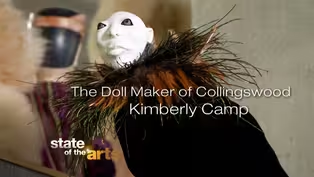
The Doll Maker of Collingswood: Kimberly Camp
Video has Closed Captions
Clip: S40 Ep3 | 5m 52s | Artist, administrator, and arts advocate Kimberly Camp on why she makes dolls. (5m 52s)
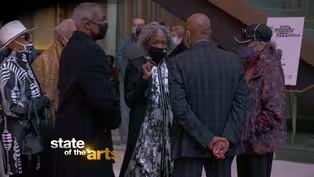
The First Lady of Jazz: Dorthaan Kirk
Video has Closed Captions
Clip: S40 Ep3 | 6m 50s | A profile of NEA Jazz Advocate Honoree Dorthaan Kirk in her hometown Newark, NJ. (6m 50s)
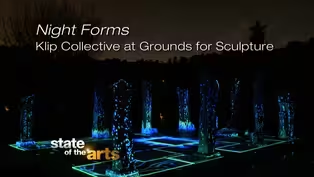
Night Forms: Klip Collective at Grounds for Sculpture
Video has Closed Captions
Clip: S40 Ep3 | 6m 26s | An after-dark, immersive experience by Klip Collective that has to be seen to be believed. (6m 26s)
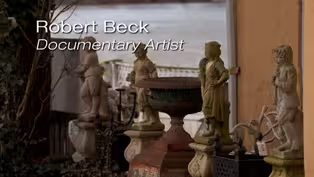
Robert Beck: Documentary Artist
Video has Closed Captions
Clip: S40 Ep3 | 4m 59s | Robert Beck paints his community, in the Lambertville/New Hope area and in Maine. (4m 59s)
Providing Support for PBS.org
Learn Moreabout PBS online sponsorship

- Arts and Music
The Best of the Joy of Painting with Bob Ross
A pop icon, Bob Ross offers soothing words of wisdom as he paints captivating landscapes.










Support for PBS provided by:
State of the Arts is a local public television program presented by NJ PBS