
December 2022
Season 7 Episode 3 | 26m 18sVideo has Closed Captions
Visit Summit Artspace and artists JBurgess Designs, Mike Alejandro and Lizzi Aronhalt.
Summit Artspace in Akron strives to support artists through every step of the creative process. Artists featured include Jessica Skinner, Mike Alejandro and Lizzi Aronhalt.
Problems playing video? | Closed Captioning Feedback
Problems playing video? | Closed Captioning Feedback
Around Akron with Blue Green is a local public television program presented by WNEO
December 2022
Season 7 Episode 3 | 26m 18sVideo has Closed Captions
Summit Artspace in Akron strives to support artists through every step of the creative process. Artists featured include Jessica Skinner, Mike Alejandro and Lizzi Aronhalt.
Problems playing video? | Closed Captioning Feedback
How to Watch Around Akron with Blue Green
Around Akron with Blue Green is available to stream on pbs.org and the free PBS App, available on iPhone, Apple TV, Android TV, Android smartphones, Amazon Fire TV, Amazon Fire Tablet, Roku, Samsung Smart TV, and Vizio.
Providing Support for PBS.org
Learn Moreabout PBS online sponsorship(upbeat music) - Hey, Akronites, welcome once again to Around Akron with Blue Green.
And do we have an amazing show ahead of us today.
This month's episode's all about Summit Artspace.
So I'm gonna stop down to Summit Artspace and learn all about that amazing building.
I'm gonna meet up with Mike Alejandro and learn all about his amazing artwork.
Then it's over to artist Lizzi Aronhalt to see what her work's all about.
Then it's over to JBurgess Design to learn all about her upholstery and woodwork.
Now to kick this show off today, I'm gonna journey to downtown Akron to Summit Artspace and learn all about the history of this building and what's going on inside.
Join me while I meet up with Heather Meeker and learn all about Summit Artspace to see what they're all about.
(upbeat music) - Summit Artspace, the building here at 140 East Market Street was actually built by the Knight Brothers and their father Charles who was the publisher at the time as the headquarters of the Akron Beacon Journal.
And at the time that it was built, it was a state of the art facility.
When they described it in the paper, they actually said that it was meant to be a community facing building and a production facility all at once.
And when I read that, it gave me goosebumps because honestly, that is what this is when it comes to artists here, almost a century later.
It was the headquarters of the Akron Beacon Journal for about 10 years.
And then they moved having acquired another paper which is what they then did over the course of decades to become the Knight Ritter conglomerate.
But in early 1940s, it became the main branch of the Akron Public Library.
And it was that until the late sixties and then it went through a number of private hands until the county purchased it.
We have been slowly taking over all the elements of this building over the last 20 years and we will be celebrating the centennial of the building in 2027.
So I like to say that it has been nearly a century of freedom of expression being championed in this building right here at 140 East Market Street.
(upbeat music) At the time that this building was built, it was at the top of the hill here on the east side of Akron and the captains of industry because let's face it, it was mostly captains at that time.
The Seiberling's, the Firestone's, they were here when it was opened.
Printing presses were in the basement and Calvin Coolidge pressed the button on the printing presses from the White House via a special connection that the director of the Western Union here set up.
And so it was a major event when this building opened.
And shortly thereafter, in November of 2027, they had a three day open house and 20,000 people came through this facility over the three days because there was such an interest in what was going on here.
It really was an amazing place to see an important element of Akron history at work.
I would say it's the same thing today.
You will walk into the building and you will see artwork everywhere.
We really are here.
Our mission is to support local artists to connect them to the resources that they need to thrive whether that's creatively, financially, professionally, personally, we want to be able to get them what they need to be a successful local artist.
So you will see our galleries and our exhibitions which change out on a quarterly basis.
You will see artist studios all throughout the building.
If you walk down a hallway or look through an open door, there will be something amazing to see or someone really interesting to talk to.
So lots of fun.
We have a lot of events here, come on Fridays and Saturdays, any time of the year.
There's always something to see and to do, and most importantly, artists for you to get to know and talk to.
They are a tremendous resource for our community and they help to make where we live and work a really special and unique place.
Artists are in fact part of what makes Akron Akron.
And so we want you to get to know them personally.
(upbeat music) We have a lot of events here at Summit Artspace.
Our aim is to give the general public lots of reasons to come back and to connect with local artists.
So whether it is our quarterly art walk, which takes place on the second Fridays of March, June, September, December, or it's our exhibition openings, which also take place quarterly.
There are lots of opportunities to come in and see something new in the building all the time.
So it is our aim to have this be a place where people come on a regular basis and enjoy getting to know their local artists.
(upbeat music) As an organization, what we are really about is helping artists to figure out what is it that they want and what is it that they need and how can we connect them to both of those things.
I think that whether it is exhibitions or whether it is events where artists can sell their work or if it is professional development programs because for us, artist care is also a really important thing.
Care can mean a lot of things personally and professionally.
For artists, this is not an easy profession to work in.
And the results of the pandemic on artists were tremendous.
The arts and culture sector will be one of the sectors probably along with the restaurant industry that is gonna take the longest for us to recover.
So being able to support and sustain artists in their practices is something that is terrifically important.
I would say to someone who is thinking of really moving into this profession whether they are young, mid-career, looking for a second career, is talk with other artists.
This is a building where we have so many artists that you can connect with and talk to all the time.
Being able to hear what they've been through, to benefit from their expertise, and to be around a group of individuals who are gonna be incredibly highly supportive of the individual vision that every artist has is a terrific value that comes with this kind of place.
And truly it is essential for any artist who is finding his, her, or their way into this profession.
(upbeat music) - Next up is to the third floor of Summit Artspace to meet up with Mike Alejandro and learn all about his amazing artwork and what he uses to portray such emotion.
Let's go see what Mike Alejandro is all about.
(warm music) - I remember in like high school, I used to carry around this little booklet like a tiny little sketchbook and I'd just like always be doodling things like anything that could catch my eye.
And at the time I thought I was interested in just like getting better at skills.
The way that, like the images that I was seeing of good drawing were drawings that were like realistic or something like photo realism or something.
The skill was what I was interested in but actually what I got interested in was the material.
And I wasn't from an arts family so I didn't have a strong arts foundation or conceptual art or like an understanding of these ideas.
But over time, I found more influences, more writers, more people that speak to kind of what that interest was.
And it was sort of just an interest in lines and lines conveying thoughts.
When you're drawing, what you're doing is you're recording your attention and there's a whole metaphor ingrained in that that's embodied.
And I've always found that really powerful and that kind of carries through in everything that I do today.
(warm music) These are painted on Masonite which is kind of a fun material.
I like a few things about it.
I like it practically just 'cause I can like nail it directly on the wall and I can start working.
There's something like really straightforward about it, really like honest about it.
Like, oh, it's just on the wall.
It is an art material.
It's also used in theater craft.
Like if you see like a high school play, they'll probably be making their sets with Masonite which is kind of funny, I'm building these sets but I really like it because it's also part of the world, it's sort of slightly industrial.
I'm painting it in the sheets that you get from Lowe's or Home Depot at their fullest size.
So it's the closest I can get between being in the art world and also being part of the real world and which is kind of the in between that I like being in.
(upbeat music) I kinda like using all media.
I like playing with hierarchies, the idea of if I can establish a high and a low, I can start frustrating them.
They'll create conflicts in their interactions on the canvas.
And I guess that is a way for me to just talk about hierarchies in general.
Like hierarchies are really sort of ways we treat each other.
So there's a metaphor in just establishing any kind of hierarchy and trying to like play with it.
There's also something exciting to me of like, if I'm talking a lot about history in my paintings.
So if the materials that I'm using have sort of conflicts, like if there's a conflict between like dry media and wet media, wet media will just override dry media.
Dry media won't rest on wet media or like oil paints and acrylics is a really famous conflict.
If you paint acrylics over oils, they have different drying times so they'll crack, they're just unstable.
It's gonna be a fugitive painting that's gonna like not sit, it's not gonna sit well, it's not gonna sit with itself like chemically.
It's gonna have an instability.
So I guess it just kind of excites me that if I'm talking about things and trying to destabilize them, or make them feel like they're still open, that they're still, they're not history, they're not just set.
If my materials themselves, the things that I'm talking about are not set, are sort of unstable, then it just feels like everything's working together.
(warm music) I guess one of my ongoing interests or I guess you could call it a theme is thinking about people's engagements with history.
The way that I've thought about how the interest came about was I am an immigrant and I was an immigrant because of political reasons.
I was born in Venezuela and we moved during the rise of Hugo Chavez 'cause my dad was involved in politics and we were just feeling really unsafe.
So that idea of history in a recorded sense, like this kind of violent upheaval was developed, was also part of my personal history, made me really think about how people fit within stories or narratives, like things that happen.
And that's not just like a refugee thing or an immigrant thing.
I think everyone's always interacting with history at all times.
History is like this thing that's always present.
It's in entropy, it's in cracks in the pavement, it's also in aging, it's in disease, it's in global warming.
Someday being possible, it's this violence that we're sitting with.
It's in being a Catholic and trying to live with both the history and the faith and the ideal, I'm bringing up a lot of things.
But that's what kind of makes it so exciting to me that it's so complicated that there's so many layers to both the how the personal and like the shared experience or the institutional experience or like the big narratives kind of fit together.
That's really hard to talk about with paintings.
But one way that I've sort of found is really great is just through art history 'cause there's so many visual signifiers.
So I can pull from art history and I can talk about sort of like the way that it has a sequence, the way that ideas can be dormant in art history and sort of reanimate them, make them new again and it can kind of feel like I'm making like alternative trajectories for those stories.
But then it also feels like I can be talking about that period in time and then also that artist fitting within a period of time.
So it can be both that idea of like be interacting with history and interacting with the individual that's part of history.
So it can get really complicated and really fun and feel kind of rich the way that when you think back about how your own life came together, there's not one take, there's so many different takes, there's so many ways to experience the same thing, to recontextualize it.
So that's what I try to do.
I try to recontextualize things in lots of different ways.
Talk about one thing with several different depictions so it doesn't feel like I have the one narrative.
It feels like I'm trying to let a narrative unravel and become subjective, become something that you can experience and feel.
(upbeat music) - Next up is Lizzi Aronhalt and her work is amazing.
She sees things that not many people when they look at architecture and design and she transforms it over to some beautiful artwork.
Let's go see what Lizzi Aronhalt is all about.
(warm music) - I always enjoyed art in school but I had interest in art in high school so I really got into it when I went to Firestone, which is in Akron and did a lot of art classes there and got really interested in art.
And then I did decide to study art in college.
I was interested in engineering also.
So I have like a little bit of interest in that.
A lot of my pieces are like architectural so I've had a lot of people be like, this makes sense, that sort of technical push and pull in the artwork.
So in college I decided to do art specifically, so I had an art education degree and then I taught in schools actually for six years up until about a year ago, I quit my part-time teaching job and now I do the art stuff full-time.
I kind of had tapered off from working full-time to working part-time so I was able to build my business while still teaching.
But it's worked well because now I have more time and space to actually do the work where before, I'd have to kind of fit it in with my work schedule at the school.
So now it's like, oh I can hop on a job kind of on short notice now and be able to work all around.
So it's been good.
(bouncy music) It's been really nice to have a space dedicated to my artwork, a place to like come and know like that's the focus.
'Cause previously I would paint wherever I lived, like I would paint, I would prime a piece of paper and tape to the wall and I'd paint in my room or in the living room, like wherever I was.
But to be able to have a dedicated space to work has been really wonderful.
And then being in a community with other artists has been really nice too, just to see what other people are doing.
And especially in the past year, since I quit my teaching job, it's like I don't have coworkers in the sense that I used to.
It's I don't have a boss, I don't have peers in the same way.
So being able to have people even in my everyday life that I can even bump into while making coffee, I didn't realize how much I liked having that, 'cause it can be like very isolating I think, working as an artist, if you don't intentionally go places.
And so that's one thing I really like about being here too.
(warm music) I've always liked outlining things.
Like that's always been an inclination of mine.
Even like in high school, I would paint with watercolor and I'd outline it with a black sharpie and that sort of bold outlined look has always been something I'm drawn to.
So I even had my high school art teacher came to one of my shows a couple years ago and he looked at my things and he said, oh you're still outlining things in black.
And it had been, eight, 10 years or whatever since then.
And I was like, I am, aren't I?
So I think it was partially following the inclinations that I had when I'm creating the work, like finding what I enjoyed doing in the process and then kind of sticking with that.
A lot of my personal pieces are like architectural city scapes and buildings as kind of my main subject matter focus.
And I lived in Montenegro in Eastern Europe for a couple years for an internship, unrelated to art.
And that's kind of when I started to notice buildings and architecture.
And I did a painting over when I lived in Eastern Europe of Budapest and I loved just the rhythm of the buildings and the patterns that they created and the strong bold lines you can use.
I feel like that's kind of when it really subject matter where I got connected to the buildings too.
So then when I moved back to Akron, it's like I saw all the buildings with a new perspective.
It was leaving and coming back.
I was like, oh wait, there's like so much to look at and so much to see and it is truly like it sounds cliche but it's like the more you look the more you see.
The more you study things, the more you start to notice the patterns and the geometry of things.
And it's fun, yeah.
(warm music) I think art is everybody's path is a little bit different.
So I think figuring out like what what you wanna do specifically and what resources you already have and what the pros are to your specific style or the stuff that you make, figuring that out is really good.
And then I think just like being your own patron, almost, like your own supporter, your own like biggest motivator.
And so for me that's been huge.
I worked six years part-time to be able to now work on the art full-time.
And I know people who have done it all sorts of different ways.
People who still work part-time doing something else.
It's okay for it to look specific to you.
And then I think, for me, also I'm always thinking like forward motion.
How can I just like keep moving forward because I could probably make a list of like 200 things I could be doing or website update, more social media, more Facebook, I could do YouTube, I could do this, I could do that and It's like, okay, what's one step I can take today to make my packaging look better or promote myself and just like letting those small forward motion steps carry you, 'cause you can't just wake up and be like, I'm gonna be an artist full time and just ta-da.
That just isn't a thing.
So it's a process and it takes time.
(warm music) - Now to wrap this show up today, which is all about Summit Artspace, we're gonna meet with another artist on the third floor of Summit Artspace, Jessica Skinner.
She runs JBurgess Design and she makes some amazing upholstery work and some woodwork.
And not only that, she does these amazing bowls.
Let's go see what JBurgess Design is all about.
(warm music) - My mom is a hardcore crafter.
So I remember making and I didn't love it at the time, but I think it probably led into why I like making things today.
My mom for holidays used to have us make sweatshirts.
So she would go to like Pat Catan’s and get stamps and glitter, like the 3D glitter things, and we would make holiday shirts.
Now, at the time I loathed this, but now I look back on it and I can see how like all the little crafts she had us do over the years really played a part into me liking to use my hands.
(warm music) Me and my husband got married young and so at 20 and we inherited like all of this furniture, kind of like a mod podge of furniture from family.
That's when I got started because I wanted it to look somewhat cohesive or at least intentionally funky, but it definitely didn't.
So that's when I started like playing with upholstery.
That was really what I got into first.
And then afterward the woodwork came after that.
But I definitely started from that.
I always say I think it was just in my bloodline, my great aunt upholstered, she taught me a little bit but for the most part I just learned.
And then woodwork too.
My papa who my business is named after he was a woodworker and so I just kind of picked it up in my mid twenties.
I was like, I think I wanna try this.
And then just got started that way.
(upbeat music) My woodworking, I usually do like 3D patterning, so there's like a base pattern and then I build up off of that.
That's one of my signatures.
I love layers and textures.
So I do that with upholstery also.
It's very layered.
I use like panels of strips to create the fabric that'll go on top of a piece.
And then I love triangles, so you'll see a lot of triangles.
So I have triangle foot stools and then from my scraps of fabric I make fabric bowls.
Those are my main stays that are like my signature items.
(upbeat music) (sowing noises) What I do always connects to like a meaning.
So like, I think honoring things that are older, applies to pieces but also applies to humans which is, older people are just such a wealth.
So I always try to take the things that I do and apply it to life.
And so when I make the bowls I talk about honoring your capacity as a human and being mindful of the things that you fill yourself with.
So you have somewhat of a choice.
Sometimes we don't have a choice, things happen in life, but like you can be mindful of choosing joy and choosing gratefulness and filling yourself with those things.
And then with woodworks, my pieces always connect like at a point.
So I talk about like meaningful connections between things in life, which is cool.
And then the last thing is that I named my business after my grandpa, which I already said.
So it is super cool to go back and talk to family members and reminisce.
He built the house my grandma still lives in to this day.
But then also to be able to leave a legacy for my kids also 'cause my older son is an artist as well.
So just to be able to leave a legacy and to think about the things that are just in your DNA whether you knew them or whether you kind of had to seek them out.
It's cool to think about the things that just run in your blood and DNA and to just be able to leave a legacy.
(warm music) The best feeling, the best feeling, So I think this is like a lot of artists, I'm not a hardcore saleswoman.
I think my space is set up kind of homey.
I want you to come in and I want it to feel warm.
But when you think about pieces that you bring into your space, I think, so, it's kind of like an intimate thing.
Like this is going into someone's home.
And so when people see things or a couple of times I've gotten commissions to make dining tables for people's first homes.
Literally tears.
It's so incredible.
Like for somebody to really connect with a piece and to think this is a place where you'll sit every day.
You'll have meals with your family or your friends.
It's like, there's no word, I wish I had a word.
There's no word for that feeling.
And for people to actually connect to it.
Do you know what I'm saying?
Like for people to connect to it.
And I would say that's happened the most with my fabric bowls as I talk about like the things I've processed, like holding space for and honoring your capacity, which can be so tricky because everything's busy, busy, busy.
People have connected to that and bought bowls for people like in hard times.
And they tell me their stories, which is so cool for people to come back and tell you the stories of this is who I bought this for and this is how they were impacted by it.
I cry a lot.
(warm music) - Thank you once again for watching this episode of Around Akron with Blue Green.
Now if you have any questions or comments you can catch me on social media.
Thank you and have an amazing day.
(upbeat music) - No mess ups today.
That's strange.
Maybe I'll put this in the roll.
(laughs) (vocalizing noises)
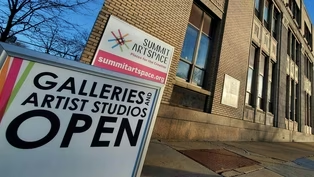
Preview: S7 Ep3 | 30s | Visit Summit Artspace and artists JBurgess Designs, Mike Alejandro and Lizzi Aronhalt. (30s)
Providing Support for PBS.org
Learn Moreabout PBS online sponsorship













Support for PBS provided by:
Around Akron with Blue Green is a local public television program presented by WNEO