
December 25, 2024
12/25/2024 | 55m 46sVideo has Closed Captions
Kate Winslet; Sonia Purnell; Diane von Furstenberg; Sharmeen Obaid-Chinoy; Oksana Lyniv
Award-winning actress Kate Winslet on portraying photojournalist Lee Miller in the film "Lee." Sonia Purnell explores the life and legacy of Pamela Harriman in her book "Kingmaker." Fashion designer Diane von Furstenberg and director Sharmeen Obaid-Chinoy discuss their documentary about Furstenberg's life. Christiane sits with The Metropolitan Opera’s first-ever Ukrainian maestro Oksana Lyniv.
Problems playing video? | Closed Captioning Feedback
Problems playing video? | Closed Captioning Feedback
December 25, 2024
12/25/2024 | 55m 46sVideo has Closed Captions
Award-winning actress Kate Winslet on portraying photojournalist Lee Miller in the film "Lee." Sonia Purnell explores the life and legacy of Pamela Harriman in her book "Kingmaker." Fashion designer Diane von Furstenberg and director Sharmeen Obaid-Chinoy discuss their documentary about Furstenberg's life. Christiane sits with The Metropolitan Opera’s first-ever Ukrainian maestro Oksana Lyniv.
Problems playing video? | Closed Captioning Feedback
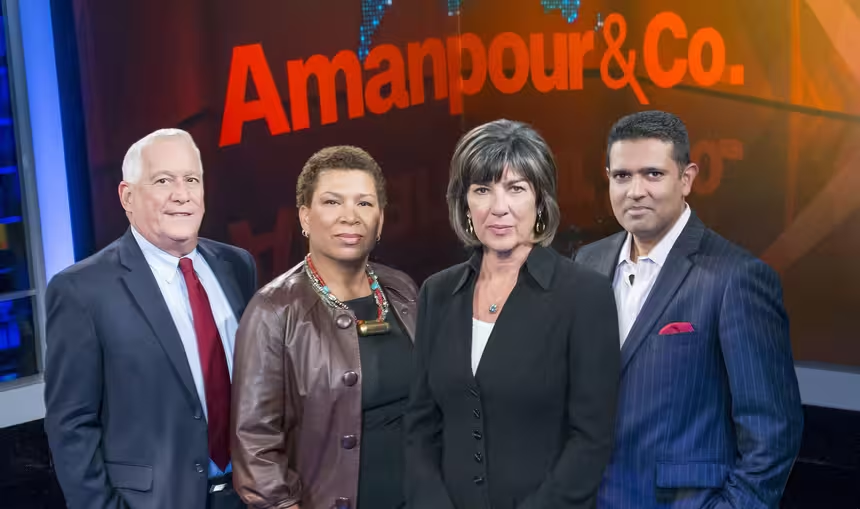
How to Watch Amanpour and Company
Amanpour and Company is available to stream on pbs.org and the free PBS App, available on iPhone, Apple TV, Android TV, Android smartphones, Amazon Fire TV, Amazon Fire Tablet, Roku, Samsung Smart TV, and Vizio.
Watch Amanpour and Company on PBS
PBS and WNET, in collaboration with CNN, launched Amanpour and Company in September 2018. The series features wide-ranging, in-depth conversations with global thought leaders and cultural influencers on issues impacting the world each day, from politics, business, technology and arts, to science and sports.Providing Support for PBS.org
Learn Moreabout PBS online sponsorship(dramatic music) - Hello everyone and welcome to Amanpour & Company.
Here's what's coming up.
Female trailblazers from past and present.
- We don't say women to combat.
- World War II photographer, Lee Miller.
My conversation with the Oscar winning actor, Kate Winslet on her starring role.
Then from Churchill to Clinton, an unsung power player.
Author, Sonia Purnell tells a story of Ambassador Pamela Harriman.
In her book, "Kingmaker".
Also ahead.
- I created the rap dress and I rapped America around.
- Being a woman in charge.
Fashion designer, Diane Von Furstenberg and director, Sharmeen Obaid-Chinoy talk about breaking boundaries.
And finally, defiance and unity through music.
Oksana Lyniv on being the first Ukrainian maestro at the New York Metropolitan Opera.
(upbeat music) Amanpour & Company is made possible by the Anderson Family Endowment, Jim Attwood and Leslie Williams, Candace King Weir, the Sylvia A. and Simon B. Poyta Programming Endowment to fight antisemitism, the Family Foundation of Leila and Mickey Strauss, Mark J. Blechner, the Filomen M. D'Agostino Foundation, SetonJ.
Melvin, the Peter G. Peterson and Joan Gantz Cooney Fund, Charles Rosenblum, Ku and Patricia Yuen, committed to bridging cultural differences in our communities, Barbara Hope Zuckerberg, Jeffrey Katz and Beth Rogers.
And by contributions to your PBS station from viewers like you.
Thank you.
- Welcome to the program, everyone.
I'm Christiana Amanpour in London.
Democracy has been tested throughout 2024.
We've seen an unprecedented year of elections and unrelenting brutal wars from Gaza to Ukraine.
It's in these times of insecurity and uncertainty that women often bear the heaviest burden.
Today, in this special holiday edition, we want to take a moment to honor female trailblazers whose courage, resilience and determination have redefined the world we live in.
To acknowledge the remarkable women who've changed history and pave the way for future generations.
First, we turn to one photographer whose story remained largely untold until very recently.
Lee Miller captured the atrocities of the Second World War on camera, despite facing resistance as a woman in the field.
Award-winning actor, Kate Winslet, brought her story back into the spotlight in the film, "Lee."
I met with Winslet in New York to ask why she chose this particular subject.
Kate Winslet, welcome to our program.
- Thank you for having me.
- It is wonderful for me anyway, and for the general audience, I'm sure, to see you playing one of the most illustrious war correspondents of the 20th century.
What made you choose this character who really wasn't very well known for what she was really best at?
- Well, I think it's probably exactly as you say.
She wasn't well known, and she wasn't revered, I felt, for the right reasons.
I knew who Lee Miller was, and I was aware of her work as a photographer, and I knew what she looked like.
But I found that as I started to really dig into the rest of her life, the sort of headline description of her was former muse, actually not even the, a former muse, and ex-lover of Man Ray, ex-cover girl, ex-Vogue model.
These sort of, these kind of reductive things that reduced her in a way, reduced her power, infantilized her, sort of stuck her in a moment in history that she couldn't wait to get away from.
- Man Ray, of course, for those who don't know the great surrealist artist of the 20th century, and in fact, it wasn't until after she died that her son found boxes of her diaries and photos hidden away in the attic.
It's almost like she didn't want to tell.
She didn't want to let on.
Why do you think that was?
- I don't think it's a case of want.
I think it's a case of couldn't.
I think it was a case of so many people had terrible, debilitating PTSD after World War II, and Lee was no exception to that.
In fact, quite the opposite.
It re-triggered in her the trauma of something that happened to her as a child.
And I think the level of exposure to such extreme horror as they witnessed during the war, it cracked her open and I think revealed old wounds that she simply had to do her very best to close.
And part of that was quite literally closing her photographs and prints into boxes, shutting them away, putting them in the attic, and never speaking of it.
And it's absolutely true that Anthony Penrose had no idea what his mother had done during World War II until after her death in 1977, and he found those boxes.
- And he did write the book on which this film is based.
Yeah, which is pretty great tribute from a son who had a difficult relationship with his mother.
- Yeah, so Lee, because of her trauma and because she got pregnant with him unexpectedly just after the war, she found it extremely hard to be a mother.
She had a dangerous relationship with alcohol and he has talked about how fractured their relationship was, even describing it as caustic at times.
I recently heard him say that until he opened those boxes and started to read her articles about the siege of San Marlo and look at those images, he said, "I just thought that she'd been "this useless old drunk, and here she was revealed to me "as being so much more than I ever could have imagined "or ever could have hoped."
And it's been a phenomenal journey for him piecing together who she truly was, but coming to understand why she had been the way she had been to him as a mother.
- It's really amazing that we brought this up so early because it goes right to the heart of what it is to be a woman and a woman at work and a woman who does dangerous things.
Let's sort of start a little bit at the beginning, before the very famous picture of her in Hitler's bathtub.
She wanted to go cover the British war effort and she wasn't allowed, right?
- Yes, she was initially, after she had decided that being a war correspondent for British Vogue in order to convey information to the female readers of British Vogue, she invented that job.
And initially she was, yes, she was given the task of going and photographing, as you say, the women, the pilots ferrying bombers between bases in the women's quarters at White Waltham, et cetera, et cetera.
But she was absolutely determined to go to the front line and women were not allowed, they were not.
Lee was one of approximately four or five US correspondents who did earn their accreditation to be able to go, but even that fight and even when she got there, as we see in the film, she's told no women in the press briefing.
I mean, the utter outrage.
And what I loved and still love and will forever love about Lee is that she led her life with intention and grace, integrity and resilience, redefining femininity already 80 years ago in the way that we live now.
And this was a woman who not only knew that she had already earned her place at the table, but was determined to fit at the head of it.
And that for me, in terms of a global message about female leadership is phenomenal and important.
And then she somehow became the first person to break the news of some of these concentration camps, notably Dachau.
How did she even get there?
Lee was phenomenally good at using her charms.
She really was.
And she lent into the fact that she was a woman and could buddy up with the guys easily.
So she would chit chat with the GIs and she would find information on the inside and she would just follow her nose.
And the more and more that they were hearing about people going missing, and the more that they became aware that no one knew where they had gone to or had been taken, the hungrier it made Lee to unearth this mystery, this atrocity, this lie, and to reveal it to the world.
She kept hearing rumors of something happening down South.
And she writes about that.
And we include words to that effect in our film.
And she and Davie Sherman were always the first in the door at any scoop.
And they arrived at Dachau not knowing really anything about what they were about to see, but knowing that that's where all the millions of missing had allegedly been taken, one of many places, many, many places across Europe, as of course we now know, so many millions of people had been taken to.
What had happened to them, of course, they were only about to discover.
- Through her pictures?
- Through her pictures.
- At one point, the most famous picture that basically the world knows about Lee Miller is frankly her in Hitler's Bathtub.
And it's been very misrepresented over the years as some kind of dilettante action, some kind of war trophy.
And the clip that we're going to play shows Davie Sherman, the colleague, setting up the shot of you as Lee Miller in the bathtub.
- Davie.
Davie.
- What?
- Come on, quick, I need you.
- For what?
- Is it good?
- Locked.
- All right.
- All right.
Come here.
- Yeah.
Ready?
- For history's sake, tell us why she took that bath.
It wasn't just a war trophy and Hitler was committing suicide or had just committed suicide in his bunker at that time.
- Yeah, so the events of that day are quite extraordinary.
Lee and Davie Sherman had been in Dachau that morning.
She, again, following her nose, had been aware of Hitler's Munich address for some years, a little bit like number 10 Downing Street.
People know where it is.
And she was determined to make her way there.
They bribed their way in.
Anthony Penrose believes she would have bunged them half a bottle of brandy or a carton of cigarettes and got her way in the door.
And it's absolutely true that there was an entire regiment already in there having a party.
Lee and Davie had not washed or changed their clothes for six weeks and they certainly hadn't touched hot water.
And that is a fact.
That is a historical fact.
So it just doesn't surprise me that Lee would think, "Well, there's no one here.
"There's a lockable door.
"There's hot running water."
And I believe, and Tony Penrose shares the same view, that it wouldn't have been until she was in that bath that she realized, "Hang on a second.
"This might just be something I need to do."
To wash off the horror.
To wash off the dirt of Dachau, the horror and the evil in Hitler's bathtub.
To stamp that mud into his girly lemon yellow bathmat as she herself described it.
That's purely, it's purely, it just doesn't surprise me.
Now I know her as intimately as I do.
I can absolutely see why she would do something like that.
- We have another clip where Lee has sent these pictures of the concentration camps back to Vogue.
You see the sort of Lee cutting them up in anger because they haven't been printed and she wants to get this story out.
We're gonna play this clip.
- Stop, stop, stop, stop, stop, stop, stop, stop!
They're an historical record!
- Well, who cares?
Nobody saw them.
You didn't print them.
- I fought for them, Lee!
I fought for them!
These must be preserved!
- What, to stick them in the filing cabinets?
- The ministry thought they may disturb people.
This happened!
This really happened!
- Lee, Lee, Lee, Lee!
- Happened.
These images will disturb people more than they've already been disturbed.
People need to move on.
Move on, move on.
This little girl in a death camp, raped and beaten.
How does she move on?
How does she move on?
Ever, ever.
(panting) Ever.
- So for me, that was an incredible scene because having covered war myself and sometimes being told you can't show that amount of detail or that amount of actual horror, it was extraordinary, the reaction that Lee had.
Tell me about her and the argument she was having with the editor, who was on her side.
I mean, the editor was a big supporter of her.
And did those pictures eventually get published?
And what impact did they have?
- So Lee and Audrey Withers, they actually had a rather exceptional relationship.
Their bond crossed over from a boss and an employee into the territory of very gentle, important female friendship.
This really happened, this scene.
It's something that actually did take place.
I met a woman when I was researching the film who's now in her nineties, who was a 15 year old secretary at Vogue at the time.
And she told me this story.
She said, "Kate, I will just tell you something that happened that was rather remarkable."
Lee came in one day and she was rather drunk.
She was in a terrible state and she was furious that more of her photographs hadn't been printed in British Vogue.
And she started pulling open drawers and ripping open boxes until she found what she was looking for, her negatives.
And she picked up my scissors and she started hacking, hacking into them.
As though she was trying to cut them out of herself.
That's how I read that.
And the only way this young girl could get Lee to stop cutting for fear that she was going to hurt herself.
She said, "Now you look here, Lee Miller.
Those are my good scissors.
You jolly well give them back."
And Lee looked her in the eye and was almost startled by this young girl's firmness.
And she stopped and she put the scissors down and she left.
And I have actually held those cut up negatives myself in my hand.
And when I heard that story, I knew it would have to be a part of our film precisely because of that deep metaphor that Lee was so traumatized and so desperately trying to get rid of these things that she had seen like so many people.
Lee felt completely betrayed by that.
And actually there was an interview with Audrey that we listened to from the 80s before she died where she does say that in fact it did haunt her for the rest of her life, that she hadn't done more.
But she did have them printed in American Vogue in an article entitled, "Believe It."
They were printed on a much larger scale and across many more pages in the end.
And Audrey did fight for that.
- You've played other characters of the World War II Nazi era.
The reader notably, you got an Oscar for it.
But you started, I think your film career when you were 17 or so, your dad, I read, drove you to the audition for "Heavenly Creatures."
And it appears that you grew up in a very level-headed, loving family.
And I just wonder, given all the trauma and PTSD that you portray in films of those characters, what helped you get through a superstar career in the level-headed way that you seem to have turned out?
- You know, the honest answer is, you know, part of me is sort of almost not sure.
I think perhaps exactly as you point out, I did have and do have an extremely grounded, loving family who care about the important things.
They care about togetherness.
They care about feasting and sharing and stopping and climbing trees and not being endlessly consumed by phones and social media.
And what the white noise is saying.
I've never read reviews.
I've never been motivated by the wrong thing.
And I think when you grow up in a family that is so wealthy with heart and wealthy with affection and spontaneity, it meant that I felt I was never searching for something more in myself.
I was searching for a dream.
I was pursuing a dream that I believed in.
I knew I wanted to act.
I was determined to do it.
And so when I went for that audition for "Heavenly Creatures", I just couldn't believe it.
Even holding a film script in my hand, I was like, "Wow, this is a film script.
This is what it feels like.
It's kind of heavy and thick.
And oh my God, I have this character who's on every single page.
My goodness, if I could get this job."
And my dad just looked at me and he said, "You'll get it."
And I thought, "Yes, actually, yes."
And from then on, I have always tried to maintain a sense of groundedness, determination.
Perhaps when I was much younger, was possibly something that gave me the courage to even walk over the threshold and into those audition rooms.
'Cause sometimes you have to just trick yourself.
No, it is me that they want.
They just won't know it until I walk in the room.
Okay, it's me.
At some point though, you had so much pressure from the public gaze, probably the male gaze.
You had so many paparazzi.
You developed a bit of a crisis, a health crisis over all that.
How did you get through that dark tunnel?
I think where I was very fortunate, and I always jumped to the positive, is that mentally I was okay.
Like I didn't crack.
I didn't have a nervous breakdown.
I'd never taken drugs.
I've really never taken drugs.
And actually people will often say to me, how did you not completely go under?
And again, that is because I had this level family.
If in doubt, I'd go home for Sunday lunch and I'd feel fitter for things.
And my mum would have put the world to rights with a wonderful roast dinner.
But I was a bit powerless as to how to navigate the way when dealing with a level of scrutiny from mainstream media that I knew was morally very wrong.
And what was I gonna do?
Stand up and defend myself for just being myself?
I mean, I wasn't doing anything wrong.
I was just being criticised for how I looked physically.
That is not okay.
And it makes me so happy to sit back and watch wonderful, powerful young actresses who are just gorgeous and enjoying this experience of acting, going into fulfilling careers and standing up for themselves and each other.
And not being afraid to say, hang on a minute, you can't say that about me.
That's not nice.
And it's a wonderful thing to think that I might have, you know, been a part of igniting that discussion and making sure that those conversations continue to happen because it remains to be spectacularly important.
- Which brings us full circle to Lee Miller again in the film.
In the film, there are scenes towards the beginning of those sort of, you know, epicurean delights in the garden.
There's Man Ray, there's all the other characters and Lee is sitting there bare chested, bare breasted and she's, you know, not necessarily the fittest.
I read that you decided not to exercise while you were preparing for this film to give your body a little bit more of a soft touch.
- You just do what you need to do to be true to the role that you're playing.
And that's who Lee was.
She was so comfortable with her physical self.
She lived life at full throttle on her terms in every capacity, mentally, emotionally, sexually, physically, with her friendships, with her lovers, with the job that she did, with how she saw the world.
She saw it her way, she did things her way.
And that as a message now, I think is phenomenally important for women.
And I have to say, I am a lot like that myself.
She was really comfortable with her body in a way that is, was admirable.
And it's a very famous recreation of a photograph that some of which were taken by Lee, some by Roland, some by Man Ray of this picnic scene.
And yeah, you know, it's just, it's hot.
The women just aren't wearing their tops.
Well, the men, they don't wear their shirt.
And yeah, we wanted Lee to be naked on her terms throughout the film.
So we never sexualized her, ever.
And that was a choice that we made.
And it was very important that we stuck to that.
And I love it.
I think it's very powerful.
- Indeed.
Kate Winslet, thank you so much, indeed.
- Thank you.
- Slowly but surely, the world is uncovering stories of powerful women who pull strings behind the scenes throughout history.
One of them was Pamela Harriman, daughter-in-law of Winston Churchill and eventual American ambassador to France.
She was frequently dismissed as little more than a sexy social climber.
But this year, nearly three decades after her death, author Sonia Purnell released a new biography called "Kingmaker", re-examining Harriman's influential legacy.
And she joined me here on set in London where we discussed that untold story.
Welcome to the program.
- Thank you so much.
- So, I mean, it's quite a story, quite a life that Pamela Harriman said had.
Why three decades after her death did you think that she was an interesting subject and that you wanted to set the record straight?
- Well, two things.
I first came across her when I was writing a book about Winston Churchill's wife, Clementine.
So I knew that she'd been a crucial part of their war effort, that they depended on her and that she had had a very, very special war mission, if you like, which I'll come on to shortly, I'm sure.
So I knew about her then, but I also knew that her own papers, huge numbers of letters and diaries and minutes and transcripts were going to be made open for the first time in the Library of Congress.
Now this was during COVID, but I beetled over there in a window in the lockdown and went into the library there.
And what I found really blew my socks off.
I thought this was going to be a book that might take me two or three years.
In the end, it was five years.
She did so much more to create what you just described as modern history than even I had any idea.
And I'd already looked into her past a fair amount, but really any big event that you can possibly think of in the 20th century, she almost always had a ringside seat and had some kind of impact on it.
- Let's start a little bit at the beginning.
Okay, so she was born to a middle-class family.
She was a little bit sort of, you know, wanted to get out of that sort of stultifying life, right?
And wanted to get married.
She didn't do very well in the debutante season and she was pushed towards Randolph Churchill.
- That was very much her decision.
She was the eldest daughter of a lord in Dorset, quite rural, very remote house.
- Upper class, sorry.
- Upper class, privileged lifestyle, but shot off from the rest of the world.
And this is foaled in the Dorset Hills.
You can't see any other lights at night.
It's very, very remote.
Her parents had gone there after the last pandemic in 1918 for sort of big, healthy outdoor spaces.
But their daughter reacted against that.
What she wanted was fun and excitement.
And she'd taken a very early interest in politics.
Now, at the beginning of the war, she met Randolph Churchill.
He asked nine women to marry him.
He wanted to sire a son before he went to war.
Nine had said no, probably for very good reason, because he was an appalling husband, a brute and a bully, really.
- And a philanderer.
- And a philanderer, and a drunkard, and pretty much anything else you can think of.
But Pamela said yes for one very good reason.
She saw it as an exit out of Dorset and into high society and the centre of power in London.
And she succeeded in finding that.
- And do you think she thought that it would lead to what you obviously write about, and that is this close relationship with Winston Churchill and this very critical role in trying to get America in on Britain's side and being kind of at Winston Churchill's side throughout?
- Well, she was, and she was also his secret weapon.
I think she set out right from the start that she was going to make herself indispensable to Winston Churchill.
I remember at the beginning of the war, he was pretty unpopular.
Everyone thought he'd been on the wrong side of history before, that he'd made too much of the threat from Hitler.
Now, okay, we were at war, but still he was unpopular.
And here was an attractive young woman who laughed at his jokes, but also took a huge interest in what he, in the serious, very serious nature of the events that were now facing Britain.
The peril from invasion from the Germans was indescribable.
Some way had to be found to lure the Americans into the war, and if not short of that, gain their support in the form of planes or weapons or even food and medicines.
So he unleashed her as his secret weapon.
- Cut to, the secret weapon was directed at, as you say, the head of America's Lend-Lease Program, Averell Harriman, who was dispatched to the UK, right, by Roosevelt?
- By Roosevelt, yes.
- And she met him and?
- Well, she met him, and I think it's fair to say fireworks happened, but that was all deliberate.
It was part of a strategic sex life.
She had to seduce this guy.
She was provided with a beautiful golden skin-type dress.
She was put next to him at a dinner at the Dorchester Hotel.
Max Beverbrook, one of Churchill's confidants, arranged all of this, and then by the time they got to dessert, she was doing what people came to call her mating dance, which involved a lot of stroking of the forearm, laughing at his jokes.
He was a rather, he was a tough guy, but quite shy and insecure, and there was this gorgeous aristocrat soaking up every single word he said.
This was unusual, it never really happened before.
It was a very, very bad air raid that night.
They went down to his suite in the hotel, which was seen as relatively safe, and I think it's fair to say, without going into too much detail, when her very special war work started that night and went on from there.
- And what was the result?
I mean, can we say it was because of her and Averell Harriman that Roosevelt came in?
No, not.
- No, we can't, but what we can say is that she was very much instrumental in recruiting him and many others, journalists, generals, all sorts of people, to the British cause.
So let's just take Averell Harriman there for a second.
He was now completely well briefed on what Britain needed.
Not only that, but he was in love with this woman and was determined to try and save Britain that she now embodied.
And by the time he went back on his first trip to Washington, this tough-nosed son of a Robert Barron railroad tycoon was so pro-Brit that people said, "Have you been bewitched?
"What's happened to you?"
But it wasn't just him.
It was a whole series of Americans that were all in love with Pamela and all would do anything to please her and be in with her.
Meanwhile, she was peddling the British line, but also extracting information from them and passing that back to Churchill to try and establish what later became the special relationship.
- Yeah, and obviously a woman of substance.
I mean, you write, "History has reduced Pamela "to a distorted stereotype, in her case, "a conniving and ridiculous gold digger obsessed by sex."
You call your book, though, "Kingmaker" for a reason.
- Well, that's right.
I mean, you know, her portrayal, even now, is totally unfair.
So what I've just described wasn't done for fun, although I'm sure there were moments of fun.
It was a strategic campaign.
She was only 22, 23 when she was doing this.
She knew exactly what she was doing.
The pressure on her was immense, but she got the taste for power.
She was beside Churchill as he waged a world war.
She spent the rest of her life after the war, when she was divorced from Churchill's son, trying to recreate that sense of power, that access to the center of everything.
Eventually, she found that, and this is where the "Kingmaker" comes in.
She found that in the States.
She married one American, he died.
She then married Averell Harriman, that she had seduced all those years before.
He always said that he wished he'd married her there and then, but he didn't.
He was her entree into Democratic politics, just really as the Republicans were taking a very firm grip of the White House.
Her job was, how do we get the White House back for the Democrats?
- And you did talk to President Clinton, right, about Pamela, and I think we have a little bit here of what he acknowledged at Pamela's funeral.
- Today, I am here in no small measure, because she was there.
She was one of the easiest choices I made for any appointment when I became president.
- So he's talking about the appointment as ambassador to France.
That's where I met her, and I obviously talked to you a little bit for your book, because she was a real powerhouse during the phases of the Bosnia war.
She was a convener, whether she had American officials there or the Balkan leaders.
It was an extraordinary thing, and you write also about how she was besieged by then-president Jacques Chirac to help smooth relations with the United States.
- Yes, that's right.
As helping Clinton into the White House, which he has frequently acknowledged, he, as a reward, made her ambassador to France, where, again, people expected her just to be a sort of, you know, a socialite, but my goodness, behind closed doors, she was anything but.
Bosnia was her big test.
She remembered what it was like from the war, what it was like to be in the blitz.
She gave birth during an air raid.
She knew the horror and terror of war in a way that these guys that she was working with didn't.
They were too young to remember, or they'd been born after the war.
She brought a moral compass, if you like, to those negotiations, and she also became super trusted by both President Chirac of France and Clinton back in Washington in a way that's really unusual.
All ambassadors are trying to perform that role.
Very, very few, probably numbered on the fingers of one hand, ever quite achieve it in the way that she did.
And she created that feeling of trust, that alliance that eventually led to the intervention in Bosnia and the sort of peace that we have now.
However imperfect that might be.
And both sides say that she was absolutely a key part in making that happen.
And yet, that's never been talked about.
It's remained behind closed doors.
This is part of her astonishing story, which scanned, you know, all sorts of things during the 20th century, that being just one of them.
>> You've made a bit of a career on exposing the true face of some of these amazing public women, Pamela Harriman, Clementine Churchill, a woman of substance about a British World War II spy who didn't get her due at the time, right?
Reflect on that a little bit.
There's so much misogyny, so much sexism in the way these women, particularly Pamela, obviously, was portrayed.
Do you feel, I don't know, a mission to break that record?
>> It's interesting you say that word mission.
I do.
I'm quite affected by what these women did, how they've never been given much credit, if any credit for it.
But more than that, they've often been portrayed in the most unflattering way.
With Pamela, that still happens.
People still say, "Oh, well, she was, you know, she was just a seductress.
She was just a courtesan.
She was just a gold digger."
Okay, she had a glamorous life, and okay, she was the mistress of wife of a number of rich and powerful men.
But what she did with that access, what she did with that wealth, what she did with that position is extraordinary, perhaps unique.
And we actually owe her an awful lot.
Another thing that she did was try and bring Russia and America together.
She went to Moscow at one point in 1983, saw Anne Dropoff, and took a message back to Washington saying that Russia or the Soviet Union that was then was finally open to creating new channels of communication and perhaps ultimately some kind of arms reduction treaty.
So, you know, she was way more than just a courtesan.
>> Which then led to Gorbachev, who then came to have that deal with Ronald Reagan.
It is extraordinary.
And I really did admire her.
I thought she was an incredibly clever and an amazing woman.
And it's really interesting because your book has had tremendous reviews.
People have acknowledged the fact that here you have actually told a story about an important woman of history who never got heard you properly.
>> Well, that's what I'm trying to do.
And a lot of people helped me along the way, including President Clinton, who was -- and including your good self.
It was amazing to get your insight, too.
I thought it was a really important thing to do.
And I'm really glad that I did.
There are very few people like Pamela in history.
We may never see her like Harriman.
We never see her like again.
>> Sonia Purnell, "Kingmaker."
Thank you so much indeed.
And next to fashion and a trailblazing female designer.
If the world knows Diane von Furstenberg, it's really for her iconic wrap dresses.
But her identity is far more complex than one simple item.
She's the child of a Holocaust survivor.
Her mother barely survived Auschwitz.
She unashamedly embraced life and love on her own terms, as she says, like any man.
And she's also the savvy businesswoman who built a fashion empire.
This year, a new documentary, Diane von Furstenberg, "Woman in Charge," tells the whole story.
(upbeat music) >> She was one of the first women who broke through the glass ceiling in business.
>> Now there's a woman.
>> It's co-directed by the Oscar winning director, Sharmeen Obaid-Chinoy, herself a pioneer in the film world.
And they both join me this summer for the film's release.
Diane von Furstenberg, Sharmeen Obaid-Chinoy, welcome to the program.
>> Hello.
(laughing) >> Thank you.
>> So listen, this is pretty amazing.
Firstly, I've spoken to both of you separately in the past.
I know some of Sharmeen's previous work.
Diane, obviously I know your work.
And I don't think I would have necessarily paired you.
So first, Diane, I wonder, what is it about Sharmeen?
What made you trust her to tell your story?
>> I am a great admirer of her work.
And a woman who, you know, gets two Oscars before she's 40 is pretty amazing.
I obviously couldn't be a producer.
I couldn't be involved in anything.
I had absolutely no involvement other than being the subject.
Of course, they had all access to my archives and I helped them get people to interview.
But I had absolutely, and I actually love it like that.
It's much better to be the subject.
>> And Sharmeen, what about Diane?
What was it about her that attracted you?
>> I've made films about women who've lived extraordinary lives, who've been faced with circumstances, adversity, and have sort of risen through it.
And if you look at the spine of Diane's life, here is a woman who was born out of the ashes of World War II, whose birth in itself was a miracle, and who started a business at a time when women needed men to cosign for something as small as a credit card.
And her journey from Europe to America as an immigrant, starting a new business, being a single mother, it's an inspirational story of a woman who was trying to chart her own yellow brick road.
And that is what I wanted to focus on, because I feel today women need to hear stories of how you make it in the world and how you find your own voice.
And Diane is a great example of someone who's fallen down many times and picked herself back up.
>> Well, listen, one of the most extraordinary things is how you decided to start the program.
Diane has always owned herself and has always been authentic.
And this clip we're going to play right now, because I just laughed out loud when I saw it.
(Diane laughs) >> Yeah.
I don't understand why so many people do not embrace age.
I've always been attracted by wrinkles.
You know, age, age means living.
You shouldn't say how old you are, you should say how long have you lived?
If you take all your wrinkles away, you know, the map of your life is different.
I don't really want to erase anything from my life.
>> Diane, are there many women that you know, I mean, even younger than you, who would be that honest about age?
>> But what I don't understand, I don't understand this honest about age.
I mean, age means you have lived.
So you have to honor that.
And when you age, you already have, you know, you already have the years before.
So I don't understand the concept of, oh, not wanting to say your age.
I'm 77 years old, and I couldn't be a week younger, because last week I learned a lot.
So it's, I just don't understand the concept of being intimidated by your age.
I think it's a victory.
>> Yeah, that's great.
You work in the fashion industry, you live in New York, you know so many women who are trying to erase the wrinkles and jack up their faces and dress in a way.
But that's why this is so interesting.
And actually, your story may have something to do with that.
You say that, you know, 18 months after your mother emerged alive from Auschwitz, you were born.
I'm going to get to that in a moment.
But first I want to ask Sharmeen, because there's an extraordinary scene whereby some of your mother, the fragments of the little letters your mother wrote that she was on the way, you know, essentially to the concentration camp that were eventually found, because you found them a decade later.
I'm going to play this clip from the documentary.
>> She took some cardboard and she wrote to her parents, and she threw it on the street, hoping that somebody would find it.
And she never, you see, she said, "Merci beaucoup," she gave the address.
And she wrote to her parents.
(speaking in French) >> I think that's extraordinary, too.
"I leave with a smile" takes something to be able to write that then.
>> It wasn't true.
I mean, it's not like she left with a smile, but she wanted her parents to think that she... And she did survive, you know, she survived 14 months.
And she always said that she felt that she survived because her mother's will, yeah.
>> You say throughout the film that your mantra is freedom and also being in charge as a woman.
You keep using those words throughout the film.
And so really, let's jump forward to when you came to the United States, and around that time, essentially became a businesswoman out of nowhere with the famous wrap dress.
And how difficult was that?
'Cause I read that, I mean, I saw in the film that you had to crisscross all over America, that, you know, people were not prepared, really, to deal with a woman who was peddling these wares at that time.
>> It was the adventure of my life, you know?
We don't choose where we are born.
We don't choose who our parents are.
But what we can do, we don't even choose our destiny.
But we try to navigate it the best that we can.
I wanted very much to be a woman in charge, to be a woman independent.
Even though I had married a young, very attractive aristocrat with money.
I wanted very much to have my own money, and to be a woman in charge.
And I became that woman because of a little dress.
And so I traveled around, and meeting women, wrapping dresses around them.
And the more confident I was, the more I was actually selling confidence with a dress.
And it was the liberation of women, and it was the time, and this dress became also a flag of freedom.
>> And I wonder, Diane, you're sitting next to Sharmeen , I mean, obviously a younger generation, but also from a country, let's face it, Pakistan, that simply would never be wearing wrapped dresses.
What does it feel like to be a successful woman in, you know, in Pakistan?
>> Well, I will say this, that I'm very much a product of Pakistan.
I was born and raised there.
I found my voice in Pakistan.
I live and work out of Pakistan.
The space exists for women like myself to be there.
We have to continue to fight every single day for our rights.
But let's be honest, women in America are fighting for their reproductive rights these days.
Women in Europe are fighting for their rights.
There are giant steps being taken around the world for women who are being pushed back.
Some of us live in countries which are far more difficult for women than others.
But I will say that women like myself stay in our countries.
We speak out, and we try and push the narrative forward so that our children and our daughters have a better tomorrow.
>> And I wanted to, you know, I was actually very interested in when you touched on Diane's sexuality.
And, I mean, there was that amazing clip where, you know, Diane talks about having had an affair or, I don't know how you describe it, but with Warren Beatty and Ryan O'Neill in the same weekend and just nearly went into a threesome with Mick Jagger and David Bowie.
I mean, that's pretty hot stuff.
Why did you want to include that?
>> Well, you should really ask me why I even said that.
And the truth is that at that time, you know, it was something to boast about.
Why a businessman can go on tour, arrive at the Beverly Hills Hotel, and, you know, go out with one man and one girl and another girl the next day?
And why can't a woman do that?
I mean, why?
And so, I mean, it's part of, you know, just speaking the truth.
And I was quite proud of it.
I mean, I actually still am.
They were hot.
They were in their early 30s.
>> I want to just flip back to your husband, your first husband, Prince Egon von Furstenberg, because eventually, or maybe you knew at the beginning, but anyway, he was gay.
And it was at a time of this terrible, terrible AIDS crisis in New York.
And he did develop AIDS, and he died of it.
And I just wonder what impact that had on your children and on you.
You had two children with him.
>> Well, first of all, more than being gay, he was promiscuous, you know?
So, and there was a time also in New York where people were very promiscuous.
And then all of a sudden, AIDS came.
And it was hard, mostly for my children, because they were growing up.
At that time, they were teenagers.
And to be teenagers and to have a fear of, you know, a sexual relationship could kill you was something very different than what I grew up with.
And they talk about it in the movie.
And we never really actually addressed it while it was there.
But the three of us were with Egon when he died, and it was a very profound moment, but actually a very beautiful moment.
>> I'll also say this, that one of the beauties about the film, I mean, one of the most incredible things about the film is how honest the family is.
Alex and Tatiana both open up their relationship with their mother, their relationship with their father.
And it's the honesty in telling their story that makes Diane's story so much stronger.
>> Sharmeen , I want to ask you this, 'cause you did get the children, they're not children, they're adults, but you did get her kids to open up and to appear and to talk.
And I was actually really, really kind of moved when Diane is reading this letter that once when she was a kid, Tatiana wrote her.
And it says, "Dear Mommy, "I was wondering if I could have a talk with you sometime, "because Mommy, you don't know anything about my life."
That just was like a dagger through my heart.
I guess, Sharmeen , how did you feel about that moment?
>> No, I love that letter.
I love that letter so much that I have a picture.
>> I know, but Diane, it was because you weren't around.
>> And then, yes, but it's part of the process.
I mean, when your children grow up, it's part of the process.
They test you, you test them.
They thought, you know, I wasn't there enough.
I was actually there more than they thought.
I never left them mentally.
When they went to boarding school, I wrote every day.
And then you go through a process, and then they grow up.
My children and I, we talk twice a day at least.
>> As someone who's a working mother and who travels a lot for work, reading that letter and sort of filming the relationship that Diane has with her children really taught me a lot about myself.
Like, Diane and I would often say, well, 25 years from now, your children are going to be telling you that you were not there for them.
>> Let's be honest, we're not like miracle workers.
There's going to be a ball that's going to drop at some point as long as we pick it up and move on.
And I think this film will resonate with working mothers everywhere because they will see a reflection of their own relationship with their children in the letters, in the moments that they feel like their children missed out on or they missed out on.
>> Yeah, I just finally want to ask you, Diane, because you are in the love of your life now with your husband, Barry Diller, and what is it about life that makes you pleased, satisfied at the age of 77, as you said, that you can say, yes, this is what it's all about?
>> Well, first it's family.
I mean, when you look back, I mean, I'm now entering, hopefully entering the winter of my life.
When you look back at the end, the most important thing is the family and the thing I'm proudest of, my best samples are my family.
So, and then it's really honoring life.
My mother did not die.
She, from whatever miracle, she did not die.
She survived.
She put the torch of freedom in my hand.
So all I did, tried to do all my life is honoring life.
>> Well, it's been an amazing life and it continues to be.
And I just want to maybe end up with you, Sharmeen, because you've done a lot of documentary and now you're going to be the first woman and the first woman of color to direct a "Star Wars."
>> Yes, looking forward to that.
>> No, but come on, more than that.
That's gigantic.
That's massive.
>> Well, you know, I'll say this, that following your own yellow brick road has been very important to me.
And I've charted my own sort of trajectory from the country that I come from right here to Hollywood.
And I've been able to do that because a number of women have left the door open for me to walk through.
And I think that is something that I hope will continue to happen.
And that is something I hope I will be able to do for other women.
>> Well, that's a really nice way to end.
>> And that is really the reason why we did this movie.
>> That is a lovely way to end.
Diane von Furstenberg, Sharmeen Obaid-Chinoy, thank you so much.
>> Thank you.
>> Thank you.
>> And finally, we shine a spotlight on a symbol of patriotism and defiance through art and culture.
Oksana Lyniv is a classical music trailblazer.
In a field still heavily dominated by men, she's emerged as somewhat of a pioneer.
This year, she became the first Ukrainian maestro at the Metropolitan Opera in New York, conducting Puccini's Turandot.
But this remarkable professional achievement comes at a time of great personal difficulty as Russia's invasion ravages her country.
Speaking with her at the Met, I asked her about this experience and why promoting Ukrainian culture is so important now.
Oksana Lyniv, welcome to the program.
>> Thank you very much.
>> What does it mean to you to be the first Ukrainian conductor to step onto the Metropolitan stage?
>> It is absolutely exciting.
I feel very honored to be the first Ukrainian conductor in 141 years of Metropolitan Theatre history and to be a part of this legendary and historical Zeffirelli production of Turandot.
(opera music and singing) (opera music and singing) >> And what does it mean to you, given the fact that there's a horrible war raging in your homeland, to you to be here and what do you hope the audience and even the choir and the performers to take from this moment in history?
>> Yes, this terrible war makes us suffer with all together people in Ukraine, even though I am abroad, but my family is Ukraine, all my friends, all my colleagues are in Ukraine.
My first Turandot I conducted in National Opera Odessa and of course on my debut night, of course I was thinking and I was thinking about this incredible experience and about the terrifying conditions which now all musicians are suffering with.
And I have to say that the fighting for the freedom makes us to feel everything deeper, everything more emotionally.
And I would like through my music, through my art, make people also to understand because art is about humanity and I would like with our art also to educate and to do some impact for the future generations.
>> And you said Odessa and we all know there was a missile attack by Russia on Odessa, very close to the opera house there.
>> Yes, and it was on 2nd of March, exactly on the day when I conducted here my second night of Turandot.
And of course I was conducting and I had tears in my eyes and for example in my future concert, I already commissioned the piece to Ukrainian composer Evgeny Orkin and I'm going to premiere this in Denmark and it will call "Five Interrupted Lullabies" dedicated to five innocent children who died in that night.
>> What would you like your audiences to know about your country now?
>> I just want to say that the war, it is not about politicians, about territory, about to see the news in the TV.
The war is about human, about people, about families, about lost childhood and it is terrible to see every day it can happen that more and more innocent people are dying because Russia is doing that terrified action just to bomb civilian cities and I just would like to say thank you, especially also to all American people for your help to Ukraine because I think that American can understand what is such important values as freedom and I just want to thank you for your solidarity and want to say that please don't lose the hope also to continue to help us.
>> And actually this war has shown the world a much more Ukrainian culture, dance, music, art.
It's an interesting by-product of this terrible war.
Oksana, thank you so much indeed.
>> Thank you so much.
(opera music and singing) >> And that is it for now.
Thank you for watching and goodbye from London.
(upbeat music) >> "Amanpour & Company" is made possible by the Anderson Family Endowment, Jim Attwood and Leslie Williams, Candace King Weir, the Sylvia A. and Simon B. Poyta Programming Endowment to Fight Anti-Semitism, The Family Foundation of Leila and Nikki Strauss, Mark J. Blechner, The Filomen M. D'Agostino Foundation, Seton J. Melvin, The Peter G. Peterson and Joan Gantz Cooney Fund, Charles Rosenblum, Ku and Patricia Yuen, Committed to Bridging Cultural Differences in Our Communities, Barbara Hope Zuckerberg, Jeffrey Katz and Beth Rogers and by contributions to your PBS station from viewers like you.
Thank you.
(upbeat music) >> You're watching PBS.
[MUSIC PLAYING]

- News and Public Affairs

Top journalists deliver compelling original analysis of the hour's headlines.

- News and Public Affairs

FRONTLINE is investigative journalism that questions, explains and changes our world.












Support for PBS provided by: