
December 26, 2024 - PBS News Hour full episode
12/26/2024 | 57m 46sVideo has Closed Captions
December 26, 2024 - PBS News Hour full episode
December 26, 2024 - PBS News Hour full episode
Problems playing video? | Closed Captioning Feedback
Problems playing video? | Closed Captioning Feedback
Major corporate funding for the PBS News Hour is provided by BDO, BNSF, Consumer Cellular, American Cruise Lines, and Raymond James. Funding for the PBS NewsHour Weekend is provided by...
December 26, 2024 - PBS News Hour full episode
12/26/2024 | 57m 46sVideo has Closed Captions
December 26, 2024 - PBS News Hour full episode
Problems playing video? | Closed Captioning Feedback
How to Watch PBS News Hour
PBS News Hour is available to stream on pbs.org and the free PBS App, available on iPhone, Apple TV, Android TV, Android smartphones, Amazon Fire TV, Amazon Fire Tablet, Roku, Samsung Smart TV, and Vizio.
Providing Support for PBS.org
Learn Moreabout PBS online sponsorshipWILLIAM BRANGHAM: Good evening.
I'm William Brangham.
Amna Nawaz and Geoff Bennett are away.
On the "News Hour" tonight: Early reports surrounding the Azerbaijani plane crash suggest Russia's anti-aircraft system might have downed the plane.
How the Assad regime in Syria benefited from producing, selling and exporting a widely used party drug.
MAN: He's traded away our souls for money.
And then he slaughtered us using the weapons he bought with our own money too.
WILLIAM BRANGHAM: And a new investigation finds thousands more Native American children died at government-funded boarding schools than previously acknowledged.
WILLIAM BRANGHAM: Welcome to the "News Hour."
There are early indications that it was a Russian air defense system that may have brought down the Azerbaijan Airlines jet that crashed yesterday, a U.S. official tells the "News Hour."
But Moscow has warned against making -- quote -- "hypotheses" before investigators make their verdict.
Some of that speculation comes from damage to the aircraft's tail section, which shows holes that could have been caused by shrapnel from an exploding air defense missile.
Stephanie Sy begins our coverage.
STEPHANIE SY: Eyewitness video shows the moment of impact.
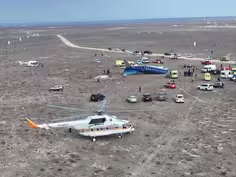
Azerbaijan Airlines Flight J28243 crash-lands in Kazakstan.
A passenger describes the experience.
SUBKHONKUL RAKHIMOV, Plane Crash Survivor (through translator): Two times, it tried to land, and, on the third time, something exploded.
STEPHANIE SY: In the minutes before landing, video shows the plane descending erratically.
Azerbaijani officials say, by this point, the pilot was flying without GPS and with communications jammed.
Video from a passenger on board shows oxygen masks deployed and what looks like a crack on a piece of the wing,relative calm among the 67 people on board, and then this.
Fiery wreckage confronts these first responders.
More than half the people on the plane were killed in the crash landing.
Yet dozens survived, shaken and badly injured.
MAN (through translator): When the plane crashed, my wife was sitting next to me.
I haven't seen my wife since the crash, and I don't know where she is.
STEPHANIE SY: As the human losses are counted, investigators at the crash scene are homing in on the multiple holes found on the jet's hull as possible clues.
Azerbaijani officials say a preliminary probe indicates the plane was struck by a Russian air defense system and its communications were paralyzed by electronic warfare.
The Azerbaijan Airlines flight was en route from the capital, Baku, to the Russian city of Grozny.
Flight trackers show the plane's route changed midway over Russia and went off course, crossing back over the Caspian Sea to Kazakstan, where it crash-landed.
The plane was diverted in an area where Moscow has used air defense systems against Ukrainian drone strikes.
The incident hearkens back to 2014, when pro-Russian Ukrainian forces shot down a Malaysia Airlines plane, killing 298 people.
Brazil has joined the probe in Kazakstan, since the Embraer E-190 is Brazilian-made.
Today, in Azerbaijan, traffic came to a standstill as citizens observed a day of national mourning.
In silence, they laid roses and shed tears, all while families of victims wait for answers to a Christmas Day tragedy.
For the "PBS News Hour," I'm Stephanie Sy.
WILLIAM BRANGHAM: For some further perspective on what might be behind this tragedy, we turn to retired army Colonel Robert Hamilton.
He spent much of his career focused on the former Soviet Union, and he's now head of research at the Foreign Policy Research Institute's Eurasia Program.
Colonel Hamilton, so good to have you on the program.
You have a great deal of expertise in how the Russian military operates.
What do you make of this speculation that somehow Russia's air defense system was complicit in this crash?
COL. ROBERT HAMILTON (RET.
), U.S. Army: So, first of all, thank you for the invitation.
It's good to be with you, William.
I think we're in a case here where this is an Occam's razor-type situation, where the simplest explanation is most likely to be the accurate one.
So the evidence that we know that we have lines up with this theory that it was a Russian air defense system that shot this plane down, because we know that there was Ukrainian drone attack going on over Grozny at the time.
We know that the Russians were jamming GPS signals to try to fight that drone attack.
We know that Russian air defense was active in the area, and that this plane was descending the land at Grozny when it was shot down, or was beginning an ascent into Grozny when it was probably shot by this missile.
A missile would have exploded in proximity to the plane, which would explain the damage to the fuselage and the tail section.
The missile doesn't actually go into the plane.
So, all the evidence that we have at this point lines up with this explanation that it was very likely Russian air defenses that accidentally damaged this plane and then caused it to crash.
WILLIAM BRANGHAM: I understand the concept of fog of war, but how is it possible that ostensibly a modern air defense system mistakes a passenger jet for what might have been drones attacking Russian positions?
COL. ROBERT HAMILTON (RET.
): Yes, and that's a great question, and that's maybe the fundamental question here.
This is a massive error, right?
I mean, this is -- the Embraer, the type of aircraft you mentioned in the intro, that almost 70 people were on board, so this is much larger than even the largest of the Ukrainian drones that they're able to use to attack Russia, so a fundamental error in identification of the target, and then probably in the chain of command there's an error in allowing the unit to engage this target.
Someone in the loop, someone in the chain should have understood that what this was a civilian aircraft and not a Ukrainian drone.
WILLIAM BRANGHAM: So your sense is that there was some human error going on here, that this wasn't an automated mistake?
COL. ROBERT HAMILTON (RET.
): Exactly.
Yes, I mean, so Russian air defenses, the systems are fairly sophisticated.
What we're reading and hearing is that this was a Pantsir-S1, which is a short-to-medium-range air defense system that combines missiles with a 30-millimeter cannon.
If they thought they were shooting at Ukrainian drones, they actually could be using either.
In this case, it does appear that they use the missile to engage this aircraft.
But, yes, this wouldn't have been an automated identify and shoot.
Some humans in the chain would have made the decision to pull the trigger at this civilian airliner.
WILLIAM BRANGHAM: If this turns out to be the case, this obviously would not be the first time that the Russians have been credibly accused of bringing down passenger planes.
I mean, we should also say it's not the first time that the United States did this back in the late '90s with an Iranian-based plane.
Is this just the risk of operating civilian aircraft anywhere near where there is active conflict?
COL. ROBERT HAMILTON (RET.
): Well, yes.
And so I think we need to acknowledge too that the Russians made another error in not closing the airspace over Grozny to civilian aircraft.
If a Ukrainian drone attack was under way and Russian air defense was active around Grozny, then that airspace should have been closed.
No civilian aircraft should have been flying into that airspace.
And then to more directly answer your question, yes, this doesn't just happen to the Russians.
As you noted, the U.S. has done this in the past.
It does happen far more often to the Russians.
You mentioned MH17 in 2014, the Malaysian airliner, the Korean airliner in 1983 that the Soviet Union shot down and, again, didn't acknowledge for a long time until the collapse of the Soviet Union.
And the Russians still haven't acknowledged the shoot-down of the Malaysian airliner.
So it happens more often to Russian air defenses, mostly because of poor training and poor leadership.
And when it does, they don't admit it.
The U.S. tends to launch an impartial investigation, affix responsibility somewhere, and take corrective action to try to make sure it doesn't happen again in the future.
WILLIAM BRANGHAM: As my colleague Stephanie Sy reported, Brazil has sent -- is offering to send people to help with this investigation.
Can you explain to us why that's important?
COL. ROBERT HAMILTON (RET.
): Yes, I think the more international -- Brazil, because they're the manufacturer of the aircraft, the Embraer, but the more international this investigation is, the more credible it will be and the more likely we will know exactly what happened.
What I'm hearing and reading initially is, it'll be a team of Russian, Kazakh, because of plane crash in Kazakstan, and Azerbaijani specialists.
The problem there, is the Russian specialists will almost certainly ensure that whatever the final report is doesn't cast blame on Russia, although it's very likely that Russia is where the blame lies.
So having Brazilians, the representatives of the manufacturer of the aircraft involved, having other international experts involved will lend credibility to the investigation and make it more likely that we find out what actually happened.
WILLIAM BRANGHAM: It's obviously a little bit too early to tell this, but do you have any sense whether this affects anything on the ground as far as day-to-day operations within Ukraine and the Russians?
COL. ROBERT HAMILTON (RET.
): I think it's unlikely.
You know, I think the Russian military -- and this is going to sound sort of harsh or callous, but I really do think this is the calculus - - they would prefer the odd shoot-down, accidental shoot-down of a civilian airliner to refining their procedures and their air defense procedures in ways that may make it easier for an enemy to attack Russian targets.
So this is, I think, from the Russian perspective, again, sounds callous, but sort of the cost of doing business.
So I don't see many changes taking place.
I don't see many changes taking place in what they're doing in Ukraine.
If there's a way to blame this on Ukraine, the Kremlin will try and will retaliate in some way.
But I don't think it's going to have a major effect on the course of the Russian war in Ukraine, certainly.
WILLIAM BRANGHAM: All right, that is retired Colonel Robert Hamilton of the Foreign Policy Institute.
Thank you so much for being here.
COL. ROBERT HAMILTON (RET.
): Thank you.
WILLIAM BRANGHAM: We start the day's other headlines in Gaza, where five Palestinians were killed by an Israeli airstrike on a TV broadcast van.
The attack happened early this morning outside of a hospital in Central Gaza's Nuseirat refugee camp.
Video from the scene showed a charred vehicle marked with the word "Press."
Palestinian officials say those killed were journalists.
Israel says they were militants posing as reporters.
The TV station they worked for is affiliated with the Palestinian group Islamic Jihad.
Their colleagues accused Israel of intentionally killing reporters to prevent them from doing their job.
TALAL AL-AROUQI, Palestinian Journalist (through translator): It's known that we as news crews work in this area surrounding the hospital.
It's where we keep our equipment, our vehicles and where we broadcast live shots.
The occupation deliberately targets journalists to obscure the truth about the crimes it's committed over months of war in Gaza.
WILLIAM BRANGHAM: Israel also escalated its attacks on the Houthi rebels in Yemen today.
That followed a week of increased missile attacks on Israel from the Iranian-backed group.
Israel targeted the main airport in the capital of Sanaa.
It also hit several power stations and ports.
The head of the World Health Organization, who was boarding a flight from there, said on social media that he was only meters away from the strikes, but he was unharmed.
Authorities in Finland have detained a ship with suspected Russian ties to investigate whether it might have damaged a major undersea power cable.
The EstLink 2 power cable brings electricity across the Baltic Sea from Finland to Estonia.
Its connection went down on Wednesday, and media reports say the ship's anchor is suspected of damaging the cable.
This is the latest disruption in the Baltic region after two data cables were severed last month and the Nord Stream pipeline from Russia to Germany was damaged back in 2022.
Australia is facing some of its worst fire conditions in years, fueled by a simmering heat wave and shifting winds.
At least four large fires are currently burning out of control across the southern state of Victoria, which is Australia's second largest.
Authorities say further fires are likely in the coming days, as the dangerous conditions will last through at least Saturday.
Those conditions are similar to Australia's Black Summer fires back in 2019 and 2020.
Those fires burned an area the size of Ohio and killed 33 people.
Stock trading resumed from the Christmas holiday with some minimal ups and downs.
The Dow Jones industrial average was the only gain on the day, up by less than 30 points.
The Nasdaq fell, but minimally, and the S&P 500 also barely budged.
There are two passings of note tonight.
First, Manmohan Singh, one of India's longest-serving prime ministers, has died.
He led the world's largest democracy for a decade.
Singh is best known for reforming India's economy when he was its finance minister back in the 1990s.
He also oversaw a landmark deal with the United States over nuclear energy.
But his second term as prime minister was clouded by corruption scandals, and Singh kept a low profile after leaving office.
He died at a hospital in New Delhi.
Manmohan Singh was 92 years old.
And business executive Richard Parsons has died of bone cancer, a close friend told The New York Times.
Parsons gained a reputation for being the man brought in to right the ship.
Among the companies he was enlisted to fix, Citigroup during the 2008 financial crisis and Time Warner after its disastrous merger with AOL.
For a time, he was one of the most prominent African American media executives in the U.S. Richard Parsons was 76 years old.
Still to come on the "News Hour": some international students are advised to return to the U.S. before president-elect Trump takes office and imposes a promised travel ban; a new movie chronicles a boxing champion's journey from humble beginnings to winning Olympic gold; and a report sounds the alarm on extreme warming in the Arctic.
Now that the Assad regime in Syria has fallen, the full scale of that government's production and distribution of illicit drugs is coming to light.
Leila Molana-Allen reports from the drug factories inside Syria.
LEILA MOLANA-ALLEN: Damascus, the epicenter of Bashar al-Assad's web of control.
Now his regime's carefully guarded secrets are being unlocked.
We're driving up into the mountains on the outskirts of Damascus, heading for a large Captagon facility that rebel fighters discovered when they took the city.
As we pull up outside an unremarkable warehouse, you would never know it was the lifeblood of an organized crime network.
The only sign of anything amiss here are the rebel fighters stationed outside, and empty bullet casings scattered across the parking lot.
A fighter leads us into the darkness.
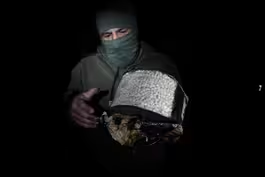
We're inside a cavernous basement of a former food factory, and when you walk inside, suddenly in front of you, pallets full of Captagon packed and ready to be smuggled, and there it is.
That's a Captagon pill, and those two little semicircles mark it.
This former corn chip factory was seized and repurposed after the owner fled five years ago, now, in place of corn and flavorings, bags of chemicals stacked along the walls.
This is the room where they actually made the pills.
You can see it was hastily abandoned because some of this liquid from the mixture of chemicals is still drying in some of the pots.
Come over here.
This is a pallet with the little shapes into which they would pour the mixed chemicals and harden the pills.
Against the walls, bunks, where workers slept here in shifts to produce high quantities of the drug at speed.
Factories like this have been found across Syria.
This is one of the largest.
The rebels who discovered this production facility think there are at least 2.5 million pills just in this room.
There are millions of dollars' worth of drugs stacked on these pallets, and this is how they were smuggling it.
This is a household voltage regulator.
When you open it up, there's a drum inside.
But break through and, inside that drum.
Captagon pills.
Abu Rashid, one of the HTS fighters guarding the factory, says they weren't surprised to find such quantities.
ABU RASHID, Hay'at Tahrir al-Sham Fighter (through translator): What he's done here is produce drugs to destroy a whole generation of people just to increase his own wealth and his power.
LEILA MOLANA-ALLEN: Captagon wasn't just a party drug.
It's been used by fighters in the region for years to keep them alert and inexhaustible on the battlefield.
HTS members we spoke to didn't want to answer whether the group's fighters had ever used the drug or if they're worried they might again.
The workers here burned documents showing where the drugs were due to be shipped before they fled.
But, in the adjoining rooms, we found evidence of other methods of smuggling them out.
This has been painted to look like a pomegranate and, inside, styrofoam filling with a little pocket for the Captagon.
This will be shipped as though it was fruit.
Cardboard fruit boxes litter the floor.
We know these pills were bound overseas.
The boxes are marked for export.
Bashar's brother Maher, who also led some of the most feared military forces, spearheaded the highly organized expansion of Captagon facilities in Syria and Hezbollah-run areas of Lebanon's Beqaa Valley after the country's economic collapse from 2019 drove Lebanese to desperate measures to survive.
In recent years, Captagon has found its way across the sea into Gulf nations, becoming one of the most widely used party drugs in countries like Saudi Arabia and the UAE, gaining popularity, as it's more discreet than alcohol.
Gulf governments desperate to crack down on the drugs flooding their cities last year began to renormalize relations with the Syrian regime, hoping the Assads would turn off the tap if given the right incentives.
Syria's regime created the problem and then benefited from their illegal trade, both financially and politically.
The Captagon trade brought in about $10 billion a year globally.
Varying estimates say the Syrian government, which manufactured 80 percent of the supply, pocketed between $3 billion to $5 billion of that itself.
Across Syria, as the regime's strongholds are broken open, incriminating documents, bereaved families and Captagon.
One of the most feared and brutal branches of Assad's police state was air force intelligence.
At this Syrian air force base in Damascus, families came to search for signs of disappeared loved ones.
FAIDA AL SAEED, Sister of Missing Prisoner (through translator): Ever since this prison was liberated, we have been searching for his name or any thread that might lead us to him.
But it's all in vain.
LEILA MOLANA-ALLEN: This is the air force base Assad used to launch barrel bombs and chemical weapons attacks on his people.
It's now clear it wasn't just a launchpad for death, in every detainment cell, evidence this place served as a torture chamber too.
As prisoners flooded out, searching families flooded in.
Alongside civilian I.D.
cards and abandoned interrogation files, they discovered piles of regime-manufactured drugs.
This man came to look for his relative.
What he found was piles of the drugs which paid for the weapons that destroyed his neighborhood.
MAN (through translator): The Captagon of Bashar al-Assad and his brother Maher.
May they be cursed.
This is the country's filth.
MAN (through translator): I have friends in Saudi Arabia and the Gulf.
They told me it's so easy to find Syrian Captagon there, and it's so cheap, any child could get it.
LEILA MOLANA-ALLEN: After half-a-century of being monitored and informed upon with spies on every corner, there's still uncertainty here about what's safe and who's watching.
Furious but nervous, these men asked us not to use their real names.
MAN (through translator): Assad has been smuggling since the beginning of his rule.
He's traded away our souls for money.
And then he slaughtered us using the weapons he bought with our own money too.
LEILA MOLANA-ALLEN: Across the country, the new authorities are doing their best to dispose of this stockpile.
But there's widespread concern that, while the large facilities will be shut down, the drug has become such a mainstay of Syria's black economy in recent years that small, secret producers may try to keep going.
Caroline Rose has studied the Assad's Captagon trade for years.
CAROLINE ROSE, Director of the Strategic Blind Spots Portfolio, New Lines Institute: All of a sudden, almost seemingly overnight, in 2018, 2019 and especially after 2020, we started to see Captagon seizures in not only the thousands, but the hundred thousands and in some cases the millions.
So, really, what changed here was the industrial scale capacity that state actors and state-aligned actors in Syria were able to commandeer.
Captagon is extremely addictive.
It is a stimulant that over time and over frequent use can cause psychosis.
Ultimately, Captagon does allow fighters to stay up late.
It allows them to stave meals.
It can sometimes produce a feeling of invincibility or euphoria that reportedly helps them focus and perpetrate attacks and fire against adversaries.
LEILA MOLANA-ALLEN: The rebel alliance now becoming Syria's caretaker government says it's going to shut down all these facilities, destroy all the pills.
Can they get rid of Captagon completely?
CAROLINE ROSE: I think that's going to be a much -- a harder thing for the new transitional government to tackle, simply because there are a few individuals and remnants of the regime's security apparatus that have knowledge of how to chemically create and manufacture Captagon in many different ways.
There will be many illicit smugglers that will seek to set up shop in Iraq, in Lebanon, in Turkey as a result of this crackdown.
LEILA MOLANA-ALLEN: The little white pills that fueled a dictator, his reign is over.
Wiping out the criminal networks he left behind may prove less decisive.
For the "PBS News Hour," I'm Leila Molana-Allen in Damascus, Syria.
WILLIAM BRANGHAM: Most college students are on their winter break right now, gathering with family and friends at home.
But some who live outside the United States may return to campus early this holiday season after a number of U.S. universities and colleges are advising them that the incoming Trump administration may make it more difficult for them to return later.
Lisa Desjardins explains.
LISA DESJARDINS: The universities are considering two factors, that president-elect Trump campaigned on again closing the U.S. to citizens of some Muslim-majority countries and that his 2017 travel ban came during his first week, sparking a logistics nightmare for some students and faculty trying to reenter the country then.
More than a dozen universities, including Harvard, Cornell, University of Massachusetts, and the University of Southern California, are now warning students to return before January 20, that's to say, before the first week of Trump's new term.
Ted Mitchell is the president of the American Council on Education, which represents more than 1,600 colleges and universities.
TED MITCHELL, President, American Council on Education: I think that there is expectation, we share it, that there will be some kind of travel ban early in the administration, maybe as early as the first week, through executive order.
And campuses are suggesting that students return early so that they won't be wrapped up either in the travel ban specifically or in just the general chaos that we saw that happened the last time we had travel bans.
LISA DESJARDINS: For more, I'm joined by Dan Berger, immigration attorney and academic fellow at Cornell Law School.
Dan, president-elect Trump has in fact said that he is thinking of bringing back a travel ban.
He has named a few Muslim-majority countries, but, other than that, we don't have really details or anything on timing or how much of a priority this is.
But how widespread is the concern among schools?
DAN BERGER, Cornell Law School: Well, thanks, Lisa.
I think schools are nervous and international students and scholars are nervous, because, during the previous Trump administration, we were surprised sometimes at what would happen.
New policies tended to drop at 5:00 p.m. on Friday and often without a lot of notice.
So I think schools are nervous, and they're probably going to be nervous not just in the first week, but for the next few years.
LISA DESJARDINS: It's interesting.
I was at the White House during that 5:00 policy drop on that Muslim -- that first ban that President - - then-President Trump put in place.
But we have a million students from around the world who come here to be educated.
My question to you, even though a smaller portion of them are from Muslim-majority countries, is, how is this going to affect their lives either right now in thinking about a potential ban or those who may be thinking about enrolling here in the future?
DAN BERGER: So, for those students, I guess there are two things to think about.
The ones who are out of the U.S. are nervous about getting in, those who are applying or who have been accepted recently.
And then those who are here are nervous about being able to travel, whether it's for study abroad or to see their family or for research or other activities.
So it really makes it difficult.
And what we found last time was that quite a few students from Muslim-majority countries were spending their time here and not traveling.
LISA DESJARDINS: Yes, do you know of any students now who have changed their plans, either not left or are coming back early?
DAN BERGER: Yes everybody's got a different story.
I just got a question earlier today about somebody who was planning to fly in at 8:30 in the morning on January 20 and wanted to know if that was OK.
But, in general, I think people are moving their plans earlier to get here a couple of days before the inauguration just to be in the United States and see what happens and work through it all together.
LISA DESJARDINS: That's so fascinating -- 8:30 East Coast, that's just a few hours before that constitutional noon swearing-in of the new president.
Let's talk also about the wider community here.
Obviously, universities and university towns really depend on students from all around the world, as well as from their own community.
I want to play more of what Ted Mitchell told us about some of the potential effects here.
TED MITCHELL: The U.S. has about a million foreign students on our campuses a year.
And so any significant elimination of those students, reduction in those students will be reduction in the diversity of experience on our campuses, reduction in tuition revenue on our campuses.
I will say that we don't think a lot about it, but all of those million students buy shoes, go to restaurants, rent apartments.
And so it's not just the institutions and the students who are going to lose out here, but it's the communities and the retailers, et cetera, who have a lot at stake in the spending power of our international student population.
LISA DESJARDINS: Our viewers are good students as well.
They love numbers and perspective.
We have got about 18 million or 19 million university students total, one million international students.
That's clearly far from the majority of them.
But what is the concern about college towns potentially if there's an issue here?
DAN BERGER: Well, I think, as Ted said, there's an issue of the fact that students are part of the economic and social life of these towns.
And so it does -- it will affect the economies of these towns.
But, also, it affects laboratories and student newspapers and activities they're involved in.
LISA DESJARDINS: From the Trump team perspective, he has campaigned on this idea that he would like to limit travel out of a national security concern.
And we know, I know from speaking to them, that some of his voters feel that way.
They're concerned about national security as a priority.
How do you see that balance?
It's a classic debate between America as a land of opportunity for the rest of the world and the idea that, during this time where we see multiple crises around the world, America needs to worry more about its own security.
And how does that play in here?
DAN BERGER: Well, absolutely.
I mean, immigration is a balance between security and opportunity.
International students are very heavily regulated.
They do go to a U.S. consulate abroad.
The biometrics are taken.
They are screened.
They do go through security checks.
Some are delayed before they get here because of those security checks.
And then, once they're here, they are tracked by a computer tracking system that's run by ICE called SEVIS, which has been around since the-post 9/11 era.
So I -- no system is perfect, and we should look very carefully at security.
But I think there are already very significant security provisions in place.
LISA DESJARDINS: Are you saying a blanket ban is not the way to go, that maybe there should be an exception for students, or... DAN BERGER: Yes, I mean, in my own opinion, I would say that a blanket ban of people from certain countries doesn't make sense.
Having individual security checks, which is what happens now for students and doing background checks and delaying students' entry if there's a concern does make sense.
And that's been the policy for years.
LISA DESJARDINS: So, given all of this, how would you advise international students and their families right now for what's ahead?
DAN BERGER: Well, I think part of it is risk tolerance.
Some students are asking me simple questions, like, can I go visit my family next summer or can I study abroad next fall?
And I have to say there's uncertainty.
We will look and see what happens the first week, but we will also wonder what's going to happen over the next year.
And students are going to have to balance the importance of what they're doing, whether it's to visit a sick family member or to do an important bit of research for a Ph.D., versus the risk of possibly being stuck outside the country.
And different students have different risk tolerances, and these are conversations that are happening on campuses between the students and their foreign student advisers every day now.
LISA DESJARDINS: Dan Berger, thank you so much for joining us.
DAN BERGER: Thank you, Lisa.
WILLIAM BRANGHAM: We return now to a dark chapter in U.S. history.
More than 3,000 Native American children died in the custody of the U.S. government after they were forced to attend so-called Indian boarding schools.
That's according to a new investigation by The Washington Post.
That is three times the number of lives lost that the government documented in its own investigation released earlier this year, and the real death toll could be much higher.
We are joined now by The Washington Post's Dana Hedgpeth.
She's one of the lead reporters on this series and is also an enrolled member of the Haliwa-Saponi Tribe of North Carolina.
Dana, welcome back to the "News Hour."
DANA HEDGPETH, The Washington Post: Thank you.
WILLIAM BRANGHAM: The U.S. government from the 1800s to the 1960s ran these schools.
Can you remind us why the government set these schools up in the first place and the kinds of children that ended up there?
DANA HEDGPETH: Absolutely.
Thank you so much for having me.
Let's step back for a minute and think about the time of when these schools were set up.
It was at a time in the 1800s.
They were created by the U.S. government and run in partnership with churches, religious groups, with one goal, to take children from their home, either forcibly or coerce them from their homes, in the name of assimilating them into white society.
And that was the purpose of them.
The idea was to take the children away from their communities and strip them of their language, their culture, their ways, their customs, and, again, to keep them into assimilation.
Many of these children were -- to call them schools, as one of our sources said, they really weren't schools.
They were really work camps.
Children spent half the day in school learning basic reading, writing, and arithmetic, and the other half really in workshops, fields, manual labor.
The idea was not to train them to be doctors or lawyers or accountants, but rather to be doing manual labor jobs.
WILLIAM BRANGHAM: And as your reporting shows, there was also another motive, that if you stripped Native culture from these children, maybe they would be more and their families might be more compliant to give up their lands, to settlers, et cetera.
DANA HEDGPETH: That's right.
Remember, at the time that this policy was implemented, this was the end of the Indian Wars.
Gone were the buffalo for many tribes in the West.
They had been pushed to reservations at this point, Native Americans had.
And so you're talking about, as Brenda Child, a Native American historian, says, probably one of the lowest points in Native American culture in life.
Then to come and take their children, it gives me shudders, because, for any culture, any people in the world, when you go after their children, you are really talking about trying to break a people.
The U.S. government had decided that the Indian Wars were too expensive at this point, and that it was actually cheaper to -- quote, unquote -- "educate" Native American children, rather than to try to fight them.
And this was all in the name of a land grab.
During this time period, Native Americans lost over a billion acres of land,again, pushed to reservations.
They were wards of the state, of the federal government.
They were not able to go freely.
Everything was run through an agent of their reservation.
WILLIAM BRANGHAM: As I mentioned, there's this incredible discrepancy in the number of children whose lives were lost in your reporting compared to what the U.S. Department of Interior put out in its findings earlier this summer.
How do you explain that discrepancy?
DANA HEDGPETH: Very good question, and thank you for asking.
The federal government for the first time under Interior Secretary Deb Haaland, who's the first Native American Cabinet secretary appointed to that position, was the first person to ever step back, take a really hard look and scrutinize her department, the very department that implemented this policy and carried it out.That's a huge step.
And kudos to her department for during that.
They worked incredibly hard for three years, and they had a lot of findings that really turned the spotlight on themselves.
They looked exclusively at federal records, solely at those.
It was limited in scope, and they admitted that, that it was an undercount.
They found 973 children died during a 150-year period at these schools.
We built upon that work and, along with hundreds of thousands of records from the National Archives, from researchers around the country who had done the work, and we brought all that together to give the most complete accounting that's really been done to date looking at the systematic effort of 400 schools across the country to wipe out Native Americans' culture.
WILLIAM BRANGHAM: I use the language of these children died in these schools, and I feel like that's almost a little bit of a sterile way of describing it.
Can you talk a little bit about the conditions that these children endured and how they came to the end of their lives?
DANA HEDGPETH: You're absolutely right.
These conditions were horrific.
There were two government reports done, one by the Meriam Report, government-commissioned report, in the 1920s that called these substandard.
They were grossly inadequate.
To call them in education, again, is not even fair.
The children were mistreated.
They were severely punished, whipped, beaten, starved of food.
We found dozens of children who, sadly, died trying to run away from these schools.
A young Navajo boy froze as he was trying to run away from the school.
Children died of suicide.
We found indications of abuse that likely led to students' death.
These are not the schools that your children or my children in modern times would be subjected to.
They really were not.
And as a very wise woman from the Fort Belknap Indian Reservation said to me, what schools have cemeteries?
I mean, just sit with that, right?
Schools shouldn't have cemeteries.
And so many of these schools, sadly, did.
We found 881 students who were buried, died and buried on their school grounds.
Again, that is so very, very wrong.
This was a systematic policy to try to eradicate a people.
WILLIAM BRANGHAM: Your reporting shows how many, many of these children are still buried on the sites of these former schools.
And you tell the story of Almeda Heavy Hair, one young woman whose -- her family's attempt to bring her remains home.
Can you tell us a little bit about that?
DANA HEDGPETH: Yes.
Almeda was part of a group of 22 students that came in 1890 from the Fort Belknap Reservation.
And we were invited and honored to go on the journey to see 19 of her tribal members go to Carlisle, watch her remains, sadly, be exhumed, and then travel with them the 2,000 miles back to Montana, where she reburied on her tribal homeland.
It was a very powerful and emotional trip, lots of mixed emotions, bringing out the past.
But she really symbolized, sadly, the loss of culture and of language that so many people felt over generations.
WILLIAM BRANGHAM: Dana Hedgpeth, this is such a tremendous piece of reporting you have done and your colleagues at The Washington Post.
Thank you so much.
0:39:55.185,1193:02:47.295 DANA HEDGPETH: Thank you for having me.
WILLIAM BRANGHAM: Claressa Shields is one of the biggest names in women's boxing, and her fame will likely grow wider now that she's the subject of a new biographical film.
Senior arts correspondent Jeffrey Brown has the story from Los Angeles.
It is part of our arts and culture series, Canvas.
RYAN DESTINY, Actress: I'm here to pay my mom's bill.
ACTRESS: So you're her, right?
You're the boxer?
ACTRESS: She's our golden girl.
JEFFREY BROWN: The new film "The Fire Inside" tells the story of Claressa Shields played by Ryan Destiny, who grew up in Flint, Michigan, amid family trauma and economic hardship.
BRIAN TYREE HENRY, Actor: What you think about girls boxing?
ACTRESS: I don't see no reason why she can't.
She got hands.
JEFFREY BROWN: At age 11, working with trainer Jason Crutchfield, played by Brian Tyree Henry, who was at first hesitant to take on a young girl, she began to box her way to Olympic and world championships, a big story, for sure, but not one that ever reached the wider culture, even for sports lovers like director Rachel Morrison.
RACHEL MORRISON, Director: I wanted to tell the story because I didn't know it.
And it was -- I couldn't believe I didn't know it.
And I follow sports.
I played sports.
And so I felt like Claressa's story, her athleticism, her resilience, it's so inspiring.
And I was kind of shocked and appalled her story isn't as visible and her voice isn't as amplified as it should be.
For Ryan Destiny, a self-described arts, not sports kid, taking on the role meant entering a whole new world.
RYAN DESTINY, Actress: It's so different than anything I have ever done, you know?
And I knew that I would have to push myself in a way that I never had before.
And that in itself was very scary, and also having to play a person who is still here, still alive.
And I knew if she didn't love it, she could fight me.
(LAUGHTER) JEFFREY BROWN: Oh, yes, Claressa Shields could fight all right, and she would definitely win, as she has all her life, two gold medals, the first in 2012 at age 17, captured in "T-Rex," a 2016 PBS "Independent Lens" documentary,and every professional match she's fought, with world titles in five different weight categories.
She is, she proclaims the GWOAT, boxing's greatest woman of all time.
And how did she, now 29, feel about a dramatic feature film on her life?
CLARESSA SHIELDS, Professional Boxer: I heard about it, I was like, hmm, interesting.
JEFFREY BROWN: Interesting?
CLARESSA SHIELDS: Yes, I said interesting, because I have this saying that my life is a movie and I'm the writer.
I have seen the movie seven times now.
JEFFREY BROWN: Oh, yes?
CLARESSA SHIELDS: Every time I see it, I cry just the same.
I cry throughout the movie.
I cry happy tears, sad tears.
I think about my upbringing and how hard it was when I was a kid and we didn't have food to eat.
And I just find myself being very grateful now because all the things that I have, everything I have been able to do, all of my hardships and my traumas, I have been able to turn my pain into power.
JEFFREY BROWN: How to bring out that inner drive in a film that also had to feature plenty of boxing action?
RYAN DESTINY: That was a very big obstacle for me.
I look at Claressa as a superhuman.
She is somebody that I don't think a lot of people can relate to in the way that her self-confidence is just like no other.
JEFFREY BROWN: Yes.
RYAN DESTINY: So I was like, how... JEFFREY BROWN: But it comes from a deep pain.
RYAN DESTINY: It comes from a very deep, deep place.
JEFFREY BROWN: This is the directorial debut for Rachel Morrison, best known until now for her work as a leading cinematographer in such films as "Black Panther" and "Mudbound," for which she became the first woman nominated for an Oscar in that category.
How does she capture "The Fire Inside" on film?
RACHEL MORRISON: We're always with Claressa.
And it feels internal.
From a visual perspective, it was really prioritizing, like, the humanity of it and the internal experience of a 16-, 17-year-old girl who's, like, going through all of these things.
JEFFREY BROWN: This is the cinematographer in you, right?
I mean, it's frame... RACHEL MORRISON: Oh, yes.
(CROSSTALK) JEFFREY BROWN: But framing the face and framing the emotional life?
RACHEL MORRISON: Yes, yes.
I mean, I think it's also -- it's the storyteller in me, right, who just really wants to build empathy through the work.
And that's not by being objective.
It's about by being subjective.
RYAN DESTINY: All these other people getting these endorsements and sponsorships.
Meanwhile, I can barely pay my mama rent.
JEFFREY BROWN: What makes this story different from any sports film, says Morrison, is its twist on success.
Shields wins her first Olympics, but, in some real sense, she also loses, as none of the attention or financial gain she hoped for follows.
Shields puts it this way: CLARESSA SHIELDS: You know, you think that every Olympic gold medalist, you win a gold medal, you get all this money and endorsements.
And I got nothing but my gold medal.
And to win the Olympics and then not get any endorsements, any sponsorships, any magazine covers, cereal boxes, it was very hurtful.
It was discouraging, but also too, it was like, you know how something makes you mad, and you would be like, you know what, I'm about to prove a lot of people wrong.
JEFFREY BROWN: Wrong gender, wrong color, wrong background, wrong sport.
Shields felt and overcame it all, helping usher in a new era of women in sports.
For Rachel Morrison, this was another way into the film.
RACHEL MORRISON: As a female cinematographer, which at I think at its high, we have maybe hit like 6 percent of studio films, like, have female cinematographers, like, it's still low.
I'm very used to being the exception to the rule and also having it not be enough just to make good work, that there's always -- these people want to throw various perceptions and how do you carry yourself?
How do you dress?
How do you work with your crew?
Can you carry a heavy camera, things that are -- of course.
JEFFREY BROWN: So, you found it personal and... RACHEL MORRISON: So, yes, I did find it personal, and I think the sad reality is, it's probably applicable to a lot of different crafts, sports,jobs, everything.
RYAN DESTINY: Can't nobody beat me.
JEFFREY BROWN: It happens there's also a different kind of personal aspect for Ryan Destiny, who's the same age and growing up in Detroit from the same area as Shields.
RYAN DESTINY: I think that that was definitely a very easy connection there, and I wanted to make sure we got certain things right, because when people are watching it that are from our hometown, they will definitely call it out if it's not something that felt very genuine.
JEFFREY BROWN: Claressa Shields says things have improved for women in boxing from when she first considered going pro.
She's earned million-dollar paychecks for several fights.
CLARESSA SHIELDS: We haven't made it to the equal pay yet.
JEFFREY BROWN: Right.
CLARESSA SHIELDS: But we are way further than what we were.
JEFFREY BROWN: And she's still very much in the arena.
CLARESSA SHIELDS: Even though I have a biopic coming out Christmas Day, I am very much not retired, OK?
JEFFREY BROWN: The story's not done, right?
CLARESSA SHIELDS: No, the story's not done.
JEFFREY BROWN: Yes.
Yes.
CLARESSA SHIELDS: So, we will probably have "The Fire Inside 2."
(LAUGHTER) JEFFREY BROWN: Claressa Shields' next fight is February 2 in her hometown of Flint.
For now, the one and only "The Fire Inside" movie is in theaters.
For the "PBS News Hour," I'm Jeffrey Brown in Los Angeles.
WILLIAM BRANGHAM: The Arctic is one of the fastest-warming places on earth, another symptom of global climate change.
Since the 1980s, temperatures there have risen at nearly triple the global rate.
This past summer was the wettest on record, and then a heat wave in August set all-time temperature records in several Alaskan and Canadian communities.
As digital producer Casey Kuhn explains, this warming is falling most severely on those who call the Arctic home.
CASEY KUHN: This summer in the Arctic was the wettest on record and the second warmest in more than a century.
These dramatic changes marked by the 2024 Arctic Report Card from the National Oceanic and Atmospheric Administration, or NOAA, present significant challenges for indigenous people.
MAX NEALE, Manager, Center for Environmentally Threatened Communities: This Arctic Report Card serves as an early warning sign for America, as a nation, that Alaska and Arctic are -- is getting hit first and worse.
And as a nation, we need to be prepared.
CASEY KUHN: NOAA found the Arctic, which typically traps carbon in its frozen soil, now emits more carbon than it stores.
That's due to increased wildfires and melting permafrost, which both release climate-warming carbon dioxide and methane into the atmosphere.
That shift, scientists say, will make climate change worse.
For Native Alaskans, a changing climate means a changing way of life, says Jackie Qatalina Schaeffer, director of climate initiatives at the Alaska Native Tribal Health Consortium, or ANTHC.
JACKIE QATALINA SCHAEFFER, Director of Climate Initiatives, Alaska Native Tribal Health Consortium: We have communities that rely on subsistence foods, which is foods that come from nature.
That economy is not equated into dollars, but if it goes away, it's a huge part of how people survive in the Arctic.
We have communities in smaller communities that rely up to 80 percent on those food resources, and they're organic natural food resources, which are being impacted by climate change.
CASEY KUHN: The NOAA report also found that Arctic ice in the sea continues to shrink after being on the decline for decades.
September's sea ice level was the sixth lowest on record.
On land, migratory caribou herds have declined by more than 60 percent in the last few decades.
The report and Native communities say it's crucial for indigenous groups and scientists to work together to manage climate change as it affects the Arctic.
JACKIE QATALINA SCHAEFFER: Caribou, in my region, is the number one meat source that we have, the protein source that we have from land animals.
So, therefore, it is our life source.
It is something - - it's no different than removing somebody who raises chickens, killing all their chickens.
CASEY KUHN: Qatalina Schaeffer says the caribou are just one symptom of a greater illness threatening the Arctic and the planet.
JACKIE QATALINA SCHAEFFER: When you look at one species like caribou, the protection of them tell a story of the ecosystem.
And because they're reliant on the lichen, which has a definite connection to that underlying permafrost, which is the cooling system for the entire planet, when you look at the planetary system as a whole, it's telling a story that is a ripple effect to something else.
CASEY KUHN: Max Neale is manager for ANTHC's Center for Environmentally Threatened Communities.
He says the 2024 Arctic Report Card sounds the alarm for a potentially dangerous and expensive future.
MAX NEALE: It really just screams, take action.
And there are solutions that are viable.
CASEY KUHN: ANTHC says federal funding for places facing melting permafrost and improved government disaster coordination are some of the measures that could help Native communities adapt to the changing Arctic landscape.
For PBS News, I'm Casey Kuhn.
WILLIAM BRANGHAM: Finally tonight, a "News Hour" tradition.
Each year, we asked DVIDS, the Defense Visual Information Distribution Service, to produce a holiday song for us performed by American service members.
On this second night of Hanukkah, we present an encore performance of "Ocho Kandelikas."
It was written by the composer and singer Flory Jagoda.
It was originally written in Ladino, which is Judeo-Spanish, and it's performed in that language here.
WILLIAM BRANGHAM: On tomorrow's "News Hour," we take a look back at 2024 through the photographers who captured the year in images.
And that is the "News Hour" for tonight.
I'm William Brangham.
On behalf of the entire "News Hour" team, thank you so much for joining us.

As Arctic warms, communities face dramatic changes
Video has Closed Captions
As Arctic warms, Indigenous communities there face dramatic changes to their way of life (3m 57s)
Assad regime made billions producing, exporting party drugs
Video has Closed Captions
How the Assad regime made billions producing and exporting party drugs (8m 31s)

Claressa Shields on new film 'The Fire Inside'
Video has Closed Captions
Claressa Shields on 'The Fire Inside,' new film chronicling her journey to Olympic gold (7m 27s)

Colleges advise students to return before Trump takes office
Video has Closed Captions
Colleges advise some international students to return to U.S. before Trump takes office (8m 10s)

Investigation finds more deaths at Native boarding schools
Video has Closed Captions
Investigation reveals higher death toll at Native American boarding schools (6m 53s)
Russian system may have downed airliner, U.S. official says
Video has Closed Captions
Russian anti-aircraft system may have downed Azerbaijani plane, U.S. official says (9m 57s)
Providing Support for PBS.org
Learn Moreabout PBS online sponsorship
- News and Public Affairs

FRONTLINE is investigative journalism that questions, explains and changes our world.

- News and Public Affairs

Today's top journalists discuss Washington's current political events and public affairs.












Support for PBS provided by:
Major corporate funding for the PBS News Hour is provided by BDO, BNSF, Consumer Cellular, American Cruise Lines, and Raymond James. Funding for the PBS NewsHour Weekend is provided by...