
December 26, 2025 - PBS News Hour full episode
12/26/2025 | 57m 46sVideo has Closed Captions
December 26, 2025 - PBS News Hour full episode
Friday on the News Hour, the Trump administration conducts strikes in Nigeria against alleged terrorists, who they claim were killing Christians. A federal judge blocks the detention of a British social media activist who tracks online hate and disinformation. Plus, the White House pushes to dismantle a leading climate and weather center — with serious implications for accurate forecasts.
Problems playing video? | Closed Captioning Feedback
Problems playing video? | Closed Captioning Feedback
Major corporate funding for the PBS News Hour is provided by BDO, BNSF, Consumer Cellular, American Cruise Lines, and Raymond James. Funding for the PBS NewsHour Weekend is provided by...
December 26, 2025 - PBS News Hour full episode
12/26/2025 | 57m 46sVideo has Closed Captions
Friday on the News Hour, the Trump administration conducts strikes in Nigeria against alleged terrorists, who they claim were killing Christians. A federal judge blocks the detention of a British social media activist who tracks online hate and disinformation. Plus, the White House pushes to dismantle a leading climate and weather center — with serious implications for accurate forecasts.
Problems playing video? | Closed Captioning Feedback
How to Watch PBS News Hour
PBS News Hour is available to stream on pbs.org and the free PBS App, available on iPhone, Apple TV, Android TV, Android smartphones, Amazon Fire TV, Amazon Fire Tablet, Roku, Samsung Smart TV, LG TV, and Vizio.
Providing Support for PBS.org
Learn Moreabout PBS online sponsorshipWILLIAM BRANGHAM: Good evening.
I'm William# Brangham.
Amna Nawaz and Geoff Bennett are away.
On the "News Hour" tonight: The Trump# administration conducts strikes in## Nigeria against alleged terrorists# they claim are killing Christians.
A federal judge blocks the detention of a British## social media activist who tracks# online hate and disinformation.
And the White House moves to# dismantle one of the world's## leading climate and weather research centers.
MATTHEW CAPPUCCI, Senior Meteorologist,# MyRadar: The atmosphere does not possess a## voter registration card.
I think it's important# to remember that scientists do.. really the only people doing the politicization# are, for the most part, politicians.
(BREAK) WILLIAM BRANGHAM: Welcome to the "News Hour."
President Trump said today that he# delayed American military strikes## in northwest Nigeria until Christmas Day# to deliver a message to groups he alleges## are targeting Christians in that country.# Meanwhile, the Nigerian government praised## the attacks and said it provided the# U.S.
with the necessary intelligence.
Nick Schifrin is here with the details -- Nick.
NICK SCHIFRIN: William, the area that# the U.S.
bombed in Nigeria is near the## border of neighboring Niger and a part# of Western Africa that suffered from## cross-border terrorism.
Northern Nigeria# has suffered from violence for years.
And while the president describes this# as focus on protecting Christians,## the violence in Nigeria and the groups# committing it are far more complex.
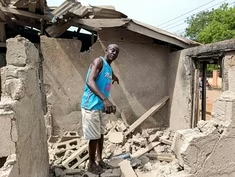
In the Gulf of Guinea, a Tomahawk missile flies to# an area never before struck by the U.S.
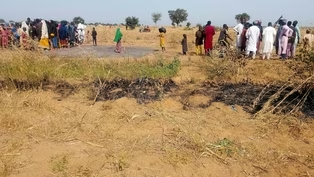
military,## Northwest Nigeria, where locals picked# up debris as nearby flames kept burning.
By day, the grass was scorched and police# cordoned off an impact site.
This missile,## at least in this remote rural# area, apparently killed no one.
NUHU UMAR JAGO, Nigerian Resident: There# was no loss of life and no loss of property.
NICK SCHIFRIN: A U.S.
military official tells# "PBS News Hour" a ship off Nigeria's coast## fired more than a dozen Tomahawks at two ISIS# training camps.
Local security analysts say the## missiles hit in at least four locations,# all in Nigeria's northwest Sokoto state.
The area has been plagued by a group known as# Lakurawa that claims affiliation with ISIS Sahel## and exploits poor local governance and access to# terrorist groups that operate in Niger and Mali.## Nigeria declared them a terrorist organization,# but locals say they're connected to bandits and## criminals, who've intimidated local residents,# most of whom are Muslim, preaching radicalization,## kidnapping hundreds of girls and young boys in# an attempt to control and exploit the population.
YUSUF TUGGAR, Nigerian Foreign# Minister: This is what we have## always been hoping for, to# work with th.. NICK SCHIFRIN: Today, Nigerian Foreign# Minister Yusuf Tuggar told Channel TV## that Nigeria provided the U.S.
intelligence.
YUSUF TUGGAR: It is a joint operation# and it is not targeting any religion.
NICK SCHIFRIN: But, last night, President Trump# wrote that the targets were -- quote -- "ISIS## terrorist scum in Northwest Nigeria who# have been targeting and viciously killing## primarily innocent Christians at levels not# seen for many years and even centuries."
And today, he told Politico the strike was# supposed to take place on Christmas Eve,## but he said: "Nope, let's# give a Christmas present."
NINA SHEA, Center for Religious Freedom Director,# Hudson Institute: The government doesn't help the## Christians.
They're not protecting them.# They're not protecting their villages.
NICK SCHIFRIN: Nina Shea directs the# Hudson Institute's Center of Religious## Freedom.
She and 30 other advocates,# Christian organizations and think tanks## wrote a letter in October to President# Trump saying the Nigerian government## "demonstrably tolerates relentless aggression# uniquely against Christian farming families."
NINA SHEA: Local Christian leaders# are telling us that they are## trying to cleanse the land of Christians, that# they are establishing the land for Islamic rule.
NICK SCHIFRIN: In reality, Nigerian# violence is more complex.
For years,## Islamist terrorists have plagued Northern and# Northeast Nigeria.
The best known is Boko Haram.## They have targeted the Nigerian military and# violently opposed female education.
It's bombed## mosques.
Boko Haram also targeted Christians,# as I saw in 2015 in the eastern city of Mubi.
Outside the nearby Church of the Brethren,# the damage is everywhere.
Inside,## high above the podium, the fire set by Boko# Haram almost erased the cross from the wall.
ELIA USMAN, Church of the Brethren: When these# people landed in Mubi, they will ask you,## are you a Christian or a Muslim?
When you# say you're a Christian, they will shoot you.
NICK SCHIFRIN: But that's the northeast, far# from today's target.
And then there's the map.## Most Nigerian Muslims live in the north.
Most# Christians live in the south, and in the middle,## the two groups overlap, as do tribes,# farmers and herders, who can clash violently.
For decades, nomadic herders, almost all# of whom are Muslim, have fought farmers,## most of whom are Christian, over# land disputes and scarce resources.## The independent conflict monitor# ACLED tells "PBS News Hour" last## year's data show a rise in Christian# fatalities, mostly in Central Nigeria,## but the vast majority of the incidents were over# land disputes, not targeting because of religion.
YUSUF TUGGAR: You can see how all these things## are interconnected.
So when you try to# reduce.. Muslims killing Christians in Nigeria, you# see how you can get it completely wrong.
NICK SCHIFRIN: And for more perspective on# the U.S.
strike against targets in Nigeria,## we turn to former Ambassador Peter Pham.
He# was U.S.
special envoy for the Sahel region## during the first Trump administration.# He's now a distinguished fellow at the## Atlantic Council and sits on the boards of a# number of companies doing business in Africa.
Ambassador, thanks very much.# Welcome back to the "News Hour."
J. PETER PHAM, Atlantic Council:# Good to be with you, Nick.
NICK SCHIFRIN: Explain who is being# targeted her.. is a group called Lakurawa connected to# terrorists in the Sahel in Western Africa,## but also criminals known as bandits in Nigeria.
J. PETER PHAM: Well, the group that was# referred to in the piece, Nick, Lakurawa,## is a good example, almost a classic one# of the cure being worse than the disease.
They originally originated as# self-defense groups in an area## where the Nigerian government and some of# the neighboring countries were unable to## provide protection for local communities.
So# they set up their own self-defense groups.
Unfortunately, over the years, these# groups, their ambitions grew.
And in## the case of Lakurawa, in Sokoto state# and some of the neighboring states,## as well as in Mali and Niger, they have# grown to establish dominion over areas of## territory where the government is -- quite# frankly, it doesn't run and is excluded.
And they have been increasingly imposing upon# the people they were -- started to protect a## harsh vision of Islam and a hard-line vision,# and increasingly kidnapping young people to## fill up their ranks.
So they have become, in# effect, the disease they were there to fight.
NICK SCHIFRIN: And I don't want to conflate# these groups.
The analysts I speak to says## it's not Lakurawa, it's not these bandits# in the northwest who are traditionally## killing Christians.
We see that more in the# northeast and the central area of Nigeria.
J. PETER PHAM: That's very much where# the conflicts between farmer-herders,## between Muslims or those motivated or agitated by## extremist interpretations of Islam# and Christians have occurred.
So I'm not privy to -- I'm a former government# official.
I'm not privy to any current## intelligence on this.
So I can't speak to why the# targeting occurred in Sokoto.
Certainly, it's a## mystery to me.
There are a couple other places I# would have picked to hit extremists in Nigeria.
NICK SCHIFRIN: So let's drill into that.
What impact, if any, could this have,## this strike in Northwest Nigeria,# on violence against Christians?
J. PETER PHAM: As far as I'm aware# of, a very limited impact.
What does## do is send a signal that the U.S.# is willing to act in this area.
But what concerns me is the fact that# all the reporting I have seen on this## has emphasized -- including Nigerian# Foreign Minister Tuggar's statements,## this was coordinated with the Nigerian# government.
And I agree with my friend Nina Shea.
Part of the problem here is actually not# all parts of the Nigerian government,## but certain parts of the# Nigerian government are suspect.
NICK SCHIFRIN: Well, we have also seen# inability by the Nigerian government,## as you were referencing before, to govern some of# these spaces, whether the northwest, the northeast## or some of these farmer-herder# conflicts in the Central Plains.
I mean, how much of this is about# -- how much of the root causes is## about the government not being able# to have governance in these areas?
J. PETER PHAM: Yes it's a matter of,# where does something start and where## something end?
There's certainly# an incapacity or lack of capacity,## but there's also a lack of political will# to put the resources necessary to that.
And in some cases -- one has to# be brutally honest here.
There's## also certain politicians in Nigeria have# their own agendas and their own political## alliances with extremists.
And you sort# of get a mixture of all that.
It's a very## complex situation that doesn't give# -- lend itself to easy solutions.
NICK SCHIFRIN: Absolutely.
And so in that sense, .. or not, that could actually help protect Nigerian# Christians, could get at this lack of governance?
J. PETER PHAM: Well, first, I think# calling attention to it is very,## very important.
Calling it out has# forced the Nigerian government to## take stock of what it is and is not# doing.
So that in itself is effective.
Secondly, I would say that important also in this# is also to be -- is operational security.
Again,## I'm not privy to current planning, but# I certainly, if I were still in there,## I'd be very, very hesitant at sharing# and coordinating if -- what the Nigerians## are claiming is was happening with this# coordination, I'd be very suspect about that.
NICK SCHIFRIN: And the Nigerian government,# as we heard the foreign minister say,## this violence is not about# any particular religion, and,## in fact, the majority of victims# of violence in Nigeria are Muslim.
But we heard President Trump# say this is about protecting## Christians.
So in the time we# have left, about 30 seconds,## do we know anything about why those two# narratives are so different right now?
J. PETER PHAM: I think a lot of it has# to do with it's a matter of perspective.## Both Muslims and Christians are suffering# because of this violence.
And where the## political will is in this in# Nigeria is the real question.
Is there political will to address# the challenges to both communities,## and is there a double agenda# on the part of certain people?
NICK SCHIFRIN: Well, but, again, on the# political will, it seems like so far,## in the past, at least, the Nigerian government# has struggled with that political will.
J. PETER PHAM: Very much so,# both in will and in resources.
NICK SCHIFRIN: Ambassador Peter# Pham, thank you very much.
J. PETER PHAM: Thank you.
WILLIAM BRANGHAM:## The day's other headlines begin in California,# where more than 45 million people were under## flood alerts today after relentless rains added# to the state's wettest holiday season in decades.
In some of the hardest-hit areas, the# downpours have died down enough for the## cleanup to begin.
The town of Wrightwood in# the mountains northeast of Los Angeles got## nearly a foot of rain in just three days.# Residents who had evacuated returned to## find their homes buried in mud.
Locals say they# will need to lean on each other to get through.
MICHELLE MEYERS, Wrightwood Resident: I# thought what my son said about this all## happening on Christmas was really poignant.
But# this community, whether it's floods or fires or## now this, they really pull together# and they're out helping each other.
WILLIAM BRANGHAM: All the way across the# country, millions are bracing for a belated## white Christmas.
Areas north of New York City# and parts of Pennsylvania could see up to a## foot of snow through tomorrow.
Travel# disruptions are also in the forecast,## with more than 1,000 flights already# canceled because of this winter weather.
Officials in Kentucky say a 15th person# has now died as a result of a recent## plane crash at Louisville International# Airport.
In a social media post yesterday,## the city's mayor said Alain Rodriguez# Colina -- quote -- "suffered severe## injuries at the time of the crash and# passed earlier this Christmas Day."
He was one of 12 people killed on the ground# when UPS Flight 2976, bound for Hawaii,## crashed just moments after takeoff.
Three# pilots also died.
In its initial report,## air safety officials said they found cracks where# the plane's engine was connected to its wing.
Ukrainian President Volodymyr Zelenskyy# says he'll discuss security guarantees## with President Trump when the two meet# in Florida on Sunday.
Zelenskyy told## reporters today that a broader 20-point plan# is -- quote -- "about 90 percent ready."
But## he acknowledged that Ukraine and Russia have# yet to reach agreement on territorial issues.
Meantime, Russia carried out# a number of strikes today,## including one on Ukraine's second# biggest city, Kharkiv.
Local officials## say at least two people were killed and# six others injured, including a baby.
In Northern Israel, officials say a# Palestinian man from the West Bank## killed at least two Israelis there# today and injured two more.
Police## say the suspect ran over a pedestrian in the# city of Beit She'an and then fatally stabbed## a young woman nearby.
He was then shot# and taken to a hospital for treatment.
Authorities are describing the incident# as a -- quote -- "rolling terror attack.
"## In response, Israel's defense minister# has ordered troops to crack down on what## he called terrorist infrastructure in# the assailant's West Bank hometown.
On Wall Street today, stocks ended just a# touch lower to wrap up the holiday-shortened## week.
The Dow Jones industrial average# slipped just 20 points on the day.
The## Nasdaq also fell by 20 points.
The# S&P 500 ended virtually unchanged.
Still to come on the "News Hour": David Brooks and# Kimberly Atkins Stohr weigh in on the events of## 2025; leading film critics offer their choices# for the best movies of the year; and we take a## look at a British pantomime theater that blends# holiday tradition with Muslim culture and humor.
A federal judge has temporarily blocked the Trump# administration from detaining or deporting Imran## Ahmed.
He's a British-born researcher who focuses# on countering online hate and misinformation.
But## the Trump administration accuses him of trying# to censor viewpoints that he doesn't agree with.
Ahmed leads a group called the Center for# Countering Digital Hate.
And he is one## of five European nationals recently barred# entry to the U.S.
by the State Department.
Imran Ahmed is in the U.S., and he joins us now.
Thank you so much for being here.
As I mentioned, the U.S.
government,# specifically Secretary of State Marco Rubio,## accuses you of trying to censor social# media companies and to pressure them## into taking viewpoints that you find# objectionable off their sites.
Rubio## called you and these other individuals foreign# censors.
What do you make of that accusation?
IMRAN AHMED, CEO, Center for Countering# Digital Hate: Well, thank you.
I mean,## it's terribly confusing.
The work that the center does, looking into# things as divers.. hatred against Jews, antisemitism on social media# platforms, which we worked on with the first Trump## administration in 2020, and we have continued# to work on a bipartisan basis globally,## including in the United States with both the# federal and state governments, and the work that## we do protecting children online, looking at the# spread of eating disorder and self-harm content,## this is, first of all, important work that# needs to be done to protect the public.
But, second, we're a nonprofit, and we# can't therefore be censoring things,## which is, of course, something# that the government does.
WILLIAM BRANGHAM: I mean, you seem to be# arguing that your free speech rights are## being violated, which is precisely what# the administration argues you are doing.
Do you have a sense as to why your organization# and why you in particular were targeted?
IMRAN AHMED: Yes, I mean, one of the issues that# we have had is that we take on, of course, some## of the biggest corporations in America, companies# like X, Elon Musk, Meta, and others, and ChatGPT,## so OpenAI, and these companies which typically# aren't able to be held accountable properly,## whether that is through the courts because# of the way that U.S.
law is structured,## that they are the only companies in America whose# products really aren't subject to any liability if## they cause harm to people, even when they persuade# kids to take their own lives, for example.
But we think that this is another example of these# companies which have tried to evade responsibility## using their big money to try and influence things# in politics.
And we have seen companies like X,## for example, suing us before because# they didn't like being held accountable.
WILLIAM BRANGHAM: I mean, in 2023, your# organization was sued by X after you## reported a rise in hate speech on# that platform after Musk bought X. Musk, again, he argued that you were trying# to destroy the First Amendment because you## didn't like particular viewpoints# that were being floated on X. Again,## that case was dismissed, I know, and there's# an appeal under way.
What do you make of that## argument that they are making that you are# simply trying to come in and censor them?
IMRAN AHMED: Look, people can say things as# they wish, and Mr.
Musk says a lot of things.
Now, what the courts actually found was that# his lawsuit, which basically said you're not## allowed to research our platform and# doing so is a breach of the contract## that you have with X when you sign up to it,# they found that he was trying to impinge on## our First Amendment rights to research and# communicate that research, which we did.
And that research went all around the world.# It led to advertisers leaving his platform.## It led to his trust and safety council# resigning.
He sued us for $10 million,## and it was dismissed with prejudice with# a SLAPP ruling, a costs awarded to CCDH.
So that's another example# of how these people simply## don't like being transparent or accountable.
WILLIAM BRANGHAM: The court, a federal# judge, has temporarily stopped this## deportation or expulsion on your part.
And# we should say, you are a legal resident.## You have a green card.
You are married to an# American.
You are the father of an American.
How comfortable are you that the U.S.# justice system will continue to protect you?
IMRAN AHMED: Look, I have lived in# America for over five years now.
I## love America.
I love the idea of America,# the idea that laws are made by people,## not by kings, that we have checks# and balances on every place of power.
And I have faith in the justice system.# I know that the justice system works,## because when the world's richest man took# on my small nonprofit and tried to sue us## out of existence, it actually protected us# and made sure that our costs were covered.
And I think, in this instance, what we're seeing# is America working just as it was intended to.
WILLIAM BRANGHAM: But we have# seen the Trump administration,## particularly when it comes to# deporting foreign nationals,## move very quickly, sometimes seemingly# in contradiction to judicial orders.
Do you have a sense as to how close you were# to being deported before this judge stepped in?
IMRAN AHMED: Well, we haven't received any# notification of any actual action by the## U.S.
government.
The State Department# put out a press release, I believe,## that Mr.
Musk was celebrating# online, saying this is great.
But there's no actual correspondence with me,# as a legal permanent resident of the United## States.
So we don't know.
But that's why I# assembled an extraordinary bunch of lawyers,## everyone from the ACLU, to Roberta Kaplan, our# lead counsel, Chris Clarke (ph), and others,## to make sure that there wasn't any chance# of an arbitrary detention and being spirited## away hundreds or thousands of miles away from# my friends, family, and my support network.
WILLIAM BRANGHAM: All right, that is Imran# Ahmed, the Center for Countering Digital Hate.
Thank you so much for being here.
IMRAN AHMED: Thank you.
WILLIAM BRANGHAM:## The Trump administration says it plans# to dismantle the National Center for## Atmospheric Research in Colorado, which is the# nation's premier atmospheric science center.
In announcing the closing, Budget# Director Russell Vought called## the center -- quote -- "one of the largest# sources of climate alarmism in the country."
NCAR, as the center is known, was# founded in 1960 and has facilitated## generations of breakthroughs in climate# and weather science.
The announcement## has drawn outcry from meteorologists and# climate scientists across the country.
Earlier this week, I spoke with two of them# who are very familiar with the center's work.## Brown University's Kim Cobb is a climate# scientist and director of the Institute at## Brown for Environment and Society, and Matthew# Cappucci is senior meteorologist at MyRadar.
Thank you both so much for being here.
Kim Cobb, to you first.
What is NCAR and why,## as a climate scientist, is it so important# and seemingly precious to this community?
KIM COBB, Brown University:# Thanks for having me, William.
NCAR is a really historic# institution in our field.
It,## of course, dates back decades now.
And, over# that time, it has really woven itself into the## fabric of both weather and climate science# across the country and around the world.
We're talking about unique, one-of-a-kind# facilities like supercomputers, ticked-out## airplanes, and most importantly, a staff of over# 800 people who are at the top of their game in## innovating in weather and climate science for# public good, putting out data that is on every## single climate scientist's computer around the# country, if not around the world, and a nexus of## collaboration as well that is important training# grounds for the next generation of leaders.
WILLIAM BRANGHAM: And, Matthew# Cappucci, as a meteorologist,## how important is NCAR to your profession?
MATTHEW CAPPUCCI, Senior Meteorologist,# MyRadar: I mean, NCAR is really the## birthplace of all the tools# we use, both technologically.
And, really, the discoveries that are made# at NCAR are crucial to our understanding## of how the atmosphere works.
That's# where we first learned about the MJO,## the Madden-Julian Oscillation, one of# the biggest overturning circulations in## the atmosphere that governs how so many# things, for example, hurricanes behave.
It's where we first created a special product# used by airplanes when they're landing to avoid## wind shear, disruptive changing winds with# height that could cause plane crashes.
They## invented a system there to prevent that.# That's where dropsondes were invented,## those little probes that are dropped# out of the belly of airplanes in the## middle of hurricanes to figure# out how strong the hurricanes are.
So, so many different tools and# discoveries have come from NCAR.## In addition, the modeling is incredibly# important.
And if we're sort of putting## the brakes on that, I worry about the# implications for weather forecasting.
WILLIAM BRANGHAM: Kim Cobb, well, what more on# that?
Well, let's say NCAR is broken up.
What## are the impacts, both for the scientific community# and for Americans who benefit from its research?
KIM COBB: I think what's really important# to remember is that NCAR focuses on the## entire continuum from weather that ranges# over hours and days that's designed to## aid the forecasts that keep people safe# and protect infrastructure and our economy.
But they also go all the way out# to looking decades into the future## and really understanding that most# important intersection right now,## how weather is responding to ongoing# climate change.
It's these kinds of## questions at the very forefront of our# field that they're focused on right now.
And these are innovations that are going to reap# absolutely untold dividends through time.
So, by## breaking this -- these up and its component parts,# if you will, first of all, the administration has## made clear that it's the climate portion of the# portfolio which they are taking squarely in aim.
And, of course, that is the portion that# is right now so important to invest in## as we seek to understand more about the coming# threats and impacts of ongoing climate change,## 2025, of course, wrapping up to be# tied for the second warmest year ever.
WILLIAM BRANGHAM: And, Matthew, the White House# has argued that NCAR and its undertakings and## its work is somehow contaminated with# woke ideology or climate alarmism.
Is there research or data that is coming out## of NCAR that is politicized# or ideological in any way?
MATTHEW CAPPUCCI: Truth be told, no.# The atmosphere does not possess a voter## registration card.
I think it's important# to remember that scientists do science.
And,## really, the only people doing the# politicization are, for the most part,## politicians and the general public and the media.
It worries me, though, that this fits into# an overall pattern of the demonization of## both science and academia.
The idea that# we're trying to shut down science that## produces results we don't like, it's# a very worrisome trend.
And we have## seen this other times in history,# and it never really ended well.
And I'm just very concerned about the tone that's# being taken that simply because one political## party or even one political person doesn't like# the fact that we're learning about the atmosphere.
WILLIAM BRANGHAM: I mean,# Kim, as Matthew is saying,## we know that President Trump has called climate# change a hoax.
He believes it's nothing that## we need to focus on.
He has directed so# much of the administration to move away## from climate research, from renewable# energy, doubling down on fossil fuels.
I'm just curious as to what -- are you# worried similarly about the future of## climate research if we continue to chip# away at these foundational projects?
KIM COBB: Well, obviously, as Matthew said, we# turn our backs on science to great risk and peril.
And I think most Americans get it right now.# In the headlines every year are these horrific## climate-fueled disasters that have taken such# a toll on communities and our national economy,## to the tune of billions of dollars per year.# So this is not a controversial subject in that## regard.
People do want the best available# science information to protect themselves.
And that's exactly what NCAR and its# scientists are focused on.
And I think the## Trump administration is just not understanding# how long an investment has been made to get us## to this point and the many dividends that we# have already reached and that, once you break## something like this, it's really going to be hard# to put it back together again.
That's my concern.
WILLIAM BRANGHAM: Matthew, the OMB# director in his announcement said## they will do a systematic review of the# work that NCAR does, and critical weather## information and research will just get sent# somewhere else or done in another location.
How confident are you that a breakup of NCAR could# still keep some of the critical elements intact?
MATTHEW CAPPUCCI: I think so many times# this administration has historically put## the cart before the horse.
And what I mean# by that is, it seems like just a year ago,## they were cutting a huge chunk of# National Weather Service forecasters.
And then, after they were laid off, the government# realized, oh, wait, we kind of need them, and## brought them back.
This seems like another really# shortsighted decision made by the administration## without realizing or fully researching the# potential implications of what could happen.
And I also just sort of think this strikes the# wrong tone for just about everybody.
Weather## and climate affect everybody.
And, realistically,# you're much more likely to be hit by a tornado or## hurricane in a red state.
And so I'm surprised# by sort of Trump and his administration doing## something that could potentially have negative# impacts on his own core audience and following.
WILLIAM BRANGHAM: All right, that# is Matthew Cappucci and Kim Cobb.
Thank you both so much for being# here.
We really appreciate it.
President Trump's return to the White House# has seen several significant changes from his## first term, turning this into a consequential# year for the presidency and for the country.
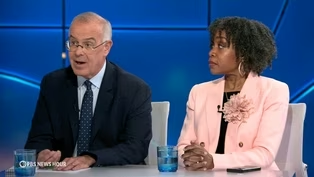
So, to reflect on it all, we turn now to# the analysis of Brooks and Atkins Stohr.## That's David Brooks of The New# York Times and Kimberly Atkins## Stohr of The Boston Globe.# Jonathan Capehart is away.
Welcome to you both.
Thank you for being here.
KIMBERLY ATKINS STOHR, The# Boston Globe: Good to be here.
WILLIAM BRANGHAM: Da.. what Trump 2.0 was going to look like# compared to the first version.
And we## have now seen a year of it, an incredibly# aggressive flexing of executive authority.
When you look back on this year,# what really stands out to you?
DAVID BROOKS: Yes, I tell two stories.
The first is that since 1945, the American# establishment, if you want to put it that way,## has built a series of institutions,# things like the Western alliance, NATO,## the Department of Justice, USAID, and all of those# things have been hollowed out over the last year.
And so we have seen a great decline# in state capacity.
You have to worry## about if we're a nation in decline,# because China is investing in science,## they're investing in technologies, they're# kicking our butts.
And so they tell the## decline.
This has been a tragedy,# an error of historic proportions.
The other story is that, since 1945, the# American establishment has lost touch## with American workers.
And they have# passed trade and immigration policies## that immigration workers didn't like.
They# have -- frankly, in the cultural institutions,## the media, the universities, they have kicked# working-class and conservative voices out.
And so a lot of people feel, I'm# invisible to these people.
And then... WILLIAM BRANGHAM: And, ergo, we get Trump.
DAVID BROOKS: And so we get Trump.
And# so I think both those stories.. And so, as much as we lament the horror# of what's happened over the last year,## it's much more horrible than I anticipated,# for people like me, we have to ask ourselves,## what do we do to bring this about?
And# I think both those stories are true.
WILLIAM BRANGHAM: What do you think?
KIMBERLY ATKINS STOHR: Yes,# two .. at me.
And one is the erosion of the rule of law.
And I see the Trumpification of the# Department of Justice, for example,## as a key role in that right alongside the White# House.
He came in pardoning the January 6 rioters,## everyone who participated in that# horrific day, but, at the same time,## weaponizing the Department of Justice# to go after his political enemies.
I mean, just today, when he was posting# on TRUTH Social about the Epstein files,## he's directing people just to look at the# Democrats that are in these files and not## the Republicans, because everything about# what the Democrats are tagging is a hoax,## and that he has an attorney general now and an FBI# director that are willing to go along with that.
As an attorney, this is not how I learned in# law school that the rule of law is supposed to## be implemented.
Another thing I think# you see a great through line, whether## it's its immigration policies or the# decimation of the federal government## with the purging of workers to the attacks# on universities, is a through line of race.
It is this idea that people within the country# who are Black or Latino or also Muslim,## the Islamophobic aspect of it, or immigrants,## it's only those that are deemed the ones# that are a danger to the country.
We will## open white South Africans -- open our arms to# white South Africans, but at the same time,## the denigration of other countries as Third# World, as less than, as hellholes and worse.
You see this real idea that there is# a white Christian nationalism that has## taken over the federal government in a way# that I never thought I'd see in my lifetime.
WILLIAM BRANGHAM: I mean, as you're both# describing what we have been seeing unfolding,## this is -- none of this should# come as a surprise.
I mean,## this is what candidate Trump promised# on so many different levels.
I will be## your retribution.
I will -- I want my# Roy Cohn in the Department of Justice.
I will deport, I mean, those signs# that the rallies.
To this question## you were asking before, David, about# how -- what we ought to look at as far## as whether we got ourselves here,# how do you answer that question?
DAVID BROOKS: The surprise# or how we got ourselves.
I mean, my simple answer is#that we live in a country where people with## high school degrees die 10 years sooner than# people with college degrees, where people with## high school degrees are five times more likely# to die of opioids, where people with high school## degrees are much less likely to get married,# much more likely to have kids out of wedlock.
People with high school degrees are 2.4# times more likely to say they have no## friends.
People with high school degrees are# less likely to go to parks.
And so we have## created an inherited meritocratic# system, an inherited caste system.
And if you tell successive generations that your# kids are not going to have an equal shot because## your kids by eighth grade have fallen five# grades level below the educated class, well,## if you know your kids are going to have# no shot, they're going to flip the table.
And that's why it's always important# to see this phenomenon as a global## phenomenon.
It's not just Donald Trump.# It's Nigel Farage in Britain.
It's the## right in France.
It's the AfD# in Germany.
It's in Poland.
WILLIAM BRANGHAM: South and Central America.
DAVID BROOKS: It's South and# Cent.. This is a global phenomenon.
It is a phenomenon of# the information age.
That information age reco.. people with money, with education, with money,# and it creates this class system.
And just as## in the 1880s and 1890s, we screwed up responding# to industrialization, we have over the last 20 or## 30 years not adequately responded to the shifts# that the information age has brought about us.
And so I look at this as a moment of rupture# and repair, that it's ugly to live through.## I hate what Donald Trump is doing, but every# time America or any country or us personally,## think of your own personal life, life moves# forward through a process of rupture and## repair.
Something falls apart, something# terrible happens, but you are strong enough## as a nation to ask yourself honest questions,# what part of this problem am I responsible for?
And when you do that, then repair begins to# happen.
And America's been through this so many## times, 1830s, 1890s, 1860s, 1960s.
I'm confident# that America will go through this horrible period## of rupture and something will come out the# other end if we're creative enough to adjust.
WILLIAM BRANGHAM: Kimberly, do you -- who do you# see as the repairers that David is yearning for?
KIMBERLY ATKINS STOHR: Well, I think that it's# going to be many of the same repairs that we## saw those periods that you talked about.
We# didn't just come through the rupture on our## own.
We came through with a sustained# plan of how to get ourselves out of it.
After the Civil War, there was Reconstruction.# That was meant to heal some of the wounds and## bring up the formerly enslaved African Americans# to a place where they can participate fully in## society.
And what did we get?
We got a# vicious blowback to it with Jim Crow,## a rejection of it, this idea that politically# people thought it was better to say, hey,## these are people taking something that# belongs to you,rather than saying,## hey, let's look for a way to bring up# everyone and to protect everyone's rights.
That's exactly what Donald Trump is doing.# He could be talking to the people that you## talked about being left behind, but instead# he's saying that these immigrants or these## Black folks or these other people are# taking something that belongs to you.
And that's what's giving people the idea that this# is unfair.
But one thing that I think, this can't## happen without institutions allowing it.
And I# think this year we saw the biggest institution,## the Supreme Court, basically allowing Trump,# before the actions that he has taken has even## been deemed to be constitutional or legal, in# the short term allowing them to go in place.
WILLIAM BRANGHAM: On the shadow# docket, all these emergency orders.
KIMBERLY ATKINS STOHR: On the shadow# docket, thes.. And so by the time the legality or# the constitutionality has decided,## very little has been so far, the damage has# already done.
And USAID is already gone.
The## Education Department's right next to it.
You're# seeing people who have been deported to countries## that they don't have family, they have never# been to before.
How do you make them whole?
That's too late.
So the# fact that the Supreme Court,## as the unelected independent branch of# our government, has basically been more## often than not a rubber stamp for him is a real# problem.
We need our institutions to step up.
WILLIAM BRANGHAM: I mean, earlier# this spring, David, you will remember,## you called for arguing that all of# these little protests, pushbacks that## are happening against the Trump administration# were insufficient for what you're diagnosing.
And you called for a civic -- collective# civic action.
I don't think I'm breaking## any news to you that I don't think# that has happened in the country.
DAVID BROOKS: Yes.
No, I mean, I was reading all these#lefty revolutionaries and I'm like,## yes, yes, let's go, get them.
(LAUGHTER) DAVID BROOKS: I think it has n.. because they fear their# organization will lose money.
But one of the reasons it has not# happened, if you look at around## the world where it has happened, where# people rose up against authoritarianism,## they had strong civic structures.
Let's# say in the Philippines in the 1980s,## when they rose up, Ferdinand Marcos was# elected, but then he tried to steal power.
And so what happened was, the students rose.# The transportation workers arose.
The business## community arose.
The Catholic Church rose.
It# happened with the institutions of civil society,## through them.
And our institutions# of civil society may be too weak.
And so every institution, whether it's a# university or a business or a law firm, faces## a collective action problem.
If I stick my head# up, I'm going to get shot down.
And without strong## civic institutions where people can move as one,# it's super hard for rare individuals to stand up.
And I'm afraid that's part of what's# happened.
The second thing that's happened is,## there has been such a decay of moral norms# that it's hard for any institution to say,## no, we are going to stand up for this.
You# are not going to talk about Rob Reiner the## way you did.
You're not going to use the# racial language that is omnipresent now.
And it's hard to articulate when the corrosion# is not only in our laws, but in our minds,## in our language.
That's a hard thing to# challenge.
But I'm hopeful in the long## term it will happen.
In the 1890s, we had a# civic renaissance.
We had the creation of the## Boys and Girls Clubs.
We had the creation# of the NAACP, the unions, the Sierra Club.
All these civic organizations were created by# a group of people who said, we can't go on this## way.
And once you had the civic institutions,# then, in around 1900, you had the progressive## movement.
You get a cultural shift, you get a# civic renaissance, and then political reform.
We're still waiting for the civic renaissance.
WILLIAM BRANGHAM: I mean, in just the last 30# seconds we have, Kimberly, the Democrats have## been one of these institutions that seemingly# have been kind of feckless in pushing back.
They have a midterm coming up.
Do# you think what we have seen in the## recent elections will be echoed?
You# have hope that they will be there?
KIMBERLY ATKINS STOHR: I hope so.
I mean, I think that it is imperative tha.. going to be -- we always say it's the most# consequential coming up.
I'm afraid of the## voter information gathering that# the federal government is doing,## trying to consolidate voter lists and be# in charge of who gets purged from them.
I see that the obstacles are already being put up# for a free and fair election.
Democrats have to## say clearly that this is not acceptable and put# forward an agenda that Americans can get behind.
WILLIAM BRANGHAM: Kimberly# Atkins Stohr, David Brooks,## so nice to see you both.
Thank you very much.
DAVID BROOKS: Thank you.
KIMBERLY ATKINS STOHR: Thank you.
WILLIAM BRANGHAM: The holidays are a great# time to catch up on the year's best films,## whether streaming at home or# heading to a movie theater.
Jeffrey Brown recently sat down# with two film critics who shared## their top picks of the year.
It's part# of our arts and culture series, Canvas.
JEFFREY BROWN: It's that time of the# year when we spotlight some of 2025's## best movies from big blockbusters to a few# hidden gems that you might have missed.
For that, I'm joined by Linda Holmes, host of# NPR's "Pop Culture Happy Hour," and Mike Sargent,## host of the podcast "Brown & Black" and# co-president of the Black Film Critics Circle.
And it's nice to see both of you# again.
Thanks for joining us.
Let's start with some of the# bigger movies of the year.
Linda, you want to start?
LINDA HOLMES, Pop Culture# Correspondent, NPR: Yes.
To me,## movie of the year in a few ways is "Sinners,"# which is from Ryan Coogler.
It's about .. brothers played by Michael B. Jordan who# end up having to battle some vampires.
ACTRESS: The vampires is different, maybe the# worst kind.
The soul gets stuck in the body.
LINDA HOLMES: Not only do I think# it's a really, really good movie,## but it's also a really good story of a movie.# It's really a situation where Coogler, I think,## was able to get the deal that he wanted to# make the movie he really wanted to make.
It is original.
It is not from# existing intellectual property.## It felt completely fresh to me.
JEFFREY BROWN: OK, how about one more# while you're at it, of a big movie?
LINDA HOLMES: Yes.
I always try# to give a little bit of love to## the superhero genre when it does a good job.
JEFFREY BROWN: Why not?
LINDA HOLMES: I .. the best movie of the year?
Maybe not.
But I think## this is truer to who I think Superman is# than some of the other recent efforts.
DAVID CORENSWET, Actor: Everybody OK?
Hey, buddy, eyes up here.
LINDA HOLMES: Good film.
Enjoyed it.
JEFFREY BROWN: All right.
Mike Sargent, what did you.. MIKE SARGENT, Co-President, Black Film# Critics Circle: "Wake Up Dead Man:## A Knives Out Mystery," which is the third#.. Daniel Craig as Benoit Blanc.
This is# written and directed by Rian Johnson.
And this is actually, I think, maybe the best# of the three.
It's an interesting premise.
It's## about a priest who's killed and everybody in# the parish is potentially a subject.
This leans## strong into character.
And it really shows# that this series could go on for a long time.
The other film I have to mention is# "Weapons."
And this is a film by Zach## Cregger.
It stars Josh Brolin, Julia Garner.# And what this film reminds me as a storyteller## and a lover of stories is, it's not just# the story.
It's how the story is told.
ACTRESS: You're either negligent or complicit.
MIKE SARGENT: Yes, there are plot points,## there are plot holes and things,## but you don't care because it's so much fun# to sit.. JEFFREY BROWN: All right, well, that# leaves us wanting more.
Thanks for that.
So, Linda, how about it among the indie or# smaller films.
Pick one that's stuck with you.
LINDA HOLMES: It's hard to define# indie and small for me sometimes.
But I did think one of the quieter#films that I very much enjoyed this year was## "Blue Moon," which is directed by Richard# Linklater, and it stars Ethan Hawke as... JEFFREY BROWN: The two of them# back together again, right?
LINDA HOLMES: Back together again# after a number of proj.. Hawke plays the lyricist Lorenz Hart, and it's# set on the night that "Oklahoma" opened.
And## "Oklahoma" is when Richard Rodgers, who had# been Hart's songwriting partner, was pairing## up with Oscar Hammerstein.
And obviously they# went on to have a lot of success together.
So this is sort of the night# that Hart feels his partnership## slipping away from him.
And it's just# very moving and it's very much about## art and people who make art.
And I enjoyed# it a great deal.
And I really recommend it.
JEFFREY BROWN: All right, Mike,# have you got a smaller film for us?
MIKE SARGENT: I do.
Actually, it's a film called "The# Secret.. writer-director Kleber Mendonca Filho.# And it's about a tech specialist who's## in his early 40s.
He's on the run from an# authoritarian regime.
Takes place in Brazil.
ACTOR (through translator): This is the person.
ACTOR (through translator):# I want a hole in his mouth.
; MIKE SARGENT: Now, what makes this# film work besides Wagner Moura's## award-winning performance is that --# how it's shot.
This -- you almost feel## like you're watching a documentary.
It's# very little artifice.
Things are dirty.## It seems very real.
Every single actor,# you completely believe them in their role.
This is one of those films when you watch# it and then you go and you watch some kind## of Hollywood movie, it just seems --# like, wow, seems like totally false.
JEFFREY BROWN: All right, so# speaking of documentaries,## it was a good year for documentaries.
Linda,# what -- give us a couple that you liked.
LINDA HOLMES: There's one that I# really liked called "The Perfect## Neighbor," which is a very upsetting film,# I will say, out of the gate.
It is about.. white woman who lived near a Black woman and# her kids and a lot of other people's kids.
And this woman just became very agitated# by the kids and was harassing them.
And## ultimately it ends in this tragic,# violent end.
And it's just a terrible## story.
It was mishandled, but# it's just an awful situation.
MAN: Sheriff's office!
Come# outside with your hands up!
LINDA HOLMES: The other one that I would# mention on a kind of a happier note... MARISKA HARGITAY, Actress: I have spent my whole## life distancing myself from# my mother, J.. LINDA HOLMES: It is a documentary that the# actress Mariska Hargitay, who is on "Law & Order:## SVU," made about her mother, Jayne# Mansfield.
It's called "My Mom Jayne."
I'm so skeptical when famous people# make documentaries about their families.
But she absolutely redeems#the whole project.
It's very honest.
It's## very fair to everybody.
It's a beautiful story# with some surprises, but also a lot of just very## heartfelt storytelling about her mother and her# kind of relationship with her mother's memory.
JEFFREY BROWN: All right, Mike, what jumped# out at you in the documentary world this year?
MIKE SARGENT: Two documentaries I will mention.
One is called "Sly Lives!
(AKA The Burden of Black# Genius)," .. this is a documentary about Sly of Sly and the# Family Stone.
And they are a band that fused funk,## soul, rock, and they broke racial and gender# boundaries in the late '60s and early '70s.
MAN: Guys and girls and black and# white.
So you get all that input.
MAN: They sounded like nothing else sounds.
MIKE SARGENT: This goes beyond just the# usual musical doc.
It explores the emotional,## cultural burden placed on Black genius in America.
And it really paints a very# vivid portrait and really## makes you appreciate the genius of Sly Stone.
The other documentary by the great Raoul# Peck is a documentary called Orwell:## 2+2=5."
And it's about George Orwell and# his life.
And what's interesting about this## documentary is that it juxtaposes what's going# on today along with his writings from over 67## years ago and what was inspiring him to write the# pieces he wrote like "Animal Farm" and "1984."
And this is really life is like science# fiction, because what you see him talking about,## what he was writing about, what he's# saying is disturbingly prescient today.
JEFFREY BROWN: All right.
I want to give you both# a shot at a film to see with the whole family.
LINDA HOLMES: Absolutely.
If you're looking for# a movie for kids, "Zootopia 2" is out.
And even## though it's big, it's Disney, I do think# it's visually inventive and a lot of fun.
The other one I would mention, there's a film# coming out at Christmas called "The Choral,"## which stars Ralph Fiennes as the director of a# community chorus during World War I. Some people## absolutely are going to find it a little bit# corny, but I found it beautiful and really moving.
JEFFREY BROWN: All right, Mike Sargent,# what do you have in the family fair?
MIKE SARGENT: There's a film called "Arco.
"# It's about a little boy who travels from the## future into our future and meets a little# girl.
And he needs to get back home.
And without saying much more, the animation# is terrific, very much a beautiful film worth## watching.
And I have to say another film that# I did not expect much from is "The Bad Guys 2."
ACTOR: How are we supposed# to get a fresh start when## we get blamed for every bad thing that happens?
MIKE SARGENT: It's a sequel to the DreamWorks# animated heist comedy.
And this is really such## an enjoyable film.
It's really -- I# think it sets the bar pretty high.
JEFFREY BROWN: A good list for all of us.
Mike Sargent and Linda Holmes,# thank you both very much.
LINDA HOLMES: Thank you.
MIKE SARGENT: Thank you.
WILLIAM BRANGHAM:## We end this holiday week with a very British# tradition, pantomime, but with a modern twist.
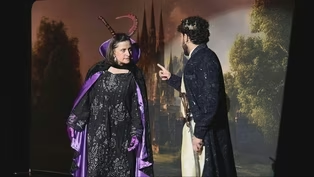
For those less familiar, a pantomime, or panto,## is a family holiday comedy show# filled with fairy tales, music,## slapstick, and audience participation,# and it's a seasonal staple across the U.K.
This year, one production is selling out.
It's# a retelling of the fairy tale "Snow White" that## blends classic panto with Muslim culture and# humor and even teases at its online trolls.
From Britain, Minnie Stephenson the Independent# Television News brings us this story.
MINNIE STEPHENSON: 'Tis is the season# of glitter, goodwill and glorious panto,## where the jokes are loud and# the costumes are even louder.
Introducing the Muslim panto, "Snow Brown# and her Seven Uncles," or "Chachay" in Urdu,## a fairy tale flipped and served with enough# one-liners to derail even the grumpiest uncle.
LUBNA SALEH, Actor: I am so glad I'm in# this role.
And having the previous shows,## honestly, I started tearing up at one point,# because the little girls were running up to## me and they looked like me.
And I looked like# them.
And they were like: "I love your hijab,## oh, my God, you look like me, I have your name."
And it's just really heartwarming# to see and be the representation I## wish I would have had when we grew# up.
We just want everyone to enjoy## the fun.
And you don't have to# be Muslim to come and watch it.
MINNIE STEPHENSON: Its creator, Abdullah Afzal,## is on a mission to spread Muslim joy in the# festive season.
From Glasgow to Notting Hill.. across 11 cities, the Muslim panto# has sold over 24,000 tickets.
ABDULLAH AFZAL, Creator and Actor:# When it comes to the pantomime,## it's a British institution.
It's very# important .. something that families go out to, but# it's my history, the upbringing I had,## the conflicts between being a British and# Muslim at the time when I was growing up.
But I'm proud of both those things, I'm proud of# being Pakistani.
I'm proud of being British.
And## I'm bringing it to the stage.
And people# like me are coming and enjoying the show.
MINNIE STEPHENSON: Of course, not everybody# is a fan.
And satire is not dead.
The panto## has become embroiled in its very own culture war# with some online trolls seizing upon the show.
ABDULLAH AFZAL: We have got to use# it as fuel and inspiration to better## ourselves.
And I have just enjoyed it.
And# I'm being attacked by a right-wing fly here.
Actually, the Snow Brown name actually came from# a right-wing troll.
One of the comments was,## Cinder Allia?
What's next, Snow Brown?
I went, all right, OK.
MINNIE STEPHENSON: Now you# have.. ABDULLAH AFZAL: Because of# them, their inspiration.
MINNIE STEPHENSON: The comedy is# halal and the joy unmistakable.
WOMAN: It makes me feel proud to be Pakistani and## Muslim and British and have all# those cultures kind of combined.
MAN: It's a twist to a typical panto,## but it's still a panto at heart# with all the fun associated with it.
BOY: I like the atmosphere of the Muslim pantos# and the funny -- and the humor and the acting.
GIRL: It just reminds me about something# that I would watch when I was little.
MINNIE STEPHENSON: The ultimate unifier# in the festive season, you may ask,## kebabs, of course.
Enter the kebab queen.
NOOR-AL-WAHID, Actor: Everyone loves the kebab.
MINNIE STEPHENSON: Wherever you're from.
NOOR-AL-WAHID: Yes.
And do you know.. when we have met the audience, I have had# a few comments where people have said:## "You know what, I'm going to# go home and have a kebab."
NOOR-AL-WAHID: "It really made# me want to have a kebab now.
": (LAUGHTER) MINNIE STEPHENSON: In a world# that often feels divided,## this panto offers something simple,# a stage big enough for everyone and## a reminder that sometimes the best# magic is seeing yourself center stage.
WILLIAM BRANGHAM: Be sure to watch "Washington# Week With "The Atlantic" tonight on PBS.
Host## Jeffrey Goldberg and his panel break down# what's left on President Trump's Project## 2025 to-do list and what it could portend# for the new year.
That's tonight here on PBS.
And on the next "PBS News Weekend": how# researchers in Yellowstone National Park are## using A.I.
to try to one day decode the language# of wolves.
That's Saturday on "PBS News Weekend."
And that is the "News Hour" for# tonight.
I'm William Brangham.
On behalf of the entire "News Hour" team, thank# you so much for joining us.
Have a great weekend.
Breaking down U.S. strikes and the conflict in Nigeria
Video has Closed Captions
Breaking down U.S. strikes on ISIS in Nigeria and the complicated conflict there (10m 25s)
British panto blends holiday tradition with Muslim culture
Video has Closed Captions
British panto production blends holiday tradition with Muslim culture and humor (3m 48s)
Brooks and Atkins Stohr on Trump's return and its impact
Video has Closed Captions
Brooks and Atkins Stohr on Trump's return and its impact on the country (11m 32s)
Film critics name their picks for the year’s best
Video has Closed Captions
Film critics look back at 2025 and name their picks for the year’s best (8m 48s)
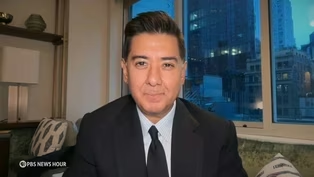
Imran Ahmed on Trump's threat to deport him over censorship
Video has Closed Captions
Imran Ahmed on Trump's threat to deport him over 'censorship' for countering online hate (6m 30s)
White House pushes to dismantle climate research center
Video has Closed Captions
White House pushes to dismantle leading climate and weather research center (7m 44s)
Providing Support for PBS.org
Learn Moreabout PBS online sponsorship
- News and Public Affairs

FRONTLINE is investigative journalism that questions, explains and changes our world.

- News and Public Affairs

Each week, explore science, health, and technology headlines with leading experts.












Support for PBS provided by:
Major corporate funding for the PBS News Hour is provided by BDO, BNSF, Consumer Cellular, American Cruise Lines, and Raymond James. Funding for the PBS NewsHour Weekend is provided by...