
December 27, 2023 - PBS NewsHour full episode
12/27/2023 | 57m 46sVideo has Closed Captions
December 27, 2023 - PBS NewsHour full episode
December 27, 2023 - PBS NewsHour full episode
Problems playing video? | Closed Captioning Feedback
Problems playing video? | Closed Captioning Feedback
Major corporate funding for the PBS News Hour is provided by BDO, BNSF, Consumer Cellular, American Cruise Lines, and Raymond James. Funding for the PBS NewsHour Weekend is provided by...
December 27, 2023 - PBS NewsHour full episode
12/27/2023 | 57m 46sVideo has Closed Captions
December 27, 2023 - PBS NewsHour full episode
Problems playing video? | Closed Captioning Feedback
How to Watch PBS News Hour
PBS News Hour is available to stream on pbs.org and the free PBS App, available on iPhone, Apple TV, Android TV, Android smartphones, Amazon Fire TV, Amazon Fire Tablet, Roku, Samsung Smart TV, and Vizio.
Providing Support for PBS.org
Learn Moreabout PBS online sponsorshipAMNA NAWAZ: Good evening.
I'm Amna Naw Geoff Bennet On the "News and Southern Gaza, including in refugee camps.
We hear from the Israeli ambassador to the United States.
A major caravan of migrants travels through Mexico, as record numbers contin at the Southern border.
And meat grown in laboratories hu rdles, potentially changing the future of the U.S. diet.
JOSH TETRICK, CEO, Eat Just: If were going to solve the climate problem, ne ed to move from intensive animal farming that is eating up a third of ou to an entirely different approach.
(BREAK) AMNA NAWAZ: Welcome to the "NewsHour."
Israel's ground offensive in the Gaza Strip continues to expand, as does the human cost.
Health officials say the 11-week-long war already claimed the lives of more than 21,000 Palestinians, most of them women and children.
As Israeli tanks bombard the Gaza Strip, the peace plan proposed by Egypt and Qatar seems far from reach.
Last night, a Hamas official said they ha countries.
OSAMA HAMDAN always open to all initiatives that achieve ou r people and to everything that achieves the highest interests of our people.
Our people do not wait for temporary truces.
AMNA NAWAZ: Israel, meanwhile, shows no sign of slowing d The New York Times verified this video from a photographer embedded with Israeli soldiers.
It shows a large group of detained Palestinians stripped to their underwear.
Some appear to be children or elderly.
Other recent videos and photos of strip-searched detainees have Military officials say they must search for weapons, but human rights groups say this violates international detention standards.
Today, the Turkish president went as far as comparing Israeli Prime Netanyahu to Adolf Hitler.
RECEP TAYYIP ERDOGAN, Turkish President (t Benjamin Netanyahu is doing any less than Hitler?
No.
As of now, H This one is richer compared to Hitler.
He is receiving support from the West All sorts of support comes from America.
And with all this support, what did they do to more They killed them.
AMNA NAWAZ: As the d Aid trucks roll in, but many Palestinians are starving or without water.
An Israeli official claimed that United Nations agencies are enabling Hamas.
EYLON LEVY, Israeli Government Spokesman: Unfortunately, to date, the U.N. aid mechanism in Gaza has been woefully unsuccessful, because it goes through UNRWA.
Aid simply isn't reaching the people who need it because Hamas hijacks it and UNRWA covers up for it.
AMNA NAWAZ: visas on a case-by-case basis, instead of automatic admission.
In corners of Gaza, life or some version of it goes on.
Tareq Al-Nuaimi lost his teaching job and home to the war, but volunteered to hold English lessons in this shelter.
TAREQ AL-NUAIMI, V of the war, we see our children distressed destruction and pain they see.
We thought of cheering them up.
We suggested the idea of cl They liked the idea and developed a passion for it.
AMNA NAWAZ: Islam Aziz is 10 years old, and says ISLAM AZIZ, Displaced Palestinian (through translator): We have the right to an education just like all the children around the world.
It has been 81 days since we AM NA NAWAZ: In this room, a glimmer of a normal childhood, while, outside, a CHILDREN: Please stop war.
Please stop war.
AMNA NAWAZ: The Israel-Hamas war is approaching To help explain what Israeli strategy and tactics are, and what the future of Gaza may look like, I'm joined now by the Israeli ambassador to the United States, Michael Herzog.
He is a retired brigadier general in the Israel Defense Force.
Mr.
Ambassador, welcome to the "NewsHour."
Thank you for joining us.
MICHAEL HERZ Thank you.
AMNA NAWAZ: We know the stated goal of Israel here is to eradicate Ham of October 7 never happen again.
Can you update us on where you are on meeting that goal?
How much of Hamas have you eliminated?
MICHAEL HERZOG: First, our goal is twofold It is to defeat Hamas, to remove the threat of Hamas in Gaza, which means to dismant their military infrastructure, their military capabilities, and to dismantle their government capabilities that built these military capabilities and operated them on October 7.
Our second goal is to release all of our hostages.
We still have close to 130 hostages, including, by the way, Americans.
And we will do everything possible in order to release our hostages and bring them back home.
We are advanci We are operating in both the northern part of Gaza and the southern part Our military operation, in military terms, is effective, in the sense that we are dismantling the Hamas military infrastructure.
Hamas is deployed in five brigades and 24 ba It's an army of terror.
And it is a war which is not th e biggest terror complex in the world, stretching hundreds of kilometers, where they host their leadership, command-and-control centers and rockets.
So this is a big challenge.
And -- but we are moving And I believe our military operation is effective.
AMNA NAWAZ: You say it's effective, but wha how far along you are in progress of dismantling Hamas?
How much of their senior leadership have you targeted?
MICHAEL HERZOG: I'm going to -- not going to put numbers on the areas that we engage their battalions in the city of Gaza, Khan Yunis, and elsewhere, we were successful in dismantling these battalions.
And I think we dealt a very severe blow to them.
There are still several thousand armed people in Gaza, and we haven't touched An d we don't intend to run after each and every one of them, but to break the backbone of Hamas in a way that they will no longer be able to pose a threat to the state of Israel.
I think there's still a lot of military work to be done.
They continue to this day to fire rockets at the state of Israel.
And since the beginning of the war, Hamas and other terror organizations in Gaza fire over 11,000 rockets into Israel, and they're still holding our kidnapped civilians.
So, there's still a long way to go, but I think we're at the point where they understand that they will be defeated militarily.
AMNA NAWAZ: I'd like to ask you about the video we just re It was shared yesterday.
The New York It seems to be a detention area se to their underwear, detained en masse.
Mr.
Ambassador, I'm sure you have seen th And human rights groups say that this violates international standards of detention.
Is this practice sanctioned by your administration?
MICHAEL HERZOG: So, first of all, I'm not sure these pictures are from recent tim We do -- when we arrest suspects... (CROSSTALK) AMNA NAWAZ: When would t These were reportedly MICHAEL HERZOG: I will say that we strip people of their clothes in order to ma are no explosive belts or explosive charges or weapons.
And I think that is customary.
The fact that these photos came out, I don't think this is our policy, and I th is was sanctioned by any people with authority in our government.
But I will say, from our experience -- you talk about children.
We have 15-, 16-, 17-, 18-old people who are part of the Hamas military wing who carry weapons and fight our forces, and they killed our soldiers.
So we make sure that none of them has explosive vest.
But I want to differentiate between the very act and the fact that these photos cam which, again, is not our policy.
AMNA NAWAZ: If this is not your policy, then Th ese seems to be groups, large groups of men detained en masse.
There were previous videos also showing men detained en masse, similarly stripped, many blindfolded, in the backs of military vehicles.
Why is this allowed to happen?
MICHAEL HERZOG: There we There are people with mobile phones who take photos.
You can't control all of it.
And, again, I'm saying it's not our We are against it.
AMNA NAWAZ: They have been verified.
Why is this practice conti MICHAEL HERZOG: Because, when you have a situation like and every mobile phone on the ground.
AMNA NAWAZ: No, sir, I apologize, n Why are your military forces detaining men en masse, including some wa y?
MICHAEL HERZ And our soldiers get killed in Gaza.
Let's not forget that.
We are fighting fo And when we have terrorists or suspected terrorists, no weapons or explosive charges.
This is war.
AMNA NAWAZ: I mean, we spoke recently to the poet Mosab Abu Toha, who said he, even th on a list to evacuate with his American citizen son, he was arrested, detained at the Rafah Border Crossing, beaten and blindfolded for over two days.
When he was asked why he was being held, he said the IDF soldier told him: "You have to prove you are not Hamas."
Is that the policy by which your soldiers MI CHAEL HERZOG: Here, we are fighting against over And our soldiers get killed there every day.
So, there are a lot of people who are terrorists, and there are being terrorists, and they are being detained in order to investigate and see if that suspicion is right or not.
If it is not, we r It is not our policy to target inno But we have to make sure -- we are talking about the protection of our forces, who, as I said, are fighting a very, very difficult war in Gaza and get killed every day.
AMNA NAWAZ: As we mentioned, that death toll among Palestinians has now risen over 21,000.
Women and children reportedly make up most of the dead.
We know your intelligence shows you how many people you expect to hit in each And I understand, according to reporting, some of those constraints have been loosened.
You previously used to tolerate dozens of civilians as collateral damage.
That number has now risen to hundreds.
Is there a limit to that number of how many civili MICHAEL HERZOG: Well, I totally disagree with that.
And I reject that.
We do not ta You cite Hamas numbers from Gaza.
There are no other numbers, only Hamas numbers And the U.S. cites Hamas numbers.
And we don't know exactly how many people got killed We do know that innocent civilians got killed.
It's a tragedy.
It's a tragedy f But Hamas never tells you -- putting aside not sure what the exact numbers that carried out a massacre is capable of also putting false numbers outside.
But we recognize that civilians were -- got killed.
But they never tell you what's the breakdown between terroris Our forces claim that, in fighting Gaza, in battle, we killed over 8,000 terrorists.
You don't know the exact breakdown.
And you don't know how many of them are women and These numbers are out by Hamas, and nobody can verify it.
And let me give you an example.
When the whole world accuse Israel o sure you remember that -- Hamas immediately put out that 407 people got killed in that attack, where When the who Jihad rocket, the numbers dropped dramatically to dozens.
Did anybody ask Hamas, where are the 471 people you claim to have killed?
Do you still count them or not?
So, let's be very careful about the number I am not here to claim that innocent civilians do n This is war, and it's tragic.
And Hamas embedded itself in civilian pop them as human shield.
And this is tragic.
But nobody really knows what the exact number We are fighting against over 30,000 armed people in Gaza.
AMNA NAWAZ: Mr.
Ambassador, I will just clarify these numbers I was citing come from the U Nations Office for Coordination of Humanitarian Affairs.
I invite you to join us again.
MICHAEL HERZOG: Cite -- cite the Hamas numbers.
AMNA NAWAZ: We have... MICHAEL HERZ They don't have numbers of their own.
AMNA NAWAZ: Ambassador Michael Herz you for joining us.
Please do come Thank you for your time.
MICHAEL HERZOG: Thank you very mu Thank you.
AMNA NAWAZ: In the day's other headlines: Form ballot in Michigan.
The state Supreme Court won't of his role on January 6.
The justices wrote in a statement -- quo presented should be reviewed by this court."
That comes days after Colorado's Supreme Court deemed Mr. Trump ineligibl in their state.
Wintry weather has blanketed parts Nebraska and Wyoming weren't too far behind with about 11 inches.
Meanwhile, strong winds continue to gust across the Southern and Central Plains.
The massive storm is expected to bring snow and rain to the Northeast later this week.
Officials in Kyiv say Russia fired nearly 50 drones at Ukraine overnight and shelled a train station as people were trying to evacuate.
The Ukrainian air force claims it shot down most of the drones, which were St ill, the attacks killed at least six people, destroyed buildings, and knocked out power to most of the southern city of Kherson.
Protests erupted in Congo today, demanding a redo of last week's presidential election.
Demonstrators took to the streets of Kinshasa, denouncing what they say was a flawed vote.
Police fired tear gas and threw rocks to break up the crowds.
One of the main opposition candidates also accused police of firing live bullets.
Protesters refused to give up.
RUDDY MANDIO, Opposition Marching is our constitutional right, and it is not over, because they need to take responsibility for this chaotic election.
We won't back down.
AMNA NAWAZ: In integrity.
They cited p Final election results are expected in the coming days.
Back in this country, The New York Times filed a federal lawsuit today against and OpenAI for using millions of its stories to train chatbots.
The Times says its never granted anyone permission to use its content for artificial intelligence purposes.
It isn't see be worth -- quote -- "billions of dollars."
And on Wall Street today, stocks managed modes The Dow Jones industrial average climbed 111 points to close at 37656.
The Nasdaq rose 24 points.
And the S&P 500 added seven.
And two passings to note tonight.
Comedian Tom Smothers has died at his home in Calif He and his brother Dick hosted the trailblazing "Smothers Brothers Comedy Hour" in the late 1960s.
It mixed humor, music and Smothers won an honorary Emmy for his work on the show nearly 40 years after it was canceled.
Tom Smothers was 86 years old.
And South Korean actor Lee Sun-kyun, known for his role in the dead today in Seoul in an apparent suicide.
He had been under investigation for alleged drug use.
Lee played the father of a wealthy family in "Parasite," which won picture in 2020.
He also appeared in several po old.
Still to com efforts to free Americans detained abroad; thousands of congregations leave the United Methodist Church amid disagreements over theology; interest in immersive exhibitions skyrockets as the way people consume art evolves; plus much more.
While the United States was able to negotiate the release of detained Americans in Venezuela, there are still at least four Americans in Russia, and approximately seven held in Gaza by Hamas and potentially other militant groups.
The U.S. government's point person working sp ecial presidential envoy for hostage affairs.
Ambassador Carstens, welcome back.
ROGER CARSTE having me to AMNA NAWAZ: home those Americans held in Gaza.
I understand Qatar was instrumental in previous hostages.
Things have Where is the holdup?
Obviously, H But are the ROGER CARSTENS: As you might imagine, I can't get into At times you can, usually after the fact, but, right now, it just, in a way, doesn't benefit the hostages to get into the nitty-gritty of it.
What I can say is that Qatar is playing a very strong and impo There are times when, of course, the United States does not really have entree into some of the negotiating groups, and this is a case where Qatar has really been able to bring its gravitas in the region to bear.
I think where we are, it's a tough fight.
I think a lot of things you read in the are.
But the bott make sure that everyone gets back.
And even if we were to get a to get all the hostages back, and we're done when everyone is accounted for.
AMNA NAWAZ: Have you been able to confirm, at least among the Americans th at they are still alive?
ROGER CARSTENS: So As you well know, the president announced just a few days ago that the American hostages in detention had already passed.
For the other seven remaining, of course, the information -- I would s information some, less on others.
But, at the end of the day, to us, we jus to include those who do pass away.
So the one gentleman that is assess bring his remains back, so that the families can have closure.
AMNA NAWAZ: The nature of your work is, to say the things come together at the last minute.
I want to ask you about the re You were able to bring home 10 American an ally of Venezuelan President Maduro.
How fragile -- give us a sense, how fragile are these deals befo I mean, when was this one final before they came home on Wednesday?
ROGER CARSTENS: To just answer directly, they're always very fragile.
There comes a time when -- even though we try to give families a sense of what's hap during the discussions, there comes a time when we tell the families like talk about it anymore, because it seems to get to that point where everything hangs on a thread and that, if there's one leak, if there's one false tweet, the other side may actually decide to collapse the negotiation.
On this one, we had some details to work out.
A lot of good work was done by the United States, particul the people at the State Department and Western Hemisphere Affairs.
But I think we got to the point where we just had to fine-tune And, as a result, on the 20th, we spent about four or five hours on a very ta rmac.
You can pict six hours, and just going back and forth between this -- these very loud planes with that heat coming off the tarmac, trying to ensure that everything was wrapped up, so that we could begin the switch between the Americans that they were holding and the person that we w holding.
But at the e put the work into it.
And, if I may, Department, but there are congressmen, senators, nonprofits, individuals like Mickey Bergman of the Richardson foundation, Jonathan Franks, Eric Lebson, congressmen, senators, their staffs, allies of the United States that all put themselves into this.
But, at the end of the day, the people that, to my mind, bear the most ba ck, the families.
They're the ones that push us, an d they're all doing that to keep their loved ones -- bring their loved ones back.
And I would even say the people that are in these prisons, they remain strong and they pretty much never lose faith in their country.
They know that we're going to AMNA NAWAZ: Speaking of folks st ill in Russia.
Tomorrow doe ROGER CARSTE AMNA NAWAZ: You put out a statement just this evening, saying: "Not a day g U.S. government efforts to bring him home."
But he recently did tell reporters he feels behind.
There have b Will he be the priority in any potential next Russian swap?
ROGER CARSTENS: You know, a lot depends on the Russians.
I mean, certainly, we want to brin Love to get them both at the same time.
AMNA NAWAZ: Evan Gershkovich is ROGER CARSTENS: Evan Gershkovich, The Wall St But we're working hard.
It's kind of belief might be that you're not.
But, at the end of the d We talked to The Wall Street Journal because they maintain an interest in Evan Gershkovich.
We talk to them on a weekly basis.
But Paul Whelan is just front and cent I probably talk to him once every two or three weeks.
Fletcher Schoen, my case officer, talks to Paul pretty much wee But this is something that we work on every day.
And that's not just throwing those word Every day, we're working on trying to bring Paul AMNA NAWAZ: We have seen a rise in foreign An d the criticism you always get is, the more you negotiate with people, you get them to see they can have a financial backer or a close political ally or billions in funds unfrozen by releasing Americans they're holding, that it may incentivize more hostage-taking.
How is that not the case?
Doesn't that s ROGER CARSTENS: No, if I were ca se numbers are actually going down right now.
I think we're in a new field.
Probably, 10 years from now, maybe come up with a more conclusive -- or, I should say, conclusion.
But, right now, my numbers are not necessarily going up.
They're -- if they're a steady state or going down, I would say th Gaza, of course, with 10 hostages being -- or 12 hostages down to eight that are still on accounted for, that kind of skews the numbers a little bit.
But, at the end of the day, people don't get back unless you're willi And President Biden and Secretary Blinken have shown great courage in making the hard decisions that bring Americans home, because unless you make that deal, that person is going to remain in a prison.
There's no other way to bring some o AMNA NAWAZ: That is Ambassador Roger Carstens, U.S. special affairs.
Ambassador, Thank you.
ROGER CARSTENS: Thank you, as alwa AMNA NAWAZ: The Biden administration is closing out 2023 in much the same way it began with headlines about a migrant crisis on the U.S. Southern border, Border Patrol agents encountering a record number of people entering the country, a caravan heading toward the border, and American cities struggling to keep up with asylum seekers.
As Stephanie Sy reports, it's with that backdrop that President Bid advisers to Mexico in search of solutions.
STEPHANIE SY: Secretary of State Antony Blinken arrived in Mexico City today, Am bassador Ken Salazar.
Blinken, along with Homeland Security Sec met with Mexico's president on their second visit since October to address the migrant crisis.
The U.S. is asking Lopez Ob and to do more to stop migrants when they try to enter Mexico from Guatemala.
In exchange, Mexico wants the U.S. to commit more aid to the migrants' countries of origin and ease sanctions on Venezuela and Cuba.
The talks come as record numbers of people try to enter the U.S. from the Southern bor At times last week, Customs and Border Protection stopped more than 10,000 people a day, adding to the more than 240,000 migrants that officials encountered in November.
The numbers have stretched Border Patrol to its limits, with agents struggling to process the influx, as thousands gathered in Eagle Pass, Texas, in recent weeks.
U.S. Customs and Border Protection closed other ports of entry in Arizona and California in the last month in order to redeploy officers to help with migrant processing.
Underlining the pressure on U.S. officials, a caravan of migrants is steadily making its way to the border.
An estimated 6,000 people fr for months in Southern Mexico.
On Christmas Eve, they began their march northwards un They make up the largest caravan in more than a year.
Many young and exhausted families are among the masses, including Jose's.
JOSE, Migrant From Honduras (through translator): My daughter can't walk anymore.
I carry her in my arms because she needs to rest.
She's only 3 years old.
And she's not healthy.
She's ill. STEPHANIE SY ROSA, Migrant From El Salvador (through because many of us are tired, without eating, and with blisters on our feet.
STEPHANIE SY: While U.S. leaders seek solutions that would control those coming into the U.S., the migrants seek rest and compassion.
For a closer look at the situation the Southern border, I'm joined by Elliot Spagat, immigration reporter with the Associated Press.
Elliot, thanks so much for joining the "New What is the goal of the meeting between top Biden administration officials Mexican president?
ELLIOT SPAGAT, San Die any public asks, but we can infer from what's been happening ove The numbers are astronomical.
They're unprecedented, to use the wo 10,000 arrests for illegal crossings on many days in December.
So they want to get a handle on the numbers.
And, of course, this is There's negotiations in Congress, with aid to Ukr So I think the U.S. officials want to get a little better handle on the numbers.
And to give one specific example, the rail crossings in Eagle Pass, Texas, and in Eagle -- El Paso were closed for five days this month and caused a lot of economic losses.
They're reopened.
But what was And the U.S. wants Mexico to do more to stop that.
So, more enforcement is what I think the U.S. is looking for.
STEPHANIE SY: You visited the Arizona side of the border with Mex What did you see for yourself about the situation and specifically about the efficacy of the border wall?
ELLIOT SPAGA About 3,000 people are crossing a day in that general area, much of it through Lukeville, which is a border crossing that is closed right now because of all the need to focus resources on processing migrants.
It's the border crossing, a duty-free sh And there's really very few agents around, but lots of people.
I saw lots, probably more from Senegal than any other coun -- I'm sorry -- Mexico, of course, Guatemala.
And they're sawing through the walls, the smugglers are, on th They're using construction-grade tools.
These are columns that were built during the final days of the They cut through and swing the columns back and forth.
So people can just walk through, young people, toddlers, older people.
It's very easy to get through.
And they walk for hours This could probably be stopped by Border Patrol agents, but they just don't have enough there.
They're busy processing.
I did -- again, Commission These are -- step up more.
There are th the dates were marked on when they had been fixed, and hundreds of them over a 30-mile stretch.
And Commissioner M breaching these wall -- the wall on the Mexican side.
STEPHANIE SY: You have been reporting on the underlying causes of from climate change to poverty.
But you have also emphasized in your recent operations.
I wonder if to the increasing flow of migrants.
ELLIOT SPAGAT: Yes.
Well, it vastly increases gl So we did a story on Mauretanians, who are very -- very few wer And then around February, March of this year, they were crossing, like, several thousand a month, most of them going to Cincinnati or New York.
They fly -- about 4,000 Chinese are crossing a month through San -- Diego.
And I mentio these countries every month.
And the -- there needs But there are travel agencies that -- many of them really are travel agencies.
And they help -- they arrange flights and communicate virtually over social media Every migrant has a smartphone.
And so they use TikTok and Facebook and You And so the smugglers are oftentimes not even with them physically.
They aren't when they cross the U.S. border.
They're just given instructions, cross he So that is a -- and that is a sea change from just a few years ago.
STEPHANIE SY: How would you describe how immigration politics have shifted in ELLIOT SPAGAT: To the right, for sure.
One big development, of course, has been the large influx o other countries to New York, Chicago, Denver, other Democrat-run cities.
And so we're seeing now, with the negotiations and Congress over this -- it includes aid to Israel and Ukraine, as well as border security measures, it is a lot of Democrats saying, like John Fetterman of Pennsylvania, even Dick Durbin, who was the original champion of the dreamer legislation, saying, Chuck Schumer, we need to do something.
Of course, the progressive wing of the Democratic Party is very much opposed to those changes.
They want to keep the asylum system going.
And other Republicans are split too.
So, we will see.
But I think, be done and more on the enforcement side.
STEPHANIE SY: Elliot Spagat with the Associated Press, thanks so your insights.
ELLIOT SPAGAT: Thank you.
AMNA NAWAZ: Nearly 90 percent of Americans eat meat as a part of their diet.
But, earlier this year the Agriculture Department approved the production of what's known as cultivated meat.
That is chicken grown in a lab That approval clears the way for companies ce lls, rather than animals bred in factory farms and killed.
William Brangham gives us a taste of what the future could hold.
William NATE PARK, C reduction.
Just give it WILLIAM BRANGHAM: At the Good Meat plant in Alameda, California, chef Nate Park i the finishing touches on a dish that is seemingly pulled right out of science fiction.
NATE PARK: A lot of people don't know what this is.
So there's a tendency to maybe back But I think once they understand what it is, and that it's just chicken, and that it's delicious, it'll be very easy for everyone to get on board.
WILLIAM BRANGHAM: Getting people comfortable wi the heart of operations here at Good Meat.
It's one of two companies now federally approved to make NATE PARK: We want to slice it in front of you.
We want you to see what it is that you're going to g WILLIAM BRANGHAM: Grilled, sliced and served with heirloom bean If you had said nothing about this, I would just think this was a lovely meal.
NATE PARK: Well, thank you.
WILLIAM BRANGHAM: It NATE PARK: It's chicken.
WILLIAM BRANGHAM: And delicious.
NATE PARK: Thank you.
WILLIAM BRANGHAM: only be seen here, inside this bioprocessing lab, as tiny microscopic stem cells.
They're all taken from real chickens without harming them.
The cells are then constantly stirred, kept warm, and nourished, so that th inside these massive bioreactors.
It's all part of a lengthy process designed to mirror how actual animals grow.
JOSH TETRICK, CEO, Eat Just: Cultivated meat has been talked about for over 100 years.
WILLIAM BRANGHAM: Josh Tetrick is the co-founder and CEO of Eat Just, which op What is the rationale for cultivated meat?
JOSH TETRICK: First and foremost, we just got to accept people l And it's difficult, really difficult, to get people to stop eating meat and choose beans or some other plant-based source, which would be better for them.
So how do you get at that?
And I think the answer is,you make rea people are used to, but you make it in a way that doesn't require billions of animals.
You just can't feed the world without the billions of animals, because each animal has to be slaughtered.
WILLIAM BRAN manmade greenhouse gases that are dangerously heating the planet.
And meat production is the major driver of that impact, with the majority of the world's croplands and forests being used to grow food for the animals we then eat.
JOSH TETRICK: If were going to solve the climate problem, we definitely need to move from fossil fuels to renewable energy.
And we also definitely need to move from intensive our planet today to an entirely different approach.
WILLIAM BRANGHAM: But not everyone is sold on this new approach.
NED SPANG, University of California, Davis: We can't just take it meat is good for the environment.
WILLIAM BRANGHAM: Ne Davis, who studies the links between food and the environment.
He says, while no animals are being slaughtered, a recent report he co-author meat indicates it's not nearly as green as many would hope.
NED SPANG: Along the lines of climate emissions or energy use, we found that cultivated meat might actually have more of an impact than the conventional agriculture.
WILLIAM BRANGHAM: And how is that possible?
NED SPANG: Well, the major driver is that these are still animal c need to eat food.
And, basically, just as a mass, we need to feed the cells.
And so we need to feed t And it takes a lot of resources to actually make the food to grow these cells to create the cultivated meat.
WILLIAM BRAN has the potential to pollute much less and consume far less land and water than conventional meat.
And he argue impacts, has to change.
JOSH TETRICK: We'r engaged with it.
WILLIAM BRANGHAM: Severa like Beyond Meat or Impossible Burgers.
But cultivated meat will likely be a tougher sell.
A recent poll from the Associated Press found that half of adults in the U.S be unlikely to try it, with many citing that it sounded weird.
JOSH TETRICK: We found the most effective way to move someone from, this is kind of weird to, all right, I'm down with it, is put it on a plate, get them hanging out with their friends and have them eat the chicken.
And then a bit about midway through it, they're like, all right, this is just chicke WILLIAM BRANGHAM: So far, only a few restaurants in the U.S. have actually served cultivated chicken, including China Chilcano in Washington, D.C. WILLIAM BRANGHAM: Take it right like this?
DANIEL LUGO, Head Chef, China Do n't be afr No worries.
WILLIAM BRANGHAM It's owned by world-famous chef Jose Andres, and here, head c as a traditional Peruvian street food.
So when Jose first came to you and said, we'd like to try cooking of chicken, what was your reaction?
DANIEL LUGO: Well, at first, I And, to be honest, once I tried it, I was super surprised and actually like WILLIAM BRANGHAM: But getting cultivated meat both into more restaurants and eventually into grocery stores won't be easy.
Good Meat is reportedly looking for ways to cut surging production costs.
The company had aimed to eventually produce up to 30 million pounds of meat annually.
JOSH TETRICK: Yes, we are nowhere near the scalability to actually make a dent in this problem.
And that was And we were in exactly the same position for electric cars 20 years ago.
And if you're ultimately going to shift the system, best to start now, because it's going to be a many-many-decade long, very, very hard, uncertain problem to solve.
WILLIAM BRANGHAM: It's a problem now being tested and tasted in labs like this one.
For the "PBS NewsHour," I'm William Brangham in Alameda, California.
AMNA NAWAZ: One of the dominant Christian denominations in the U.S., the United Methodist Church, is experiencing a major split.
Since 2019, more than 7,000 congregations across t to leave the Methodist Church.
That's about a quarter of all Methodist churches those departures happened this year.
United Methodist leaders gave congregations until Factions within the denominations split over disagreements in theology, namely, how the church considers LGBTQ+ ministers and congregants.
In Oklahoma, where the United Methodist Church was one of the most practiced beliefs in the state, more than 120 congregations voted to leave the church.
Adam Kemp is one of our communities correspondents.
He is based in Oklahoma City an So, Adam, just give us the background we need to understand on this split.
How did we get here?
ADAM KEMP: Y debate and discussion in the United Methodist Church over sexuality.
It's been a long time coming, and what experts are saying, it's the largest denominational split since the Civil War, basically.
And it's focused on LGBTQ inclusion, whether or not the UMC wants or congregants or same-sex marriages within -- in their congregation.
There's been a continuing push, despite the fact that the church has kind of been to their stance that homosexuality is not in congruence with their teachings.
That push, though, for more inclusion has made some of the more conservative groups within the denomination uncomfortable, ultimately with them asking to be let out So, in 2019, a general conference was held in St. Louis, where they decided to let individual congregations vote to leave the United Methodist Church, to disaffiliate.
Flash forward to now.
More than a quarter of all those churches have voted to AMNA NAWAZ: Adam, more than 7,000 congregations since 2019 getting approval to leave.
What's been the result of those churches leaving?
ADAM KEMP: Right.
Well, beyond the huge lo rise to the Global Methodist Church in the United States, which is a more conservative branch of the United Methodist Church.
They say they're going to adhere to more Wesleyan roots in their teachings a would mean, yes, no LGBTQ ministers, no same-sex marriages within those churches.
But also, interestingly, many churches left the UMC to go nondenominational, to kind of choose their own path, which experts have said that, for five decades straight now, has been a choice millions are making in what they are seeing as becoming one of the larger church denominations, nondenominations, within the U.S. AMNA NAWAZ: You have been talking to some people who grew up in the church.
How are they grappling with this change?
ADAM KEMP: Yes, I spoke with a th e United Methodist Church, is -- followed in his father's footsteps to become a UMC pastor, just what that process was like.
He now himself is no longer a United Methodist pastor and led a church through pr ocess as well.
AARON TIGER, I mean, ther While there was a day, October 31, when I was no longer a Unit had been in my heart making that decision over the slow process of four years.
So, it was 35 years in the making of a connection and has kind of been four years slowly drifting away from seeing myself as a United Methodist, what we call elder in the church.
AMNA NAWAZ: So, Adam, we mentioned that December 31 deadline for congregations to decide if they want to leave or not.
What happens next?
ADAM KEMP: Y They might have a better understanding of what comes next at their next general conference, which is this spring, where they will -- experts say again will have a push for more LGBTQ inclusion, including possibly changing the rules to allow for gay ordination, as well as same-sex marriages within the church.
But experts say the effects of this could be long tail and that the so me soul-searching to do as they have to analyze whether they can keep the nu employees they have, as well as seminaries across the U.S., and ultimately whether they can keep the number of churches they currently do have.
AMNA NAWAZ: That is Adam Kemp, our communities correspo Adam, thank you for your reporting.
Good to see you.
ADAM KEMP: Thanks.
AMNA NAWAZ: In recent years, immersive art exhibitions have become a hot ticket.
They put viewers in the midst of the art, often through computer-generated lights and sounds.
Special correspo It's part of our arts and culture series, Canvas.
CAT WISE: In one room, colorful graffiti painted virtua lights precisely choreographed to an otherworldly soundtrack.
These are some of the high-tech experiences, along with technology-free installations, that are part of Hopscotch, an immersive gallery space in Portland that opened in June.
NICOLE JENSEN, Co-Founder, Hopscotch: We are an experience that is driven by art.
CAT WISE: Nicole Jensen.
is the co-founder of Hopscotch, which San Antonio, Texas, that opened in 2020.
NICOLE JENSEN: We just felt like, as consumers, it's h experiences or just large-scale art experiences that weren't at a festival.
While you might see an interactive art piece at a traditional gallery or in an airpo or in a city park, you might not see it next to 14 other similar types of art.
CAT WISE: In Portland those 14 commissioned installations, which come from a mix of local, national and international artists, are displayed in a former hardware store that Jensen and her team transformed into a sleek, modern space, where play is encouraged.
So tell me about this room.
NICOLE JENSEN: Well, we are This artist is from Russia.
We support them.
They believe CAT WISE: Jensen and I created NICOLE JENSEN: It tracks your movements.
CAT WISE: This interactive So , we are basically becoming part of the art, is that right?
NICOLE JENSEN: Yes.
Basically, y Obviously, the ability to work with peo of these types of things.
It just open CAT WISE: While fun is a foc well.
In Rainbow Cave, New York ar the number used around the world about every five seconds.
GAZE is a collaboration with the Human Rights Campaign.
NICOLE JENSEN: We take their message and bring it to life through 34 different panels that are uplifting and empowering.
CAT WISE: A national Jensen is on the organizations board of governors.
NICOLE JENSEN: It just was really important a business owner, you know, you can create the spaces you want to be in and you want others to feel comfortable in.
CAT WISE: In other rooms, visi SETH NEHIL, Sound Designer and Electric Musician: This is Unknown Atmospheres.
It was created in collaboration with P We were looking to match light and sound behavior.
CAT WISE: Seth Nehil is a Portland sound d the installations.
He spent six months composing this five- SETH NEHIL: Sound can really act in an unconscious level and affect people's mood or the of other senses in a way that they're not necessarily thinking about it.
CAT WISE: While numerous studies have found connections between the arts and human well-being, more research is now under way looking at the specific impacts of immersive art experiences.
One study last year by researchers at the University of Pennsylvania found higher levels of immersion were associated with heightened emotions, such as happiness, awe and feeling relaxed.
That mini-vacation for the he surge of interest in immersive art.
Co-founder Jensen says Hopscotch tickets, which are limited to about 1,000 a day and cost $24 for adults and $15 for children over the age of 3, have sold out most days since they opened.
Are you tryi or been interested in traditional art?
NICOLE JENSEN: Absolutely.
My favorite And they have been told through society that they aren't creative or they in art, or maybe they didn't feel comfortable, frankly, is what I think it comes down to, in artistic spaces.
And then they have a So it's about making people connect.
CAT WISE: On a recent afternoon, those connections backgrounds.
SURI JOHNSON CAT WISE: Suri Johnson and Ashley Stiles, who down to Seattle.
SURI JOHNSON: Af It sparks conversation and emotions.
ASHLEY STILES, Visitor: We talked about h and how you view something that may have happened, and this definitely leaves you feeling something different after every room.
CAT WISE: Wh aspect is emphasized to the detriment of the art, Portland artist Francisco Morales doesn't see it that way.
FRANCISCO MO blurred.
So, I don't CAT WISE: Morales, whose mural depicts predatory advertisements that target Latin American communities, says he's not bothered that some may miss his message.
FRANCISCO MORALES: As an artist, I would rather folks engage with my art at whatever capacity, whether it be with a critical lens or on more of like a superficial, kind of like, oh, it's aesthetically pleasing.
So, I think that spectrum.
CAT WISE: Ho out installations roughly every two years.
They are hoping to open two new locations, including a waterf Angeles, over the next several years.
For the "PBS NewsHour," I'm Cat Wise in Portland, Oregon.
AMNA NAWAZ: And that is the "NewsHour" for tonight.
I'm Amna Nawaz.
On behalf of the entire

Hostage affairs envoy on efforts to free detained Americans
Video has Closed Captions
Clip: 12/27/2023 | 6m 53s | Envoy for hostage affairs describes efforts to free Americans detained abroad (6m 53s)

How 'lab-grown' meat is made and will people accept it?
Video has Closed Captions
Clip: 12/27/2023 | 7m 18s | How 'lab-grown' meat is made and will people accept it? (7m 18s)

Immersive exhibitions change the way people consume art
Video has Closed Captions
Clip: 12/27/2023 | 6m 23s | Immersive exhibitions are changing the way people consume art (6m 23s)
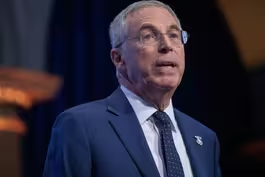
Israeli ambassador to U.S. on war tactics, future of Gaza
Video has Closed Captions
Clip: 12/27/2023 | 10m 27s | Israeli ambassador to U.S. discusses strategy, war tactics and future of Gaza (10m 27s)

Israel shows no sign of slowing down strikes in Gaza
Video has Closed Captions
Clip: 12/27/2023 | 3m 17s | Israel shows no sign of slowing down, launching new strikes in central and southern Gaza (3m 17s)

U.S. asks Mexico to help stop migrants from reaching border
Video has Closed Captions
Clip: 12/27/2023 | 8m 38s | White House wants Mexico to make it harder for migrants to reach U.S. border (8m 38s)

Why congregations are leaving the United Methodist Church
Video has Closed Captions
Clip: 12/27/2023 | 5m 9s | Why thousands of congregations are leaving the United Methodist Church (5m 9s)
Providing Support for PBS.org
Learn Moreabout PBS online sponsorship
- News and Public Affairs

FRONTLINE is investigative journalism that questions, explains and changes our world.

- News and Public Affairs

Amanpour and Company features conversations with leaders and decision makers.












Support for PBS provided by:
Major corporate funding for the PBS News Hour is provided by BDO, BNSF, Consumer Cellular, American Cruise Lines, and Raymond James. Funding for the PBS NewsHour Weekend is provided by...