Vermont This Week
December 27th, 2024
12/27/2024 | 26m 46sVideo has Closed Captions
As 2024 comes to a close, we recount the top 10 stories of the year, as voted on by our panelists
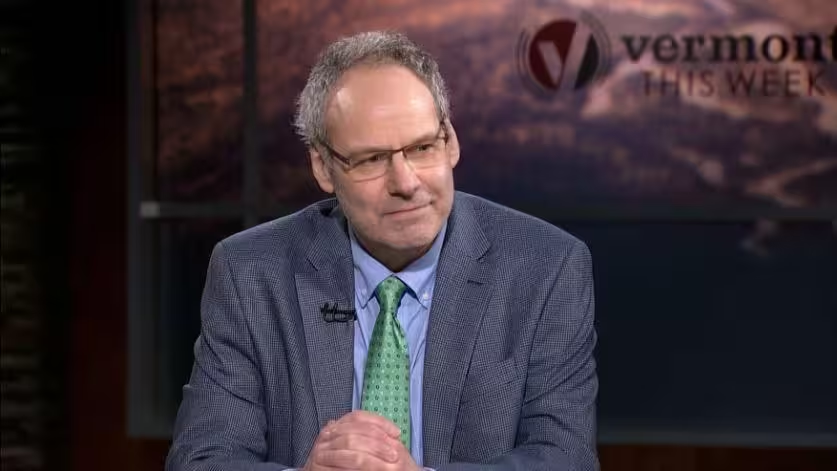
As 2024 comes to a close, we recount the top 10 stories of the year, as voted on by our panelists | Panel: Mitch Wertlieb - Moderator, Mark Johnson - WCAX, Lola Duffort - Vermont Public, Lisa Scagliotti - Waterbury Roundabout.
Problems playing video? | Closed Captioning Feedback
Problems playing video? | Closed Captioning Feedback
Vermont This Week is a local public television program presented by Vermont Public
Sponsored in part by Lintilhac Foundation and Milne Travel.
Support provided by:


Vermont This Week
December 27th, 2024
12/27/2024 | 26m 46sVideo has Closed Captions
As 2024 comes to a close, we recount the top 10 stories of the year, as voted on by our panelists | Panel: Mitch Wertlieb - Moderator, Mark Johnson - WCAX, Lola Duffort - Vermont Public, Lisa Scagliotti - Waterbury Roundabout.
Problems playing video? | Closed Captioning Feedback
How to Watch Vermont This Week
Vermont This Week is available to stream on pbs.org and the free PBS App, available on iPhone, Apple TV, Android TV, Android smartphones, Amazon Fire TV, Amazon Fire Tablet, Roku, Samsung Smart TV, and Vizio.
Support the crew
Help Mitch keep the conversations going as a member of Vermont Public. Join us today and support independent journalism.Providing Support for PBS.org
Learn Moreabout PBS online sponsorshipAs 2024 comes to a close, we recount the top ten stories of the year as voted on by our panelists ahead on a special edition of Vermont this week.
From the Vermont public studio in Winooski.
This is Vermont this Week, made possible in part by the Lintilhac Foundation and MilneTravel.
Here's moderator Mitch Wertlieb.
Good evening, everyone, and happy holidays.
I'm Mitch Wertlieb, and today we've got our annual year ender, where we review the top ten stories from 2024, as voted on by the reporters who join us each week on this show.
And here with us today to discuss this year in news is Mark Johnson from WCAX.
Lola Duffort with Vermont Public and Lisa Scagliotti of the Waterbury Roundabout.
Thank you all so much for being here today.
And we're going to be talking about the year that was in news with Vermont.
Top ten stories voted on by the panelists.
We'll start with number ten.
And this story was about students in Vermont joining pro-Palestine encampments across the nation.
We saw protests happen at the University of Vermont, at Middlebury College, and showing really that, you know, students here in Vermont were as keyed into the news as were their counterparts around the country.
Also of note, there are the ACLU of Massachusetts has written now and sent letters to schools in Massachusetts saying do not scale back on protests in the coming year.
They're thinking about the Trump administration and some possible crackdowns coming on with that.
So we'll be following what could be happening in protests with, college students around the country as we get into the new year as well.
Our ninth top story of the year, Lola, was the governor and the legislature in Vermont at odds over the secretary of Education, Zoe Saunders.
What happened there?
Yeah, this was a really fascinating story with a kind of fascinating arc.
So, after having an interim education secretary for, over a year, I think, Phil Scott finally appointed Zoe Saunders, who came to Vermont from Florida.
And, she was a highly controversial pick, mostly because of her long tenure, in, working for a private charter school company.
And, you know, there are stories that you write about where it feels like people, you know, only people in Montpelier really care.
I was getting emails in my inbox from all kinds of people, you know, my friends that I would like go have a dinner party with would, like, bring this up.
Right.
It really, it really made a splash.
She failed to get Senate confirmation, gubernatorial appointments.
Well, are supposed to be, subject to, the Senate's review.
But immediately after that, the governor reappointed her to the role, in an interim capacity, which basically circumvents the Senate's ability to say, yay or nay.
And she served in that capacity for, what, like six months?
And then very recently, I want to say, a couple weeks ago, he announced that he had appointed her again, in a permanent capacity, which means that it would now go back to the Senate.
Now, in that interim period, of course, the Democrats have taken a huge drubbing.
And another story we'll get to get to, and, you know, I so I called Phil Burrus, who is, currently the leader of the Senate and likely to be, the leader of the Senate next year, even though his caucus will be, greatly diminished.
He's a Democrat.
DPI, actually, and I asked him, you know what?
What's going to happen?
She is going to come up before the body again.
He said, we are I am not planning on holding a vote on this until the end of the session.
You know, she can serve, continue to serve.
He was like, we we have too much to do.
We need to be talking about property taxes.
We need, education finance reform to be the most important thing that we do.
And we, you know, this would be a distraction, right?
And so this story, which kind of started, you know, with, such intensity is kind of ending in a little bit of a, in a little bit of a whimper, a bit of a fizzle.
Right.
And, a lawsuit that a couple of lawmakers tried to bring against this failed as well.
It just did not happen.
And the Supreme Court of the state Supreme Court was going to weigh in on that, too, right?
About saying yes.
And I believe the state Supreme Court has not yet weighed in.
So they sued.
Their case was dismissed.
Right.
But they are appealing to the Supreme Court and that, I believe, has not happened.
We'll see what happens with that.
Our eighth top story of the year comes from Vermont's largest city, Burlington progressive Emma mulvaney Stanek was elected mayor of Burlington.
Pretty big deal here.
Mark Johnson.
Absolutely.
Of any cynic.
First of all, the first woman to be elected mayor of Burlington.
And I think many people saw it as an upset.
She ran against Democrat John Shannon.
This was all in the background of law and order.
The city of Burlington is been experiencing a real increase in crime.
And Joan Shannon, her primary, her main opponent, who won the primary really on a on a pretty simple message of I'm going to restore law and order.
Seem to have the message that everybody wanted to hear, but Mulvaney Stanek won, and pretty convincingly.
And it's so fascinating to me.
I feel like so many of the things that we will talk about today on this show will be about a sort of rightward shift, a kind of inflection point.
And here was one election where that did not happen.
The opposite happened.
And I don't know if that's because Burlington is its own microcosm or because maybe there was, you know, this rightward shift is also an anti-incumbency shift.
Right?
And Joan Shannon, even though she was not the current mayor, had some of some of that stink on her.
And I think that's definitely the case.
I think she was seen as the pick of Moira Weinberger, the continuation of that.
I also think that, you know, Joan's been around a while and has some people that are just not not fans of hers.
And I think what you also said is also the case that, you know, Burlington, everybody says, you know, there's Burlington and then the rest of Vermont, the, the city was pretty evenly split on this city council with the Democrats and the progressives.
I mean, there's no Republicans in Burlington left.
So but it really was, you know, I think a lot of people were surprised that Emma was able to pull this off.
We heard discussion about crime and law and order was much more nuanced than Joe, Joan Shannon.
And I think, you know, Joan was really appealing to more of the kind of the crack down crowd I would call them as we sort of, take a look at a story that is affecting everyone a little wider than just Burlington.
Our seventh top story of the year was this landmark report that came out, advocating for dramatic changes to Vermont's health care system.
This was, a consultant's report, and boy, did it land hard.
I mean, Mark, you've been following this, scaling back services, recommendations to cut back here.
They're small hospitals affected everywhere.
How does this report affect people around the state?
Well, it's you know, our health is probably the number one issue.
Maybe second is education of our children.
And really a lot of parallels between those two issues, as were looking at Vermont with a rural population.
Where can we support this number of hospitals?
Can we support this number of schools?
I actually think that the bigger story in health care was the dramatic increases in health care insurance.
And that really, in some part drove this, as well as a number of the other stories that we'll get to, you know, where this report goes is also another big story, this, you know, this contention between the Greenmount Care Board, the regulated regulatory Board, and the leaders of these hospitals.
And, you know, that might be to preview 2025, be one of the real top stories is, you know, how does that play out?
And what happens with this report?
Does it just go nowhere?
And do we continue to have this situation that we're in today?
Lisa.
Go ahead.
Yeah, yeah I was gonna say, Mark, you make a good comparison between the health care situation and the schools.
You know, we are maybe looking at in the future not too far down the road, consolidation of schools and communities having to wrestle with do we keep our schools?
How many schools do we have?
What does that look like?
But we're also seeing as a result of this report, with the announcement that the UVM, Health Care Network made, as far as its shrinking of its services over in the Matt River Valley, which is in our backyard, there were demonstrations and protests at the health care clinic.
There's a family practice clinic there.
There's a physical therapy clinic there that they're looking to close, and that's a community that's going to lose to really busy health care facilities.
And people there are really upset.
There's they feel very connected to it.
And it's it's part of their it's part of the social fabric as part of their, their routines.
And they're wondering, where will we go to the doctor.
Where will we go to the physical therapist.
Now we're having to go to Berlin.
Are we having to go to Waterbury?
There's not.
Is there capacity in these places?
Do we have to go to Burlington?
So this is really going to be a big impact on people's regular routines and their, you know, who where their providers are, who their providers are.
And a big impact to on attracting more people to come to Vermont and not have everybody just live in Chittenden County or around the major urban centers.
If you're a young family and you're moving, why are you going to move into a community where they've just shut down the school?
Right.
And we have an elderly population who's not going to want to be very far away from a hospital, either.
Right.
And these places to these places, too.
You know, there are so many connections that people have, to generations.
You know, they say, you know, my, my, my daughter, my granddaughter was born here, you know, small hospitals like Gifford, etc.
people have connections to those.
Is it a fair comparison, Lily, because you've done so much reporting on school, closings, consolidation districts and that sort of thing.
What Lisa was saying about the consolidation factor hospitals, schools.
Is there a kind of connection there?
Yeah.
I mean, it's absolutely the same, dynamic and a little bit of the same kind of financial death spiral.
Right.
Yeah.
And I think the, you know, I mean, the the big question is whether or not decision makers will have kind of reform paralysis in the upcoming year.
I think it's likely.
And I also think that a lot of these problems are a little bit too big for Vermont to solve by themselves, especially in the health care space.
Although, of course, health care space, the health care space has a trickle down effect on education, right, because schools have to pay for health insurance.
And yeah, I mean, I think that will be the big question, right?
It's it's it's the emotional tie that people have, to, to these institutions as well as the, kind of like material needs that they have.
And I think the, the really tough thing is going to be like figuring out what is what is a want and what is it.
What is just an emotional tie, right?
Yeah.
And talk about it.
Another big story that, you know, affects so many people and that ties into so many other things.
And that's housing.
And our sixth top story of the year was towns urging the state to provide options for unhoused residents leaving motels.
This is an incredibly sad story, and there has been no fix to this.
To this point.
Lola, you know, what were the towns asking the Scott administration to do?
For folks who phased out of the motel voucher program?
Right?
I mean, the towns have been asked what they've been asking for for the past, what, 3 or 4 years now, which is a plan, right?
A plan that doesn't involve, warehousing large amounts of, unhoused folks in a, you know, selection of hotels and then kind of cyclically sort of evicting them en masse, which creates a lot of, dysfunction on the ground and, you know, trauma to the, the actual folks involved.
And, you know, a big a big plan is not is not yet forthcoming, in part because anything is going to cost a lot of money.
Right.
And any permanent fix is going to involve building a heck of a lot more housing.
And even if we had the money to do that, that takes a long time.
So I'm sure we'll be back here saying the same thing next year.
I think that's probably true, and I think that's probably true about a lot of these stories.
And I think the message really from the towns to the state was, don't dump this problem on us, which really seems to be what's happened.
Well, let's move on to a story that may be a little brighter.
A lot of people were excited about, Vermont's total historic, the historic total solar eclipse that was best seen in parts of Vermont here.
I kind of thought, personally, it was amazing.
I guess I was, not expecting a lot at first.
One of the most incredible things I ever saw.
But, Lisa, you know, what did you think of the total solar eclipse when it happened?
You know, in Waterbury, they started talking about this.
This happened April 8th, right of this year.
And we were talking about it back in June of 2023.
Yeah.
Where we kind of got our first little, you know, shot across the bow from our economic development organization in town, revitalizing Waterbury.
They'd been at a conference, after they heard about this, having had an experience with people who had a total eclipse in Tennessee, a few years back, and they were starting to lay the groundwork for what to expect, that there's going to be thousands of people.
And how where will they go and where will they be and how will we accommodate them?
It's going to be sort of like, imagine fall foliage in a weekend.
And so you know, the town started to prepare and we started.
Then the state ramped up with a website, and there was a lot of hype ahead of time.
I have to say, but I feel like, you know, where where I was in our little community and in central Vermont, it seemed like people were ready.
We had a huge influx of tourists and and just not just tourists, but people had family members come.
It was it was people who were gathered in public spaces to go and see this outside.
But there are also people at every one of it.
We could see it everywhere.
Right.
So you didn't have to go very far.
You just had to go out in your own yard, essentially.
So there were many, many people especially, you know, they came over a few days, the state, in their final report, estimated that it was something around 175,000 visitors came to Vermont for that event.
And the impact was, somewhere around $54 million, which they try to, you know, we're excited about that.
And they were happy for that boost.
But they try to put that in the perspective of fall foliage.
Season usually sees somewhere around 2.5 million people come, but that's over what, several weeks.
And that's usually about a $500 million impact.
So all relative.
But, I'm very happy that I was able to see it here in Vermont and didn't have to travel because the lines on the highway, 89 South was like a parking lot for a whole day, right?
Yeah.
Everybody wanted to they came over several days, but they all wanted to leave, as soon as it was over.
So that was probably the gnarliest part of it.
It did feel like Vermonters were all tied together with this weather, you know, just the watch parties, the people coming together and, you know, a few minutes.
But I did think it was something quite spectacular.
I'm certainly glad I got to see it.
It was more like a fish show and then fall foliage spread out.
You know, you've been here, you back I haven't you haven't been to a ton of fish shows.
I'm guessing.
I've been there one.
Okay.
Fair enough.
Okay.
Was that in Vermont?
Yeah.
Okay.
And I mean, just the influx of people in a short amount of time and then everybody leaves and the parking lot factor.
But, you know, after the pandemic, where we were, you know, a couple years.
Right?
We were trying to stay apart.
We're trying to avoid gatherings.
We're trying to avoid being together.
And I feel like that sort of turn the page on the pandemic and the gatherings and people, people were very happy, I think, to be together for that and to see that we are going to move ahead here and I'm going to jump order here.
I'm taking the ownership of this.
We're going to take our second top story.
But talk about it now.
And this was number two Vermont flooding on the anniversary of 2023.
All the damage that was done, the flash flooding that tore through the Northeast Kingdom.
This is coming on the heels, you know, of 2023 stuff.
This was a this was a big deal and we're still seeing the effects of it now.
You know, certainly, Lisa, you were writing about this.
It wasn't just northeast.
There are other areas too.
We think about Barry.
We think about what happened in Montpelier last year.
Oh, yeah.
I mean, you couldn't have.
You couldn't have scripted this if you tried to do the screenplay and said, oh, let's, let's have a flood in this little northeastern state on July 11th and let's give them another flood the next year.
On July 11th.
People would say, that's a really silly idea, but that's exactly what happened.
And so it was the whole arc of it was was kind of traumatizing, I think, for many people who went through this in a big way in 2023, to then see the River forecast, the weather forecast this past July and the same sort of pattern played out.
However, the storm that we that we had this year was, not so much the river flooding intense storm as 2023, but the flash flooding, in all the mountainous areas was huge and very widespread.
So, you know, we didn't see Montpelier underwater this year like we saw last year.
But, there were so many roads washed out, so many little communities.
Something like the town of Bolton, right next door to Waterbury, the town of Duxbury.
We had state roads and bridges that were washed out that you had to go around.
And that was just sort of a much more extensive area affecting many more municipalities.
And they're still dealing with the aftermath of that now in terms of getting things put back together, getting their applications in to FEMA for the reimbursements that can come to the municipalities.
And in the meantime, we're watching Congress to make sure that, you know, is that money going to be coming to us?
Right.
And that's it's sort of out of our hands.
And we're, you know, looking to our delegation and the federal officials to make sure that that continues so that the recovery can can happen.
You know, I would highlight that impact you talked about on people who were having difficulty getting the FEMA aid, even from the first flood when they had experienced the second flood.
And unfortunately, I think of having just seen this whole debate play out in Washington, talking about trying to keep the government open.
And one of the things on the table was this kind of relief.
So, you know, this is a this is another one that could be around next year.
We have a long term recovery group right now that's working on this.
And one of the standard operating procedures that they're going through is helping people with appeals to their FEMA applications.
Yeah.
So it's a pretty standard thing that you apply for your FEMA aid and you get rejected.
And so it's like a part of the process that you have to apply multiple times in order to actually see this through.
And it takes a lot of, you know, it's a lot of fortitude that people have to have, especially if they're trying to put things back in their own homes and their lives.
The frustrations with FEMA is another story unto itself.
Reason we jumped ahead on that one is because these next three stories that that round out the list are all kind of connected.
Lola, lawmakers passed a nearly 14% property tax bill.
And that sort of set things in motion for what you were talking about before with that, that right wing shift.
What was the reaction to that 14% property tax bill here in Vermont?
It was not good.
Good.
Well, it was very good for Republicans, and it was very bad for Democrats.
But generally it was bad for incumbents.
Right.
Except for Phil Scott.
It was, you know, so we should back up and say that that 14% tax bill was originally projected to, you know, hit 20%.
And the only reason it got to 14% is because, you know, districts made some cuts.
But also, lawmakers brought down the tax rate pretty aggressively, which we'll have to kind of deal with in this upcoming, budget season.
But, the 14% hike, though, they brought it down, but still but but still sticker shock.
It it was still shocking.
And also this is an average.
Right.
So you have some people that are dealing with like 30%, 50%.
And then you have some people who are dealing with like a 2%.
And so, you know, we saw a taxpayers revolt, it seems like at the ballot box.
And, you know, it really feels like we saw this kind of pendulum, you know, swing in this other direction two years ago, you know, we were talking about how Democrats had claimed more seats in, the Vermont House of Representatives than they ever had before.
You know, we hadn't seen any one party have as many seats as, as like, sorry.
No one party has held that many seats since the 1960s, when Vermont was red.
Red rock.
Yeah, yeah.
And this year we saw them make these, you know, we saw tremendous losses at the ballot box where they've lost their super majorities in both the House and the Senate.
And Republicans, now have real momentum.
I mean, they're a, you know, there's a what, 1713 split in the Senate, which is not quite half, but, that's a really sizable opposition party.
And that is our top third story of the year.
Republican victories, cracking the Democrats veto proof majority in the Vermont state House.
Mark, you know, when we did this show, right after this all happened, I asked the reporters then, were you shocked?
They also they were were you shocked at just how many gains the Republicans made?
I'd love to say that I wasn't shocked, but I was surprised.
I think the depth of it, it is, I think a classic case.
That's what I think Lola was alluding to, that whoever's in gets blamed for the problem.
I would say also that in addition to the losers politically, you know, we all lost as residents of this state seeing these kinds of property tax increases.
And unfortunately, you know, the projections for next year are less.
And yes, it was less than the 19% projected, but this could be an ongoing story.
And, you know, getting back to one of the points you made earlier about paralysis, you know, there's been this group now commissioned by the legislature to come up with some suggestions and ideas about how to fix this.
And, you know, some people will say, this is a group, that the problems have been kind of dumped on because politicians don't really want to deal with it, but they've struggled to, you know, there really isn't any sort of magic answer here how to reduce this, other than going back to another, the stories we talked about, you know, school consolidation there, all of these things that are going to have to be put on the table, any one of which is a third rail politically here in Vermont, no question.
And that leads us to our top story of the year as voted on by panelists.
And again, I wonder if this was a shocker, Lisa, to you, nearly one third of all the school budgets failed on Town meeting day.
It wasn't a shocker.
I think, given the run up to town meeting day last year, January, February, it was all over the place as far as the projections that we were hearing from the state, with the numbers that they are handing out to the school districts to plug into this massive, confusing equation that they have to use every year to come up with their school budgets.
You know, halfway halfway through, they realize as, as Lola mentioned, you know, schools had they cut back on some of their budgets, but it was because they were using this new formula that allowed them to expand their budgets.
And then they realized after the budgets were set for the town meeting day warnings that they it was going to be untenable.
So some districts decided we're not going to vote on on town meeting day.
And they held them off.
Our district voted and it it went down once, then it went down again in April and finally passed in May.
And we still ended up with with property taxes between 10 and 19%, increases going up.
And I feel like that commission that now only had six months that came out last week with their their preliminary report that had no solid recommendations because they really didn't have time to pull them together.
I clicked on their list of ideas.
There's 110 ideas that are called brainstorming right now.
That's a lot.
Yeah, it it takes time to go through all of that.
And unfortunately, that's all the time that we have for today.
But a big thank you to our panel, Mark Johnson at WCAX, Lola Doffurt for with Vermont Public and Lisa Scagliotti from the Waterbury Roundabout.
And thanks to you, our loyal audience, for tuning in to our show each week.
To kick things off, in January, we'll have another special episode where we will discuss youth mental health with a panel of well-known experts.
So be sure to tune in live on television, on the radio, on demand, as a podcast, or however you get.
Vermont this week I'm Mitch Wertlieb, Happy Holidays and have a Happy New Year.

- News and Public Affairs

Top journalists deliver compelling original analysis of the hour's headlines.

- News and Public Affairs

FRONTLINE is investigative journalism that questions, explains and changes our world.












Support for PBS provided by:
Vermont This Week is a local public television program presented by Vermont Public
Sponsored in part by Lintilhac Foundation and Milne Travel.