
December 29, 2023
12/20/2023 | 55m 21sVideo has Closed Captions
Patty Murray; Jane Harman; Matthew Bryza; Gordon Fairclough; Ali Zaidi
Sen. Patty Murray and fmr. Rep. Jane Harman reflect on the life and legacy of Dianne Feinstein. Matthew Bryza, fmr. US ambassador to Azerbaijan, discusses the takeover of the Armenian enclave of Nagorno-Karabakh by Azerbaijan. Gordon Fairclough of The WSJ on the struggle to free his fellow reporter Evan Gershkovich. National climate advisor Ali Zaidi on the US's plans to combat climate change.
Problems playing video? | Closed Captioning Feedback
Problems playing video? | Closed Captioning Feedback
December 29, 2023
12/20/2023 | 55m 21sVideo has Closed Captions
Sen. Patty Murray and fmr. Rep. Jane Harman reflect on the life and legacy of Dianne Feinstein. Matthew Bryza, fmr. US ambassador to Azerbaijan, discusses the takeover of the Armenian enclave of Nagorno-Karabakh by Azerbaijan. Gordon Fairclough of The WSJ on the struggle to free his fellow reporter Evan Gershkovich. National climate advisor Ali Zaidi on the US's plans to combat climate change.
Problems playing video? | Closed Captioning Feedback
How to Watch Amanpour and Company
Amanpour and Company is available to stream on pbs.org and the free PBS App, available on iPhone, Apple TV, Android TV, Android smartphones, Amazon Fire TV, Amazon Fire Tablet, Roku, Samsung Smart TV, and Vizio.
Watch Amanpour and Company on PBS
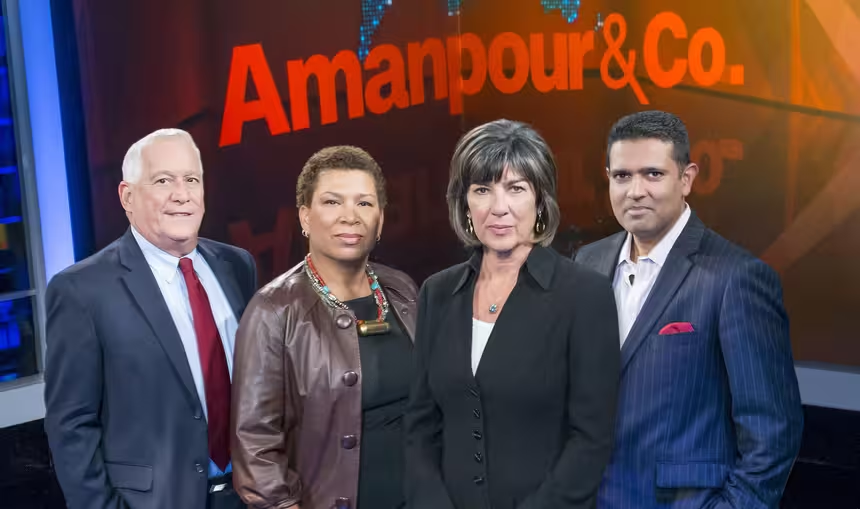
PBS and WNET, in collaboration with CNN, launched Amanpour and Company in September 2018. The series features wide-ranging, in-depth conversations with global thought leaders and cultural influencers on issues impacting the world each day, from politics, business, technology and arts, to science and sports.Providing Support for PBS.org
Learn Moreabout PBS online sponsorship[commanding music] - Hello everyone, and welcome to Amanpour and Company.
Here's what's coming up.
After rolling back Carbon Neutral Targets, Britain now doubles down, drilling for more gas and oil.
Senior Green Party leader, Zack Polanski joins me.
Then, President Biden's historic picket where his climate targets are an issue for striking auto workers.
But what are the facts?
I ask Michigan Economics Professor Betsey Stevenson.
Plus, as migrant crossing surge at the southern U.S. border, Chilean author Isabel Allende gives a face to the faceless in her new novel, "The Wind Knows My Name."
Also ahead.
- They're looking around and they're starting to wonder whether the church is just using Jesus as a means to an end.
- [Christiane] "American Evangelical Christians are adrift," says Russell Moore, former leader of the Southern Baptist Convention.
He speaks to Michel Martin about his new book, "Losing Our Religion."
[commanding music continues] - [Announcer] Amanpour and Company is made possible by Candace King Weir; the Family Foundation of Layla and Mickey Straus; Jim Atwood and Leslie Williams; Mark J. Blechner; Seton J. Melvin; Charles Rosenblum; Koo and Patricia Yuen, committed to bridging cultural differences in our communities; Barbara Hope Zuckerberg.
Additional support provided by these funders and by contributions to your PBS station from viewers like you.
Thank you.
- Welcome to the program, everyone.
I'm Christiane Amanpour in London.
Is the Global Green Agenda in trouble as leaders around the world roll back climate policies and pledges, they say, to boost their economies?
Here in Britain, the government has just approved a huge new oil and gas field in the North Sea, just a week after Prime Minister Rishi Sunak slow rolled carbon neutral targets.
But to be clear, the International Energy Agency says that limiting global warming to that 1.5 degrees celsius would require no new drilling, and the green potential is huge.
A new Oxford University report finds that Britain's energy needs could be met entirely by wind and solar power by 2050.
We're going to explore this in depth tonight.
And my first guest is the deputy leader of Britain's Green Party, Zack Polanski.
Welcome to the program.
- Thanks for having me.
- I was shocked actually to hear this as breaking news this morning, this new announcement.
It's controversial.
Why do you think it's happening?
And explain to us why you oppose it.
- I think it's absolutely controversial.
We know right now that we're in a climate emergency and we have to listen to the scientists.
But science is really clear that we need to act now.
And the very least we could do is to reduce our emissions, nevermind, make things worse.
As to why this is happening.
I really think the government is in free fall, they're panicking.
They can see they're falling in the polls and they just don't seem to be able to get any ground.
I really think Rishi Sunak is thinking, "If I'm just controversial or I appeal to a very minor base, "that's something to grow from."
I think that's-- - Who is this minor base?
- Well, I'd say it's climate deniers or climate delayers.
It's people that talk about woke wars and culture wars.
But actually this is too serious to play politics with.
And I also think that's a strategy that won't work.
We see time and time again that people are worried about the climate emergency.
They're worried about their children and their grandchildren's future.
I think it's really important that people like me and other people in the green movement tell these stories that essentially say we're in a cost of living crisis, but it's not really a cost of living crisis; it's an inequality crisis.
The super rich are doing better than they ever have before.
Meanwhile, people are living in mass poverty.
This is an opportunity to make sure that we have good green jobs for people as we renew those industries and transition.
And also, if you take insulating homes, for instance; if we insulated every single home in Britain that needs it, that both reduces bills, it lowers emissions, and again, it creates those jobs I was just talking about.
- And this is often promised by various governments, but never comes through.
But let's stick with this North Sea oil and gas field.
So first and foremost, the government says that it'll bring energy security to the UK.
After what we've seen with Russia, and potentially other fossil fuel producing nations, holding us hostage for whatever political upheaval might be going on.
So, what about energy security?
What about that argument?
- This is egregious nonsense because most of the oil that will come from this oil field will be sold on the international market.
We're effectively giving it to Norway who is giving a big subsidy to this massive oil fossil giant, and then selling it back to the UK.
But actually, if we really want energy security and we want to protect our planet, investing in renewables is the exact way to do this.
Now in 2015, under David Cameron's government, he famously said, "Let's cut the green crap."
We've now got lots of evidence that shows if we'd invested right then we'd be saving everyone masses on their energy bills right now.
So, these are real missed opportunities.
The best time to invest in renewables would've been about 10, 20 years ago.
The second best time is right now.
- I mean, what do you make of that?
That's a pretty extraordinary Oxford University report to come out practically as this Rosebank Field is announced.
And it says by 2050 solar and wind could power all of UK's needs.
- I think it's really telling, and it points, again, to what this government have missed, which is that long-term strategy.
We're so short-termist all the time.
But actually if they took that step back, looked at this report and lots of other evidence, you could see how investing in renewables is exactly the way forward.
And just last week we lost out on offshore wind because we failed to bid high enough at an auction.
Again, we can't keep making mistakes like this.
And this is vital why we need more Green MPs in parliament because every Green MP is someone making this case.
And we know the difference a Green makes in the room, that it's a powerful voice that will say to probably a future Labor prime minister, the climate is important.
And I think it's important to note that Labor today have said they won't revoke these licenses.
They are complicit in what is essentially a climate crime.
- They won't do any new ones, but they say they won't revoke existing permissions.
- And I feel like that's just spin, when we've just had the biggest oil and gas license committed.
To say we won't do any new ones feels very convenient.
And it's worth pointing out that the emissions from this one alone are equal to 28 of the lowest income countries.
That's about millions and millions of people.
Again, it's just outrageous that Labor won't stand up.
- So the thing is, though, you said it's important to have more Green politicians.
If I'm not mistaken, I think you only have one MP, right?
Your former leader, Caroline Lucas.
- That's correct.
- Right.
So, she basically has called it the greatest, this new field, "The greatest act of environmental vandalism "in my lifetime."
But I just wanna ask you about the facts here.
She was told by the energy firm, Ithaca Energy, that the oil would not be mostly exported.
And then the briefing from the main investor, as you said, says the oil will be sold on the open market and the most likely destination is Europe.
Who's telling the truth?
- Well, I think let's explore both options very quickly.
This is about Scope 3 emissions, which are essentially when you burn this oil.
Now, if those emissions are being outsourced to another country, that would make it net zero, which is what the government are arguing.
They're saying it doesn't cause any problems because it's essentially being sold on the international market.
But then that story doesn't add up.
If they're being burnt right here, as we know, in the UK, then they are contributing to our emissions.
Either way we're still burning oil and that's awful.
But the government's story is just incoherent and doesn't add up either way.
- And what does it mean for prices for the British consumer?
- Well, we've seen prices go further and further up.
And I think Liz Truss's government was not an accident.
That was not some kind of aberration.
That's the natural extension of what happens if you allow the free market, if you allow the planet to burn, and you just keep allowing capitalism to be the only way forward here.
I think ultimately what we need to do is grab that agenda.
So again, we're saying we're investing in green jobs for the future.
We're protecting the most vulnerable.
And actually we should be taxing the wealthiest the most as well.
91 P in every pound from this oil is going back to the fossil fuels.
That's subsidizing fossil fuel companies as opposed to subsidizing the people of Britain.
- But I mean that is huge.
That's a huge subsidy to the fossil fuel companies.
- I mean, it's really grim.
And you talk about Green politicians, that's why people like Carla Denyer in Bristol West and Adrian Ramsay in Waveney Valley, we need to get those people elected 'cause they'll be making these arguments in parliament.
- Those are names, maybe, our international audience won't know, but I get your point, they're Green politicians.
Zack Polanski, thank you very much for being with us.
- Thanks so much for having me on.
- Now, in the United States, green policies and incentives are the backbone of President Biden's Inflation Reduction Act.
The state of the U.S. economy, a big focus for tonight's Republican presidential debate, just as Biden and Trump are both trying to court blue collar workers in Michigan.
Here to unpack all of this is Betsey Stevenson, Professor of Economics at the University of Michigan, and a former advisor to President Obama.
And she's joining me from Ann Arbor.
Betsey Stevenson, welcome.
You just heard one of the leaders of the Green Party here talk about the vandalism, the environmental vandalism, and also talk about the costs.
Do you think, or the costs that the government claim, do you think that in general, whether it's Britain or the United States, the green agenda is at risk right now in a serious way?
- You know, I, I...
I guess, I don't think so.
I think we're seeing a movement forward.
If you wanna focus on a small part of it, which is the electrification of vehicles, shifting from gas vehicles to electric vehicles, it's clear that just enormous progress has been made on that front.
And you have to do it in a couple of different ways.
One is that we have to get the car companies to realize that's where their future is.
I think if you listen to the heads of the big three automakers, they understand that in order for them to continue to compete, not just within the United States but globally, they're going to have to shift to electric vehicles.
But we also then need the infrastructure within the United States for people to be able to count on and rely on electric vehicles.
And that's something that the Inflation Reduction Act really put a lot into.
And then I think the U.S. needs to know that it can have a sustainable auto industry, even with a shift to electric vehicles.
And that's what the CHIPS Act was all about, helping to make sure that we can keep manufacturing in the United States with sourcing of some of the components that we need right here in the U.S. And so, the Biden administration's been trying to facilitate this transition while protecting U.S. industry.
- So, as I said in the introduction, both President Biden and former President Trump are trying to make their case on this issue in Michigan.
Former President Trump has called it, "Biden's all-electric car hoax," and that it will annihilate the U.S. auto industry.
How...
I mean, that seems to be resonating in certain quarters, and obviously some of the auto workers on strike are concerned about the fallout from all of this.
So how does this story get told to the people who matter?
- So, it's really easy to tell a story of we're not going to allow progress to go forward.
Electric cars are terrible.
We're gonna just keep doing things the old way.
The problem is actually holding back change.
And, I think that's gonna be really difficult.
I think the biggest threat to the U.S. would be if the U.S. doesn't manufacture electric vehicles and other countries do, and our auto industry dies.
One of the reasons the U.S. had such a strong auto culture and auto industry was because we were first movers early on when it came to ICE, the internal combustible engine.
We wanna be able to do the same thing on electric vehicles.
I understand why there's a lot of skepticism.
If you look at the kinds of subsidies that were put in place by the Obama administration for electric vehicles, Tesla was a company that was a big capturer of those subsidies.
Tesla's a non-unionized company.
They're actually a company known for a lot of violations of workplace safety rules.
They're not where American auto workers wanna envision themselves working.
And so what they wanna make sure is that the policies that are getting put in place are going to allow electrification in a way that protects union jobs.
That's the case Joe Biden has to make.
Donald Trump's gonna be out there saying, "I'm gonna promise you no change."
People shouldn't believe no change 'cause that's not possible.
The question will be, can Biden convince them that it's gonna be different from what we've done in the past?
- Okay, so let me read you a stat that might help that, if it was made.
According to the Bank of America, Biden's climate law has led to 86,000 new jobs and $132 billion in investment.
And he's always saying, "When I think of climate change, "I think of jobs, good jobs, union jobs, well-paying jobs."
But that stat is pretty good, isn't it?
- The stat is great.
And the reality is that in the near term, it has led to the creation of jobs.
What the union's fighting for right now is a promise that we won't see industry, not just move outside of the United States, but move to non-union states, states that have created laws making it harder to unionize, and non-union firms.
And so they wanna make sure, they want a promise that when we start to shift to electric vehicles, when the big three automakers are shifting to electric vehicles, there's gonna be union jobs making those cars.
And that's the way for that industry to continue to grow, to be able to hire more people.
But they've gotta promise their employees that they're not gonna open plants in non-unionized areas, that they're not going to be using that tiered system to hire people who aren't union workers to be able to fill those new positions.
And so I think there's a real reason the union's having the fight they're having right now.
They need to level set and say, "We're gonna work with you on this move to electrification, "but this is what we need."
And I think Biden going out and showing up on the picket lines, and saying, "I'm here for that," is what he needs to be doing to be making the case that he really can achieve a just transition.
- [Christiane] Let's play a little bit of what he said yesterday when he was on the picket line.
Obviously historic, no sitting president has done that.
And the UAW has had this historic strike.
So, let's just play what he said.
- The fact of the matter is that you guys, the UAW, you saved the automobile industry back in 2008 and before.
You made a lot of sacrifices, you gave up a lot, and the companies were in trouble.
But now they're doing incredibly well.
And guess what?
You should be doing incredibly well, too.
Wall Street didn't build the country, the middle class built the country.
[people cheering] [people applauding] And unions built the middle class.
- [Crowd] Yeah.
- That's a fact.
- That's a fact.
- So, let's keep going.
You deserve what you've earned and you've earned a hell of a lot more than you're getting paid now.
- So lots of cheers, obviously competing for that vote.
And he's got a track record there, of course.
Now, critics including, you mentioned Tesla, Elon Musk is saying that striking workers' demands will, quote, "drive GM, Ford, and Chrysler bankrupt."
Is that true?
- I don't know where they're gonna come out in terms of their final agreement, but what we're seeing is an industry that's been highly profitable, and it can afford to pay its high ranking executives outsized salaries.
And all the workers are saying is, "You haven't even taken us back to where we were in 2019.
"And we want more than 2019 "because the companies have really improved."
Remember, these are workers who made a lot of concessions to save the industry in the 2008 crisis.
Now they're saying, "You guys are doing really well.
"You have a plan for being able to expand "and move into the next century with electric cars.
"We want some of that."
And, I don't think that it will bankrupt them.
But it's kind of interesting that Elon Musk is the one saying that because what he's saying is, "I would never give my workers anything like this.
"I operate by having people work long hours at low pay, "and they've gotta compete against me."
That's certainly what the big three is afraid of.
- Yeah, and let's just talk about Trump, who's also in Michigan.
And he's also, obviously, trying to court as many voters as possible, including blue collar workers.
But I just wanna point out what he said on Fox News in 2008 about unions.
He basically said, "Unions get their little 5%.
"They get another 2%, they get another 3%, 4%.
"All of a sudden they're making more money "than the people that own the company."
That was him two weeks after the UAW made massive concessions to the big three in December, 2008.
So it's a little hypocrisy there, isn't it?
Who is he standing for?
- Well, I think what I would point there is you can hear it in the tone, which is the idea that the people who build the things should get more than the people who invest in it, the stockholders.
That seems outrageous to him.
To a lot of people, that's not outrageous.
Labor should be getting a big share of whatever's produced.
It's not just the investors.
Look, I invest in companies with my retirement funds too.
I like to get a nice return.
But do I really deserve more than what the workers get?
I don't think so.
- So I wanna play something that Paul Krugman, Nobel economist, told me about Biden's, the economics and the facts and Bidenomics, saying that there's this disconnect between what the polls say about it and what actually is happening.
Let's just play this.
- Even optimists are just stunned by how quickly and how painlessly inflation has come down.
No hint of a recession, at least so far, never know, but no so far.
Inflation, not too far from the target of 2%, and under 3% by most measures, and all of that just achieved painlessly.
So this is great.
This is a Goldilocks economy.
People say it's a terrible economy.
But what's really odd is that people don't behave as if it's a terrible economy.
We can talk about surveys in which people seem to be relatively happy with their own financial situation.
Or we can just look at behavior.
People are out there with a lot...
Discretionary consumer spending, travel, hotels, restaurants, all of that is booming, so people are acting as if they're in good shape financially.
And yet they say, "Wow, this is a disastrous economy.
"Somebody, must be disastrous for somebody, but not for me."
- What do you make of that?
- I do think it's one of the real challenges right now, particularly for President Biden, is that it's clear that people are actually doing okay.
When we look at where wages are at, overall growth in jobs, the unemployment rate, and then we look at their consumer spending, which is very strong and it's continuing to fuel economic growth, it looks great, but people don't feel good.
I think one answer to that is people don't feel good when there is higher than normal inflation, even if it's just a little bit higher than normal.
Right now we're at inflation that is higher than normal, but not by a lot.
The other thing, though, is it's been an economy where everybody's been really shook up, and there's been more winners and losers randomly impacted by luck.
If you're a union worker, your wages haven't kept up with inflation.
If you're an older worker, your wages haven't kept up with inflation.
Young workers don't have enough experience to understand that inflation has really helped drive higher wages for younger workers and people changing jobs.
So that's a benefit of inflation.
Unfortunately, the people who are getting helped by it don't tend to appreciate it.
The people who are getting hurt by it absolutely notice.
- All right.
Betsey Stevenson, thank you so much indeed for joining.
Now, when it comes to climate, more and more are taking their concerns to court, as we've been documenting on this program.
And now we bring you six Portuguese young people who are suing dozens of countries in the first climate case to be filed in the European Court of Human Rights.
Salma Abdelaziz has their story, [wind whooshing] - [Salma] Destructive hurricanes, widespread fires, massive floods, scientists say catastrophes like these are becoming more common because of climate change.
Now, six young Portuguese, including Andre and Sophia Oliveira are taking 32 countries to court.
They want the EU, Norway, Switzerland, Turkey, and the UK to act faster.
[speaking in Portuguese] - [Translator] We need you to do a better job.
I noticed that climate change has a big impact on my life.
[dramatic music] - [Salma] Their case is being heard this week; but the buildup started six years ago after the 2017 fires in central Portugal, the country's deadliest.
[sirens wailing] More than 250 people were injured and 66 killed.
Many of those, unable to escape when the flames reached this stretch of road, died trapped inside their cars.
The tragedy spurred the applicants into action, especially some who, like Catarina, lived close to the area most affected by the fire [speaking in Portuguese] - [Translator] None of our family houses burned down or anything like that.
But we obviously felt it.
And we increasingly feel the impacts of climate change in our summers.
- [Salma] Catarina, and others, say climate change is already having a negative impact on their lives, and are asking the European Court of Human Rights to protect them: a true David versus Goliath case.
But their lawyer believes they have a shot.
- We believe this is an opportunity that the court should take, and we're optimistic that it will recognize the opportunity and demand that states do more to avert a climate disaster.
- [Salma] A win would legally bind countries to take more action on climate change.
But even if they lose, Catarina is happy they've been able to raise awareness.
[speaking in Portuguese] - [Translator] This entire process has been very positive and we've been able to achieve a lot.
If the court's outcome is positive, that would be the cherry on top.
- [Salma] A cherry in the form of government action to secure a future that doesn't look like this.
- Salma Abdelaziz reporting there.
Climate disasters like the ones we've just seen are intensifying migration crises around the world, including on the U.S. southern border where crossings surged over 8,600 in a 24 hour period last week.
There are many reasons to leave home, of course.
And my next guest, Isabel Allende, has personal experience of fleeing Chile after the 1973 coup.
She captures the love and tragedy within these journeys in her new novel, "The Wind Knows My Name."
The bestselling author is joining me now from California.
Welcome to the program, Isabel Allende.
- Hello.
Thank you for having me.
- So, let me ask you about what you've set out to do with this new novel, especially in light of how we've introduced you, talking about the migrations, the crises, people having to live.
What are you trying to say in this novel?
- Well, I have a foundation that works at the border.
So we get to know many cases, particular cases.
When we talk about numbers, that's an abstract number that we cannot relate to.
But when you hear the stories one by one, you know the names, you see the faces, then everything changes.
And I think that's what I intended to do with this book, just tell the story of one little girl, blind, who was separated from her mother at the border during the time of the pandemic.
And her case was particularly dramatic because of the fact that she was blind.
And so, I thought that in a way she could embody the tragedy of so many people, especially minors that find themselves abandoned and crossing the border because they're desperate.
Nobody leaves their place of origin unless they're desperate.
- Just remind us about your story so that we understand, and everybody understands, the personal experience you have and the empathy you're able to communicate about these stories, because they are dehumanized.
These people who come across the border, many just think they're just numbers, as you say.
- Yeah, they're not numbers.
Well, my case is I'm a privileged refugee because I got out of my country after the military coup in 1973.
And I went to Venezuela, which at the time was a rich, generous, open country full of immigrants from all over the world that came to work.
So there were chances, opportunities, hospitality.
And I was able to reunite with my family there, so my case was particularly good in that sense.
I haven't gone through all the horrible tragedies that people experience in the humanitarian crises at the border of the United States with Mexico, and in other places as well.
But there's another factor here when we talk about immigrants and about refugees and asylum seekers.
There is a racist component.
When people from Ukraine leave the country, they're welcome, not only because the country's at war, but because they're not black.
And in the south of the United States, people who come are people of color.
And that is a factor here in the United States, and people don't talk about it at all, but it is.
I have been all my life a displaced person because as a child I moved from one country to another following my stepfather who was a diplomat.
Then I became a political refugee, and then an immigrant in the United States.
And the experience of refugees is completely different from that of immigrants.
Immigrants are usually young people who leave their country in search of a better life.
Refugees are running for their lives.
- Well, for instance, about the southern border, you focus one of your stories on Leticia who fled El Salvador after most of her family was killed in a massacre there.
As you said, not many people accept that many, not many people in the United States accept that many of these people are literally fleeing for their lives.
- Yes.
Leticia, the character in my book, is one of the very few survivors of the massacre of El Mozote in El Salvador in the eighties, where the military, trained by the United States, went into an area called El Mozote, and they exterminated almost a thousand people, including the children.
They hacked them to pieces, they burned them alive.
And so, when we think of those events, we realize that we can't even imagine ourselves in that situation.
We can never say, "Well, that could happen to me."
But when you see one case at a time, then you can connect and you can say, "Okay, this could have been me.
"That child separated at the border, blind, "could be my child," and everything changes.
That's, I think, the art or the power of photography, cinema, the personal story, and, of course, fiction.
- Yeah.
But then does it?
Because people who may not be reading your books are leaders in Congress.
Let's say the hardline Republicans right now are forcing their speaker and basically their conference there to shut down the government if Biden doesn't shut down the border.
- Yeah, but I cannot help that.
I cannot change what the politicians think.
I can only do my little work as a fiction writer and the work that we do through the foundation in the border, helping organizations and programs that support especially women and children at the border.
But what can I do?
How can I-- - [Christiane] I just wondered what you thought about that.
I wondered what you thought about that.
- That this is a humanitarian crisis.
- Yeah, I wondered what you thought about that because as you remember, and you actually draw a line from Nazi Germany to the U.S. southern border, you remember that back then boatloads of refugees were turned back.
And your novel paints a parallel between Samuel separated from his family as he flees Nazi-occupied Austria and Anita, who we talked about, who was torn from her mother in the U.S.
The book opens with this story of Kristallnacht.
What are you saying, 'cause that is a real drama and it's a shameful chapter in U.S. and Western history?
- That history repeats itself if we are not aware of the past and try to prevent it.
I think that humanity evolves, that we move forward, but we don't move in a straight line.
We go in a spiral.
And we seem to revisit many of the horrors that have happened in the past.
I make the connection very easily between what happened with the Kindertransport in Germany and Austria and what happens in the border today.
They are refugees, they're people that are running away, people who need shelter, who need hospitality, and it's not given to them.
How many Jews died because the ships were turned back, as you said?
I hope that more and more through art and through information and journalism and programs like this that you are doing today will help people understand what it is.
Plus this is a global crisis that will only increase with climate change.
It will not be solved with walls and bullets.
We need to find a global humanitarian solution to a terrible tragedy that is going to increase in time, very soon.
- You started your writing career, at least as far as we know it, with your most famous book, "The House of the Spirits."
And it was born essentially out of the tragedy of what happened to your country.
And it's known as magical realism.
And quite a lot of your books are, I think, are framed in that way.
I hope you would agree that I get it right.
And this book is very different.
The magic is cast off.
There's no fairy dust being sprinkled over your latest book.
Did you make a deliberate turn to that?
Or is this just part of your evolution?
- Not all stories can be treated with magic realism.
Magic realism is not like salt and pepper that you can sprinkle everywhere.
Some stories allow it and some don't.
I have written 27 books and not all of them have magic realism.
And this is one of the books that doesn't allow it.
It's a very, it's a very realistic story.
- So I wonder how you are, I mentioned it briefly, but it is 50 years since the coup that saw your cousin Salvador Allende killed.
He was the president killed in Pinochet's takeover in 1973.
What has it been like to reflect on this anniversary?
And I guess I wanna ask you what you think.
Last month, Chile's current president, Boric, he formally launched the nation's first plan to search for victims of the forced disappearance and political executions under Pinochet.
- It's different to see the process from outside, from the United States, as I do, than seeing it inside Chile.
In Chile, people are divided.
It's very polarized.
There's a lot of hatred in the air.
And the popularity of the Boric government is very low.
They proposed a constitution that was very leftist and was rejected by the people.
Now there's a new constitution being drafted by the extreme right in Chile, which are the descendants of Pinochet.
And that is, I think, going to be rejected as well because it's the other extreme.
We have to find a middle point.
But this anniversary, which I thought would be an opportunity to reflect upon the value of democracy and what we have to do to put the country together because we have many more things in common than things that divide us.
But it has not happened that way.
The anniversary was on September 11th, and since then there is more polarization and more division than before.
So I don't know what is needed in Chile to bring people together.
The issues that are most, the hot issues are immigration, inflation, and inequality, and also urban crime, which if you compare it to any city in the rest of Latin America or the United States is nothing.
But for Chile it's an issue.
So, the government of Boric has not been able to tackle any of those.
And it's time to do it.
- Let me end by asking you about age, and I'm asking you not to be impertinent because I know that you have talked about it, especially in a podcast with Julia Louis-Dreyfus.
I don't whether you wanna say your age, but certainly you are active, you are writing, you're doing, you are showing up all the time.
And I'm asking you because of the current debate over politics and age and Biden and all the rest of it.
To you, what are the advantages of it?
- I am 81, very proud to have reached this age.
And very happy, this is a very happy time in my life because I have retired from everything I don't want to do.
And I am really active in those things that I'm passionate about, and there are several of those.
I think that the advantage of age, if you have good health and you have a community that supports you, is that you can really contribute to the world because you have 80 years of experience and you have nothing to lose.
So I feel that I can say anything, I can do anything.
I am freer now than I ever was before.
And I am, as I said, at 81, I'm in love, so even that is possible.
- Well, that's pretty amazing.
That is amazing.
So what's next?
Are you... You've often said that you finish a book and start writing another one.
Are you on to the next one?
- Yes, of course.
On January 8th, I begin all my books.
I began another book, and now we are almost in October, and so I should have a first draft finished by the middle of October.
- [Christiane] Gosh.
We look forward to when that eventually comes out.
That's a lot of industry and a lot of wisdom.
Isabel Allende, thank you so much for joining us.
- Thank you, Christiane.
- And now, the evangelical church in the United States faces significant challenge from the current political landscape.
Russell Moore is the editor in chief of Christianity Today, and he explores this theme in his new book.
And he's joining Michel Martin to discuss questions of religious identity.
- Thanks, Christiane.
Pastor Russell Moore, thank you so much for talking with us.
- No, thanks for having me.
- I think people, even if they don't necessarily follow issues of faith and politics closely, they might remember you because you had a very high ranking position at the Southern Baptist Convention.
You were one of the people who was tasked with speaking out on issues of public concern.
You begin this book by recounting your experiences at the end of your tenure, and it's pretty bracing to read.
Would you describe what was happening that caused you to think differently about your time there?
What those last couple of years were like?
- Well, it was bracing to write and even more bracing to live.
But it was a situation where really there was controversy over Trump and politicization of the church; some controversies over racial justice and whether or not that's something that the church ought to be concerned with at all; and then questions of sexual abuse.
And those were the ones that became the most revelatory, in some ways, to me.
I was not shocked that sexual abuse was happening in the church.
I was shocked by some of the responses to it, or at least the lack of response to it, and the kind of backlash that even raising the question could bring.
That's what was surprising to me.
- Talk about some of that, if you would.
What was some of the, what were some of those internal conversations that the rest of us would not have been privy to?
- Well, there were some people who would say, "Well, there's really no problem.
"In our churches, we all know each other.
"Nothing like this is happening.
"It's just made up by the media."
There were some people who would say, "Well, this is just the me-too movement "in the secular world, "and it's not something "that the church should concern itself with."
And then there was, frankly, a lot of really really misogynistic sorts of statements and actions that would be made.
And so it was a confluence of events, not with most people.
And I think with most people in the pews and most people in the pulpits, there's a different sort of priority.
But there's a significant minority who would make their will known and make their will happen.
- So you've written many books about theology and the culture and the church and the direction you would hope the church or the country would go.
What would you describe as the purpose of this book?
- It largely came out of the fact that I find myself having this conversation every day with people who are in the kind of crisis in which they say, "I'm not wanting to lose my faith, "but I'm right on the precipice."
Because they're looking around and they're starting to wonder whether the church is just using Jesus as a means to an end.
And so I'm trying to help people to guard against cynicism really in either direction.
Because one can be cynical just by shutting down and numbing oneself.
Or one can become cynical by saying, "Well, this is the way the game's played, "I'm just going to play it."
And I think there's another way and a better way and a less exhausting way for people.
- It was resonating to read in the book that earlier in your life and career as a pastor you talked about how you were often called upon by parents who were sad about the direction that they saw their kids going in.
"They're not faithful, they're not churchgoers, "they're not hewing to the standards "that we hope for for them."
Now you say you are often called upon to counsel young adults who are worried about their parents going down this kind of rabbit hole.
Would you talk a little bit about that?
- Well, this is a conversation that happens all the time where someone will say, "My parents have become radicalized on social media," or, "I don't even recognize my parents anymore.
"They've become involved in conspiracy theories "of various kinds."
Now, the thing that's striking to me is that none of these people are asking me, how do I win an argument with them?
All of these people are saying, "I love my parents," or, "I love my mentors," or whoever it is.
"I really want a connection with them.
"But everything turns into an argument "about some conspiracy theory or so forth.
"How do I connect with them without giving into that?"
And that comes up all the time now.
- Well, the book does a number of things.
It is kind of a meditation on your own faith journey at this stage of your life and how you reconcile your moral compass and your deeply held beliefs with the way the institutions that you have lived through have changed.
But it's also a broader meditation on what has happened to evangelical Christianity in the United States.
How would you describe the state of evangelical Christianity for people who are not as familiar with it as you are?
- We are the people Jesus warned us about.
We have spent many years warning about secularization as though it's something on the outside.
And what we didn't see is the way that we have become secularized.
And so the aims and objectives and even our emotional temperature is being driven by something other than the gospel of Jesus Christ.
And that's one of the reasons why we've lost our credibility to the outside world.
The outside world often wonders if they aren't more moral than we are.
And they have good evidence to bring forward.
Well, one can't credibly bear witness to a gospel under those circumstances.
- What happened?
When did this start?
- I think it's been happening for quite a while with the level of rhetoric that came along with political involvement.
And so, in order to mobilize people, there had to be this rhetoric of imminent threat.
And so, "Desperate times call for desperate measures.
"You're about to lose everything.
"The outside world is going to destroy you."
And there are genuine challenges that people need to be equipped to handle.
But that kind of rhetoric, I think, turned us into an apocalyptic people in all the worst kinds of ways and not in the best kinds of ways.
And then if one adds to that a social media atmosphere that's able to very quickly give information, misinformation, disinformation, to the point that people can't sort through the difference between truth and falsehood, we end up in this place.
- You use the metaphor of the lizard brain.
It's an idea of human psychology that's constantly alert to threat and danger.
And you say that this could be particularly toxic when it's merged with religious identity and a church that is afraid of extinction.
How do you see that playing out in the evangelical circles right now?
- Well, it's dangerous to a person because if one is in a state of constant alert and in an adrenal crouch, there's no way to reflect and to contemplate and to pray and to engage with one's neighbors.
But it's also dangerous for everybody else and for our democracy and for our church because we end up being driven from one fear and one crisis to the other in a way that strips us down.
And I think it gives to people an illusion of vitality.
If they get that adrenal jolt that comes with hating their enemies, it can almost substitute for life for a little while.
- There are people of tremendous stature who have given their lives to the church, but because they disagree about something or other, are literally cast out.
Like for example, Saddleback Church has been, I don't know what's the right term, kicked out of, excommunicated from the Southern Baptist Convention because they have given women the authority to preach in that church.
And I just... And a lot of people who I'm thinking about, I'm thinking about a number of ministers for example, who for example said that they didn't support Donald Trump or who raised questions about his conduct, raised questions about his personal conduct, raised questions about the vulgarity and his coarseness and his attitude of hatred toward other people, who have been disinvited from their own, separated from their congregations, disinvited to speak.
And just a lot of people wonder like, how is that possible?
Why is this figure who seems very loosely attached to the core principles of Christianity is so much more powerful than people who've given their lives to the church?
- Well, that's the central question right now.
I mean, one person said to me just the other day, "Can there be one part of my life "that is not completely dominated "by conversations about Donald Trump?"
And you think about the way this one figure has emerged, whatever one thinks of this person, the way that every family, church, community has been split apart by our opinions of this person.
I just don't think we would've ever imagined that a decade ago or 20 years ago.
- What is the hold, though?
I mean, what's the appeal?
- Well, I think that there is a sense that he's a fighter.
That he doesn't have weakness because he's willing to take it to the people who are perceived to be enemies.
And so that kind of fighting language, I think, is energizing to some people.
And then you add to it, there are people who would say, "Well, he promised that he would appoint "a certain kind of judge and justice, and he did."
And so they're willing to overlook a lot of other things.
But I think largely it's the same reason why other Americans, who are supporting Trump, do, which is that they think he speaks for a kind of resentment that's lashing back and lashing out.
- It's interesting that there's these two competing strains that you've talked about, that you also talk about in the book, which is on the one hand 76% of white evangelical Christians identify as Republican today.
That's up from 53% 20 years ago.
This is according to the Survey Center on American Life.
And I think it's pretty well known by now that white evangelical Christians were, and remain, some of President Trump's strongest supporters.
On the other hand, the number of white Americans who identify as evangelical Christians is dropping rapidly according to the survey, the same survey that I just cited here.
I'm just wondering, what do those two things mean?
- Well, I think it's even worse than that, because at the same time that we're seeing people who are actual evangelicals refusing to use the word and walking away from it, we have other people, who are embracing the word, who might not even go to church at all, but who think, "I must be an evangelical "because of my political convictions."
That's not an even trade.
And so whenever someone says to me, "I just don't want to think of myself as an evangelical," in almost every case that's somebody with a high view of the Bible, a high view of Jesus, all of the classic markers of evangelical Christianity.
That's really concerning to me.
- You're in the faith business, so what's giving you hope right now?
Because I see this book both as a testament to your sadness and grief over what has happened, but it also is a statement of your belief that something better is possible.
So why don't we talk about that, like how you fix this thing?
[both chuckle] - Well, every time that I start to get cynical, I encounter someone whose life is being transformed by the gospel.
And so, that's happening all over the country.
You look at what's happening among young Christians who really aren't interested in a mascot for their political views or something else, but who really are seeking to follow Christ, that gives me great hope.
When I look at what's happening around the world and the way that there's a vibrant, growing kind of Christianity in Asia and Africa and Latin America, and that's becoming more and more, those are the leading areas of evangelical Christianity, that gives me a lot of hope.
And then I'm a Christian.
I believe in the Holy Spirit, so I can't be somebody without hope.
- The book is titled "Losing Our Religion: "An Altar Call for Evangelical America."
So for people who aren't familiar with the concept, what's an altar call and why is your book that?
- Well, an altar call is when, at the end of a service, the church invites people to come forward to repent of sin and to confess faith.
And so the reason I chose that language of altar call is because it's bad news.
You have to first recognize something is not going right with my life.
And it's also good news.
There is another way.
There is a hope for new birth.
And that's what I'm hoping to say in this book.
- Well, what does it look like?
- I think it looks like... What's happening right now, we're in a time of great change, and you have a lot of the old coalitions that are breaking down, but a lot of new alliances and coalitions that are emerging, people who are finding each other.
And so I think that looks like a different kind of Christianity that really is much more in touch with ancient Christianity.
And I think we've seen that happen repeatedly in the history of the world: the Wesley Brothers and others who have come in and revitalized Christianity by saying, "Let's get back to the basics of what it is we believe."
- We're not here to decide for people or to tell people what they should believe or not believe, but the reality of it is there is an increasing secularization of the United States and the West.
I mean, if you look at the rates of connection to Christian faith in Europe, for example, or Western Europe in particular, it's very low.
And then there are a lot of people who would say that this is exhibit A of why this is a toxic force and really we all would be better off if more people walked away from it.
I mean, obviously you're not in the business of trying to persuade people who believe that firmly, that's not who this book is for.
But for those who do feel that way, who may be listening to our conversation, do you have a message for them?
- Well, I would say fundamentally the question is, is it true?
And by it I mean the gospel, the resurrection of Christ.
That changes the way that we see everything.
But secondly, I would say it's important, even for people who are outside the church, what happens within the church.
There are going to be religious Americans forever.
And that has a lot to do with the health of the rest of the nation.
So even if you are somebody far distant from evangelical Christianity, you ought to be hoping for a healthier evangelical Christianity.
It affects everyone, what's happening, and that's especially true when we look around and we see institution after institution after institution in crisis.
You can't...
The rest of the country can't come in and replicate what churches have brought to communities and to persons.
And so when that becomes unhealthy, that's dangerous for everybody else.
It's also dangerous when people use religion for authoritarian or demagogic ends.
That's always been the case, because if you can use religion, you can give oneself, you can give yourself an extra kind of authority that says, "If you disagree with me, you disagree with God."
That matters to everybody.
- Pastor Russell Moore, thank you so much for talking with us.
- Thank you.
- And finally tonight.
- Fantastic, yeah, everybody did really well.
- [EMT] You look very well.
- Thank you.
- Very well.
- Thank you.
It's good to be home.
- And welcome back to NASA astronaut Frank Rubio, who's broken the record for the longest single space flight by an American.
That was 371 days.
But it was an unintended record, to be sure, since his homecoming was delayed by six months after a leak in his return vessel left him stranded in space.
So, he touched down in Kazakhstan this morning and he'll be making his way home to the United States where he'll be reunited with his wife and four children.
Speaking to reporters last week, Rubio said that he probably would've turned down the mission had he known that it would last a whole year.
And that's it for our program tonight.
If you want to find out what's coming up on the show every night, sign up for our newsletter at pbs.org/amanpour.
Thanks for watching, and goodbye from London, [commanding music]

- News and Public Affairs

Top journalists deliver compelling original analysis of the hour's headlines.

- News and Public Affairs

FRONTLINE is investigative journalism that questions, explains and changes our world.












Support for PBS provided by: