
December 31, 2024 - PBS News Hour full episode
12/31/2024 | 57m 46sVideo has Closed Captions
December 31, 2024 - PBS News Hour full episode
December 31, 2024 - PBS News Hour full episode
Problems playing video? | Closed Captioning Feedback
Problems playing video? | Closed Captioning Feedback
Major corporate funding for the PBS News Hour is provided by BDO, BNSF, Consumer Cellular, American Cruise Lines, and Raymond James. Funding for the PBS NewsHour Weekend is provided by...
December 31, 2024 - PBS News Hour full episode
12/31/2024 | 57m 46sVideo has Closed Captions
December 31, 2024 - PBS News Hour full episode
Problems playing video? | Closed Captioning Feedback
How to Watch PBS News Hour
PBS News Hour is available to stream on pbs.org and the free PBS App, available on iPhone, Apple TV, Android TV, Android smartphones, Amazon Fire TV, Amazon Fire Tablet, Roku, Samsung Smart TV, LG TV, and Vizio.
Providing Support for PBS.org
Learn Moreabout PBS online sponsorshipNICK SCHIFRIN: Good evening.
I'm Nick Schifrin.
Geoff Bennett and Amna Nawaz are away.
On the "News Hour" tonight: new revelations in South Korea about the last moments of the Jeju Airways flight and why authorities worried months ago about that barrier at the end of the runway.
In Gaza, one of the last hospitals in the north is shut down by Israeli soldiers, as the U.N. and Israel trade accusations over Hamas exploiting Gaza's health infrastructure.
And what's keeping new American mothers from getting the mental health care that so many desperately need?
ALLOCIANNA JONES, Mother: I know everybody says you're not the only one, you're not the only one.
But, in that moment, it feels like it.
It feels like you're at the bottom of a hole and there is no way out.
(BREAK) NICK SCHIFRIN: Welcome to the "News Hour."
American investigators have arrived in South Korea to help investigate the year's worst airline crash of a Boeing 737-800 south of Seoul.
But, today, we learn the airport's own internal guidelines questioned the placement of a barrier that likely made the crash far more deadly and has led to an outpouring of grief for the families of the 179 people who died.
Here's Stephanie Sy.
STEPHANIE SY: Tears that won't stop, pain that's inconsolable.
At a memorial set up in the Muan International Airport, devastated families paid their respects to loved ones.
Five employees from this office were among those killed.
Lee Kwi-Sun mourns the loss of a colleague.
LEE KWI-SUN, Colleague of Plane Crash Victim (through translator): I still can't believe it's real until now.
She was promoted recently, and all of a sudden this happened.
I still can't believe it.
I miss her smile.
STEPHANIE SY: Investigators continue to gather evidence on what caused the crash.
MILES O'BRIEN: I think the thing that has stumped a lot of aviation experts is why that aircraft came in with its wheels up and its flaps not deployed.
Obviously, before landing, you like to have both of those, the flaps down and the gear down.
So the question was, why would the crew elect to do this?
STEPHANIE SY: "News Hour" science and aviation correspondent Miles O'Brien, who is a licensed pilot, said the crew appeared forced to make split-second decisions.
MILES O'BRIEN: This was a crew that didn't just lose one engine, but might have lost both for some reason, either through birds or some other problem, and put them in a situation where they wanted to get back on that runway as quickly as possible.
STEPHANIE SY: Video by an eyewitness on the ground shows the plane landing on its belly, skidding off the runway and slamming into a concrete embankment.
On Sunday, the South Korean Transport Ministry said the pilot aborted an initial landing after air traffic control issued a bird strike warning.
He then made another approach, but, within a couple of minutes, issued a mayday call.
It all happened too fast, said transport ministry official Kang Jung-Hyun.
KANG JUNG-HYUN, Senior Official, South Korean Ministry of Land, Infrastructure and Transport (through translator): If there had been more time, they could have requested preparation measures, such as dispatching fire trucks to stand by and preparing for an emergency landing.
STEPHANIE SY: The runway design itself may have proved fatal.
There's only one runway at that airport, and there was a concrete barrier if one overshot the runway, which is exactly what happened.
MILES O'BRIEN: Yes, it's not what anybody would consider a smart or safe airport design.
The antennas that sit on top of that reinforced concrete berm at that airport have to be where they're located because they're designed to keep the airplane centered on the center line of the runway.
In this case, it was way overengineered.
It was reinforced concrete and a mound, which sat right in the middle of what we call the overrun area of the runway.
And if it weren't for that, you can't help but wonder how many people might have survived.
STEPHANIE SY: Muan Airport's own internal guidelines released earlier this spring had flagged that the airport failed to comply with the recommended length space at the end of the runway, and a reinforced concrete berm used to House navigation antennas was too close to the runway.
MILES O'BRIEN: Every accident is something where the aviation community learns a little more about safety.
And this is one piece that might have been overlooked, unfortunately, which, hopefully, this accident will lead to similar obstacles not being in place at runways all over the world.
STEPHANIE SY: The investigation is far from over.
Officials say retrieval of data from the cockpit voice recorder has begun, as has the work of identifying the remains of the 179 victims.
For the "PBS News Hour," I'm Stephanie Sy.
NICK SCHIFRIN: The disaster comes against the backdrop of increasing political uncertainty.
Today, a court in Seoul issued an arrest warrant for impeached President Yoon Suk Yeol, part of an investigation into whether his declaration of martial law earlier this month amounted to rebellion.
Yoon was impeached by South Korea's opposition-led Parliament on December 14, sending one of the United States' most important allies into political freefall.
The acting president has been on the job for just five days and has declared a weeklong period of mourning following the crash.
Turning to the day's other headlines, we start in Puerto Rico, which is spending New Year's Eve almost completely without power.
A blackout began at dawn, and officials say it could take two days to get power fully restored.
Puerto Ricans who could afford generators powered them up, as others stocked up on supplies.
The private company that runs most of the electricity on the island says as many as 1.4 million of its customers have been affected.
LUMA Energy says the failure of an underground power line is likely to blame.
Puerto Rico struggles with chronic power outages due to crumbling infrastructure, though widespread blackouts like this one are rare.
A military appeals court ruled against Defense Secretary Lloyd Austin's attempts to throw out plea deals for three 9/11 defendants being held at Guantanamo Bay.
The ruling would once again allow Khalid Sheikh Mohammed and two others to plead guilty for their roles in the attacks that killed nearly 3,000 people.
In exchange, they'd be spared the possibility of the death penalty.
Secretary Austin had tried to nullify that deal, but the judge hearing the case decided he lacked standing to intervene.
Separately, the Pentagon repatriated a Tunisian man held at Guantanamo since 2002 without being formally charged.
Ridah Bin Saleh al-Yazidi's departure leaves 26 men at the facility, down from a peak of about 700.
In Ukraine, Russia struck targets across the country overnight with a barrage of missiles and drones.
In the capital, Kyiv, air raid sirens rang out and residents reported multiple explosions.
Local officials say missile debris struck Kyiv's Darnyts'kyi district.
There have been no reports of casualties so far.
Elsewhere, authorities in the northeastern Sumy region reported strikes near the city of Shostka.
The mayor there says 12 residential buildings had been damaged, as well as two educational facilities.
Turning to the Middle East, the U.S. military announced it had struck Houthi rebel targets in Yemen yesterday and today.
U.S. Central Command says it used aircraft and Navy ships to target a Houthi command-and-control center, weapons production and storage facilities.
Smoke rose in the capital, Sanaa, following the attacks.
The U.S. says the Houthis have used the facilities to strike warships and merchant vessels in the Red Sea and Gulf of Aden.
The group says it targets shipping in those areas because of the war in Gaza.
Chinese President Xi Jinping used his New Year's Eve speech to vow, no one can prevent reunification with Taiwan.
China considers Taiwan its own territory, but Taiwan has never been governed by the Chinese Communist Party and has its own democratically elected government.
Xi's comments are just the latest warning to what Beijing considers pro-independence forces both inside Taiwan and abroad.
XI JINPING, Chinese President (through translator): The people on both sides of the Taiwan Strait are one family.
No one can sever our family bonds and no one can stop the historical trend of national reunification.
NICK SCHIFRIN: China has been carrying out near-daily military exercises in the waters and airspace around Taiwan, home to some 23 million people.
Taiwanese officials say that's an effort to -- quote -- "normalize" Chinese military presence around the island.
Police in New York announced the identity today of the woman who was burned to death on a New York subway car earlier this month.
Authorities say the victim was a 57-year-old from New Jersey named Debrina Kawam.
New York's mayor says that she spent a brief period in the city's homeless shelter system.
The man accused of lighting her on fire has been indicted on murder and arson charges.
Federal officials say the 33-year-old is from Guatemala and entered the United States illegally.
In Los Angeles, federal aviation officials are investigating a near-miss at LAX involving the Gonzaga men's basketball team.
A livestream of the incident captured air traffic controllers ordering the team's jet to stop just as it was crossing a runway on Friday as a Delta flight was taking off.
The plane came up short of the runway edge.
No one was injured.
According to the FAA, there were more than 1,100 near-miss incidents in the 12 months that ended in may of this year, some more dangerous than the others.
One of the longest running power couple dramas in the history of Hollywood appears to be over.
Angelina Jolie and Brad Pitt have reached a divorce settlement.
The pair filed a court document on Monday saying they have reached a written agreement on their marital and property rights, though few details have been made public.
Jolie had filed for divorce in 2016, claiming Pitt had been abusive to her and their children during a private flight.
A judge declared each of them single in 2019, but they still had to split assets and child custody.
An attorney for Jolie says today she is exhausted, but relieved at the outcome.
And Wall Street ended 2024 with a bit of a whimper after roaring through much of the year.
The Dow Jones industrial average was virtually flat, losing nearly 30 points.
The Nasdaq dropped 175 points on the day.
The S&P 500 also ended in negative territory.
But it was a banner year for stocks.
The S&P 500 posted back-to-back annual gains of more than 20 percent for the first time since the late 1990s.
And analysts expect stocks to continue rising in the new year.
Still to come on the "News Hour": the fatal beating of an inmate at a New York state prison sparks outrage; how artificial intelligence has changed our lives over this last year; and the high stakes of college football's expanded playoff.
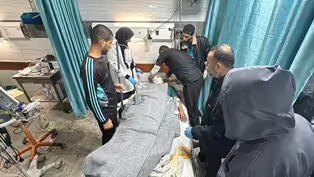
Today, the U.N. Human Rights Office said that Israel's military operations in Gaza has pushed the health care system there to -- quote -- "the brink of total collapse" and maybe a violation of international law.
Israel accuses Hamas of integrating its operations in the hospitals and using hospital staff as shields to attack Israel.
The debate has come to a head in the last few days over the Kamal Adwan Hospital at the center of an ongoing Israeli operation in Northern Gaza.
It was one of Northern Gaza's final lifelines.
Today, it is a shell of dust and debris.
This weekend, with the help of a drone, Israeli soldiers announced final evacuation orders to those left inside Kamal Adwan Hospital.
Patients walked out of the hospital with their hands up, passed an Israeli tank through a war zone.
The Israel Defense Forces says it facilitated the evacuation of more than 350 patients to hospitals in Gaza City.
Faris Al-Afaneh was one of them.
FARIS AL-AFANEH, Patient (through translator): We were taken for interrogation at around 3:00 p.m.
They stripped us naked and left us there until sunset and no one to aid us.
We were left in the dust.
Then one soldier would come every once in a while and would curse at us and spit at us.
It was very ugly.
NICK SCHIFRIN: For months, hospital director Dr. Hussam Abu Safiya tried to alert the world, posting online, appealing for blood and supplies and conditions he described to us as catastrophic.
DR. HUSSAM ABU SAFIYA, Director, Kamal Adwan Hospital (through translator): As you see now, there is one being near our hospital.
We're suffering from a lack of medications and medical supply and medical stuff.
One day before, one -- our team doctor was killed.
NICK SCHIFRIN: To locals, he was a hero who chose to stay, despite the loss of his own son.
But, today, he's detained by Israel, last seen in videos aired on Israeli Channel 14 in the back of an armored vehicle, accused by Israel of being a -- quote -- "Hamas terrorist operative."
Israel said it raided the hospital because it had become a -- quote -- "terrorist stronghold," where gunmen hid weapons and launched attacks on Israel.
And Israel said it arrested 240 terrorists inside the hospital, including 15 who participated in the October 7 attacks.
Kamal Adwan is in the middle of a three-month-old Israeli operation in Northern Gaza that's focused on Jabalia.
The Israeli military says Hamas regrouped here, storing weapons and explosives in local schools and in the waiting rooms of U.N. medical clinics.
Jabalia still has terrorist infrastructure, including rocket launch sites.
LT. COL. YOEL, Israeli Defense Forces (through translator): We will reach any location where the enemy places launch facilities or anything that fires towards the citizens of the state of Israel.
NICK SCHIFRIN: But U.S. officials say, as Israel has tried to evacuate the entire area, it's not allowed in enough aid.
And as the weather gets colder, underequipped Gazans grow vulnerable.
This week, a father held his newborn who froze to death, one of six babies who in recent days have died from the cold.
The Israeli military says one soldier was killed in combat in Northern Gaza and that operations in the north are continuing.
For perspective on this, we get two views, Dr. Zaher Sahloul, co-founder and president of MedGlobal, a nonprofit that has provided support directly to a Kamal Adwan Hospital, and retired Israeli Brigadier General Assaf Orion, the former head of the Israel Defense Forces' strategic planning, who is now a fellow at the Washington Institute for Near East Policy.
Thanks very much.
Welcome, both of you, to the "News Hour."
Zaher Sahloul, let me start with you.
What is your reaction to what Israel describes as the Kamal Adwan Hospital serving as a Hamas terrorist stronghold in Northern Gaza from which terrorists have been operating throughout the war?
DR. ZAHER SAHLOUL, President, MedGlobal: I don't believe that.
It's consistent with what the Israeli army has been doing over the past year, which is basically attacking hospitals, forcing people to leave their communities, attacking health care providers.
More than 1,000 health -- attacks on health care were recorded, according to the WHO.
Kamal Adwan Hospital is one of those small community hospitals that I visited multiple times before this war.
I know Dr. Hussam Abu Safiya from before.
I met with him.
I spoke with him regularly over the past year.
He's the essence of what medicine means.
He's a pure humanitarian person.
He cares about his community.
He cares about providing care to the children, to the newborn.
He wanted to expand his facility to provide health care to the community despite of the limitation and the siege and the war.
And what's happening to him and to Kamal Adwan Hospital is heartbreaking.
It should not be done even in the time of war and conflict.
NICK SCHIFRIN: General Orion, is Israel attacking hospitals and is this a heartbreaking attack on a doctor?
BRIG GEN. ASSAF ORION (RET.
), The Washington Institute: Israel is attacking terrorists which take refuge in hospitals, abusing the sanctuary for terrorist means.
This is not a rumor.
This is not a lie.
This is actually a fact, which we have as a recurring pattern, from the Shifa Hospital to the Rantisi Hospital.
NICK SCHIFRIN: Shifa in Gaza City, the -- Gaza's largest hospital.
BRIG GEN. ASSAF ORION: Yes.
So we have many Gaza hospitals used by military or the military wing or military purposes of Hamas over the war and before the war.
This is something I know from 2014, when the Shifa Hospital was actually a hub for terror organizations.
NICK SCHIFRIN: Dr. Sahloul, this has been a constant accusation by Israel and international journalists who have been there as well.
Have you experienced that, Hamas infiltration, Hamas use of hospitals and civilian infrastructure as shields?
DR. ZAHER SAHLOUL: Not in any hospital that I visited or my colleagues have visited.
I have been in multiple hospitals during this war in medical missions.
Hundreds of doctors from the United States and the United Kingdom and Europe worked in hospitals like Kamal Adwan and Nasser Hospital and Al Shifa before and many other hospitals, and they did not find anything suspicious.
In Nasser Hospital, there was no areas that were blocked.
There were no people who were shooting at the other side.
I saw -- it was similar to my hospital in Chicago.
So I don't think that these accusations are true.
And it should be verified by a independent organization.
The World Health Organization verified also that these hospitals are providing care only and there is no terrorists there.
So I don't know why this focus on wars on hospitals and children in Gaza.
Only seven hospitals out of the 39 hospitals right now are functioning.
That mean the hospitals -- the communities in Gaza, the 2.1 million people, are deprived of access to health care.
And this should not be done even in the war.
Providing health care to children and women and even injured people is not a crime in the war, but attacking hospital is a crime, according to international humanitarian law.
NICK SCHIFRIN: General Orion, is it possible that there is a bright line between people who provide medical care in hospitals and the militants, the terrorists, as Israel defines them, who use these hospitals?
BRIG GEN. ASSAF ORION: Sometimes, the line is blurred, and, sometimes, it's crystal clear.
The predecessor of Dr. Abu Safiya, Dr. Ahmad Kahalot... NICK SCHIFRIN: Yes, the former director of the Kamal Adwan.
BRIG GEN. ASSAF ORION: Former director was apprehended, was interrogated.
And everybody can watch him on the web saying: I'm a Hamas member from 2010.
Many people in my crew, in my staff, my medical staff, in medical positions were actually at the same time members of the Qassam Brigades.
That's the military wing of Hamas which, is a recognized terror organization.
We found just in the last operation 15 people who participated in October 7 attack on Israel out of 240 Hamas and Palestinian Islamic Jihad members arrested in the hospital.
So I think we're beyond the question of, is it a rumor?
No, it's a pattern when Hamas is abusing hospitals as a place to launch and plan and hold terrorist attacks.
Even one of our hostages were murdered in Shifa Hospital.
There's no question of the use of hospitals or the abuse by the terror factions in Gaza.
NICK SCHIFRIN: Dr. Sahloul, Israel has long argued that the safeties and the protections afforded by international law to hospitals are lost because Hamas, because terrorists are using these hospitals.
What is your response to that argument?
DR. ZAHER SAHLOUL: First of all, statements taken under torture should not be taken as statements.
And I think many people mentioned that the statements that were taken by Dr. Kahalot were taken under torture.
The other issue, that these accusations against hospitals and care providers in Gaza were not verified by a third party.
The third thing, that even if hospital was used, let's say, by an armed group or so, it does not justify to cut electricity against incubators that have newborn, or prevent patients from getting medicine, or attacking the radiology department or the ICU in the hospital, or closing the hospital altogether and depriving the community from health care.
So these issues have to be verified.
And it does not justify the unproportional reaction of the Israeli army against the health care system in Gaza.
NICK SCHIFRIN: General Orion, is - - are the attacks disproportional?
And are there strategic risks to the tactics that Israel is using when it comes to trying to figure out how to clear Gaza of what it identifies as terrorists?
BRIG GEN. ASSAF ORION: Actually, what we saw in Saturday's operation against Kamal Adwan Hospital is a very surgical operation.
They came.
They encircled the place.
They vetted the people going out.
They allowed 350 people to evacuate on the weeks before and 95 people to evacuate on the same day.
They brought fuel and food and medicines to this hospital and to the Indonesian Hospital, to which some... NICK SCHIFRIN: Also in Northern Gaza.
BRIG GEN. ASSAF ORION: Yes, to which some patients and staff were evacuated.
So, actually, we're seeing Israel trying to uphold the medical care to the civilians there in a quite impressive way.
It's seldom reported, but this is the reality on the ground.
NICK SCHIFRIN: Retired Brigadier General Assaf Orion, Dr. Zaher Sahloul, thank you very much to you both.
BRIG GEN. ASSAF ORION: Thank you.
DR. ZAHER SAHLOUL: Thank you.
NICK SCHIFRIN: There is growing outrage today over the death of an inmate in a New York state prison who was brutally beaten by more than a dozen correction officers.
Detainee advocates are concerned it's part of a larger culture of violence within the state's correctional system.
Laura Barron-Lopez has our look.
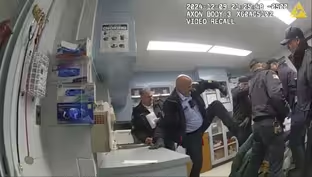
And a warning to our viewers: The video, which we will show only in part, is very disturbing.
LAURA BARRON-LOPEZ: Bodycam footage shows Robert Brooks repeatedly kicked, punched and choked after arriving at the Marcy Correctional Facility on December 9.
Brooks had been serving a 12-year sentence for an assault in 2017.
It is unclear why he was transferred to the Central New York prison.
At one point, one officer yanks him by the neck and drops his semiconscious body on an examination table.
The beating lasted roughly 20 minutes.
Brooks died the following morning.
In a statement, an attorney for the Brooks family said: "Mr. Brooks was fatally, violently beaten by a group of officers whose job was to keep him safe.
He deserved to live."
New York Governor Kathy Hochul has requested the termination of 13 guards and one nurse implicated in the assault.
After visiting the facility where Brooks was beaten, Governor Hochul released a statement yesterday, saying, in part: "The system failed Mr. Brooks, and I will not be satisfied until there has been significant culture change."
In the aftermath of Brooks' death, community leaders and activists are calling for justice and reform.
PROTESTER: What do we want?
PROTESTERS: Justice!
LA-MEIK TAYLOR, Protester: Just because individuals are incarcerated doesn't mean that they give up their rights to be human beings.
LAURA BARRON-LOPEZ: A 2023 investigation by The Marshall Project and The New York Times found that, from 2010 to 2022, New York's Department of Corrections filed 5,642 disciplinary cases against prison staff, but only succeeded in firing 28 officers.
Three of the guards involved in the assault against Brooks were previously accused of beating inmates in a similar manner.
As of today, none of the 14 employees implicated have been charged with wrongdoing.
But New York state Attorney General Letitia James promised a full investigation.
LETITIA JAMES, New York Attorney General: I have a responsibility and duty to provide the Brooks family, their loved ones, and all New Yorkers with transparency and accountability.
LAURA BARRON-LOPEZ: Authorities have not released an official cause of death for Brooks, but, according to court documents, the medical examiner's preliminary findings show -- quote -- "concern for asphyxia due to compression of the neck."
Robert Brooks was 43 years old.
For the "PBS News Hour," I'm Laura Barron-Lopez.
NICK SCHIFRIN: 2024 will be known as the year that artificial intelligence redefined the technology landscape.
2025 may be known as the year that the United States and tech leader allies of president-elect Trump try to win an A.I.
race with China.
Jeffrey Brown takes a look at the ups and downs of A.I.
advancement.
JEFFREY BROWN: A.I.
has quickly become part of everyday life, with A.I.-powered features integrated into everything, from search engines and cell phones to hospital equipment and politics.
But how fast, with what impact, and what are the limits on further growth?
For some end-of-the-year-thoughts, I'm joined by Reed Albergotti, technology editor of Semafor.
So, thanks so much for joining us.
And knowing that this is a fast-moving field, give us two or three of the big developments of the last year and why they stood out for you.
REED ALBERGOTTI, Semafor: Yes, one, I think, is self-driving cars.
After stalling really with its progress over the last couple of years, we saw big leaps this year.
And Waymo, which is Google's autonomous driving robo-taxi that's available in San Francisco and Arizona, is now going to expand to 10 cities in the upcoming year.
We also saw Tesla's full self-driving make big strides.
So that's really interesting.
I think another one with A.I.
models were these text-to-video models, which were sort of teased by OpenAI's Sora earlier this year.
That's now available to the public.
And these allow you to prompt a model with text.
And it comes up with this video that's really almost indistinguishable from reality.
Google released its similar model, competing model, later this year.
And I think the really big one that I think not enough people are paying attention to is the reasoning models.
Late this year, we saw massive increases in capability due to this new technique, where, instead of just prompting an A.I.
model and getting an answer back, the model will actually go back and find many different possibilities for an answer and do what's called chain of thought reasoning, where it breaks down prompts into multiple steps.
And we're -- it's very expensive right now to do this technique.
But I think the costs are coming down.
We will see massive improvements.
JEFFREY BROWN: You mentioned the expense.
I mean, it's not hard to find articles questioning the limits, the kind of roadblocks.
What's something that you thought might have happened that hasn't happened so far?
And what kind of limits are cropping up?
REED ALBERGOTTI: Yes, I mean, this year -- I really predicted that this year we would see a big change in how we use computers due to A.I.
So, instead of clicking and typing to do a given task on a computer, you will just ask that computer, I want to do this and it will do it for you.
And that really hasn't happened.
And part of that is expense.
Part of it is technological capability.
And I think these reasoning models will help because they will allow us to sort of trust models more to actually carry out the tasks that we ask them to do and not sort of go off the rails.
So that may happen this year or next year.
I think it will eventually.
But at infrastructure costs, those are some of the big barriers, I think, to that sort of technology.
JEFFREY BROWN: What about the government's continuing or growing role, both first in regulations, in other ways in promoting A.I., and then, of course, its new connection to our politics?
REED ALBERGOTTI: Yes, I think that the conversation around A.I.
will completely change.
I think we will talk less about reining the technology in.
And because of the big influence from people like Elon Musk on the incoming administration, I think we will see more talk about how we can get the U.S. to win the A.I.
race with China.
I think that's going to be a big topic.
And I think the way government will be able to help is by help building infrastructure and sort of clearing the red tape that prevents some of the development of new nuclear power plants or other forms of energy to power these huge data centers that are required to make these A.I.
models work.
JEFFREY BROWN: What about a couple of other developments that you're looking forward to in the next year?
I don't know how good a predictor you have -- you felt you have been in the past, but I'm going to make you come up with a couple for this year that might impact all of us in our daily lives.
REED ALBERGOTTI: Yes, it's always a fool's errand to do this, but I will do it anyway.
I think, next year, we will see some big advancements in robotics.
Right now, the way robotics works is, you program it for a very narrow and specific task.
And I think we will see, maybe not in consumer products, but in sort of labs and maybe big tech companies showing off some of these experiments.
We will see robots that are able to do tasks that they were not ever trained to do.
And that's what people in the A.I.
world call generalization or general intelligence.
I think that we will see also another one that I think will get less attention, but it will be there, is new scientific research.
I think we will see papers come out in fields like physics and biology and material science where A.I.
was -- played a big part in making that -- those discoveries.
And that's just because these models can read millions of pages of research in a few minutes that would take humans more than a lifetime to read.
JEFFREY BROWN: So much is happening and so many of us still don't get it or don't understand the technology or its impact on us.
What's your advice to those of us in that situation?
REED ALBERGOTTI: Well, first of all, you shouldn't feel bad, because I think even people who are the top A.I.
researchers in the world, they don't know exactly what's going to happen with this technology.
So pay attention to the technology, play around with it, be curious about it, because it eventually will make a massive difference in all of our lives.
JEFFREY BROWN: All right, Reed Albergotti of Semafor, thank you very much and happy new year.
REED ALBERGOTTI: Thanks.
You too.
NICK SCHIFRIN: In the United States, the rate of maternal mortality has soared to nearly three times that of other high-income countries.
And among new mothers, mental health disorders are the leading cause of death.
Health care providers have made progress in addressing the most common maternal mental health disorders, anxiety and postpartum depression.
But barriers to care remain and disproportionately affect women of color.
Ali Rogin reports as part of our Race Matters coverage.
ALLOCIANNA JONES, Mother: Yes, good job, Aiden (ph).
Yay!
ALI ROGIN: Allocianna Jones gave birth to her son Aiden last summer.
ALLOCIANNA JONES: Aiden is, I might be a little biased, but the best baby.
(LAUGHTER) ALLOCIANNA JONES: His favorite color is red.
He's super goofy and he loves to dance.
ALI ROGIN: The birth was challenging.
And soon after he was born, once the initial flood of emotions passed, she started feeling something else, something she'd never felt before.
ALLOCIANNA JONES: I'm typically an outgoing, happy, bubbly person.
However, I was not postpartum.
I was self-isolating.
I was sad.
I wasn't sleeping at all.
Things on social media just made everything worse.
It was not pretty.
It was not me and something was wrong.
ALI ROGIN: Jones was experiencing postpartum depression, which can be a severe, long-lasting mood disorder that affects roughly 14 percent of new moms.
Yet the majority of women experiencing maternal mental health conditions go without treatment or a diagnosis.
ALLOCIANNA JONES: I know everybody says you're not the only one, you're not the only one.
But, in that moment, it feels like it.
It feels like you're at the bottom of a hole and there is no way out.
ALI ROGIN: While there is no single cause of postpartum depression, genetics, stress, and physiological changes like the hormonal shifts new mothers experience all play a role.
DR. CATHERINE MONK, Columbia University Irving Medical Center: Twenty years ago, we wouldn't be having this conversation for the most part.
ALI ROGIN: Dr. Catherine Monk is the chief of the Division of Women's Mental Health and Obstetrics and Gynecology at Columbia University Irving Medical Center.
DR. CATHERINE MONK: We have really made a lot of progress the last 20 years, and it's very exciting.
There are evidence-based treatment.
There are more and more people who are specializing in reproductive psychiatry, reproductive psychology.
We're understanding more the roles of prevention that can come with the social support from people's communities and networks.
ALI ROGIN: But, Dr. Monk says, there are still many hurdles to getting care.
Black mothers are referred to mental health professionals less often, even though they are impacted at higher rates.
ALLOCIANNA JONES: As a woman of color, it's even more difficult and even more scary.
ALI ROGIN: Her fear of becoming a statistic led Jones, who lives in the suburbs of Detroit, to search out Birth Detroit, a Black-led midwife practice, to deliver her baby and also to care for her after giving birth.
ELON GEFFRARD, Co-Founder, Birth Detroit: If you imagine your medical experience, you have been pregnant practically a year, and then you're told after maybe 24 to 48 hours' stay, we will see you later.
Enjoy your new baby.
ALI ROGIN: Elon Geffrard is one of the co-founders of Birth Detroit, which is designed to address the gaps in maternal care for Black mothers from pregnancy to several months into postpartum, when the focus is traditionally on the baby, not the mother.
ELON GEFFRARD: Birth Detroit, we are in the home within 24 hours after birth.
Then we're seeing you again at, like, day three or four.
Then we're seeing you again at day seven.
And then we see you again in two weeks.
We have health care professionals in the home assessing the family right in their own environment.
And we're able to catch those things that can be more serious before they become more serious.
ALI ROGIN: Jones says she was lucky her midwife recognized her symptoms and referred her to care.
ALLOCIANNA JONES: You hear about these things, postpartum depression, postpartum, anxiety, but you don't have a blueprint of, here are the items to look for.
ALI ROGIN: Jones received counseling and medication, but her midwife also referred her to a new center in nearby Ferndale, Michigan, offering something different.
MELISSA SCODELLARO, Fourth Tri Sanctuary: We really wanted a space that moms could come and settle and spend hours.
ALI ROGIN: Melissa Scodellaro is the co-founder of Fourth Tri Sanctuary, one of a handful of postpartum centers that have recently opened across the country, catering to new mothers seeking support and community.
MELISSA SCODELLARO: The space was designed to be approachable and to help moms feel welcome and to be able to watch each other as well, because there's so much in learning in watching each other, and there's so much forgiveness that you can give yourself when you watch another mom do things.
ALLOCIANNA JONES: The first day I came, I stayed the whole day, did not want to leave, and I kept coming back.
It feels like a safe place for you to be vulnerable.
ALI ROGIN: Part day care, part cafe and with a spa-like atmosphere, Fourth Tri Sanctuary allows mothers to socialize with other moms, join information sessions, bathe their babies, or hand them off to experienced on-staff doulas while they shower, nap or get their hair done.
MORGAN VANDERKAAY, Mother: The first week when I came here, all I did was sleep, which was really great.
ALI ROGIN: After the birth of her first son, Morgan Vanderkaay was diagnosed with postpartum anxiety, a common condition marked by excessive worrying and feelings of panic after childbirth.
MORGAN VANDERKAAY: I was crying a lot.
I mean, there was no sleep as well, which doesn't help.
And I felt very anxious, which I had never really felt before.
And I just felt like I was going to fall down the stairs and, like, land on my baby and no one would be home and we would both be dead.
It just, like, seemed so severe.
ALI ROGIN: She gave birth to her second son in September, and she credits Fourth Tri for an easier postpartum period this time around.
MORGAN VANDERKAAY: I just felt calmness.
People check on you.
How are you doing?
How was your night?
It's just been so nice to just sit in a relaxing hot shower and let the stress kind of melt off of you.
I couldn't ask for a better postpartum period this time.
ALI ROGIN: Fourth Tri is a concept that came to Scodellaro, a mother of two, in her career as a salon owner, where she saw many new mothers looking for reassurance.
MELISSA SCODELLARO: Someone would find me at a wedding and be like, is it OK that I give my baby formula today?
And I'm thinking, there must be a gap in the system if you're finding your hairstylist at a wedding and asking how you should feed your baby.
WOMAN: It's going to change because your baby's going to change.
As they get more solids, they usually take less breast milk.
ALI ROGIN: Answering those new mom questions is what Fourth Tri aims to accomplish with their daily fireside chats, informal conversations with experts.
WOMAN: And every mother was very worried about these babies, but I was more worried about you guys.
ALI ROGIN: But all these amenities come at a cost, ranging from $35 for 90 minutes to $900 for a monthly pass.
While clients can pay with a health savings account, Fourth Tri does not currently accept insurance, but they are working to get their services covered because Scodellaro says she knows her center is helping new moms.
MELISSA SCODELLARO: We have moms that walk in here a shell of themselves.
They're not smiling.
They're crying.
And by day five, they're like, this is a good day.
The space was designed to empower moms and to give them a space to practice being a mom.
ALI ROGIN: But that space can be hard to find.
DR. CATHERINE MONK: The biggest impediment to recovery from a mental health issue is access to care.
We really do have tools.
We have evidence-based psychotherapies.
We have pharmacology.
The combination of the two is what's really the gold standard when medication is needed.
ALI ROGIN: But medications can be pricey, like the one approved just last year by the FDA, the first pill for severe postpartum depression.
A two-week course costs nearly $16,000, and insurance coverage is inconsistent.
Dr. Monk says progress has been made when it comes to treatment, but insurance companies simply haven't caught up.
DR. CATHERINE MONK: We have developed a lot of work-arounds, and we have not tackled the elephant in the room, which is reimbursement rates for mental health care for people who want to use their insurance to cover it.
It is absolutely the elephant in the room.
ALI ROGIN: Back at Fourth Tri, Scodellaro has tried to make her services accessible to more women by offering scholarships in the form of a monthly pass to moms who are unable to afford them.
Jones was one of the recipients, and she plans to keep visiting Fourth Tri even after it expires.
She says it's a much-needed continuation of care for her son and her.
ALLOCIANNA JONES: Pregnancy doesn't just stop after you give birth, which is what it seems like our nation has ingrained in their brain.
I don't think that it's a shock that postpartum depression is so high, unfortunately.
But I do think it's a shock for the lack of care following postpartum depression.
I do think that it's scary how limited moms have support there.
ALI ROGIN: Support that places like Fourth Tri are providing, because it takes a village to raise a child and a mom.
For the "PBS News Hour," I'm Ali Rogin in Ferndale, Michigan.
NICK SCHIFRIN: The college football playoff, which recently expanded to 12 teams, resumes tonight.
And unprecedented money is pouring in.
ESPN is reportedly paying more than $1.3 billion to televise these games, and some players are now receiving millions.
William Brangham talks with sports journalist Pablo Torre, who hosts the podcast "Pablo Torre Finds Out," about a brave new world for college football.
WILLIAM BRANGHAM: Pablo Torre, so good to have you on the "News Hour."
So imagine some of our audience has not been paying attention to all of this, and they're now waking up and seeing this new playoff structure in college athletics.
What is going on there?
What was the rationale for this, and how has it been playing out so far?
PABLO TORRE, Host, "Pablo Torre Finds Out": Yes, if you have been hibernating, welcome to the new age of college football.
It's very strange in some key ways, but also flowing from a logic that I think is fairly ancient within the sport when it comes to the playoff system specifically, which is that the most valuable property in televised sports in general has always been playoff games.
And so, when it comes to college football, the most valuable of all of the college sports, it's always been logical that more games, expansion to 12 teams, it's more football.
And America's demand for football, William, is inelastic.
That remains true.
And so this is just yet more profit, yet more billions of dollars accruing to a sport that is also grappling simultaneously with how much to give those to the players that actually comprise the product.
WILLIAM BRANGHAM: And that is the other big shift that is going on here, this -- what's called name image, likeness, where college players, after this being considered a taboo forever in college football, now those players are getting enormous sums of money.
How did that changeover happen?
PABLO TORRE: Yes, it's a half-measure, but it is radical because of that ideology fundamentally that you described, which is that these are student athletes.
These are not employees.
And that's been the NCAA, the governing national body of college sports -- that's been their core tenant the entire time is that these are college kids.
But it came to a head at the Supreme Court where there was a 9-0 decision in favor of Shawne Alston, a former West Virginia running back, who was the head of a class that sued the NCAA for back pay, for basically the right to have monetized their name, image and likeness.
And so what they argued successfully in front of the Supreme Court to a 9-0 decision, Brett Kavanaugh excoriated the NCAA for trying to block what seems obvious now, which is that a student athlete is in fact a person that should be able to monetize their own likeness.
And so it wasn't quite yet pay for play, which the NCAA is still fighting, but it was the ability to get money for how your image had been monetized by all of the players in the college sports economy.
And so it was the highest court in the land that opened the floodgates that led to some radical change.
WILLIAM BRANGHAM: How does that mechanism happen?
Because, again, that was considered, for people who are not really paying attention to this, the grand taboo.
If you got caught buying a Jaguar for some young player, that was a huge no-no.
Now money is flowing to these kids.
PABLO TORRE: When it comes to the individual players being paid, they are being paid by these third parties, these third-party companies that could be anywhere, as familiar to you as your local auto dealership in a college town all the way up to a big multinational corporation.
And the ostensible justification for why this is allowed is that this is a marketing deal for the players for their name, image and likeness.
This is not paying for performance.
This is basically them cutting a series of advertisements.
But it's been very obvious from the beginning that there really is no good philosophical or, frankly, constitutional way to delineate between you are getting this money because you are good at something versus you are getting this money because you are famous enough to provide some marketing value for the company that is paying you to endorse them.
WILLIAM BRANGHAM: The most notorious example, a recent moment was this player who had promised himself to LSU, but now all of a sudden he's playing for the University of Michigan.
Tell us that story.
PABLO TORRE: Yes, so this is the star quarterback in the incoming freshman class.
And his name is Bryce Underwood.
And all you need to know about him is that he has been the high water mark when it comes to both, I would say, the market economy, but also the absurdity of college football, because his main benefactor, his booster, so to speak, has been Larry Ellison, who is, of course, former Oracle CEO, a billionaire many times over, somebody who has apparently entered a relationship with a woman who is his fifth or sixth wife.
I say that with the ambiguity built in because it's not clear, but we know that it's the case because she, the woman in question, is an enormous Michigan football fan.
And so Larry Ellison, in conjunction with the new seemingly love of his life, decided to fund the greatest gift you could give to a Michigan football fan, which is the next great star quarterback.
And so it is football mercantilism in a sense.
It is also familiar, in the sense of these kids have always been the hottest commodities, but now we are getting a peek behind what used to be a pretty opaque curtain.
WILLIAM BRANGHAM: The rationale for a lot of this was that it was always unfair that these young athletes played sports for these schools and the schools got enormous amounts of money from their performance.
And this is now supposedly tipping the balance back in favor of the athletes.
But it's hard not to see that this is also being corrupted in other extremely unfair ways.
I mean, do you see it that way?
PABLO TORRE: Well, it's certainly the Wild West.
And that is a term of art that maybe undersells the absurdity that we mentioned, right?
In terms of what it's doing to the product that can be disquieting to people who love college football, as we understood it for decades, is that it is certainly killing the fictionalized version of what college sports has been.
Now what you're getting is the capitalism that had been restricted released in front of you in a way that does logically gesture towards a future where this is merely the minor leagues for professional sports, for the NFL itself.
And so much of the magic of college football, the reason why this week and throughout this playoff system you will see these tribal loyalties come to the fore in ways that are both insane and also heartwarming -- so I would say that it is fair to the athletes who are now getting to monetize something, after not having access to those billions of dollars that they generated, but entertainment and equity are not quite the same thing.
It may not be the sport you loved, the sport that you may watch in the years to come, because it will be different.
It will be less fictionalized in the ways that maybe you fell in love with in the first place.
WILLIAM BRANGHAM: Pablo Torre, thank you so much for sharing all your insights with us.
PABLO TORRE: Thank you, William.
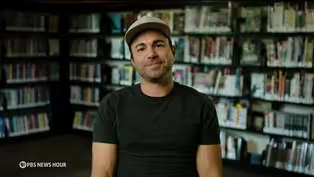
NICK SCHIFRIN: Tonight, we have a Brief But Spectacular take on being amazed at the world around us.
Mark Rober discovered his passion for engineering as a kid tinkering with gadgets and creating contraptions.
Today, the former NASA engineer is a YouTube sensation who runs CrunchLabs, taking young minds and sparking their curiosity and innovation.
MARK ROBER, Founder, CrunchLabs: And the greatest thing about engineering is, if something doesn't exist and you want it to exist, you can just freaking will it into existence.
I think, for a lot of people, maybe they were in high school and they took a math or science class, and they didn't get it.
So they have this negative connotation to math and science and to physics.
And that kills me.
I'm about to plug in this fan to test whether blowing on this sail will move the boat forward.
This is space and this is an egg moments before I attempted the world's highest egg drop.
The channel now has 58 million subscribers.
So there's other people like you who said they weren't good at science and they didn't enjoy it who myself and other creators like me have kind of convinced, actually, there's some part of your brain that does love this.
Just never looked at it in this way.
Oh, this is crazy.
What am I doing?
I think the key to really learning something is to not frame it as learning.
So, on my YouTube channel, I like to do what I call hide the vegetables.
So you might see a really clickbait thumbnail of a 15-ton Jell-O pool, and it's like, well, that's real interesting.
I'm going to click on that.
This is the world's first ever actual pool of Jell-O.
Before you know it, you're learning about the scientific method and chemistry.
I have a handful of teachers that not only shaped my own learning process, but shaped the way I teach now.
Give me one second.
You ask me about my teachers, I literally get a little bit emotional.
Shout-out, Mr. Malloy, my AP high school statistics teacher.
Hands down, teachers are my favorite profession.
I think they're incredibly important.
At some point, I'm going to retire from all this and be like a volunteer high school physics teacher.
That's my dream job.
After high school physics, I was like, what is the career that applies most to whatever this is?
Like, this just feels really good in my brain.
And I settled on mechanical engineering because, you could see there's electrical engineering or chemical engineering.
An electrical engineer can't make the world's largest Nerf gun.
You need a mechanical engineer for that.
Straight out of college, I went and worked at NASA, and I was there for nine years, seven of those working on the Curiosity rover.
I went and worked for about five years at Apple in their special projects group, and I signed a very thick stack of NDAs which tells me I'm not allowed to talk about it.
But I did have one patent I was the lead author on about using virtual reality and self-driving cars.
That's public.
Don't sue me, Apple.
My initial goal was just a creative outlet.
Nobody knew you could make money off YouTube in those days.
And I think over time, as I have seen response, especially from young folks, I have taken on this mantle of, like, I want to make engineering and science, like, not only accessible, but cool and interesting.
My favorite part of the job is knowing, like, I'm a freaking nerd.
I'm like, I talk about science.
And society actually is saying, hey, we like this.
Two for two, baby.
Two for two!
My name is Mark Rober, and this was my Brief But Spectacular take on just being amazed at the amazing physical world around us.
NICK SCHIFRIN: And you can watch more Brief But Spectacular videos online at PBS.org/NewsHour/Brief.
And, finally, on this New Year's Eve, when the world can feel a bit unsettling, it is perhaps reassuring to witness the wave of 2025 arrivals across the globe, fireworks over the iconic Opera House in Sydney, Australia, a celebration in Hong Kong's famous harbor, and the world's tallest skyscraper in Dubai.
Here in the U.S., an estimated one million people are expected to brave the rain to watch a tradition that is 120 years old.
But tonight's lights won't only be fireworks.
From Portland, Oregon, to Portland, Maine, those in the U.S.' northernmost states could glimpse the Northern Lights.
There's a science behind the sublime.
It includes solar explosions and geomagnetic storms, but the ancient Greeks had a more cosmic explanation, the sun and moon racing across the sky to mark the dawn of a new day.
And so I hope the arrival of your 2025 brings a new good year full of laughter, love and light.
That's the "News Hour" for tonight.
I'm Nick Schifrin.
On behalf of our entire "News Hour" team, thank you for joining us.
Have a great night.
Happy new year.
A Brief But Spectacular take on being amazed at the world
Video has Closed Captions
Mark Rober's Brief But Spectacular take on being amazed at the world around us (3m 42s)

College football's expanded playoff is reshaping the sport
Video has Closed Captions
How the expanded playoff and unprecedented money is reshaping college football (7m 21s)
Death of man beaten by corrections officers sparks outrage
Video has Closed Captions
Death of New York man beaten by corrections officers sparks outrage and protests (2m 57s)

How artificial intelligence affected our lives in 2024
Video has Closed Captions
How artificial intelligence impacted our lives in 2024 and what's next (6m 33s)

New mothers face barriers getting mental health care
Video has Closed Captions
New mothers face barriers getting the mental health care so many need (9m 13s)

Officials were worried about barrier hit by Jeju Air flight
Video has Closed Captions
South Korean officials were worried about barrier before it was struck by Jeju Air flight (4m 42s)
U.N. says Gaza's health care system at brink of collapse
Video has Closed Captions
U.N. accuses Israel of pushing Gaza health system to ‘brink of total collapse' (11m 35s)
Providing Support for PBS.org
Learn Moreabout PBS online sponsorship
- News and Public Affairs

Today's top journalists discuss Washington's current political events and public affairs.

- News and Public Affairs

FRONTLINE is investigative journalism that questions, explains and changes our world.












Support for PBS provided by:
Major corporate funding for the PBS News Hour is provided by BDO, BNSF, Consumer Cellular, American Cruise Lines, and Raymond James. Funding for the PBS NewsHour Weekend is provided by...