
December 5, 2023
Season 2 Episode 134 | 27m 31sVideo has Closed Captions
Lawmakers react to a report critical of the legislative process.
Lawmakers react to a report critical of the legislative process, another longtime lawmaker is leaving Frankfort, an Ibogaine skeptic talks about his cause for concern, and how a Kentucky group is working to save certain mollusks from extinction.
Problems playing video? | Closed Captioning Feedback
Problems playing video? | Closed Captioning Feedback
Kentucky Edition is a local public television program presented by KET
December 5, 2023
Season 2 Episode 134 | 27m 31sVideo has Closed Captions
Lawmakers react to a report critical of the legislative process, another longtime lawmaker is leaving Frankfort, an Ibogaine skeptic talks about his cause for concern, and how a Kentucky group is working to save certain mollusks from extinction.
Problems playing video? | Closed Captioning Feedback
How to Watch Kentucky Edition
Kentucky Edition is available to stream on pbs.org and the free PBS App, available on iPhone, Apple TV, Android TV, Android smartphones, Amazon Fire TV, Amazon Fire Tablet, Roku, Samsung Smart TV, and Vizio.
Providing Support for PBS.org
Learn Moreabout PBS online sponsorshipYeah, we need more.
But we know what works.
How about more of that?
>> Should Kentucky fund Ibogaine research here from a skeptic.
That was very much like holy Cow.
This is not that.
Some newer Kentucky lawmakers talk about their surprise at how things happen.
And Frankfort.
>> There's several that we've worked with that.
I probably would be close to being extinct mail if we hadn't stepped in.
>> And a group of Kentucky scientists are flexing their muscles.
>> Production of Kentucky Edition is made possible in part by the KET Endowment for Kentucky Productions.
Leonard Press Endowment for Public Affairs and the KET Millennium Fund.
♪ ♪ >> Good evening and welcome to Kentucky EDITION on this Tuesday, December, the 5th, I'm Renee Shaw.
Thank you so much for spending some of that Tuesday night with us.
>> With the 2024 Kentucky General Assembly.
Now less than a month away.
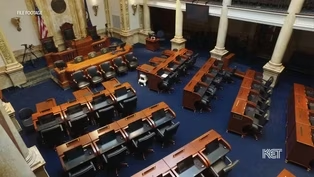
Lawmakers are reacting to a new report from the progressive leaning League of Women Voters of Kentucky.
The report says fast tracking bills with little time for review or debate.
This happening now more than ever now, a leading state senator is calling on legislators to change the way they operate.
>> I've got a lot of e-mails as a phone call from public We agree with the League of Women voters.
We don't have enough time to digest all the changes to really speak to the changes, even though what's in the bill.
And and you have a lot of people believe it or not, who do follow this legislation?
You know, they they care about is important to them.
It impacts their lives and their livelihood and their voice is the one that needs to be or anyone else at no time.
Should the bill be brought to the floor on the same day that the that the actions taken at least again, a gap of 24 hours, probably more should take place before the bill comes to the fore for final vote.
Helen Committee action and then turning around an hour or 2 later and then vote on that floor.
No, really gags the public.
I mean, the public has no voice.
And in the bidding that legislation, no, no opportunity to contact their legislators to say here's how we feel about the legislation.
The legislators don't have time really to 2.
We'll digest and consider all the changes that have been made and that's really bad for the public.
That is not democracy at its best.
This should not be an issue where where one party will tries to one up the other.
I think these kinds of suggestions and proposals by the legal vote, a reasonable and again at all times are all those who want the public involved as much as possible because we're voting on arm on matters and policies that it impact the public.
We're coming up on a 60 day session.
This is a long session.
We're going to see each other every day for 60 days.
We've we know what bills out there pretty much, you know, by the 10th 20010th Day, there's never need to rush a bill and no legislation should be justified on the fact that need to be rushed.
There's plenty of time to make changes on the bill.
Is that important that important?
We've got enough time to make changes.
Put it out there.
Have the public considered because we want public input and and the public demands input this into the public and then vote on.
>> Republican State Senator Damon, Thayer of Georgetown, the Senate majority floor leader says there's no need to change how the General Assembly handles legislation.
He told W Eek a U public radio, all bills in the General Assembly are legally passed under the state Constitution and Mason's Manual of legislative procedure.
And Robert's rules of order.
And he said the Senate operates in a transparent manner.
They are says the General Assembly will continue to operate in a way that makes good laws and he doesn't see any massive changes coming.
For relatively new lawmakers.
2 Republicans and 2 Democrats also reacted to the League of Women Voters report last night on Kentucky tonight.
>> So I'll say coming from local government.
It blew my mind.
But I got to Frankfort that we do have some sort of online database where people can see committee subs where they can see offered amendments are a lot of times.
We're still dealing with hard copies getting handed out someone.
Check your email.
It's there.
>> And when I think about transparency that really bothers me.
I think the public should be able to see what we're doing and see what we're voting on.
>> And understand the impact of the decisions that we're making on the floor every day.
We work for them with their tax dollars on the issues they care about.
And I know a lot of other states, including some Republican led Legislature's, have taken big moves towards transparency around creating these kinds of electronic systems where the public can really see what the bills are, see, what the amendments are.
I think that's a very basic first step to take to let the public understand exactly what it is we're voting on.
I think it's also important that we make sure the public has a meaningful chance to tell us what they think about it.
After that to have hearings to make sure that having the process be sort of slow enough and meaningful enough that we really do hear from the public about the things we're doing.
And so I think there are things big and small we could do to make the public feel as though their voice matters because it should.
>> Representative Gaetz, were you ever frustrated by the fascinator of how bills and amendments we're considered?
Did you feel like you had ample time to review and to understand what you are voting on, particularly in those last hurry, days of the session.
So I think that's really a a two-part question for me.
And I've learned that more.
>> And since we've been in the interim, so during the interim, we spent a lot of time flushing out issues.
We sit in our committee meetings and were able to see what happens before we go into session.
I didn't have the benefit of that the last times.
I don't know what went on during the interim and what was discussed.
So as much as I might have felt that that was very fast paced.
I don't know what was discussed during the interim.
I feel much more prepared now to go into this session with what I know has discussed in the different committee meetings.
So, yeah, I think there's a frustration with the process I come from obviously legal background and we follow rules and things are filed ahead of time and you're used to seeing those and there's no surprises when you litigate.
There's not supposed to be.
yeah, you know, I so I think surprised at that.
>> But I'm hoping I feel much more prepared going in this time knowing what we've talked about during the interim, OK?
So how do you feel about us and our most by side actually completely agree.
I think not having an interim really when you walk into it is very fast tonight.
Completely sure Senate chambers and we've talked a lot about the local government representatives for as long as we both were and then coming to this election in highly values, transparency almost to a fault.
Nothing is done it.
You have things done well in advance and public and it was very much like holy cow.
This is not that this fast and we do have the benefit of full year legislation.
So you do have a limited time.
So you are being moved quickly that quickly and it can be a challenge, I think just to figure out if it's on your e-mail or not, it was going on.
But I I definitely share that perspective that I feel much better going into this year than I did last year.
I think we can make some compromises to provide some stuff online.
It will be easier and faster to not feeling like there's something being said they can't find Representative, all sunlight is the best disinfectant.
What usually stay here a lot.
And Frankfort.
>> It sure isn't.
And I think there's 2 things I want to say here.
One, the legislature could just slow down and hear their own rules and stop suspending the rules and go to the 3 days and post a having committee and then passing going the other chamber.
And sometimes we KET waving our own rules not to not even follow our rose.
We've set up our sales.
That would be a good first step.
But number 2, the interim does give us a time.
2 work on the budget mark on these bills.
But it doesn't give the public.
For input when the legislation is dropped.
There are several bills last session that were amended last second called in for a special meeting and on the House floor in 30 minutes, passing over into the same Senate chamber impasse that night.
So while we might have personally an opportunity to better understand and work on some of those pieces of legislation during the interim.
Public does not.
And our job is to slow down and listen to the public and get their input.
And if we would do that, we would probably find many things in bills when we should have not had a hand or and or as an example in some particular bills.
So we need to slow down and let the public have an actual meaningful opportunity to provide a speed back on these critical piece of legislation that fix people's laps.
If we need to do this, there's no reason we should rush and get these things through in a few hours.
Slow down the process will be better.
>> So we touched on many interesting issues last night on Kentucky tonight.
You can see the full hour-long conversation online on demand at KET DOT Org.
Slash K why tonight now should Kentucky have a full-time legislature?
You'll hear some of the pros and cons of that tomorrow on Kentucky EDITION.
Another longtime Kentucky lawmaker is leaving Frankfort after 2024.
State Senator Dennis Harper Angels says she will not run for reelection next year.
So the upcoming session will be her last Harper Angel is a Democrat from Louisville.
She's been in office since 2005.
In a statement she says it's been a profound honor to serve, but now it's time to focus on her personal life.
For the past few days.
We brought you several stories about a psychedelic plants called Ibogaine.
Supporters say it can curb opioid addiction withdrawals and create a pack to recovery.
But it has its critics who are concerned about the lack of research.
We spoke to one addiction expert in Kentucky about his cause for concern.
>> We need to be open to the idea of novel therapeutic for substance use disorders, red, large.
We should be open to studying psychedelics for substance use disorders, including up against disorder.
I would think about other things like psilocybin is an example.
The farmer think about it again.
The research I've again is is very much based on case reporting observation.
Studies.
And so the evidence base to suggest that I've again is effective for opiate use disorder in particular.
That's really where it's been studied.
The most.
It's not as strong as rigorous as we might like.
So, you know, so then that leads us to the idea that maybe want to do more research with it.
But there's some regulatory challenges.
It acts on a heart channel that basically prolongs the contraction and relaxation of the heart muscle that can lead to fatal arrhythmias.
That doesn't mean that it is always fatal, but it is a significant concern.
So again, to go back to my point about the heart channel that axons called the Herd channel.
The FDA when they're thinking about the proving a new drug testing and it looks even start there.
Go back a step testing, a new drug if I if that drug has heard back Kitty, which I'm again, does that is often a nonstarter with the FDA.
They will not let you has that drug in people.
So even if we thought, OK, let's move on to the game forward.
I don't know that the FDA would allow clinical testing in the United States.
So I think that some of that would have to be figured out, right, like.
We're going to invest all this money.
Can we even to this work in the U.S. or Kentucky?
I think there's sort of practical regulatory and safety considerations not to just mention the lack of the sort of scientific, rigorous scientific controlled studies.
We would want to tell us that again is the fact that, you know, 42 million dollars is a lot of money.
It absolutely is.
When you bring a drug to market, we're talking on the order of billions of dollars to bring the drug to market.
42 million dollars will get us somewhere, but we'll certainly not bring out again to market.
I would argue, yes, that that that money could be used for some real evidence based interventions that we know work.
You know, I think I think that a lot of the argument is.
I don't I don't agree with this argument.
Want to make clear that, you know, the existing treatments don't work.
I think that they can work better.
But I think also that people can access them.
So this 42 million could go to increasing access to things like methadone or buprenorphine.
It could go, you know, go to naloxone at that access.
And again, yes week we can and should be thinking about not approaches to opioid use disorder and substance use disorder.
And I think there are ways to do that.
I again would caution against advancing of the game for all the reasons that I mentioned and safe.
Yeah, we need more but we know what works.
How about more of that?
>> The Kentucky Opioid Abatement Advisory Commission is considering 42 million dollars for ibogaine research that would come from nearly the 900 million dollars Kentucky received as opioid settlement money.
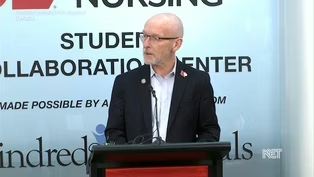
The commission will hold more public hearings before any money is allocated the University of Louisville School of Nursing has received a boost in its efforts to bring better health care access to medically underserved areas of the state.
The university announced today it was awarded 6 and a half million dollars in federal grants to support recruitment and retention of nursing professionals.
More than 4 million dollars will go toward an accelerated, licensed practical nurse to Bachelor of Science in Nursing Pathway.
It will support scholarships for up to 83 students to pursue a Bachelor of Science in nursing degree.
The other 2 million dollars will go toward increasing the number and the diversity of nurse practitioners.
>> As a community of care, U of L fosters that service mindset in the classroom and community that empowers our students to make a difference.
As an institution committed to diversity and inclusion.
These grants will enable more students from underrepresented and disadvantaged backgrounds to succeed in the nursing profession.
>> Grant recipients will participate in an emerging clinical experience working with rule or urban vulnerable populations.
This immersion experience will provide him P students with new experience to learning opportunities that will prepare them to address health inequities right here in the city of Louisville and across the Commonwealth of Kentucky.
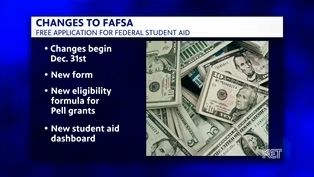
>> The 2 federal grants were awarded through the Health Resources and Services Administration changes are coming to the FAFSA program.
FASFA stands for Free Application for Federal Student Aid.
The program lets future college students figure out if they're eligible for federal financial help fast.
So will use a new form starting December 31st.
There's a new eligibility formula for Pell Grants.
And FAFSA is launching a student a dashboard to help students understand the complicated process.
The goal is to allow more students to access financial aid so they can attend college.
The dangers of low head dams and how a Kentucky community is honoring former first lady Rosalynn Carter.
Our Toby Gibbs has more in tonight's look at headlines around Kentucky.
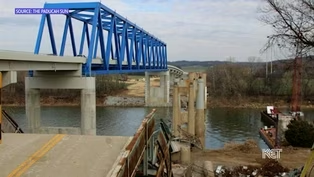
♪ ♪ >> Crews demolish the U.S. 60 Cumberland Bridge and Smith won Kentucky by explosives last week, the Paducah Sun reports after the bridge fell.
It took workers less than 2 hours to clear the new bridge of debris.
Crews also worked to remove debris from the river.
2 more explosions will be set off to demolish the remaining parts of the bridge in the coming weeks.
Wildlife officials are warning of the dangers of a low head dams in the state.
The Kentucky Lantern reports more than 1000 low head dams remain in Kentuckyian most do not have a purpose.
The dams, which can be as little as one foot or as high as 15 feet.
We're responsible for at least 40 deaths in Kentucky in the last few decades.
Ward Wilson, a former executive director of the Kentucky Waterways Alliance tells a Kentucky land and people can easily get stuck and drowned because of the way the water flows around the dam.
Russell County soldier killed in combat during World War.
2 was buried in Pulaski County last week.
The Commonwealth Journal reports the 24 year-old Henry Castle.
Wade was from the cater.
Army.
Officials said Wade was killed November of 1944. a defensive p o w m I a accounting agency.
Press release says Wade died during a battle with German forces were fighting lasted for days.
He was declared non recoverable in 1951.
His remains were identified through DNA testing in 2021.
Habitat for Humanity of Pulaski County, Kentucky is allowing people to share kind words on a frame door to remember.
Former first lady Rosalynn Carter, who was a passionate volunteer Carter died November 19th, her husband, President Jimmy Carter served in the White House from 1977.
Through 1981, the Commonwealth Journal reports the door has been placed in the lobby of the Pulaski County court house on the Fountain Square.
The Carters were regarded as the nonprofit's most famous volunteers.
With headlines around Kentucky.
I'm told he get.
♪ ♪ >> While they're simple parents, there's more than meets the eye to the muscles and other mollusks that live in Kentucky's water.
Raise the creatures play a vital role in the health of their ecosystems.
While several species of mussels are on the verge of extinction.
The Kentucky Department of Fish and Wildlife Center from Alex Conservation is working to KET that from happening >> one of the interesting things about the muscles in Kentucky.
We have over 100 species.
That's about a 3rd of what we have in North America and about.
>> 100 out of 800 or so in or, you know, nationally in the world.
But any one time you can go to a site anywhere in Kentucky in the bigger rivers like the greener, the looking and you can pick up like 30 species of mussels at one location.
We unfortunately have 29 species out of the 100 species or so in Kentucky that are listed as threatened endangered by the U.S.
Fish tomorrow service.
2 of those 3 of those are threatened and 26 are endangered.
So that means we have 26 species that are close to extinction.
When they're reading, they're filtering the water from madge, an area the size of a football field.
And that's the with the river.
You have this water flowing across the football field.
>> Imagine there's 100,000 little tiny filters that are pumping all that water.
And then taking anything that's in the water like my head bacteria, any kind of suspended particles even pollution and concentrate on that.
And I'm putting on the bottom sometimes binding it up so it doesn't get re suspended.
That result of that.
You have this huge ecosystem benefit.
>> I think they're very under-represented group.
And I've just learning about them and try to do research and bring them back to the species that's been around.
And we want to make sure the same number of species are always, you know, we don't want to lose any species if we can help them anyway.
And then just a civically towards muscles would be that how important they are to show good water quality, which is enduring good for our health and even just for drinking water, too.
So it's good.
Make sure they're around for that reason.
There's several that we've worked with that.
I >> probably would be close to being extinct.
Now, if we hadn't stepped in.
One is that is in danger in purple cast ball.
That species was thought to be extinct in the 1990's.
And then a researcher from Ohio.
This happened to run across one in a little stream in northeastern Ohio after 5 years of searching for these animals in the wild, we finally found 3 of 4 individuals that were females.
We brought them facility in 2012 and started working with them up to 2023, we have raised now over 10,000 animals and we've So now we have 12 locations around the country.
There are at 52,000 individuals of the danger purple cast Paul, they just look like a rock.
So they just seem not very advanced.
>> But just seeing all the different lures, the different ways that they interact with the ecosystem like them with the fish and how the fish are important.
So just cool to me.
This how different they all are.
We just think they're just a little Roxanne, the bottom of the river, we raise our own fresh water algae there's not many places.
Maybe a couple other place in the country that do that.
And the reason we do that is because we are working with more species and most people.
As a result of that, we need a good variety diet.
As a result, a razor on food.
We can raise a few species may be others, other places that have trouble with because they don't do that.
It's nothing frustrates 15 or 20 different species with.
8 or 10 of those being endangered species.
Each year.
Muscles that are rare and endangered living only the best water we had.
And so if there are places where we don't have in danger, air masses, that should send up a red flag to the people that live in that community.
Why aren't there muscles here?
If they're here, that's a good thing.
That means that they're still hanging or water quality has been good enough to support him.
>> But if they're not here, we need to do something about it.
>> Along with our work with muscles, the center for mollusk conservation is also working to repopulate the endangered Eastern Hellbender salamander.
♪ ♪ >> One in 8 American women is at risk of developing breast cancer, according to the American Cancer Society.
>> Breast Cancer is also the second leading cause of cancer deaths among women in Kentucky.
Screening guidelines have changed in recent years.
Our doctor when talks and sits down with Doctor Jeff hard just to cut through the confusion.
>> I want to talk about a subject that has absolutely no controversy associated and that screen.
Haha.
So yeah, we can do the whole show.
Yeah.
Mammography.
Where are we with?
Well, that's that's the more controversy, one that could go on for hours and hours.
So I think the main controversy has been 2 started for the restart of 50.
I think a lot of that's very confusing.
Confusing to patients.
Unequivocally worldwide consensus.
There is a benefit over inch 50 probably stopping at age 70 75 and us as a family history of prior history of cancer.
Assume that means nothing.
So the controversy in the 40 year-old is the moderate feels much more difficult to interpret because the breast tissue and younger women is thicker more dense and difficult to determine what's positive and what's negative mention the low-risk between your 40th and 50th birthday of getting breast cancer is only about 1.5%.
If you do a mammogram and every 40 year-old Fort.
10 consecutive years to their 50th birthday.
Most of the women will have one possibly more call backs or biopsies and the their stress with that, that's not having to wait to come back 2 weeks to get the second study done.
And then 3 weeks after that for biopsy and 2 weeks for that to come back, the downside and when it's unclear in the data is how much long-term benefit we get to that.
Was that really impact on getting earlier stage breast cancer and the data status kind of in our friends overseas in Europe.
And their socialized medical systems.
They don't they won't pay for anything over 50.
But I think when women getting between 40, 50, certainly if you have a family history, absolutely.
Can to 50 with no family history and try to focus on those diet lifestyle issues that that certainly reasonable decision and something.
They always say when you read about it that, you know, the doctor should talk about with patient.
Well, the poor primary care physician and the gynecologist they have long and busy days to go for that in fine detail.
I think that's still the proper way to put it.
>> Some important information there you can see doctor toxins, full interview on this weekend's edition of Kentucky Health, which airs on Sundays at one 30 pm Eastern 12, 30 central right here on KET.
♪ ♪ >> And the horse capital of the world work continues to make equestrian sports safer.
>> There's a new approach called the Triple A model.
It's from the UK Sports Medicine Research Institute.
We'll tell you how it works and what it means for keeping horses and riders safer.
That story and much more tomorrow on Kentucky.
Addition along with our weekly interview with dry Lynn Barton, public Radio journalist on the Political News of the Week.
>> And you can see it all tomorrow night at 6.30, Eastern 5.30, central on Kentucky EDITION where we inform connect and inspire subscribe to our Kentucky Edition email newsletters and watch full episodes and clips at K E T Dot Org.
Find us on the PBS video app on your mobile device and smart TV.
Send us a story idea.
And public affairs at KET and T Dot Org and follow KET on Facebook, X and Instagram to stay in the loop.
Thank you so much for watching.
We hope to see you right back here again tomorrow night.
Meantime, take really good care.
Tonight.
♪ ♪ ♪ ♪ ♪ ♪
Another Longtime KY Lawmaker Leaving Frankfort
Video has Closed Captions
Clip: S2 Ep134 | 25s | State Senator Denise Harper Angel says she will not run for reelection next year. (25s)
A Boost for Louisville’s School of Nursing
Video has Closed Captions
Clip: S2 Ep134 | 1m 35s | The University of Louisville's School of Nursing has received a boost in its efforts to... (1m 35s)
Video has Closed Captions
Clip: S2 Ep134 | 2m 52s | One in eight American women is at risk of developing breast cancer, according to the ... (2m 52s)
Changes Coming to the FAFSA Program
Video has Closed Captions
Clip: S2 Ep134 | 31s | FAFSA stands for “Free Application for Federal Student Aid.” The program lets future ... (31s)
Video has Closed Captions
Clip: S2 Ep134 | 2m 27s | The dangers of "low head" dams and how a Kentucky community is honoring former First ... (2m 27s)
Lawmakers React to “Fast-Tracking” Report
Video has Closed Captions
Clip: S2 Ep134 | 8m 32s | Lawmakers are reacting to a new report from the progressive-leaning League of Women ... (8m 32s)

Video has Closed Captions
Clip: S2 Ep134 | 4m 36s | While several species of mussels are on the verge of extinction, the Kentucky ... (4m 36s)

Video has Closed Captions
Clip: S2 Ep134 | 3m 37s | Supporters say Ibogaine can curb opioid addiction withdrawals and create a path to ... (3m 37s)
Providing Support for PBS.org
Learn Moreabout PBS online sponsorship
- News and Public Affairs

Top journalists deliver compelling original analysis of the hour's headlines.

- News and Public Affairs

FRONTLINE is investigative journalism that questions, explains and changes our world.












Support for PBS provided by:
Kentucky Edition is a local public television program presented by KET