
December 5, 2023 - PBS NewsHour full episode
12/5/2023 | 57m 46sVideo has Closed Captions
December 5, 2023 - PBS NewsHour full episode
December 5, 2023 - PBS NewsHour full episode
Problems playing video? | Closed Captioning Feedback
Problems playing video? | Closed Captioning Feedback
Major corporate funding for the PBS News Hour is provided by BDO, BNSF, Consumer Cellular, American Cruise Lines, and Raymond James. Funding for the PBS NewsHour Weekend is provided by...
December 5, 2023 - PBS NewsHour full episode
12/5/2023 | 57m 46sVideo has Closed Captions
December 5, 2023 - PBS NewsHour full episode
Problems playing video? | Closed Captioning Feedback
How to Watch PBS News Hour
PBS News Hour is available to stream on pbs.org and the free PBS App, available on iPhone, Apple TV, Android TV, Android smartphones, Amazon Fire TV, Amazon Fire Tablet, Roku, Samsung Smart TV, and Vizio.
Providing Support for PBS.org
Learn Moreabout PBS online sponsorshipGEOFF BENNETT: Good evening.
I'm Geoff Bennett.
AMNA NAWAZ: And I'm Amna Nawaz.
On the "NewsHour" tonight: U.S. lawmakers wrangle over whether to give Ukraine more military aid, as current funding is set to run out by the end of the year.
GEOFF BENNETT: Israeli troops move south into Gaza's second largest city, displacing thousands of civilians, including some who already fled fighting in the north.
AMNA NAWAZ: And Palestinians freed by Israel and their families reflect on the resumption of fighting and their time in prison.
NAWAF AL-SALAIMA, Father of Ahmed Al-Salaima (through translator): We feel happiness because our child is free.
But this happiness is not complete, because the price to get freedom for our kids was very expensive.
And the price was our people's blood in the Gaza Strip.
(BREAK) GEOFF BENNETT: Welcome to the "NewsHour."
A new phase in the bloody war in Gaza is now under way.
Israel is assaulting the largest city in the south, Khan Yunis.
Most of Gaza's population is now in that region.
AMNA NAWAZ: The war is now nearly two months old, with a death toll fast approaching 20,000, mostly Palestinian.
Despite pleas for more precision and fewer civilian killings from the U.S. and other Israeli partners, the thunderous campaign to root out Hamas in Gaza continues.
After weeks of fighting Hamas in Gaza's north and a weeklong pause inviting, a new phase in the war, as the IDF enters Gaza's second largest city.
LT. GEN. HERZI HALEVI, Chief of Staff, Israeli Defense Forces (through translator): Those who thought that the IDF would not know how to renew the fighting after the pause inviting were mistaken.
And Hamas is already feeling this.
AMNA NAWAZ: Israel believes that Yahya Sinwar, Hamas' leader in Gaza, is hiding among civilians there.
IDF commanders on the ground said this fight is their campaign's fiercest so far, as they aim to wipe out Hamas.
According to the U.N., Israel's bombardment has so far destroyed more than 46,000 housing units in Gaza and displaced an estimated 1.87 million people, or about 80 percent of the entire population.
And for the first time, Israeli officials released their own death toll estimates in Gaza, saying 15,000 Palestinians have been killed, about 30 percent of whom Israel claims were militants.
Gaza's Hamas run-Health Ministry says about 16,300 Palestinians have been killed, 70 percent of whom they say were women and children.
In Israel today, families of hostages still held by Hamas met with Prime Minister Benjamin Netanyahu and said time is running out.
RUBY CHEN, Father of Hamas Hostage: Each day that passes by, they are dying slowly each day.
We need to get them out immediately, whatever the price might be.
AMNA NAWAZ: They were reportedly told by Netanyahu in that meeting that there is -- quote -- "no possibility right now to bring everyone home."
Some families reportedly walked out in response.
And in the Israeli Knesset, a passionate appeal from Shir Siegel, whose mother, Aviva, was released from captivity in Gaza, but her father, Keith, still remains.
SHIR SIEGEL, Daughter of Hamas Hostages: While we speak, there's a Holocaust a three-hour drive from here.
Why is it more important for Bibi to kill Hamas leaders and not to bring my father back home?
AMNA NAWAZ: In an evening speech, Netanyahu responded.
BENJAMIN NETANYAHU, Israeli Prime Minister (through translator): Cabinet members and I met today with families of the hostages, those who we have already returned home and those who we are doing everything we can to get back.
AMNA NAWAZ: A Hamas representative said today they will not release more hostages until Israel's offensive in Gaza stops.
OSAMA HAMDAN, Hamas Spokesperson (through translator): We assure here again that there will be no negotiations or exchange of hostages until the aggression against our people and the steadfast Gaza Strip stops.
AMNA NAWAZ: Gazan civilians just want the horrors of war to end.
At Khan Yunis's Nasser Hospital today, victims lined the emergency room floor after another night of Israeli airstrikes, leaving some speechless.
MAN (through translator): There was shelling.
I can't even talk about it.
AMNA NAWAZ: Um Ibrahim's entire immediate family was left crushed under a building.
UM IBRAHIM AL NAJJAR, Gaza Strip Resident (through translator): Where are the ambulances?
I lost my children and my husband.
Where is the United Nations?
My children, my children, since 10:00 p.m., are still under the rubble.
AMNA NAWAZ: Residents of Khan Yunis, once declared safe by Israel, are now trying to escape to the southern town of Rafah on the Egyptian border.
Awaiting them there, a swelling humanitarian disaster, a line of hundreds at the only working water station in the city.
Ahmad Al-Attar has to walk more than a mile every day to fill up.
AHMAD AL-ATTAR, Displaced Palestinian (through translator): You have to wait for three hours in line.
You hold water on your shoulders.
The situation is very hard.
We take a bath once a month.
I am 63 years old and I'm carrying the gallon my shoulder for more than a mile.
AMNA NAWAZ: Others are packed into tent cities with no idea where they will go next.
Meanwhile, after a surge of settler violence against Palestinians in the West Bank since the war began, the U.S. State Department, in a rare move, imposed travel bans on dozens of Israeli settlers.
State Department spokesperson Matthew Miller: MATTHEW MILLER, State Department Spokesman: These acts threaten West Bank stability in the immediate term and take us further away from a future in which Palestinians and Israelis can both live in -- both can live in peace and security in two states.
GEOFF BENNETT: Meantime, tens of billions of dollars in military assistance for Israel and Ukraine and money for the U.S. Southern border remain stalled on Capitol Hill.
For the White House perspective, I spoke with National Security Adviser Jake Sullivan earlier this evening.
Jake Sullivan, welcome back to the "NewsHour."
JAKE SULLIVAN, U.S. National Security Adviser: Thanks for having me, Geoff.
GEOFF BENNETT: The administration is delivering a clear warning that, without congressional action by the end of the year, resources will run out for the U.S. to provide Ukraine with the weapons and equipment it needs.
Practically, what would that mean for Ukraine on the battlefield?
JAKE SULLIVAN: Well, what it would mean, Geoff, is that we would no longer be able to supply Ukraine with the artillery ammunition they need to hold their lines against Russian advances and to help them advance themselves to deoccupy territory Russia has taken.
It would mean that we would no longer be able to provide interceptors for Ukraine's air defense systems, which are protecting their soldiers on the front lines and, even more importantly, are protecting their cities from attacks by Russia that are trying to plunge the country into cold and darkness by destroying the electricity grid.
So these are the kinds of practical results that would happen if we do not continue to provide funding to Ukraine.
And Vladimir Putin is counting on this.
In fact, he said that if the United States stops giving money to Ukraine and the rest of the world stops giving money to Ukraine - - quote -- "Ukraine would have one week to live."
We need to prove Vladimir Putin wrong.
We need to get the funding to Ukraine so they can bravely and courageously continue to defend their country against Russian aggression.
GEOFF BENNETT: The U.S. has already contributed well over $100 billion to Ukraine's war efforts since Putin invaded that country back in February of 2022.
Beyond the funding, how can the U.S. better enable and empower Ukraine to actually breach Russian defenses and win the war, instead of sustaining their current fight?
JAKE SULLIVAN: Well, we have to take a step back.
When this war started in February of 2022, the experts were predicting that Ukraine would fall in a week, that the capital of Ukraine, Kyiv, would be under a Russian flag.
Today, Kyiv stands, and Ukraine stands as a sovereign independent country because of the funding that we have provided to Ukraine.
And more than that, since Russia launched its offensive in the early months following the invasion, Ukraine has taken back more than half the territory that Russia has occupied, more than 50 percent of that territory.
And that is thanks first to the bravery of the Russian -- of the -- excuse me -- Ukrainian forces, but second to the arms and supplies that the United States and the international coalition has provided to them.
So, if we can sustain those supplies, if we can continue to support Ukraine, it can continue to make progress on the battlefield and, equally importantly, it can continue to resist efforts by Russia, continuing efforts, to take more Ukrainian territory.
And that is basically fundamentally in the interests of the United States, because if, Russia succeeds in this fight against Ukraine, all of Europe is at risk.
And history tells us that, when all of Europe is at risk, the United States will pay a lot more later than the sums we are paying today to support Ukraine in this fight.
GEOFF BENNETT: House Speaker Mike Johnson says there will be no additional funding for Ukraine without first making extensive reforms to the U.S. immigration system.
And it was the White House, not Republicans, who initially linked funding for Israel, funding for Ukraine, money for Taiwan, and border security.
Why are the Republicans' border demands now a nonstarter?
JAKE SULLIVAN: Well, you make a very good point, Geoff.
It was, in fact, President Biden who put forward a supplemental funding request that included a substantial amount of funding for the border to enable us to have an effective and humane border security policy.
And that should have bipartisan support.
Democrats and Republicans should be able to come together around commonsense measures to ensure that our border policy is rational, effective and humane.
Democrats are ready to do that.
It turns out that what the Republicans are putting forward is to take-it-or-leave-it proposition.
They are not prepared to have a serious discussion at this time -- hopefully, that will change - - about border policy.
And as a result, they're holding Ukraine funding hostage to their demands on the border.
Our view is that it is in America's core national security interests to fund Ukraine against Putin, against Russian aggression.
And we can work together on the border.
But Ukraine should not be held hostage to the border.
That would be a grave mistake for our own national security and for broader global stability.
GEOFF BENNETT: On the Israel-Hamas war, the World Health Organization, the representative in Gaza said the humanitarian situation is getting worse by the hour, with intensified bombing and Khan Yunis and in Rafah.
A spokesperson for UNICEF said there is nowhere for civilians to go.
"Nowhere is safe," that was the quote.
In the administration's view, is Israel heeding the administration's insistence to limit civilian suffering in the southern part of Gaza?
JAKE SULLIVAN: Well, Geoff, what the Israeli Defense Forces has done in the last couple of days is highly unusual.
They have actually identified the specific areas of this city in the south, Khan Yunis, that they intend to conduct ground operations in and asked civilians to leave.
They have asked them to leave those areas.
So, in a sense, they telegraphed their punches where they were going to conduct their military operations.
Outside of those areas, we have made the case to Israel that it is critical that we get humanitarian assistance to Palestinian people who have been displaced because of the fighting, that they get shelter, food, water, medicine as necessary.
And over the course of the past days, we have seen a flow of humanitarian assistance coming in through that border crossing in Egypt.
We would like to see more.
There needs to be more aid that comes in, and Israel needs to take every possible care in the world to distinguish between legitimate targets, Hamas terrorists, who they are going after, and Palestinian civilians, who deserve to be protected, whose lives should have the same sacred quality that every life, every innocent life around the world has.
And we have made that case relentlessly to our Israeli counterparts, both publicly and privately, over the last many weeks.
GEOFF BENNETT: What is the U.S. prepared to do if it determines that Israel is not following a specific plan to mitigate civilian casualties?
JAKE SULLIVAN: Well, instead of trying to answer an if-then question, what I would just describe is what we do every day, what I did today.
I was on the phone for more than an hour with one of my Israeli counterparts walking through practical measures, like how to get more fuel in to power sanitation, desalinization, bakeries, so that people can eat and get potable water.
I talked about the steps that Israel could take to reduce the potential for civilian casualties, particularly in these safe areas outside of active combat hostilities.
We're going to continue to do that, and we're going to continue to expect that Israel meet the basic standards of international humanitarian law, and we will state our principles clearly and directly, as President Biden has done since the earliest days.
But at the same time, we are also going to support Israel as it goes against those terrorist masterminds who authored the worst massacre of Jews since the Holocaust on October 7.
And we cannot forget that Hamas is, even as we speak today, continuing to fire rockets and missiles against innocent civilians in Israel and represents a continuing threat that any country, including Israel, would have the right to go after.
GEOFF BENNETT: Is there any semblance of a path or a timeline to resume the talks for another temporary cease-fire?
JAKE SULLIVAN: Unfortunately, Geoff, there's not a specific timeline.
And the reason for that is because Hamas did not follow through on its end of the bargain.
It said that it was going to release the women and children that it was holding.
And it is still to this day holding civilian women who it refuses to release.
And we don't know why it refuses to release them.
But Israel is not prepared to move forward and leave those women behind.
And so Hamas chose not to release them, and that meant the end of the pause.
The ball is in Hamas' court.
It could release those women, and then Israel has made clear it is prepared to move on to additional negotiations to deal with other hostages as well.
And we, the United States, are determined not to rest.
We will be relentless until we ensure that every American hostage being held is safely reunited with their family.
GEOFF BENNETT: National Security Adviser Jake Sullivan.
Jake, thanks for your time this evening.
JAKE SULLIVAN: Thanks.
AMNA NAWAZ: For more on the debate over Ukraine funding and its global implications, we're joined by our congressional correspondent, Lisa Desjardins, and foreign affairs and defense correspondent Nick Schifrin.
Lisa, your reporting is that this was already a precarious moment when it comes to that funding for Ukraine.
It got even worse today with a very explosive meeting on Capitol Hill.
Why the impasse and why this incredible tension?
LISA DESJARDINS: Amna, President Biden proposed a national security funding bill to include money for Ukraine, for Israel, and for border funding.
But Republicans say there needs to be a change in border policy, and they said they don't think that Ukraine should be funded until that is taken care of.
That's the basic impasse.
So, come to today, there was a briefing on Ukraine, its security needs, but it got off to the wrong start immediately when Ukrainian President Volodymyr Zelenskyy, who was to be there by Zoom, canceled on the senators.
And then what resulted after that was senators pushing back at the secretary of state, at the secretary of defense, Republicans standing up, shouting, including at the Army -- the chief of staff to the Pentagon.
This was an extraordinary moment, where Republicans had been told that there wouldn't be questions about the border allowed.
And some stormed out, including Mitt Romney.
There are two very different versions of what happened.
SEN. MITT ROMNEY (R-UT): There's no reason to sit and listen to people talking about how important it is to help Israel and Ukraine.
We know that.
We get basically pabulum that's been available for weeks, which, by the way, we agree with, and an unwillingness in the part of Leader Schumer to discuss what it's going to take to actually get a deal done.
SEN. CHUCK SCHUMER (D-NY): When I brought up the idea that they could do an amendment and have the ability to get something done on border, they get stuck.
They got stuck.
They didn't like it.
And even one of them started -- was disrespectful and started screaming at the general -- one of the generals and challenging him to why he didn't go to the border.
QUESTION: Screaming at a general, Senator?
SEN. CHUCK SCHUMER: Yes.
LISA DESJARDINS: That's right, screaming at generals.
This is incredibly unheard of here in the Senate.
But it just shows you, Republicans, including in the Senate, are digging in on border demands, Democrats saying, no, it's not time to discuss that.
Let's fund Ukraine.
AMNA NAWAZ: Nick, when it comes to that funding for Ukraine, you heard Jake Sullivan telling Geoff earlier what he says the Biden administration sees as the stakes.
What do Ukrainians say about the stakes for this funding?
NICK SCHIFRIN: The bottom line is, they admit they cannot continue to fight the way they have been fighting without this money.
Take a listen to Andriy Yermak, President Zelenskyy's top aide, in Washington today admitting that U.S. support was the difference between victory and defeat.
ANDRIY YERMAK, Head of the Office of the President of Ukraine: It make with very high possibility impossible to continually liberate and give the big risk to lose this war.
NICK SCHIFRIN: Yermak admitted that, without more American weapons, Ukraine couldn't even try and recapture the 20 percent of territory that Russia continues to occupy, and would have to move to some kind of defensive crouch, essentially ceding, for now, at least, that 20 percent.
You also heard Jake Sullivan make this point, that Ukraine's air defense system, which is mostly American, mostly European, could run out of interceptors if this money is not sent.
And that's critical for protecting Ukraine's critical infrastructure, cities, but also preventing Russian jets from flying over and bombing at will.
And, lastly, Amna, without U.S. budgetary support, Ukraine's government cannot pay its bills, and that is from everyone from teachers to troops.
And so that's why Ukraine thinks this money is critical.
AMNA NAWAZ: But, Nick, even if Ukraine were to get this funding and the weapons they have requested, could they themselves meet the goals they have set?
NICK SCHIFRIN: It's such a good question, because the argument that Ukraine and its supporters make is this, that if only the U.S. and Europe had been giving them more weapons, if only the U.S. continued to give weapons today, then Ukrainians would be able to seize back all their land.
But the bottom line is that Ukraine has failed to overcome Russian defenses, especially in the south.
Units in Ukraine with the least combat experience got the most advanced training and weapons.
And there is a civ-mil divide.
There is a divide between the military and the civilian leadership that has become very public, while Russia is increasing its production of artillery and tanks.
So the bottom line, it's not clear that Ukraine could achieve its own goals, as you put it.
Zaluzhnyi, the commander in chief, admitted it himself.
There is a stalemate.
AMNA NAWAZ: So, Lisa, as you have been reporting, Republicans are holding up this funding over funding for the U.S.-Southern border.
What do the two sides want and what happens now?
LISA DESJARDINS: That's right.
There is agreement of more funding, but it's really these policy differences.
So look at the changes, the differences here.
Republicans, when they're talking about border talks, what they want is a deal on the border, including asylum policy and parole, basically shutting down those to policies to most of the Southern Hemisphere.
Democrats, what they want is Ukraine, Israel, and border together in a bill that looks like President Biden's bill, no border policy or limited border policy.
Now, Republicans, what they would like to do at the border is to sharply restrict asylum and parole.
As we're saying, people would not be able to apply directly from Mexico, most people, versus Democrats.
They say, hey, if we're going to open this up, we should be talking about DACA and including more status for people and maybe up some new asylum limits, but not going as far as Republicans want to go.
Now, Amna, we have been here before.
They disagree all the time, Republicans and Democrats, but I have to say, I have not seen them this far apart on such a core issue with as such little time as I do right now.
AMNA NAWAZ: Lisa, as you have also been reporting, at least one impasse was resolved tonight after nearly a year, right?
Senator Tommy Tuberville has released his hold on more than 450 military promotions and nominations.
Why the change now?
LISA DESJARDINS: How about that?
I think the pressure has been on Senator Tuberville, including from Republicans, who say you can no longer hold up these flag officers, as you say, over 400 military commanders who were not being promoted because of his hold having to do with the Pentagon's policy paying for travel for service members who needed to travel for abortion and other reproductive services.
He's held this up the whole time.
But, today, he did a full -- almost a full 180, a surrender on this.
They will still need to go through him for four-star generals.
That's just 11.
But, today, Amna, he went ahead, gave up his holds, and, within just a few hours, they passed these promotions.
Now 425 members of the U.S. military, as I speak to you now, have been promoted just today.
They have been waiting for 10 months.
AMNA NAWAZ: All right, Lisa Desjardins on Capitol Hill, Nick Schifrin here with us in studio, thank you to you both.
In the day's other headlines: President Biden suggested he might not have run for reelection if former President Trump weren't in the race.
Mr. Biden spoke this afternoon outside of Boston.
He told a crowd at a campaign fund-raiser - - quote -- "If Trump wasn't running, I'm not sure I would be running.
We cannot let him win."
Mr. Trump currently holds a wide lead in the Republican presidential field.
The House of Representatives will vote next week on formally authorizing an impeachment inquiry into President Biden.
Republican-led committees have been investigating business dealings of Biden family members for months.
But Speaker Mike Johnson said today the White House has balked at providing information.
REP. MIKE JOHNSON (R-LA): And the House has no choice, if it's going to follow its constitutional responsibility, to formally adopt an impeachment inquiry on the floor, so that, when the subpoenas are challenged in court, we will be at the apex of our constitutional authority.
It will be a movement of a vote of the full House.
AMNA NAWAZ: So far, the investigation has not produced any direct evidence against President Biden.
North Carolina Republican Patrick McHenry now says he won't run for reelection to the House after all.
The 10-term congressman had served as interim speaker in October until Republicans chose a permanent speaker.
After that, he said he'd seek another term next year.
Today, he said -- quote -- "I believe there's a season for everything, and, for me, this season has come to an end."
McHenry's statement gave no reason for his change of heart.
FBI Director Christopher Wray urged Congress today to renew the bureau's authority for surveillance without warrants outside the U.S. That authority comes from section 702 of the Foreign Intelligence Surveillance Act.
Wray told a Senate hearing that letting warrantless wiretaps lapse at the end of the month would amount to unilateral disarmament.
CHRISTOPHER WRAY, FBI Director: 702 allows us to stay a step ahead of foreign actors located outside the United States who pose a threat to national security.
And the expiration of our 702 authorities would be devastating to the FBI's ability to protect Americans from those threats.
AMNA NAWAZ: Both Republicans and Democrats are pressing for changes in the program.
They have cited concerns that FBI analysts improperly accessed data on Americans during the January 6 riots and racial justice protests.
A top European Union official has issued a stark security warning for the holidays.
That follows a weekend attack in Paris.
One person was stabbed and killed at the Eiffel Tower and two others injured with a hammer by a man who had pledged allegiance to the extremist Islamic State.
Today, in Brussels, the European home affairs commissioner said there is -- quote -- "a huge risk" of terrorist attacks in Europe during the Christmas season.
The German interior minister agreed.
NANCY FAESER, German Interior Minister (through translator): This brutal violence shows just how acute and how serious the threat posed by Islamist terrorism is currently in the E.U., not only in Germany, but also in all neighboring countries.
And the war in Gaza and Hamas' terror are exacerbating this situation.
AMNA NAWAZ: The European Commission now plans to spend more than 30 million dollars on additional security, especially for places of worship.
Close to 400 Rohingya refugees are still stranded tonight off the coast of Thailand.
U.N. officials say they have been at sea for two weeks, and some of them may die due to lack of food and water if they are not rescued soon.
The refugees are adrift in the Andaman Sea,about 200 miles offshore after fleeing crowded camps in Bangladesh.
There is fresh data that shows students worldwide suffered unprecedented learning losses during the pandemic.
The Program for International Student Assessment reports average math scores in 2022 fell 15 points from four years earlier.
Average reading scores during that same period were down 10 points.
The findings are based on testing of 15-year-olds in more than 80 countries, including the U.S. And, on Wall Street, the Dow Jones industrial average lost nearly 80 points to close at 36124.
The Nasdaq rose 44 points, and the S&P 500 slipped two.
Still to come on the "NewsHour": college leaders face congressional scrutiny about rising antisemitism and Islamophobia; Vice President Harris makes history with a record-setting tiebreaker vote in the Senate; Tarik "Black Thought" Trotter of The Roots reflects on his impact on hip-hop in a new memoir; plus much more.
GEOFF BENNETT: More than 200 Palestinians detained or imprisoned by Israel were released last week during the truce between Israel and Hamas, among them, mostly women and children.
They are just some of the thousands of Palestinians held by Israel for a range of both alleged and convicted offenses.
Nick Schifrin reports.
NICK SCHIFRIN: This is the day the Al-Salaima family had been waiting for; 14-year-old Ahmed Al-Salaima is home in East Jerusalem after three months of Israeli incarceration, back in the protective embrace and watchful gaze of his father, Nawaf Al-Salaima, who told us this moment is bittersweet.
NAWAF AL-SALAIMA, Father of Ahmed Al-Salaima (through translator): We feel happiness because our child is free.
But this happiness is not complete, because the price to get freedom for our kids was very expensive.
And the price was our people's blood in the Gaza Strip.
NICK SCHIFRIN: Ahmed Al-Salaima was one of Israel's youngest prisoners.
He was released last week at the same time as his 15-year-old cousins Mohammed (ph) and Mutaz (ph).
Of the 240 Palestinians released during the pause in Gaza, nearly half were children.
Did the conditions of your detention change from before October 7 to after October 7?
AHMED AL-SALAIMA, Released Palestinian Detainee (through translator): Before October 7, they treated us well.
For example, they'd say hello and good night.
They were respectful.
But after October 7, they started hitting female prisoners.
And they started to reduce the quantity of the food.
There were nine of us in the room, and they gave us two meals in small quantities.
Before entering the jail, I was 158 pounds, but now I'm 121 pounds.
NICK SCHIFRIN: An Israeli prison spokesperson told the "NewsHour": "We are not aware of the claims you described, and all prisoners are detained according to the provisions of the law."
Ahmed Al-Salaima and his cousins live in East Jerusalem, captured by Israel in 1967.
Israeli police first placed them under house arrest in may.
In July, they bid their grandmother goodbye when police arrested them for -- quote -- "rock-throwing, causing serious bodily injury, damage to property and hostile terrorist activity."
Police say his trial was still ongoing when he was released.
AHMED AL-SALAIMA (through translator): There's no proof at all that I was throwing stones at that time.
I never used to leave the house at night.
Israeli forces came to the house at 4:00 a.m., where me and my 12-year-old brother were asleep, and there's proof that they took me from inside my home.
TALA NASSER, Addameer Prisoner Support: Currently, there are more than 7,600 Palestinians detained in Israeli prisons.
So this is an unprecedented number.
NICK SCHIFRIN: Tala Nasser is a lawyer with Palestinian prisoner support and human rights organization Addameer.
She said, since October the 7th, Israel had detained or arrested more than 3,000 Palestinians, including more than 200 children.
TALA NASSER: The occupation tries -- and tries to silence the Palestinians, and that happens when the occupation arrests the possible number - - the largest possible number of Palestinians.
BRIG.
GEN. ILAN BORREDA (RET.
), Former Head, Israeli Prison Service Intelligence Division: They are not innocent people, not at all.
NICK SCHIFRIN: Last week, the Israeli government organized a briefing from retired Brigadier General Ilan Borreda, a military lawyer and former head of the Israeli Prison Service Intelligence Division.
BRIG.
GEN. ILAN BORREDA: They made an act of terror.
They were captured, they were tried and convicted in court by law, and they were in prison for making an act of terror.
NICK SCHIFRIN: In the occupied West Bank, Israeli soldiers administer justice.
Advocates call those military courts unfair.
TALA NASSER: Palestinians are actually convicted in these courts at a rate exceeding 99 percent.
NICK SCHIFRIN: And Palestinians in Jerusalem also call Israel's civil courts unfair to Palestinians.
Nehaya Sawwan was released on the first day of the temporary truce and hugged her niece, Rouaa Jobran.
ROUAA JOBRAN, Niece of Released Palestinian Prisoner (through translator): My heart was broken when I see her the last -- the first time.
NICK SCHIFRIN: Sawwan had breast cancer when she was arrested.
Her family says, in jail she didn't receive any treatment and also became diabetic.
Jobran says now she barely recognizes her aunt.
Even though she's now surrounded by family, she's struggling with her recovery.
ROUAA JOBRAN (through translator): My aunt can't sleep, and she has stopped talking to people.
She entered the jail as someone, and she became a different person there.
She's someone else now.
NICK SCHIFRIN: Israel denies any prisoner is mistreated.
BRIG.
GEN. ILAN BORREDA: So, in prison, all of the prisoners, not only terrorists, all of the prisoners get medical care.
NICK SCHIFRIN: But advocates say conditions have long been difficult, more so since October the 7.
TALA NASSER: We have documented many of the extensive violations, including violent raids by special forces, including firing the tear gas, rubber bullets, live ammunition, and brutally beating prisoners, actually.
NICK SCHIFRIN: An Israeli Prison Service spokesperson says Nehaya Sawwan was convicted for supporting terrorism, serious bodily injury and illegal carrying of knives and daggers, and was sentenced to three years and eight months.
Her family says she was jailed as she prayed at the Al-Aqsa Mosque.
ROUAA JOBRAN (through translator): She is a peaceful, nice person who treats others well.
Even when she was first arrested, we didn't believe it, because she was only trying to defend herself while she was in Al-Aqsa Mosque.
NICK SCHIFRIN: As for Ahmed Al-Salaima, he wants to be the shoulder to lean on for his doting mother, and he takes pride in being his father's son.
AHMED AL-SALAIMA (through translator): I want to follow in my dad's footsteps.
I want to go back to school and graduate.
My father is a driving instructor, and I want to finish school, so I can help my dad test the student drivers.
NICK SCHIFRIN: Nawaf, what do you want for your son's future?
NAWAF AL-SALAIMA (through translator): I want him to be better than me.
I know that he wants to help me and be a driver, but, for me, I wish him a better life.
I will give him the freedom of choice, but I want him to finish his education.
And the most important thing that I want him to be is a good person.
NICK SCHIFRIN: But, this week, Nawaf Al-Salaima posted this video describing how Israeli authorities prohibited released prisoners from returning to high school.
NAWAF AL-SALAIMA (through translator): We want to ask, where are we going to take our children after today?
NICK SCHIFRIN: Nawaf Al-Salaima is hoping the answer to that question is not another round of detention.
For him, that is a generational fear.
NAWAF AL-SALAIMA (through translator): I spent 1993 and 1994 in the same prison that I took my son and his cousins to on July 30.
I refused to take their mothers, because I didn't want anyone to see my emotions and tears.
NICK SCHIFRIN: So, how, sir, in your opinion, can this cycle end?
NAWAF AL-SALAIMA (through translator): The only way out of the tears and anger and woes is to end the occupation and to return to life before occupation, where we lived in one country as Palestinians, Jews and Christians, not the nationalists, but the Jews who know that Muslims welcomed them when they were exiled from countries around the world, when they left Europe because of the Holocaust, and we shared our lands and our lives.
NICK SCHIFRIN: But there's not a lot of hope these days for sharing or more releases, now that the fighting in Gaza has resumed.
For the "PBS NewsHour," I'm Nick Schifrin.
GEOFF BENNETT: We're going to shift our focus now to the heated debate on many college campuses over the Israel-Hamas war and concerns over incidents of violence, threats and hate speech, which made their way to Capitol Hill today.
Protests that erupted after the October 7 Hamas attack on Israel have roiled college campuses across the country, with college administrators facing backlash over their responses to alleged incidents of antisemitism.
That was the focus of the congressional hearing today, as the presidents of Harvard University, the University of Pennsylvania, and Massachusetts Institute of Technology faced questions from the House Committee on Education and the Workforce.
Committee Chairwoman Virginia Foxx opened the hearing accusing the schools of fostering a culture of antisemitism.
REP. VIRGINIA FOXX (R-NC): Institutional antisemitism and hate are among the poison fruits of your institution's cultures.
GEOFF BENNETT: Harvard President Claudine Gay, who assumed the role this summer, acknowledged her own struggles at such a tense moment.
CLAUDINE GAY, President, Harvard University: I know many in our Harvard Jewish community are hurting and experiencing grief, fear and trauma.
I have heard from faculty, students, staff and alumni of incidents of intimidation and harassment.
At the same time, I know members of Harvard's Muslim and Arab communities are also hurting.
During these difficult days, I have felt the bonds of our community strain.
In response, I have sought to confront hate while preserving free expression.
This is difficult work, and I know that I have not always gotten it right.
GEOFF BENNETT: Sally Kornbluth is the president of MIT.
SALLY KORNBLUTH, President, Massachusetts Institute of Technology: I have been president of MIT since January of this year.
As an American, as a Jew, and as a human being, I abhor antisemitism.
And my administration is combating it actively.
GEOFF BENNETT: All of the college leaders who were testifying said bigotry against Jews, Muslims, Arab Americans, or anyone else was unacceptable and described their efforts to protect students and foster civil dialogue at their schools.
But since the outbreak of the war, it's been easier said than done.
At Harvard last month, a Jewish student was surrounded by pro-Palestinian protesters yelling "Shame."
REP. LISA MCCLAIN (R-MI): Was any discipline action - - I love the lip service.
I do.
And you academic -- I love that.
I'm looking for an action item.
Yes, no, was anybody expelled, any action item?
And if you don't know, that's OK too.
CLAUDINE GAY: We hold our community to account for our policies.
REP. LISA MCCLAIN: All right, I will reclaim my time.
GEOFF BENNETT: Republican Congresswoman Elise Stefanik of New York followed up.
REP. ELISE STEFANIK (R-NY): Well, let me ask you this.
Will admissions offers be rescinded or any disciplinary action be taken against students or applicants who say, from the river to the sea or intifada, advocating for the murder of Jews?
CLAUDINE GAY: As I have said, that type of hateful, reckless, offensive speech is personally abhorrent to me.
REP. ELISE STEFANIK: ... today that no action will be taken.
What action will be taken?
CLAUDINE GAY: When speech crosses into conduct that violates our policies, including policies against bullying, harassment, or intimidation, we take action.
And we have robust disciplinary processes that allow us to hold individuals accountable.
GEOFF BENNETT: The lawmakers were universal in their condemnation of antisemitism, but Democrats accused Republicans of using today's hearing for other purposes.
REP. SUZANNE BONAMICI (D-OR): I also want to note that the main point of this hearing should be to identify bipartisan solutions to combat antisemitism, not an excuse to attack higher education, liberal arts education, or important diversity, equity, and inclusion work that's happening at colleges and universities across the country.
GEOFF BENNETT: Ahead of the hearing, Republicans organized a press conference with Jewish students sharing how antisemitism has affected them.
TALIA KHAN, MIT Student: For my part, I was forced to leave my study group for my doctoral exams halfway through the semester because my group members told me that the people at the Nova Music Festival deserved to die because they were partying on stolen land.
GEOFF BENNETT: Penn's president, Elizabeth Magill, repeatedly touted the university's plan to combat antisemitism.
LIZ MAGILL, President, University of Pennsylvania: We are in the midst of making certain that all anti-bigotry efforts ensure education about antisemitism.
Some parts of our program do, and some parts of our program need to be enhanced.
So we're working on that right now.
GEOFF BENNETT: In light of multiple events at various campuses, the Department of Education recently launched an investigation into seven schools.
The inquiry is focused on complaints of antisemitism and Islamophobia, and schools could face a loss of funding if they don't comply.
AMNA NAWAZ: A milestone moment in the U.S. Senate today, the 300th tiebreaking vote, and an even bigger moment in history for Vice President Kamala Harris, who has now broken 33 deadlocks, more than any other V.P.
before her.
Lisa Desjardins takes a look at Harris' role in a polarized Senate.
LISA DESJARDINS: On watch next to the Senate chamber sit the busts of vice presidents past, some famous, some infamous, many now forgotten.
But none ever saw what just happened, a 191-year-old record broken.
KAMALA HARRIS, Vice President of the United States: On this vote, the yeas are 50 and the nays are 50.
LISA DESJARDINS: Vice President Kamala Harris first tied and now clinched the record for most tie votes cast by any vice president.
SEN. CHUCK SCHUMER (D-NY): The record Vice President Harris sets today is significant, not just because of the number, but because of what she's made possible with tiebreaking votes.
LISA DESJARDINS: Her tiebreaking votes have included some especially weighty ones.
KAMALA HARRIS: The Senate being equally divided.
LISA DESJARDINS: The nearly $2 trillion American Rescue Plan with COVID stimulus.
KAMALA HARRIS: The vice president votes in the affirmative.
LISA DESJARDINS: Last year's Inflation Reduction Act with climate and health care provisions and over a dozen... KAMALA HARRIS: The vice president votes in the affirmative, and the nomination is confirmed.
LISA DESJARDINS: ... nominees from the Federal Reserve to federal courts.
KAMALA HARRIS: The vice president votes in the affirmative.
KELLIE CARTER JACKSON, Wellesley College: It shows that there's a lot of power that Kamala Harris has in her role right now in deciding really the direction of the country.
LISA DESJARDINS: Kellie Carter Jackson is a historian and professor at Wellesley College.
She points out that Harris is always already historic, the first female vice president, the first Asian American, and the first African American.
And she has now taken the record for the most ties from John C. Calhoun, perhaps the most influential white supremacist in U.S. history.
He argued slavery was good for Black people.
KAMALA HARRIS: Do you solemnly swear that you will support and defend... LISA DESJARDINS: It's unlikely he ever imagined someone like Harris in the Senate... KAMALA HARRIS: The nays are 50.
LISA DESJARDINS: ... much less casting its deciding vote.
KELLIE CARTER JACKSON: Occupying those spaces of a Black woman or woman of color, I think it is unprecedented.
But I also think that what's interesting is that when you compare her leadership alongside someone like John C. Calhoun, the two couldn't be further apart.
LISA DESJARDINS: And consider this.
It took Calhoun nearly eight years to rack up 31 tiebreaking votes, but Harris beat that number in just over two.
FMR.
LT. GOV.
BILL BOLLING (R-VA): I think it just reflects the political polarization that exists in the broader society.
LISA DESJARDINS: Bill Bolling is a professor of policy and government at George Mason University and: FMR.
LT. GOV.
BILL BOLLING: So, I have the distinction of having cast more tiebreaking votes than any lieutenant governor in the history of our state.
LISA DESJARDINS: In the 2000s, the Virginia Senate, like the U.S. Senate today, was narrowly split, and sometimes evenly so.
As lieutenant governor, Bolling cast dozens of tiebreaking votes.
FMR.
LT. GOV.
BILL BOLLING: Well, it's a lot of responsibility.
LISA DESJARDINS: And burden.
When the Senate is in town, Harris must be also.
Her supporters say this is one reason her approval ratings aren't higher.
She can't travel and build a profile as easily.
WOMAN: So now they might need the veep?
LISA DESJARDINS: But also, in these tie votes, whether state or national, are broader lessons.
FMR.
LT. GOV.
BILL BOLLING: As a political scientist, I'm often reminding my students that we are living in one of the most political -- politically polarized times in American history.
And that's going to increase the frequency with which these tiebreaking votes occur.
And it's going to increase both the responsibility, but also the power and the influence that these presiding officers can provide.
LISA DESJARDINS: Joe Biden never cast a single tie vote as vice president.
But Harris told CBS her repeated job of it is a bonding point.
KAMALA HARRIS: In fact, the president and I joke.
And when I leave one of our meetings to go break a tie, he says, "Well, that's going to be a winning vote."
Whenever I vote, we win.
It's a joke we have.
But the stakes are so high.
LISA DESJARDINS: High stakes in an institution where process is power and where no vice president has ever been as decisive of a vote as this one, with more tiebreaks almost certainly ahead.
For the "PBS NewsHour," I'm Lisa Desjardins.
AMNA NAWAZ: The Roots are known as one of hip-hop's most important and influential groups.
They're also well-known as the house band of "The Tonight Show."
And their lead emcee, Tariq Trotter, better known by his stage name, Black Thought, has been called one of the most skilled and prolific rappers of our time.
Now, during this 50th anniversary year of hip-hop, the Grammy winner tells his own story in a new memoir and sat down with Jeffrey Brown recently for our arts and culture series, Canvas.
TARIQ "BLACK THOUGHT" TROTTER, Musician: Yes, and then this is my block.
Like, this is where I essentially grew up.
So... JEFFREY BROWN: A drive through south Philadelphia with native son Tariq Trotter.
TARIQ "BLACK THOUGHT" TROTTER: It's a place where you have to persevere, you know what I'm saying, to get anywhere.
It's the sort of place that eats folks alive.
JEFFREY BROWN: But it also came with its own energy.
Trotter recalled his time as a youngster selling shopping bags.
TARIQ "BLACK THOUGHT" TROTTER: So I was the one of the kids who walked up and down this street saying, shopping bags, got shopping bags here, shopping bags.
Fifty cents, shopping bags.
Get your shopping bags, shopping bags over here.
JEFFREY BROWN: You were always working.
TARIQ "BLACK THOUGHT" TROTTER: I was.
JEFFREY BROWN: Under his stage name, Black Thought, Trotter would write and rap his way to world stages as co-founder of The Roots, a band known for its instrumentation, live performance, and grounding in jazz and other genres.
Now, in "The Upcycled Self: A Memoir on the Art of Becoming Who We Are," he takes us back to the experiences and contradictions of his early years, deep love from family, yet hardness, violence and loss all around, the house he accidentally burned down as a young child, friends and family destroyed amid the crack epidemic of the 1980s, most of all, his mother, lost to addiction and then murdered.
But this is also a story of resilience and triumph that came through art, most of all, the art of hip-hop.
TARIQ "BLACK THOUGHT" TROTTER: Hip-hop is making something out of nothing.
Hip-hop is -- I talk about the upcycle in this book.
Hip-hop is that, is the upcycle.
It's using -- it's putting the pieces of a thing, right, that are salvageable to use.
JEFFREY BROWN: And the upcycled self-means sort of taking what's around you and what?
TARIQ "BLACK THOUGHT" TROTTER: Taking, I mean, not only what is around you, but dealing with that which lies within.
It's about a world view, a way of moving through this space that at one point in time was life or death, right?
And it's about understanding the difference between that which needs to be abandoned and that which needs to be put to a different use.
And this is beautiful work.
JEFFREY BROWN: Visual art seeing and making it came first and then music.
TARIQ "BLACK THOUGHT" TROTTER: I was looking for just a place to -- where I had the freedom to continue to be creative.
JEFFREY BROWN: A seminal period was the two years he spent at the Philadelphia High School for Creative and Performing Arts, known as CAPA, where he took us to watch band rehearsal and then encouraged current students.
TARIQ "BLACK THOUGHT" TROTTER: It's not always comfortable to lean into your talents and to lean into your graces, but it's sort of our responsibility as artists.
JEFFREY BROWN: CAPA, then in a different location, is where he met Ahmir Thompson, better known as Questlove, a brilliant percussionist and student of music of all kinds who befriended and influenced Trotter.
They first called their band The Square Roots, then The Roots.
You write: "Art saved me."
TARIQ "BLACK THOUGHT" TROTTER: Yes.
JEFFREY BROWN: So, saved you from what and how did it save you?
TARIQ "BLACK THOUGHT" TROTTER: Art saved me from becoming a statistic, as so many of my friends and family members and neighbors and just so many of my contemporaries had and have become.
From the first glimpse, right, from my first, my earliest exposure to art and to the arts, I was sort of hooked, and it became my escapism, and it became the fuel for my imagination and the way that I saw the world.
JEFFREY BROWN: And, for you, I mean, this is what you describe -- it is so striking - - the use of the discovery and then use of words and language and then rhyming.
TARIQ "BLACK THOUGHT" TROTTER: Yes.
Yes.
I initially found words in the encyclopedias.
We had the full on, the sets of Encyclopedia Britannica and World Book Encyclopedias and stuff.
That was the Internet long... JEFFREY BROWN: Were you flipping through the pages?
(CROSSTALK) TARIQ "BLACK THOUGHT" TROTTER: Absolutely.
That was the Internet, long before the Internet.
It was transportive.
It was transcendent and transformative for me.
You have become a symbol in the spirit life.
Rest in power, rest in paradise.
JEFFREY BROWN: As Black Thought, Trotter became known as a master wordsmith, building phrases and rhymes into powerful storytelling, especially of Black identity and experience.
In 2017, he delivered a now legendary 10-minute solo freestyle performance on Funkmaster Flex's Hot 97 radio show, a verbal acrobatic mix of references, metaphors, personal and political punch.
TARIQ "BLACK THOUGHT" TROTTER: I'm pulling everything from everywhere, every experience, every relationship, every moment of one's life.
When it's good, you're -- at best, you should be able to channel that energy.
JEFFREY BROWN: Pulling words, images, histories from everywhere.
TARIQ "BLACK THOUGHT" TROTTER: I feel like one of the purposes that I serve as an emcee is as a historian.
It doesn't seem like I'm coming from a place with the intention of teaching, but... JEFFREY BROWN: But you are.
TARIQ "BLACK THOUGHT" TROTTER: But I am.
JEFFREY BROWN: So, entertain, but also teach.
TARIQ "BLACK THOUGHT" TROTTER: Educate.
JEFFREY BROWN: Educate.
TARIQ "BLACK THOUGHT" TROTTER: Yes, yes, and it's not easy, but that's what I do.
That's why I'm Black Thought.
JEFFREY BROWN: In recent years, Trotter has expanded his palette, including a series of solo recordings titled "Streams of Thought."
TARIQ "BLACK THOUGHT" TROTTER: See right where the man coming from.
JEFFREY BROWN: And as an actor appearing in the HBO series "The Deuce" and in the off-Broadway musical "Black No More," for which he also wrote music and lyrics.
The hope is to bring it to Broadway.
Now 50, Trotter looks back and ahead with a keen sense of legacy for himself and his art form.
TARIQ "BLACK THOUGHT" TROTTER: It's important to me just to continue to tell my story, our stories.
That's part of my responsibilities, to continue to elevate this craft to that level of high art, whether it's my own art, my own contribution that is recognized as such, or whether it's just my contribution is in having the culture recognized as such.
I feel that is part of -- you know, that's my mission.
JEFFREY BROWN: Next up for Tariq Trotter, AKA Black Thought, a new Roots album, plus the latest in his solo recordings.
For the "PBS NewsHour," I'm Jeffrey Brown in Philadelphia.
GEOFF BENNETT: Later this evening on PBS, "Frontline' presents a film about the school shooting in Uvalde, Texas, back in May 2022.
"Inside the Uvalde Response' draws on real-time firsthand accounts and uses official bodycam footage and audio.
Produced with ProPublica and The Texas Tribune, the film reconstructs the chaotic response to the shooting and examines the missteps, lessons learned, and the lingering trauma of that day.
NARRATOR: The gunman fires through the door of one of the classrooms, grazing staff Sergeant Canales and Lieutenant Martinez.
STAFF SGT.
EDUARDO CANALES, Uvalde Police Department: Am I bleeding?
Am I bleeding?
Am I bleeding?
That's when I feel my blood or something, and I was like, what -- was I (EXPLETIVE DELETED) shot?
What's going on?
And Javier was like: "Hey, I feel like" -- so we both kind of retreat back a little bit towards where we (INAUDIBLE) entered.
And we kind of turned around, and we were just like -- I don't know if this guy is to come out.
NARRATOR: Surveillance footage shows Lieutenant Martinez going back down the hallway alone, then returning to where other officers are positioned.
LOMI KRIEL, ProPublica/Texas Tribune Investigative Unit: The first few moments of a response is crucial, is what experts said.
This is the best moment in time to engage the shooter and rescue any victims.
So officers initially did that, and then they stumbled back when they're grazed by bullets.
And that ends up really setting the stage for the rest of the response.
No one tried to go into the room for another 70 minutes.
STAFF SGT.
EDUARDO CANALES: I honestly didn't think anybody was in there besides the gunman, because I - - and not that -- I just honestly thought that they were in the cafeteria, because it was -- it seemed like all the lights were off and it seemed like it was really quiet.
I didn't hear any screaming, any yelling.
I literally didn't hear anything at all.
And you would think if there was -- kids would be yelling and screaming.
LOMI KRIEL: Officers after officers said that, because it was so silent, they didn't hear any screams or any indication that a child was inside that wing, that they believed it was empty, even though it was the middle of a school day on one of the last days of the semester.
DET.
RONALD RODRIGUEZ, Uvalde Police Department: We couldn't hear the kids.
We couldn't hear him shooting anybody or anything like that.
So I guess that's why they were waiting to make entry, because we didn't know what was going on in there.
It was too quiet.
GEOFF BENNETT: "Inside the Uvalde Response" premieres on PBS stations and streams on YouTube at 10:00 p.m. Eastern.
And that is the "NewsHour" for tonight.
I'm Geoff Bennett.
AMNA NAWAZ: And I'm Amna Nawaz.
On behalf of the entire "NewsHour" team, thank you for joining us.

College leaders face questions over threats and hate speech
Video has Closed Captions
College leaders face congressional hearing over antisemitism and Islamophobia on campus (5m 9s)

Global implications of Ukraine military assistance debate
Video has Closed Captions
The global implications of the U.S. debate over Ukraine military assistance (6m 49s)
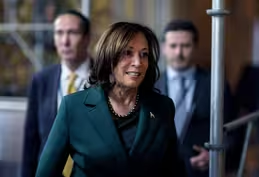
Harris makes history with 32nd tiebreaker vote in Senate
Video has Closed Captions
Harris makes history with record-setting 32nd tiebreaker vote in Senate (4m 22s)
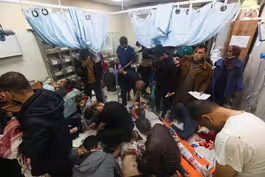
Israeli troops move south into Gaza's 2nd largest city
Video has Closed Captions
Israeli troops move south into Gaza's 2nd largest city amid pleas to protect civilians (4m 46s)
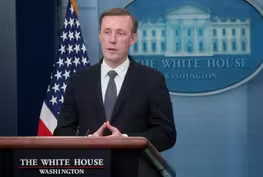
National security adviser on Ukraine funding debate
Video has Closed Captions
National security adviser discusses Ukraine aid as funding remains stalled in Congress (8m 43s)
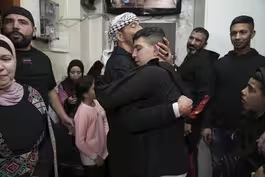
Palestinians freed by Israel reflect on their time in prison
Video has Closed Captions
Palestinians freed by Israel reflect on time in prison and resumption of fighting in Gaza (7m 17s)

Tariq Trotter on his new memoir 'The Upcycled Self'
Video has Closed Captions
Tariq 'Black Thought' Trotter on his impact on hip-hop and new memoir, 'The Upcycled Self' (8m 1s)
Providing Support for PBS.org
Learn Moreabout PBS online sponsorship
- News and Public Affairs

FRONTLINE is investigative journalism that questions, explains and changes our world.

- News and Public Affairs

Today's top journalists discuss Washington's current political events and public affairs.












Support for PBS provided by:
Major corporate funding for the PBS News Hour is provided by BDO, BNSF, Consumer Cellular, American Cruise Lines, and Raymond James. Funding for the PBS NewsHour Weekend is provided by...