
December 5, 2024
Season 3 Episode 136 | 26m 32sVideo has Closed Captions
A Northern Kentucky city votes to put some restrictions on medical marijuana.
A Northern Kentucky city votes to put some restrictions on medical marijuana, local reaction to a SCOTUS case focused on transgender medical care for youth, meet a Kentucky woman who has skipped medications because of high costs, and see the grocery store that set up shop in a food desert.
Problems playing video? | Closed Captioning Feedback
Problems playing video? | Closed Captioning Feedback
Kentucky Edition is a local public television program presented by KET
December 5, 2024
Season 3 Episode 136 | 26m 32sVideo has Closed Captions
A Northern Kentucky city votes to put some restrictions on medical marijuana, local reaction to a SCOTUS case focused on transgender medical care for youth, meet a Kentucky woman who has skipped medications because of high costs, and see the grocery store that set up shop in a food desert.
Problems playing video? | Closed Captioning Feedback
How to Watch Kentucky Edition
Kentucky Edition is available to stream on pbs.org and the free PBS App, available on iPhone, Apple TV, Android TV, Android smartphones, Amazon Fire TV, Amazon Fire Tablet, Roku, Samsung Smart TV, and Vizio.
Providing Support for PBS.org
Learn Moreabout PBS online sponsorship>> A lot of other cities might start to take this type of position.
>> A northern Kentucky town cancels medical cannabis for some city workers.
Last year.
We worked with over 70,000 students total.
We visit what could be Kentucky's largest classroom.
I know that if I were stock in that situation, I would want to feel loved and appreciated.
>> And meet the high school students toying with a 17 year-old tradition.
>> Production of Kentucky Edition is made possible in part by the KET Millennium Fund.
♪ ♪ Good Evening and welcome to Kentucky EDITION on this Thursday, December the 5th, I'm Renee Shaw.
Thank you for spending some of your Thursday night with us yesterday.
The U.S. Supreme Court heard arguments about Tennessee's ban on gender affirming care for young people.
>> That case has ties to a suit filed by Kentucky's American Civil Liberties Union and will decide the legitimacy of Kentucky's own ban.
The national ACLU argued these laws are discriminatory, not protections for children.
>> One justice was completely silent and not as a justice who actually wrote the case on which we all have that we rely, which was the case call boss stock.
That was decided to 2020 and that every that that it in the context of employment discrimination, if you discriminating against a person is transit.
That is a form of discrimination.
That discrimination on the basis of sex and that therefore it is.
It is a that's where discrimination that the Civil Rights Act prohibits.
An argument is that it's the same ring.
It's it's a say in sort of grammatical analysis of how you classify of them are a nation that it's just now it's applied to the protection positives, not of statutory interpretation, that there's no choice but to be optimistic for the parents and families of kids who have to leave the state to get the health care that they and their doctors believe is necessary.
And so in order to stay optimistic after his hope that there are 5 justices who agreed that that this heightened level of scrutiny should apply.
Last year.
Kentucky's General assembly ban hormones and surgeries for minors seeking transition to a different gender.
>> That prompted a lawsuit against the law by the ACLU of Kentucky on behalf of 7 Kentucky families seeking that gender affirming care.
That case was consolidated with the Tennessee suit at the appellate level, a Christian conservative group in Kentucky welcomes judges and politicians to weigh in on matters of gender identity.
>> You know, from our side.
It's very clear it too.
Anyone with any ounce of reason and what a man is and what a woman is and those sorts of questions.
Your answer to what is a man in what is a woman?
What determines someone being a man and what determine someone being a woman really plays into everything else that you think about the function of government, the structure of society, everything like that.
So those foundational questions, Yasser are very important.
And we think those are certainly at play in this case.
But as far as what the justices were concerned with, that's not really a line that they went into all that much.
And I think they probably did that on purpose.
They probably wanted to stay out of the larger cultural issues.
But we certainly wouldn't see any reason why it would be bad too.
Make the claim in that if you're born a man, your man and if you're born a woman, you're a woman.
>> The family foundation of Kentucky says batting hormones are surgeries for transgender adults is not on its policy agenda.
Now, a longtime Republican state lawmaker has died.
Wy MTN Hazard reports.
Former state Senator Albert Robinson of Laurel County died Monday at the age of 85.
He began serving in the state house in 1972.
He eventually moved to the state Senate and served there until 2021.
He was married to his wife Lucille for 62 years.
Police officers, firefighters and paramedics and one northern Kentucky town won't be allowed to use medical marijuana under.
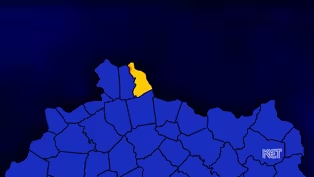
>> The city's new rules, Wilder, Kentucky in Campbell County is part of the northern Kentucky metropolitan area along the Ohio River.
The Wilder City Council voted this week to prohibit public safety and health workers from using medical cannabis.
And our Reporter's Notebook segment, I talked with a journalist in the region about what it means and what could come next.
>> Renee, on Monday, the city of Wilder, they essentially past and a resolution that would bar people who work in health and safety positions at the city from being able to consume medical cannabis to anything really with medical cannabis.
Now a health and safety worker is defined at least by the city as someone who is a police officer, firefighter or paramedic, it does not include administrative positions.
It doesn't include anybody who might work in the city's recreation or public works department.
So it's really just those kind of positions that have really >> critical.
>> Time sensitive types of roles that people rely on.
They decided to go ahead and ban those.
Obviously a lot of other cities might start to take this type of position.
But as far as I know, Wilders the first one in northern Kentucky, at least that I've covered that has this type of law.
>> Right.
And so are these professionals achieve mentioned they're already has subjected to drug testing, right?
Is that one of the rationales for why they would not be able to consume medical cannabis.
>> That's right.
They are already governed by the rules.
The city of Wilder regarding drug testing and other drug policies essentially the way the state of Kentucky has laid out the law.
It requires city it burn.
It does not require cities to re nag on any previous positions that they were governing drug policies by.
So if the city of Wilder or Tuesday last year, the city of Wilder passed and a new employee handbook that late out those rules just because medical cannabis is now legal in the state of Kentucky.
The state law essentially lays out that Wilder is able to continue to follow those rules.
I think really where the rationale from their standpoint comes in is they wanted to go ahead and make the health and safety workers specifically barred from being able to do that because the city believes that it's a critical position and the public need.
>> So is there any backlash about that or any pushback people say while that seems to make sense?
>> As far as I know, people say that it seems to make sense.
I don't think there was really any publicly public objections at the meeting toward this law.
Now, I haven't really seen anything on social media and indicate that people are upset over this ruling.
I would imagine a lot of other northern Kentucky cities would probably start to roll out similar types of laws.
But as far as I know, no, there hasn't been any public backlash.
>> And speaking of those cities, as you had reported earlier this week, there are Wilder is one of the 10 northern Kentucky cities that voted during the November 5th election to allow medical cannabis operations within city limits.
So to your point, do you expect other cities nearby in northern Kentucky to follow Wilder suit here?
>> And yes, I do.
I believe a lot of other cities that have voted to allow medical cannabis will also allow medical cannabis business operations will eventually take up some sort of measures that will bar public health and safety workers from being able to consume medical cannabis on the job.
>> Well, Ken Hornback, thank you so much for your time today and for your reporting and I know we'll be in touch with you again soon.
>> Thanks so much, Renee.
Appreciate it.
This year, KET launched a special initiative focused on the issues facing Kentucky's aging population and their loved ones.
One issue we hear frequently about is the high cost of health care for the aging and fact a report from the CDC shows one quarter of older adults have trouble affording their medications.
Our Laura Rogers introduces us to a Logan County woman who in the past has skipped doses and rationed her prescriptions.
This story is part of Katie's next chapter initiative that focuses on the rewards and challenges of growing older.
>> We want to break.
That's one thing.
It's scary when you cannot.
Murray is very scary.
>> Theresa Hudson, who's in or 6 days struggles with several health conditions COPD and asthma diabetes.
>> I was in and out sometimes my insulin because it was so hot.
>> There was a time when Hudson could not afford all of her medications.
I used to go without some of my neighbors because sometimes was like 15 $75.
And that was after ensure you go If you can't afford a, she would often find herself rationing her medical supplies.
I go with that one month and try to go with a jail in higher.
>> And then I would buy one like every other month.
>> 3 years ago she had half of each long removed.
A procedure called lung volume reduction, prolonging what one day may become a lung transplant.
I get up and go right now.
Want to bathroom?
I'm getting out of breath.
I got to act on.
Weaving in rule Logan County Hudson has to travel an hour and a half each way to a heart and lung doctor in Nashville.
And I don't like to drive.
And unfortunately, they don't have and that I can get rides to doctor's.
>> But they my area, they don't have one that will take your way to Nashville.
Luckily she has an adult son who can drive her there, but she admits she doesn't always like asking for help.
I will always good for myself.
>> I was very active.
Active person in it for myself all the time and then ask for help.
>> And now I have to ask for help sometimes and that's hard when you're not used to asking for help, they need more access to health care, affordable health care.
>> And they need better.
Weiss for transportation to get to their health care.
>> Theresa Jones manages the senior Center EOC community Action of Southern Kentucky in Hart County.
Some of them we have have family members that live in the state.
Are any family members at all and they can just get left behind.
Jones says she meets a lot of older Kentuckians who struggle to afford their basic needs.
We have some fat their nutrition.
It comes from us.
We have some that this is only meal they get.
>> And for others, the senior center is a place to gather and socialize to cope with isolation and loneliness.
Coming here.
>> It really helps me.
Coe at home, I get depressed.
>> Maryalice Shirley has been coming to community action for the past 20 years.
You have a full team on the advice of her doctor.
He told me that I need to be checked out in the with people.
>> How are my sisters and number approach, Nancy Haigh Craft a widowed a couple of decades ago has a host of health issues and that may tie K. >> I paid hard to take so pay.
Kraft says she's only able to afford her medications because of Medicare and Medicaid.
Coverage for the Almeida son.
>> The House like one model, $50.
And then I'm back to school to Dak can get that Mylan medicine at the bay.
>> But there are some crucial treatments.
Not all health plans will cover.
There's a place at the right here where they can go to get mental health.
They have to pay every visit they go.
And when you live on a limited income and you still have to pay for some of your medicine, you don't have the extra money to go get things like that.
They need more help.
I mean, you know, some of them, droughts, small checks and time they pay.
They ran away with a edge.
>> You know, it takes it up.
>> Theresa Hudson agrees she says most of the resources she's found to make her life more affordable.
She's had to scramble to find on her own.
Got a lot of digging yourself to try to find some mail to what to do because otherwise you're a tiny hands up there and do with that tremendous.
>> We're Kentucky edition.
I'm Laura Rogers.
Thank you, Laura.
And we take a closer look at issues like affording medications and transportation.
>> And a special report that we have coming up.
It's called aging and health care Akt special report.
It airs Monday December 16th at 8 Eastern 07:00PM Central Time right here on KET and some good solutions to those challenges will present.
From the cave to the classroom.
Students are getting hands-on lessons in geography, history.
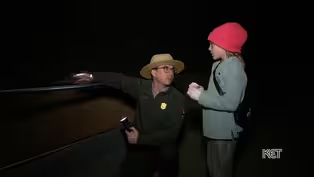
Geology and other subjects through the efforts of Mammoth Cave National Park and our Education Matters report.
Our Laura Rodgers back to explain how the environmental Education Department reaches tens of thousands of kids a year.
>> With Ranger, Shannon, this is truly or become learned the most effective.
It's not your traditional classroom.
You have this right here.
You've got the surface, but you also have the cable world, but Mammoth Cave National Park is a treasure trove of learning.
They requested that we go as far back and look at the French and Indian War.
Jonathan Rager initially wanted to be a history teacher.
It's career led him to the National Park Service.
>> It does teach history in a very interactive way.
>> It's always good to have that human history interwoven with the natural history and you're doing something hands-on educationally that's going to stick in your brain.
Students are able to learn about the caves, ecosystems and biodiversity were actually putting meaning.
And we're actually putting a firsthand experience is what they've been learning about a supplement classroom curricula.
I want to partner with them.
Let us Skaggs teaches chemistry, financial literacy and consumer Matt.
>> I like the fact that I can incorporate what they're teaching can teach with my >> And the Cave National Park reached 70,000 kids last year on site online and in school.
>> I really love that we are able to work with, you know, one Ranger, any 20 ish students in a classroom.
I think that's a really great part of the program.
Classroom visits are provided free of charge.
Trips to the park are often cover through funds from the National Park Foundation.
They have a program called Open Outdoors for Kids.
It's a grant program.
>> And the Friends of Mammoth Cave Rhoda Grant and got I think it was 89,000.
It was a little over $89,000.
>> So that money used to bring kids to the park.
Many of them for the very first time.
It surprises me when I always ask how many of kind McKay that only 5 or 6 hands will go up.
>> I came here on my 4th grade field trip and fell in love with him.
Okay.
The thought was amazing.
Jennifer Shackleford spent nearly a decade in public education before joining environmental education at Mammoth Cave.
Last year we worked with over 40,000 students in local schools, students getting to explore the world's longest known cave system.
You see it's just a magical experience.
Jonathan Rager says he hopes to help kids reestablish a connection to nature.
We're saturated and technology, but I'm hopeful that we can take a lot of modern technology and use that.
>> And parent with the outdoor world, there's apps that can identify plants in real time.
>> There are also collaborating with alliance for a healthier generation on the Walking Pass Room podcast.
>> They are going to work with the Education Department here probably in the next month or so.
And we're going to be taping some podcast that they've written about Mammoth Cave and then those will be distributed to students around the nation.
It's all about bringing the classroom to Mammoth Cave or Mammoth Cave to the classroom for an enriching educational experience.
It is bronzer buys horizons to what's out there for Kentucky edition.
I'm Laura Rogers.
Thanks again.
Laura.
A grocery store and restaurants serving food deserts has opened a second location locals food, how been Pizza Pub opened its doors in October in Louisville, Smoke Town, neighborhood owners, Birch and Michelle brags say it's a way to help both underserved communities and Kentucky's farmers.
>> After COVID and seeing, you know, people getting really feel this really the disruptions in and globalized supply chains, empty grocery store shelves and we wanted to try to come up with a business that can really help long term solve those issues and focus on sourcing food, regionally and locally and help strengthen our local food supply chain by supporting our farmers, a growing food in a local in small diversified market way is a very hard job.
And one of the most challenging pieces to that is marketing that food and selling that food.
>> For tonight met in Bowling Green.
He was running a.
A small farmers market and a small.
And we were making pizzas at farmers, markets sourcing local ingredients.
You know, we pull.
Wood fired pizza on a wagon with a sweet set up the whole thing at a farmers market.
It's just the nonstop push and we understand what that's like working with real individuals that humanistic nature, right?
It's really great being able to offer this to people with young families who rely on this income to pay their bills.
You know, to raise their family, doing what they feel like.
It's the most important thing to do at that moment in time, which is harming.
We're producing something and then the second goal that we had this to make this food nutrient rich, locally sourced food.
>> And they'll build all members of our community, especially the underserved in typically underserved community members who needed the most can afford it.
The least the need.
I think here in Louisville, specifically is astronomical.
And the farther west we go, the more that need becomes real.
And as the majority of the larger multinational, private grocery stores choose to set up in areas that are of a higher wells and higher means from a business standpoint.
But that doesn't do anything to to serve the underserved any given community for that matter where historically black neighborhood traditionally underserved the USDA certified food desert so we can make so much impact or a food access programs in a grocery store simply by being here.
We accept snap and a grocery store and we have we participate in the Kentucky double dollars program, which is an amazing program administered by Community Farm Alliance.
And so what that means is somebody can walk in here and spend $20 on snap and we can double those dollars, meaning they walk out with $40 in food.
We've taken that a step further.
We've created our own Triple Dollar program.
So we just recently received $2000 donation from the Leslie and Ryan Fraser Foundation here in Louisville.
And we also run Triple Dollar program and our storm Frankfort.
What that means someone can walk ins been 20 on SNAP and walk out with $60 worth of food.
>> What's interesting about our is that there's nothing out of state are out of season.
And I feel like in the beginning with Frankfort, we got a little pushback or some hesitancy when we would tell people that they're like, well, how are you going to feel yourselves?
And we've never had an issue killing ourselves during the wintertime.
There's a lot to offer here around here in the state.
As you look around here and you see the abundance of the products we have, you begin to realize like, wow, there is a robust >> supply chain right here in the state of producers who are already producing and processing amazing foods.
The neat thing about this concept is it literally can work in any community in this state.
There's enough regional supply chain no matter what part of the state that we're in to be able to to make that supply chain and have this robust offering.
And there's definitely enough of a need for real food in numerous communities across the state.
>> The first locals food have been pizza pub opened in Frankfort and 2021.
Since then, it's purchase more than 1 million dollars in products from more than 185, Kentucky producers.
The college basketball community is rallying behind a case in Pryor of the University of Louisville and a game against Oklahoma.
He tore his ACL in his left KET according to the Cleveland Clinic.
An ACL tear is more common than you may think.
With between 100 to 200,000 occurring each year.
So what exactly is this leg injury?
U of L team physician explains how it happens.
And tonight's look at.
>> Medical News.
>> see else that stands for your anterior cruciate ligament and so limit connects 2 bombs together.
So that's connecting your 5 and tear shin bone.
And it's making sure that Russian men doesn't move out ahead or in front of your event.
So once that ruptures, typically that's from Mike, a rotational force applied to the KET.
And it's something that we usually see symptoms consistent with the injury pretty immediately.
>> The A C L has a lot of blood flow.
So when that tears, you still a lot of blood.
So you'll see a lot of swelling right away.
There's a very specific physical exam.
The neighbor that we do contest.
And if that's positive, we pretty much almost diagnose it right on the court.
You know, on the sideline when things occur like that, you want to rule out the scary stuff first, right?
And you know, it's never want to see it.
But we've seen dislocations before.
So just making sure that join to preserved and that, you know, they're getting the blood flow that they needed, that they're stable.
When the injury is first diagnosed, we typically like to do right away is what we call pretty have.
So we want to rehab before the surgery.
Then we want to start strengthening right away.
The surgery not use also be can always spot somebody that had an ACL repair because there was a huge decision down the predator like and now with all of that advance that we had our surgical techniques, you know, a lot of times, it's a disco.
And we get players, you know, going with a few weeks that a lot to do with the ACL.
It's just banned law.
>> Pryor's injury will take him out for the rest of the season.
We wish him well.
♪ ♪ Toys bring joy this time of year, especially for those who could use a little extra lift and their spirits.
Students at Dunbar High School in Lexington hosted their annual Toy Drive for families at the Kentucky Children's Hospital on Wednesday, they filled a pediatric transport vehicle with toys they collected.
This goes back many, many years.
There was a student who has since passed on.
>> That this was something that's really important to him.
And so this is something that has been on the hearts of Dunbar students for 17 years.
This toy drive.
We do it about every year we collect toys from probably October till the beginning of December.
>> And we will take the toys and stuff them into an ambulance and bring it to the children's hospital.
They have a large winter event in which families are able to shop for their children.
Both the children who are patients in the hospital, but also the other children to be able to provide some like holiday joy.
In a time of of darkness or fear or anxiety.
So our kids are really excited helping.
>> Spread that joy throughout Lexington.
So they get collection process starts about October.
It's really student-led.
And so some of our students and they created posters, which we then have on the hallway.
TV's we put on our TV station here at Dunbar have posters all around the building.
>> A school.
We do it through a stop and it really means a lot to me that we do so many service projects.
I know that if I were stock in that situation, I would want to feel loved and appreciated.
And this gives us a very solid way to give back and help kids feel seen by others and know that they're not alone in times of distress.
>> Good Samaritans.
Indeed.
The students were also able to hear from the transport team about job opportunities after graduation.
Well, that'll do it for us tonight.
We hope to see you right back here again tomorrow night at 6.30, Eastern 5.30, central for Kentucky Edition.
We're we inform connect and inspire.
We hope that you'll subscribe to our e-mail newsletters and watch full episodes and clips at KET Dot Org.
Look for us on the PBS video app on your mobile device and smart TV.
We encourage you to send us a story idea and public affairs at KET Dot Org by email and also check in with KET and public affairs on Facebook, X and Instagram to stay in the loop.
We've got inside Kentucky politics tomorrow bought with an outgoing Senate majority Leader Damon Thayer.
That comes your way tomorrow night.
That and more on Kentucky Edition until I see you then take really good care.
So long.
♪ ♪
Grant Offers Classroom Activities at Mammoth Cave
Video has Closed Captions
Clip: S3 Ep136 | 3m 21s | Grant Offers Classroom Activities at Mammoth Cave. (3m 21s)
KY City Blocks Medical Cannabis for Some
Video has Closed Captions
Clip: S3 Ep136 | 4m 11s | A KY city puts restrictions on who can participate in the state's new medical marijuana program. (4m 11s)
KY Groups Watching SCOTUS Case
Video has Closed Captions
Clip: S3 Ep136 | 3m 7s | Two Kentucky groups discuss the transgender case before the U.S. Supreme Court. (3m 7s)
Providing Support for PBS.org
Learn Moreabout PBS online sponsorship
- News and Public Affairs

Top journalists deliver compelling original analysis of the hour's headlines.

- News and Public Affairs

FRONTLINE is investigative journalism that questions, explains and changes our world.












Support for PBS provided by:
Kentucky Edition is a local public television program presented by KET