Vermont This Week
December 6, 2024
12/6/2024 | 23m 59sVideo has Closed Captions
New analysis predicts 5.9% hike in property taxes next year
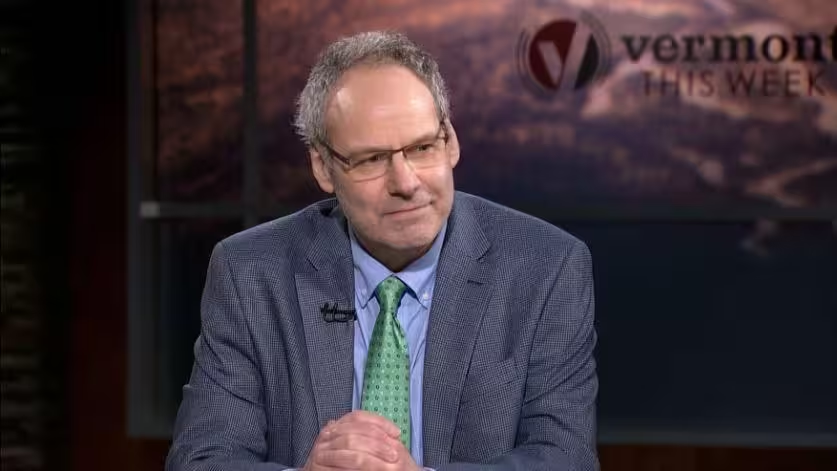
New analysis predicts 5.9% hike in property taxes next year | Treasurer’s Office launches retirement savings program | Congressional delegation urges feds not to cut hours at Vt. border crossings | Panel: Mark Davis - Moderator, Vermont Public; Sarah Mearhoff - VTDigger; Calvin Cutler - WCAX; Erin Petenko - VTDigger.
Problems playing video? | Closed Captioning Feedback
Problems playing video? | Closed Captioning Feedback
Vermont This Week is a local public television program presented by Vermont Public
Sponsored in part by Lintilhac Foundation and Milne Travel.
Support provided by:


Vermont This Week
December 6, 2024
12/6/2024 | 23m 59sVideo has Closed Captions
New analysis predicts 5.9% hike in property taxes next year | Treasurer’s Office launches retirement savings program | Congressional delegation urges feds not to cut hours at Vt. border crossings | Panel: Mark Davis - Moderator, Vermont Public; Sarah Mearhoff - VTDigger; Calvin Cutler - WCAX; Erin Petenko - VTDigger.
Problems playing video? | Closed Captioning Feedback
How to Watch Vermont This Week
Vermont This Week is available to stream on pbs.org and the free PBS App, available on iPhone, Apple TV, Android TV, Android smartphones, Amazon Fire TV, Amazon Fire Tablet, Roku, Samsung Smart TV, and Vizio.
Support the crew
Help Mitch keep the conversations going as a member of Vermont Public. Join us today and support independent journalism.Providing Support for PBS.org
Learn Moreabout PBS online sponsorshipWith the 2025 legislative session on the horizon, a new analysis predicts a 5.9% hike in property taxes next year.
And everyone seems to think that's too high after having such a large property tax increase this year.
Hearing about another increase, in the round, the 6% will not be welcome news for most.
I'm guessing you have to look at the over the period of 3 or 4 years and and we're talking, you know, 30, 40% increase.
So that's not sustainable.
And so we're going to have to do something different.
But our state House officials willing to make the tough choices to bring the rates down.
Plus, the Vermont Treasurer's office launches a new retirement savings program.
The feds have built some new surveillance towers on the border, but they want to cut back on crossing stations.
A more town couple raises their home and Milton remembers a local servant.
All that and more ahead on Vermont this Week.
From the Vermont Public studio in Winooski.
This is Vermont this Week.
Made possible in part by the Lintilhac Foundation and Milne Travel.
Thanks for being with us.
I'm Mark Davis in for Mitch Wertlieb.
It's Friday, December 6th.
Joining us on the panel today.
We have Sarah Mearhoff from VtDigger.
Calvin Cutler from WCAX and Erin Petenko from VtDigger.
Thank you all for being with us today.
Well, we start our show inevitably, as we always seem to these days with property taxes.
This week saw an annual state house event, the so so-called December 1st letter was released.
That's usually a nonevent, but Calvin not so much this year.
Yeah, especially following last year.
Right.
I mean, everybody was waiting for this letter to come out with bated breath, especially after it was 18.5% last year.
It wasn't, by all accounts, it wasn't as bad.
It's about 6% this year.
And this is essentially it's a projection of what property taxes could increase if it's a snapshot essentially, of school budgets, that have not yet been voted on by town meeting day voters.
But it's essentially how school spending is shaping up.
And so right now, there's about $115 million of new school spending, which is forecasted to increase 6% for property taxes like last year.
You know, we're seeing the same cost pressures, student mental health needs, you know, health care for teachers is huge.
You know, we're still seeing double digit rate hikes, for commercial insurance premiums, year over year, we've got deferred maintenance on school buildings.
A confluence of factors are leading to to that 6% number.
And, you know, I think a lot of people are somewhat relieved that it's not as bad as last year, but, 6% is still pretty significant.
I think the governor and, Craig, you know, the the tax commissioner even said that with the 6%, this now marks, over 30% that Vermonters have seen their property taxes go up in the last 3 or 4 years.
So certainly, it's really significant.
Sarah, this almost feels like an unofficial start to the legislative session.
We have this number.
We know this is, such a huge priority.
How is this going to go over in the legislature starting in January?
Oh, this is going to be the big fight.
Absolutely.
There's no question about it.
And yes, 6% is significantly lower than what we saw in last year's December letter, for sure.
But remember, of course, that this is also 6% on top of last year's increases, which by the end of the day, when the yield bill passed was 13.8%, I believe, it's exponential growth, right.
And so and that's the point that the governor has been making.
And now Republicans in their new bolstered numbers are certainly going to be beating that drum all this legislative session.
I think we're going to see also a lot of turnover in these committees of jurisdiction.
In terms of who's actually going to be writing the legislation, and kind of reimagining what education, spending and fundraising could look like in the state of Vermont.
So 6% is the goal here going to be to get to a number that's smaller than six?
Is the goal going to be zero?
When I ask the governor about that at this week's press conference, he indeed said zero is the number that he wants to see.
Now, I think you could question whether that's possible.
Of course, I mean, inflation remains what it is, lower than what it was, of course, but inflation is still raging in a way.
Also, Calvin mentioned, of course, health care costs are just ballooning through the roof.
And I think we should be emphasizing the connection between health care insurance premiums for teachers and staffers and everyone who works at schools, and the just enormous strain that that it's putting on these relatively small school budgets.
And I think it's also worth pointing out to, you know, what the question is?
What can they do this year to get that number down?
Will it be taking state reserves like the governor had proposed last year?
Which was, criticized or panned by, by Democrats.
And the treasurer also had concerns about it or, will they try to raise new revenue on, or new taxes on like, second homes or other things to try to buy down that rate?
That remains to be seen this year in terms of what are we going to see, for, for longer term systemic cost containment, you know, we can't keep going like this year over year.
I think there's a wider agreement in the statehouse right now, that something needs to change, but it's going to be it's going to be a really difficult, long, uncomfortable conversation.
The commission on the Future of, education that the legislature put together last year.
In a few weeks in December, they're going to be issuing their, report, essentially, which is a list of ideas.
They're not recommendations, but they're what options should be on the table.
And, just putting some of those ideas out there, there's think things talking about renegotiating health care contracts.
Combining or consolidating governance and supervisory unions.
You know, potentially closing or consolidating schools.
There's a lot of ideas there to help bring down those costs.
But I expect all of that to happen next year.
Wasn't there like a consultant report that came out a few weeks ago suggesting school consolidation?
And it got like a huge backlash from a lot of districts.
It did.
Yeah.
And that's the thing is, you know, it's about the student to staff ratio, I think in many ways, right.
Because a building is a building.
But it's having it's the people we know that it's 75 or 80% of costs within schools go toward people, toward teachers, towards salaries and wages.
And so, yeah, the question is, how are we going to rein that in or rightsize our system, without causing too much, harm or pain?
Yeah.
Some interesting stats this week.
I said since 2016, staffing in public schools has come up about 5%, while student enrollment has come down about 5% in that same time that Vermont has the lowest student to staff ratio, in the country, something tells me we'll hear a lot more about that, in the months to come.
Calvin, we've talked a lot about property taxes, education, what else is going to be top of mind?
Legislature come January?
We'll also sort of inextricably linked with property taxes.
Is housing too, right?
I mean, that of course comes to the top.
Will we see, you know, new subsidies for housing or will they try to take more of an approach on act 250 and look at more exemptions for act 250 or looking at, the appeals process?
Those are things that, you know, might be moving forward.
Housing, of course, was also a really big recommendation of that.
The Oliver Wyman report with our hospitals, which are also, having huge financial challenges.
That's a separate issue in itself, but it's related back to housing or demographics workforce.
I think that one is big.
And the other one, which is going to happen at the very beginning of the session, is the clean heat standard.
They're going to have to make a decision on it one way or the other.
There is opposition that's been growing toward it.
Concern about the potential cost.
And so if there is no clean heat standard, the question then becomes, how do we meet our legal obligations under the Global Warming Solutions Act?
Or do we push it back?
So we're talking about some big ticket items here.
This is not an easy list Sarah.
How does this all shake out come January?
What do you what do you do first?
How do they solve all these problems?
Or do they.
I wish I knew.
Tough questions.
Yeah, right.
I'm very eager to see what the dynamics are going to be like in the building, because we're also seeing an enormous amount of turnover right in the legislature.
And with that comes, I think, fresh perspectives and ideas from folks who, you know, haven't been in the building for and have the kind of building brain in a way.
Right, baked in.
And then also, though those are folks that are kind of getting their feet under them, and maybe are not so used to the machinations of the building and how things operate.
So I think that may have a really big impact.
And also, I mean, we've talked so many times about the, Partizan breakdown and how that's going to make things shake out.
This is not going to be another repeat of this past biennium, where Democrats could know that the governor was opposed to a bill and say, we're doing it anyway.
They're not going to be able to do that this year.
There's going to have to be some level of negotiation and coming to the middle in that way.
In order for anything to get done or I mean, of course, nothing could get done.
That's not always an option.
I want to shift a little bit.
We're talking Democrats or Republicans in the state House.
You had a very interesting story this week looking at the gender breakdown of our legislature.
What did you learn?
Well, Aaron, I did this story together.
Aaron is, such a whiz with data.
And I had an inkling as I was watching the results kind of pouring in on election night.
And I was looking at all of these names and I thought, wow, that's a lot of dudes.
Coming in, especially in our new incumbents, the the gender shift is very, very clear, particularly in the Senate, 100%.
All nine of the new Senate members, incoming senators are men.
And then in the House, too, there's also a stark, you know, shift to to men in terms of these newly incoming legislators.
And I thought that was so fascinating.
I mean, there is a bit of, quote unquote year of the woman.
In that first midterm after President Trump was first elected, there was this, like, real groundswell of support for, you know, having to vote for women in and all the way through office, right.
Not just at the top of the ticket, but there was like this kind of newfound, I thought, at least there is a newfound cultural understanding that we got to elect women down ballot and it seemed to not, like, translate to this year, really.
There was this big wave of men that are coming in and after, a bit of a plateau in female representation in the legislature.
We're actually seeing a bit of a dip this year, notably, we have never hit 50%.
We've never actually hit parity, even though in the past couple of years there's been some excitement about incoming, committee leaders, Senate and House, leadership being women.
You know, they they are still trying to reach that 50%.
And I think that there's also a sense of, you know, any any erosion is seen as a long term problem because incumbents tend to stay in their positions for a very long time.
And it's hard to make progress on that when people are literally aging in their seats.
So that's a big factor as well.
Yeah.
We also looked at this and broke it down further by party.
Yeah, make up.
And I've been fascinated for a really long time about the dynamics of women in the Republican Party and the kind of dance that I think Republican women have to perform in that role, the party as a whole.
The platform tends to really shy away from identity politics and making a point of, you know, say your gender, when you're running for office.
But there's also among, I would say, certainly younger women who are Republicans.
I think this is partially a generational thing.
There is a level of recognition of we're not going to reach parity if we don't actually work for it.
And how do you work for it if you don't make the effort and recognize that gender plays into these things right.
Calvin and I actually in a previous life, we both reported in South Dakota together, and we covered the election of Governor Kristi Noem.
And she was the first female, elected governor in the state of South Dakota.
And this is something that I've watched since covering that election and seeing how she navigated that at the very top of the ticket in the state to now looking at these down ballot races and seeing how, you know, Republicans have to kind of work around this issue if they're ever going to reach parity.
Terrific reporting.
Interesting story.
I also now have to go find, South Dakota this week clips to see what you guys are talking about.
Back then.
I'm sure you were both great.
Let's shift gears a little bit here, Erin.
We learned this week that as many as 100,000 Vermonters do not have access to a workplace retirement program.
Yeah.
So the, the Vermont legislature last year passed a bill that creates a state run workplace retirement program.
How it works is very similar to a Roth IRA, if anyone's familiar with it.
But the advantage is that now small employers can automatically have, people's earnings deducted and set aside into this account without having to invest in, you know, finding a 401 K provider paying the fees, keeping track of, of the payroll, stuff like that.
And data shows that or at least the treasurer said that, 15 times more likely to save for retirement if it's through your workplace, because it's just so much easier to do it when it's just automatically deducted from your payroll.
So they're definitely touting this program as a way to expand retirement access, which is still pretty brutal for a lot of Americans.
The vast majority of people are not saving enough to sustain their, you know, living income in retirement.
So, you know, this is definitely a, program aimed at easing that gap.
Yeah.
And especially acute problem in an aging state.
That stat, 15 times more likely just just blew me away.
Yeah.
I mean, I remember when I was 22 and going, wait, they want me to sign up for a 400 and K. What's that?
So I think that that's part of where they're hoping to reach people, as people who just haven't gotten the message about, you know, you need to save early and save as much as possible.
Up to 100,000 people in a state the size of Vermont is remarkable.
Good reporting.
Well, we have, some news up at the border area.
Sarah, Vermont's congressional delegation not happy with the recent decision from Customs and Border Protection.
Yes.
So Customs and Border Protection recently announced that they would be cutting back hours at four border crossing stations, ports of entry, and also maintaining already previously cut hours at two additional locations, that they rolled back hours during the pandemic.
And this is a huge issue for folks who, live along these border towns where the border becomes very transient in your everyday life.
You may have family across the border, you may work across the border.
One really important, piece of infrastructure close to our border is North Country Hospital, of course.
And, I know that also the CEO of North Country Hospital just like blasted this decision in a letter this week.
Because they have folks who, commute to the hospital every day from Quebec.
And if you're a E.R.
nurse and you're working the overnight shift, it's not going to work for you if you can't cross 24 hours a day.
Right.
And so this is a workforce issue.
It's also like, an issue for emergency services being able to get, to a hospital if you need or what have you.
The, the four locations that are looking to roll back their hours, they're currently 24 hour operations.
You can cross the border one way or the other 24 hours a day.
And they're looking to cut it to 8 to 8, 8 a.m. to 8 p.m..
So essentially in half huge cuts.
And that's Kane in North Troy, West Berkshire.
And Albert very striking that hospital.
How concerned they were, how many workers they have who live in Quebec, how concerned they are that if they lose those employees, they're up in Newport.
Finding employees is incredibly difficult right now.
I heard something similar from Jay Peak, of course, who relies heavily on their Canadian customers.
Yeah.
Big problem for people up north.
There was some other reporting I want to briefly touch on and shout out this week.
Frankly, it came from from your outlet, a story about some surveillance towers.
Yeah.
Sean Robinson, who is my beat partner in the Politics Beat.
He's been doing some fantastic water coverage for a number of years now.
And more broadly, we've, talked on the show about how border crossings along the northern border, while they, you know, are far under those that we see at the southern border, they're still on the rise significantly over the past several years.
And to monitor that, the feds have installed these surveillance towers along the northern border.
And it's all very kind of cagey in a way.
You know, they kind of quietly put up these surveillance towers that Sean went and saw them in person and walked around them and, had a little tour with a farmer who took them up to the.
Yeah, the line tower and.
Yeah.
And, they're, like, decked out in all of these cameras and they can see for seven miles, night or day to try to monitor these, these border crossings.
But it's a really nuanced story because while we are, you know, seeing this rise in undocumented people coming across the northern border, at the same time, there are some folks in the kind of advocacy space who are really concerned about technology like this, because they think that it just pushes people who are going to cross anyway because they have, you know, needs, to more dangerous routes, you know, further into the woods or further away from these towers, and under the kind of cover of night, especially in a northern climate like Vermont, that can be really dangerous for people, especially going into winter.
And Clare.
Sean, three towers, one in Derby, two in Champlain, New York.
Right.
Near, near the lake.
And and, suggestions and documents that there could be more coming.
Yeah, yeah.
In the future.
Erin, the town of Hardwick got some good news this week.
Belated news, but good news?
Yes.
FEMA has announced that they have, distributed $4 million in funds to help Hardwick repair from their July 2023 floods specifically.
But this will also help them with the damage from the 2024 floods.
Because some of those are the same infrastructure that got damaged twice, unfortunately.
So I got to talk to, the town manager who said, oh, yeah, this is really great because we really need a retaining wall for a main street.
It's right next to the lamp oil, and we really don't want our town washing down the river.
So those those are some really much needed repairs coming to Hardwick, which has seemingly received the highest amount in public assistance for any Vermont municipality.
Those funds are still being distributed, and some of them could take years to coordinate, though, so we'll see how it goes later on.
Yeah, so worth restating.
Here we are celebrating funds from the historic floods of 2023, funding to help out from the historic floods of 2024.
Yeah, to come quite a long time away.
Calvin, speaking of flooding, you found a couple in Moore Town, I believe, with a pretty innovative solution to flood mitigation there.
Yeah.
You bet.
Howland Brown and Becky all.
Claire bought their home in Moore Town back in the 1990s, and they went through Tropical Storm Irene.
They've gone through the flooding in 23.
There was flooding in December that you can see on your screen right here.
And it just was one thing after another and a really traumatic experience for them and their neighbors and their community.
And so they made this.
They wanted to move.
They wanted to, you know, they looked around, but they also knowing that this is a flood prone location, they didn't want to hand it off to somebody knowingly, like, here's here's a problem.
It's yours now.
So they decide to sort of fight back against flooding actively.
And so they're now taking their home and physically lifting it up.
And you can see it there.
It's going to be a garage underneath.
And it's going to be maybe 12, 13ft up in the air.
And it's just an example about, you know, what it takes for flood resiliency.
You know, how many how our downtowns are made.
This is one house.
And we don't know the exact cost of the project, but it is it's expensive.
And this is what it will take to make Vermont communities, flood resilient.
Yeah.
And they were they were saying they're hoping to maybe inspire this, give other people the idea.
I must say, when I read raising the House, I thought one thing when I saw the visuals of how high up that thing is now, it was quite stark, fascinating.
Reporting.
Well, we need to end, today on on two notes.
The first is a happy one.
We want to congratulate the UVM men's soccer team.
They have advanced to the quarterfinals of the NCAA tournament.
The second time in three years they've made it this far.
They're going to play the two seed, the Panthers in Pittsburgh on Saturday afternoon.
We're rooting for them.
Go, cats.
Lastly, we want to take a moment to note the passing this week of Don Turner.
Now, the most prominent part of Turner's resume was the many years he spent in the Vermont House of Representatives.
He was the Republican minority leader for many of those years.
He ran for lieutenant governor in 2018.
But Turner's true legacy is rooted in his beloved hometown of Milton.
He joined the local fire department there when he was just 16 years old.
He eventually became the chief.
He also served as town manager.
In his spare time, he worked as a real estate agent.
He helped run his family's bowling businesses and family's construction company.
I had a wife, daughter, three daughters, three grandchildren, a large extended family.
Don Turner died at age 60 of brain cancer.
We offer our condolences to his family and everyone who loved him.
And that's where we'll have to leave it.
Today, my thanks to our wonderful panelists, Sara Mearhoff from VtDigger, Calvin Cutler from WCAX, and Erin Petenko from VtDigger.
Thank you, everyone for watching.
Mark Davis, have a wonderful weekend.

- News and Public Affairs

Top journalists deliver compelling original analysis of the hour's headlines.

- News and Public Affairs

FRONTLINE is investigative journalism that questions, explains and changes our world.












Support for PBS provided by:
Vermont This Week is a local public television program presented by Vermont Public
Sponsored in part by Lintilhac Foundation and Milne Travel.