
December 8, 2023 - PBS NewsHour full episode
12/8/2023 | 57m 46sVideo has Closed Captions
December 8, 2023 - PBS NewsHour full episode
Friday on the NewsHour, heavy airstrikes continue across Gaza as thousands of civilians crowd into ever-shrinking safe zones in the south. We speak to the foreign minister of Saudi Arabia about the war and wider diplomatic challenges in the Middle East. Plus, who gets access to medical treatment for drug addiction highlights the racial inequities of the opioid epidemic.
Problems playing video? | Closed Captioning Feedback
Problems playing video? | Closed Captioning Feedback
Major corporate funding for the PBS News Hour is provided by BDO, BNSF, Consumer Cellular, American Cruise Lines, and Raymond James. Funding for the PBS NewsHour Weekend is provided by...
Support provided by:

December 8, 2023 - PBS NewsHour full episode
12/8/2023 | 57m 46sVideo has Closed Captions
Friday on the NewsHour, heavy airstrikes continue across Gaza as thousands of civilians crowd into ever-shrinking safe zones in the south. We speak to the foreign minister of Saudi Arabia about the war and wider diplomatic challenges in the Middle East. Plus, who gets access to medical treatment for drug addiction highlights the racial inequities of the opioid epidemic.
Problems playing video? | Closed Captioning Feedback
How to Watch PBS News Hour
PBS News Hour is available to stream on pbs.org and the free PBS App, available on iPhone, Apple TV, Android TV, Android smartphones, Amazon Fire TV, Amazon Fire Tablet, Roku, Samsung Smart TV, and Vizio.
Providing Support for PBS.org
Learn Moreabout PBS online sponsorshipAMNA NAWAZ: Good evening.
I'm Amna Nawaz.
GEOFF BENNETT: And I'm Geoff Bennett.
On the "NewsHour" tonight: Heavy airstrikes continue across Gaza, as thousands of civilians crowd into ever-shrinking safe zones in the far south.
AMNA NAWAZ: We speak to the foreign minister of Saudi Arabia about the war and wider diplomatic challenges in the Middle East.
GEOFF BENNETT: And who gets access to medical treatment for drug addiction highlights the racial inequities of the opioid epidemic.
DR. AYANA JORDAN, Addiction Psychiatrist: There's still this thought that Black people who have a opiate use disorder have to be controlled in a way that white people don't, that Black people are not as trustworthy with their medications.
(BREAK) GEOFF BENNETT: Welcome to the "NewsHour."
The U.S. vetoed a United Nations Security Council resolution today that called for a cease-fire in Gaza.
The U.S. was the lone no-vote in the 15-member council.
AMNA NAWAZ: The move came as the U.N. and others are ramping up already dire warnings of humanitarian catastrophe if more aid isn't sent into Gaza soon and if the fighting isn't stopped.
According to the Hamas-run Gaza Health Ministry, nearly 17,500 Palestinians have been killed since the October 7 Hamas terror attacks against Israel.
And the Israeli air and ground campaign is not slowing down.
In Southern Gaza, explosions shroud the skyline from afar, and up close shake the streets.
Israel has ramped up it's airstrikes across the Strip, hitting 450 sites in just 24 hours.
More destruction means fewer places to shelter.
Hundreds of thousands of Palestinians are now crammed into a fast-shrinking space.
Younis Al-Halabi finished morning prayer with his family when a strike hit his home.
YOUNIS AL-HALABI, Gaza Strip Resident (through translator): This is not a life.
Death or destruction, it's all the same.
Those forced out of their home might as well be dead.
AMNA NAWAZ: In Central Gaza's Deir al-Balah last night, people in Yafa Hospital were given 30 minutes' notice to evacuate before an Israeli airstrike.
Today, many returned, including the elderly, to sleep in the halls among broken glass and shattered medical equipment.
ANTONIO GUTERRES, United Nations Secretary-General: Nowhere in Gaza is safe.
AMNA NAWAZ: Before the U.S. veto, U.N. Secretary-General Antonio Guterres urged the Security Council to vote for an immediate cease-fire, warning Gaza's humanitarian system faced a high risk of total collapse.
ANTONIO GUTERRES: We anticipate that it will result in a complete breakdown of public order and increased pressure for mass displacement into Egypt.
AMNA NAWAZ: In the north, Israel's mission to -- quote -- "eradicate' Hamas intensified.
More images circulated today showing Palestinians detained by the IDF stripped of their clothes, some blindfolded, and crammed into military vehicles.
The IDF says it will continue to make sweeping group arrests.
EYLON LEVY, Israeli Government Spokesman: We're talking about military aged men who were discovered in areas that civilians were supposed to have evacuated weeks ago.
Now those individuals will be questioned and we will work out who indeed was a Hamas terrorist and who is not.
AMNA NAWAZ: But the killing of Palestinians who are not affiliated with Hamas continues to far outnumber those who are.
Yesterday, celebrated poet and Palestinian academic Refaat Alareer was killed in an airstrike at his home in Gaza City.
Two years ago, during the may 2021, conflict, "NewsHour"'s John Yang spoke to Alareer by phone.
REFAAT ALAREER, Palestinian Academic and Author: We believe our struggle is part of a global struggle, the historical struggle around the world of the indigenous peoples around the world.
AMNA NAWAZ: On October 10, Alareer had given this interview to Reuters.
REFAAT ALAREER: Israel wants us out of Palestine or kneeling in submission, in total subjugation.
Palestinians are looking forward to a future with equal freedom, equal rights and freedom, and that is not much to ask.
AMNA NAWAZ: After news of his death broke, fellow Palestinian poet Mosab Abu Toha shared Alareer's last poem called "If I Must Die."
MOSAB ABU TOHA, Poet: "If I must die, you must live to tell my story."
AMNA NAWAZ: In the occupied West Bank, six more dead after a gunfight following an Israeli raid on the Far'a refugee camp.
Military raids here have surged dramatically since the October 7 Hamas attack.
Meanwhile, in Tel Aviv, the wail of sirens sends crowds running for shelters as Hamas continues to fire more rockets toward Israel.
Many are intercepted by its Iron Dome.
At the funeral of IDF soldier Gal Eisenkot, wails of sorrow.
His father, Israeli war cabinet member Gadi Eisenkot, delivered the eulogy for a son killed in combat yesterday in Gaza.
Senior officials mourned with the family in the most high-profile loss for the IDF so far.
GEOFF BENNETT: In the day's other headlines: The latest jobs report out today shows the U.S. economy is still holding its own without sliding into recession.
The Labor Department reported employers added a net 199,000 employees in November, helped by the end of the autoworkers and actors strikes.
The unemployment rate dropped to 3.7 percent, down from 3.9 percent in October.
Unemployment has now been under 4 percent for nearly two years, the longest stretch since the late 1960s.
A federal appeals court largely upheld a gag order on former President Trump today in his 2020 election interference case.
The ruling backed a ban on attacking court staff and potential witnesses.
It said "incendiary comments pose a significant and imminent threat to the criminal trial process in this case."
The court did allow criticism of Jack Smith, the special counsel who brought the case.
Mr. Trump could still appeal to the Supreme Court.
A pregnant woman in Kentucky is challenging the states near-total ban on abortions.
The woman, identified only as Jane Doe, filed suit today, arguing the ban violates the state constitution.
The state Supreme Court had already barred doctors from suing on behalf of patients.
And the American Civil Liberties Union says this suit meets that standard.
AMBER DUKE, Executive Director, ACLU of Kentucky: Jane Doe has courageously stepped forward as a directly impacted pregnant Kentuckian to challenge these abortion bans and try to restore abortion access in the commonwealth.
GEOFF BENNETT: The Kentucky suit comes one day after a Texas judge allowed an abortion for a woman whose pregnancy could endanger her life.
The long-running court case over separating migrant families at the border to deter immigration is finally ending.
A federal judge in San Diego formally banned the practice today for eight years under a settlement involving migrant families.
Some 5,000 children were separated from their parents under then-President Trump.
He has not ruled out reinstating the policy if he is reelected.
In Michigan, a teenager was sentenced to life in prison without parole today for killing four students in a school shooting.
The gunman was 15 when he carried out the attack at Oxford High School in 2021.
Today's sentencing followed hours of statements by survivors and family members, including the father of a boy who was killed.
BUCK MYRE, Father of Shooting Victim: We want you to spend the rest of your life rotting in your cell.
What you stole from us is not replaceable.
But what we won't let you steal from us is a life of normalcy, and we will find a way to get there through forgiveness and through putting good into this world.
GEOFF BENNETT: The gunman's parents face trial for involuntary manslaughter for allegedly neglecting his mental health and making a gun accessible.
An American jailed in Russia, Paul Whelan, made an anguished appeal today for U.S. officials to win his release.
The former U.S. Marine has been held for five years and is serving a 16-year sentence for espionage.
In a statement, he again denied spying and said -- quote -- "My parents are quite elderly, and I have given up hope of seeing them again.
The Russians have ruined my life."
The U.S. State Department said this week that Moscow rejected a proposed deal that would free Whelan and American journalist Evan Gershkovich.
Russian President Vladimir Putin confirmed today that he will run for another term, a decision that was long expected.
He's already been in power for nearly 25 years.
Today's announcement came at a Moscow ceremony where Ukraine war veterans praised Putin and urged him to run again.
The Kremlin claimed it was all spontaneous.
VLADIMIR PUTIN, Russian President (through translator): I will not hide the fact that at different times I had different thoughts.
Now, you are right.
This is a time the decision need to be made.
I will run for the post of president of the Russian Federation.
GEOFF BENNETT: Putin is now 71.
Over the years, he has supported amendments to the Russian Constitution that could let him stay in power into his mid-80s.
People suffering from sickle cell disease may have new hope.
The FDA today approved two gene therapies for the painful inherited blood disorder.
Most sickle cell victims are Black, and the U.S. has an estimated 100,000 cases.
The gene therapies are designed for those 12 and over with severe forms of the disease.
On Wall Street, stocks moved higher after the November jobs report.
The Dow Jones industrial average gained 130 points to close near 36248.
The Nasdaq rose 64 points.
The S&P 500 added 18.
And the countdown to reopening France's famed Notre Dame Cathedral one year from now has begun.
The roof and spire were badly damaged by a fire in 2019.
Today, in Paris, President Emmanuel Macron climbed scaffolding to check out the progress.
He called it a wonderful image of hope for all of France.
And after and actor Ryan O'Neal has died.
His career took off with the TV serial "Peyton Place" back in the 1960s.
He went on to gain major stardom in the 1970 romance film "Love Story" and later played opposite his daughter Tatum O'Neal in "Paper Moon."
Ryan O'Neal was 82.
Still to come on the "NewsHour": the checkered safety record of the Osprey aircraft fleet that's been grounded; what we know about the latest charges against Hunter Biden; and David Brooks and Jonathan Capehart are here to weigh in on the latest political headlines.
AMNA NAWAZ: Foreign ministers from several Arab allies of the United States are in Washington this week for meetings with the Biden administration about the Israel-Hamas war.
Nick Schifrin sat down earlier today with Saudi Arabia's foreign minister, Prince Faisal Bin Farhan Al Saud, to discuss that war and the kingdom's role in the region.
NICK SCHIFRIN: Prince Faisal, Mr. Foreign minister, thank you.
Welcome to the "NewsHour."
You are here in Washington.
You are calling for a cease-fire.
The U.S. is not.
What is your message today here in D.C.?
PRINCE FAISAL BIN FARHAN AL SAUD, Saudi Foreign Minister: Our message is that too many civilians have already died on October 7 and since.
We have now seen a level of carnage in Gaza that is unprecedented, that is unjustifiable under any pretext of self-defense.
So, we need to find a path out of this conflict, and, therefore, we think there should be a cease-fire that can allow us, first of all, to address the dire humanitarian situation in Gaza.
And we're not just seeing people dying from Israeli bombs or from the fighting on the ground.
We're also seeing people dying now of diseases such as cholera because of the broken-down sanitary system.
So we need to focus on protecting the lives of the civilians of Gaza.
NICK SCHIFRIN: The U.S. is vetoing the Security Council resolution.
Does that mean they're not listening to you?
PRINCE FAISAL BIN FARHAN AL SAUD: Unfortunately, we are seeing a position that cease-fires are somehow a dirty word, and I can't -- honestly can't understand that.
Usually, what we see when there's a conflict in the international scene, we are all always looking for a way to end the fighting.
So we're very disappointed that the Security Council hasn't been able to take a firm position on that, and we certainly disagree with the U.S. that this resolution deserves -- doesn't deserve to go through.
NICK SCHIFRIN: How will you respond to that?
I mean, you're here chairing the Arab Islamic Ministerial Committee with a group of foreign ministers.
What will you do concretely in response to, to be honest, what it sounds like, the U.S. not listening?
PRINCE FAISAL BIN FARHAN AL SAUD: I mean, we're going to continue to push this very important message that too many civilians have already died, there is no reason for more civilians to die, and, more importantly, this continuing military operation and this continuing level of civilian casualties does not serve anybody's interests, including the interests of Israel or its security.
NICK SCHIFRIN: With all due respect some officials, tell me that your public calls do not match your private calls to destroy Hamas.
Why the dual message?
PRINCE FAISAL BIN FARHAN AL SAUD: There is no dual message.
What we say in private and what we say in public is exactly the same, not just for the kingdom, but for all of the Arabs.
I am very proud that what we are saying in public and private is the same.
I can't say the same for some of our Western interlocutors.
NICK SCHIFRIN: Meaning what the United States says in public and private is different?
PRINCE FAISAL BIN FARHAN AL SAUD: I didn't name any.
And I'm not going to -- it's not the United States or any particular country.
I'm just saying that some of our Western interlocutors are saying things in public that they are not saying in private.
NICK SCHIFRIN: Today, Antonio Guterres, the secretary-general of the U.N., told the Security Council -- quote -- "There is a high risk of the total collapse of the humanitarian support system in Gaza."
In Northern Gaza, 90 percent of those remaining there have spent at least one full day and night without food; 22 of 36 of Gaza's hospitals are not working.
Is there will among Arab nations to step in with a humanitarian plan to help Gaza?
PRINCE FAISAL BIN FARHAN AL SAUD: The situation is extremely dire, just as you described.
We have already stepped up.
There's Arab countries and others.
We have provided significant quantities of aid.
This aid is being restricted from going into Gaza.
This aid is being blocked and obstructed.
I was struck some -- a week or so ago when I was at the U.N. Security Council, the Israeli representative said -- and I quote -- "Humanitarian aid is important, but more food, water and medicine will not bring us a solution."
And I'm curious,what is a solution?
NICK SCHIFRIN: Gazans tell us that they feel abandoned by the Arab world.
They're angry.
The war continues.
Do you think you have let them down?
PRINCE FAISAL BIN FARHAN AL SAUD: I think they are justifiably angry that they are suffering while the international community as a whole has let them down.
You see that the established mechanisms for international security and peace have not acted.
This is a failing of the entire international community.
We all bear that burden.
NICK SCHIFRIN: Are you worried that the Israeli Defense Forces are waging their campaign in a way that the region could be engulfed with a kind of extremism that would prevent your vision of the future to be prevented from actually being achieved?
PRINCE FAISAL BIN FARHAN AL SAUD: This is absolutely a critical concern that we have.
These images of dead babies in Gaza, of collapsed buildings, just like the images of October 7 have been shocking to the Israeli public, the images since shocking and infuriating not just to Arabs, not just to people in our part of the world, but all over the world.
It means that people are losing their trust, first of all, in the two-state solution.
They're losing their trust in the argument for peace in our region, but they're also losing their trust in the international systems of security and legitimacy.
And that, I think, is a danger to us all.
And, of course, there is the risk of extremism.
There is the risk of, whether it's lone wolves or others being driven to violence by these images and these scenes of civilian suffering.
NICK SCHIFRIN: Is there a risk that, as the Gaza war goes on, as the world continues to see these scenes of sufferings, you could refuse to re-begin talks to normalize relations with Israel and everything associated with that deal?
PRINCE FAISAL BIN FARHAN AL SAUD: We are convinced that the only solution is peace.
And this is the strategic choice we have made in Saudi Arabia and all of the Arabs have made, and from 1982, when Saudi Arabia proposed the face initiative to the 2002 Arab peace initiative and beyond.
We are committed to making peace, including supporting peace with Israel.
And we will engage and we are ready to engage with a two-state solution.
NICK SCHIFRIN: But this is a little different.
This is normalizing relations with Israel, getting a security guarantee from the United States, getting civilian enrichment, nuclear program, from the United States, giving the Palestinians I'm not sure exactly what.
Are you willing to restart those negotiations at some point?
Or, at some point, do those negotiations become impossible, given the nature of the war?
PRINCE FAISAL BIN FARHAN AL SAUD: We are focused on ending the war now, but we are also very, very interested in moving the cause of peace forward.
And that has been what we were working on before.
And that is something we continue.
And I have to say, both in my engagements with the administration and with Congress, I hear a clear message that peace is the answer.
And that will need a Palestinian element.
That will need us to move irrevocably to a Palestinian state.
NICK SCHIFRIN: Does the kingdom, does the crown prince consider the possibility there could be a kind of Sadat moment of going to Israel to make the kind of peace that you're talking about?
PRINCE FAISAL BIN FARHAN AL SAUD: So, the priority now is, let's stop the killing.
And, after that, hopefully, we can focus again on peace and moving forward.
And peace means dignity and prosperity for the Palestinians and a state in which they can have those and that will allow them to live in the region, along with Israel, in that peace and dignity.
NICK SCHIFRIN: Are there any Arab governments willing to come into Gaza, as the U.S. is requesting, as some kind of peacekeeping arrangement after the war?
PRINCE FAISAL BIN FARHAN AL SAUD: Look, we have made two things clear, that we cannot talk about the day after in Gaza without talking about Palestine as a whole.
That is a unified position of the Arab world.
And we have also said that we cannot talk about the day after without an end to the fighting, because we don't know, what does the day after mean?
What does the day after look like?
What does Gaza look like?
NICK SCHIFRIN: Since October the 7th, the Houthis from Yemen have launched cruise missiles toward Israel, attacked and even hijacked a commercial vessel in the Red Sea, and have sent drones toward U.S. ships.
How concerned are you by these Houthi attacks?
And what messages are you delivering to the Houthis directly?
PRINCE FAISAL BIN FARHAN AL SAUD: Look, we are clear that escalation is in nobody's interest.
And that's the message we are sending very clearly.
We hope that we can focus on ending the situation in Gaza and the conflict.
The risks of this conflict continuing and this conflict escalating and spiraling are significant and real.
We are committed to ending the war in Yemen and we are committed to a permanent cease-fire that opens the door for a political process.
And we are going to continue to work towards that end, and we are very -- fully engaged in that.
And I don't think that we are going to see a significant risk to that right now.
NICK SCHIFRIN: Mr. Foreign Minister, thank you very much.
PRINCE FAISAL BIN FARHAN AL SAUD: Thank you very much.
GEOFF BENNETT: The U.S. military announced earlier this week that it would ground its entire fleet of V-22 Osprey aircraft.
That's while they investigate the cause of last week's crash off the coast of Japan that killed all eight service members on board.
The military took the extraordinary step of grounding the fleet after an initial investigation found something wrong with the aircraft itself that led to the crash, and not errors by the crew.
The crash last week was just the latest for the Osprey with a near-century-long checkered and deadly record.
SABRINA SINGH, Pentagon Deputy Press Secretary: This action is being taken out of abundance of caution while the AFSOC investigation is conducted.
As each service conducts operational safety reviews within their fleets, each will reevaluate their respective grounding bulletins and then determine timelines for resuming flight operations.
GEOFF BENNETT: No other American military aircraft does what the V-22 Osprey can, take off and land just about anywhere, lifting off like a helicopter.
But when its rotors are tilted forward, it can fly fast and far like an airplane.
Almost all of the military services rely on Ospreys.
For the Marine Corps, it's their workhorse.
The Navy flies people and supplies to aircraft carriers.
And Air Force Special Operations uses it to rescue crews shot down over enemy lines.
All told, there are about 400 Ospreys in the U.S. military, and there have been 10 fatal crashes, killing 57 people, over the past 23 years.
An investigation of two crashes in the year 2000 during test flights found the Marines had cut corners during the trials.
This week's grounding is not the first.
Ospreys were grounded in February due to ongoing issues with the tilt rotator's clutch.
Last year, the Air Force grounded its fleet for the same reason.
BRIAN ALEXANDER, Aviation Attorney, Kreindler & Kreindler: It is so challenging and complicated from a mechanical standpoint to create this platform.
You're going to have issues from time to time.
GEOFF BENNETT: Brian Alexander is a former army helicopter pilot.
He's now a lawyer who has represented family members with loved ones killed in Osprey accidents.
He says, unlike other aircraft, the Osprey is much harder to land safely when there's a major failure.
And it can't auto-rotate well like normal helicopters when the pilot uses the lift provided by the spinning propeller to land.
BRIAN ALEXANDER: If something goes wrong, it is unlike an airplane, where you're usually at tremendous altitude with a lot of options maybe to get to a safe landing area, or even a helicopter, which is much more challenging and risky, but you have got auto-rotation capabilities.
That's really not the case for the Osprey.
REX RIVOLO, Former Pentagon V-22 Program Analyst: The utility that this aircraft brings through the military is enormous.
It really gives you a complete new operating world.
But we're paying the price for it.
GEOFF BENNETT: Rex Rivolo was a fighter bomber aircraft pilot during the Vietnam War.
And, after, he flew helicopters.
He later worked for the Pentagon and evaluated the Osprey as it was being developed.
He says the most recent crash was likely due to problems with the clutch.
REX RIVOLO: Given the eyewitness accounts of seeing the aircraft tumbling and spinning, the only way you can explain that is if an engine was lost or was surging and the interconnecting driveshafts were severed.
GEOFF BENNETT: In 2003, Rivolo wrote a memo called "Lingering Safety Concerns of the V-22."
And he noted that the side-by-side engines made the aircraft prone to roll at times.
High vibrations from the engines would cause parts to fail and the high downwash from the rotors would kick up dirt, making it hard to see.
REX RIVOLO: That was 2003.
Here we are in 2023, and we basically have seen a spate of accidents all linked to these five or six items that I outlined in that memorandum.
GEOFF BENNETT: We asked the Marines to respond to what both Alexander and Rivolo told us.
In a written statement, they said the Osprey has a 10-year average mishap rate of 3.28 per 100,000 flight hours, and that the 10-year total Marine Corps average mishap rate is 3.36 per 100,000 flight hours.
They said there's no evidence that last week's crash was caused by a clutch problem, but they theorize that clutches that have been installed for a lengthy period of time need to be replaced.
In the meantime, as the military tries to get to the bottom of what caused the most recent crash and find a solution, the Ospreys will remain grounded.
AMNA NAWAZ: The CDC says synthetic opioids, particularly fentanyl, contributed to about 75,000 overdose deaths in the United States last year.
It's a crisis that hits every demographic group, but there are large racial disparities between who's offered the most effective treatment and who isn't.
William Brangham reports for our ongoing series America Addicted and Race Matters.
KEVIN HARGROVE, Patient: I would travel from Washington, D.C., as far as to California to participate in martial arts tournaments.
WILLIAM BRANGHAM: Kevin Hargrove has spent much of his life teaching and competing in martial arts.
He loved the discipline and the combat, but now this 66 year-old says his main fight is with pain.
KEVIN HARGROVE: I have broken just about every bone in my body except my spine, my skull and my pelvis.
That is where I was originally introduced to Tylenol 3's Tylenol 4's, Percocets.
The doctors would prescribe them for me.
WILLIAM BRANGHAM: He started on prescription pain medication as a teenager.
Those pills later became a habit he could not quit.
By his 40s, his life was spiraling down.
KEVIN HARGROVE: When you are going through codeine withdrawal, it is the same exact thing as going through withdrawal from a drug, say, heroin.
They are opiates.
WILLIAM BRANGHAM: Hargrove now has no permanent home, still struggles with opioid addiction, and often has to sleep under a bridge in Washington, D.C. Once a month, he makes a long commute to go see the man who is trying to help him get a handle on that addiction.
DR. EDWIN CHAPMAN, Addiction Specialist: How have you been?
KEVIN HARGROVE: I'm great, great, man, thanks to you.
WILLIAM BRANGHAM: DR. EDWIN CHAPMAN: We are just going to get your medicine put in.
WILLIAM BRANGHAM: Chapman is an addiction specialist who has been treating mostly African American patients with opioid use disorders for more than two decades.
DR. EDWIN CHAPMAN: We have lost some patients that we just couldn't stabilize.
WILLIAM BRANGHAM: Chapman prescribes all of his roughly 200 patients a drug called buprenorphine.
Combined with another drug, it is known as Suboxone, and it helps people withdraw from opioids, and reduces their cravings.
It is one of three federally approved medications to treat opioid use disorders.
Hargrove has been a patient of Dr. Chapman's since 2017 and now takes Suboxone, on his own, four times a day.
What role do you see Suboxone playing in his life?
DR. EDWIN CHAPMAN: It's a lifesaver.
I would dare to speculate, knowing what has already happened, I don't think Kevin would be here.
WILLIAM BRANGHAM: Without it.
DR. EDWIN CHAPMAN: Without it.
WILLIAM BRANGHAM: But earlier this year, Hargrove had to switch his Medicaid-funded insurance to a insurer that no longer covered that full four doses of Suboxone.
When he was taking only three, his cravings went up, and he relapsed, buying on the street what he thought was codeine, but were counterfeit pills laced with fentanyl.
He overdosed, but, thankfully, his sister found him.
KEVIN HARGROVE: She told me my eyes went up into my head.
I started slurring my words, and the next thing she knew, I was on the floor not breathing and no pulse.
WILLIAM BRANGHAM: Hargrove was saved by paramedics who used the overdose reversal drug Narcan.
You have this drug that you believe is really helping your patients, and they struggle with access, insurance, paying for it.
How common is that?
DR. EDWIN CHAPMAN: It is every day.
It is every day.
We see about 20 patients a day.
There is no standard of care, and that is what we are concerned about, the fact that everyone should have the same rules, and we should be able to dose everybody up to the maximum dose that we think they need, because it saves lives.
WILLIAM BRANGHAM: Hargrove's story is unfortunately a familiar one, particularly for Black Americans.
Across the U.S., overdose deaths among Black people are rising faster than any other ethnic group, but they are far less likely to be prescribed these medications that are proven to treat opioid addiction.
A recent study shows that white patients receive those medications up to 80 percent more frequently than Black patients.
DR. AYANA JORDAN, Addiction Psychiatrist: There still remains very considerable barriers for Black people compared to white people in accessing medication for addiction treatment for opiate use disorder.
WILLIAM BRANGHAM: Dr. Ayana Jordan is an addiction psychiatrist who teaches at NYU's Grossman School of Medicine.
She says Black patients are often treated differently by addiction providers.
DR. AYANA JORDAN: There's still this thought that Black people who have a opiate use disorder have to be controlled in a way that white people don't, that Black people are not as trustworthy with their medications, that they won't be able to handle it, that they will sell it.
And what we have seen is, that's not the case at all.
WILLIAM BRANGHAM: This bias, she says, stems from several factors.
Only 5 percent of all physicians in the U.S. are African American, and Black patients are less likely to have access to doctors who are authorized to prescribe buprenorphine.
On top of that, pharmacies in Black neighborhoods often don't carry addiction medications.
DR. AYANA JORDAN: So, if you're a Black person who has a substance use disorder, a opioid use disorder who also needs access to medication, you are not going to feel empowered to come out and ask for help, because you already know that people are going to treat you differently.
They're going to stigmatize you.
WILLIAM BRANGHAM: Studies have found that white people are 35 times more likely to receive buprenorphine than Blacks.
The roots of this disparity date back several decades, says Helena Hansen.
She's author of the book "Whiteout: How Racial Capitalism Changed the Color of Opioids in America."
Why is it that there is such a huge racial disparity in who gets buprenorphine?
DR. HELENA HANSEN, UCLA Department of Psychiatry: The medication itself was introduced and legalized as a doctor's-office-based treatment for opioid use disorder as a response to a suburban -- a quote, unquote -- "suburban, perceived as white, opioid crisis in the late 1990s to early 2000s.
So this was rolled out as a treatment for a very specific clientele.
WILLIAM BRANGHAM: Hansen says this results in Black and brown patients often being left with only one medication treatment option, methadone, a medication that works, but comes with many more strictures.
DR. HELENA HANSEN: If you are on methadone treatment in this country, you're restricted to a very small handful of clinics that are directly licensed and regulated by the DEA, that require you to come in every day to be watched taking your medication to ensure that you're not diverting the medication, not swallowing it and perhaps trying to sell it on the street.
You're going to be subject to regular urine testing.
It's a much different feeling than being in a private office with a personal doctor.
DR. EDWIN CHAPMAN: And you haven't had any trouble with your diabetes or blood pressure?
WILLIAM BRANGHAM: At Dr. Chapman's office in Washington, his mostly older patients have lived difficult lives.
Many have been homeless or spent time in prison, but, here, they not only receive buprenorphine, but also have regular physicals and can get mental health care as well.
MAN: I want to see just once in my life how to live.
WILLIAM BRANGHAM: Dr. Chapman says this is all particularly important in Washington, D.C., where Black people account for more than 80 percent of all opioid overdose deaths since 2017.
DR. EDWIN CHAPMAN: When we look at overdose death statistics, we see that, generally, only one out of 10 has actually been on medication-assisted treatment.
So there's an obvious gap there.
WILLIAM BRANGHAM: For Kevin Hargrove, he is now back on his regular four-dose regimen of Suboxone and working every day to maintain his sobriety.
KEVIN HARGROVE: If it was not for Dr. Chapman and not for me taking the Suboxone, I would have been dead a long time ago.
WILLIAM BRANGHAM: For the "PBS NewsHour," I'm William Brangham in Washington, D.C. GEOFF BENNETT: Hunter Biden has been indicted on nine tax-related charges, including three felony counts, according to documents filed yesterday in a federal court in Los Angeles.
According to federal prosecutors, the president's 53-year-old son -- quote -- "engaged in a four-year scheme to not pay at least $1.4 million in taxes that he owed from 2016 through 2019."
Prosecutors allege that he instead spent hundreds of thousand dollars on drugs, escorts, and exotic cars.
NPR justice correspondent Ryan Lucas is with us now.
So, Ryan, the charges are spelled out in a 56-page court document.
It's a speaking indictment, in that it is extraordinarily detailed.
What is the special counsel in this case, David Weiss, what is he alleging?
RYAN LUCAS, Justice Correspondent, NPR: Well, he's alleging, as you said, that this was a four-year scheme that Hunter Biden followed in order to not pay some $1.4 million in taxes.
He says that Hunter Biden, in essence, cheated his own kind of payroll company and its payroll and tax withholding process in order to not pay these taxes.
It says, instead, he was using this money to pay for various women, to pay for escorts and girlfriends, to pay for luxury cars.
There's one instance that's documented in the indictment in which it says that he spent $1,500 on an exotic strip club.
There's another instance in which he paid $11,500 on an escort for two nights.
So, the document, as you said, is a speaking document.
It provides a lot of detail, a lot of it sordid and salacious, into what Hunter Biden was spending his money on over this four-year period, instead of paying his taxes.
GEOFF BENNETT: And this case was on the verge of being resolved back in July, when that plea deal fell apart.
And what would have been two misdemeanors are now, what, six misdemeanors and three felony counts.
It raises the question of why the DOJ would have been willing to offer a plea deal in the first place.
RYAN LUCAS: This is something that special counsel David Weiss was willing to resolve only five months ago in a plea deal in Delaware.
It would have resolved two misdemeanor counts of tax charges, as well as a gun count.
And, instead, what we have actually is three gun charges in Delaware that the special counsel brought earlier this summer.
Hunter Biden has pleaded not guilty to those.
And what Abbe Lowell said last night in response to these new charges is, look, there's -- this is all material that the special counsel has had for five years, five years that he has been investigating Hunter Biden.
There's no new evidence, and yet now we have nine new tax charges.
GEOFF BENNETT: And we should say this indictment does not allege any connection to or involvement by President Joe Biden.
You mentioned Hunter Biden's attorney, Abbe Lowell.
He also said in a statement: "If Hunter's last name was anything other than Biden, the charges in Delaware in now California would not have been brought."
Is he right?
What would an average citizen face charges like this, especially after, as Hunter Biden did, paid back the taxes?
RYAN LUCAS: Well, there certainly are other avenues for resolving cases like this.
There are civil procedures that many cases like this are resolved in such a manner.
This is up to the Justice Department on how it wants to resolve these cases.
And what prosecutors can point to is the fact that there were four years in which Hunter Biden was supposed to file taxes, in which he had money, it says, in order to pay these taxes.
And instead of doing so, it says he was spending them on personal items, personal expenses that ultimately was money that should have been going to the U.S. government.
GEOFF BENNETT: What consequences does Hunter Biden face, potentially, and do you have a sense of when this case would start?
RYAN LUCAS: Well, the Justice Department says that he faces up to 17 years in prison if convicted on all these counts.
There's no indication at this point in time when all of this will get under way.
His gun case in Delaware is set for a hearing this month.
Lowell has said that he intends to file motions to dismiss that case.
They are fighting that case.
And there's certainly every indication at this point in time that Hunter Biden intends to fight these tax charges as well.
GEOFF BENNETT: NPR's Ryan Lucas.
Ryan, thank you for joining us this evening.
We appreciate it.
RYAN LUCAS: Thank you.
GEOFF BENNETT: For more on the political implications of the new charges filed against the president's son and this week's other major news, we turn to the analysis of Brooks and Capehart.
That's New York Times columnist David Brooks, and Jonathan Capehart, associate editor for The Washington Post.
Good to see you both.
JONATHAN CAPEHART: Hey, Geoff.
DAVID BROOKS: Good to see you.
GEOFF BENNETT: So, let's start with the latest legal trouble facing Hunter Biden, with the important context that Hunter Biden is a private citizen.
He is not seeking, nor has he ever held, public office.
He does not work in the White House for his father in the way that Jared Kushner and Ivanka Trump did.
And the indictment does not in any way implicate President Joe Biden.
And yet this will certainly add to the problems, the political problems, facing this White House, as House Republicans, Jonathan, zero in on Hunter Biden's business dealings as part of their own investigations.
JONATHAN CAPEHART: As part of their own investigations that have been going on for years now, and they have been using the president's son, the president's troubled son, to try to sully the president.
And, so far, they have come up with nothing, even though, next week, apparently, they're going to be voting on to authorize an impeachment inquiry, trying to make connections that aren't there.
Look, when you read the indictment, when you hear about the indictment, it's bad.
I mean, it's not good.
It's not good at all.
But we're talking about someone, as you -- I'm glad you put that proper context there.
He's an adult.
He has not held office.
He's not sought office.
He's not worked for his father.
The only thing is that he -- his father is president of the United States.
He's being held accountable.
And I take -- I agree with Abbe Lowell that, if his name -- last name weren't Biden, he probably wouldn't even have these charges.
They would have worked it out.
But he's facing the consequences, and he's going through the legal avenues that are afforded to him.
And for Republicans to try to make a connection between Hunter Biden and trying to say that, well, if you're going to go after Trump, well, why shouldn't we go after Biden, these are two completely different cases.
GEOFF BENNETT: And, David, the flip side of Abbe Lowell's statement that if Hunter Biden's last name wasn't Biden, there would be no charges, the flip side of that, one could argue, is that if his last name wasn't Biden, he would not have made $11 million in five years with these overseas board appointments and the whole thing.
How do you see that?
DAVID BROOKS: I was just about to say that.
(LAUGHTER) DAVID BROOKS: I agree.
Republicans -- politics is now a game of narratives.
And Republicans got two of their narratives totally supported this week.
The first is that progressive elites have gone a little bonkers, and the testimony of those other three college university presidents underlined that story.
And then the Hunter Biden story, I agree, there's nothing so far connecting him to Biden.
But one of those stories Republicans tell is that Washington is filled with people selling influence, making zillions of dollars, and who are fundamentally corrupt, and wandering around like mini Jeffrey Epsteins.
And that Hunter Biden story looks bad from that context.
He made money because his name is Biden.
And then he lived a lifestyle that is offensive.
Let's put it that way.
I mean, we were talking earlier, like, somehow he withdrew $1.6 million from ATMs, according to the indictment.
How do you do that?
But, basically, it underlines the story that Washington is fundamentally corrupt.
And that's a story Republicans like to tell.
GEOFF BENNETT: Well, let's shift our focus to President Biden's push to pass tens of billions of dollars in new aid for Ukraine, which stalled in the Senate this past week, largely because Senate Republicans want tougher immigration restrictions.
And, Jonathan, it was President Biden who decided to link money to -- money for Israel with money for Ukraine and money for Taiwan, and to link all of that to money for the Southern border, in large part to address the crisis, but also to entice Republicans to support it.
Was that a mistake?
Is he now boxed in?
JONATHAN CAPEHART: Well, I mean, sure, he's boxed in, but was it a mistake?
Was it a mistake to go before the American people and say to the Republicans, let's make a deal?
I'm willing to talk.
I'm willing to -- let's come up with something so that we can address the border, but also get vitally needed funding to Ukraine and Israel and Taiwan, two that are in active wars, and one that could be.
I mean, it was the right thing for the president to do.
What I don't understand is why Republicans won't take yes for an answer, especially when they are trying to jam through a policy change, and a policy change that Democratic administrations and Republican administrations have talked about and fought over for at least two decades and have gotten nowhere.
So, if they're not going to take the president up on his offer to negotiate, whose fault is that?
Is that the president for saying, hey, I'm willing to make a deal?
Or is it the Republicans who are saying, well, we'd like to play a little more politics with this while democracy is on the brink in Ukraine?
GEOFF BENNETT: Well, David, the White House makes the point that it was the right thing to link all of those issues, because, in their view, they all constitute emergencies.
How do you see this playing out?
DAVID BROOKS: I thought it was the right deal at the time, because the normal thing is, you have got a bunch of issues, they're somewhat related and on security, and so you give every - - you put it all in one package and everybody gets a piece.
The downside is, if it doesn't go through, everybody loses.
And so we're now facing the real possibility of that.
First, if we don't support Ukraine, it's a disaster for American reputation.
It's going to be a disaster for America's budget, because, if Vladimir Putin takes Ukraine, you think defense spending is high now?
The defense spending is going to be a lot higher then.
And it's a disaster for our relations to our allies that we can't be trusted.
It's a disaster for Xi Jinping, who sees the U.S. can't defend its allies.
And so, to me, it's just a disaster.
Nonetheless, I differ with Jonathan a bit, in that I do think the Republicans have thrown a bunch of different ideas on the table for what they want on the Southern border, adjusting the asylum rules, E-Verify, all sorts of proposals.
And I think the Democrats should hop on as much as they possibly can, because the border is a genuine national crisis.
It's also their biggest, the Democrats' biggest political liability.
And so if there's any possibility for a deal, I think that the Democrats will be very smart to say, we and the Republicans take co-ownership of the border right now, because, otherwise, it's very perilous for Joe Biden's reelection chances.
GEOFF BENNETT: Well, let's talk more about 2024 and the president's reelection chances.
The Republicans had another debate this past week.
And the knives were out, Jonathan, for Nikki Haley.
It's a clear sign of her rise in the race.
How do you think she fared this past week?
JONATHAN CAPEHART: I think she fared fine.
I mean, when you are the focus of everyone's attention a debate stage, that means that you are at the top of the pack, although the person who was really at the top of the pack wasn't even there, and they're all fighting over second place.
But I think, was it last week or maybe the week before, David, you were talking about Nikki Haley's slow and steady rise through this race, and we saw it again this week.
I mean, nice for Governor Christie to come and defend her honor after being ripped to pieces by the Vivek Ramaswamy.
But as we have seen through all the debates up until this week, she is more than capable of defending and standing up for herself.
GEOFF BENNETT: Well, David, as Jonathan mentioned, Donald Trump was not there.
In fact, he appeared the night before in a televised town hall with Sean Hannity, and Hannity gave him the chance to reassure the American people that, if reelected, he would not abuse power, he would not use his time in office focused on retribution.
And here's how Donald Trump answered that question.
DONALD TRUMP, Former President of the United States (R) and Current U.S. Presidential Candidate: He says, you're not going to be a dictator are you?
I said, no, no, no, other than day one.
We are closing the border, and we are drilling, drilling, drilling.
After that, I'm not a dictator.
GEOFF BENNETT: Your response to that?
DAVID BROOKS: I guess I take him literally, but not seriously on this one.
I think it was a joke.
I think he was just playing to the crowd.
I mean, he was telling a joke.
On the other hand, it is still true that he's likely to be a dictator.
So I think he was telling a joke, but it is still true that there are policies that he and people around him have been embracing for six years now which are clearly authoritarian, and that he's likely to be more and more authoritarian now than he was even in 2016.
GEOFF BENNETT: Our audience could not see.
But, as you gave that answer, Jonathan's mouth was agape.
DAVID BROOKS: I noticed that.
(LAUGHTER) DAVID BROOKS: I have enough peripheral vision.
(LAUGHTER) JONATHAN CAPEHART: He's not joking.
And if he is joking, the joke's not funny.
We have seen over the past few weeks story after story after story about things that Donald Trump has said or things that are happening behind the scenes about what he wants to do if he gets the second term that should make every American's blood run cold.
The front page of The New York Times two or three weeks ago just detailing the immigration policy that they want to institute on day one, the Project 2025, which basically wants to set up a turnkey operation for any conservative president to come along and do all sorts of things to remake not just American government, but American democracy.
Donald Trump has been telling us exactly what he will do if he gets another opportunity to be president pretty much every day for the last two or three months in detail.
And anyone who does not take him seriously is not taking the danger that this country faces seriously enough, because he can joke all he wants about, ha, ha, ha, I'm going to be dictator, but for one day.
It's not for one day.
He told us he's going to be a dictator.
And it's not just one day.
It will be his presidency, if we can call it that.
GEOFF BENNETT: David, is it too late to stop Donald Trump?
For those Republicans who detest and disdain him, for the Republicans who are concerned about his impulses toward authoritarianism, and for the Republicans who are afraid he's going to lose another election for the party, he is 50 points ahead of the rest of the pack.
Is it too late to stop him?
DAVID BROOKS: Yes, I give Nikki Haley maybe a 10 percent chance.
I mean, something could happen.
Chris Christie, A, could get out of the race.
Ron DeSantis could get out of the race.
You can get the whole Republican Party supporting her, but, even so, maybe 10 percent chance.
I think it's probably too late.
GEOFF BENNETT: David Brooks and Jonathan Capehart, thanks, as always.
JONATHAN CAPEHART: Thanks, Geoff.
AMNA NAWAZ: Now a "NewsHour" tradition.
Each year, we ask the Defense Visual Information Distribution Service at the Pentagon to produce holiday songs with service members singing.
On the second night of Hanukkah, we present "Ocho Kandelikas" by the composer and singer Flory Jagoda.
It originally was written in Ladino, which is Judeo-Spanish.
(MUSIC) GEOFF BENNETT: That is my new favorite Hanukkah song.
(LAUGHTER) AMNA NAWAZ: Mine too.
GEOFF BENNETT: All right, tune in to "Washington Week with The Atlantic" later tonight on PBS.
Jeffrey Goldberg and his panel discuss the fight over funding U.S. allies and border security.
AMNA NAWAZ: And tomorrow, on "PBS News Weekend," an in-depth look at a newly FDA-approved treatment for sickle cell disease.
And that is the "NewsHour" for tonight.
I'm Amna Nawaz.
GEOFF BENNETT: And I'm Geoff Bennett.
Have a great weekend, and happy Hanukkah.

Addiction treatment disparity highlights racial inequities
Video has Closed Captions
Clip: 12/8/2023 | 8m 47s | Racial disparity in addiction treatment access highlights inequities of opioid epidemic (8m 47s)
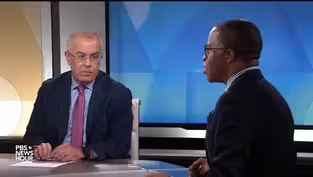
Brooks and Capehart on political impact of Hunter Biden case
Video has Closed Captions
Clip: 12/8/2023 | 10m 40s | Brooks and Capehart on the political impact of the latest charges against Hunter Biden (10m 40s)
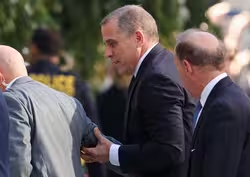
A look at the latest charges filed against Hunter Biden
Video has Closed Captions
Clip: 12/8/2023 | 4m 32s | A look at the latest federal charges filed against Hunter Biden (4m 32s)
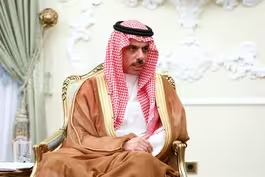
Saudi foreign minister on Israel-Hamas war, wider challenges
Video has Closed Captions
Clip: 12/8/2023 | 8m 58s | Saudi foreign minister discusses Israel-Hamas war and wider challenges in Middle East (8m 58s)

The troubled safety record of the Osprey aircraft fleet
Video has Closed Captions
Clip: 12/8/2023 | 4m 51s | The troubled safety record of the Osprey aircraft fleet grounded by the U.S. military (4m 51s)

U.S. service members perform 'Ocho Kandelikas' for Hanukkah
Video has Closed Captions
Clip: 12/8/2023 | 3m 23s | U.S. service members perform 'Ocho Kandelikas' for Hanukkah (3m 23s)

U.S. vetoes UN resolution for Gaza cease-fire
Video has Closed Captions
Clip: 12/8/2023 | 4m 49s | U.S. vetoes UN resolution for cease-fire as Israel ramps up airstrikes in Gaza (4m 49s)
Providing Support for PBS.org
Learn Moreabout PBS online sponsorship
- News and Public Affairs

FRONTLINE is investigative journalism that questions, explains and changes our world.

- News and Public Affairs

Amanpour and Company features conversations with leaders and decision makers.











Support for PBS provided by:
Major corporate funding for the PBS News Hour is provided by BDO, BNSF, Consumer Cellular, American Cruise Lines, and Raymond James. Funding for the PBS NewsHour Weekend is provided by...