
December 8, 2024 - PBS News Weekend full episode
12/8/2024 | 24m 9sVideo has Closed Captions
December 8, 2024 - PBS News Weekend full episode
Sunday on PBS News Weekend, a lightning offensive by Syrian rebels ends a half-century of iron rule by the Assad regime. Then, a documentary details how governments use commercial spyware to monitor their own citizens. Plus, a StoryCorps tale of small gestures that mean a great deal in two lives.
Problems playing video? | Closed Captioning Feedback
Problems playing video? | Closed Captioning Feedback
Major corporate funding for the PBS News Hour is provided by BDO, BNSF, Consumer Cellular, American Cruise Lines, and Raymond James. Funding for the PBS NewsHour Weekend is provided by...
Support provided by:

December 8, 2024 - PBS News Weekend full episode
12/8/2024 | 24m 9sVideo has Closed Captions
Sunday on PBS News Weekend, a lightning offensive by Syrian rebels ends a half-century of iron rule by the Assad regime. Then, a documentary details how governments use commercial spyware to monitor their own citizens. Plus, a StoryCorps tale of small gestures that mean a great deal in two lives.
Problems playing video? | Closed Captioning Feedback
How to Watch PBS News Hour
PBS News Hour is available to stream on pbs.org and the free PBS App, available on iPhone, Apple TV, Android TV, Android smartphones, Amazon Fire TV, Amazon Fire Tablet, Roku, Samsung Smart TV, and Vizio.
Providing Support for PBS.org
Learn Moreabout PBS online sponsorshipJOHN YANG: Tonight on PBS News Weekend, a lightning offensive by Syrian rebels ends a half century of iron rule.
Then a documentary details how governments use commercial spyware to monitor their own citizens.
MAN: I realized, well, this is not an incidental issue.
This is not some esoteric human rights problem that's far away.
This is coming for all of us.
JOHN YANG: And from StoryCorps, a tale of small gestures that mean a great deal in two lives.
(BREAK) JOHN YANG: Good evening, I'm John Yang.
For more than a half century, Syria had been ruled with an iron fist by the Assad regime.
First Hafez Al Assad, then his son Bashar.
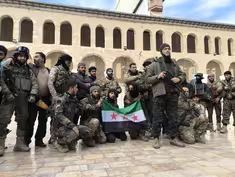
It all came to an end this weekend with stunning lightning speed as rebels moved into the Syrian capital of Damascus, took the city, and with it, the country.
JOHN YANG (voice-over): Across Syria today, gunfire, chanting in cheers in celebration of the end of an era.
The rebels faced no opposition as they advanced overnight, Russian state media said President Bashar al-Assad fled to Moscow where he was granted asylum.
At a mosque in the capital city, the leader of the largest insurgent group addressed his fighters.
ABU MOHAMMED AL-GOLANI, Syrian Rebel Commander (through translator): This victory, my brothers, is for the Islamic nation.
This victory is a new history for the region.
JOHN YANG (voice-over): Ordinary citizens roamed the presidential palace in Damascus, rifling rooms and taking selfies.
Across the country, symbols of the Assad family's repressive 53 years in power came toppling down.
In 1974, President Nixon became the first U.S. president to visit Syria, meeting with Hafez al-Assad, who had seized power in a coup.
Hafez and son Bashar ruled Syria by relying heavily on security forces to crush dissent.
And they forged alliances with Russia and Iran.
A civil war ignited in 2011 killed hundreds of thousands and forced millions of Syrians to flee their homeland.
Today, the Syrian diaspora celebrated in Erbil, Iraq, in Istanbul, in Paris.
HARIRI LAMA (through translator): A renewal, we are starting on new foundations without all the tyranny.
JOHN YANG (voice-over): And in Berlin.
MAN (through translator): This day to day last night has the same meaning as the fall of the Berlin Wall.
This is freedom.
JOHN YANG (voice-over): The speed of Assad's collapse surprised many around the world.
At the White House today, President Biden spoke of the days ahead.
JOE BIDEN, U.S. President: The fall of the regime is a fundamental act of justice.
It's a moment of historic opportunity for the long suffering people of Syria to build a better future for the proud country.
It's also a moment of risk and uncertainty.
JOHN YANG (voice-over): The rebel supporters wasted no time in unfurling the opposition flag at Syrian embassies around the world.
JOHN YANG: Even as these events unfolded, U.S. Central Command said it carried out airstrikes against known ISIS camps in Syria, hitting more than 75 targets.
What lies ahead for Syria and the Middle East is an open question.
Hassan Hassan is the founder and editor-in-chief of New Lines magazine.
So, a regime that controlled Syria for more than half a century has been erased in what feels like a week and a half.
How big a deal is this?
What's the significance of this?
HASSAN HASSAN, Founder and Editor-in-Chief of New Lines Magazine: It's a big deal, not just for Syria, for the entire region.
The regime has been slow kind of disintegration over the past decade or so.
It needed to be saved twice.
First by Iran in 2013, when the regime looked like it was losing very fast major parts of the country.
And then later in 2015 by Russia, when also the regime started to feel under so much pressure by the rebels, you know, Iran failing to save it the second time.
JOHN YANG: What do we know about the main insurgent group, Hay'at Tahrir al-Sham, which the State Department classifies as a terrorist group, and the leader of that group, Abu Mohammed al-Golani?
HASSAN HASSAN: We know quite a bit of it.
It's been a prominent part of the Syrian rebel groups over the past.
Like I said, over the course of the conflict they started.
They evolved over time, I think like at least three, four times over the course of the conflict.
First started as part of ISIS in Iraq to just keep it simple, and then left ISIS and then joined al-Qaeda and then still left al-Qaeda and clashed with both, and then evolved from a kind of a jihadist dominated force into still a jihadist organization, but away from global jihad into kind of a Syria focused organization.
It's been evolving since.
JOHN YANG: Is there any hint or sense of what government or what's going to be next for Syria or is there a power vacuum that could cause problems?
HASSAN HASSAN: So a lot of people kind of think, is this another Iraq chaos and then civil wars and so on and so forth kind of a long saga of kind of just violence.
Or Libya and other places also face the same thing.
I think to me, Syria start not from stage one of the Iraq War, but advanced stages when, you know, after civil wars, after exhaustion, people start to kind of try to work together and try to find something.
Remember the Syrian rebels who just taken over Syria have anywhere from five to 10 years of governing in Syria, and they've gone through all the civil wars, fighting each other and fighting until they succeeded in the past few years to unify their ranks, become more organized, become better at governing and working together through coalitions, getting training as well.
They've been preparing for this moment for many years as the Assad regime has been weakening, especially over the past week -- past year, when the Assad regime, other Iranian allies in the region have been entered this relentless campaign by Israel.
Hezbollah in Lebanon.
Hezbollah has been key ally of the Assad regime.
Without Hezbollah, without Iran, the Assad regime cannot contain and continue sustain, unsustain fighting in Syria.
That's why when Hezbollah has been weakened, when Iranian -- the Iranians have become -- it's become harder for them to freely operate in Syria.
That's when the Assad regime has become so exposed to such an attack.
Then obviously, don't forget that Russia has been also entangled in the Ukrainian war.
So Assad is left without allies and the rebels are filling the gap.
JOHN YANG: You mentioned that this is a big deal not just for Syria, but for the region.
Talk about that.
What has this done to the balance of power in the region?
HASSAN HASSAN: I think the best way to think about it is Syria is a piece in the puzzle, in the Iranian in the region, but also as part of the Iranian axis.
And like I said, Israel, the fall of Assad has to be seen in the context of Hezbollah just being finished essentially in Lebanon, or weakened significantly, severely reduced to kind of a small, you know, faction as opposed to the previous power that the jewel of Iranian access in the region.
So it's a kind of two in a row.
Hezbollah has been weakened by Israel.
A day, in fact, after Hezbollah had to sign what looked like it's a kind of a surrender deal with Israel, the Syrian rebels launched this operation.
So now you have two of the most important allies of Iran in the region essentially either weakened or gone.
And Iran is left with almost no influence or very little influence in the Levant, Gaza.
Hamas has been weakened.
Hezbollah in Lebanon has been weakened, and Assad is out of the picture.
So now Iran is left with Iraq, influence in Iraq.
And there are -- there's chatter that Iraq is going to be next in terms of pressure by Iranian like Israel and others who will take on Iran -- in Iraq and obviously Yemen with the Houthis.
JOHN YANG: Hassan Hassan, thank you very much.
HASSAN HASSAN: You're welcome.
Thank you.
JOHN YANG: Elsewhere, President-Elect Trump weighed in on the war in Ukraine.
Hours after meeting with Ukrainian President Volodymyr Zelenskyy in Paris, Mr. Trump posted on Truth Social to call for an immediate ceasefire with Russia.
While Ukraine wants to join NATO, in an interview on NBC's Meet the Press, Mr. Trump said the United States may leave the alliance.
He says European countries are taking advantage of the United States.
He wouldn't commit to staying unless countries meet defense spending targets.
The president-elect also doubled down on his pledge to launch mass deportations as soon as he takes office.
KRISTEN WELKER, NBC NEWS WHITE HOUSE CORRESPONDENT: Is it your plan to deport everyone who is here illegally over the next four years?
DONALD TRUMP, U.S. President-Elect: Well, I think you have to do it.
And it's a very tough thing to do.
But you have to have, you know, you have rules, regulations, laws.
They came in illegally.
You know, the people that have been treated very unfairly are the people that have been online for 10 years to come into the country.
And we're going to make it very easy for people to come in terms of they have to pass the test.
They have to be able to tell you what the Statue of Liberty is.
JOHN YANG: In that interview, Mr. Trump also said he would sign an executive order ending birthright citizenship on day one, acknowledged that he couldn't guarantee that his planned tariffs won't lead to higher prices, though he said they will make the country rich and said he wouldn't replace Federal Reserve Chairman Jerome Powell and asked if he would concede that he lost the 2020 election in a move to unify the country, Mr. Trump refused.
The hunt for the man who killed UnitedHealthCare CEO Brian Thompson is intensifying.
New York police released new photos of the suspected shooter in what appears to be the backseat of a cab.
The reward for information leading to an arrest is now at $60,000.
And a bit of Hollywood history has sold at auction.
Dorothy's iconic red ruby slippers from the wizard of Oz have sold for $28 million.
Judy Garland wore several pairs while making the classic movies, but only four are known to have survived.
Up next on PBS News Weekend, commercial spyware that governments use to monitor dissidents and small gestures of kindness that make a big difference.
(BREAK) JOHN YANG: This past week, the White House detailed the scope of the massive Chinese hacking campaign that's infiltrated at least eight U.S. telecommunications companies.
A foreign power reaping information from American cell phone networks.
But an HBO original documentary called Surveilled, which is available to stream now on Max, says some governments around the world use commercial spyware to monitor their own citizens.
MAN: Spyware is this powerful surveillance tool.
Big spyware companies say they sell this tech only to governments.
But this multibillion dollar industry is mostly unregulated.
The most advanced spyware can turn your smartphone into a spy in your pocket.
It can copy everything and record you without you ever knowing and then just disappear without a trace.
JOHN YANG: Pulitzer Prize winning investigative journalist Ronan Farrow produced the documentary.
Ronan, is there a difference between the salt typhoon hack that's been in the news so much and what you're covering, what you report on here?
RONAN FARROW, "Survielled": Well, there is, but there's also a shared theme here.
Our data is becoming more and more accessible, porous.
And that goes for critical national security, sensitive infrastructure.
It goes for data held by major telecom firms.
And it goes for what's examined in this documentary, which is our phones, which fascinated me as a reporter who's dealt with various forms of surveillance.
And then when I saw that the bleeding edge of that technology, of those kinds of efforts were so advanced that you could turn any phone into a listening device if you have the resources, I realized, well, this is not an incidental issue.
This is not some esoteric human rights problem that's far away.
This is coming for all of us.
JOHN YANG: You've got an example in the documentary.
This is a member of the European Parliament from Catalonia, which is a region in northeastern Spain.
This politician favors independence from Spain.
You were with him the moment he found out his phone had been hacked.
Let's take a look.
MAN: We just received confirmation that your phone was hacked twice.
Once on the 11th of June and then again on the 27th of June.
MAN: 2020?
MAN: 2020.
RONAN FARROW: When does it look like you were infected?
MAN: I have to check at the date, but around that day, I was appointed member of the European Parliament.
RONAN FARROW: How do you feel, knowing that you may have been compromised in this way?
MAN: Well, I feel surprised and angry at the same time.
JOHN YANG: Ronan, who's likely to have hacked that phone, and to what end?
RONAN FARROW: Well, as you pointed out, in Spain, there is an autonomous region, Catalonia.
The capital is Barcelona, where a big swath of the population wants independence for that territory.
And it doesn't really matter what you think of that prospect politically.
The point is there's peaceful activists and politicians and protesters and civil society members, journalists covering the issue, who wound up in a massive surveillance dragnet.
The Spanish government did admit to at least some of the hacking, and there was a firing of an intelligence chief there.
And I just want to point out this isn't a Spain issue.
We've seen a string of these kinds of scandals involving the overreach of spyware and its use to target peaceful political opposition members.
We've seen it in Poland, in Greece.
So I think we have to heed the people in the film who are in Western democracies and say, we didn't think it could happen here, but it can happen anywhere.
JOHN YANG: Talk about that.
Talk about the U.S. government.
Do they have this capability, and do we know if they're using it?
RONAN FARROW: So the United States government has one of the most sophisticated surveillance set of capacities in the world.
Under the first Trump administration, the FBI purchased Pegasus, the same spyware technology that you saw in that scene infecting the phone of that European Parliament member.
Now, the FBI, initially, when this came out, said, well, we just -- we're going to use it to test it and understand what our enemies were doing with that kind of tech.
But the New York Times later sued for more information.
And it seems very clear that the FBI came pretty close to operationalizing this.
It really wanted to.
I just reported in the New Yorker on the fact that this fall, the Department of Homeland Security purchased another powerful form of spyware, also made by an Israeli company.
In this case, it's a company called Paragon.
And the spyware is called Graphite.
And this focuses on hacking, even encrypted messaging apps.
To my knowledge, there aren't known cases of targeting of political opposition members by the U.S. government on U.S. soil.
But the history of surveillance in this country is full of those kinds of overreach.
The legal framework for this is very porous, John.
And you have a new administration coming in that's made it clear that they flout a lot of even that existing legal framework.
JOHN YANG: In the documentary, you also spoke with a former employee of the Israeli company that sort of at the center of this.
This person used to demonstrate the product for potential clients, left the company over ethical concerns.
In this clip we're about to play the voices distorted to protect the person's identity.
Let's take a listen.
RONAN FARROW: So you're hacking these phones.
What kinds of reactions did you get?
MAN: It's jaw-dropping.
It's very impressive the first time that you see it.
RONAN FARROW: What was the pitch that you were offering these governments?
MAN: Usually we had like one iPhone, one Android device.
We used to demonstrate how we can exfiltrate the data from those devices.
Actively take snapshots of the screen or pictures from the camera, actively record through the microphones.
RONAN FARROW: What should the average citizen in any country in the world know about this company and this technology?
MAN: It's very powerful.
It's very interesting.
RONAN FARROW: Should people be concerned?
MAN: Yeah, yeah.
JOHN YANG: People should be concerned.
Is there anything people can do to protect themselves?
RONAN FARROW: Well, there are limited measures you can take if you're a journalist doing confronting politically charged work.
If you're a dissident of some kind, you may want to turn your lockdown mode on in iOS.
If you're like most people out there where you're looking at this issue and you're thinking, you know, no one's going to want my nudes.
Why do I have to care?
I still think exercise good digital hygiene because the truth is you don't know how your information is going to be used.
Turn off your phone every day and reboot it.
It's not a fail safe, but it will create a situation where at least some of these types of technology would need to be reinstalled.
You'd have to be reinfected after the reboot.
So a daily reboot is a really good idea.
Update all of your apps, update your operating systems.
Every single time there's a patch out, don't sleep on it.
JOHN YANG: Ronan Farrow, thank you very much.
RONAN FARROW: Thank you, John.
JOHN YANG: Finally, for the holiday season, animated story from our partners at StoryCorps.
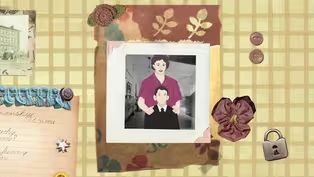
In 1958, when John Cruitt's mother died, his third grade teacher made a small act of kindness that meant a great deal to him.
Decades later, he sat down with Cecile Doyle to tell her how that gesture changed his life and in the process, made a difference in her life as well.
JOHN CRUITT: We talked about decorating the Christmas tree when I came home from school that day.
But I walked into the living room and my aunt was there, and she said, well, honey, Mommy passed away this morning.
And I remember at my mother's wake, someone in my family came to me and said, Johnny, your teacher's here.
CECILE DOYLE: When I found out she died, I could certainly relate to that, because when I was 11, my own father died.
And you just don't know how you're going to go on without that person.
JOHN CRUITT: When I returned to school, you waited until the other children left the room at the end of the day, and you told me that you were there if I needed you.
And you bent over and kissed me on the head.
It was really the only time someone said to me, I know what you're feeling, and I know what you're missing.
And I felt in a very real way that things really would be okay.
CECILE DOYLE: John, I really loved you as a student, and I'm so glad that I could be there with you for that time.
JOHN CRUITT: Many years later, when I became a teacher, I started to think more and more about you.
And I started to think to myself, here I am with a memory of a teacher who changed my life.
And I've never told her that.
And that's why I finally wrote this letter.
Dear Mrs. Doyle, if you are not the Cecile Doyle who taught English at Emerson School in Kearney, New Jersey, then I'm embarrassed and you can disregard the sentiments that follow.
My name is John Cruitt, and I was in your third grade class during the 1958-1959 school year.
Two days before Christmas, my mother passed away, and you told me that you were there if I needed you.
I hope life has been as kind to you as you were to me.
God bless you always with great fondness, John.
CECILE DOYLE: And your letter could not have come at a better time, because my husband had Parkinson's and he was going downhill.
And I had just come home from the hospital and I read this beautiful letter, and I just was overwhelmed.
JOHN CRUITT: Well, the funny thing is, when I finally wrote to you again after 54 years, I typed a letter.
I was afraid my penmanship wasn't going to meet your standards.
Well, after all this time, Mrs. Doyle, all I can say to you is thank you.
CECILE DOYLE: John, what can I say?
I'm just glad that we made a difference in each other's life.
JOHN YANG: And that is PBS News Weekend for this Sunday.
I'm John Yang.
For all of my colleagues, thanks for joining us.
Have a good week.
Half-century of iron rule ends as rebels seize Syria
Video has Closed Captions
Clip: 12/8/2024 | 8m 24s | Half-century of iron rule ends in Syria as rebels seize Damascus. What’s next? (8m 24s)

How governments use spyware to monitor citizens’ phones
Video has Closed Captions
Clip: 12/8/2024 | 7m 16s | New documentary details how governments use spyware to monitor citizens’ phones (7m 16s)
A student and teacher connect over small acts of kindness
Video has Closed Captions
Clip: 12/8/2024 | 2m 58s | A student and teacher connect over small acts of kindness that made a big difference (2m 58s)
Providing Support for PBS.org
Learn Moreabout PBS online sponsorship
- News and Public Affairs

FRONTLINE is investigative journalism that questions, explains and changes our world.

- News and Public Affairs

Amanpour and Company features conversations with leaders and decision makers.











Support for PBS provided by:
Major corporate funding for the PBS News Hour is provided by BDO, BNSF, Consumer Cellular, American Cruise Lines, and Raymond James. Funding for the PBS NewsHour Weekend is provided by...