
December 9, 2023 - PBS News Weekend full episode
12/9/2023 | 26m 44sVideo has Closed Captions
December 9, 2023 - PBS News Weekend full episode
Saturday on PBS News Weekend, a new treatment for sickle cell disease using revolutionary CRISPR gene-editing technology has been approved by the FDA. Tensions rise in South America as Venezuela threatens to take over a large region of Guyana that’s rich in resources. Plus, a conversation with Harvard professor Claudia Goldin on the eve of her receiving the Nobel Prize in economics.
Problems playing video? | Closed Captioning Feedback
Problems playing video? | Closed Captioning Feedback
Major corporate funding for the PBS News Hour is provided by BDO, BNSF, Consumer Cellular, American Cruise Lines, and Raymond James. Funding for the PBS NewsHour Weekend is provided by...
Support provided by:

December 9, 2023 - PBS News Weekend full episode
12/9/2023 | 26m 44sVideo has Closed Captions
Saturday on PBS News Weekend, a new treatment for sickle cell disease using revolutionary CRISPR gene-editing technology has been approved by the FDA. Tensions rise in South America as Venezuela threatens to take over a large region of Guyana that’s rich in resources. Plus, a conversation with Harvard professor Claudia Goldin on the eve of her receiving the Nobel Prize in economics.
Problems playing video? | Closed Captioning Feedback
How to Watch PBS News Hour
PBS News Hour is available to stream on pbs.org and the free PBS App, available on iPhone, Apple TV, Android TV, Android smartphones, Amazon Fire TV, Amazon Fire Tablet, Roku, Samsung Smart TV, and Vizio.
Providing Support for PBS.org
Learn Moreabout PBS online sponsorshipJOHN YANG: Tonight on PBS News Weekend, a new treatment for sickle cell disease using the revolutionary CRISPR gene editing technology now approved by the FDA.
Then rising tensions in South America as Venezuela threatens to take over a large region of Guyana that's rich and resources.
And on the eve of receiving the Nobel Prize for Economics for her work on women in the workforce of conversation with Harvard professor Claudia Goldin.
CLAUDIA GOLDIN: I have the sense that this this is just my Nobel, it's a Nobel for women in general.
And for that I entered please.
(BREAK) JOHN YANG: Good evening, I'm John Yang.
An unusual abortion rights case in Texas has taken a turn.
The State Supreme Court temporarily blocked a lower court ruling that would have allowed a pregnant woman whose fetus has a fatal diagnosis to get an abortion despite some of the nation's most restrictive abortion laws.
The one page order stresses that it is not a ruling on the two sides legal arguments and that the case remains undecided.
Lawyers for Kate Cox, the 31-year-old mother of two in the case say they fear that justice delayed for the at risk pregnancy will be justice denied.
Texas Attorney General Ken Paxton asked for the pause saying that abortion while the case is pending, could not be undone.
Cox says she wants another child but her doctors say carrying the fetus to term or inducing labor could risk serious complications including infertility.
Israel hit targets across the Gaza Strip today is its war with Hamas entered its third month, Israel ordered an evacuation of the central part of Khan Younis in southern Gaza.
The Hamas run Gaza health ministry says nearly 18,000 Palestinians have been killed since the start of the war.
Israeli officials claimed that 7,000 of them are militants, and at least 1,200 Israeli civilians and soldiers have been killed most of them in the initial Hamas attack on October 7, and Israeli hostages reported to be among the dead.
Hamas said 25-year-old Sahar Baroque (ph) was killed in a failed Israeli rescue mission.
The Israeli military only says that two soldiers were seriously wounded in a rescue attempt that didn't free any hostages.
On the final weekend of the United Nations COP28 Climate Conference nations are clashing on long standing disagreements over a global reduction in the use of fossil fuels.
There are reports that the head of the powerful oil cartel OPEC urged its member nations to reject any language calling for a reduction of fossil fuels.
And China, the world's largest emitter of greenhouse gases won't say whether it would agree to reductions in the use of oil, gas or coal.
Some of the end on Tuesday.
And ending weeks of speculation two-way baseball superstar Shohei Ohtani says he's signing with the Los Angeles Dodgers report say the 10-year deal is worth $700 million.
That's a North American Sports record.
Ohtani who excels both as a hitter and a pitcher had spent the last six seasons with the Los Angeles Angels.
Ohtani had elbow surgery in September and doctors say he should be ready to go for next year's opening day.
Still to come on PBS News Weekend, South American neighbors feud over an area rich in oil and gas and Harvard professor Claudia Goldin on her Nobel Prize winning work studying women in the labor market.
(BREAK) JOHN YANG: This week, the Food and Drug Administration approved a revolutionary treatment for sickle cell blood disease, a chronic debilitating condition that affects nearly 100,000 Americans, most of them with African ancestry.
It's caused by an inherited genetic mutation that distorts the shape of red blood cells.
Yale Medical School assistant professor Cece Calhoun, specializes in caring for people with the disease.
CECE CALHOUN, Yale University School of Medicine: When I talk to patients, my especially my young adults who have sickle cell disease, they often tell me, it's a silent disease.
I feel unseen people can't see what it is that I go through what I'm trying to navigate.
And so, what in part, what this time represents is awareness.
And people seeing that sickle cell is real, starting to understand the way it affects people's ability to live life every day.
JOHN YANG: This is the first U.S. approved medicine for a genetic disease that uses the groundbreaking gene editing tool called CRISPR.
Gina Kolata in New York Times reporter who focuses on science and medicine.
Gina, how big a deal is this not just for the people who have sickle cell, but also for this technology, this gene editing technology.
GINA KOLATA, The New York Times: Is actually a really big deal for both for the people who have it, it offers them hope, because there really wasn't much hope before this, if a cure.
Now, most people are probably not going to get it.
It's expensive.
It's onerous, not everybody's going to be eligible.
But you can see sort of something on the horizon that maybe could make a difference change your life.
For CRISPR, it's also a huge deal.
Because one of the questions with CRISPR is, is it safe?
In this case, it's making a little cut in the DNA.
And the issue is how do you know a cut in the right place?
And that didn't start cutting someplace else to, how do you know you aren't disrupting another gene that might cause cancer, for example.
So what happened was the company Vertex and CRISPR therapeutics that make this treatment?
What they did was extensive tests saying, we're looking and looking to see if this treatment is disrupting other genes.
So in both cases, it means a lot to have this treatment approved.
JOHN YANG: You say not all people with sickle cell would qualify for this, what's the difference?
What would make someone ineligible for this?
GINA KOLATA: What happens with sickle cell is the red blood cells get deformed, and they get caught in blood vessels, and people have frequent episodes of really unbearable pain that send them to emergency rooms looking for opioids.
And often they're dismissed as drug seeking, they get hospitalized, it's totally debilitating.
In order to qualify, you have to have several of these episodes a year, then the other thing that could make somebody ineligible as if their doctor thought they could not tolerate the grueling treatment.
First, you have to have eight weeks of transfusions, when people are trying to take stem cells, immature cells out of your bone marrow, you have to go to the hospital and spend a month there.
First, they give you very intense chemotherapy to just totally wipe out your bone marrow, which is the source of your immune system, so that it's sort of cleaned out and ready for the gene edited cells that they're going to put in.
And then you have to wait for your bone marrow to grow back again.
And so you have you're pretty much without an immune system for a month.
And people who are frail, who've had a lot of other things go wrong with them, are not going to be able to tolerate it, at least in their doctor's opinion.
JOHN YANG: Now, the cause of sickle cell has been known for decades.
But research seems to have languished over these years.
Why do you think that is?
GINA KOLATA: People attribute it to a couple of things.
One of them is it was they knew what the cause was, but they didn't really know what to do about it.
So that was made it really difficult to try to figure out how do you treat this thing where you have one tiny change out of 3 billion DNA letters, one of them has changed and you have this awful disease.
But another reason is, there was not a lot of money poured into doing research on sickle cell.
There's a thought that that had a lot to do with the population that was that was affected, mostly black Americans, Hispanic Americans, many of them without much money.
And they didn't have a strong advocacy group.
People often compare it to cystic fibrosis, which strikes mostly white children.
And it's not as common as sickle cell.
But they had big fundraisers and telethons and lots of advocacy and people knew about cystic fibrosis.
And money poured in.
And there was a lot more research on cystic fibrosis than there was on sickle cell.
So I think that that's one reason that languished was simply that people kind of didn't care enough.
JOHN YANG: Gina Kolata, The New York Times.
Thank you very much.
GINA KOLATA: Thank you.
It's a pleasure talking to you.
Thanks a lot.
JOHN YANG: Tensions between South American neighbors Venezuela and Guyana escalated this week over a century old territorial dispute.
Today, Venezuela signaled openness to high level talks to resolve the standoff, but Guyana has yet to respond.
Ali Rogan has more.
ALI ROGIN: Last week, Venezuelan President Nicolas Maduro held a referendum to declared sovereignty over a resource rich region that makes up two-thirds of Guyana's territory.
Maduro pledged to begin oil and mining exploration immediately.
PRESIDENT NICOLAS MADURO, Venezuela (through translator): Let's see where on the map here celebrate tonight.
long lived a complete map of Venezuela.
Long live the Homeland.
Long live all of Venezuela.
ALI ROGIN: Both countries have claimed ownership of the Essequibo region since its borders were decided in favor of Guyana over a century ago when Guyana was still a British colony.
But the discovery in recent years of 11 billion barrels worth of oil and gas off Guyana's Coast gave new life to the dispute.
New oil drilling is driving huge gains in Guyana as economy as Venezuela's economy flounders despite its own massive reserves.
Carolina Jimenez Sandoval is president of the Washington Office on Latin America, a research organization that advocates for human rights in Latin America.
Carolina, thank you so much for joining us.
Can you tell us a little bit more about the importance that Essequibo has played in recent years and decades in terms of the culture of both of these countries?
CAROLINA JIMENEZ SANDOVAL, Washington Office On Latin America: I think for Venezuela, this is an old sentry issue.
Most Venezuelans who grew up and, you know, believing strongly reinforcing the idea that the Essequibo is part of Venezuela, but that it is a territory in dispute.
And then, you know, as children in schoolbooks, people used to draw the Essequibo region with dotted lines saying, you know, territory to be claimed.
For Guyana, its territory.
I mean, it comprises two thirds of the current Guyana's as a country territory.
So I think it is indeed, you know, a very complex country when you have a country that lives there that occupies the territory effectively, and another one claiming its historical rights to the land.
ALI ROGIN: And why is Maduro taking these steps at this time?
CAROLINA JIMENEZ SANDOVAL: I think there are two things that are important to understand when one see the current conflict.
One is oil.
That's a huge reserve.
And it's a very important as we know products for the world even today.
But the second and I think it's really important to think about this is internal Venezuelan politics.
Maduro is a deeply unpopular leader.
And he's also deeply authoritarian enter he faces presidential elections in 2024.
At the end of October, the opposition for the first time in years, self-organized primary elections to choose one candidate who could run against Maduro in 2024.
It seems the Maduro government underestimated this citizen exercise because he was self-managed.
The National Electoral Authority didn't play any role.
Over 2.3 million people voted, including people in different cities around the world because the diaspora had a chance to participate.
And the support went overwhelmingly to one candidate Maria Corina Machado, the government seems to have been taken by surprise.
As a result, we see a tremendous propaganda apparatus set in place to then change the narrative and, you know, take all the attention away from that issue and make everyone speak about a territorial dispute that is, over a century years old.
ALI ROGIN: And how is this playing out with the average Venezuelan?
What are they thinking of this?
And how do they view Nicolas Maduro in this context?
CAROLINA JIMENEZ SANDOVAL: When you look at the at the referendum itself, what you notice is that, although Maduro claimed that 10.4 million people went to vote, independent media and citizens and self-reporting, reported a very low turnout, but I think his lack of popularity really chose her on this.
And I think Venezuela was want a peaceful transition to democracy because it's, you know, for many years human rights violations has been at the forefront of his leadership.
ALI ROGIN: How is Guyana responding?
CAROLINA JIMENEZ SANDOVAL: For Guyana, this is an existential threat, right?
I mean, Maduro is claiming, you know, two-thirds of their territory and I think the president of Guyana has been very clear about first of all defending their country but they have also, I mean the government has also be very strategic rally support from its allies.
The U.S. government has very clearly said that he supports Guyana.
I think the Guyanese government has also gone to the U.N. Security Council has tried to rally support among Caribbean countries.
So it's -- it seems that the strategy is to get as much international support as possible to avoid escalation of the crisis.
ALI ROGIN: And how big is the risk of escalation here, there have been troop movements that have taken place as a result.
But what is the possibility that this turns into some sort of a confrontation?
CAROLINA JIMENEZ SANDOVAL: Maduro's nationalistic rhetoric seems to, you know, promote the idea that the government is willing to go to the very end, whatever the consequences to reclaim this territory, but the reality that it is -- that Maduro salaries will not support, you know, any further escalation of the conflict.
And that and I don't think, you know, any leader in the region, or even the U.S. wants another war in the world, and certainly a war in South America.
So, despite its loud narrative about going all the way, I think there will be a lot of international resistance.
ALI ROGIN: And in terms of the United States response, they've come out squarely behind Guyana, but at the same time, the United States lifted sanctions, oil sanctions on Venezuela earlier this year in exchange for some electoral concessions in the upcoming election, allowing opposition candidates to stand at least that was the agreement, if not in, in practice, how does this affect that situation with the United States?
CAROLINA JIMENEZ SANDOVAL: I think Maduro keeps putting the U.S. calm into a major dilemma, to continue supporting negotiations between the democratic opposition and the government, to continue supporting the agreements signed in Barbados.
And at the same time, you know, to react to Maduros actions around the Essequibo and to demand that it fulfills agreements because so far the U.S. indeed, lift the sanctions, but Maduro hasn't done his part.
He hasn't released the political prisoners that are Americans or political prisoners.
He still hasn't given proper electoral guarantees for the elections in 2024.
But I think the best thing the U.S. can do is to continue supporting the negotiation process between the opposition and the Maduro government supporting human rights and, you know, for Venezuelans inside the country and outside of the country, and to oppose any further escalation of this crisis.
ALI ROGIN: Carolina Jimenez Sandoval with the Washington office on Latin America.
Thank you so much for your time.
CAROLINA JIMENEZ SANDOVAL: Thank you.
JOHN YANG: At a time honored ceremony in Stockholm, Sweden tomorrow, the King of Sweden has to hand medals to this year's Nobel Laureates.
Among them will be Claudia Goldin, recipient of the Prize in Economics for her research on women in the American workforce.
She's only the third woman to get that honor and the first two when it's solo, not sharing it with anybody else.
Economics correspondent Paul Solman spoke with her about her trailblazing work.
PAUL SOLMAN: Where did you grow up?
CLAUDIA GOLDIN, Nobel Prize Winner: The Bronx?
New York City.
PAUL SOLMAN: Were you at all interested in economics?
You went to the Bronx High School of Science, right?
CLAUDIA GOLDIN: I didn't know what economics was.
Most high school students don't know what economics is.
That's good.
That's fine.
There are many things that you should learn when you're more mature.
PAUL SOLMAN (voice-over): Goldin's Nobel Prizes for her work on the economics of women.
And in particular, the increasing role of women in the workplace.
MAN: If happened about a woman's delicate touch, enabled her even to excel men in certain precision operations.
PAUL SOLMAN (voice-over): One against the grain finding that Rosie the Riveter was not a main driver, Goldin post a question.
CLAUDIA GOLDIN: You know, if World War II had not existed, what would labor force participation of women have been in 1950?
It probably would have been a little bit lower, but not much.
The treatment effect of the war was probably felt most by the more educated women who had had the clerical jobs during World War II, not the ones who like Rosie would have been in the factories.
PAUL SOLMAN (voice-over): The most accurate image of Rosie says Goldin is Norman Rockwell's, a temporary wartime factory worker whose job was to crush Hitler under foot.
Not the now more famous image, but that's the one that's become so supine.
CLAUDIA GOLDIN: That's right because she's cute.
PAUL SOLMAN: She's tough.
CLAUDIA GOLDIN: But she's also very pretty.
She was like 17, 18 years old.
Norman Rockwell Rosie is the real Rosie.
PAUL SOLMAN (voice-over): Rosie who often returned to housework when the soldiers can came home from the war reclaiming the factory work but other women kept joining the workforce.
One reason the birth control pill Goldin says easier access to the pill in the 1970s helped more women pursue life outside the home.
CLAUDIA GOLDIN: It gave to women who were graduating from college the ability to have more time to form their careers, either in the workplace, or by going to professional or graduate school, it led to causally led to an increase in the age at first marriage.
And that meant that one could concentrate more on careers, and do and have the family later.
PAUL SOLMAN (voice-over): Which leads to today with more than 77 percent of women in the workforce up from 28 percent in 1940.
And yet, the gender wage gap hasn't closed all that much.
Women earn 82 cents for every man's dollar, some 20 years ago, they earned 80 cents on the dollar.
CLAUDIA GOLDIN: When men and women begin their lives as workers, they earn similar amounts and as their lives progress these differences warning.
I mean, that's a fact.
And then the question is, how do we explain it?
PAUL SOLMAN: And what did you find?
CLAUDIA GOLDIN: Much of this occurs around the time of the birth of a child that explains a large part of the widening gap between men and women, as men and women get older.
What women particularly those who are mothers lose relative to men who are fathers is not fully made up.
And if anything, men who are fathers we see seem to have something that we call the paternal premium.
PAUL SOLMAN (voice-over): Mom and dad are equally educated, equally able, working with golden goals, greedy jobs, a 100 hour weeks and sky they but then -- CLAUDIA GOLDIN: They just had a child, they want a second one.
And they realize this is untenable, that someone has to be the on call at home parent.
PAUL SOLMAN (voice-over): So mom stays home dad stays in the pressure cooker, but fathers not only work more hours and thus make more money than mothers, they also make more than single men.
PAUL SOLMAN: Why?
CLAUDIA GOLDIN: There are several possibilities.
But the one that seems most believable is they somehow internally decide that they should rev up their energies to earn more provide for the growing group of children.
PAUL SOLMAN (voice-over): That was the story until the pandemic, which may now cause the pay gap to narrow.
CLAUDIA GOLDIN: About 30 percent of days worked are now at home, or now remote three (ph) jobs have gotten more flexible, and flexible jobs have gotten more productive.
We have learned to work better.
We have learned too, that working remotely can be done productively.
PAUL SOLMAN (voice-over): Which means women are more able to do greedy jobs too.
PAUL SOLMAN: Moreover, women are getting more graduate and even post-graduate degrees and that difference is increasing.
Right?
We still need to worry about a gender gap.
CLAUDIA GOLDIN: In differences in earnings.
At the upper end of the education and occupation distribution, the gender gap is much, much larger than for individuals who have less education whose jobs are not in the professional category.
So it's enormously high.
PAUL SOLMAN: Grade something that said five years from now, women will be getting double the number of college degrees as men.
So, won't that mean that women are taking more and more high positions in the economy, even though women might still be expected to take care of the kids more than men are?
CLAUDIA GOLDIN: We would have to see, first of all, who's married whom and what degrees they have and what jobs they're going into.
But to the extent that higher education means that the more doors are open to you.
Yeah, that certainly could narrow the gap.
PAUL SOLMAN: I had one last question.
What's your reaction to getting the Nobel Prize in economics?
CLAUDIA GOLDIN: It has not yet sunk in and the fact that I got 1,600 emails in 36 hours that I had to go through and it caused a certain amount of eyestrain.
I am delighted and I -- the 1,600 emails included hundreds and hundreds of emails that said I cried, I want to hug you and I have the sense that this isn't just my Nobel.
It's a Nobel for women in general and for that I am very pleased.
PAUL SOLMAN (voice-over): As are many of us for PBS News Weekend, Paul Solman.
JOHN YANG: Before we go, we want to let you know that Liz Magill says she is resigning as president of the University of Pennsylvania.
She's been under fire after seeming evasive when asked at a congressional hearing this week if Penn would discipline students if they called for the genocide of Jewish people.
And that is PBS News Weekend for this Saturday, I'm John Yang.
For all of my colleagues, thanks for joining us.
See you tomorrow.
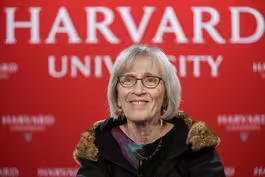
Nobel laureate Claudia Goldin on women in the workforce
Video has Closed Captions
Nobel laureate Claudia Goldin’s takeaways from her research on women and work (7m 33s)
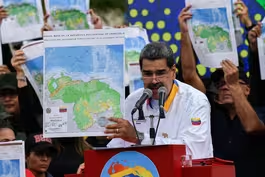
What to know about Venezuela and Guyana’s territory dispute
Video has Closed Captions
What to know about escalations in Venezuela and Guyana’s territorial dispute (7m 28s)

Why FDA approval of sickle cell gene therapy is a ‘big deal’
Video has Closed Captions
Why the FDA’s approval of revolutionary sickle cell gene therapy is a ‘big deal’ (5m 8s)
Providing Support for PBS.org
Learn Moreabout PBS online sponsorship
- News and Public Affairs

FRONTLINE is investigative journalism that questions, explains and changes our world.

- News and Public Affairs

Amanpour and Company features conversations with leaders and decision makers.












Support for PBS provided by:
Major corporate funding for the PBS News Hour is provided by BDO, BNSF, Consumer Cellular, American Cruise Lines, and Raymond James. Funding for the PBS NewsHour Weekend is provided by...