
December 9, 2025
Season 4 Episode 117 | 26m 31sVideo has Closed Captions
Lawmakers debate ending DEI initiatives at K-12 schools in Kentucky.
Lawmakers debate ending DEI initiatives in K-12 schools. Two federal legislators team up to push for a nationwide ban on no-knock warrants. The state sees a surge in enrollment in health-related programs. The outgoing CEO and president of the Kentucky Lottery talks about record-breaking sales in the face of greater gaming competition.
Problems playing video? | Closed Captioning Feedback
Problems playing video? | Closed Captioning Feedback
Kentucky Edition is a local public television program presented by KET
December 9, 2025
Season 4 Episode 117 | 26m 31sVideo has Closed Captions
Lawmakers debate ending DEI initiatives in K-12 schools. Two federal legislators team up to push for a nationwide ban on no-knock warrants. The state sees a surge in enrollment in health-related programs. The outgoing CEO and president of the Kentucky Lottery talks about record-breaking sales in the face of greater gaming competition.
Problems playing video? | Closed Captioning Feedback
How to Watch Kentucky Edition
Kentucky Edition is available to stream on pbs.org and the free PBS App, available on iPhone, Apple TV, Android TV, Android smartphones, Amazon Fire TV, Amazon Fire Tablet, Roku, Samsung Smart TV, and Vizio.
Providing Support for PBS.org
Learn Moreabout PBS online sponsorship>> State lawmakers have already ended Dei programs at Kentucky universities.
What does one lawmaker have in mind for younger students?
I wouldn't.
>> Think of it in terms of a threat.
I would say that we better get our act together and go compete with it.
>> The Kentucky Lottery isn't the only game in town.
The lottery's longtime leader talks about dealing with the competition.
>> Production of Kentucky edition is made possible in part by the KET Millennium Fund.
>> Good evening and welcome to Kentucky Edition for this Tuesday, December the 9th, I'm Renee Shaw, and we thank you for spending some of your evening with us.
Diversity, Equity and inclusion, or Dei, was hotly debated during a legislative hearing in Frankfort today.
During the 2025 Kentucky General Assembly, legislators passed House Bill four, which eliminated Dei initiatives at the state's public universities.
Now, a Republican lawmaker wants to introduce similar legislation to put an end to die in K through 12 schools.
She says funds used on those initiatives are wasteful and are not beneficial to Kentucky students.
Some Democratic lawmakers raised concerns about the legislation.
More in tonight's legislative update.
>> Diversity is not anything that people should be afraid of.
People should not be afraid to learn about other cultures, or to learn about other religions, or those who may be differently abled, or what our history is.
Senator, you had said that you talked about schools shaping young minds.
That's actually the goal of education.
>> I don't want kids minds to be shaped against one another.
>> That's the purpose of education.
>> I said I don't want them, their minds, to be shaped against one another.
That was my quote.
That was that was what I said.
And I would hope you would agree.
That's an important concept, that we don't shape minds to be against one another.
Of our young students, I want to also bring up, you say this is a divisive bill.
Let me tell you something that's divisive in the diversity, equity and poverty department.
At J-c-p-s, there's an employee who wrote a document put together called the Affirming Racial Equity Tool that's to be used in the classroom.
She is an anti-racist specialist.
That's her title.
So in the back of this document for teachers use, it says a definition of diversity.
Oh, excuse me.
For the purpose of this component, diverse will be defined as pertaining to any and all cultures that are not heterosexual, male centered, white, Western or Christian.
I think that's divisive.
I'm not done.
And now anti-racist.
>> Heard from the state Department of Education about school testing reports, which were released last month.
We'll have more about that.
And the anti Dei legislation tomorrow night on Kentucky edition.
A Republican and a Democrat from Kentucky are leading the fight to ban no knock warrants nationally.
The Courier-Journal reports Congressman Morgan McGarvey of Kentucky's third district, which encompasses Louisville, plans to reintroduce the Breonna Taylor Act tomorrow.
And U.S.
Senator Rand Paul of Kentucky is a co-sponsor in the Senate.
The bill aims to ban warrants similar to the one used by Louisville Metro Police in March of 2020.
It's a type of judge issued warrant that allows police to enter a property without announcing their presence or knock.
Police went into Taylor's apartment wrongly believing there were drugs inside.
Police ended up shooting and killing Taylor, prompting protests in Louisville and across the nation.
Louisville has already banned no knock warrants, and the state restricts their use.
Bills to ban no knock warrants have stalled in Congress in recent years.
Arguments continue about whether Kentucky can execute a man who's been on death row more than 30 years, Ralph Baze, shot and killed Powell County Sheriff Steve Bennett and Deputy Arthur Briscoe in 1992.
He claims it was self-defense.
Governor Andy Beshear argues he can't sign a death warrant because the state lacks access to the necessary execution drugs, and because of concerns about executing a person who is insane or intellectually disabled.
Attorneys for Baze and Kentucky Attorney General Russell Coleman offered arguments yesterday in a Franklin Circuit courtroom.
According to the Lexington Herald-Leader, Baze attorneys argued a 2010 ruling banning the death penalty in Kentucky is still valid.
Coleman's side says the governor can sign a death warrant even if the drugs aren't available.
Jack Heyburn, Kentucky's deputy solicitor general, says he didn't think it would be a problem getting the necessary drugs.
Kentucky Democrats seem unimpressed with President Donald Trump's proposed $12 billion aid package for America's farmers affected by his tariff policies.
Kentucky soybean farmers have been hurt by tariffs on China that led China to stop U.S.
soybean imports.
Coleman Eldridge, chair of the Kentucky Democratic Party, said, quote, Trump's economic chaos, unpredictable tariffs and trade wars have resulted in Kentucky farmers shutting down operations, laying off workers and struggling to sell their crops.
After ignoring their cries for help and spending billions to bail out their foreign competitors, Trump is now proposing a bailout from his very own policies, one that is less than half the size of what he handed Argentina.
End quote.
As we told you yesterday, State Representative Deanna Frazier Gordon is dropping out of the Republican primary for the U.S.
House in Kentucky's sixth Congressional district.
She says she will seek reelection to her seat in state House district 81.
One of her Republican opponents, State Representative Ryan Dodson of Winchester, praised Gordon for her decision.
He put out this statement that reads, in part that seems aimed at one of his remaining opponents, says, quote, there.
This is no time for fragile politicians looking to coast into office on name ID, personal wealth or self-serving ambition.
Voters know the difference between a fighter and a placeholder, between someone running to serve and someone running to climb.
Our country can't be saved with a weak voice, a checkbook, or a campaign built in a mirror.
End quote.
Dodson and former state Senator Ralph Alvarado are among the Republicans running in the 2026 primary.
Kentucky is facing a shortage of health care workers, but there are signs of improvement.
The Kentucky Council on Postsecondary Education says enrollment in health related degree programs is up nearly 23% since 2022.
That's almost 7000 students.
CPE says bills passed by the Kentucky General Assembly to help address the shortage are beginning to pay off, but they hope to do more.
CPE says it's requesting $1 million from the Kentucky General Assembly to build on its success.
The money would fund Kentucky's Health Care Workforce Collaborative, which provides grants to Kentucky's public institutions and works to raise student interest in health care jobs.
Now to health care at home.
Those who are full time caregivers for their elderly parents or others being ready for the unexpected emotions that come with caregiving can make the journey a little easier.
Our Christy Dutton sat down with a psychologist who specializes in aging and dementia about common emotional challenges caregivers face, and offer some practical advice for those navigating these feelings with strength and compassion.
>> Doctor Benjamin Marsh joins us.
You are a professor at University of Louisville in psychological and brain science, and you have worked with caregivers for decades now, your entire career.
So we're talking about the caregiver and care recipient relationship.
A lot of times that's caring for a spouse or caring for a parent or grandparent.
How do you often see that relationship evolve over time?
>> Yeah, it's a it's an interesting change in the relationship, right.
Because you have this existing long term relationship, whether a parent or a spouse.
And the thing that's tricky about it is no one tells you in advance that you're going to become a caregiver.
It just sort of slowly happens over time, and you find yourself taking on things that the person used to be able to do for themselves very easily.
You know, maybe managing money or medications or even just keeping them safe in the home.
And so you get a mix in this relationship.
You have the old part, and then you have this new piece that comes in and it really starts to make a shift in those relationships.
>> Yeah.
And for people caring for an aging parent, that is a kind of a role reversal.
How do you see those caregivers coping with this new role, this new identity?
>> Yeah, I think that's a good way to put it.
It is a role reversal.
These are people who took care of you, who were responsible for you for many years, and then you had this transition period where you're on your own.
And then slowly you find yourself having to take take on the care of them, maybe making decisions for them.
Again, no one tells you in advance you're going to be doing this.
And so a lot of times people wonder, am I doing too much?
Am I doing too little?
You know, how much freedom should I be restricting?
How much should I let them continue to choose?
It can be really disorienting for them.
>> Yeah.
And it becomes parenting your parents sometimes.
And then when for those caring for a spouse, how does that relationship evolve?
What are some of the emotions that have to be dealt with in that arrangement?
>> Yeah.
So there's a little bit different sort of feel to it when it's a spouse.
Right.
So you're sharing life together in the same home typically.
And again you're having to take on things that they used to be able to do for themselves.
And what can be really acute in this type of situation is that there is a lot of fear.
There can be a lot of sadness, fear about what is this mean?
What does this mean for our future?
Sadness about the changes that the person is experiencing.
And what we sometimes see is even that maybe once a diagnosis happens, maybe a diagnosis of Alzheimer's or another dementia, that people start to grieve even while the person is still living, grieving losses they've already seen.
Maybe they had plans to retire together and do certain things, travel, and maybe they feel like they can't do those things anymore, and they start to grieve that loss.
And they also grieve things that they see coming down the road.
>> Okay.
And you called this pre-death grieving.
Yeah.
I'm sure a lot of caregivers feel this and they don't know the word for it.
So.
So keep on describing that a little bit.
>> Yeah.
So what you're seeing in Pre-death grief is different than the usual way we think about grief is when there is a lot of sadness and loss after the person has passed away.
And what we see in dementia, caregiving and other terminal illness is that families begin the grieving process even while the person is still living.
>> And a lot of times I hear from caregivers, once the person they're caring for has passed, that grief feels different than they might have expected.
>> Yeah.
So what some people experience and there's good research to support this as well, is when people have been grieving throughout the caregiving experience, sometimes when the actual passing of the person happens, they don't feel the same level of grief as they expected to.
Caregiving can be really hard, and sometimes people feel a sense of relief that that part of their journey together is finished.
And that can prompt a whole new set of emotions, you know, guilt.
Why do I feel relieved when I've just lost my loved one?
But they've been on this very difficult journey and they again, they've been grieving for a long time.
And some of those people will actually experience less intense negative emotions once the person actually passes away.
>> Okay.
For caregivers, where do they go?
Who can help them kind of navigate these emotions they may feel?
>> Yeah, it's a great question.
I think there are informal means and formal means.
I think the biggest thing that I see is that family caregivers tend to be more isolated.
They might be overwhelmed by the tasks of caregiving.
They don't feel like they can leave the person alone.
Some of them feel ashamed about the situation.
They don't want to tell other people.
So for those people, what I encourage is really just finding one person that you can trust to start sharing what's going on so you don't feel so alone.
You don't feel so isolated.
On the formal side, you can reach out to different organizations in the community, maybe a counselor.
Certainly the Alzheimer's Association, the Trager Center with U of L, there's plenty of places where you can get support on the caregiving journey.
The point is to find some sort of outlet to share what's going on.
So you're not so alone and isolated.
And that can sometimes lead to both emotional support and physical support, helping with the person, maybe some respite care and taking some time so that you can get out and doing the things that you need to do.
>> Yes, because both are very important.
>> Absolutely.
>> Doctor, thank you so much for all the work you do.
And thank you for your time today.
>> Thank you.
>> And thank you, Christie Dutton.
You can learn more about the costs, strategies, and support services for caregivers and our special report, The Caregiving Experience.
Then you can watch online on demand at ket.org.
Kentucky wants to keep roads free of illegal signs.
And the case against a former sheriff accused of murder moves forward.
Our Toby Gibbs has details in this.
Look at headlines around Kentucky.
>> A special judge refused to dismiss the case against an ex-sheriff accused of murder in Letcher County.
Sheriff Mickey Stines is accused of killing Judge Kevin Mullins in September of 2024, according to Weku radio.
Stines defense team wanted the special judge assigned to the case to dismiss the murder charge on the grounds that the grand jury heard misleading testimony from a Kentucky State Police detective.
Also from EKU news that Thanksgiving weekend shopping in Kentucky broke records.
The Kentucky Retail Federation says Black Friday, Small Business Saturday and Cyber Monday generated big money.
Retail forecasters believe retail sales grew between 3 and 4% over last year.
The state is removing illegal signs and Highway District 12 Floyd Johnson, not Lawrence, Fletcher, Martin and Pike counties.
The Paintsville Herald says unauthorized signs have popped up on state highway signs, utility poles, guardrails and fences.
Illegal signs can be a driving hazard, and they get in the way of mowing, litter cleanup, ditch cleanup and maintenance operations.
A barber shop in Stanford Unbridled Barbershop is joining the Interior Journal to offer free haircuts and toys to kids in need, the journal says.
The program runs from December 16th to December 23rd at barbershops location on Miller Street.
The program began last year with the goal of making every child feel seen, valued and confident during the holidays.
With headlines around Kentucky.
I'm Toby Gibbs.
>> She's the first woman and the second Kentucky native in over 30 years to run the Kentucky Lottery.
Mary Harvill is making a career pivot after five years at the helm of the organization she's contributed to for decades.
I talked with her yesterday at Ket's Louisville Operation Center about the kinds of partnerships she's brokered thriving during the Covid 19 pandemic, and how she's been able to increase sales more than $1 billion in her five year term as president of the Kentucky Lottery.
Even in the face of greater gaming competition.
Well, let's talk about a little bit about before you came into the lottery, you were an attorney and from private practice.
And so was that a pivot for you?
And what did you set out to do when you took over as the head of the lottery five years ago?
What specifically was it?
>> Well, I came to the lottery out of private practice.
I became the general counsel, senior vice president and general counsel.
So I'd had a lot of years of experience, and I worked next to Arch Gleeson at his right hand, learned a lot from him, and was able to see how to best move us forward.
Of course, everything is changing in the lottery industry.
We know that player habits change and you got to stay up with that.
So I had a bird's eye view of that, and when I became president and CEO, I thought we could do a better job connecting all across the board with our players, with our retailers.
We have 3500 retail locations, everything from a Kroger store to a smoke shop, and we have 3500 locations to be able to connect with and with our vendor partners to better connect with them.
Of course, the governor is my boss.
We need to be able to connect with them and our legislators.
So I wanted to get busy being out there with the people and making the most of that and being in Kentucky, and I was excited to be able to have that opportunity.
So those are the things I've been busy with, as well as putting the team together to make it all happen.
>> Well, let's talk about the changes with the lottery and the competition that has stiffened since the lottery came on board decades ago.
Now we have sports betting.
You have HHR historical horse racing machines which people think are kind of slot type devices.
Really.
And I'm curious because I've watched you testify before the legislative hearings about all of these expanded forms of gaming.
How much of a threat has that been to the lottery?
>> Well, I wouldn't think of it in terms of a threat.
I would say that we better get our act together and go compete with it.
And that's what I've always said.
I don't think the folks in Frankfort are going to hear us cry about having competition out there from legal forms of gaming.
It's legal and we better be able to deal with it.
And that's what we're doing.
We're finding ways to be able to deal with that.
And sports wagering is popular.
I know I have a couple of 30 year old sons that do that, and they they love doing that, but we have things we can do still, those 3500 retailers that we have, we're the legal gaming that's in there, and we've got that market and we're online and we have lottery online so we can make the most of it.
>> You talked about the hundreds of of retailers of places where you can get lottery products.
What about the big box retailers.
Is that on the to do list is could you would you ever want to go into I won't name a particular store that people frequent for a lot of retail goods and say, okay, I want to get my lottery ticket there and why?
And what would be the disadvantage or barrier to that?
>> Well, it is a matter of the technology of making sure everyone's connected and connected with the lottery.
But I can tell you, I know our vendors, our partners that have the wherewithal to do that and make that happen.
They are working on it.
I mean, how wonderful would it be to walk in and buy a Kentucky Lottery ticket wherever you are?
And we know that it's all about convenience, right?
I had an epiphany on Halloween night.
I saw the trick or treaters leaving my street, which is a back street, and heading out to the main street, and I looked to see where they were going.
They were going out to the main street of the neighborhood because that's where it all was.
It was the main part of the neighborhood, and parents were literally parking their cars on that street, letting the kids out, and they walked down the street and they'd sit in their car and they'd be on their phones, or maybe they would be driving the car down the street and the kids would get in.
But what that told me was, convenience is number one, right?
Right.
So we've got to be the same way.
We've got to find out where those people are that want to purchase our tickets and make sure our tickets are there.
>> And of course, there's always a concern about compulsive gambling, habitual gambling, problem gambling.
I mean, how does the Kentucky Lottery ensure that there is responsible applying of the lottery?
>> We absolutely do want to ensure there is responsible play.
We support one 800 gambler.
It's a number that folks can call if they feel like it's not fun anymore.
Because lottery games are fun, it's not fun.
Then you need to get help.
So we've got that sticker on everything.
It's on the back of all our scratch tickets, and when you play online, you'll see a clock.
There's the ability to self-exclude if you wish to, for varying amounts of time.
There are limits on how much you can deposit into your account, so there are many controls as well as training that we conduct.
We're affiliated with the Kentucky Council for Problem Gambling as well as the national organization as well.
So we do have a robust program.
>> And some of those proceeds go to those organizations.
>> We do support one 800 Gambler.
We do pay for the individual counselor that you will get if you go to one 800 gambler and you want to text or chat, we pay for the training of those counselors that are there.
>> Does go back about five years, right?
When you came in, actually, and there was a little thing called the Covid 19 pandemic, when entertainment options were shuttered because of contagion concerns.
But you could still go to a grocery store, get a lottery ticket.
I mean, when you look on the other side of Covid, not to say that that would be a silver lining, but did that expand markets?
Because for a while there weren't any entertainment options for people, but the lottery was still there and accessible.
>> You got it.
We benefited greatly from that, no question about it.
We were watching those sales and as those businesses are competition were shuttered.
The racing, the tracks.
Yeah, we could see our sales going up.
But see there's another component to that too.
And it was all hands on deck because in some grocery stores it was the machines that were the problem, right?
They remember we weren't supposed to stand next to each other, so people were in line, right?
Right.
And all of us, it was all hands on deck.
And I remember talking to several grocery store chains out in eastern Kentucky and saying, could you please work with us on this?
Just leave those machines open.
I think we can work a line out where you can put people so they won't be in the way, and we had to really work on that.
But you're exactly right.
We did benefit from that.
We had a wonderful distribution of scientific games.
We had a wonderful effort to make sure those tickets were delivered and in the machines, and we had so many people say, we're just so grateful you were there.
It made me feel like there was still something we could do that was fun and entertaining.
So when people were looking for an entertainment, we provided it.
>> Yeah.
And those people still hung around, right?
>> Did they did.
That's where the extra effort had to come in.
You know, we saw this trajectory, this upward trajectory due to Covid.
We had to find out how to keep it and keep it going.
And we did for a while.
But of course, it's reset somewhat if you look at it.
Of course we went went up, but then the whole trajectory has reset a bit.
As we've gone back to normal.
>> We'll bring you part two of my interview with Mary Harville tomorrow night.
I ask about winter anonymity and legislative efforts to shield prize winners identity, and we'll talk about how lottery proceeds are helping many Kentuckians get a college education and change their lives for the good.
Tune in for that discussion tomorrow night on Kentucky Edition.
This is.
Then there's Frankfort.
Police are reporting an active aggressor situation at Kentucky State University in Frankfort that has campus on a lockdown.
More details about that tomorrow night on Kentucky Edition.
Also tomorrow.
He once crafted messages and now he's crafting knives.
>> I think there was something in me that said a knife has legacy to it.
>> How this former pastor made the move from the ministry to metalwork, that story and much more in the update on the situation at K state tomorrow night at 630 eastern, 530 Central on Kentucky Edition, where we inform, connect and inspire.
We hope that you'll connect with us all the ways you see on your screen the social media channels Facebook, Instagram and X formerly known as Twitter to keep you in the loop of what's happening here at KET, we also encourage you to send us a story idea by email at Public Affairs at ket.org, and you can look for us and stream us on the PBS app, where all of our great programing is.
And also you can stream online on demand at ket.org.
Thanks so very much for watching.
I'm Renee Shaw have a great night and take good care.
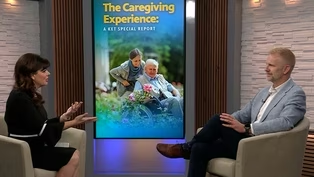
Emotional Challenges of Caring for Elderly Parents
Video has Closed Captions
Clip: S4 Ep117 | 6m 50s | Dementia and aging expert on emotional challenges of caring for elderly parents. (6m 50s)
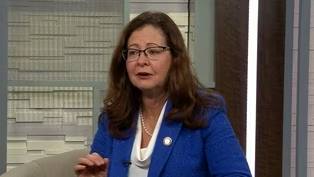
Kentucky Lottery Sales Increasing Despite More Competition
Video has Closed Captions
Clip: S4 Ep117 | 8m 36s | President of the Kentucky Lottery talks about facing more gaming competition. (8m 36s)
Providing Support for PBS.org
Learn Moreabout PBS online sponsorship
- News and Public Affairs

Top journalists deliver compelling original analysis of the hour's headlines.

- News and Public Affairs

FRONTLINE is investigative journalism that questions, explains and changes our world.












Support for PBS provided by:
Kentucky Edition is a local public television program presented by KET