VPM News Focal Point
Defining free speech and why it's a counter-intuitive idea
Clip: Season 3 Episode 1 | 3m 45sVideo has Closed Captions
Frederick Schauer explains how free speech is counter-intuitive and commonly misunderstood
Free speech is one of the most essential parts of American democracy and one of the most hotly debated rights. Frederick Schauer, a law professor at the University of Virginia, explains why free speech is frequently misunderstood and how Americans can better understand what is and is not protected speech.
Problems playing video? | Closed Captioning Feedback
Problems playing video? | Closed Captioning Feedback
VPM News Focal Point is a local public television program presented by VPM
VPM News Focal Point
Defining free speech and why it's a counter-intuitive idea
Clip: Season 3 Episode 1 | 3m 45sVideo has Closed Captions
Free speech is one of the most essential parts of American democracy and one of the most hotly debated rights. Frederick Schauer, a law professor at the University of Virginia, explains why free speech is frequently misunderstood and how Americans can better understand what is and is not protected speech.
Problems playing video? | Closed Captioning Feedback
How to Watch VPM News Focal Point
VPM News Focal Point is available to stream on pbs.org and the free PBS App, available on iPhone, Apple TV, Android TV, Android smartphones, Amazon Fire TV, Amazon Fire Tablet, Roku, Samsung Smart TV, and Vizio.
Providing Support for PBS.org
Learn Moreabout PBS online sponsorshipFREDERICK SCHAUER: The idea of free speech is that it is harder for government to restrict certain forms of communication than it is for government to restrict other forms of conduct.
Most of the questions, at least as a matter of constitutional law, are questions about what governments can restrict.
FREDERICK SCHAUER: It turns out that the idea of free speech is a counter-intuitive idea.
And once we understand that it's a counter-intuitive idea, we have a pretty good explanation of why there is so much misunderstanding.
Psychologists, in particular social and cognitive psychologists, have done a lot of research on something called “motivated reasoning.
” Motivated reasoning is believing that the world is the way you want the world to be.
That is, your factual perception are motivated by your desires.
And because free speech is such a counter-intuitive idea, people engage in motivated reasoning to think that the law and the general idea comports with what they think it ought to be.
Even though it doesn't.
FREDERICK SCHAUER: It turns out, based on a 1989 Supreme Court case that burning the American flag is protected by the First Amendment.
Most people not only believe that that's wrong as a normative matter, they believe that that's mistaken in terms of what free speech actually involves.
That's just false.
And has been false as a matter of constitutional doctrine since 1989.
Nevertheless, the resistance on the ground to that conclusion, in my view, is substantially influenced by people's motivated reasoning by what they think the law ought to be rather than what it is.
FREDERICK SCHAUER: The enforcement of free speech is not largely enforcement by the government.
Its enforcement in everyday discourse, its enforcement in how people react to speech and so on.
The enforcement of legal norms, the enforcement of constitutional norms depends to a very significant extent on public acceptance of them.
If we want to avoid actions that violate the law in other respects, including violate the first, violating the First Amendment, then we need a fair amount of education of public officials, education of law enforcement officials, education of school teachers.
That will do far more good than the formal devices of legal and constitutional enforcement.
Because by the time we get to the formal devices of legal and constitutional enforcement, it's too late.
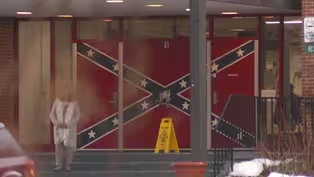
Confederate imagery in Virginia public schools
Video has Closed Captions
Clip: S3 Ep1 | 4m 11s | Confederate symbols prompt debate about what’s appropriate in schools (4m 11s)
Disagreeing Agreeably: How Conversations Could be a Cure
Video has Closed Captions
Clip: S3 Ep1 | 3m 34s | How do you talk to someone when you disagree? The key to having difficult conversations. (3m 34s)
Is the solution to offensive speech more speech?
Video has Closed Captions
Clip: S3 Ep1 | 11m 5s | Some argue the way to push back against offensive speech is by allowing even more speech. (11m 5s)
Responding to incidents of bias on college campuses
Video has Closed Captions
Clip: S3 Ep1 | 2m 40s | Is the right to freedom of speech guaranteed at institutions of higher learning? (2m 40s)
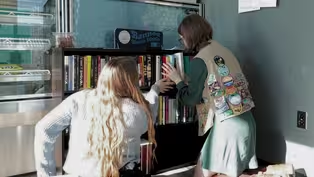
Students fight a book ban by giving away free banned books
Video has Closed Captions
Clip: S3 Ep1 | 7m 45s | Hanover Co. School Board banned 91 books. Students say this violates freedom of speech. (7m 45s)
Providing Support for PBS.org
Learn Moreabout PBS online sponsorship
- News and Public Affairs

Top journalists deliver compelling original analysis of the hour's headlines.

- News and Public Affairs

FRONTLINE is investigative journalism that questions, explains and changes our world.












Support for PBS provided by:
VPM News Focal Point is a local public television program presented by VPM