
Delivering Health Care to the Community
Season 3 Episode 312 | 26m 45sVideo has Closed Captions
Ilias Simpson, President, Modivcare Mobility, talks about delivering health care.
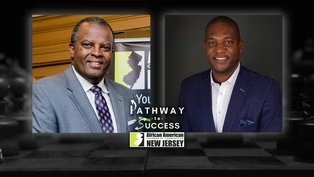
John E. Harmon, Sr., Founder, Pres. & CEO of the African American Chamber of Commerce speaks with Ilias Simpson, President of Modivcare Mobility about making connections in the community and delivering health care. He also discusses business opportunities with Modivcare. Produced by the AACCNJ, Pathway to Success highlights the African American business community.
Problems playing video? | Closed Captioning Feedback
Problems playing video? | Closed Captioning Feedback
Pathway to Success is a local public television program presented by NJ PBS
Delivering Health Care to the Community
Season 3 Episode 312 | 26m 45sVideo has Closed Captions
John E. Harmon, Sr., Founder, Pres. & CEO of the African American Chamber of Commerce speaks with Ilias Simpson, President of Modivcare Mobility about making connections in the community and delivering health care. He also discusses business opportunities with Modivcare. Produced by the AACCNJ, Pathway to Success highlights the African American business community.
Problems playing video? | Closed Captioning Feedback
How to Watch Pathway to Success
Pathway to Success is available to stream on pbs.org and the free PBS App, available on iPhone, Apple TV, Android TV, Android smartphones, Amazon Fire TV, Amazon Fire Tablet, Roku, Samsung Smart TV, and Vizio.
Providing Support for PBS.org
Learn Moreabout PBS online sponsorshipannouncer: Support for this program was provided by: Horizon Blue Cross Blue Shield of New Jersey.
PSE&G, proud sponsors of "Pathway to Success."
JCP&L and the African American Chamber of Commerce of New Jersey, working together to build a stronger community for all.
Investors Bank, banking in your best interest.
Berkeley College.
Education drives opportunity.
Be inspired.
NJM Insurance Group.
The New Jersey Economic Development Authority.
[upbeat jazz music] ♪ ♪ - Hello, and welcome to "Pathway to Success."
I'm your host, John Harmon, founder and president and CEO of the African American Chamber of Commerce of New Jersey.
We're delighted today to have with us Mr. Ilias Simpson, president of Modivcare Mobility.
They are one of the leading health-care service providers in the nation.
Mr. Simpson, welcome to "Pathway to Success."
- Thank you, John.
I'm excited to be here and share a little bit more about Modivcare and our mission and what we're doing to provide access to care across the country.
- You know, the work that you do is so critically important.
But before we get into, you know, the day-to-day execution of the mission of Modivcare, let's talk a little bit about you.
- I was born in Philadelphia.
So my mother-- my biological father wasn't around when I was young, so my mother had three kids at a young age, and she joined the army to take care of us.
So when I was four, she enlisted in the army, and we went to live with my grandmother for a while while she completed all of her training.
She eventually ended up meeting someone in the army, got married to my stepfather, and we spent our childhood moving around while my mom served in the military.
She ended up doing 23 years in the army and retired while I was in-- just finishing college, actually.
- On this show, we've heard story after story about mothers making it happen.
You went on to get a formal education.
Why did you choose the institutions that you chose?
- I grew up playing sports and ended up going to-- I actually started at a small college playing football and then ended up transferring to the University of North Texas to play football there.
Me and my brothers all played sports growing up.
It was just kind of our way of keeping off the streets, to be honest, and keeping ourselves busy.
So we were all blessed to play college sports and ended up playing at the University of North Texas.
And chose that university for a couple of reasons.
One, I was actually in the Air Force National Guard while I was in college, and North Texas had some-- a great supportive program that allowed me to be close to the base that I was serving at as well as some great programs in terms of waiving my tuition and things like that... - Wow.
- As a part of serving in the guard, so-- and then they had a great football program on top of it.
And then I ended up doing my MBA-- my master's of business administration-- at the University of Dayton.
And I chose them because they just have a great mission as a university.
Big on servant leadership and the greater good is a big part of what they're about.
So I actually serve on their advisory board for the business school today.
- So let's just talk about those different geographical locations.
- Yeah, absolutely.
So, you know, been all over the world, so obviously, being born in Philly, love Philly.
Die-hard Eagles fan still to this day.
And I love the grit and grind of Philly.
You know, then going to Texas, and, you know, they say everything's bigger in Texas.
And Texas is all about the pride, right?
Like, they love their-- they love their state.
I've actually lived in a bunch of states.
I lived in Georgia, then moved to Colorado.
Lived in Europe for three years.
- Wow.
- So for me, it was great because, you know, I got to meet people from all different backgrounds.
You know, was always going to new schools, which, you know, is difficult but also gives you an opportunity to really find yourself and learn a little bit more about who-- and focus on who you are and, you know, learning to get along with all different kinds of people and meeting new people all the time.
So for me, getting that exposure to different communities and different parts of the world, even, was critically important to who I am today.
- You know, traveling around the world, traveling throughout the United States, that in itself is an education-- those different experiences.
But professionally, before you became president of Modivcare, what did you do?
- Yeah, so I actually started my career as a management trainee at Enterprise Rent-A-Car.
I wasn't really sure what I wanted to do coming out of college, but I knew I wanted to work with people and hopefully have the opportunity to lead people.
And then, you know, through the military, actually, I was deployed overseas.
I--my sergeant overseas introduced me to manufacturing, and I ended up going to work for Halliburton.
And then from there, I just built a career in supply chain and operations and manufacturing from that point on and, you know, started out as a supervisor at a manufacturing facility, eventually worked my way up to where I was a plant manager and then eventually a director, eventually a vice president.
And before joining Modivcare, I was the CEO of Radial, an e-commerce logistics company.
So again, I've been fortunate to get some great opportunities, some great experience.
- When was Modivcare established?
- Been around for over 30 years.
But Modivcare-- the name Modivcare is recent.
It's a combination of several acquisitions that have taken place over time.
The legacy business was a company called LogistiCare that focused on transportation services.
But in the last few years, we've acquired a few other businesses around personal care services and remote monitoring, and when we brought that all together, we renamed the organization to Modivcare a few years ago.
- Can you describe your role as the president of Modivcare?
- Yeah, absolutely.
So I lead all of our mobility functions.
Essentially, I'm responsible for all of our nonemergency medical transportation, all of our call centers, as well as our client account-- client success and client account management groups.
I support our clients, which is a combination of MCOs-- managed care organizations-- as well as working directly with the states, for example, our largest state client, New Jersey.
- So what would you say the mission is for Modivcare?
- Our mission is to provide access to care.
We are really focused on addressing the social determinants of health.
You know, something for me that I've learned and been privy to here at Modivcare is that zip code is actually one of the key determinants of a person's health.
And so we're out here focused on serving the underserved populations and making sure that everybody gets access to the care that they need and the care that they deserve.
So, you know, our mission is providing connections to care in any way we can, and we do that through transportation, through caregivers in the home, monitoring, and the meal delivery.
- You know, when you talk about core values of any organization and how that connects to your customer base, I would love to hear you elaborate on that.
- You know, like any organization, we have several core values: trust, respect, transparency.
You know, for me, it's--the one I like to focus on is respect.
I think that when you look at what we do, it's about people, and that starts with respect.
- Mutual respect can go a long way.
If you could just share with our viewers a little more about the footprint of the organization.
- Yeah, absolutely.
So, you know, across the country, we serve over 34 million members.
We have operations in pretty much every state.
We do over 21 million rides a year.
- Wow.
- We have over 230,000 remote monitoring patients that we serve.
And then we have over 20,000 caregivers across the country.
So the scale's quite impressive.
And then in New Jersey specifically, we have over 2 million members that we serve and provide over 16,000 rides a day.
- You know, every number you've given is significant.
These are all big numbers.
So describe your typical day.
[laughter] - Yeah, so I think the great thing about my job is that there is no typical day.
Every day is unique.
- I figured as much.
- When you're doing what we do, you know, there are some unique challenges.
I think, right now, for example, we have the hurricane down in Florida, so we've been dealing with that and trying to make sure that, you know, the members down there can still get access to the critical care they need, that our own employees down there-- we have over 500 employees in the area.
You know, every day is a little different.
I mean, for me, what I focus on is, you know, making sure that our customers are taken care of-- you know, meaning our states and clients and partners-- but most importantly that the members are getting their rides done on time.
- Can you speak to some of the specific initiatives that you're executing in New Jersey in addition to providing transportation?
- You know, first thing that comes to mind is, recently we held what we call Modivcare Academy here in New Jersey.
That's basically where we come out and get with our transportation provider partners in the community to help them learn a little bit more about Modivcare.
Gives us an opportunity to learn a little bit more about their business.
And really, our focus is on growing business owners in the area.
So when you look at our business, we rely heavily on these transportation providers, and that business gives individuals an opportunity to become business owners.
So we actually have focus on minority business owners, and we leverage those opportunities to help folks create a business for themselves and become a business owner and then also support their own community at the same time.
You know, obviously, with Modivcare itself, we're always looking to hire talent, so, you know, whether it be, you know, caregivers or whether it be in our corporate offices, you know, we're definitely focused on just finding the best talent.
And to do that, you've got to hire from a diverse pool of talent.
There's definitely opportunities for people from all backgrounds with Modivcare.
Going back a ways, during COVID, we actually delivered over 1.5 million meals here in the state of New Jersey, and we provided rides-- over 85,000 rides for caregivers... - Wow.
- In New Jersey to make sure that folks got the care they needed in their home.
So again, New Jersey, it's a big focal point for us here.
We have our partnership with the chamber here that we value extremely.
And we're looking to continue to grow in New Jersey and continue to partner with other organizations and with the state itself.
- Well, we truly value your partnership with the African American Chamber of Commerce, and together we're doing our best to make a difference.
So let's take a break here on "Pathway to Success."
We'll be back in a moment.
announcer: The African American Chamber of Commerce of New Jersey is your pathway to success.
We encourage you to visit our website at www.aaccnj.com, or call us at 609-571-1620.
We are your strategic partner for success.
- Welcome back to "Pathway to Success."
Today's guest is Mr. Ilias Simpson, president, Modivcare Mobility, and we've been having a great conversation.
So one thing that comes to mind-- and my staff was really excited about it-- was the recent distribution of over 23,000 meals in this region.
Can you speak to that?
And how often does something like that happen?
- We do quite a bit of that.
Any opportunity we get to donate meals or provide transportation or get involved in any kind of volunteering capacity, we like to take advantage of that.
- You know, how has the pandemic impacted the operations of Modivcare?
- The pandemic impacted us in a lot of different ways.
How do we provide care safely?
How do you, you know, get members to their appointments in a COVID environment?
How do you get caregivers in the home in a COVID environment?
So there was a lot of focus on, how do we do those things?
Obviously, we stayed and worked through the entire pandemic.
But then also, there was changes in health care, a lot more telehealth appointments and those sorts of things, so obviously, that impacted the amount of rides we were doing.
And so we saw a different mix in what we were doing.
It did present some good opportunities for us as well in terms of how things are being done differently.
So, you know, I think everybody's still trying to find their way in this new world, and we're not excluded from that.
- You know, we, too, at the chamber had to pivot.
And to your point, we found a tremendous amount of opportunities not only for our members but for the organization.
But I think, to your larger point, it's always about being positioned, being at the ready, being nimble to respond to the marketplace in a way that's of mutual benefit.
You know, that said, we have experienced some severe weather changes, particularly in the state of Florida, and I know you have operations there.
Can you speak to, how did that impact your operation?
- Yeah, you know, obviously, what happened in Florida recently was devastating, with Hurricane Ian.
And I could not be more proud of how our team responded to that.
You know, our organization really came together to support the community, to support one another, you know, to make sure that members were getting to and from their appointments.
You know, despite the weather, if you've got dialysis, you still need to get there.
So we had to figure out how to make sure that these members still got to their appointments.
And our employees in that area are trying to serve these members while also trying to take care of themselves and their families in this hurricane environment.
So the effort and the collaboration, couldn't be more proud.
I mean, we saw things where we had an employee who has a newborn and ran out of milk.
And we had another employee, you know, about 60 miles away who was able to get to a store, get some milk, and go take care of that employee.
So just hearing those kinds of stories and seeing our members being taken care of, seeing our employees taking care of one another, our transportation providers being taken care of has been really heartwarming.
I actually--my family actually lives in Tampa.
My parents are down there.
My brother's down there.
So it hit home for me.
And, you know, I think that the efforts we're doing are great, and we're gonna continue to see what we can do to support the community down there.
But again, I couldn't be more proud of our organization and how they came together.
- You know, it's fantastic what people will do in a time of crisis and a time of need.
It just underscores the significance of the African proverb.
And, you know, we're all in this together, and sometimes it takes these uncertain situations to occur to get people to realize that we're better together.
Post-George Floyd-- you know, George Floyd was murdered on national television, and we saw a sustained protest, nonviolent marches throughout the country, throughout the world.
And as a result, there was a lot of reaction, a lot of declarations made by many corporations throughout the United States.
And so from your perspective, how did that land on the doorstep of Modivcare?
What changes that you've made organizationally?
Can you speak to that?
- Yeah, you know, I think, after the events with George Floyd and the murder of George Floyd, organizations took a hard look at themselves from a diversity, equity, and inclusion perspective, Modivcare included.
And I think there's a much more conscientious effort to improve diversity within organizations.
And, you know, Modivcare, like many other organizations, still has a long way to go, but we're focused on it.
We have a chief diversity officer in Nate Vaughn, who's doing some great things within our organization.
We recently launched some employee resource groups: a Pride group, African ancestry group, women's group.
So, you know, we are very focused on our DE&I efforts.
You know, I think, again, as I mentioned, you know, corporate America still has a long way to go.
You know, you still don't see the level of representation that we would like to see amongst minorities and women, particularly in leadership roles.
But again, I think that organizations are focused on it.
You know, you're seeing more diversity on boards.
You know, it hasn't quite caught up on the executive level at all organizations, but you're starting to see it there.
And we just have to continue to focus on it and continue to provide opportunities.
- Well, I can say I'm proud to see that you're in the presidential role there, the president today.
But let's talk about some of the strategic partners that you have that enable you to execute your mission more efficiently, more effectively.
I think those partnerships really matter.
- Yeah, so I mean, obviously, our biggest partner is our transportation providers, right?
So, like, when you look at what it is that we do, we can't do it without the support of those transportation providers.
It's actually an interesting business in which, you know, we function as the broker.
So the actual transportation services are provided by our partners.
So we partner with over 6,500 different transportation providers across the country, some large who have, you know, 1,000 vehicles and some who are small-business owners, as we mentioned earlier, who have 3 or 4 vehicles.
- You know, this is a great conversation, and I just think about the relationship that you all have with the African American Chamber of Commerce of New Jersey.
And I believe it's also an opportunity for other groups that are at the community level to get aligned with you and your mission.
Your thoughts?
- Yeah, absolutely.
So even though we're a large national organization, we are a community-based organization, and we do focus on building connections and relationships specifically within the community.
When you look at the mission of Modivcare and what we're doing to serve the members in those communities, it's important that we understand the community.
It's important that we have a presence in the community and that we're connected.
You know, when you look at our personal care business, a lot of those caregivers are folks coming out of that community to support that community.
When you look at our transportation providers, a lot of those business owners created their business because they saw a need within their community, and they saw that these folks couldn't get access to the care they needed.
So, you know, for us, it's very important that we understand the communities we're in and that we're a part of the community and connected to that community.
- You know, during the pandemic-- and I know we talked about it earlier-- there was a lot of disruption, a lot of adverse impact to organizations because of the supply chain.
How are things today?
- Yeah, so at Modivcare, we're still dealing with some of the supply chain disruptions, as most businesses are.
You know, probably for us, the biggest impact is just the challenges in getting drivers, getting vehicles, and just getting labor in general.
Again, we're a people-based organization, so finding people is difficult in these times.
But, you know, we're finding ways to increase our employee value proposition, make sure that we're an attractive organization to work for, and continue to face tho-- address those challenges.
So, you know, for us, like everyone, we're still trying to figure out what we can do to make sure that we can sustain our business in this difficult environment.
- Hmm, everyone is dealing with the same situation.
So we're about to bring this conversation to a close.
I'm having a great time chatting with you.
Volunteers--are there are opportunities for volunteers?
And then how can those that may be interested-- how can they reach you?
- Yeah, absolutely.
Great question.
We actually have a very robust volunteer driver program.
So for those who want to get involved and, again, help address these social determinants of health, we can connect you to the volunteer driver program, where we actually provide mileage reimbursement for those who want to drive members to their appointments.
And you can find access to that just on our website at modivcare.com.
But yeah, I mean, there's great opportunities, whether you want to get involved as a volunteer or, again, you know, join our caregiver community or our driver population.
- The African American Chamber of Commerce of New Jersey--any thoughts about our partnership?
What does it mean to your organization?
- No, absolutely.
So first of all, we think very highly of the chamber here in New Jersey.
And, you know, we're just proud to have a partnership with the chamber, and the connections that have been provided for us have been fantastic and allowed us to really get involved in a new way.
And I just think the world of what the African American Chamber is doing here in New Jersey and doing to support the community.
Again, the mission of Modivcare: address these underserved populations, and that's exactly what the chamber's doing here in New Jersey.
So I think our missions are very much aligned.
And, you know, again, very proud to be associated with you all.
- Well, we're equally as proud.
You know, I had to lean into that one a little bit.
Just excited, and we're grateful for the partnership.
So just want to thank you, Mr. Simpson, the president of Modivcare Mobility, for being here with us today.
Until the next time on your "Pathway to Success," this is John Harmon, founder, president, and CEO of the African American Chamber of Commerce of New Jersey.
♪ ♪ You know, several years ago, I had the opportunity to found the New York State Black Chamber of Commerce along with a handful of talented individuals.
And we're looking to bring this organization to market in a great way.
In the state of New York, there's approximately 4 million Black people and over 220,000 Black businesses.
New York State is ranked in the top three or four in the country in terms of Black businesses.
They have similar challenges as here in New Jersey.
This organization will be a division of the African American Chamber of Commerce of New Jersey, and it's our hope we will be able to leverage our best practices, and many of our corporate members, we're hoping to bring them across the other side of the Hudson.
New York has the policy to incentivize more inclusion of Black businesses in the economy.
You know, this is not about subtraction.
We're not coming into this market to take from the great work that many of the organizations have done over the years.
There are various chambers throughout the boroughs and upstate.
This is in addition.
We're looking to complement and work in partnership with all those great men and women who have been advocates for more equitable participation in the workforce, board seats, and prime roles in contract opportunities.
There's a lot going on on this side of the Hudson in New Jersey as well as in New York.
This is a great opportunity to be more aligned regionally to get more benefits for Black people.
Notwithstanding, again, all that we've contributed to the greatness of America, we're still not where we should be.
You know, the African American Chamber of Commerce of New Jersey has been in existence over 15 years here in New Jersey.
I have been a chamber executive over 25 years now.
I serve on the board of chambers across the country and on boards of public corporations in this region.
And we hope to leverage all those relationships to make a greater impact economically and socially for Black people.
Stay tuned.
More to come.
♪ ♪ announcer: Support for this program was provided by: Horizon Blue Cross Blue Shield of New Jersey.
PSE&G.
JCP&L.
Investors Bank.
Berkeley College.
NJM Insurance Group.
The New Jersey Economic Development Authority.
Delivering Health Care to the Community
Video has Closed Captions
Preview: S3 Ep312 | 30s | Ilias Simpson, President, Modivcare Mobility, talks about delivering health care. (30s)
Providing Support for PBS.org
Learn Moreabout PBS online sponsorship
- News and Public Affairs

Top journalists deliver compelling original analysis of the hour's headlines.

- News and Public Affairs

FRONTLINE is investigative journalism that questions, explains and changes our world.












Support for PBS provided by:
Pathway to Success is a local public television program presented by NJ PBS