State of Affairs with Steve Adubato
Dena Mottola Jaborska; Sean Spiller; Mariekarl Vilceus-Talty
Season 5 Episode 39 | 28m 26sVideo has Closed Captions
Dena Mottola Jaborska; Sean Spiller; Mariekarl Vilceus-Talty
Dena Mottola Jaborska talks about the ways the pandemic exacerbated racial and social inequities in underserved communities; Sean Spiller shares the role of educators and public schools in teaching about race and racism and the future of education post-COVID; Mariekarl Vilceus-Talty discusses the racial disparities in maternal health and infant outcomes.
Problems playing video? | Closed Captioning Feedback
Problems playing video? | Closed Captioning Feedback
State of Affairs with Steve Adubato is a local public television program presented by NJ PBS
State of Affairs with Steve Adubato
Dena Mottola Jaborska; Sean Spiller; Mariekarl Vilceus-Talty
Season 5 Episode 39 | 28m 26sVideo has Closed Captions
Dena Mottola Jaborska talks about the ways the pandemic exacerbated racial and social inequities in underserved communities; Sean Spiller shares the role of educators and public schools in teaching about race and racism and the future of education post-COVID; Mariekarl Vilceus-Talty discusses the racial disparities in maternal health and infant outcomes.
Problems playing video? | Closed Captioning Feedback
How to Watch State of Affairs with Steve Adubato
State of Affairs with Steve Adubato is available to stream on pbs.org and the free PBS App, available on iPhone, Apple TV, Android TV, Android smartphones, Amazon Fire TV, Amazon Fire Tablet, Roku, Samsung Smart TV, and Vizio.
Providing Support for PBS.org
Learn Moreabout PBS online sponsorship- [Narrator] Funding for this edition of State of Affairs with Steve Adubato has been provided by Valley Bank.
RWJBarnabas Health.
The Turrell Fund, supporting Reimagine Childcare.
The Robert Wood Johnson Foundation.
Johnson & Johnson.
The Fidelco Group.
New Jersey Institute of Technology.
NJIT makes industry ready professionals in all STEM fields.
PSE&G, committed to providing safe, reliable energy now and in the future.
And by MD Advantage Insurance Company.
Promotional support provided by CIANJ, and Commerce Magazine.
And by ROI-NJ, informing and connecting businesses in New Jersey.
[INSPRATIONAL MUSIC] - Hi, I'm Steve Adubato, folks, and it's our honor to welcome Dena Mottola Jaborska, who is Associate Director of New Jersey Citizen Action.
Good to see you, Dena.
- Good to see you too.
How are you?
- We'll put up the website for New Jersey Citizen Action.
Tell everyone what the organization is.
- Yeah, we're a statewide coalition and grassroots organization that works for social, racial, and economic equality for all.
- In 2022, what would you say the two or three most pressing issues will be, are, for the folks you are most concerned about, the, those who are, in all candor, been getting the shaft for way too long?
- That's right, so we represent low and moderate income New Jerseyans.
That's about half the people living in our state, and our concerns for them have a lot to do with how we're all recovering from the pandemic, the economic impact of the pandemic, and how well people are getting back to work, and being able to, you know, fulfill their economic security for their families, so that takes in a lot of different issues, but that's our overall concern.
- Dena, let me play devil's advocate, if you will, okay?
We're taping several weeks after the 2021 election.
Be seen in 2022.
So one of the things that people say, some people- I hate when people say some people say.
There are people who say this, that the one of the messages is Phil Murphy, too far to the left, the Democrats too far to the left, the progressive agenda leans too far to the left.
We need to get more back to the center.
There are many who perceive New Jersey Citizen Action organization, I know, well, as a progressive, left organization, so is one of the messages you get- I promise there's a question here, that the most New Jerseyans, most Americans don't want what you want?
- Yeah, well this, in this past election, more democratic voters voted than in the election before, so I expect the accomplishments that the governor and the legislature delivered for working families definitely brought out more voters, and definitely showed that those policies, that the public and the people we represent, continue to want those policies, those types of policies to be adopted and moved forward.
There was another effect in the selection, as you well know, Steve, which is that the right wing, or the Republican base voters, which are pretty far to the right, people who are anti-vax, and anti mask, came out in even greater numbers, and they were very motivated and mobilized on these issues, which they're pretty deeply emotional about.
So there were a variety of things happening in this last election, and it is really kind of lazy to assume that the result is that the public doesn't want the legislature and the governor to adopt policies that help working families.
I think that's really an over-simplification, and not at all, actually what happened.
I think those issues, those economic issues that they delivered on, they poll really high.
People really like them.
- Define economic justice.
- Economic justice could be anything from fair wages, or living wages so that a person doesn't have to work three jobs to support their family.
It could also be equal pay, so fairness in, against discrimination, so men and women make the same amount, white people, black people, brown people are not being, nobody's being discriminated on their race, so that's, those are some of the aspects of economic justice.
There are many.
- But there's so much pushback, not just in New Jersey, but across the nation, about, hey, let me play this devil- I keep saying I play devil's advocate.
All I'm really trying to do is make an argument that others make.
You know, these undocumented immigrants, we can't, we don't even have enough to take care of our own people, right?
Those who did it the right way.
What do you say to those folks?
- Yeah, I mean, we have, there are some jobs right now, companies are desperate to hire.
We certainly need people at all income levels to take those jobs.
We need people in all walks of life to take those jobs, including immigrants.
We do have enough, we have enough to meet their needs.
Immigrants are largely cut out of the public benefit system anyway, so I'm not even really sure what that argument is actually about, whether it's about jobs or public benefits, but for the most part, immigrants are not eligible for, you know, public benefits.
- COVID has laid bare a whole range of racial and social issues of inequities, or issues of social and racial inequities in underserved communities.
What are the worst aspects of that, Dena?
- You know, I think, you know, one aspect is we just talked about immigrants were really largely left behind.
They didn't receive a stimulus checks, unemployment, and that was a substantial challenge for undocumented immigrant families in this country who really couldn't find work because so much was closed, and really struggled.
Also essential workers, so all kinds of people who continued to have to go back to work during the pandemic, I think, you know, they just contracted COVID at higher rates, and so mostly lower-earning families who were working in essential, the majority who working were low-income in essential work, really got sicker, higher death rate among that population, so that was one of the inequities that we, you know, we do have to face.
Healthcare was a big challenge for people who lost work.
Especially in a pandemic, everybody needed healthcare to, for example, get tested to, to get the vaccination.
Ultimately the government made decisions to make sure that people could access all those services for free, but at the beginning it was unclear, how do I get tested if I don't have health insurance?
Or how do I get care if I'm sick with COVID?
It took the government a little while to act, to fill that void.
- Dena, a minute left.
2022, the Murphy agenda, which has to be measured against what the state legislature does, and excuse me, we have leaders from the state legislature joining us to talk about the relationship with the governor, and policy issues that are a priority in 2022.
One issue, one area that needs to, that the governor, together with the legislature, they need to take real action on, based on the agenda that you and the other folks at Citizen Action care about, what is it?
- I think, you know, a lot of what we're working on deals very squarely with acknowledging that racism exists, and has had an effect on our state, and has led to, and the country, and it has led to the racial wealth gap, and so a lot of what we're working on is to really close the racial wealth gap.
To that end, we're still working to expand coverage for people.
We still have a substantial number of people uninsured here in the state, not just undocumented people, low-income people who can't afford Affordable Care Act plans, so we're still working on that.
That's still, you know, on the agenda for 2022.
We're still working on things like who pays more in the marketplace for important services like car insurance?
Black and brown people pay way more, and why is that?
So we're still working on dissecting that issue, looking for solutions there.
We're still working on policing, and the unfair, disproportionate impact of unfair policing practices on people of color.
- Before I let you go.
Before I let you go, you do not support, or do you support "defunding the police"?
- No, we've never supported defunding the police.
- Okay.
- If that's- - Just clarifying that.
- That's my simple answer.
- Yeah, listen, I know it's a complex issue, and we've covered it.
Look at our website, a whole range of programming we've done in that area.
Dena, I'm sorry for cutting you off.
We'll have you back again.
Just as always, we're managing time, but we thank you, and wish the team at New Jersey Citizen Action all the best.
Thank you.
- Thanks for having me, thank you.
- You got it.
Stay with us, we'll be right back.
(grand music) - [Announcer] To watch more State of Affairs with Steve Adubato, find us online and follow us on social media.
- We're honored to be joined by Sean Spiller, who's president of the NJEA.
Also happens to be, to disclose the mayor of my hometown.
I mean, I'm born and raised in Newark, but Montclair has been my hometown for a long time.
Mr. Mayor, thank you for joining us, Sean.
- Thank you.
And it suits you well, glad to have you here in town.
- You got it.
Hey, listen.
There's a whole bunch of things that we're focusing on.
A lot of it's about the NJEA convention, which was in-person and virtual.
Next year, we will be on the convention floor talking to people directly in person, but this year we're doing it this way.
I wanna ask you something, the theme of racial equity, social justice, the inequities that exist, exacerbated if you will, by the pandemic, no less important this year than any other year, right Sean?
- Yeah, that work continuous.
You know, I think especially when we talk about justice and certainly educational justice, environmental justice, racial justice, social justice, economic justice.
It's not like you start it, you know, you work on it for a few months or a year or two, and then you're done, you know, this is ongoing work.
I think, as you note, the pandemic has laid bare a lot of the challenges that we face, certainly in the educational space and as a society.
And we've got to keep working on this.
This is a matter of all hands on deck.
We've got to keep as educators, the process moving that journey going forward.
And we're committed to that as an organization.
And we're gonna keep going.
- You know, there's a lot of noise about quote unquote critical race theory.
Let people decide that where that is a real issue in their state, but the question and the issue of teaching about race and racism, you and I've talked about this before.
I'm not exactly sure what's controversial about that, but the question is where, from your perspective, as the president of the NJEA, where is the role, what is the role for educators in public schools to teach about race and racism?
And if we don't do that, then just let the parents talk about it?
Okay, let's talk about it.
- I couldn't agree with you more.
I don't understand when this became controversial.
You know, when we're talking about history, when we're talking about, you know, teaching history, making sure that our students understand what has happened, that we can always learn from history, that we can look forward and try to do better because we've learned those things because we can learn that the contributions, in a state as diverse as ours to boot, learn that the diversity that we have and the strength that we get from it and share all of those pieces, it's never at the expense of someone else, or it doesn't diminish any other experience.
It's to uplift us all.
So it's saddening in some ways, because I know that as educators throughout the state are engaging in that work and making sure we are inclusive in what we do and teach and talk about and show the different perspectives and the broad dynamic population that we have here in this state, And want to honor that.
We're hearing about quote unquote critical race theory, which I will note and if you want to put it to the side, that is not what is happening.
So let's be clear, but people are talking about, you know, people are talking about history, people are talking about race.
People are talking about racism.
People are talking about what we've done, what we can do better, how we can move forward, what we can critically think about.
And I think all of those things are important and we should demand nothing less for our students to be learning about and to be able to cope with, learn from, and do better because of.
- Real quick, I'll get off this in a second, but those who say, come on, that's not quote for the classroom.
There are many who argue that reading, writing, and arithmetic basically, and science, that's the job of our educators.
Beyond that, we'll handle that at home.
Talk to those folks.
- Well, listen, I'd say this now more than ever, we want our students to be able to get information, understand how to sort through that information.
You might be like me.
I remember when we'd had to go to the encyclopedias that were on the shelves or finding information in other ways.
And now there is so much at our students' fingertips, right there, right online.
They're plugging something in and they're getting a lot back, but what they're getting back, isn't always factual.
It isn't always relevant or accurate.
You know, we've got to make sure we teach them how to look through that information.
And then when they come to an opinion in their minds, we need to challenge them and say, how did you come to that?
Why, did you know about this in our history?
You know, how does that shape how you look at this moving forward?
Did it change your view or perspective?
Those are all things that we should want to teach because it's gonna allow our children to become critical thinkers.
That's gonna help them as they move into the workforce.
But most importantly, it's gonna help them as we move forward in their civic society, their duty to be on a field where we can help this democracy work and where we can move forward in a constructive way as humans and be kind to one another.
- Sean, I do not want this to turn into a commercial for public broadcasting and I won't let it be that.
But at the same time, you're talking about civic education, public education, public awareness, which is the business we're in.
We don't advocate for anyone or anything, but I've disclosed this before that the NJEA supports NJ Spotlight News, it supports other programs in public broadcasting.
It supports what our independent production company does.
What does that have to do with what we just talked about?
- You know, a lot of people say to us all the time, oh, what you said before, just stay in the lane and just talk about, two plus two equals four.
And we say to all of them, no, because that student sitting in front of us, isn't going to learn two plus two equals four, if they're impacted by so many other things going on in society, and we're not helping their community.
That student isn't gonna learn two plus two equals four, if we don't understand and recognize, they've never seen anything in a textbook that speaks to their lived experience.
That student isn't gonna learn two plus two equals four, if we know that they're facing challenges in every other aspect of their life that helps to push them down.
We've got to make sure we're in all these spaces, because we want to give every student that opportunity for success.
That's our role, nothing less.
And we've got to honor that charge.
- And our role is to provide meaningful objective information and analysis.
And we have no horse in this race.
You get that information, decide for yourself.
Sean, listen in the couple minutes we have left, the so-called new normal in public education.
It will never go back to what it was.
I'm not passing judgment on this.
What do you believe it will be, particularly as it relates to the teacher-student relationship moving forward into 2022 and beyond.
- Yeah, I think and I hope that there are aspects of the old.
- By the way, Sean is an educator, I want to make it clear that Sean has been a long time educator, not just an executive.
Go ahead.
- I'm a high school science teacher.
So I think the key piece is, we don't want to go back and adopt everything from the old normal.
There are certainly key pieces we want to make sure we bring back into our new normal.
There's a lot that we've learned in that new normal that we said, man, this is a way to reach a student that we didn't have before.
This is another tool or technique.
I'd love to see us taking the best practices of what we learned, not rushing and quickly going back to just, hey, we're back to where we were, all things are good.
Let's look at some of those pieces that allowed us to have a better connection with our students.
Educators know what those have been.
We've been able to try those out, quite frankly, over the last number of months.
And then as that goes forward, let's infuse some of the new with some of the old, and let's get back to a new normal, that's a better normal.
And I think that's what everyone in the educational space is talking about, how we could all work with one another.
That means administrators.
That means in classroom educators, support staff, everybody talking about how we can make that new normal, even better for our kids.
- The Push to Walk initiative.
It was a big theme at the NJEA convention.
Talk about it.
- Listen, it's a situation where a former, actually student that I work with and is a hockey player, unfortunately had a tragic incident where he became paralyzed and kudos to his parents for helping to start Push to Walk and really over the last 15 years or so, it has turned into something that's such an important piece for so many individuals that have had spinal cord injuries.
It's an opportunity for a rehabilitation both mentally and physically, and they do just such great work.
It was really an honor to honor them as one of our event and convention groups that we focused on and highlighted.
And really just so appreciative of the work that they do.
I certainly will say for anybody who's looking to support or learn more, just go to www.pushtowalknj.org.
www.pushtowalknj.org.
They're a great organization.
They do wonderful work.
We all know insurance runs out at some point and you need extra help and extra care for a loved one.
They're a great place that you can turn to.
- Before I let you go, real quick, 30 seconds or less, the second agenda in the Murphy administration, and we keep saying the Murphy administration, but there's new leadership in the state Senate.
There's a whole range of things going on in the lower house, 2022 in New Jersey in the New Jersey state house, top two issues for the world of education should be?
- Let's focus on that new normal.
I'd love to see the governor really put a focus on it with his administration in terms of a direct person in charge of taking a look at how we work on staffing issues, a big concern right now, we see it all across the board.
What that new normal looks like.
You've got educational partners who who've really been working close together the last number of months, and we're excited to do that work moving forward together.
And I certainly think that there's space there for this governor to really leave a mark to say, not only did I bring us back to X point in education, I moved at this far forward.
- Real quick, biggest highlight for you from the NJEA convention of 2021.
- I loved seeing individuals again in person.
I know we had a robust online piece as well, and a lot of people participated that way, but for me personally, you get recharged and energized when you see people and can kind of go from there.
I thought it was a wonderful dual use there.
Certainly excited, hopefully next year we're back to a more regular convention with an online component, of course, but I was really excited to see people and to be engaged in that professional development in-person with colleagues.
- Well said, thank you, Sean.
- Good to see you, sir.
- You got it, we'll be right back.
(grand music) - [Announcer] To watch more State of Affairs with Steve Adubato, find us online and follow us on social media.
- We're honored to be joined by Marielkarl Vilceus-Talty, who is President and CEO of the Partnership for Maternal and Child Health of Northern New Jersey.
Marielkarl, great to see you.
- Great to see you as well.
Thank you so much for having me.
- Uh, we met, and I was so impressed.
I was moderating a meeting of the Greater North Healthcare Advisory Board, and you presented, and you talked about maternal and child health.
Some things I wanna make sure that you clarify for our audience, because they're so important, an African American baby is three times more likely than a white baby to die before his or her first birthday?
- Yes, absolutely.
These- - Because?
- Because when you get down to the crux of it, it's really about racism.
Not race, but racism.
And an African American mother is seven times more likely to die.
- Because of racism?
- Absolutely, because of racism.
When you gather the data, the quantitative and qualitative data, it shows you that African American women, when they complain about pain, or they have an issue, or they're concerned about something, the response is not, it's not juxtaposed to what the issue is.
And if someone of a different race or a different ethnicity were to complain about that, that concern would be, would be, would, you know, they would quickly get onto that concern, be like, "Oh, you have a headache.
How long have you had that headache?
Let's do some more tests."
As opposed to an African American woman, "Oh, you work too much.
Why don't you just put your feet up?"
Meanwhile, we know that we have higher rates of high blood pressure, cardiovascular disease, diabetes.
It's all about those social determinants of health, and when you look at it, it goes all the way back to racism.
Not race.
So that is really, really important to clarify.
- You know, statistics are one thing, Marielkarl, but personal experience is quite another.
Talk about yours, and your sister's.
- Well, my sister...
I am a woman of a certain age, my sister is six years younger than me, having her first child in her late forties.
Unfortunately, instead of this being a really joyous time, every day, Steve, for 40 weeks, every day she would ask me, "Please, make sure that you're there.
Please don't let me die.
Please don't let me die."
- By the way, by way of background, you're an OB/G- you're a nurse, an OB/GYN.
- I am a nurse, I have been a maternal-child nurse.
- Sorry.
- Yeah.
I have been a maternal-child nurse.
- Sorry for not clarifying that, go ahead.
- It's perfectly okay.
Love nursing, have been a maternal-child nurse for over 30 years, and because of all of the qualitative, and not only qualitative, but the quantitative information that we are getting, you know, the stories, the Instagram, the Twitter, just the data.
Every day she asked me, "Please don't let me die."
So you can imagine, this was a joyous occasion, but also in the back of my mind, now COVID hit.
"Oh my god, am I gonna be able to be there?
Am I gonna be able to advocate for her without all of the misrepresentations and stigmas of asking too many questions?
Now am I an 'angry Black woman?'
Am I-" I'm lucky that I have been in the healthcare field, so I know how to navigate those questions, and to advocate for someone, but someone not in my position is in a completely different situation.
I moved to New Jersey about eight years ago, and I found an OB/GYN, went to her office, very nice office, nice reception desk, um, got into the room, speaking to the nurse, she was going through my history, and I told her how many children I had, two, and interestingly enough, she asked me, "Do they have the same father?"
- She didn't ask you that.
- She did.
- She... - Asked me if they had the same father.
I have to say, Steve, in the 30 years that I have been a nurse, I have never asked a patient that.
At all.
Because what difference does it make?
I found it interesting, so I said, "Well, why do you ask?"
"Oh, I just wanna know."
"Well, why, is it going to make a difference?"
- There's no, I wanna be clear.
There's no clinical reason.
There's no medical reason, there's- - Absolutely not, no.
No clinical indication, no medical indication.
So she just wanted to know.
So I started thinking, I said, "Well, why did you ask me that?"
And I kept pressing her.
She's like, "I just needed to know."
In my earlier years, I worked in an OB/GYN's office, and I know that is not one of the questions on the (indistinct) form.
So, again, why did she want to know?
I never got the answer, but because of that one experience, I decided not to go back to the doctor.
And when the doctor asked my why, I said, "I think there's something inherently wrong with your practice.
That someone would ask me such a question that has absolutely nothing to do with the reason that I'm here."
So, again, what does this go back to?
It goes back to the differentiation of care that you get as a Black woman.
Which is... - Marielkarl, let me try this.
First of all, I'm sure people are being impacted greatly by what you're saying right now, but in the time we have left, some concrete, specific recommendations to improve the, frankly, horrific situation you just described.
- Well, one of the good things that we're doing is, the First Lady in 2021 has unveiled her "Nurture NJ Maternal and Infant Strategic Plan."
- Excuse me, look at our website, look at our website, it'll be up right now, the interview that we did with Tammy Murphy, First Lady.
I apologize, go ahead, Marielkarl.
- It's okay, so that plan is specific and it is aimed at decreasing the rates of mortality and morbidity in the community, the disparate care that we're giving, putting a name to what is happening, and making sure that all the practitioners that work with women and children have a basis of implicit and explicit racial bias training, which is extremely important, and we at the Partnership are conveners.
We bridge the gap, we ensure that the patients have the education that they need, that they are empowered to make those decisions, that the hospitals that we work with and the providers that we work with understand the standards of care and are practicing the standards of care that are out there to ensure that we're not being treated as a homogenous group, right?
Every group is different and every group needs to be treated as such.
And most importantly, I know that we have to go, there is a maternal experience survey with, that we're working with the NAACP and PPI, which is pregnancy- Prematurity Prevention Initiative, which is extremely important, because we have the data, now we need the qualitative information, because the experiences that we have are extremely important.
It's an important tool that we have in our toolbox to ensure that the joy that Black women have is not juxtaposed to pain and suffering.
That is not the only thing that we have, we have a lot of joy.
So, doing that maternal experience survey really does craft the narrative of what is happening in real time within our prenatal care, within our L&D visits, within our postpartum care, to ensure that we are able to change that narrative.
- Hey Marielkarl?
- Yes, sir.
- You just helped a lot of people, and you helped us learn.
And we thank you for joining us.
- I look forward to joining you again.
- Wish you all the best and the folks, you and your colleagues at the Partnership for Maternal and Child Health of Northern New Jersey all the best, Marielkarl.
- Thank you, thank you.
Nice seeing you.
- I'm Steve Adubato, thank you so much for watching, and we'll see you next time.
- [Narrator] State of Affairs with Steve Adubato Is a production of the Caucus Educational Corporation.
Funding has been provided by Valley Bank.
RWJBarnabas Health.
The Turrell Fund, supporting Reimagine Childcare.
The Robert Wood Johnson Foundation.
Johnson & Johnson.
The Fidelco Group.
New Jersey Institute of Technology.
PSE&G, And by MD Advantage Insurance Company.
Promotional support provided by CIANJ, and Commerce Magazine.
And by ROI-NJ, (hands clapping) (drums banging) (fingers snapping)
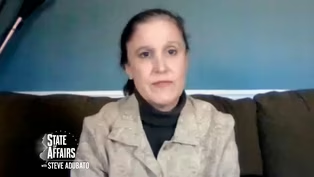
How the Pandemic Exacerbated Racial and Social Inequities
Video has Closed Captions
Clip: S5 Ep39 | 9m 22s | How the Pandemic Exacerbated Racial and Social Inequities (9m 22s)
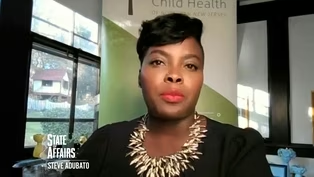
Racial Disparities in Maternal Health and Infant Outcomes
Video has Closed Captions
Clip: S5 Ep39 | 8m 55s | Racial Disparities in Maternal Health and Infant Outcomes (8m 55s)

Teaching About Race & Racism in Public Schools
Video has Closed Captions
Clip: S5 Ep39 | 10m 56s | Teaching About Race & Racism in Public Schools (10m 56s)
Providing Support for PBS.org
Learn Moreabout PBS online sponsorship
- News and Public Affairs

Top journalists deliver compelling original analysis of the hour's headlines.

- News and Public Affairs

FRONTLINE is investigative journalism that questions, explains and changes our world.











Support for PBS provided by:
State of Affairs with Steve Adubato is a local public television program presented by NJ PBS