Ken Kramer's About San Diego
Desert Secrets & Haunting Ghost Trucks
Clip | 9m 36sVideo has Closed Captions
Take a fascinating journey to two remote San Diego County destinations.
Take a fascinating journey to two remote San Diego County destinations. First, visit the Imperial Valley Desert Museum, where you can travel back 10 million years. Nearby, the Motor Transport Museum preserves over 300 vintage trucks, buses, and classic vehicles, standing as "steel ghosts" against the desert sky in an effort to save motor transport history.
Problems playing video? | Closed Captioning Feedback
Problems playing video? | Closed Captioning Feedback
Ken Kramer's About San Diego is a local public television program presented by KPBS
Ken Kramer's About San Diego
Desert Secrets & Haunting Ghost Trucks
Clip | 9m 36sVideo has Closed Captions
Take a fascinating journey to two remote San Diego County destinations. First, visit the Imperial Valley Desert Museum, where you can travel back 10 million years. Nearby, the Motor Transport Museum preserves over 300 vintage trucks, buses, and classic vehicles, standing as "steel ghosts" against the desert sky in an effort to save motor transport history.
Problems playing video? | Closed Captioning Feedback
How to Watch Ken Kramer's About San Diego
Ken Kramer's About San Diego is available to stream on pbs.org and the free PBS App, available on iPhone, Apple TV, Android TV, Android smartphones, Amazon Fire TV, Amazon Fire Tablet, Roku, Samsung Smart TV, and Vizio.
Providing Support for PBS.org
Learn Moreabout PBS online sponsorship(bright piano music) - [Announcer] Here's "A Little Something About San Diego" with Ken Kramer.
(bright piano music) - We've discovered a couple of museums that we thought were pretty fascinating, and thought you might too.
The first one involves a roadtrip.
(gentle guitar music) Interstate 8.
Take the Ocotillo turnoff, okay, make a couple of right turns, and there is what's called the Imperial Valley Desert Museum.
A story of survival in the desert, where they have a favorite saying.
- Well, we always say, "Give us 20 minutes and we'll give you 10 million years."
- [Ken] 20 minutes, 10 million years?
Okay, there are exhibits that do take you back that far, like the Gulf of California.
Did you know it used to extend all the way up to the Coachella Valley?
Topographic sand that changes color as you build dunes by hand.
And a little darkened room where you can go in and experience the Kumeyaay relationship to the night sky, listening to bird songs used in Kumeyaay ceremonies dating back centuries.
(Kumeyaay chanting) You look around so much of life and living in the harsh desert has to do with surviving.
Pottery that's lasted the elements preserved 1,000 to maybe 2,000 years.
Geological artifacts dating back to time immemorial.
There's Dottie, an endangered Sonoran Desert tortoise, who here survives and thrives.
Even this museum itself.
Kristin O'Lear is its executive director.
- So, initially, the museum actually was on Main Street in downtown El Centro, but there was a series of events like hurricane, like Tropical Storm Kathleen that came through.
We also had an earthquake that came that kind of forced our doors to close.
- [Ken] Skeptics joke that this museum out here just off the interstate would never open, never attract a crowd and be successful.
But here it is, still a mostly undiscovered gem, but doing well, thank you.
- So much like the desert environment, we've had to really adapt.
(gentle guitar music) - [Ken] Outside is a walking tour with little signs, descriptions of the land or plant life of the Yuha Desert all around us.
It's a Kumeyaay word.
It means "there is water."
And there are springs not far from here, but you go back 10 million years.
- I mean, what's right in front of us, those are the Coyote Mountains.
And those, we actually have a hike to that called the Top of the Ocean, 'cause that is how high the Gulf of California used to reach.
- Really?
- Was the top of those mountains over there.
- You weren't kidding me?
- No, not at all.
It was quite deep and quite vast.
- [Ken] That's right.
You still find sand dollars and fossils up there, while everywhere we are walking now was once deep under water.
I can never think of the parched, arid desert here quite the same way.
Nor of the Kumeyaay, who millennia later lived here and survived here and still do, have this relationship with the land and the nighttime sky.
There's an area on the grounds, an area protected from light and the desert wind, a place to savor the night sky as it might've been enjoyed in antiquity.
- But no, it's really, really beautiful.
'Cause when everything's dark and then this kind of, you know, will drown out the sound of the highway and you're really just taking it in.
- [Ken] So, there are star-gazing events here that link us with the wonder and awe at the universe that the Kumeyaay treasure to this day.
It is enwrapping and welcoming.
And in fact, in the daytime there is the Kumeyaay word "howka," a word of greeting.
But more than that, it is a blessing.
And that's really what this museum is out here in the desert.
- But we think, you know, the trip is worth the effort.
- [Ken] Just off the interstate at Ocotillo, the Imperial Valley Desert Museum, where there's a commitment to tribal voices and tribal participation to 10 million years of historic authenticity and yes, to survival.
(gentle guitar music) (bright piano music) (lighthearted orchestral music) 60 miles east of San Diego, this is Campo Meadows along Highway 94, which, if you're driving, you'll see this landmark big metal building.
You can't miss it.
It's the old Campo Mill.
And to know what this building nine stories tall used to be, we've gotta go back to the mid-1920s.
Brian Elmore is going to help us.
- Okay, so this is the inside of the building here, where the elevators would've went.
This goes way up here.
- [Ken] The Campo Mill was built to do mostly just one thing, grind up feldspar that came from mines just a few miles away in Hauser Canyon.
Feldspar, a crystalline mineral used in making ceramics and porcelain.
Here's what it looked like.
- [Brian] One might have little tones of red, some has brown in it.
(lighthearted orchestral music) And some of it has quartz in it.
- [Ken] You can still see the wheels they used to grind that rock into very small bits and then, inside the building, lift it all up and let it fall through different size screens until what hit the basement was super fine.
Almost like powdered sugar.
See?
And this ground-up feldspar would then be put in 100-pound sacks, shipped up to the San Francisco Bay area, and made into sinks and bathtubs, spark plugs, all kinds of things.
- [Brian] And then it would give you that beautiful porcelain finish.
- [Ken] The late Carl Calvert wrote a "History of the Campo Mill," even listing the names of workers and working conditions, which were brutal, hot in the summer, deafening noise, and every day inhaling that micro fine powder.
- In fact, the guys would work in here for 20 minutes, and then they have to leave the building and at least be outside for another 20 minutes to clear their lungs.
- [Ken] Even outside the building, the ground was coated with a fine layer of white.
- Yes, as far as where the highway is here now, 2 or 300 feet in whichever direction that the wind was blowing, it would be all dust.
- [Ken] By the late 1950s, other worldwide sources of feldspar were found.
By 1959, the Campo Mill stopped work, the place was sold, and later it was sold again and then again.
And if you look today, outside the mill, there is a plaque, an historical marker where you can read about the mill.
And if you look just beyond it, on its 2.5 acres of property, there is the other part of this story.
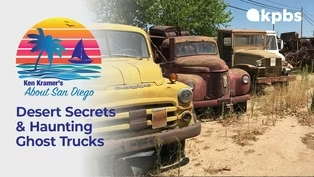
(gentle music) For here are dozens of old trucks.
Lined up in rows amid the desert, dirt, rocks, and sagebrush, they are like steel ghosts standing in silence against the wind-blown sky.
(gentle music) About 300 trucks brought here to stay maybe forever.
Even though many are rusted and decayed well beyond their useful life, there's just something about seeing them here.
- Ken, this is what's amazing.
Because people will come, and they'll just come and they're just standing there staring at this vehicle, and it brings back all these memories for them.
(bright orchestral music) - [Narrator] Many, many things will be delivered by truck today.
(bright orchestral music) Painting supplies.
Lumber and construction materials.
Bread and coffee cake for breakfast tables.
Yes, and the United States mail too.
(bright orchestral music) - [Ken] Every one of these trucks played its role and might have been headed for the scrap yard, but instead was donated to this place called the Motor Transport Museum.
Carl Calvert, the man who wrote that "History of the Campo Mill," when the museum was just getting started, he was its driving force.
- The interest isn't just the vehicles, it's the building and the arts and the association with elements of time gone by.
- [Ken] A few trucks have been restored and are on display, but most are out in the Sahara-dry baking sun, curiosities of past days and past glories.
(lighthearted orchestral music) - In our current society, we think that this stuff is junk.
This is not junk.
This is history, this is a part of us.
- No matter what it looks like, museum volunteers and staff honor every one of these old vehicles.
Like this.
It's a Pickwick Nite Coach, a bus with sleeping compartments.
Introduced in the late 1920s, Pickwick was incorporated into Greyhound, the bus with its beds and onboard buffet disappeared into history, except for this one, which ended up here.
(lighthearted orchestral music) Tow trucks from Lemon Grove.
A Navy bus from North Island.
(bright orchestral music) And this was the ultimate in 1945.
This vehicle used the construction of Hoover Dam.
(bright orchestral music) And hundreds of trucks that might have built your house or brought you anything from butter to bananas.
(lighthearted orchestral music) So what, will they be restored someday?
Some will, probably.
Clearly, many won't be.
And honestly, right now, Brian says, they're just on a mission to not let motor transport history get away.
- For the present time right now, we just need to collect these and keep them here where they're preserved.
- [Ken] At the Motor Transport Museum next to the old Campo Feldspar Mill, along Highway 94, inside and out preserving history about San Diego.
(lighthearted orchestral music)
Video has Closed Captions
Clip | 8m 13s | A volcano in San Diego County? It’s true. Also the history of the highest spot in the city. (8m 13s)
Video has Closed Captions
Clip | 6m 27s | A restaurant built from a trolley car and a peek at when you could take the trolley to Balboa Park. (6m 27s)
Saving History One Image at a Time
Video has Closed Captions
Clip | 7m 14s | The story of Pea Hicks, who discovers old bits of history in cast off film video, slides, and photos (7m 14s)
Sandy the Sea-lion Guy & Ramona Grassland
Video has Closed Captions
Clip | 7m 49s | An underwater photographer and a visit to the Ramona grasslands. (7m 49s)
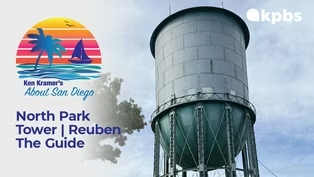
North Park Tower & Reuben The Guide
Video has Closed Captions
Clip | 8m 55s | The story of North Park's Water Tower, and meet the city's 1st tour guide. (8m 55s)

Video has Closed Captions
Clip | 6m 42s | Join Ken aboard the majestic Star of India, the world's oldest active sailing ship. (6m 42s)

The Impossible Railroad & A 100-Year-Old Candy Shop
Video has Closed Captions
Clip | 9m 1s | Journey back in time with the Pacific Southwest Railway Museum and see the "Impossible Railroad." (9m 1s)
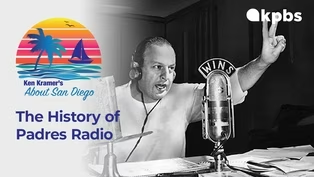
Video has Closed Captions
Clip | 6m 32s | Discover the charming and surprising history of a clever broadcasting trick, (6m 32s)
 Now Playing
Desert Secrets & Haunting Ghost Trucks
Video has Closed Captions
Clip | 9m 36s | Take a fascinating journey to two remote San Diego County destinations. (9m 36s)
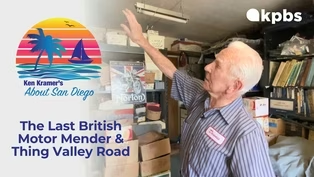
The Last British Motor Mender & Thing Valley Road
Video has Closed Captions
Clip | 7m 29s | Meet Dennis Tolley, a British mechanic and local treasure. Then the story behind Thing Valley Road. (7m 29s)
Providing Support for PBS.org
Learn Moreabout PBS online sponsorship















Support for PBS provided by:
Ken Kramer's About San Diego is a local public television program presented by KPBS