
Desert X 2021
Season 12 Episode 4 | 56m 34sVideo has Closed Captions
Site-specific desert art about land ownership, water scarcity and overlooked histories.
The desert is both a place and idea. Learn how the recurring site-specific, international art exhibition "Desert X" in 2021 explored issues such as land ownership, water scarcity and overlooked histories. Desert X includes newly commissioned works by 12 participating artists from eight countries.
Problems playing video? | Closed Captioning Feedback
Problems playing video? | Closed Captioning Feedback
Artbound is a local public television program presented by PBS SoCal
Desert X 2021
Season 12 Episode 4 | 56m 34sVideo has Closed Captions
The desert is both a place and idea. Learn how the recurring site-specific, international art exhibition "Desert X" in 2021 explored issues such as land ownership, water scarcity and overlooked histories. Desert X includes newly commissioned works by 12 participating artists from eight countries.
Problems playing video? | Closed Captioning Feedback
How to Watch Artbound
Artbound is available to stream on pbs.org and the free PBS App, available on iPhone, Apple TV, Android TV, Android smartphones, Amazon Fire TV, Amazon Fire Tablet, Roku, Samsung Smart TV, and Vizio.
Providing Support for PBS.org
Learn Moreabout PBS online sponsorshipWoman: I'm eager for people to experience art outside the walls of a museum.
Man: Desert X is a show that's free.
You can come at it however you want.
Woman: Part of the experience is driving through these endless highway miles and these dirt roads.
Man: You know, the idea of having this continuous sequence of discoveries.
Woman: What you see is issues of Black Lives Matter, sustainability.
Woman 2: Environmental issues, immigration issues.
Man: But at the root of every artist's project is, ultimately, the desert.
Man 2: We're in an unbounded environment and the hope is that the conversations will be equally unbounded.
Announcer: This program was made possible in part by City of Los Angeles Department of Cultural Affairs, Los Angeles County Department of Arts & Culture, National Endowment for the Arts, and the Frieda Berlinski Foundation.
Man: Richard Mille is more determined than ever to support creativity today with Desert X.
This unique outdoor art experience aligns with our commitment to promote the art and craft of fine watchmaking, bringing it into a new realm of design, art, sculpture, and architecture.
[Birds squawking] Man: We're sitting right behind one of the first installations, which at the moment is a skeleton waiting to receive the parts.
I think what's exciting to me about a show like this is these pieces aren't up forever, you know.
The idea is that they come here and encourage exploration, discovery of the environment that they inhabit, and then leave, hopefully without any trace.
This is Nicholas Galanin's piece.
Some of these projects have a long gestation period.
This is one of them, and it's been worth the wait.
Galanin: Neville reached out to me 3 years ago.
I flew out to Desert X.
Just a site visit to go visit the land and visit the community and get an understanding for the history.
If you look at the street names and the boutique hotels, it was very clear that the chosen narrative in this space was the Hollywood narrative.
And this work is engaging with that in many different ways.
Wakefield: It's a riff on the Hollywood sign and the connection between Palm Springs and Hollywood.
He is interested in the mythology of the American West as it's been co-opted by Hollywood in particular in those tales of cowboys and Indians.
[Gunfire] Galanin: Hollywood cinema historically glamorized settler violence towards our communities.
The history of the sign itself is highly problematic.
The icon that this work is based off of was a real estate land advertisement for a white community.
This work, it's been built to scale.
It's massive.
Indigenous communities.
The original stewards to this place for 10,000+ years.
We have less than 3% of land title.
Wakefield: The idea of this piece is actually a call to action and we hope that this work can be attached to the land back movement in a significant way.
Galanin: The land back movement is a call for landowners to return land back to Indigenous communities.
Doing the opposite of the original sign, this work is trying to invite everyone to understand these histories and to participate.
Wakefield: You know, one of the missions of Desert X, I think, is facilitating artists to create works that are responding to the manifold conditions here.
And it's very different from a institutional show, where you might start with a thesis and then use the art to illustrate the thesis.
You know, the thesis is, is here.
Woman: The so-called creation story of Desert X is that I wanted people to be able to engage with art and learn about this community and then, more importantly, to learn about each other.
Woman: The first year, it was so exciting.
The way that it focused the attention on the natural world with these unexpected views.
We were so taken.
Davis: The miracle of Desert X is that you have people from all over the world coming together, where they can have conversation, share experiences.
Man: Kind of looks like it goes all the way down to the center of the earth.
Woman: I thought it was awesome.
It wasn't something we're expecting, so.
Wakefield: All art is conversation.
Where that conversation leads us is what makes something like this interesting and, you know, a show like this is about questions.
It's not about answers.
So, now we're in the fourth iteration of Desert X, and I think the way that this differs from the first is that this one is engaging with the social landscape as much as it is with the physical landscape.
Davis: The show this year is really a show for our times.
We've just gone through 15 months where we've grappled with humongous issues, all in our own isolation.
Wakefield: Certainly at the beginning of COVID, it was a thought that this maybe couldn't happen.
It's an improbable show to pull off.
Davis: Neville and I felt that it was imperative that we move forward.
Wakefield: The museums in L.A. have been closed, but this kind of art is obviously outdoors.
Doesn't involve large concentrations of people.
And I think it's gonna be one of the first shows to open.
And, you know, I think people are seeking cultural nourishment.
Woman: What is super important for me, which became more important in the last year, is to place art in public spaces.
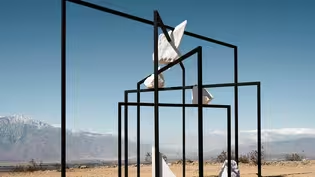
We believe that it is like a very powerful tool and I started to think what I could propose for Desert X. I thought it would be such a great idea to bring the actually Icelandic idea, which was about the glaciers and the environment and water and melting.
I hope that it's creating this very hard contrast, but also kind of wake up this idea of where we are and what we do.
Wakefield: Alicja's piece is on top of a hill.
And I think there's a reason for that.
There is this kind of space between things and I think the sculpture itself is an exploration of that.
We're seeing in between what we would normally look at.
I mean, that's what's exciting about this show.
You're discovering not just the pieces but also the spaces in between.
For 2021, I've been working with Cesar Garcia-Alvarez as a co-curator and I think he's brought so much to it.
Garcia-Alvarez: Quite frankly, I never imagined myself working out in the desert.
I have a complicated relationship to the region.
I was born in Mexico in a border town that's about two hours south from here.
This was the desert we traversed to get to the United States.
So, it's often been a space I've avoided, but I decided the notion of coming to a place where I had skin in the game seemed like an interesting opportunity.
I spend the first couple of months in this project trying to learn more about the people who lived here and their stories.
Who were the people that made up this place?
Woman: It was a rainy morning in January 1943.
I read a small item in a Los Angeles newspaper stating that Uncle Sam was opening certain public lands in the desert for 5-acre homestead leases.
Jackrabbit homesteads, they were called.
Woman 2: All kinds of people really lived and experienced the desert.
The idea of this is to really break down the stereotypes of the people that participate in these particular landscapes.
Riverside County was opened for small tracts with the Small Tract Act in 1938.
You were able to get 5 acres from the federal government.
This was a working-class dream.
A lot of people may not own property.
Westerns were king.
You know, this is a way to get your piece of the American West.
Woman: That first night on my jackrabbit homestead was one of the longest nights of my life.
The light of the lamps from my windows gave me an uneasy, target-like feeling.
It quieted my uneasiness to peer out the windows to see what I could see.
I thought of staying up all night, but was soon driven to bed for warmth.
Stringfellow: This woman's voice, it's based on the writings of Catherine Venn Peterson.
She got her homestead in 1950 and she wrote about it for "Desert" Magazine.
Woman: The little rock hill behind my cabana was dotted with butter-gold clusters of encelia.
This was the only visible change on the hill in the 4 months since I had taken up abode at its base.
Stringfellow: She kept her life very rustic.
Like, these did not have electricity.
There was no water.
And she actually drove it out for the first time on a flatbed truck from Pasadena, where she purchased it.
I kind of did the same thing here by bringing it down from the high desert.
Hi!
Basically, we're gonna do something like this, and this is the door.
Being a single woman, you know, I was really intrigued by this idea that these women did this, especially in that time period, because it was pretty tough.
Woman: It was extremely unusual for a woman to be able to buy property in the forties and fifties.
If you were married, you couldn't have your own bank account.
Stringfellow: That angle's perfect.
It's a--kind of owed to her but it's also kind of my alter ego in a way.
The story of the American West is written by a white, Euro-American male perspective.
So, this re-evaluates who those people were.
Man: One of the things that I think is fascinating about Palm Springs is the idea that you have all of these communities from way, way back in the day kind of coming together in the possibility of this place.
This place is naturally a pretty harsh place to live.
But all these folks come together in this possibility.
The West was one of those places that had so much open in it.
So much imagination in it.
The unwritten story of the West includes things like one in 4 cowboys were Black.
Cattle ranchers needed the skill that these men brought to bear.
That skill transcended so much of the discrimination that they would have naturally faced.
The West was full of people of color.
African-American and Chicano cowboys who were trying to reinvent themselves and rewrite history, and we forget these histories so easily, I think.
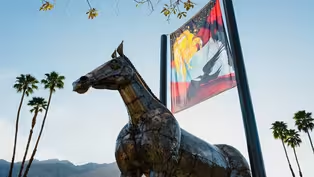
We make statues to bring the past into the future.
Statues end up being the sort of time travelers of our narrative.
This is a monument in the form of 6 steel horses and 6 banners that tell the story of Alton Vero and Loper.
Two cowboys that build the world for themselves in Palm Springs.
Garcia-Alvarez: The work of Chris' along Tahquitz Canyon and these sculptures also lead up to a very problematic monument in Palm Springs of a former mayor and a horse that some community members tried to remove a few years ago, to no success.
Myers: To be in this place of traditional monuments and to kind of offer an alternative to what traditional monuments are, that's part of what the point of this work is.
The problem with monuments in the past has been their definitiveness.
They stand as the periods at the end of the sentence of history.
I'm not interested in periods.
I'm interested in commas and semicolons, question marks, open ends.
There is always a conversation to be had about who we are, about where we're going, about Where we've come from.
Garcia-Alvarez: This is a border region.
We are incredibly close to a border.
There is a history of movement of people here.
That was the next conversation I wanted to have--what migration means and what the American dream actually entails.
Man: When I first got invited to Desert X, I immediately thought about the desert.
I thought about my mother and her journey through that desert.
Crossing the border and coming to the United States.
I usually don't know what I'm making or what these projects turn into.
I like telling a little bit about my story with different textures and different layers of things that are happening.
Garcia-Alvarez: Most stories of migration are always about people coming to the United States from other places.
Eduardo decided to leave the United States and go back to his parents' home country.
And his story, I think to some folks, may seem unique, but it's actually something that we're seeing more and more of.
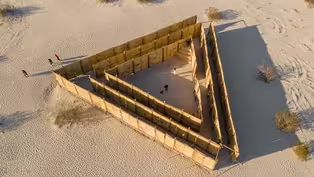
Sarabia: I was thinking a lot about journey and a maze kept coming up in my head.
It's one of those symbols that just, like, represents how complicated things can be or feel.
The viewer enters the maze and they become the passenger.
The walls are made out of petates.
It's a traditional material that's been used in Mexico for sleeping mats and for traveling.
A lot of rich history around the material that triggers all these feelings, kind of warm, inviting place.
[Woman speaks Spanish] Sarabia: Once you make all the decisions that get you to this center area, that's where anything is possible.
I'm hoping that the viewer is willing to contemplate their situation and have a little bit of perspective on somebody else's situation.
You're imagining all the possibilities before you see the light at the end of the tunnel.
Man: The first time I heard about Sarabia's "Passenger," I was really excited.
I thought, "Wow, what a cool piece.
I can't wait to see it in person."
And then I saw it in person and it had just a tremendous effect on me.
My father, to walk through a desert at 15 years old, didn't have an education, didn't have any money on him.
I could see that kid in him who was walking through a desert scared for the first time, not sure what was gonna happen.
This reminded him of all that.
As we're entering "The Passenger," he's touching these walls.
He's remembering who he was at that age.
What he was wearing and the people he was with.
And he just describes to me some of the most crazy experience I've never knew about.
There's things in the desert when you're walking, you don't expect to see.
There are people in the desert who don't make it.
And you as a 16-year-old walking the first time, you encounter this and you just have to keep going.
Being here sunk that all in for me.
I learned so much about my father from this experience.
I've never seen him get emotional my entire life.
This was the first time ever I've seen that man shed a tear.
I saw this everywhere as a kid.
I saw this a lot and I never really understood what it meant and why it was important.
I just thought it looks cool.
But I didn't realize that this is like at the root of our people.
This represents our culture and to be surrounded by it and almost blinded by it.
You're not gonna be the same person that went in.
It's gonna change you forever.
Man: That really vast, beautiful area of the desert right there is Indian land.
As all this is, and we need to remember that.
Man 2: We're about halfway through the exhibition and as we get further into the show, it's interesting to have strong reactions to the work.
Man 3: For me, the most powerful piece was Christopher Myers' piece, which looks at sort of, who do you put on a pedestal?
Who do you put on a horse?
Man 4: I think that's a great piece of art, and it is socially conscious, so, it is important.
Woman: Well, you know, it's legit Indian land and it was taken.
We've seen 3 so far.
Man: Yeah.
This is the fourth one.
Woman: I really am looking forward to seeing all of them.
Davis: I believe, personally, that art is extraordinarily important to the soul.
On opening day, the numbers of people who came out and were literally gleeful at not only seeing art, but being with people.
Woman: Started to cry.
Woman 2: Yeah, literally started to cry because it was just, you know, just the message around kind of community and coming together and-- Woman 1: It was just perfect.
Woman 2: Yeah.
Woman 3: So far, "Women's Qualities" is my favorite piece.
Woman 4: It's sensitive and simultaneously strong.
It doesn't reveal itself too quickly.
You walk in and just see beautiful nature and botanicals and it's only as you're experiencing it that you realize it's letters and words and thoughts about women.
Woman 5: I'm doing the work called "Woman's Quality."
It's a piece that I have done in 2001 and I asked people in the streets.
7 woman's quality.
I took these words and I wrote it with flowers.
[Man grunts] Amer: I want to know what are they thinking about?
Man: Perfect.
Amer: I want to know, like, it's a ghost, like, where are we standing?
The title gives you a clue.
Man: How does that look?
Actually, I think this looks pretty good.
Ha ha ha ha!
Woman: "Nurturing" and "loving" and "determination."
Are you determined or what?
Woman: I'm definitely a determined woman.
Dambrot: Ghada's work, I found it really enchanting.
You're looking at flower boxes on a lawn, but it was perfect as a way to have a conversation about feminism and strength and fragility and thriving, like, literally and metaphorically speaking.
Amer: I chose to do this because when the woman were allowed to paint, they were allowed to do portraits.
They weren't allowed to do any other thing than portraits.
So, I am choosing the portraiture with flowers because of that.
Woman: Been a master gardener for over 20 years.
Through history, women have had an intimate relationship with plants.
To nourish your family, to care for your family, to heal your family, keep your family in balance with the land, you depend on plants.
Woman 2: The feeling of being surrounded by these words.
It's really extraordinary.
I've been alone for the pandemic.
So, to be around this, in contrast to that, was like grace, these words.
They were reminders.
Amer: "Beautiful," "loving," "nurturing," "resilient," "strong," "caring," and "determined."
It's too much, no?
Dambrot: You know, I think about this all the time.
There's no question that land art has been dominated by men.
Garcia-Alvarez: There's a pattern.
Most of them are men.
Most of them are white men who are advancing this history of land art, right?
Histories of land art don't always entail these monumental gestures within the land.
Woman: I move to Guatemala because I like the nature there so much.
Also wanted to get away of the art society that have strict rules.
I work outside.
I use the paintings.
They'd be on the floor.
And there's a storm and the leaves and sticks come and the dogs walk over and they stay there.
Garcia-Alvarez: Vivian's relationship to the natural environment is one of the most genuine from any living artist that I know who's grappling with ideas of the landscape.
There is a mystical, even emotional and psychological dimension to these works that remind us that places have feelings.
And that is what I think Vivian brings to this project.
How the desert is felt and lived.
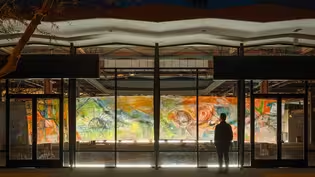
[Suter speaks Spanish] [Garcia-Alvarez speaks Spanish] Garcia-Alvarez: Vivian's work is going to be installed in a very iconic, modernist building, right in the heart of Palm Springs.
So, you have two landscapes in conversation in the installation.
[Garcia-Alvarez and Suter speak Spanish] Dambrot: Vivian Suter's piece is absolutely informed by and inflected with the tradition of land art.
Much like the landscape itself, it's a flying expanse of tiny details.
All kinds of things happening in there.
When you go to take a picture of it, you're like, "My picture doesn't look anything like the landscape."
It's inside a former commercial setting.
It's inaccessible.
You got this meta-- oh, you want to talk about land use?
Talk about why there's even a city here.
I mean, the water usage to keep half of it vaguely alive is insane.
The city itself is this insane fiction of urban...whatever.
I mean, yeah.
Welcome.
Garcia-Alvarez: There are major water problems here.
Especially when you look at communities in the East Valley.
We are going to have a major water crisis at a global scale.
Thinking about water as a connecting thread, I invited Serge to bring these conversations to the forefront.
Man: Ghana, where I'm from, water is a major issue that we deal with every single day in our life.
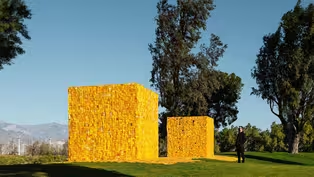
I'm looking at the consumption aspect of the jerry cans.
How toxic it is to store water in them.
It's not hygienic.
It's not safe to store water.
So, what else do we use them for?
[Saw whirring] I started cutting the containers.
Garcia-Alvarez: Serge represents a new generation of young artists working in Africa that are attempting to advance an art scene globally, but also to reconnect with cultural and art historical traditions in their countries.
Clottey: I'm interested in engaging community as part of my practice.
4, 5 people working on one piece.
Garcia-Alvarez: Serge's work was not welcomed city of Coachella.
It made some elected officials very uncomfortable when we tried to open up conversations about this water crisis.
I have to say, I was incredibly disappointed.
And then we received an email from a group of community members that said, "We'd like you to consider this location."
Man: My name is Dieter Crawford.
I'm vice president of the Desert Highland Gateway Estates Community Action Association.
We thought that it would be a good fit being that we're the largest predominantly Black community in the Coachella Valley.
And we also have our issues here around environmental and social injustice.
This neighborhood, it's long been underserved by the city of Palm Springs.
We currently live here in a food desert.
There's no pharmacies nearby.
There's no banks.
There's no museums.
There's no libraries.
And that goes back to some of the historic segregation in the country with redlining.
We know that art fosters intellectual curiosity.
Our hope in bringing this to the neighborhood is that when you came to Palm Springs, that you would see the community center, you'd see the mural, and you would understand that there is a African-American community here.
Woman: I didn't know this park was here until this piece was here.
Woman 2: She grew up here, for context.
Woman: Yeah.
I grew up here.
My family's been here since 1964.
Crawford: The reaction's been pretty favorable.
We've been doing lots of events here and it's just really gotten the community out and got them engaged.
Clottey: Yeah, and I'm happy that I met with--with the kids because, I mean, working with kids has been part of my life.
Masks, for me, has been something that represents, you know, a tribe, you know.
It represent people, represent history.
The masks you create now represent yourself, represent your vision, your aspiration.
You know, what you want as person.
I have my own mask that I made from the jerry cans.
I'm sure tomorrow you'll see it.
When I put them on, I transform.
Garcia-Alvarez: What I find really powerful about Serge's work is his performances, where he was engaging in these processions.
The conversation translates across geographies.
Davis: The group that was able to gather here were moved, I think to tears in many cases, to see him bring together issues of sustainability, community, Black Lives Matter, all in a 15-minute performance.
Man: Showing that there's a struggle to get water, there's a struggle to live, there's a struggle as a people, as African-Americans as well as Africans and seeing the relationship that the parallel of our cultures from one continent to the next.
Wakefield: For 2021, these artists brought a very different kind of aspect to this Desert X and one that is really trying to go deeper into this idea of social history.
Garcia-Alvarez: There is a long and difficult history here in the Coachella Valley around its relationship to migrant communities, to queer communities.
It's a difficult history that a lot of people don't like to acknowledge.
So, for me, opening up those dialogues is what really drew me in when I was thinking about what kind of artists I'd invite to the show.
Man: My name is Felipe Baeza and we're in my studio.
Home and land are complicated issues that I'm still trying to figure out for myself.
You know, I came here at a young age.
I don't have a sense of home in this country.
How do I inhabit and live here in my fullness, outside of citizenship?
Garcia-Alvarez: I spend a large part of my youth undocumented in this country.
Felipe's work sort of got me to a place thinking about the responsibilities that come with having those experiences.
Baeza: When I was thinking about the project for Desert X, my initial thought was to make a mosaic tile mural to highlight queer people of color and immigrants in the valley.
The mirror itself is comprised of tiles hand-painted by artisans at the Ceramica Suro in Guadalajara.
I think for me it was also important for me not to fully be part of the process... and for the work to be translated through other hands.
[Man speaks Spanish] Baeza: The mirror itself is comprised of two hands made out of different tints of skins.
Through these arms, you would assume there is a wound, but there's something flourishing and thriving.
Garcia-Alvarez: Felipe's work is remarkably beautiful.
I as a curator have almost been trained to be incredibly suspicious of pretty things.
Beauty in Felipe's work is emancipatory.
It's about giving people who can't think beyond their current reality the opportunity to site themselves in a better communal future.
Baeza: Been interesting to work at this scale, but also to work in regards to making a public artwork.
Engaging with it right now, one-on-one, just seeing the monumentality and seeing these two brown hands has quite of an impact on me.
To imagine that other people like me with similar experiences will see those hands but also people that don't have a similar experience will see those hands, to know that those histories, those bodies live here.
Woman: I think it's beautiful to see this work in public space because this show has compounded people's experiences.
There are many exhibitions about the Americas, about race, but they're inside of institutions, which have closed doors.
When you're outdoors, you're able to surprise people.
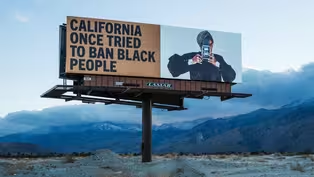
Wakefield: Initially, ...team had a billboard project.
The first one was by Jennifer Balerdi and it was really about taking that space and using it to advertise the space it inhabited.
And now in 2021, we have Xaviera, who's creating this sort of synthetic moment that you drive by, and I'm not quite sure what it is.
Simmons: You get a call from Neville and he's like, "I want you to make these billboards.
Do you want to do them?"
And I'm like, "Of course."
My brain really started to kind of go and think about, like, well, what can I say and do with this large-scale announcement?
This country was built off of 300 years of free labor.
Force.
Violently.
It takes a lot of work to undo that.
We live within the fallacies of collective imagination that's been constructed for us.
Woman: I was particularly struck by Xaviera Simmons's billboards.
This is an artist who has long thought about land--who benefits from that land occupation and who doesn't.
Wakefield: I had a sense of what they would look like, but I didn't have a sense of the actual impact.
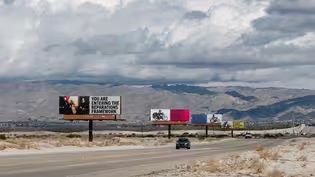
You see a call for reparations next to "Make America Great!
Rocky's Pawn Shop," or an advert for mattresses.
These puncture the reality of that drive across the desert.
Simmons: When I'm making these billboards, I'm thinking about a conversation between the billboard company, the land that it sits on, the men who are gonna put the billboard up.
And then the passers-by.
All of that primarily is dominated by white people.
Whiteness as a construction has to shift entirely.
[People chanting "Black Lives Matter"] Simmons: Had this moment not happened in this country at this particular time, I'm not sure that we would have been collectively ready for the information inside of this billboard.
I'm hoping that the language and the image will start to shift people's minds about what needs to happen, given the histories here.
Sarabia: So, what's going on?
Little repairs this morning?
It's funny how I was just thinking it was just kind of pushing you back and it's like it's--it's, you know, feels alive.
Like stitching up a person.
I like that time is part of the aesthetic.
It's been up for 3 months surviving windstorms and sandstorms and sun, and getting deep and people visiting.
And, you know, and with this wind, you know, it's breathing.
It sounds like it's aged.
Ha ha!
Wakefield: The desert's always present in the work.
It's not just a context.
It's really part of it.
You can look at these pieces in photography, you know, in renders as we did before.
Then you are here and you're in front of the work and there are crows wheeling above it.
You can feel the temperature.
It's all part of it.
We're in Desert Hot Springs.
We're behind Zahrah Alghamdi's work.
The desert is delivering its visceral experience.
It's hot, windy, and beautiful.
[Woman speaks Arabic] Man: There's a lot of care in the engineering.
That wall is 27 feet tall, 25 feet wide, by two foot thick.
So, it's a wind sail.
That wall is highly engineered.
There's 6 x 6-inch posts.
We know that wall's not gonna tip over.
[Alghamdi speaks Arabic] Wakefield: To me, the piece, it's both a redaction of the landscape but also an invitation to look behind it.
That invitation is really important.
Man: You know, my background, I'm from Iran.
There are certain connotations to that sort of structure that to me kind of stood out.
From far, it kind of looks like Mecca.
It's monolithic first, but it's a thin wall.
Which, to me, was kind of interesting.
That sort of perception of something that's-- Woman: An illusion.
Man: Yeah.
Dambrot: The experience of walking up there yields all these sort of secrets and you see the way that the wind and the elements have started to erode it.
The idea that it could tumble, we've been there before in human history.
Wakefield: You know, just so many of the works like the one here speak about accretion and how history is a process of layering and accumulation.
So, hopefully, is the exhibition.
Garcia-Alvarez: The way that time plays out in this exhibition, that's something I want to take from this process.
The fact that we can not necessarily curate just in space, but we should curate across time.
Woman: Where do we want to go, guys?
Do we want to go to Azerbaijan, for instance?
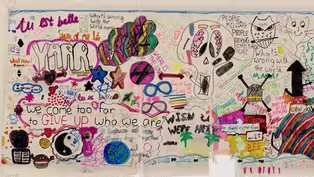
Frequency started as an exercise to engage and collaborate with youth, particularly kids aged 10 to 16.
Oscar sees in that group a transition from being children to being adolescents.
You see?
I mean, the amount of energy that they have.
It's just amazing.
Since beginning, we've been to more than 350 schools and we have collaborated with about 100,000 children worldwide.
Man: Frequency is this idea that constant movement, constant flux, and the only thing that is consistent is this recording device in a desk, such as this one here.
We affix a blank canvas on the surface of the desk, and we really leave it there as a recording device of 6 months.
The conversations is very much about this idea of freedom.
To me, they look like 19th- century manuscripts.
Dublanc: I think that this is quite interesting as well because you see the desk shape, yeah?
This come from Colombia, actually, from the region where Oscar was born.
And, you know, I mean, the sort of messaging that you have here, [speaks Spanish] "You can overcome everything, but you cannot forget."
We had always given ourselves a decade to do this project.
That decade was coming to an end and all of a sudden COVID happened.
[Child speaks indistinctly] Woman: You help me remember the things... Man: We adapted the project for the home learning experience and about 1,000 students throughout the Coachella Valley received canvases that were stretched in wooden boards to simulate, like, the flat surface of a desk.
And the idea is that over the duration of this exhibition, students are going to be giving us an insight on how this educational experience has transformed.
We don't know what the outcome is gonna be, which is one of the exciting things about the project.
Girl: Me and my sister had decided to come up with this idea.
Basically, just means that we're all in this together and that we're all the same, no matter what.
Murillo: I think this idea of Frequencies at home is something more for the future as a memory of the times that we're going through, as a record of that shift that I think we will see in education.
Wakefield: What's particularly interesting about Oscar's project and the conversations that we're seeing here is that you see Black Lives Matter, you see every sort of societal change that we've been through.
What's wonderful here is that the children seem to be more in touch with those social resonances perhaps than the adults.
I think it's a lovely way to end because I think it's a sort of handing off.
We always hope that the works that we do by these emerging and established artists are gonna be inspirational, and in a way, this is the manifestation of their inspiration.
It's been quite emotional particularly in COVID with everything that we've been through.
Garcia-Alvarez: It was such a strange exhibition, from organizing it in the middle of a pandemic to having so many aspects of every project and exhibition be a fight in many ways.
Wakefield: Obstacles aside and the pandemic aside, I think there have been so many sort of different conversations that have been running through it.
I'll be sad to be leaving those conversations behind.
Dambrot: I'm so glad that I went because this year was about quiet moments, real issues, and thinking them over.
It was perfect for a world that's thinking about everything in new ways.
Quieter ways.
I think I needed a meditative version this year.
Davis: Giving people the opportunity to be up close and personal with these large art installations is critical and important and good for the soul.
Wakefield: Desert X is a temporary exhibition.
We try to leave no trace.
We come and we go and we hope that we leave not much behind other than changed attitudes.
Announcer: This program was made possible in part by City of Los Angeles Department of Cultural Affairs, Los Angeles County Department of Arts & Culture, National Endowment for the Arts, and the Frieda Berlinski Foundation.
Man: Richard Mille is more determined than ever to support creativity today with Desert X.
This unique outdoor art experience aligns with our commitment to promote the art and craft of fine watchmaking, bringing it into a new realm of design, art, sculpture, and architecture.
Video has Closed Captions
Preview: S12 Ep4 | 30s | Site-specific desert art in the California desert. (30s)
Alicja Kwade's Glaciers in the Desert
Video has Closed Captions
Clip: S12 Ep4 | 1m 53s | White marble, like glaciers, are suspended on high in the desert. (1m 53s)
Christopher Myers Rethinks Monuments
Video has Closed Captions
Clip: S12 Ep4 | 2m 5s | Christopher Myers rethinks the symbolism of the traditional man-on-a-horse statue. (2m 5s)
Eduardo Sarabia Makes Passengers of Us All
Video has Closed Captions
Clip: S12 Ep4 | 1m 55s | Eduardo Sarabia uses the Mexican petate to evoke a sense of complexity to immigration. (1m 55s)
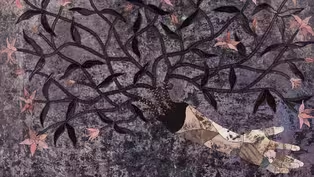
Felipe Baeza Honors the Queer and Immigrant
Video has Closed Captions
Clip: S12 Ep4 | 2m 17s | Felipe Baeza shines the light on the stories of immigrant, undocumented queer communities. (2m 17s)
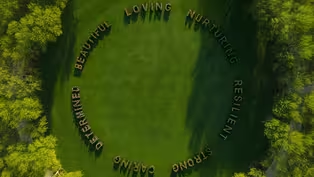
Ghada Amer Excavates Women's Qualities
Video has Closed Captions
Clip: S12 Ep4 | 2m 22s | Ghada Amer creates a botanical self-portraiture of women's qualities. (2m 22s)
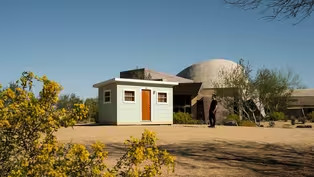
Kim Stringfellow's Jackrabbit Homestead
Video has Closed Captions
Clip: S12 Ep4 | 2m | Kim Stringfellow tells the story of desert landownership from a woman's perspective. (2m)
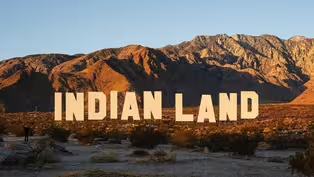
Video has Closed Captions
Clip: S12 Ep4 | 2m 9s | Referencing the Hollywood sign, the artist gives space to the question of land ownership. (2m 9s)
Video has Closed Captions
Clip: S12 Ep4 | 59s | Oscar Murillo indexes inner lives of students learning from home in a pandemic. (59s)
Serge Attukwei Clottey's Wishing Well
Video has Closed Captions
Clip: S12 Ep4 | 1m 46s | Serge Attukwei Clottey comments on the world's water crisis using the humble jerrycan. (1m 46s)
Vivian Suter: A Place Has Feelings
Clip: S12 Ep4 | 8m 54s | Vivian Suter's large-scale paintings are inspired by the Coachella Valley landscape. (8m 54s)
Xaviera Simmons and the Construct of Whiteness
Video has Closed Captions
Clip: S12 Ep4 | 2m 13s | On billboards, Xaviera Simmons adds shape and and text to the construct of whiteness. (2m 13s)
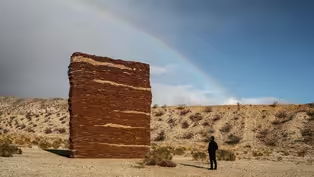
Zahrah Alghamdi's Wall Connects Two Deserts
Video has Closed Captions
Clip: S12 Ep4 | 1m 57s | Zahrah Alghamdi connects the desert landscapes of Saudi Arabia and Palm Springs. (1m 57s)
Providing Support for PBS.org
Learn Moreabout PBS online sponsorship

- Arts and Music
The Best of the Joy of Painting with Bob Ross
A pop icon, Bob Ross offers soothing words of wisdom as he paints captivating landscapes.











Support for PBS provided by:
Artbound is a local public television program presented by PBS SoCal