
Design Core Detroit Installations/WomxnHouse Detroit
Season 5 Episode 29 | 26m 46sVideo has Closed Captions
Design Core Detroit Installations/WomxnHouse Detroit
Design Core Detroit’s Month of Design continues to positively impact the city outside the month of September. Artist Asia Hamilton moved out of her childhood home in Detroit and along with Laurie Earle transformed it into a whole house interactive art exhibition called WomxnHouse Detroit: The Art of Being Female in America Today. Episode 529
Problems playing video? | Closed Captioning Feedback
Problems playing video? | Closed Captioning Feedback
One Detroit is a local public television program presented by Detroit PBS
Design Core Detroit Installations/WomxnHouse Detroit
Season 5 Episode 29 | 26m 46sVideo has Closed Captions
Design Core Detroit’s Month of Design continues to positively impact the city outside the month of September. Artist Asia Hamilton moved out of her childhood home in Detroit and along with Laurie Earle transformed it into a whole house interactive art exhibition called WomxnHouse Detroit: The Art of Being Female in America Today. Episode 529
Problems playing video? | Closed Captioning Feedback
How to Watch One Detroit
One Detroit is available to stream on pbs.org and the free PBS App, available on iPhone, Apple TV, Android TV, Android smartphones, Amazon Fire TV, Amazon Fire Tablet, Roku, Samsung Smart TV, and Vizio.
Providing Support for PBS.org
Learn Moreabout PBS online sponsorship- Hi, I'm Christy McDonald and here's what's coming up this week on "One Detroit Arts and Culture."
A celebration of design around Detroit plus artist Asia Hamilton turns her childhood home into an interactive art exhibition.
Then, how the Detroit arts and culture scene continues to survive during the pandemic.
It's all just ahead on One Detroit Arts and Culture.
- From Delta faucets to Behr paint, MASCO corporation is proud to deliver products that enhance the way consumers all over the world experience and enjoy their living spaces.
MASCO, serving Michigan communities since 1929.
- Support for this program is provided by The Cynthia and Edsel Ford Fund for Journalism at Detroit Public TV, The Kresge Foundation, Community Foundation for Southeast Michigan.
- The DTE Foundation is a proud sponsor of Detroit Public TV.
Among the state's largest foundations committed to Michigan focused giving, we support organizations that are doing exceptional work in our state.
Visit DTEFoundation.com to learn more.
- Business Leaders for Michigan Dedicated to making Michigan a top 10 state for jobs, personal income, and a healthy economy.
Also brought to you by The Fred A. and Barbara M. Erb Family Foundation and viewers like you.
(♪♪) - Hi there, and welcome to One Detroit Arts and Culture.
I'm Christy McDonald.
Thanks so much for being with me.
The creative community in Metro Detroit keeps changing things up to continue thriving during the pandemic.
Performances outdoors, virtual art exhibitions, and so much more all help fill the need for arts and culture right here in Detroit.
Coming up on the show this week, Design Core Detroit's month of design impacts the community way beyond the month of September.
The stories behind the installations.
Plus we'll take you to an interactive art exhibition encompassing an entire home in a Detroit neighborhood.
It focuses on being female in America today.
Then my conversation with Omari Rush from Culture Source.
We talk about what the arts and culture scene has done to continue to thrive.
It is all coming up on One Detroit Arts and Culture.
Every fall we celebrate the Detroit Month of Design and many of the installations stay up for weeks to come all around the city for people to enjoy.
Will Glover spoke to Design Core Detroit's Kiana Wenzel about all of the projects, and how the designs combine beauty with a learning experience.
- Let's start with for, those of us who may not be savvy about what the Detroit Month of Design is.
Can you just give us a little insight into what it is, what we're looking at, what we're talking about.
- Sure, the Detroit Month of Design is an annual multi-disciplinary design festival that occurs throughout the city of Detroit, September 1st through the 30th.
And 2021 marked the eleventh anniversary of the festival.
And this year we had 80 plus events on the calendar.
It was a hybrid program, so we had a virtual events, outdoor installations, and indoor events, following CDC guidelines.
- Who's participating, who's making these decisions about who gets to participate, you know, how does all of that work?
- Sure.
Every year we have an open call.
So I call it like a call in response to the community.
Detroit's design community, you know, do you have ideas and work that you would like to showcase in September?
If so, apply to participate.
And this year, we received 188 submissions.
And we have a curatorial selection committee.
Every year it changes.
We had six people this year and they all look at the applications, give feedback, we have an internal review, and we really try to show a holistic, you know, view of our community, because it's a multi-disciplinary design festival located all around the city you have cultural institutions, non-profits, community groups, people working in the build environment, visual communication.
And so we narrowed it down to the 80 plus that we had on the calendar this year.
- So when we're using the term design, you referenced that it's a multi-disciplinary.
And I just wanted to be clear that when we're saying design we're not speaking specifically about, you know, the aesthetics of everything, although that is a portion of it, but just explain a little bit about what design, what falls under that umbrella of design.
- Sure.
Design overall, I define design as a process.
From idea to fruition.
What does that look like?
And that is like the definition of design.
but for Design Core, we really categorize it into three main brackets.
Design creatives working in the build environment, so that could be architecture, landscape, urban planning, interior design.
Or are you a creative working in visual communication, which would be illustration, user experience, augmented reality, anything that you're kind of like creating those visuals and graphic assets that people use.
And then the third bracket would be product design.
Are you a craftsperson where you're making jewelry, making fashion, making shoes, or are you a product designer that's making something more industrial, like a robot or a machine.
And so we have built environment, visual communication, and product design are the three main ways that we kind of describe the multidisciplinary aspects of the festival.
There's also the Motown Museum.
Celebrated the 50th anniversary of Marvin Gaye "What's Still Going On" They have pop-up markers and learning opportunities along Grand Boulevard where you're looking at album covers.
And what's the role of album covers and communicating, you know, how people are addressing society and what's happening to them.
- Are there any plans that you guys are making for next year?
Is there anything you can give us a sneak peek on or give us some insight into, you know, maybe some of the things that you guys are looking for or hoping for?
- Yes.
You know, one of my goals is to see the festival as a platform beyond just the celebration.
And you made a really good point.
What's the role of the festival for learning, you know, and making learning more accessible design education.
What's the role of the festival in creating business opportunities for our creatives and entrepreneurs, for the people participating in the festival?
How can they connect with more audiences, customers, or meet people in industry?
So if anyone out there, it's a rolling kind of basis.
Yes, we have the open call, but I'm talking to people all the time.
You know, that call and response is about 12 months of community engagement because people can only participate if they know about it or know that it's available for them.
And we're hoping to bring back some of our monthly programming in 2022, like Drinks by Design, where we had designers showcase their skills on a monthly basis.
And it popped up, it was in a different location every month.
Oh, that's pretty cool.
- Kind of leading up to the trademark or design.
And we were getting 300 to 400 people a month.
So it was a great way to have like interdisciplinary networking.
And when you talk about strengthening your community, it's about meeting people that you wouldn't normally meet at work cause they don't work there.
They don't live in your community or they're not in your family.
So how are you going to build those connections?
And opportunity.
I want to look at how can the festival create non-traditional learning opportunities and business opportunities for people that didn't go to design school, you know.
We saw that a lot with Sneaker House.
There was one company that really stood out, Clean Sneaker Care, a young company, Daryl Blanding started his own company cleaning sneakers.
And now he's doing like 300 to 400 pairs of sneakers a month.
And let's talk about those entrepreneurs when we talk about the festival and how can we lift them up.
- For more on Design Core Detroit and the projects they're working on next, just head to our website at OneDetroitPBS.org.
Alright, turning now to an art exhibition that focuses on being female in America today.
It's called Woman House Detroit.
And one of the co-creators is artist Asia Hamilton.
She helped put together this interactive exhibition of 14 female artists.
It is actually inspired by the 1972 feminist installation project called Woman House.
I spoke with Asia about the exhibition, which is located inside her childhood home on St. Mary's Street in Detroit.
Let's talk about Woman House and the exhibition that you have- installation that is actually happening in your childhood home.
It's 14 artists that you've gathered in this house.
And it really is looking back at that famous exhibition from 1972.
- Yeah.
- Of the same name.
Talk to me about how a Woman House here in Detroit came to be.
- So Laura Earl, she is my, she is the chief curator for Woman House.
She actually did an exhibition in, I guess, Manchester, Michigan called 'Dear Woman House'.
And she turned her home into an exhibition space based on the model of Judy Chicago's Woman House.
So I had already decided that I wanted to turn my house into an artist residency for women.
And, you know, I was actually getting prepared for that, doing a lot of, you know, renovation on the house and such, but, you know, she suggested that we have this exhibit.
So we went down the line of thinking of different artists that would be great for this exhibit.
And we thought of women who speaks to the female experience, you know, women who really talk about their experiences in their lives as women, as well as, you know, sharing opportunities with, with other women artists.
14 awesome diverse women from around the Detroit metropolitan Detroit area.
And once we, once we got the women together, we, you know, did a series of conscious raising, you know, workshops where we spoke about our experiences as women in, you know, not just in the arts, but just period, you know, and how that relates to, you know, society today and back then.
- Yeah I was just going to say, I mean, we look at the seventies and the period in time for women and, and coming through, coming into our own and finding where are we in 2021?
What have some of the reactions been of seeing Woman House now?
- We've had some very strong reactions.
You know, we have one, one installation called The Womb, which is an actual, like walking into the womb of a woman that's done by Jessica DeMuro.
And a lot of people have, you know, been touched by that.
You know, just thinking about, you know, what women go through as far as childbirth or, you know, dealing with, you know, maybe the loss of a child, because that was what sprung from Jessica's piece.
Also we had Sabrina Nelson, she did a piece in the bathroom, a pocket area, you know, just really speaks to healing and woman and self-love and loving yourself and taking care of yourself naturally, you know, and not, you know, putting societies, you know, chemicals all over yourself to make yourself more beautiful.
Another piece speaks to abortion and, you know, our right to choose, and you know, how, you know, the bill that was passed in Texas has taken away that right for women.
So, you know, there's various different things that have, has pulled the heartstrings of, you know, people who have come into the space.
And then there's some funny pieces, you know, I, you know, I did some art.
I was in it too.
(laughter) Yeah.
There are my pieces on the front porch.
It's called 'Fall in Love'.
On the porch, there's porch swing and it's covered in fall stuff and it smells good and it's all about the lovey-dovey feelings of love, but it's also a fairytale.
(laughs) You know, the fairytale that we are, you know, that we're taught growing up as a kid about what, you know, what love is and what it holds.
And then in the back on the back porch, there's a picture of a man and a woman pointing fingers at each other.
So every part of the house has become a part of the art.
- And for it to be your childhood home.
Your journey, becoming an artist, and then giving your childhood space to other women to express their art.
There's something really powerful about that, Asia.
- I, the house has always been a house full of women.
You know, there are more women in my family than there are men.
Having the house be a space for art is my give back to that community.
To be able to share with them how I see art and how I've experienced it and let them see it and experience it.
It is like my pleasure.
(laughs) It's my pleasure.
Seeing my neighbors drive by and slow down and say, "What's going on here?"
You know.
I'm like, "Come on in!"
And when they come in and they experience the art, I'm like, that is what- that's what this is all about.
- For more information on Asia Hamilton and Woman House, which will be open until the end of October, just go to our website at OneDetroitPBS.org.
Alright.
Let's head up to Mackinaw Island where I was able to have an in-depth discussion at the policy conference with Culture Sources, Omari Rush.
We talked about the state of the arts and culture scene in Michigan as we move through the pandemic.
So talk to me about the last year and a half and, and the arts and culture scene.
And you've been able to interact with a lot of artists who, for a lot of them, their livelihoods came to a screeching halt for a bit.
And then it was alright, now, what do we do six months in, eight months in?
And what has Culture Source been able to do to help support arts and culture in this time?
- So certainly we've seen people come together more just because everybody is experiencing this crisis in a different way, but also realizing that we're stronger together.
And so, we've just really been pleased by being able to bring together tables of artists and arts organizations leaders, to talk about what they're experiencing and what we can learn from each other.
As we've been doing that, we've certainly been hearing that things are pretty rough out there.
They continue to be rough as, you know, the Delta variant surges.
And as people are still a little bit hesitant to engage in the way they had before.
As an example, we have commissioned Wolf Brown to do audience research, to help us understand what people are feeling today about how they participate culturally in the future.
The survey is going out every other month and we're just getting great and incredible data.
It's really exciting because it's allowing leaders on the ground to make data-driven decisions so one of the things we know is that arts audiences are reporting being 90% vaccinated.
And that's been the case since earlier this year and holding pretty consistently.
We're hoping that that's going to make people feel just a little bit easier and better.
Just similarly at this conference, knowing that everybody here is vaccinated, when you're shoulder to shoulder with somebody in an auditorium seat, they're likely vaccinated and you can breathe a little bit easier.
We also know that audiences are very much tracking what's happening with the virus.
They understand that a surge is happening.
And so, whereas earlier in the spring, when everybody was getting their shots and feeling very optimistic, I was, I was making all kinds of plans.
- Oh yes, for the summer and beyond.
- People are now saying, let me put on the brakes.
And we're seeing people predict that they will be ready to go back, not this fall, not October, but now we're looking at January, where people are expecting, they're going to really re-engage.
And across all that, we're really excited that folks are feeling like, you know what, we really trust our arts and cultural organizations to keep us safe and entertained as we're in their space.
- So as we keep seeing plans change and adapt, I mean, you see the DSO performing at outdoor venues or saying that now you've got to be vaccinated to be able to be at an indoor event.
What do you think some of the changes that organizations have had to go through over this last year and a half that they'll keep as we move forward?
Because sometimes out of great challenges, we come up with some of the most creative solutions or different ways of doing things that like, you know what, if we weren't forced to, we would've never done this.
- Well, you know, I'm really pleased to see people engaging in some long-term planning, because it's the most difficult kind of planning to do right now in a state of complete and total ambiguity.
But people are understanding that they have to find a way to persist with, you know, engaging people in creative and cultural expression.
And some of that means taking what they learned during the deepest, darkest days of the pandemic and keeping it going.
So we are certainly seeing people continue to do hybrid work, digital, online engagement, as well as in-person engagement.
The challenge there is that people are having to just make pretty core and expensive investments in digital technology.
They're having to get as pro as you and Detroit Public Television are at broadcasting.
Although it's so wonderful to have you all as allies, so we don't have to do it ourselves.
So that's one of the things that we're seeing is just more hybrid work, digital and in-person.
We certainly are seeing people get very creative with distanced programs and so innovative outdoor events and interesting spaces.
There's an upcoming show this weekend in a parking garage.
People have invested in different kinds of scheduling tools to help get people in and out of a space on time and efficiently.
So those kinds of efficiencies I think are also here to stay.
And then finally people are also just realizing that vaccine mandates are maybe the way to go.
You know, as the federal government, as big business are making these decisions, it's making it easy for the, the little guys, if you will, to similarly say, you know, in order to be in our space, you really need to have a vaccine.
I'm sorry if that is tricky for you, but it's where we're at and it's where we want our, kind of, community to be and our country to be.
- Well and that's how you're going to be able to have a sustainable program moving forward, to be able to have people in the seats, pay for the programming that you want to see.
You know, it's funny, you talked about kind of pivoting to the digital divide.
My sister-in-law is the director of the Washington Gay Men's Chorus and she said, I never thought I'd have to be a video producer.
I'm usually the conductor and the creative director and the coordinator she said, but I'm creating video programs now because we haven't been able to be in person the way that we are.
What are you sensing from the performance community about maybe changing, changing profession, getting out of the arts, finding something different because it's so tenuous right right now?
- Well, Christy, we can talk a lot about this great recession.
I mean, great resignation.
And the way that the pandemic has given people time to think about what they really want to do, what's really important to them and also what they're built for, you know.
And so certainly we are seeing people leave the field and, and try other things.
It's also one of the things that we learned during the pandemic is it's very hard to be an artist.
Artists have very little safety net, social safety nets.
Their gigs were the ones to go the quickest and are the last likely to come back.
And I mean, that's pretty just as a sidebar, that's pretty significant for our economy, knowing that the arts and culture sector is about 5% of GDP, larger than construction, transportation, and construction, transportation, and agriculture combined.
- Oh really?
- Yes, not having them in the workforce, not having them powering our communities is really kind of devastating.
And so our hope is that as a cohesive community, that we can do what we can to continue to make pathways, create pathways for artists to have viable careers in performance and exhibition.
I will also say that people are certainly realizing that, yeah, it's hard to do digital programming.
It's hard to be a producer, you know, when these are not our skills.
And so people are starting to gradually develop those kinds of competencies, realize where they need to skill build and who they can reach out with and also partner.
Partnerships are the way to go.
- What about some kind of, you know, help from Culture Source to say, this is how you need to kind of run your gallery now.
Or these are the things that we can show you that'd make it easier to transition to doing more digital or this is who you should talk to if you want to do some more digital work.
Are those kinds of conversations happening between smaller organizations that may not have the six month, 12 month back-up or revenue to be able to support themselves.
- 100%, which is very exciting.
So one of the things, even just last week, we had a, one of our monthly calls with CEOs and executive directors of arts organizations and I got a direct message from a leader saying, you know, we could really use some help with vaccine mandates, vaccine- proof of vaccination.
And so this week we have a call coming up with a national app, vaccine app to see if we might be able to standardize, like, make it easy and efficient for the smallest organizations and the largest organizations to use the same app, to make it very easy on the audience member end.
- Right so the can go across organizations.
And it's like, as long as I have one proof for here, it goes across the board.
- Absolutely.
We also in the past year had a pretty major partnership with Rocket Community Fund.
You know, Rocket is so much powered by digital cultures in their work, and were really interested in helping us, help our members, think about transitioning their infrastructure to something that feels more digitally rich.
And so we had a series of workshops on how to work digitally, how to analyze, you know, audiences digitally, those kinds of things.
A grant program to get equipment into organizations that modernize their kind of infrastructure and something that we call the tech expert in residence, somebody that was an on-demand resource that people could call and connect with to say, - That's excellent.
- "Hey, I'm connect- I'm conducting this chorus online and a screen went out," or "Hey, we're thinking that we should do a virtual walking tour of our gallery, but we're not sure if it's right for us, can you help us?"
And so we've been really excited to provide those kinds of supports to the field during this really tricky time.
- You know, one of the things that we talk about arts and culture, music performance, it feeds our soul.
And it's something that I know that I gravitated toward during the pandemic, just because it helped take me away from the everyday and I think a lot of the stress that we all experienced, and I think that we're all still having to deal with even immersing ourselves into this new world that we live in.
Talk a little bit about, excuse me, there are flies all around here.
(laughs) Talk a little bit about how important arts and culture in Southeast Michigan is to all of us.
- Certainly I can speak for myself and say that it was a real lifeline for me.
From watching Schitt's Creek on Netflix to, to really kind of getting engrossed in kind of brilliant fiction.
This idea of connecting with very creative inspired work was core to my, kind of, navigating a really dark time.
So there is that.
In Southeast Michigan, you know, if you think about things that we're known for and about reasons why people visit our region, why people anchor to our region, a lot of it has to do with arts and culture and the way it, it defines the soul of a community.
Motown has done that for years and years and years.
And certainly we have institutions that lined main streets, Woodward, you know, throughout the region, that really create a sense of place.
And it's, you know, one of the things that the pandemic did for me, and I think for the community generally is help people remember and kind of understand how important it is to have those places when we're needing to grieve, when we're needing to be inspired.
I mean, Rochelle Riley did that beautiful exhibition on Belle Isle.
- Oh my gosh and it was so needed.
- Yeah, these art moments are so important.
And so one of the, you know, things about the pandemic is I think, and I hope, I think, and I also hope, that it really reminded people about the centrality of arts and creativity in their lives.
- For so much more on our arts and culture stories, and our live performances, just head to ONEDETROITPBS.ORG for so much more, as well as our social media channels at OneDetroit.
That is going to do it for me.
Take some time to experience some arts and culture this week.
Enjoy it.
And I'll see you next time.
Take care.
You can find more at OneDetroitPBS.org or subscribe to our social media channels and sign up for our OneDetroit newsletter.
- From Delta faucets to Behr paint, MASCO corporation is proud to deliver products that enhance the way consumers all over the world experience and enjoy their living spaces.
MASCO, serving Michigan communities since 1929.
- Support for this program is provided by the Cynthia and Edsel Ford Fund for Journalism at Detroit Public TV.
The Kresge Foundation Community Foundation for Southeast Michigan.
- The DTE Foundation is a proud sponsor of Detroit Public TV.
Among the state's largest foundations committed to Michigan focused giving, we support organizations that are doing exceptional work in our state.
Visit DTEFoundation.com to learn more.
- Business leaders For Michigan Dedicated to making Michigan a top 10 state for jobs, personal income, and a healthy economy.
Also brought to you by The Fred A. and Barbara M. Erb Family Foundation and viewers like you.
Video has Closed Captions
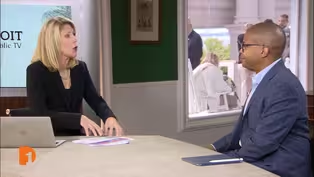
Clip: S5 Ep29 | 10m 36s | Culture Source | Episode 529/Segment 3 (10m 36s)
Design Core Detroit Installations
Video has Closed Captions
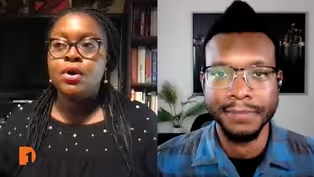
Clip: S5 Ep29 | 5m 43s | Design Core Detroit Installations | Episode 529/Segment 1 (5m 43s)
Video has Closed Captions
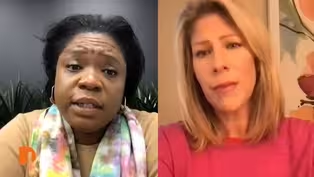
Clip: S5 Ep29 | 5m 17s | WomxnHouse Detroit | Episode 529/Segment 2 (5m 17s)
Providing Support for PBS.org
Learn Moreabout PBS online sponsorship
- News and Public Affairs

Top journalists deliver compelling original analysis of the hour's headlines.

- News and Public Affairs

FRONTLINE is investigative journalism that questions, explains and changes our world.












Support for PBS provided by:
One Detroit is a local public television program presented by Detroit PBS