
Detroit Action on employment barriers for returning citizens
Clip: Season 7 Episode 22 | 7m 30sVideo has Closed Captions
Nearly 7,500 returning citizens come home from incarceration in Wayne County each year.
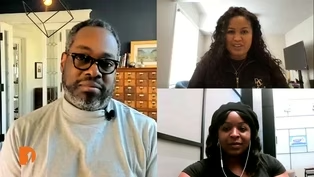
Detroit Action’s Good Jobs Now program is working to make employment accessible for returning citizens. One Detroit producer and Future of Work host Will Glover sits down with Detroit Action Executive Director Branden Snyder to learn about the resources available for returning citizens, what can be done by lawmakers to strengthen hiring equity, and how employers can get involved.
Problems playing video? | Closed Captioning Feedback
Problems playing video? | Closed Captioning Feedback
One Detroit is a local public television program presented by Detroit PBS
Detroit Action on employment barriers for returning citizens
Clip: Season 7 Episode 22 | 7m 30sVideo has Closed Captions
Detroit Action’s Good Jobs Now program is working to make employment accessible for returning citizens. One Detroit producer and Future of Work host Will Glover sits down with Detroit Action Executive Director Branden Snyder to learn about the resources available for returning citizens, what can be done by lawmakers to strengthen hiring equity, and how employers can get involved.
Problems playing video? | Closed Captioning Feedback
Where to Watch One Detroit
One Detroit is available to stream on pbs.org and the PBS app.
Providing Support for PBS.org
Learn Moreabout PBS online sponsorship(upbeat music) - That's what I wanted to talk to you about is, in particular, your "Good Jobs Now" program.
So why is it necessary?
Who is it for?
What's the overall goal for Detroit Action's "Good Jobs Now" program?
- We can do many of the workforce development tactics.
We can do many of the skills and services that are needed by the housing and (indistinct) that are needed by the formerly incarcerated are needed by young people in order to place them into the jobs of today through direct community organizing, developing leaders to be able to tell their stories, to be able to feel like they have social capital, to have a community, and also to be able to grow as people in our community.
And we do that through just traditional community organizing, developing people's ability to just be able to have a conversation, to tell their story, to have a community and own the experiences of their world, and only experiences of their community.
- When we're talking about returning citizens, unhoused young people, how many people are we talking about who might be struggling with getting into the job market or getting into a place that actually has a living wage?
Or is sustainable to raise that quality of life?
As you put it, maybe to dampen that exploitation.
- On average, when you think about the entire prison population, unfortunately African Americans constitute maybe about 34% of that population.
In Wayne County, we know that there's approximately 7,500 people who are coming home every year.
Who are coming home from incarceration.
Who are coming from... Who are coming from jails.
Who are undertrained.
Who are, in many cases, locked out of the community in which we live.
And for us, what that means is that we have 7,500 people yearly that we have an opportunity to really engage and to be able to provide the tools that they need to be able to make a living and be able to make ends meet.
Targeted individuals being released and connect them in the career opportunities, given the reentry population, the tools that helps to get recidivism and giving folks a career path.
And opportunity strengthens families and communities.
And so for us, it's simple things like being able to connect people to our canvas.
Our year round canvas programs where they're able to have a community to be able to tell their stories, to be able to be be around other people who've experienced the same things and see that they're working on policy solutions to crime and safety.
Or it's other small niche things like just being able to get people IDs and birth records.
- As we're talking about this, the question that strikes me is if you know a person who has been formally incarcerated is looking for a job, what are they hearing?
If they do have the credentials, if they do get the certificate to be able to do whatever the job is, but there's still a gap there, it's still not quite linking up.
What are they hearing from employers who are essentially keeping them out of these positions?
- One of the things that people talk about is just being left on red, if you will.
And so, having... And so, part of the work that we do and part of work that our partners like "Michigan Liberation" or "Michigan United" and other community organizations in our state, really have been fighting for, is how do we make sure that more fair chance hiring is happening to where people can come do an interview, show their skills, show their development, and be judged based on that.
And then, once they have a background check being run, versus that checking that box be the practice that keeps people in or out.
I think that that's one policy solution that many of our organizations have been fighting for, both locally at the city but also at the state over the last few years could attest to.
There was a fair chance hiring bill that was introduced during the last session by representative Cynthia Johnson out of Detroit.
And so things like that are key and important.
- Post pandemic, employers have been having a hard time getting people through the door to do all sorts of jobs across all sorts of sectors.
Has that changed the success rate for people getting hired that maybe previously were locked out of certain positions?
Has that... Have you seen any market change?
- Yeah, we think so.
And we think that those who are of the populations that we serve and that we organize are the folks who are the first out in the first often disqualify.
And so we know that overall, black and brown workers are going to be the ones who bear the brunt of exploitation.
Who bear the brunt of discrimination in the workplace.
And so, part of the work that we believe in is not only being able to develop the skills and develop the skill sets of these workers, but then also be able to give them a place to where they can grow and be able to have worker power.
- Right.
And so, because we're not all (chuckles) business titans, we're not all policy makers, but I like to think that we all wanna help.
What are some things that the average person can do to either help Detroit Action and its mission or just to help the people that are coming back into their community or people who are in their communities that need this kind of help?
Where would you send people?
What would you tell 'em?
- Yeah.
I guess from a... From one standpoint, it's like if you are an employer, as you take a chance on a person, be able to offer and be able to invest in.
And utilize the sort of fair chance hiring practices that reduce discrimination and reduce exploitation of folks who have criminal convictions on their background.
And then, I think, finally, if you're a community member or maybe you are somebody who's been directly impacted and wants to make change or wants to be involved, or may want to be involved in a service, you can reach us out at detroitaction.org online.
Or any of our social media is: Detroit Action, or Detroit_Action on Twitter and IG.
And if it's... Our work is about the holistic cycle of development people to become leaders.
So not just being able to provide folks a charity, but also thinking about it as solidarity for the long haul.
Being able to give people the experiences to where if you come in, you can be a leader on these policy fights.
So if you are somebody who is experiencing that direct need, it a opportunity to both come in, maybe for a need, but also stay and be a participant.
To be able to provide and give back for the future.
Black women entrepreneurs face unique business challenges
Video has Closed Captions
Clip: S7 Ep22 | 8m 46s | Black women entrepreneurs face an uphill battle for business growth compared to men. (8m 46s)
Providing Support for PBS.org
Learn Moreabout PBS online sponsorship New Episode
- News and Public Affairs

Top journalists deliver compelling original analysis of the hour's headlines.

- News and Public Affairs

Today's top journalists discuss Washington's current political events and public affairs.

 New Episode

 New Episode





 New Episode
Support for PBS provided by:
One Detroit is a local public television program presented by Detroit PBS