
Detroit Area Agency on Aging/Sundown Towns
Season 48 Episode 34 | 24mVideo has Closed Captions
Detroit Area Agency on Aging/Sundown Towns | Episode 4834
A report from the Detroit Area Agency on Aging reveals alarming statistics about mortality rates for older people in the Detroit area. A look at sundown towns. That’s the phrase used to describe cities that historically did not permit African Americans to live in their communities. Episode 4834
Problems playing video? | Closed Captioning Feedback
Problems playing video? | Closed Captioning Feedback
American Black Journal is a local public television program presented by Detroit PBS
Detroit Area Agency on Aging/Sundown Towns
Season 48 Episode 34 | 24mVideo has Closed Captions
A report from the Detroit Area Agency on Aging reveals alarming statistics about mortality rates for older people in the Detroit area. A look at sundown towns. That’s the phrase used to describe cities that historically did not permit African Americans to live in their communities. Episode 4834
Problems playing video? | Closed Captioning Feedback
How to Watch American Black Journal
American Black Journal is available to stream on pbs.org and the free PBS App, available on iPhone, Apple TV, Android TV, Android smartphones, Amazon Fire TV, Amazon Fire Tablet, Roku, Samsung Smart TV, LG TV, and Vizio.
Providing Support for PBS.org
Learn Moreabout PBS online sponsorshipComing up on American Black Journal, a longterm study on mortality rates among seniors in Detroit reveal some startling facts.
We're gonna talk about the report and the urgent call for action.
Plus a closer look at the history of sundown towns and their anti-black policies.
That's all next on American Black Journal.
It starts now.
Announcer 1: From Delta faucets to Behr paint.
Masco corporation is proud to deliver products that enhance the way consumers all over the world experience and enjoy their living spaces.
Masco serving Michigan communities since 1929.
Announcer 2: Support also provided by the Cynthia and Edsel Ford fund for journalism at Detroit public TV.
Announcer 1: The DTE foundation proudly supports 50 years of American black journal in covering African American history, culture and politics, the DTE foundation and American black journal partners in presenting African American perspectives about our communities and in our world.
Announcer 2: Also brought to you by Nissan foundation, Ally and viewers like you.
Thank you.
♪♪ Welcome to American Black Journal.
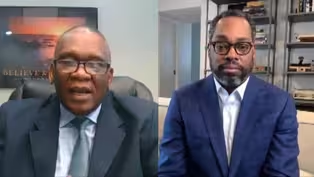
I'm Stephen Henderson, a report from the Detroit area agency on aging reveals alarming statistics about mortality rates for older people in the Detroit area.
The report is called dying before their time and it analyzes data collected over a 19 year period in Detroit and eight neighboring cities.
The research shows that the death rate for residents aged 60 to 74 is 48% higher than the rest of Michigan.
And for people aged 50 to 59, they're dying at a rate 122% higher than other areas in the state.
I talked with the agency CEO, Ronald Taylor, about the reasons behind the disproportionate death rates and what can be done to change the numbers.
Ronald Taylor, welcome to American Black Journal, Well thank you so much for having me, Stephen.
So I found this report really interesting and not in a good way.
The numbers in the report are just harrowing.
I wanna start our conversation there.
These are gaps that I think most people are not aware of number one, but that point to incredible danger for people of color and African Americans in particular and older African Americans especially to just spend some time talking through what you found here.
Yeah, this is the third edition or the third iteration of the down before your time report that was initially completed in 2002 by the Detroit Area Agency on aging.
And when that report was initially commissioned one of the things in which we were curious about, and I had to get my predecessor, Paul Bridgewater, a great deal of credit for having the foresight to commission such a report, but we were concerned about the out migration of the population.
And what we found in the study of the report was very startling.
And the fact that our population had excess mortality rates, which were two to two and a half times greater than their cohorts within the rest of the state of Michigan.
And it and as you stated, Stephen, this is troubling that after 19 years of longitudinal data, that we're still seeing that some of the same trends are in place as related to we have folks that are 50 to 59 that are passing away at much, much greater rates than their counterparts in the rest of the state.
And then also the number of individuals that are dealing with what we call chronic illnesses and especially dealing with three or more chronic illnesses.
We're talking about close to 40% of our senior population that is very startling and it's very troubling.
Talk about some of the risk factors that that help produce these numbers.
What is it that we're dealing here?
I would say some of the risk factors is there's a buzz word out in the industry now and what we call social determinants of health, and the social determinants of health, essentially take a look at those conditions or those factors that can influence the health outcomes of an individual or community.
And so when you take a look, as far as the education or the food availability or access to healthcare, also, you take a look at as far as the opportunities for employment, environmental concerns, those are all factors that impact, you know, folks generally say that you could tell by a person's zip code, what their health outcomes will be.
And those are some of the factors that go into that consideration.
Right now, of course, we're dealing with a once a century perhaps kind of health crisis that of course makes everything more urgent and makes everything more critical.
Talk about the effect of the pandemic on these numbers that you're seeing in this there's longitudinal survey.
I think the COVID-19 or this pandemic in which we're dealing with has really pulled the scab off the wound in many ways, or is really a placed a magnifying glass on the conditions of those communities of color and especially within the African American community.
And I say that because we're dealing with the community in many ways that are dealing with this all pandemic as related to the health disparities or the chronic illnesses in which folks are dealing with.
And when you layer that on top of what I would say would be some systemic issues that my community has faced.
It truly has magnified all the various injustices and disparities in which unfortunately we're still having to deal with today.
And of course, in response to George Floyd's murder, the highlight on systemic racism, Black Lives Matter movement really brings into focus some of these things that you're talking about, the fact that if you are born black in this country, if you are over the age of 50 in this country, it just looks different.
Everything you're dealing with is sort of processed through the lens of bias and racism and that has consequences for the people who are a part of those communities for us.
That's correct.
That's correct.
You know, I've been thinking about as related to my own upbringing and some of the things in which my grandmother who was born in Mississippi and just some of her concerns and fears, and then also some of the stories in which she shared about the opportunity to receive healthcare services and how it really wasn't there and how they had to really travel around to get those services.
And, you know, you take a look as far as growing up and becoming a little older as far as a teen and you see some of your parents not parents, but your, your loved ones.
Aunts and uncles and others, and they're passing away at early ages.
And whether it's because of hypertension or diabetes or whatever that condition may be like, and we come in and then we're at this particular point in stage, and the fact that we're still dealing with these issues at that same level as when I was a child, it's kind of alarming.
And it seems like it's a face is being placed upon these chronic illnesses and recognition is there that the social determinants health and has an impact on the chronic conditions in which our community faces, but the gap in regards to addressing these issues are still great.
Yeah, I mean, again, those numbers just blow your mind when you know, how dramatic they are.
I wanna spend the rest of the time talking about solutions and things we ought to be really focused on as ways to move the needle both in the short term and then of course, as you point out longitudinally, right across time, how we get to close that gap with other communities.
Yeah, there's a number of, I think, as you indicated, short term and long term action steps that we'll probably have to be pursued.
And I believe the first step and is one in which this community and other places throughout the country have tried before, but we have to continue to take a swing at the bat as related to addressing it, but we have to collectively come together as a community.
And we have to collectively come together across industries and across sectors to really come up with solutions, to improve our availability of food, to improve the access to healthcare, to improve the employment opportunities, to improve the environmental factors, to improve the, you know, just the various factors that enhance the quality of life.
And that's going to be a collective and collaborative effort.
But one thing in which I will say Stephen, is I also believe it has to be an intentional effort and it has to be intentional in fact, that it has to be a priority and something that is... addressed on a continuous basis.
So that's one of the aspects.
And so that would entail that we would have to improve the stock as far as healthcare professionals within the community and access to care.
But some of the things also in which we're taking a look at is that we also need to do provide activities and services and awareness type of programs that addresses the lifespan.
It really does us no good to try to address the chronic illness when the person who turns 50 or 60, we need to be looking downstream in the lifespan and raising awareness to our youth and to our, to our young adults, as related to these are some of the preventative things that can take place or that you should be adapting to have an enhanced quality of life.
The second part of it is that we're taking a look in, or what we're proposing is that we really need to provide additional supports and resources to caregivers and reason in which, and also grandparents raising grandchildren.
And the reason in which we say that we need to provide those supports to our caregivers is because informal caregiving, it is the backbone of our healthcare system.
And we need to provide those supports to those individuals that are really provide the services and the support to individuals dealing with chronic illnesses.
The third aspect of things is that we really believe that funding, more funding needs to be allotted to what we call human community based services.
And essentially what that entail is that we can probably address more services or more lives by providing services in the community.
And the other aspect of that equation though Stephen is that, we need to get the resources to those community based organizations that people of color will probably trust and probably respond to as related to addressing their needs.
And then the fourth aspect that I would say really needs to be taken a look at is that most of our allocation methodologies from a federal and a state perspective they're provided based upon population and some other factors, the factor of need really needs to be brought into the discussion and brought into the equation when allocating resources from the federal and state levels.
And now look at sundown towns.
That's the phrase you use to describe cities that historically did not permit African-Americans to live in their communities.
Black people were told to leave by sundown or face possible violence or arrest.
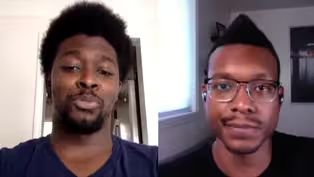
One Detroit's Will Glover spoke with Bridge's Detroit's Bryce Huffman, about his report on the Detroit suburbs that are wrestling with the legacy of being sundown towns with anti-black policies.
What is a sundown town?
And you know, why did you decide to write this article?
So a sundown towns are towns where either one paper in a law or in housing contracts, black people basically weren't allowed to live there.
They're called sundown towns because oftentimes black people were allowed to work there usually in butler or nanny capacities, but they weren't allowed to own homes there.
So if they were there after sundown, they would either be escorted out by law enforcement, escorted out by the threat of violence, by an angry mob, or actually faced real violence.
And I wanted to write about this because a lot of the time when we talk about racism and our country's history with it, we don't talk about how racism looked in the North.
We often think about, you know, the dogs and the fire hoses and the civil rights movements down South.
But we don't think about the fact that, you know, as me, I'm someone who lives in Detroit about a mile from Grosse Pointe.
We don't talk about the fact that if this was 60 years ago, me living a mile from Grosse Pointe would mean my life had all sorts of factors that I would have to think about on a daily basis.
Right and so just, I guess, to explain to some people, what is the difference between what we're talking about when it comes to sundown towns versus segregation, or as you referenced the racism that people were facing down South?
So I think the big difference is the legalities, right?
So sundown towns didn't all have the same laws and same practices, but what kind of gives them the term sun downtown is that somewhere they were explicitly being anti-black, whether it was in housing policies, for instance, a lot of the Grosse Pointe and a lot of Detroit suburbs had it in housing contracts that you weren't allowed to sell this home to a black family, even, you know, when black families could afford to buy the house, or other times there were laws literally saying black people aren't allowed to be here after dark.
So when we think about segregation, a lot of the time we're talking about sometimes accidental segregation, where people lived in these areas, 'cause they came in groups when they migrated to Detroit and migrated North.
But with the sun downtown, it's very purposeful.
It is very much so if you are a white middle class family, we are gonna give you this house even if the black family that wants to buy it can pay us more money.
What policies bolstered the ability for sundown to exist?
What laws were, you know, assisting in that, you know, oppression.
Red lining is certainly one practice that contributed to it.
But I think the one that we really don't talk about as much is lending policies.
Like I said, even when black families could afford to buy these homes, banks wouldn't give them loans, not to live in these communities anyway.
And when you think about the way that wealth is generated over generations, home ownership plays a big factor into that.
So what essentially happened in Detroit and a lot of other places up North is you'll take a look at the urban core and you'll see that, okay, there's all of these black families that live in this area.
And then you look at the more affluent areas, right outside of where they live and black people weren't allowed to generate wealth in areas that didn't already have all of these problems, that big cities had.
So it's just one contributing factor to the chronic segregation we see.
The current economic divide that we see, and quite frankly, the current racist attitudes of a lot of people in America.
So obviously today, black people aren't being escorted to the edge of town by police officers, or, you know, being ran out by an angry mob.
But how are some of the remnants of this sundown towns and that segregation still, you know, with us today?
So the one way that I saw it a lot growing up, especially when I got to high school and started driving to hang out with friends that lived in some of these suburbs was racial profiling in police.
And it's something that people really pushed back on this idea, but it's actually quite simple.
If you live in a suburb that is 90 plus percent white, and you see a group of black kids driving through it, the police automatically look at them as outsiders.
People who don't live here, what are they doing here this late at night?
Why are they driving, you know, in groups of young teens?
You know, and I think that actually is where a lot of the implicit bias against young black men particularly comes from when it comes to law enforcement.
It's you're in an area that historically you have never been in, what are you doing here?
It automatically brings up suspicion.
And instead of, you know, seeing me as someone who's going home after visiting a friend, I'm now someone who's seen as a suspect in some wrongdoing.
So how are these suburbs changing their respective histories?
How are they working to, you know, desegregate to actually make places as welcoming as some would claim.
Like, have there been any tangible results that you came across while you were putting this together?
Yeah, so the tangible results part is kind of up in the air, depending on who you are.
If you're a very cynical old Detroiter you're probably like, "Yeah, they're not really doing enough."
And I would probably agree with that perspective that they're not doing enough.
But what you're seeing is efforts to really educate people on the history and efforts to really have people in these communities talk about race and talk about racism and look at all right, why does our neighborhood look this way?
I talked to a woman from Grosse Pointe, which is probably one of the more notoriously racist places in the area.
Not that they were anything special.
Like when you look at their history, they weren't doing anything way worse than other places.
But when Detroiters talk about where not to drive at night, you know, Grosse Pointe's probably one of the first places that comes to mind, but I talked to people who live there and they say that a lot of the effort isn't necessarily on the city officials or the elected officials, because they're so busy with just kind of the general day to day operations of the city and keeping things going that a lot of the time falls on the neighborhood groups to be more welcoming and to call out racism when they see it.
When I was a kid in the 2004 election was happening, you would drive through Grosse Pointe and you would just see Bush, Cheney sign left and right.
And you would almost exclusively see white homeowners.
Now, you know, it's still very majority white, but you see kind of an influx of young black homeowners in these places that historically they wouldn't have been allowed to be.
And I kind of think of it as like the domino effect.
You know, when one, all white suburb starts to integrate more, it starts to happen around.
So as far as efforts, some cities like Ferndale have really changed their reputation.
Ferndale to many people's surprise when I published the piece, was a sundown town but now Ferndale is seen as this very progressive liberal place where everyone is accepted in large part because their acceptance of the LGBTQ community.
And I don't know about you, but when I see a pride flag, I feel a lot safer because I'm like, I'm saying they like gay people there's chance they don't hate black people.
(laughs) Its not always true.
Just a little bit-- It makes me feel just a little bit more comfortable, you know.
Absolutely.
So, yeah, I think a lot of these suburbs have really changed their reputation just with the influx of new people coming in.
And finally, today, we're gonna leave you with a song to uplift your spirits a bit during these challenging times.
The song is titled "America coming together" and it's written and performed by Erica Johnson.
She's the granddaughter of the late entertainer, Jackie Wilson.
Stay well and we'll see you next time.
♪ America, we must come together ♪ ♪ If we want change is for the better ♪ ♪ No one man stands alone ♪ But united in strength we can move on ♪ ♪ From a land filled with strangers ♪ ♪ To one full of friends ♪ And inside of everyone of us ♪ Is where it begins ♪ We must decide to love ♪ Decide to win ♪ We must stand up and be counted ♪ ♪ And only then

Video has Closed Captions
Clip: S48 Ep34 | 25m 30s | "America Coming Together" by Erika Johnson | Episode 4834/Segment 3 (25m 30s)
The Detroit Area Agency on Aging
Video has Closed Captions
Clip: S48 Ep34 | 11m 37s | The Detroit Area Agency on Aging | Episode 4834/Segment 1 (11m 37s)
Video has Closed Captions
Clip: S48 Ep34 | 8m 55s | Sundown Towns | Episode 4834/Segment 2 (8m 55s)
Providing Support for PBS.org
Learn Moreabout PBS online sponsorship New Episode
- News and Public Affairs

Top journalists deliver compelling original analysis of the hour's headlines.
 New Episode
- News and Public Affairs

Today's top journalists discuss Washington's current political events and public affairs.


 New Episode
 New Episode
 New Episode
 New Episode

 New Episode
 New Episode
 New Episode
Support for PBS provided by:
American Black Journal is a local public television program presented by Detroit PBS