
Detroit Black Film Festival, a Concert of Colors performance| ABJ Full Episode
Season 54 Episode 37 | 26m 46sVideo has Closed Captions
The Detroit Black Film Festival is back for another year & Concert of Colors featuring Carmen Lundy
The Detroit Black Film Festival is back for another year of showcasing African American films from around the world. Hear the details on what to expect at this year’s event. Plus, a special performance by jazz vocalist Carmen Lundy from the 2026 Concert of Colors.
Problems playing video? | Closed Captioning Feedback
Problems playing video? | Closed Captioning Feedback
American Black Journal is a local public television program presented by Detroit PBS
Detroit Black Film Festival, a Concert of Colors performance| ABJ Full Episode
Season 54 Episode 37 | 26m 46sVideo has Closed Captions
The Detroit Black Film Festival is back for another year of showcasing African American films from around the world. Hear the details on what to expect at this year’s event. Plus, a special performance by jazz vocalist Carmen Lundy from the 2026 Concert of Colors.
Problems playing video? | Closed Captioning Feedback
Where to Watch American Black Journal
American Black Journal is available to stream on pbs.org and the PBS app.
Providing Support for PBS.org
Learn Moreabout PBS online sponsorship- Coming up on "American Black Journal," the Detroit Black Film Festival is back for another year of showcasing African American films from all around the world.
We'll get the details on what to expect at this year's event.
Plus, we'll have a special performance by jazz vocalist Carmen Lundy from the 2026 Concert of Colors.
Stay where you are.
"American Black Journal" starts now.
- [Narrator 1] Across our MASCO family of companies, our goal is to deliver better living possibilities and make positive changes in the neighborhoods where we live, work, and do business.
MASCO, a Michigan company since 1929.
Support also provided by the Cynthia and Edsel Ford Fund for Journalism at Detroit PBS.
- [Narrator 2] The DTE Foundation is a proud sponsor of Detroit PBS.
Through our giving, we are committed to meeting the needs of the communities we serve statewide to help ensure a bright and thriving future for all.
Learn more at dtefoundation.com.
- [Narrator 1] Also brought to you by Nissan Foundation and viewers like you.
Thank you.
(light upbeat music) - Welcome to "American Black Journal."
I'm your host, Stephen Henderson.
The seventh annual Detroit Black Film Festival is going to take place at various locations in the city from September 23rd through the 27th.
The event celebrates the creativity and talent of black filmmakers and actors from all over the world.
This year's festival is going to showcase nearly 90 independent films.
Here's a trailer from one of the films titled, "Please Return Your Cart."
(humorous music) - Yo, Benson!
When's the last time you talked to someone that wasn't metal and had four wheels?
(wheel clattering) Man, just say the word, I'll hook you up with the whole Woods makeover.
You ever, uh, you ever heard of a manscape?
(sultry music) (vocalist vocalizing) - Who's that?
- That's Nona from Atlanta, known for giving brands the business.
- You know, helping brands rediscover themselves is my passion.
And when I look around Lovie's, I see the old Nona.
How long you been working at Lovie's?
- 10 years.
- What'd you do before that?
- [Benson] Military, army.
- Someone swiped right on my profile.
- You on a dating app?
(tentative music) Do I have dating apps?
- On a flip phone?
(Crystal laughing) You boomers are funny.
- I'm Gen X.
(Crystal laughing) - The theme for this year's Detroit Black Film Festival is "Sincerely Detroit," and it'll include the Taste of Black Spirits event, which features handcrafted cocktails made from African-American-owned spirits.
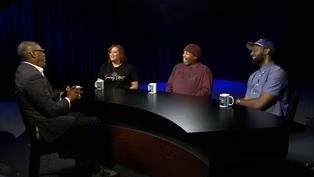
Joining me now are the festival's co-directors, Marshalle and Lazar Favors of Trinity Films Entertainment Group.
They're joined by one of the filmmakers, Zachary Cunningham.
Welcome back to "American Black Journal."
- Thank you.
Thank you.
- Thank you.
- We do this every year.
- Thanks for having us.
- Every year, yes.
- And I got to say, it is one of the shows I really look forward to - Aw.
- just because I am such a fan of the very idea of this festival.
This is the seventh year, but you guys have been coming here every year - Every year.
- to talk about it.
- Thank you for supporting us.
- It's been really cool to watch it grow and change.
So, let's talk about what's different and new this year.
- You can kick us on off.
- I'ma kick us off?
Okay, I'll do that.
(laughs) So this year, again, it's our love for Detroit, that's why it's "Sincerely Detroit."
It's our letter.
We have 17 films from Detroit filmmakers.
We have some great partnerships.
We launched a script-to-screen competition this year with our partner, Silver Line Entertainment Group.
We've forged another relationship with the Detroit Historical Museum, and of course, we're back at the Charles H. Wright Museum, so it's been, for me, it's those things that help us build and help fuel what it is that we're doing.
So, I'm excited just for that alone, - Yeah, yeah.
- myself, yeah, yeah.
- So, 90 films.
Marshalle, I know you do a lot of the work getting those films together, right?
So, talk about how you put that slate together.
- Well, you know, and of course it is always a team effort and you know, we have jurors that come together.
- Now you're being modest.
(Stephen laughing) - No, I'm telling you, it does not happen without the team.
And so, we get a little over, like, 400 submissions.
So, it's really hard to narrow the films down, but we look at the story, we look at overall production quality and the entertainment value because people come to watch great films.
So, the genres are very vast.
And so, you're going to see romance films and drama and comedy and documentaries.
- [Stephen] Mm-hm.
- And I think some of those are my favorite because of the historical aspects that documentary films tell as well.
But I just always feel like there's something for everyone.
- Yeah.
Yeah.
I mean, that range I think is interesting because I mean, you get a range, I think at any film festival, but when it's African American themed, that range is as broad as it is anywhere else, but it also takes on a different flavor and different personality.
- Oh, absolutely, and I think it's the nuances of the films as well because you know, there isn't one culture that's monolithic and the same with our stories as well.
So, to see all the different stories and how they're told and how they're real, it's really exciting.
- Yeah.
Zach, it's been a while since we've talked to you, but you've been a guest here before for this very thing.
Talk about what you're working on now.
- So I have two films in the festival, - Uh-huh.
- thank God, I have... One is called "When the Music Stops."
It was written by Lamont Leak who also executive produced it, produced it, put it all together, and it's a film about two musicians who kind of come together in Detroit and kind of have like this jazzy, soulful love story.
(Stephen chuckling) And then, I have a second film called "My Hands Touch the Sand," which is more of an art film and it's an artistic interpretation of my friend's journey, Greg, as he went through a stroke at the age of 30.
- Wow.
- So, it documents the stroke itself, his recovery, and just the dark moments that he went through and where he is today.
- Yeah.
That's, again, speaking of range, you're all the way out here on one and all the way over there - Absolutely.
- on another.
Talk about the difference in the way you approach those subjects.
- I mean, I think each film just takes, like, I would say a different approach, like, a different mindset.
So, like, when you're directing for somebody else, you're more so trying to deliver what they want while adding your sprinkle, your flavor into it.
But with the one about my friend Greg, like, no, that's our film.
So I'm going, "You have to come into our world to really appreciate it."
So it's just more so like, "Hey, we're making this for public consumption or we're making this for the select few who really need to hear this particular story?"
- Yeah.
Lazar, the spirits dimension of this, that's what, two years, three years now?
- Five.
- Five?
- Five years, 17 editions in five states.
- Lost track of time.
- Okay, yeah.
- Yeah, so we produced that event in Brooklyn, Miami, Houston and also Atlanta and of course Detroit, and this is our 17th edition.
And this year, we're excited because we took it to the island, right?
We took it to our Belle Isle at the Belle Isle Casino.
No, you can't gamble, but it's still at the Belle Isle Casino.
And you know, the Belle Isle Casino just did a $7 million renovation, so we're kind of like one of the first events in there after that renovation, so it's going to be exciting.
This year, it's more of the canned cocktail.
- [Stephen] Mm-hm.
- Right, we have about four different canned cocktails.
One specific is something they used to call me in high school was flavor, so it's this flavor-canned cocktail and it has great lemon drop and great packaging.
It's just going to be a beautiful time.
21 and over, of course.
- Yeah, right.
- And then, of course, we have our Liquid Forum where you get to learn about the industry itself.
You get to understand what distribution is, you get to understand how to raise funds and how to really, really operate in this industry.
As black people, we only represent 3% of this industry.
So, that's already a struggle, but events like this one, events like The Taste of Black Spirits help you along.
And, I think, since we last talked, we've raised over $35 million for small African-American-owned spirit brands.
- Wow.
You know, I think some people might think it's strange to have these two things together.
Talk about why in your mind that works.
- It works because we're able to marry two audiences, right?
We're able to bring a filmmaker and a spirit brand owner together to possibly, right, to possibly move some things around and of course, maybe feature their product in a film, and filmmaker become an ambassador for the brand, but it just works.
When we tried it the first year, we had no idea where it was going to go, but we saw what happened.
We saw that communication.
We saw what was building and it just makes sense.
It's one of the only, if not the only film festival in the country or even in the world that does something like that.
Everything is very specific to us and it's very specific to what we're trying to achieve, and that is just really bringing our culture and highlighting us in a very specific way so we see us clear this time.
- Yeah, well, and that's the point of the whole festival, for us to be able to see ourselves.
- Yes.
- Oh, absolutely.
Absolutely.
And I think that for us as well, the LOVE Building is one of our venues and it gives us a chance to showcase our love for film, our love for the arts community, and it ties into our theme, "Sincerely Detroit."
- Yeah.
- And so, one of the highlights for this year's festival is the fact that we have 17 films that represent Detroit as well.
- That are Detroit, yeah.
- And we're going to culminate it with very special guests.
Diarra from Detroit has a... That's actually the name of her TV show that's out and she's going to close the festival for us as our love letter to Detroit as well.
- Yeah.
Yeah.
Zachary, I'm always curious what the struggle looks like for any filmmaker, but especially African American filmmakers and maybe even African American filmmakers from Detroit.
Give us a sense of that.
- [Zachary] The struggle.
- Mm.
- Or maybe that's not a struggle.
You seem like... You're like, - I mean, - "I'm not sure it is."
- Yeah, you just make it happen, right?
Like, so I think struggle is a mindset, so you can choose to struggle in it because the reality is it's a choice, right?
It's a blessing to be able to make films.
To be able to make films is a privilege, you know?
So, you use what you have.
And I think a lot of us, we tend to struggle because we think we need things that we, you know, that we see other people have, but thou shall not covet, right?
Like... (Stephen laughing) So for me, it's more so just like, hey, if the resources I have, the team I have, the relationships I have, the locations I have, my father's a pastor, so I know a ton of people.
It's like I use the resources that I have in order to get things done and I get done.
- Yeah.
I'm sure I've asked you this question before, but how did you get started in film and decided this was what you wanted to do?
- So, I'm a poet.
That's how I got into it.
I wrote poetry, had a chance encounter at, like, a surrogate grandmother's house, ran into a cousin and she had a camera.
And I was like, "Hey, let's make some documentaries about Detroit based on these three poems that I have."
This is 2011.
And we made a film called "#Detroit."
- Yeah?
- Creatively, that was the most creative title that we had at the time.
(Stephen laughing) "#Detroit," which was... (Zachary laughing) - So, it was creative.
- Right?
And man, I just fell in love with the process and really just went down through the line.
And really, I give a lot of credit to Marshalle and Lazar.
Like, they've supported me, you know, for years, for over a decade.
They gave me my first award.
They produced pretty much, like, the film that changed my entire life.
You know?
And they... You know, I can call them for anything.
Marshalle is one of the few people who held my son when he was a newborn.
He wasn't even two months.
- My goodness.
- You know?
- Yeah.
- So yeah, they're like family and they've always assisted me and helped me.
Well, they've produced two of my films now, now that I think about it.
- Yeah, so yeah.
- I mean, just the, I guess the path, the journey that he's talking about, I think you probably see that in lots of the relationships you have with the filmmakers that you feature in the festival.
- Yeah, we tend to ride that journey with them.
If we find someone, for instance, it's a young lady, Okema T. Moore, who she had a film at our festival last year.
She ironically has four films in our festival this year, but it's not about the film, it's about her.
She's a producer, writer, director, an actress, and she just... Just watching her grow and watching what she's doing for the industry and for women in the industry, it's just a huge deal.
So, this year, we wanted to make sure that we sliced a piece of the pie for people to meet, talk to her, have a conversation with her and get an understanding of why we're doing this or why she's doing this thing, and then why we're doing this thing with her.
- Yeah, and part of the reason we have the festival also is to make these relationships and connections happen so people, no matter what stage you are as a filmmaker, can keep growing, learning, and connecting.
- How do you find the filmmakers?
I mean, how do you find the folks that you want to work with and feature in the festival?
- We're constantly in film communities, right?
And so, being immersed and we go to workshops as well.
We travel and go to other film festivals and we connect with the film community here.
And so, those relationships are constantly growing.
So, by immersing yourself within the film community constantly.
- Yeah, yeah.
And you're changing that community by doing what you're doing.
- And we tend to watch six to 800 films a year.
- Oh my goodness.
- It's true.
- How do you find time for that?
(laughs) - Well, it's- - I mean, it's your job, but- - 'Cause we're it, right?
- And we love it!
- And we love it.
- I love it.
- And we love it.
- We love it.
And I think that there's a lot of great filmmakers out here at different stages, like she said.
And I think if there's someone like a Zachary who shows, like... Zachary loves film.
Zach, he loves it.
I mean, I can tell.
- I mean... - You know, when he's talking about it.
- He can talk all day about it, and that's what we look at.
We look at how serious you are, and if you are that serious, we're going to set a table for you.
We're going to invite you in.
We're going to open any door that comes across, that comes our way, we're going to help you walk through that door.
- Yeah, yeah.
Zachary, we've got about a minute left.
- Yes, sir.
- I wonder what you would say to a young teenager in Detroit who's thinking, "Oh, yeah, I'm pretty good with this camera," or, "I'm pretty good telling stories," or, "I'm a poet.
Is film for me?"
- I would say do it.
Just do it.
Get with people who are like-minded, you know, and tell a story that's true to you.
- Yeah.
- Don't worry about how it's going to resonate within the marketplace.
Make sure it moves you first because if it moves you, it'll move the audience.
- Yeah.
- And so, just be honest, be authentic, and be uniquely you.
Your eccentricities are your greatest gift as an artist.
- Yeah.
Yeah.
Be about the work, not the job.
- Absolutely.
- Yeah, all right.
Okay.
Well, it's great to have all three of you here.
And guys, congratulations on the seventh - Thank you.
- annual Detroit Black Film Festival.
- Thank you.
We appreciate - Thank you.
Thank you for having us.
- Thank you.
- For years, African Americans have faced challenges in the film industry that range from stereotypical roles to a lack of representation in decision-making positions behind the camera.
We've got a clip from a 1997 episode of "American Black Journal" that featured author and film historian Donald Bogle.
He spoke with host Darryl Wood about Blacks in Hollywood.
- We hear a lot of talk in media circles today about Blacks in film and how there aren't as many as there should be or how there aren't many quality roles.
Is that a lot different from the way it's been historically in Hollywood?
- Well, I think that, no, I think this has always been a problem historically in Hollywood that, I mean, the very early years with African American images on screen, many people don't realize it, but in the very beginning, real Blacks didn't even work in the movies.
You had white people in blackface playing Black roles, and- - Most notably, D.W.
Griffith's "Birth of Nation."
- Well, D.W.
Griffith's film, yeah, "Birth of Nation," the major roles.
There are Blacks playing minor roles in "Birth," but the major black roles are played by whites with burnt cork, and consequently, the roles which are stereotyped anyway are all the more grotesque because you don't have people from the community who might be able to play around with the role and bring another dimension to it.
But nonetheless, through the decades, there have been these steady changes and there've been movements forward.
But it isn't as if we're at the place where we want to be today.
I think that, you know, many people are still concerned about these images on screen.
And I think a crucial problem is, is that we still don't have a diversity of African American images on screen.
I mean, these comedies that they've done recently, and you mentioned some of them, "B.A.P.S."
"How to Be a Player."
- [Darryl] I think another one was "Booty Call," I think, - [Donald] "Booty Call," and of course, "Booty Call," - [Darryl] as it was termed.
- [Donald] just the very title is insulting.
- [Darryl] Mm-hm.
Mm-hm.
- [Donald] But the market right now, they really go after what they perceive to be this youth market, and these films are designed for that market.
And what the industry doesn't realize is that, one, you can satisfy that market and reach that market without insulting it.
And two, there is another market.
It's been estimated now that 25 to 35% of the movie audience, the general movie audience, is African American, and that audience goes to see all types of movies.
- It's not a matter of these roles in and of themselves being so evil or awful.
What it is, is the lack of balance that we have to focus on.
- Well, it's the lack of balance and some of the roles are pretty evil and pretty insidious.
- For instance?
- Well, for instance- - What strikes you as particularly hideous in recent memory?
- I just, well, I mean, if you see "The Fifth Element," this movie with Bruce Willis and Chris Tucker's role in that.
I mean, it's an old-style coon character that should have gone out during the days of Stepin Fetchit or after the days of Stepin Fetchit, and you still see this kind of thing popping up in the movies in white films.
And we're at the point where we really should be beyond that.
- Well, and sometimes the argument might be perhaps the venue in which the Black actor/executive producer is allowed to move will not accommodate a larger effort, a more legitimate effort, a more intellectual effort.
- Well, this is what the industry has been telling us, you know, wants us to believe, and it's not the case at all.
I mean, I think that a real answer to this and we saw some of it happening a few years ago.
When we do get more African American filmmakers getting there to tell the story from their perspective, and people in the early '90s like Spike Lee, John Singleton's "Boyz n the Hood," their movies reached an audience and affected an audience.
And maybe sometimes people didn't always like those films, but those films nonetheless very much communicated the filmmaker's point of view.
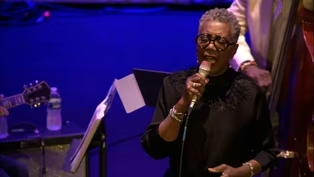
- We're going to leave you now with a performance by vocalist Carmen Lundy, who is one of the 2026 National Endowment for the Arts Jazz Masters.
The performance was recorded at this year's Concert of Colors, and it aired on "Detroit Performs" right here on Detroit PBS.
For more on today's guests, go to americanblackjournal.org, plus you can connect with us anytime on social media.
Take care, and we'll see you next time.
(tentative music) (tentative music continues) (Carmen vocalizing) (funky music) (funky music continues) (Carmen vocalizing) ♪ Blue woman, blue woman ♪ ♪ Why must you cry all day ♪ ♪ Blue woman looking for someone ♪ ♪ To wipe your tears away ♪ ♪ Hold your head up high ♪ ♪ Somehow I know you'll get by ♪ ♪ Everything's going to be all right ♪ (funky music continues) ♪ Blue woman, blue woman ♪ ♪ You cry to ease your pain ♪ ♪ Blue woman, searching for someone ♪ ♪ To make you smile again ♪ ♪ When you love yourself ♪ ♪ You can believe someone else.
♪ ♪ Then your world will begin to change ♪ ♪ You've got one heart ♪ ♪ One life, one soul ♪ ♪ Just a little time ♪ ♪ So, sing your song ♪ ♪ And you won't feel alone ♪ ♪ Blue woman, blue woman ♪ ♪ Be happy and be gay ♪ ♪ Hold your head up high ♪ ♪ Somehow I know you're going to get by ♪ ♪ Everything's going to be all right ♪ (funky music continues) (Carmen vocalizing) (funky music continues) (audience cheering) (funky music continues) - [Narrator 1] Across our MASCO family of companies, our goal is to deliver better living possibilities and make positive changes in the neighborhoods where we live, work, and do business.
MASCO, a Michigan company since 1929.
Support also provided by the Cynthia and Edsel Ford Fund for Journalism at Detroit PBS.
- [Narrator 2] The DTE Foundation is a proud sponsor of Detroit PBS.
Through our giving, we are committed to meeting the needs of the communities we serve statewide to help ensure a bright and thriving future for all.
Learn more at dtefoundation.com.
- [Narrator 1] Also brought to you by Nissan Foundation and viewers like you.
Thank you.
(bright music)
A Concert of Colors performance featuring Carmen Lundy
Clip: S54 Ep37 | 7m 30s | Concert of Colors performance by Carmen Lundy (7m 30s)
A look at this year’s Detroit Black Film Festival
Clip: S54 Ep37 | 15m 45s | The Detroit Black Film Festival - the annual celebration of Black cinema is back. (15m 45s)
Providing Support for PBS.org
Learn Moreabout PBS online sponsorship New Episode
- News and Public Affairs

Top journalists deliver compelling original analysis of the hour's headlines.

- News and Public Affairs

FRONTLINE is investigative journalism that questions, explains and changes our world.
 New Season


 New Episode

 New Episode



Support for PBS provided by:
American Black Journal is a local public television program presented by Detroit PBS