
Detroit Federation of Teachers
Clip: Season 49 Episode 6 | 10m 50sVideo has Closed Captions
Detroit Federation of Teachers | Episode 4906
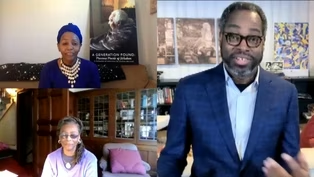
Stephen Henderson speaks with Terrence Martin, the president of the Detroit Federation of Teachers, about the possibility of educators returning to the classroom. Episode 4906/Segment 1
Problems playing video? | Closed Captioning Feedback
Problems playing video? | Closed Captioning Feedback
American Black Journal is a local public television program presented by Detroit PBS
Detroit Federation of Teachers
Clip: Season 49 Episode 6 | 10m 50sVideo has Closed Captions
Stephen Henderson speaks with Terrence Martin, the president of the Detroit Federation of Teachers, about the possibility of educators returning to the classroom. Episode 4906/Segment 1
Problems playing video? | Closed Captioning Feedback
Where to Watch American Black Journal
American Black Journal is available to stream on pbs.org and the PBS app.
Providing Support for PBS.org
Learn Moreabout PBS online sponsorshipLet's start with the position of teachers, the position that teachers are in during this pandemic.
We haven't talked a lot with teachers.
We've talked a lot about teachers, but I haven't had a chance really to talk a lot with teachers who are experiencing this or making the changes that are necessary and I assume, anticipating a time when we'll get back to in-class learning for everyone.
But just give us a sense of how this has been for Detroit teachers this school year.
Well, as many can imagine, there was no methods course in college on how to teach through a pandemic and do it remotely.
And so, as you can imagine, teachers have been feeling very frustrated.
as obviously something extremely new, something that none of us have been through before.
And so it hasn't been easy.
Certainly been very difficult.
And as we approach a year that we've been in this environment, it's growing and increasingly getting tougher.
You can imagine having to deal with death and illness in your own family, but also reaching out to students who are experiencing the same issues.
And for us, you're not able to mourn in the ways that we typically do, you are not able to comfort your loved ones in the way that we'd like to, because of the restrictions.
It's been very difficult to teach through this environment.
What about the support that teachers have gotten?
What about the ways in which the district has made it possible for distance learning to take place and maybe made it easier?
Do you feel like you've gotten the kind of support that you need?
Yeah, I think one of the things that certainly we're proud of as a union is, the letter of agreement that we signed with the district back in the early fall, late summer, where it allowed teachers to have the option of whether or not they wanted to teach face-to-face or continue to teach online.
And I think for a lot of educators, that served as a huge relief for them.
Many live in a multi-generational household where they're taking care of care of the elderly parents, and they have children of their own.
And so being exposed to this virus saw a great risk in that.
To be able to choose and have that decision solely with you on the health and safety of your family and the health and safety of students, teachers really appreciated that.
And so we certainly appreciate the district seeing that and then being able to accommodate folks.
Nevertheless, we do have some teachers that want to go back face-to-face, and they were allowed to do so, and they received extra compensation as a result of that.
And also, the testing protocols that we were able to establish with School District allow for a voluntary testing of students, staff and the community at large at schools.
And so that has been huge.
Philanthropists coming through, allowing for every student in DPS to have a laptop with connectivity was also a huge support.
Those are the things that we thought we needed at the time.
Now that we've gone through this for a year, there are other things that we now need, other supports that are needed.
We knew at the beginning of this that this was gonna take a huge toll mentally and emotionally for our students and for our staff.
And so now we know.
It has been confirmed that the emotional and health of our students and our staff are gonna be paramount to address coming up.
I had a very brief conversation with the superintendent last week about using some of the federal funds to actually provide support, mental health support to students and the staff very, very soon here.
And so we're really looking forward to that.
And again, now we're a year in it, vaccines are around and out and folks are getting them, but there's still so much that we don't know.
But what we do know that this has taken a huge emotional toll on us all.
And so that certainly has to be addressed.
Now the discussion is around the vaccine, what that allows us to do in the school environment in the next few weeks or months.
Superintendent Vitti has announced that he'd like to have kids back in school at 100% within just a few weeks.
Whenever somebody says that though, I immediately think, well then how come we're not making sure that every teacher has a vaccination?
That hasn't been the way that the protocols have worked.
That has not been the way that we've done this.
I wonder if you have that same concern.
And if we do go back to the point where they say, "Hey, we're back to in-person school for everybody all the time."
Are you gonna be okay doing that if all your teachers haven't had vaccinations?
I think we all have to be comfortable with saying, we really don't know.
And the bottom line is this, we all wanna go back to work.
Teachers want to teach in schools, but it has to be safe.
We have to remain healthy.
We've gotta have the resources necessary in order to do that.
We don't know what in-person education is gonna look like.
After a year of having it just sporadically here in Detroit, who knows what it's going to look like moving forward?
And I think that, obviously the vaccine is gonna be huge to continue testing is also going to be huge.
But what we also have to understand is that, Detroit is no different than LA, and DC, and Chicago, with a huge population of black people and black students.
There's an undercurrent there of distrust in the government and distrusted in healthcare and there is a history of it there.
We're really gonna have to truly educate the public on what this vaccine is and what it is not in order to get folks back.
It's certainly not the end all to be vaccinated, but certainly is a strong first step to getting us back.
And I think it's really too early for us to say or put a percentage on how many folks we want back.
I think we really have to analyze where we are and both the union and the district have committed to really looking at the numbers, the hard numbers.
We made a commitment that the positivity rate had to be at least at five or less, a 5% or less in order for us to return to some sort of in-person learning.
And we're gonna stick to that.
The union plans on sticking to that.
I'm certain that we'll have more teachers who choose to teach in-person now than we did back in the fall.
Many of our teachers have been vaccinated.
There needs to be more obviously, for us to get to the point where we're comfortable.
But we also have to look at the families also being vaccinated and the general public in Detroit being vaccinated and tested right along with that.
We have goals in terms of how many students we want back.
We're far from certainly where any of us would like to be at this point.
I also wanna talk about once we get back to in-person learning, all the time that's passed since we were at that point last year, and what that will mean in terms of some sort of loss.
I think there's no other way to cast that, right?
There's going to be some loss because we've had to disrupt things so much and so many different times in so many different ways.
How do you prepare teachers for the challenge that's gonna face them when they get all their kids back in front of them in a physical classroom?
There's no question that there's gonna be learning loss.
And one of the things that this pandemic has done is really expose the inequities in education that already existed, particularly in the city of Detroit.
Now we get into a conversation of funding and really to be funded properly and appropriately for the student population, by which we serve.
And so that has been a challenge for us for a number of years.
And we have pressed upon Lansing to really look at a way to school formula, which really says that, let's provide the service, the support and the funding for students based on their needs.
Based on their individual needs.
And we know when you look at students in the city of Detroit, we have almost a third of our students who receive specialized student services, be it speech, be it OT, or PT assistance, resource room, special education services, all encompassing What our teachers know inherently now, is that we're already at deficit and what they know, in the coming months, in the coming years, is that that deficit has now grown because of this pandemic.
And so there's gonna be a reliance on funding and a reliance on supports, not only from our school district, but from our state and from the federal government to ensure that black students and brown students and students of special needs aren't left behind in this country.
Video has Closed Captions
Clip: S49 Ep6 | 11m 8s | Generation Found with Roohee Marshall and Carole Hall | Episode 4906/Segment 2 (11m 8s)
Providing Support for PBS.org
Learn Moreabout PBS online sponsorship New Episode
- News and Public Affairs

Top journalists deliver compelling original analysis of the hour's headlines.

- News and Public Affairs

Today's top journalists discuss Washington's current political events and public affairs.

 New Episode

 New Episode


 New Episode


Support for PBS provided by:
American Black Journal is a local public television program presented by Detroit PBS