
Detroit Food Co-op, PTSD, Ford Piquette Plant, Mother’s Day
Season 8 Episode 45 | 26m 46sVideo has Closed Captions
Detroit People’s Food Co-op, renaming PTSD, Ford Piquette Museum and Mother’s Day events.
The Detroit People’s Food Co-op, a new Black-led, cooperatively owned grocery store has opened in the city’s North End neighborhood. Two local veterans advocate changing the term Post Traumatic Stress Disorder. Take a tour of the Ford Piquette Avenue Plant Museum, where Henry Ford first created the Model T car. Plus, ways to celebrate Mother’s Day and AAPI Heritage Month this weekend.
Problems playing video? | Closed Captioning Feedback
Problems playing video? | Closed Captioning Feedback
One Detroit is a local public television program presented by Detroit PBS
Detroit Food Co-op, PTSD, Ford Piquette Plant, Mother’s Day
Season 8 Episode 45 | 26m 46sVideo has Closed Captions
The Detroit People’s Food Co-op, a new Black-led, cooperatively owned grocery store has opened in the city’s North End neighborhood. Two local veterans advocate changing the term Post Traumatic Stress Disorder. Take a tour of the Ford Piquette Avenue Plant Museum, where Henry Ford first created the Model T car. Plus, ways to celebrate Mother’s Day and AAPI Heritage Month this weekend.
Problems playing video? | Closed Captioning Feedback
How to Watch One Detroit
One Detroit is available to stream on pbs.org and the free PBS App, available on iPhone, Apple TV, Android TV, Android smartphones, Amazon Fire TV, Amazon Fire Tablet, Roku, Samsung Smart TV, LG TV, and Vizio.
Providing Support for PBS.org
Learn Moreabout PBS online sponsorship- [Narrator] Coming up on "One Detroit", we've partnered with Bridge Detroit to examine the impact of a new black-led grocery co-op in a Detroit neighborhood.
Plus, our senior producer, Bill Kubota, is up for Journalist of the Year.
We'll look back at his story on post-traumatic stress in military veterans.
Also ahead, a tour inside the birthplace of Henry Ford's Model T. And we'll give you some ideas on how to spend Mother's Day weekend in metro Detroit.
It's all coming up next on "One Detroit".
- [Male Announcer] From Delta faucets to BEHR Paint, Masco Corporation is proud to deliver products that enhance the way consumers all over the world experience and enjoy their living spaces.
Masco, serving Michigan communities since 1929.
Support also provided by the Cynthia and Edsel Ford Fund for Journalism at Detroit PBS.
(light music) - [Female Announcer] DTE Foundation is a proud sponsor of Detroit PBS.
Among the state's largest foundations committed to Michigan-focused giving, we support organizations that are doing exceptional work in our state.
Learn more at DTEFoundation.com.
- [Male Announcer] Nissan Foundation and viewers like you.
(upbeat music) - [Narrator] Just ahead on "One Detroit", two Michigan men are trying to change how the nation views and treats the mental health of military veterans.
Plus, we'll take a look at Detroit's automotive history inside the Ford Piquette Avenue Plant Museum.
And, Cecilia Sharpe and Dave Wagner of 90.9 WRCJ have a list of events and activities around town this weekend and beyond.
- [Cecilia] This weekend.
- [Narrator] But first up, a new African American-led community owned grocery cooperative in Detroit's North end is providing healthy food options and food education for residents.
The Detroit People's Food Co-op will have its grand opening on May 18th, but it's already open and welcoming customers.
Bridge Detroit's Jena Brooker, and "One Detroit's Jonathan Shed, examine the store's impact on food access and economic development in the city.
(light music) - A new black-led cooperatively owned grocery store has officially opened in Detroit.
The Detroit People's Food Co-op on Woodward near East Grand Boulevard, started welcoming shoppers on May 1st.
It focuses on providing access to culturally relevant healthy foods.
What would be the impact of having such a big grocery store open up in the north end in Detroit on the local economy?
- We are focused on uplifting black people, and what we find is that when the people who are most marginalized and most oppressed in society are lifted up, everybody benefits.
We expect that The Detroit People's Food Co-op will stimulate the local food economy, focusing centering black people who are playing within that kinda space, but also it's going to benefit the entire local food economy.
- [Jena] The Detroit Black Community Food Sovereignty Network, D-B-C-F-S-N for short, spearheaded the co-op project.
It also runs D-Town Farms on Detroit's West side.
Yakini said DBCFSN and the Co-op were created out of the need for greater health equity across the city.
- Gonna get a pound of spinach.
We were concerned about the lack of access to good high quality food, but even equally as importantly, we were concerned about the lack of self-determination and the economic extraction from black communities.
- [Jena] After losing roughly a dozen grocery stores in Detroit over the last decade, the co-op will fill a much needed gap for many Detroiters.
- We see in some specific areas, there's been multiple grocery stores that have left.
You know, there's areas now on the east side that are very much pockets where access to food opportunities is very limited.
One store in particular closed, and it was across the corner from a high rise senior living facility.
And all those folks would just walk across the street to get their groceries and now they can't.
- [Jena] Hill has been mapping Detroit's grocery store landscape and studying food access since 2011.
The United Ways Alice Report provides a peak into food security for Detroiters.
- In Detroit, it's like 70% of households that meet that Alice Threshold where, you know, they're very likely facing food insecurity on some semi-regular basis.
The housing development happening in the north end, tied with this food co-op development that is also so community rooted, it's gonna be an amazing access point for a lotta people.
- [Jena] But the co-op is focused on more than just healthy food access.
- Black farm land.
- Doctor Shakara Tyler of DBCFSN wants to increase people's understanding of the full process, from seed to shelf.
The local food will be traveling less miles to get to the shelves.
It's really important that we uplift how many Detroiters will now have access to local foods that sometimes can be hard to nail down.
Most of our food travels from miles and miles away, California, Mexico, Florida, Georgia.
And so we wanna really uplift the food that's being grown here in Detroit.
- [Jena] The co-op plans to source fresh produce from black run farms like D-Town Farms, the Oakland Avenue Farm, and the Green Boots Project.
It will also stock food and wellness products from more than 40 local vendors.
- We have a model of 50/50, so like 50% healthy and organic, 50% clean and conventional.
So you'll see products that you're used to seeing right next to products that you are not used to seeing.
- [Jena] Okay.
- I'll give you one example.
We had a couple of member owners saying, "Oxtails, we like oxtails, "and you cannot find that in most grocery stores."
(people speaking indistinctly) - [Jena] Shoppers will also seek cookies and other products from Zella's Bakery, a plant-based bakery created by two sisters from Detroit in 2015.
- We've been waiting on this, we've been waiting on a co-op, we've been waiting on, you know, a black lead store that could speak to food sovereignty the way that you know this one does.
It meets the needs of the people centralized in an area that, you know, whether you live east or west, you can get here right off of Woodward.
It gives us an opportunity to send our products into a store where they have beliefs as we have, and want wanting to feed our people, and feed them in a healthy way.
(tractor rumbling) - We're trying to be very thoughtful about the partnerships that we build and the role we play, both in creating a self-determining food economy, but also the role we're playing in a highly gentrifying neighborhood.
- [Jena] Research from Fair Food Network, shows that Detroiters spend an average of 300 million to 500 million annually on groceries in the suburbs.
- It's a insane amount of money that leaves the city in grocery money.
Any thriving city you have opportunity and you have choice.
And I think that's the most important part for Detroiters, like they deserve choice.
And you know, it shouldn't just be that they can walk to this grocer or they can drive 30 minutes to this one.
- [Jena] In the past two years, Detroit has added two other new black-owned grocery stores, Neighborhood Grocery and Linwood Fresh Market.
More than adding another grocery store for Detroiters, the co-ops leadership hopes it can be an example for what's possible.
- I completely believe in the fact that anywhere on the planet that anyone lives where there's children, the children should see the adults creating solutions that are culturally relevant, and that are necessary for that city, that village, those people.
- If people can see that we can feed ourselves through a economic cooperative model, maybe we can clothe ourselves, maybe we can house ourselves.
It reverberates outward beyond just food.
So if you are not already a member, please become a member because this is what we need.
The building black food sovereignty is a participatory process, so we need all head, hearts, hands on deck, this is the community process.
(people talking indistinctly) - [Narrator] By the way, Bridge Detroit reporters, Jena Brooker and Nushrit Rockman, who is also a "One Detroit" contributor and Detroit Free Press reporter, are finalists for the 2023 Young Journalists of the Year award given by the Detroit chapter of the Society of Professional Journalists.
The winner will be announced at an award ceremony on May 15th.
We're also pleased to announce "One Detroit" senior producer, Bill Kubota, is a finalist for the 2023 Journalist of the Year Award from the Detroit Chapter of the Society of Professional Journalists.
- Do you think there should be more?
- [Narrator] Kubota's stories have covered a range of topics, including the 60th anniversary of the Detroit Walk to Freedom, the impact of climate change on an east side Detroit neighborhood, and efforts to reduce recidivism among the formerly incarcerated.
- Give you a piece of paper.
- [Narrator] Kubota also produced this story on efforts to eliminate the stigma of post-traumatic stress in veterans.
(light music) - [Bill] Williamston population 3,820 miles east of Lansing, Kent Hall, Vietnam vet and community leader has another meeting tonight.
(car door closing) How you doing?
- Good, how are you?
- [Bill] He served on city council, now he chairs the parks and rec committee.
- Motion to excuse Maggie and Wolf?
- Kent nominated me for mayor in 2016, and we've had a, the friendship has blossomed ever since.
- You've cut through the bureaucracy sometimes to make good happen.
It's for the betterment of the community.
- Do you know the two most important days of your life is the day you were born and the day you figure out why.
I figured out my why, and it's what I'm doing, and it feels good - [Bill] Hall's why, helping veterans cope with post-traumatic stress.
His group, Honor for All, led by another Vietnam vet, Tom Mahany.
Now Hall's story starts in Linden, near Flint, high school class president, top athlete, a champion pole vaulter.
It was the 1960's, in college he had a shoulder injury that needed surgery.
- I lost my deferment by dropping out for one semester.
(Kent laughs) They snatched me right away.
- [Bill] In the army he spent time in Europe, the back end of his tour, Vietnam.
- I never saw so many mortars and explosives go out, it was like it was fire all around.
- [Bill] Post-traumatic stress?
Hall didn't know he had it, the term didn't even exist yet.
In Linden he finished college, worked, became a city councilman, an upstanding citizen, so everyone thought.
- I was 40-years-old when I just couldn't take it anymore.
I mean, I had three beautiful kids, I had a beautiful wife, and I didn't wanna live anymore.
So I started (Kent sighs) suicide by cop.
- [Bill] Hall made the news in 1986, they called him the jogging bandit, former star athlete turned bank robber.
- I robbed 13 banks with a toy gun, but they called me the jogging bandit 'cause I didn't run away I just, come on and catch me.
Well the first one was right in Grand Blake, the second one might've been Grand Blake.
They were all Michigan national banks until the one in Ohio.
- [Bill] Michigan National?
Hall didn't like them.
- They gave me a hassle about a car loan.
(interviewer laughs) (Kent laughs) - [Bill] For that, six-and-a-half years in federal prison.
- I was an elder in the church, I was a councilman in the city of Linden.
In fact, the night before my arrest, I was re ordained as an elder in the Presbyterian church there.
- [Bill] Hall rebuilt his life, eventually moving to Williamston.
Hall's Honor for All partner Tom Mahany, he's got a story too.
- Was started.
- [Bill] He lives in Royal Oak, a stone mason artist, as a child destined for the US Military Academy.
But Mahany was conflicted about Vietnam when he was a cadet at West Point.
- I was reassigned to the infantry when I was released on West Point.
And I was released on West Point because I had different views of what Vietnam was, and what we should be doing about it.
And that was in '68.
I spent the next year and a half in the Army.
- [Bill] When Mahany got back, he headed to Washington.
Unhappy with the US taking the war to Cambodia, he joined another hunger striker at the Capitol.
He'd hold other hunger strikes by himself more recently against the stop loss policy during Iraq and Afghanistan, forcing soldiers to keep serving long past their scheduled release dates.
(guns firing) And he spoke about the high suicide rates among veterans.
- Suicides keep going, the battle stops, but the suicides keeps going.
- [Bill] It's estimated as many as 22 veterans will kill themselves each day.
- Your brother-in-Law, right was?
- Well, yeah, my brother-in-Law, he committed suicide back in the eighties.
- But that was part of your motivation too, right?
- Yeah, well I saw what it did to my sister and our two little boys, - Right.
- So how long were you actually on that hunger strike?
- 29 days.
- [Bill] Mahany in Washington, a one man lobbyist for veterans mental health.
- I take him a new letter every day, tried to get somebody to listen, and it was finally Carl Evans office that listened.
- See, I've never heard this story before.
- No.
- Don't really get into each other's personal you know.
- I like to talk about what's gonna happen instead of what happened.
Because most of what happened wasn't that good.
- This is the Honor for All trail, and it's all been approved by City Council, the Parks Commission, and the Planning Commission.
- These are tulips.
- [Man] These are tulips.
- These are tulips and these are daffodils.
- [Bill] Big plans, more work needed at Williamson's Memorial Park on the banks of the Red Cedar River.
With the section dedicated to Veterans, hope is someday a national monument too.
- That's what this park is all about.
You gotta work something out, you can come here and work it out, or at least work on working it out.
(people talking indistinctly) - [Bill] Still a bigger project dealing with that term PTSD, Post-Traumatic Stress Disorder.
Psychiatrist, Frank Ochberg medical Advisor for Honor for All, he ran Michigan's Department of Mental Health and helped define PTSD as a diagnostic term in 1980.
- What we based it on, it had a lot to do with the Vietnam War.
It also had a lot to do with women and what women were very concerned about at the time.
- [Bill] Amongst them, the second wave feminist leaders like Gloria Steinem who tied sexual assault and domestic violence to traumatic stress.
- I saw it as the two genders coming together to define something worthy of putting, not just in the psychiatric dictionary, but the General Medical Dictionary.
- [Bill] The mission changed the term PTSD to PTSI, post-traumatic stress injury, and get that in the diagnostic manual, the DSM.
So all can know the problem is not their fault.
It's an injury to be treated like any other injury, as you would say, a broken leg.
- Well if I admit to having post traumatic stress disorder, I'm disordered, so I'm not gonna admit it.
And if I'm not gonna admit it, then I'm not gonna get treatment for it.
This is a file containing all the resolutions from all the states starting back in 2014, - [Bill] PTSI, Mahany's been working on this for 11 years, collecting resolutions from Michigan, then 46 other states in both chambers of Congress.
- And it's going to lessen their guilt, and it's gonna cut down on suicides.
Okay, that's it for the crocuses.
- [Bill] Tom Mahany, Dr. Frank Ochberg, and Kent Hall, have helped change some minds, but they want to change a lot more.
(people speaking indistinctly) - So it's getting there, but it's not getting there quickly enough.
So I wanna show you my graphic here, PTSI, not PTSD.
- [Bill] In Chicago, Doctor Eugene Lipov treats traumatic stress.
He shows the trauma is visible in brain scans, and says he can prove the name change can help.
- So I did a survey, which I published in 2023, and presented American Psychiatric Association.
The body that controls the naming, turns out yes, if you change the name, the stigma will get better.
- I think now we have the evidence to change it.
I think when we do change it, there will be a celebration that we've done the right thing.
- [Bill] The American Psychiatric Association confirms the PTSI proposal is now under initial evaluation by the DSM Steering committee.
Perhaps the is coming soon, driven in part by a little nonprofit in Williamston, Michigan.
- We have a wall of honor there and all the people on the wall of honor died in action, and we're here to honor them today.
But there's another bunch of people that might have died years later, even at their own hands possibly, and those are the victims of post-traumatic stress issue, and they deserve honor.
It's as though that sniper's bullet took years or months or whatever to actually strike, and the hell they went through before they got there.
- [Narrator] Let's turn now to a story that's truly Detroit.
The Ford Piquette Avenue plant in Detroit's Milwaukee Junction neighborhood is a major part of the Motor City's legacy.
The site is the birthplace of the Model T, and it has been transformed into a museum to preserve its automotive history.
When Detroit's Chris Jordan toured the museum with president and COO Jill Woodward.
(light music) - The Ford Piquette Avenue Plant is really one of the most important historic sites for the automotive industry in the world.
It is really the origin point of the motor city.
So when we ask ourselves, you know, where did Detroit get its start as the Motor City?
It happened right here in Milwaukee Junction.
This is one of the world's oldest surviving automotive factories.
And so we're just thrilled to be able to share it with the public.
This is sort of quintessential Detroit.
When you think about what's iconic to say Philadelphia, you think of, you know, independence Hall in Boston, you think of the old North Church, to us here, we think of the Ford Piquette Plant as completely iconic to the Motor City.
Henry Ford built the Ford Piquette plant in 1904, he was here until 1910.
And this is where he en envisioned and built the very first model T, which we know is the car that put the world on wheels.
We actually have Henry Ford's secret experimental room rebuilt here in the museum on the third floor, and it's holy ground for a lot of people to see the spot where that vehicle, the very first one was made.
And we had an industrial archeologist come and help us rebuild that exhibit so it looks exactly as it did in Henry Ford's time.
And you gotta think, this vehicle went on to be in production for 19 years, over 15 million were made.
And when you come here you can see for instance, number 220 that was made right here in this building.
That's our Red Model T downstairs, a 1909.
The museum that you see today is the effort of several decades of volunteer labor.
We have dozens and dozens of volunteers, but the museum that you see today really came together around 2017 when we accepted this very important collection of cars from the Porter Foundation.
We have over 65 very rare vehicles here, including one of the only collections of Henry Ford's letter cars, those are all the models leading up to the T that you can see anywhere in the world in the place where they were made.
Henry Ford was interested in making lightweight, inexpensive cars for the everyday person.
I feel like we've lost a little bit the significance of Milwaukee Junction.
When we think about this neighborhood, you know, it just doesn't roll off the tongue even for a long time lifelong Detroiters.
But this is exactly where the Motor City got its start, right here because of the railroads, and the Erie Canal had just opened, and there were minerals coming down from northern Michigan on the Great Lake Steamships.
So much was happening here.
They were making stoves, and carriages, and bicycles.
So there was all that innovation and entrepreneurship happening that really set the stage for what Henry Ford was gonna do right here in this building.
There were over 25 manufacturers within a five mile radius of this plant where we're standing today.
So it's really hard to to imagine the activity that it would would've been here, not just automakers, but also auto suppliers.
It was really the Silicon Valley of its day.
When we think about Detroit and what it means to the rest of the world, I think our contributions are really summed up by places like this that contain our history, our history that really went on to change the world.
The Model T really changed the way we live and drive today.
It enabled people a new level of freedom to be able to leave their small town neighborhood and travel across the country, or the world.
Prior to that, people didn't really go beyond 25 miles of their home.
So the Model T was very freeing, it was freeing for women, model T's took doctors and dentists across the country, it opened up the National Parks for camping, which Henry Ford and his friend Thomas Edison popularized.
The ramifications of this vehicle are just really untold.
So to have the birthplace of that vehicle here in Detroit preserved by chance, and a lot of hard work, is really a great gift.
- [Narrator] Mother's Day is this weekend and there are special celebrations taking place around metro Detroit.
And if you're a sports fan, the Golden Gloves Tournament arrives in Detroit next week.
Cecilia Sharpe and Dave Wagner have all the details in today's "One Detroit" Weekend.
- We're so excited to bring you all the fun events taking place this weekend in metro Detroit.
So Dave, what do you have cooking up for our audience this weekend?
- Well, Cecilia, it's Mother's Day on Sunday, so Friday, May 10th, the Fox Theater is honoring mothers a little early with a Mother's Day celebration, featuring gospel artist John P. Kee, Yolanda Adams, Hezekiah Walker, Tye Tribbett, and comedian host Jay Lamont.
- And if you want to hang out downtown another day, head to the Detroit Opera to see "The Cunning Little Vixen" on Saturday, May 11th.
The opera is based on a comic strip composer Leoa Janák saw in a newspaper.
- And we're going to bring you that opera live on WRCJ this Saturday night opening night.
Now let's get back to celebrating moms.
On Mother's Day, May 12th, the Great Patty de Bell and El DeBarge have their Salute two mothers concert at the Fox Theater.
- And next week, starting May 13th is the Golden Gloves Tournament of Champions at Huntington Place.
The week long national Boxing competition will showcase over 30 boxing franchises from across America.
- Also, May is Asian-American Pacific Islander Heritage month, and Little Asian Bites is presenting its third night market at Eastern Market Shed five, where you can come celebrate culture and community.
The event runs from 5:00 PM to 10:00 PM.
- And of course there's always so much happening around our city and state, so stay tuned for a few more options.
Have a great weekend.
(light music) - [Narrator] That'll do it for this week's "One Detroit".
Thanks for watching.
Head to the one Detroit website for all the stories we're working on.
Follow us on social media, and sign up for our weekly newsletter.
- [Male Announcer] This program is made possible in part by Timothy Bogert, Comprehensive Planning Strategies.
- [Male Announcer 2] From Delta faucets to BEHR paint, Masco Corporation is proud to deliver products that enhance the way consumers all over the world experience and enjoy their living spaces.
Masco, serving Michigan communities since 1929.
Support also provided by the Cynthia and Edsel Ford Fund for Journalism at Detroit PBS.
(light music) - [Female Announcer] DTE Foundation is a proud sponsor of Detroit PBS.
Among the state's largest foundations committed to Michigan focused giving, we support organizations that are doing exceptional work in our state.
Learn more at DTEFoundation.com - [Male Announcer] Nissan Foundation, and viewers like you.
(light music) (light music continues) (light music)
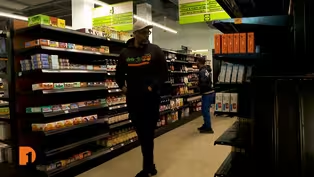
Detroit People’s Food Co-op broadens healthy food access
Video has Closed Captions
Clip: S8 Ep45 | 6m 19s | The Detroit People’s Food Co-op grocery store has opened in the North End neighborhood. (6m 19s)
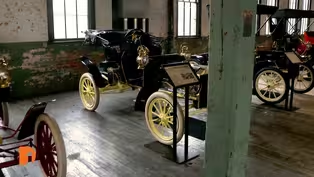
Ford Piquette Avenue Plant Museum preserves Detroit history
Video has Closed Captions
Clip: S8 Ep45 | 4m 6s | The Ford Piquette Avenue Plant Museum is preserving Detroit’s automotive history. (4m 6s)
One Detroit Weekend: May 10, 2024
Video has Closed Captions
Clip: S8 Ep45 | 1m 53s | Celebrate Mother’s Day, Asian American and Pacific Islander Heritage Month and more. (1m 53s)
Veterans push to rename Post Traumatic Stress Disorder
Video has Closed Captions
Clip: S8 Ep45 | 9m 5s | Two Michigan Vietnam veterans are pushing to rename Post Traumatic Stress Disorder. (9m 5s)
Providing Support for PBS.org
Learn Moreabout PBS online sponsorship
- News and Public Affairs

Top journalists deliver compelling original analysis of the hour's headlines.

- News and Public Affairs

Today's top journalists discuss Washington's current political events and public affairs.












Support for PBS provided by:
One Detroit is a local public television program presented by Detroit PBS