
Detroit Future City Report/Discover Your Spark
Season 49 Episode 23 | 23m 58sVideo has Closed Captions
Detroit Future City Report/Discover Your Spark | Episode 4923
A new report from Detroit Future City on the economic opportunity gap for people of color and what needs to be done to create change. P Plus, an online resource for parents looking for safe and affordable summer activities for their children. Episode 4923
Problems playing video? | Closed Captioning Feedback
Problems playing video? | Closed Captioning Feedback
American Black Journal is a local public television program presented by Detroit PBS
Detroit Future City Report/Discover Your Spark
Season 49 Episode 23 | 23m 58sVideo has Closed Captions
A new report from Detroit Future City on the economic opportunity gap for people of color and what needs to be done to create change. P Plus, an online resource for parents looking for safe and affordable summer activities for their children. Episode 4923
Problems playing video? | Closed Captioning Feedback
How to Watch American Black Journal
American Black Journal is available to stream on pbs.org and the free PBS App, available on iPhone, Apple TV, Android TV, Android smartphones, Amazon Fire TV, Amazon Fire Tablet, Roku, Samsung Smart TV, and Vizio.
Providing Support for PBS.org
Learn Moreabout PBS online sponsorshipWe've got a great show coming up for you on "American Black Journal."
we're gonna talk about a new Detroit future city report that takes a look at the gaps that exists for people of color when it comes to opportunity in changing Detroit.
And we'll talk about what needs to be done to fill those gaps, but also talk about a new way for parents to find safe and affordable options for their kids during the summer.
Stay where you are, "American Black Journal" starts right now.
Announcer 1: From Delta faucets, to bare paint, Masco Corporation is proud to deliver products that enhance the way consumers all over the world experience and enjoy their living spaces.
Masco, serving Michigan communities since 1929.
Announcer 2: Support also provided by the Cynthia & Edsel Ford Fund for Journalism at Detroit Public TV.
Announcer 1: The DTE Foundation proudly supports 50 years of "American Black Journal" in covering African-American history, culture and politics.
The DTE Foundation and "American Black Journal" partners in presenting African-American perspectives about our communities and in our world.
Announcer 2: Also brought to you by AAA, Nissan foundation, Ally, Impact at Home, UAW Solidarity Forever, and viewers like you.
Thank you.
♪♪ Welcome to "American Black Journal."
I'm Stephen Henderson, and as always, I'm glad you joined us.
Detroit Future City is out with its annual report on the state of economic equity in Detroit.
And the bottom line is not good.
The economic opportunity gap remains a powerful force for the lives of people of color in our city.
The gap is even wider apparently, in some areas.
The report cites inequities in income for Detroiters because of disparities in education and employment.
I talked with Detroit Future City CEO, Anika Goss about the findings and some of the recommendations for us to do better.
The new report suggests that we still have these tremendous gaps in opportunity, in outcomes for people of color here in Detroit.
Tell us what the picture looks like in 2021.
One thing to think about is that the state of the equity report, the way we've organized it this time it is a picture pre-COVID.
And so people need to keep that in mind.
So the data is what did Detroit look like in the context of the region prior to COVID?
And I think that that's really important because we are under the impression or the narrative right now is that everything was great and then COVID hit and wiped everything out.
And I think what we'll find, the numbers that are gonna come out for '20 and '21 then later this year in '21 and in '22 are gonna be really bad.
They're going to show further job losses, further losses in small business, but we now know that we're starting with much larger gaps.
We also really, really wanted to focus this report on opportunity.
And the reason that we focus so closely on opportunity for middle-class is because at Detroit Future City we really believe that this can't be a poverty narrative.
This can't be a narrative that just says, "Are we ticking up slowly against the poverty barometer without any opportunity for people to go someplace else once they reach a certain income level?"
And I really feel like now that we're seeing some of these income gaps between Detroit and the region, some of it echoes what we've said in previous reports, Some of it is new information, I think now we can really say, people will end up staying poor forever, unless we begin to really create some of these opportunities.
Give us some of the highlights, I guess, of this report that might stand out from previous reports.
I mean, I get that the trend line is consistent, but what's new on this one?
Yeah, so for this report, we actually start the report with an analysis of the region, and the region is growing and was doing really, really well pre-COVID.
And that's really important and that's a sign of opportunity for us, right?
Because if you can build, if you have a strong region to anchor from, you can only grow from there.
I think one of the primary things that we really looked at from previous reports to this report that where we saw significant change and that was new for us was entrepreneurship.
We've reported before that we were concerned that entrepreneurs are not growing in Detroit.
And so we really doubled down on this, this time including looking at the average loan size.
So this to capital and the inequity between Detroit small businesses with staff and suburban small businesses with staff, the loan value is about $1,000 more per average loan.
And that is a significant problem.
It's new data.
It's something that we just found and we hadn't reported on before.
The other thing that we should look at in terms of jobs and job opportunity, we really spent a lot of time looking at transportation and commute time.
And so we even came up with a customized indicator that would track commute time for your personal automobile as well as public transportation.
And we really wanted to include that because cost burden which is something that we've reported on before, is really high.
And commute times should be included in your overall costs for whether or not you can actually afford to live where you live and work, where you work.
The final thing that I really wanna say is that there is some good news from this.
So it's not a complete bad news report.
There are two areas that have shown significant growth, particularly when the public sector, the city, the state, the county, and the private sector, private business private industry are working together.
So CTE Certifications, a Career in Technical Education, those numbers have almost doubled just in a very short period of time, just in a year.
The other thing that we should be paying attention to is infant mortality.
Just in one single year it's gone from 16% to 11%.
Now it's still too high.
11% is twice the national average.
But if in a year they could change those numbers, imagine what they could do for any of the other indicators.
What do we need to be doing?
As you pointed out, the numbers are gonna get worse because of COVID.
You know the devastation that all of us have experienced here in Detroit is gonna show up in every assessment of 2020 and 2021.
So, we'll be further behind.
Yeah.
What are the things we should be doing in anticipation of those numbers which reflect the reality that people are living right now.
So one of the things that we really wanna focus on, and there is a set of recommendations.
This report just doesn't throw a terrible data news at you and say, you know, go for it.
We actually come up with a set of recommendations of things that we really want people to focus on and where we believe at DFC, where we can make change and move forward.
And one of those is combining, which is a big issue in this report, the combination of education, employment, and wealth, right?
Income and wealth.
And those three actually go together significantly.
And then I would also then add health and housing to that.
But what we've learned from this is that there is such a gap, Stephen, in education.
So the average jobs in Detroit, the only jobs that have been growing in Detroit are low-wage jobs for jobs in Detroit.
The jobs in the region are middle wage jobs.
Now you could say, "Well a low-wage job is better than no job."
But if those are the only jobs that are growing, right then that's going to be problematic for everyone.
That seem to be trapping people in poverty, right?
Exactly, exactly.
Trapping people in poverty.
And furthermore, if our education attainment is so low and when I say majority Detroiters, and when I say majority, I mean like 78% of Detroiters do not have at least an associate's degree.
Then we need to have new jobs without needing a degree.
On the other side of that, we have got to really be pushing for higher education attainment, community college, CTE, four-year college because the average wage is double.
It's $17 an hour if you don't have a degree.
It's $32 if you do have a degree.
It's slightly lower if you're African-American and it's extremely lower if you're a woman, which is a whole other conversation because the majority of of households in Detroiters are single women.
And so if they're making $11 less than a white man in Detroit, then that's a whole other issue that we need to talk about around wage parity.
And then the final thing that I really feel like is going to be critical for us unless we change this trajectory is how we look at our neighborhoods.
We have to begin to see the value of middle-class neighborhoods, places where people can grow because if we are able to slow this tide, change this trajectory, create new middle-class jobs, middle-wage jobs for Detroiters, the first thing that they're going to do is move out of Detroit.
So middle class households, in particular black middle-class households are not seeing Detroit as a place to raise their family.
And that is hugely problematic for a city that's 78% black.
And the only neighborhoods that are growing right now are also white, upper middle-class households.
So we need to be able to focus on that trajectory as well.
School is going to be out in just a couple of weeks.
And that means parents are deciding how to keep the kids active and engaged over the summer.
Research tells us that black and brown kids tend to fall more behind academically during the summer than other kids because they just don't have the same opportunities.
The free online directory called, Discover Your Spark, is trying to connect parents with fun, educational and affordable summer programs that'll keep their kids learning while they're out of school.
The directory is managed by the Youth Development Resource Center.
I spoke with the group's Executive Director, Sarah Elliott and with Tonya Adair of United Way for Southeast Michigan, which is one of the funders.
So Sarah, I'm going to start with you.
My kids are teenagers, but I remember this question and every summer, "What are you gonna do with them?
How are you gonna keep them engaged?
It is the eternal parent question, I think, and here in Detroit, of course, it looks (indistinct) place to talk about this idea that you have to connect parents with a quality choice.
We partner with the United Way for Southeastern Michigan to bring parents across the region a website called discover your spark.org.
And it's a place you can go to discover all kinds of opportunities for your young people in the summer and and out of school time and afterschool.
I'm a parent as well.
I've got little ones, so I'm not yet in the teenage years, but I have a five-year-old, and that was a question this summer, too.
So particularly right now where everything's kind of slowly coming back to normal.
I know parents are almost resetting and trying to find new places and opportunities for their kids.
So Discover Your Spark has over 200 different opportunities in Wayne, Oakland, and McComb counties.
There's, in-person, there's virtual, there's hybrid.
It goes from Pre-K all the way up to grade 12.
So we really cover the bases.
And for the summer, there's gonna be a mix of, you know, one time like sports leagues or virtual STEM programs or cooking classes, but there's also gonna be like the boys and girls club or other school-based or community-based summer camps that you can get your young people involved in.
So, the connections that we're making here between parents and these organizations, talk about how that work and how it comes together, we should also emphasize, this is free.
You don't have to pay.
Right, well, I can let Tonya speak about the investment of United Way that does help make it free.
And that is what is a little different about Discover Your Spark than some of the other summer camp locators.
We know, summer camp can be really expensive, you know $300 a week or more.
And so Discover Your Spark was created really to provide the whole range of cost options.
So you can search for free, low-cost, scholarship, there are fee-based programs as well.
So we wanted to really cover the whole gamut for parents Tonya, to talk about the subsidy here and United Way's Investment.
We're really excited about this partnership.
One of the things that I know is like this last year has been really hard on everybody with a pandemic and parents have had to do, play multiple roles and children have been inside, you know, on virtual school and they're ready for some really, really fun activities.
And it's wonderful to be able to invest in a program like the Discover Your Spark because it provides so many options for young people and for parents to be able to go online and locate those options, either their home or their work.
One of the things that we did last year was we did a virtual literacy fair.
And as a result of that literacy fair, we also continued conversations with parents.
The literacy fair was focused on parents and being able to give them enrichment activities or ideas for how to work with their children at home.
And we continued having those discussions throughout the year with parents and just from hearing from parents, like they're really, really ready and excited to have activities for their children to participate in.
And so, you know, just as previously, it's really just a no-brainer an investment that, you know is needed in the community, but especially now given everything that has happened during the pandemic and, you know being isolated for so long.
So it really is the right timing, everything.
YDRC provides really great connections for parents to be able to identify those fun activities for their children.
Sarah, I wonder if, because of the pandemic, if it's harder to assign an identified provider, you know, maybe tell me didn't make it through in terms of, you know being able to keep the doors open.
They don't (indistinct) to get out there and say that they're still around or what would that look like?
We're definitely really still assessing the impact of this time period on the non-profit community and watching that closely.
The federal government is releasing a lot of dollars to schools and local communities to run summer programs this summer and afterschool programs.
And so we're almost seeing a shake up in our marketplace of out of school time opportunities that there are suddenly more funding opportunities than have been available in the past, but the providers, you know, they had to pivot too, and really got locked out of a lot of schools this last year so they've been doing virtual programming.
Now they have to quickly shift, hire up staff, train staff.
So our organization also supports those youth development providers with training and professional development focused on making sure they're providing high quality programming for young people.
So that's another role, and we wanna make sure a high quality program for parents looks like safe, it's supportive.
And I'm wearing safe as physically, and you should ask about their COVID procedures 'cause our young ones still can't get vaccinated, but also emotionally safe.
And then supportive, and are they building skills in the program, academic or sports, art, STEM, all those things that make them a well-rounded learner.
Tonya, I wonder if you can talk some about community-wide, what this picture looks like in terms of the providers, in terms of parents looking for options, there'll be a bit of a scramble I think, at the end of COVID.
Absolutely.
At United Way, our goal is really to provide opportunities to help families stabilize households and ensure that children receive the resources to help them thrive in school and in life.
And we've been providing those resources for a number of years.
Most recently during COVID, we actually had an opportunity to help nonprofits throughout, not at the levels that we typically do, but we were able to help over a hundred nonprofits, you know, continue to provide some type of services.
But when it came to programs like YDRC and the nonprofit programs that provide student services, we found that many of them were closing and just could not provide those opportunities.
The demand was not there because of COVID for one, but even when we try to reopen a little bit last year, the demand was that there, as well as people were just not able to pick up and open back up.
And so now, we just did an RFP that we are releasing, we've released an RFP rather.
And I can't know, say the number of people we are providing services to, but it's much lower than it has been in the past, as far as the number of people who even applied for the grants and able to reopen.
So we know that the need is great from parent's sake because the parents that we're talking to are saying that they want provide opportunities and activities for enrichment for their children.
However, although the demand is high, what's available right now is not that high.
And so we wanna help nonprofits to be able to reopen, as much as we can, but understanding that safety is a number one priority, but people are still skeptical from what I'm seeing and hearing.
They're still skeptical to reopen right now.
Sarah, I wonder if you have guidance for parents in terms of the balance between what might be fun for our kids and what they need during the summer, and especially kids of color because, as we know they tend to lose more ground academically over the summer than other kids because of lack of opportunity.
But if you're a parent trying to think this through, what are some of the things you ought to keep in mind?
And the research really shows it's the cost is the barrier in summer.
So for kids of color who do live in households that are income constrained, it's really overcoming that cost issue in the summer.
And so we do need schools to extend the way they think about education.
It should be a public good that there is some year-round opportunity for young people.
So I'm encouraged that the federal government is investing in thinking that way more.
We really need schools and community organizations working in partnership to fill that gap, if we wanna close the achievement gap.
It's gonna take those year-round opportunities and real coordination.
So on a policy level, that's also something we advocate for.
And in terms of what parents should be looking for besides advocating with their schools, you know like it's not okay if you're, you know a school that your child has to attend a school without an afterschool program or a summer program.
So put the pressure on your principal or superintendent to make those things available.
That would be wonderful, but also, you know, ask your young people, I mean, my kid, right, Like they're all so individual in terms of how they manage this pandemic.
And I think it's okay this summer to, you know, check in with your kid and ask, you know, are they ready to go back to a program?
Do they wanna stay home with grandma, but do some more virtual programming?
I think our narratives that kids are suffering under the virtual world may or may not be true for each kid, you know?
And so one of the positive disruptions of right now is now there's more choices in terms of virtual and hybrid learning.
And I think what we want for our kids is for them to be so self-motivated learners.
So helping them to adapt and adjust and take charge of their own learning would be a good thing for parents to think about this summer.
That is gonna do it for us this week.
Thanks for watching.
You can get more information about our guests at americanblackjournal.org, and as always you can connect with us on Facebook and on Twitter.
We'll see you next time.
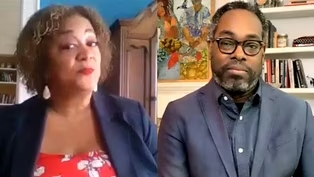
Video has Closed Captions
Clip: S49 Ep23 | 9m 58s | Detroit Future City Report | Episode 4923/Segment 1 (9m 58s)
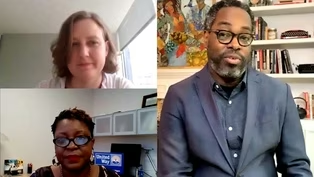
Video has Closed Captions
Clip: S49 Ep23 | 10m 29s | Discover Your Spark | Episode 4923/Segment 2 (10m 29s)
Providing Support for PBS.org
Learn Moreabout PBS online sponsorship
- News and Public Affairs

Top journalists deliver compelling original analysis of the hour's headlines.

- News and Public Affairs

FRONTLINE is investigative journalism that questions, explains and changes our world.












Support for PBS provided by:
American Black Journal is a local public television program presented by Detroit PBS