
Detroit Greenway, Flooding Aid, GDYT, Music for Ukraine
Season 6 Episode 20 | 26m 46sVideo has Closed Captions
Detroit Riverfront Greenway, Flooding Aid, Grow Detroit's Young Talent, Music for Ukraine
This week, One Detroit takes viewers to the groundbreaking of an $8-million greenway project that will connect Detroit's southwest side with the city's riverfront. Then, One Detroit contributors Stephen and Nolan discuss flooding relief for the city's residents. Plus, the Grow Detroit's Young Talent jobs program is back, and two Michigan students show support for Ukraine through their music.
Problems playing video? | Closed Captioning Feedback
Problems playing video? | Closed Captioning Feedback
One Detroit is a local public television program presented by Detroit PBS
Detroit Greenway, Flooding Aid, GDYT, Music for Ukraine
Season 6 Episode 20 | 26m 46sVideo has Closed Captions
This week, One Detroit takes viewers to the groundbreaking of an $8-million greenway project that will connect Detroit's southwest side with the city's riverfront. Then, One Detroit contributors Stephen and Nolan discuss flooding relief for the city's residents. Plus, the Grow Detroit's Young Talent jobs program is back, and two Michigan students show support for Ukraine through their music.
Problems playing video? | Closed Captioning Feedback
How to Watch One Detroit
One Detroit is available to stream on pbs.org and the free PBS App, available on iPhone, Apple TV, Android TV, Android smartphones, Amazon Fire TV, Amazon Fire Tablet, Roku, Samsung Smart TV, and Vizio.
Providing Support for PBS.org
Learn Moreabout PBS online sponsorship- One, two.
- [Announcer] Just ahead on, One Detroit, a new multi-million dollar Greenway, will connect residents in Southwest Detroit, to the city's riverfront.
Plus, Steven Henderson and Nolan Finley, discuss the situation for Detroiters, who suffered major losses from last year's floods.
Also ahead, the city of Detroit's summer jobs program, is gearing up to put thousands of teens and young adults to work.
And make music, not war.
Two musicians from Russia and Ukraine, come together to promote peace.
It's all coming up next on One Detroit.
- [Narrator] From Delta faucets to Behr paint, Masco Corporation, is proud to deliver products, that enhance the way consumers all over the world, experience and enjoy their living spaces.
Masco, serving Michigan communities since 1929.
- [ Narrator] Support for this program is provided by, the Cynthia an Edsel Ford Fund for Journalism at Detroit Public TV.
The Kresge Foundation.
- [Program Narrator] The DTE Foundation, is a proud sponsor of Detroit Public TV.
Among the state's largest foundations committed to Michigan focused giving, we support organizations that are doing exceptional work in our state.
Visit DTEFoundation.com to learn more.
- [Program Narrator] Nissan Foundation and viewers like you.
(hip synth music) - Just ahead on this week's One Detroit, rainy weather is coming, and some Detroit residents are still cleaning up from last year's floods and waiting for financial assistance.
Steven Henderson and Nolan Finley, debate the current state of the city's infrastructure and the denial of damage claims.
Also coming up, the city of Detroit is planning to match 8,000 young people with employers this summer, for work opportunities.
American Black Journal, gets the details on this year's, grow Detroit's Young Talent program.
Plus, we've heard it said that music soothes the soul during troubled times.
In the midst of the Russian-Ukraine war, a University of Michigan music student from Russia is encouraging hope and unity, by teaming up for a special performance, with a Ukrainian musician.
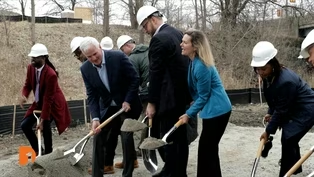
(music sounds) But first up, the groundbreaking for Detroit Southwest Greenway, the nearly one mile path, will connect the Detroit riverfront to the Michigan Central District and southwest Detroit neighborhoods.
The $8 million project, is led by the Detroit Riverfront Conservancy and the Greenway is expected to open in the fall.
One Detroit contributor, AJ Walker, was there for the start of the work on the long awaited project.
(slow beats music) - One, two, three.
- Woo!
- Enjoy the riverfront!
- Today's a big day.
We promised you we're gonna get west, and here we are.
So thank you for all your help here today.
(group cheers) - A day that has been several years and millions of dollars in the making.
The groundbreaking ceremony of Southwest Greenway.
The project will span from Bagley to Jefferson.
- This is gonna connect the river to everything taking place in Southwest Detroit, not just Michigan central and the great project of four holmes, but to all the Southwest Detroit, Mexican town, court town, the vibrant neighborhoods over here.
And it is really gonna bring this spectacular waterfront and connect it into the neighborhood.
So this will be the Dequindre Cut for the west side.
And it's gonna be not, not just the connector, but a place that people can enjoy just being out here.
The, you know, he resident neighborhoods and the commercial and that kind of thing.
They can enjoy it every day of the year.
- Matthew Cullen, chairman of the Detroit riverfront Conservancy, is a part of the team that has made this dream a reality.
- I think for me personally, it will be just connecting the neighborhoods of Southwest Detroit.
It's our most dense and most vibrant neighborhood in the city.
And for decades, they've had no access to the water.
They literally couldn't get to the water, because of the industrial buildings or the railroads or all of those kinds of things.
And now because of the hard work of a lot of people, we're gonna be able to bring everybody down to the waterfront and have them enjoy the best asset we have in the city of Detroit.
- The Southwest Greenway, wasn't originally part of the plans to connect Detroiters to the riverfront.
Cullen says that came about after hearing from the community.
- When we started our vision, what we thought was pretty bold and audacious all by itself.
We were gonna go from the former Joe Lewis arena site, all the way to Belle Isle, three and a half miles in the middle of one of the biggest urban areas in the United States.
We, you know, we thought that was pretty powerful, but almost immediately, our friends from Southwest Detroit said, "Hey, that's really cool.
We really like that vision, but what about us?"
We immediately went back to the drawing board and even though we weren't really sure how we were gonna pull it off after a number of community meetings, a number of different outreaches, we really concluded that we needed to do that.
And so we, we broadened our vision to five and a half miles, bridge to bridge.
- One of the things that we want to do, is not only have this be the best river front for the city, but also the best river front for Detroiters.
And that really means including and ensuring, that every Detroiter feels that this is their riverfront.
And I think this is going a long way, towards making that a success.
- Antoine Bryant, director of planning and development for the city of Detroit, says getting to this point was not without challenge.
- The biggest problem was assembling all the land, making sure we had to address several different owners, to put it all together.
That took over five years.
Now that we got that part, during that effort, we also were very intentional, to ensure that the residents were part of this discussion, to making sure that this is a collaborative thing.
And we've been very, very, I think, successful, to show the inclusion of all of our residents in the Mexican town and in Corktown.
And as you heard, and as we'll begin to see upon its opening, that this will be an opportunity just for Detroiters.
And that's something that we're really excited about.
- Under this tent, spectators who came to cheer on the groundbreaking and those who have been rolling up their sleeves for years to make it all happen.
- If it wasn't for all of you, we would not have this desire, to want to change Detroit like we have.
- Mary Culler, chair of Michigan central, says that there's still more work to be done.
- Even if you're someone who isn't, you know, able to get on a bike, who isn't able to walk, but wants to actually enjoy the Greenway, we wanna work on those mobility solutions, to actually give them access to the Greenway.
So that's gonna be part of our role as well, is to take our innovation district and to invent, to come up up with those pilot projects, that we're gonna actually be able to test safely on the Greenway.
We're very excited about that.
- The Detroit riverfront Conservancy and its community partners, say they're ready to put in that work.
- We're confident it's gonna become just as important, on the west side and generate just as much community love, as the Dequindre Cut has.
- The Detroit front means a great deal to a lot of people.
And this was evident last year when USA today, declared us the best river walk in America.
And I have to agree with them.
(crowd clapping) We won that award, not because we're the most expensive river walk or because we're the fanciest river walk or because we're the biggest river walk, we received that recognition because people love their Detroit riverfront.
And we're building on that.
- Cleanup from last year's flooding is still underway for some Detroit residents and many have paid out of their own pockets, to repair the damage.
The Detroit free press reports nearly 39,000 households in the city, have received federal aid, but thousands more have been denied or are still waiting to hear about their claims.
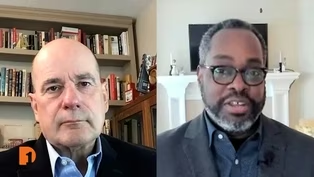
Nolan Finley of the Detroit news and Steven Henderson of American black journal, sat down to talk about the relief for flood victims, the city's infrastructure and the risk of heavy rains in the future.
(slow beats music) - So Nolan, on top of all of the incredible loss, that Detroiters suffered last year, 'cause of the storms and the floods that got into their houses, were now learning that a lot of 'em didn't get the federal relief that was supposed to get to them, through the city.
That a lot of 'em are covering these cost themselves or letting insurance, which is not, as much of a payout, do it.
It is insult to injury in a way that we rarely see happen in real life.
And I just cannot, I can't imagine for those folks who lost so much in those floods, that they're not gonna get the reimbursement that the federal government is trying to get to 'em.
- And they truly aren't.
Many of them caught in a bureaucratic nightmare.
Now a lot of people haven't gotten settlements.
Haven't gotten money either through FEMA or through the Great Lakes Water authority, but you know, the catch 22 here is if you had insurance, if you've got flood insurance, only part of your claim is covered or perhaps not of it all.
A lot of these claims are being denied , because you had some insurance.
So, you know, you have people talking about 30, $40,000 worth of damage in their basement and still can't get relief.
There's something on the order of 10,000 FEMA claims still waiting and 40,000 separate claims, I believe, before the great lakes water authority, which is, you know, it's position is, if your basement was flooded because a pump failed, you are eligible or may be eligible.
If it, your basement flooded just because the rains were heavy, you're, that's not the Great Lakes Water Authority position.
And navigating sort of all of these ins and outs, of try to get assistance, very difficult people.
And meanwhile, many of 'em still have horrible damage to their homes.
- Yes.
Especially over on the east side, of course, where the damage was worse.
There are still people who are cleaning up from all of the stuff that that happened.
It's not as if this is something in the past.
And then if you think about the calendar, you know, spring, it's gonna be summer.
The chance of more of these storms.
- Yeah.
- Is really, really high.
And can you imagine having to go through it all again?
I think that because I believe that this is, you know, a function of climate change, in some form.
I think we're gonna have to rethink the way we deal with a number of these things, right?
This whole I idea of flood insurance has to be re revisited, the way that we hold government authorities responsible for their end of it.
You know, They was saying that if a pump doesn't fail, somehow it's not their fault, but the truth is, it's the the storm sewers and the regular sewers that are old and backed up that also contribute to the flooding.
It's not just the pumps.
And then this whole idea of where people live in this community.
And how much of the properties in Metro Detroit, are in flood Plains.
We've on some things to dry 'em out, so we could build housing, but we have not eliminated the threat of this kind of thing, especially given what the weather is.
You're talking about another major investment, to make sure that people's houses don't flood, when we get these storms, which I think is gonna be a much more regular part of life.
- No matter what we do, in terms of combating climate change, this is a very long term prospect.
If we can do it at all.
So we're going to have to start focusing on adapting and where we build homes, not just in Metro Detroit, but look at Florida.
I mean, we've built homes in places that should be swamps and Everglades, along coasts, not along the Great Lakes coast, along the Atlantic and Pacific coast, where water is expected to rise.
Similarly, you know, Las Vegas and other places in other desert communities, where people weren't meant to live and the demands of air conditioning as temperature rises, it's going to become prohibitive.
We've gotta rethink how much those areas continue to grow.
We also have to talk about how we build our houses.
If you're using your basement as a living space, extra living space, as a lot of people are, going to have to have some pumps with backup power, to keep that water outta your house and, you know, take it from somebody who's lived through a few basement floods.
You probably, unless you have that, you probably don't wanna put a whole lot of stuff you care about, in that basement, because you're gonna have floods here.
- The big cost of repairing the infrastructure that we're talking about.
- Yeah.
- Is the other thing that's looming in the background.
Last summer, I can't remember which official It was, said that the number was approaching $17 billion.
Some people knocked that down and said, "well, it's only $5 billion."
But really when you're talking about that kind of money, what's the difference in this community?
I mean, raising that kind of capital to reinvest in infrastructure, is something we've never been able to convince people to do, either through the cost of their water bills or through some sort of other assessment.
I mean, it's.
- Well, it's there now.
I mean, we are awash infrastructure money.
And I think the governor, I know the, the governor is dedicated to this.
- Some of it will go to this.
Yeah, yeah.
- The governor has dedicated some money to fixing those pumps, which are on the freeways, which is essential to keep the freeways from flooding.
We also need to look at what it's gonna take to move water outta residential areas.
That money is there now in a way it'll never be the there again, I wouldn't expect.
And so maybe they make a grant.
Maybe they start offering grants for people in flood Plains and susceptible areas to install pumps and back up power.
I mean, this, I covered basement floodings 30 years ago as a reporter or 40.
And you know, this has always been of with us.
It's gonna get worse and it's always gonna be with us.
Let's start thinking about how we prevent the damage, rather than paying for the damage after it occurs.
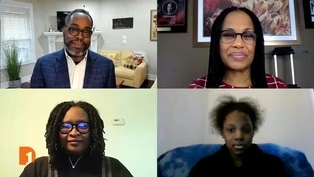
- Each year, the grow Detroit's young talent program, provides summer jobs for young people, ages 14 to 24.
Employers partner with the city to offer both in person and virtual work experiences.
And the young people learn skills that will help them advance in their future careers.
As part of Detroit public television's future of work initiative, American black journal, Stephen Henderson, spoke with two people connected to the program.
Along with a past participant.
(slow beat music) - This will be the eighth year, of Grow Detroit's Young Talent.
What have we learned about how important these kind of opportunities are for young people in our city to get?
- Oh my goodness, giving young people an opportunity to explore careers, is just priceless.
Young people, 14 to 24, can do anything, if they really see that there's true opportunities, and then we give them pathways.
So what we've learned over these, you know, eight years, is that young people are really interested in learning about pathways and careers and opportunities and what it takes to actually be successful in areas that they never knew anything about.
What I really, really enjoy and think is valuable about GDYT, is that young people can play in a space safely, and if they don't like it, they can choose something else.
You know, a lot of times we get older, we spend money on tuition and college, and then we realize, Oh Oh, this is not what I'm really interested in.
So this is career exploration 2.0 and young people are talented and they have so many options.
And this program really gives 'em a chance to do it in a safe space with meaningful adults and earn money to do so.
- Shuna, I wonder if you can talk about, from a little bit, from the employer side, the kinds of places that are participating and what they're getting out of all of this.
- Right.
It really is a partnership, a group effort to make the program work.
We have community based organizations, nonprofits, that wrap their arms around young people and get them ready for these experiences.
And then we have our private sector employers, that are ready to embrace and take young people in and offer them, as Stephanie was saying, the exposure to what it's like to really be, in a work setting, to have a boss, to have a supervisor, to have to be somewhere on time, all of those pieces.
And so, we work hard to match young people to things that they're interested in.
So if you want, want to be a lawyer, then we wanna connect you with the law office.
If you wanna explore trades, then we wanna connect you to some training and experiences in the area that you're interested in.
If you're interested in nonprofits or community work, community development.
So because of the wide range of support that we have in the community, we're able to offer young people an equally wide range of experiences.
- So Jocelyn, this is all about you and other young people like you, in our city.
So I'm really eager to hear what this experience was like for you.
Let's start with where you worked and why you chose that place to spend your summer.
- I worked throughout GDYT, I worked through the healthcare program and I chose that because what I want to do when I get older, is relating to that.
So like, when I get older, I want to become a radiologist.
And I chose that throughout the GDYT, is because it would help me gain communication skills, when I go to that certain field.
And also it taught me pros and cons in the healthcare field, that would help me decide on where I wanted to go in the career field.
So yeah.
- So, tell me what that first day of work, was like for you.
Most of us can remember our first days of work.
We were probably a little older than you were, when we went and did it.
Were you nervous?
Were you excited?
How did that feel?
- I was excited because it was my first year doing GDYT, but I was also kind of scared because, I didn't have any friends to do it with, but I knew that I could meet new people to do it with.
So that's what helped me throughout the GDYT experience.
- Stephanie, when we think about programs like this, I think it's useful in some ways, to think about outcomes and hope for outcomes, and then how close we come to reaching those outcomes.
Give us a sense, after eight years, of what kind of outcomes we're seeing long term, with the people who participate and whether they're measuring up to what we thought might happen.
- Well some of the things that we we look for is that young people do connect beyond GDYT, to permanent opportunities.
Either they go on to post-secondary or they go into permanent work opportunities within the career path that was best for them, from their experience with GDYT.
We see that young people are retaining these opportunities.
They're going back to school.
They are likely to take their SATs and ACTs.
We've seen where there's some math scores, we've seen a difference in people, young people just understanding the importance of education and why, you know, why do I need to learn how to do algebra?
Well, there's some careers where algebra, kinda is beneficial.
So we start, we talk about contextualized learning.
So I think that retention in school and seeing the importance of education and remaining all the way through to graduation, is, those are some of the things that we're seeing.
And we we're looking forward to, over the years, young people coming back, being mentors, talking about their experiences.
Jocelyn, we hope you'll come back and talk to young people about your experiences and just encouraging them to continue.
So, yes Steven, retention in school, high school, going on to post-secondary and then employment opportunities.
And what we see as a participation rate, that's above 80% every year.
So young people are sticking and staying, and that's important, particularly, what we had to go through over the last two years with COVID and the virtual experience, young people are staying with us and just really just sticking and staying and moving into career pathways, to be the feeder to the workforce of the future.
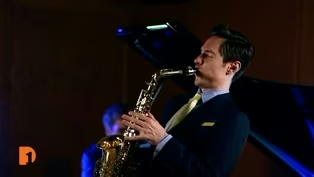
- A Russian saxophonist, is using music to promote solidarity and hope in the midst of the Russia/Ukraine war.
Valentine Kovalev, is studying for his master's degree at the university of Michigan school of music, theater, and dance.
He turned to his Ukrainian friend and pianist, Alexander Polyakov, to join him for a performance of the great gate of Kyiv.
(slow beat music) (Piano and saxophone playing) - I'm studying here for my master's degree, at University of Michigan school of music, theater, and dance.
I am a Russian saxophonist with deep Ukrainian roots.
And for me, it's very important to show, as a sign of solidarity with Ukraine, that we are, as Russian citizens, we are against of this war, and it's not our decision to invade this beautiful country, which I visited many times before.
(saxophone and piano playing) And the whole idea of me doing something about this, came to me when at first I read than news online, I was so terrified and so frustrated about this situation.
So I called my friend, Ukrainian friend, pianist, who is studying here for conducting and together we decided to play something and recorded.
So it was great Gate of Kiev, at the last movement of pictures, at an exhibition by Modest Mussorgsky.
So together we recorded that piece, as a sign of kind of a friendship in between Russians and Ukrainians, that we used to, and we will make music together, not war.
(piano and saxophone playing) This is one of the most famous works by Modest Mussorgsky.
And this is the last movement of the piece.
This piece has lots of imitations of bells.
And those bells for me represent the hope for brighter future for all of us.
(piano and saxophone playing) But the fact that we are playing it together, Russian and Ukrainian Citizens, and he was actually born in Kiev, my friend, pianist.
So we have a lot of connection towards this piece, and we feel this is very important to bring it to life.
(piano and saxophone playing) - That will do it for this week's, One Detroit.
Thanks for watching.
Make sure to come back for One Detroit arts and culture, on Mondays at 7:30 PM.
Head to the One Detroit website for all of the stories we're working on.
Follow us on social media and sign up for our weekly newsletter.
- From Delta faucets to bear paint, Masco corporation, is proud to deliver products that enhance the way consumers all over the world, experience and enjoy their living spaces.
Masco, serving Michigan communities since 1929.
- Support for this program is provided by, the Cynthia and Edsel Ford fund for journalism at Detroit public TV, the Kresge foundation.
- The DTE foundation, is a proud sponsor of Detroit public TV.
Among the state's largest foundations, committed to Michigan focused giving.
We support organizations that are doing exceptional work in our state.
Visit DTE foundation.com to learn more.
- Nissan foundation and viewers like you.
(Slow beat music)
Detroit Greenway to Connect Southwest Detroit to Riverfront
Video has Closed Captions
Clip: S6 Ep20 | 5m 12s | AJ Walker takes viewers to the groundbreaking of a greenway path on Detroit's riverfront (5m 12s)
Grow Detroit’s Young Talent Summer Jobs Program
Video has Closed Captions
Clip: S6 Ep20 | 6m 43s | ‘Grow Detroit’s Young Talent’ jobs program benefits youth, employers and the city (6m 43s)
Russia, Ukraine Students Perform 'The Great Gate of Kyiv'
Video has Closed Captions
Clip: S6 Ep20 | 3m 5s | University of Michigan students perform 'The Great Gate of Kyiv' for Ukraine Benefit Show (3m 5s)
Some Detroiters Are Still Waiting for Flooding Federal Aid
Video has Closed Captions
Clip: S6 Ep20 | 6m 59s | Stephen and Nolan discuss flooding relief and federal aid for Detroit homeowners (6m 59s)
Providing Support for PBS.org
Learn Moreabout PBS online sponsorship
- News and Public Affairs

Top journalists deliver compelling original analysis of the hour's headlines.

- News and Public Affairs

FRONTLINE is investigative journalism that questions, explains and changes our world.












Support for PBS provided by:
One Detroit is a local public television program presented by Detroit PBS