
Detroit Jazz City/Beacon Park Exhibition
Season 4 Episode 31 | 26m 46sVideo has Closed Captions
Detroit Jazz City/Beacon Park Exhibition | Episode 431
Beacon Park manager Meg Heeres and Detroit Artist Jon Harris talk about the Bonded Art Exhibition. A first glimpse of the first 5 minutes of “Detroit Jazz City,” the upcoming half hour DPTV documentary. A dive into the origins of Coney Island restaurants. Episode 431
Problems playing video? | Closed Captioning Feedback
Problems playing video? | Closed Captioning Feedback
One Detroit is a local public television program presented by Detroit PBS
Detroit Jazz City/Beacon Park Exhibition
Season 4 Episode 31 | 26m 46sVideo has Closed Captions
Beacon Park manager Meg Heeres and Detroit Artist Jon Harris talk about the Bonded Art Exhibition. A first glimpse of the first 5 minutes of “Detroit Jazz City,” the upcoming half hour DPTV documentary. A dive into the origins of Coney Island restaurants. Episode 431
Problems playing video? | Closed Captioning Feedback
How to Watch One Detroit
One Detroit is available to stream on pbs.org and the free PBS App, available on iPhone, Apple TV, Android TV, Android smartphones, Amazon Fire TV, Amazon Fire Tablet, Roku, Samsung Smart TV, and Vizio.
Providing Support for PBS.org
Learn Moreabout PBS online sponsorship- Hey, I'm Christy McDonald.
And here's what we have coming up this week on One Detroit Arts and Culture.
A closer look at the role of women in the black church at the Shrine of the Black Madonna in Detroit.
Plus a juried art show this week at Beacon Park in Detroit.
Also ahead to try jazz city, the history of jazz here and the impact felt today.
And you can fight over your favorite, but we'll give you the straight up history of Detroit's Coney craze.
It's all coming up this week on One Detroit Arts and Culture.
- [Speaker 1] From Delta faucets to Behr paint, Masco corporation is proud to deliver products that enhance the way consumers all over the world, experience and enjoy their living spaces.
Masco, serving Michigan communities since 1929.
- [Speaker 2] Support for this program provided by, the Cynthia and Edsel Ford fund for Journalism at Detroit Public TV.
The Kresge Foundation, Community Foundation for Southeast Michigan.
- [Speaker 3] The DTE foundation is a proud sponsor of Detroit Public TV, among the state's largest foundations committed to Michigan focused giving.
We support organizations that are doing exceptional work in our state.
Visit DTEFoundation.com to learn more.
- [Speaker 2] Business leaders for Michigan.
Dedicated to making Michigan a top 10 state for jobs, personal income and to help the economy.
Also brought to you by, the Fred A. and Barbara M Erb Family Foundation.
and viewers like you.
(upbeat music) - Hi and welcome to One Detroit's Arts and Culture, I'm Christy McDonalds.
So glad that you are with me this week.
Well, while we are all staying safe and masking up more arts and culture events are starting to happen around the area as the weather gets better.
Coming up, art in Beacon Park this week, one Detroit's, Will Glover fills us in.
Plus April is jazz appreciation month.
So we do a historical dive into Detroit jazz legacy.
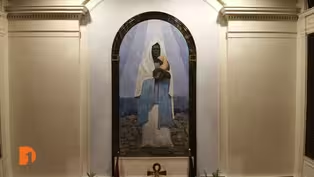
Then this artwork of a black Madonna holding baby Jesus shocked the world when it was unveiled over 50 years ago in Detroit, but you'll hear the story of how it represents the power women hold in the black church.
It's a special series from American Black Journal.
And we'll wrap it all up with probably the most unique Detroit meal, Coney dogs.
We'll give you the history of how the Coney craze started here in Detroit.
It is all just ahead.
But we are starting with an outdoor art exhibit heading to Beacon Park this weekend.
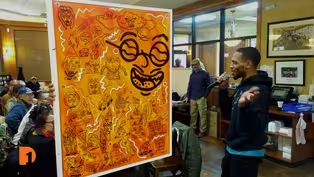
It's a juried event from multiple artists from painting to photography to prints.
One Detroit's, Will Glover has more.
- Meg we can get started with you.
What is the event?
Where is it?
When is it happening?
- Yeah, great.
It's at Beacon Park, which is at the corner of Grand River and CAS in the Western side of down Detroit.
And we're excited to kick it off on April 23rd from six to 9:00 PM for an opening exhibition.
And then the 24th and.
25th, it'll be open from 12 to 7:00 PM.
And it's outdoors.
It's gonna be outdoors in an open air tent and welcome, it's free and open to the public, open to all ages and just really excited to have a safe outdoor space to share some art.
- And safe is probably one of the key words for everybody these days.
So what are... What have been some of the challenges and what are some of the things that you guys are doing to take precautions as far as COVID?
- Yeah.
- No, I appreciate that.
So since, you know, since the pandemic started the park has been open and we've really strived to do events that are safe and also people really need a respite and need some joy and need to... Can gather outside safely.
And so what we ask when people come to Beacon Park they show up healthy.
They show up, you know, with clean hands, all the good practices.
Also we require masks.
Even though you're outdoors, we ask that people have a mask on that are able to, and then also, you know keeping socially distanced.
And we'll set the space up in a way that people can safely navigate throughout it and can keep a distance from each other.
- Jon, it's come to my attention that you were somewhat of the catalyst for this art exhibition happening.
So tell me a little bit about how this came about and you know why Bonded as the title for this exhibition?
- I chose the title Bonded with Mic because we wanted like a strong word that will bring the city together and bring artists together and collectors together where everybody could just meet at like this one point, which is art.
And it'd be positive and safe.
I had this idea very early on when the pandemic had first started last year.
This exhibit it started only with four artists, me and three of my friends.
So while we were planning the exhibit, we had the idea to add more artists and now it went from four artists to over 20 artists from the local Detroit area.
A lot of artists I had never even known.
They just reached out to me and we made it happen.
- Who are some of the artists that we're gonna to see?
And what kind of styles are people gonna encounter as they make their way through this exhibit?
- Some of the artists that you you'll see are guys like Javier Gonzalez, (mumbles) Priscilla Pipher, Zody Bowman.
It's just a lot of different types of styles and mediums of where we have people to work with acrylics.
We have people to work with oils.
We have photographers.
We have people who work with wool burning.
It's just a wide range of artists and art.
It's like a big gumball of art.
- Why is it important to keep art events and exhibitions and things like this going even in the face of a pandemic right now?
- I think, you know, when Jon first reached out to me and I knew he was connected to the Detroit's Fine Arts Breakfast Club, I really, really loved the work that the Detroit's Fine Arts Breakfast Club is doing.
And the fact that they're gathering inside this Coney Island, and haven't been able to do that because of the COVID conditions.
And the thing I love about the work that they're doing there is like really connecting collectors and artists and are hands-on, very physical way.
You need to be in each other's presence in order to do that.
And so it was really important for us to be able to support.
We're really committed to supporting local business.
We're really committed to supporting local artists as much as we can.
And so this was, I think a really great opportunity to be able to do that.
- As an artist, it's already kind of attached to sell art and so it gets our name out there.
And I feel like a lot of artists had a lot of momentum up until the pandemic, and I didn't want that to stop.
I wanted artists to actually keep that momentum even moving through the pandemic.
I believe that art is therapeutic not only for the artists, but also for the collector.
And I felt like this exhibit will be a real big creative like therapy session.
- Where can we go to find out who the artists are, get more information and how will people be able to support the artists that they do encounter?
- [Meg] You can always go to DTEbeacon park.com.
Also on our Facebook, the Beacon Park Facebook page on Instagram and Twitter.
All the handles that Beacon Park has.
That's a great way to find out who the artists are and also the hours of the exhibit.
So any of that information is at yeah, DTBbeaconparkpark.com.
Facebook is probably the best way, but if you're not on Facebook, definitely head to the website.
- Jon, what can we expect to see from the Detroit Fine Arts Breakfast Club coming up in the future?
- All right.
So we have a lot of breakfast club members taking part in this exhibit and they have a lot of beautiful work.
We have some very small pieces and we have some very large pieces as well.
This is a really nice gathering of people.
A really nice collection of work and a really good time.
- One of our shows here on Detroit Public Television is American Black Journal and it's hosted by Stephen Henderson.
this year on ABJ, they have a series looking at the history of the black church in Detroit.
This latest story looks at the role of women in the black church.
And their influence was depicted in a painting that shocked the nation when it was unveiled more than 50 years ago at the Shrine of the Black Madonna.
The portrait of a black Madonna and baby Jesus was not only a symbol of black liberation and power, it also represented strength of the black woman in the fight for equality.
- I call upon my brothers, I call upon my sisters.
Together, we can overcome evil and injustice in this world if we choose to act with courage and conviction.
- Women at a church have always been the backbone of the church.
But the backbone in the background.
And that's not where we are here.
- The church started in 1953 after our founder, Reverend Albert B. Cleage Jr. left the Presbyterian church, St. Mark's Presbyterian.
Because he felt like he didn't have the latitude to do the kind of social ministry that he wanted to do.
And in 1962, they purchased this building.
And it became since, United church of Christ.
And 67 with the unveiling of the portrait of the black Madonna also came the launch of black Christian nationalism, that was the movement that gave birth to black liberation theology and everything we know about that struggle.
- [Cynthia] I heard all sorts of pushback.
I heard "That's ridiculous."
I heard "Did you see she's so dark, she's ugly."
I heard "Well, what's that light-skinned man doing with that dark baby and child up in this church?
Everybody knows blah-blah-blah."
There was a lot of pushback.
But from then to now, it is amazing to see how many brown angels, brown Madonna's, brown Jesus are in churches from the storefront to the big cathedrals.
- Some churches, the Baptist churches, some what you call holiness or sanctified churches didn't allow women in the pulpit.
If a black woman was permitted to give the announcements for the church, she had to stand in front of the pulpit.
Not on the pulpit.
And you of hear black women preachers.
- It inspired a whole revolution of iconography, black iconography, not just religious but also cultural and social iconography.
So it had a tremendous impact on the the culture and the social force of black communities, white communities, all across the world.
And also he wanted to pay tribute to the role of black women in our historical struggle for freedom and justice and inequality, and who better to represent that than the mother of Jesus, Mary.
- [Cynthia] You know how they first started to talk about we as a community said, but we needed representation, right?
And so we wanted to see ourselves in various careers.
Well, what better to see yourself as?
- The mother of Jesus represents motherhood and the important role that women play in the family and the community.
But also, I think she's an example of our willingness to serve God.
So she represents that highest level of servant hood to be used as an instrument to do the work of God here on earth every single day.
- Amilka Kabral said you can judge people by how they value their elders and their women.
And people often think about that as, you know, value "Put her up on a pedestal, isn't she pretty, let's buy her something cute to wear.
Isn't she lovely?
I'll open the door."
I want a door opened, okay.
And I love it when my husband buys me something pretty.
But respect and making use of the talents.
If you don't fully make use of the talents of women, the community is forever robbed.
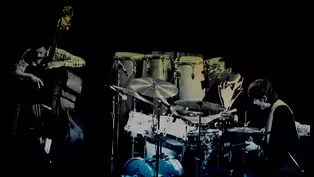
- April is jazz appreciation month, and Detroit is known as one of the richest jazz cities in the world.
Here's more on the history of jazz in Detroit from our documentary called Detroit Jazz City.
(jazz music) - [Mark] You can't tell the story of jazz in America without also telling the story of jazz from Detroit.
There are just too many musicians that have come from here that have made too big, an impact.
And the list of great musicians from here just goes on and on and on all the way up to the present date.
I don't think that Detroit jazz musicians have gotten their due as a group.
Until you put all of these musicians together, you don't really realize how profound an impact that the city has had on the course of modern and contemporary jazz.
- And if you just look at the list of artists and you're a jazz fan it's like, "Wow, all these guys are from Detroit?"
- When you can't pick up a record that was made on the East coast between say 1955 and 1970 and not run into one, two, three sometimes four or more musicians that are from Detroit.
- I would look through the records and find out that wow, Donald Byrd is from Detroit.
Oh, Tommy Flanagan, the great pianist is from Detroit.
Oh wow, the Jones brothers, Elvin Jones, Hank Jones and Thad Jones and someone like Ron Carter, who was someone who was really been a mentor to me, probably the most recorded bass player in the history of jazz is right here from Ferndale.
- [Joan] People don't realize the importance of Detroit jazz, you know.
Of course, you've got new Orleans, you got New York, but then there's Detroit, you know.
And it's just a little different, you know.
It's a little different, the expectation is higher.
When you say that you from Detroit, they expect you to be a bad ass.
(jazz music) - Why is it that this town of all cities would hire me?
Because I mean, it's out the way.
And why is it that it became the music center?
And I was talking to some people today.
Actually, I would say that when somebody wanted to sit down and write the history, they will find out that this town has produced more talent and musicians than any other city in America.
On a one-to-one basis.
You got more people that come out of Detroit that are in the music entertainment field and than other parts in the world.
- Jazz is an expression of African-American culture.
By 1950, 300,000 or so African-Americans are living in Detroit.
It's about 16% of the population.
You have to remember Detroit, the middle of the 20thcentury, in 1950, we're the fifth largest city in the country with 1.85 million people.
- Afro-Americans coming from the South.
You know, he was running from fields.
(laughs) Oh, at least we can work at the factory, oh that's like heaven, you know.
And they're getting a steady of paycheck and paycheck was, after a while became a really substantial.
So this became like one of the first middle classes.
You know, it was built from the auto industry being that they had good insurance, good pensions.
They couldn't do any wrong.
(laughs) - [Mark] The center of black life in Detroit in those days was paradise Valley.
There were scores of restaurants, clubs, hotels providing opportunities for live music and for musicians to make a living.
And, you know, musicians could work here and stay here and thrive here.
And those neighborhoods just walking down the street you could hear blues and jazz seeping out of windows.
This sort of thick haze of blues and swing just kind of would settle on street corners.
There was classical music in the community, gospel music in the community.
Detroit was a center for all kinds of musical activity.
You can't underestimate the way in which this culture was saturated with music and jazz is an expression of all of that.
- These places were significant.
And that it created a space for the African American community.
For musicians, for doctors, for lawyers, for families.
This was a place that was ours.
Something that was near and dear to the hearts of people.
It was a domain.
- The name musicians were working around here.
I'm talking about, like Charlie Parker, John Coltrane and those...
They will live in Detroit and we'll go to New York to record and then come back in and work (mumbles).
- [Linda] The Bluebird is where Dizzy Gillespie and miles Davis and others would come to play in the late 1940s.
And they'd play with the local talent who kept up with them.
In fact, inspired them.
And, you know, they brought this energy.
- And for more on Detroit Jazz City just head to onedetroitpbs.org.
And finally, we all love Detroit Coney dogs.
And we're all pretty particular when it comes to our favorite.
So we're gonna be totally neutral on this one and just give you the straight up history of Detroit's Coney craze.
Eric Smith brings us the story from our documentary "Detroit Remember When" made in the motor city.
- [Erik] The iconic brands of Detroit.
No, wait a minute.
This is Highland park.
So why start here?
Well, the city of Highland park is in the city of Detroit after all.
And this is where Henry Ford built his iconic model T. The very first affordable car for the working man.
And the guys working there of course had to eat something.
So when the Coney Island hot dog came along Borry had made a real splash.
And they made them right here, Red hots, Coney Island.
The model T plant was just up the street of course.
So lunchtime.
(chuckles) This was the perfect recipe.
Good bun, great dog, a layer of mustard and then the Coney sauce and some onions.
Oh Yeah.
Okay, if you haven't heard about Red Hots, I know you know about those two Coneys right there at Michigan and Lafayette.
The Lafayette and the American iconic motor city cuisine.
- [Grace] Iconic.
And I don't use that word very often cause some people overuse it, but it really is.
- [Erik] Grace Keros is the third generation owner of American Coney Island.
Grace's grandfather, Gus actually started it all down on Michigan Avenue back in 1917.
- He came from a place called Dara in Greece, little village out in the mountains.
Landed at Ellis Island, heard there were jobs in Detroit.
So he made his way to Detroit.
But in fact, couldn't get anything.
Well, he thought, well, "I'll start something on my own."
And right there on that same corner that we're at right now he started a little pushcart selling hotdogs and shining shoes and cleaning hats and popcorn.
- [Erik] Soon, Gus' brother Bill came over and joined him and they opened up a storefront and called it American Coney Island.
- It was a very simple lunch.
There didn't need to be a menu.
You could get a hot dog, chips, something to drink.
That was about it.
- [Erik] It wasn't long before brother Bill opened Lafayette Coney Island next door.
- These Coney Island's are running in the fastest growing city in the world.
- [Erik] But why are the restaurant's called Coney Island's?
Chili dogs too.
- Coney Island in New York is an amusement park.
It's not a food.
- [Erik] In New York.
Coney Island was known for Luna park, those bathing beauties, and hot dogs.
What Gus Cara saw was an opportunity knocking.
- [Grace] When he saw they had an amusement park, it made such a huge impact on him.
He was like, "You know what?
I'm in America."
Cause he's in America.
And he's so grateful and thankful for that.
American Coney Island and hence the name.
- [Erik] In Brooklyn, the got dirt dogs and sauerkraut, but not Coneys.
No, no, not like they make them here.
- [Joe] That sauce is very much like a Greek spaghetti sauce if you will.
And so we think they took a little bit of Greece, put it on a little bit of America and sold it.
- [Erik] Pure, Coneys can be found in other parts of the country if you wanna look hard enough these days.
There are many across Michigan, but nothing like well, the ones here in Metro Detroit.
Here, it's tradition.
And we have our own Coney decorum.
- [Grace] As a matter of fact, even today, when people ask for ketchup on a hotdog, I give them the bottle.
So you put it on.
We don't put ketchup on a Coney dog.
- No ketchup goes on and Coney.
The ketchup is only there for the fries.
- And it's always the dog.
Forget about the mustard and the Chili.
The dog makes the Coney.
- You don't fry a hot dog.
You don't steam a hot dog.
You don't boil a hot dog.
- Does it have skin on it?
You know does it break apart?
The ones with skin and casings on it, that's the Coney Island.
- It's a flat-top stainless steel grill.
And you just put them right on the grill, start cooking them until they start Browning and popping.
- [Erik] American Lafayette and other Coney Island's get their hot dogs, believe it or not from the same place, Dearborn sausage.
- We're a niche company.
And that's exactly what's... That's what we're there for.
You know, we, we do specialty things.
- [Erik] The maker may be the same but the hot dog recipes are different for the different Coney Island's.
- [Don] Everybody seems hey have a particular taste profile.
So you have to stick to what the customers are used to.
- [Erik] After the dog, of course comes the sauce.
- These are trade secrets.
We ask everybody for the recipe.
Nobody will give you the recipe.
- [Erik] Judith Martin, the famed miss mannerist gave it her best to follow the first rule of Coney Island etiquette.
- You don't need a Coney with a knife and a fork.
- [Joe] Judith Martin was an expert on manners, but she's no an expert on Coneys.
- You're supposed to pick it up with your hands and eat it.
- And I use an over and under grip.
And you come in like this on one end.
- But whatever falls falls.
- But if it's kinda messy you gotta kind of go all the way.
- Three bites and that's it.
- You know, a good Coney by how many napkins you use.
- [Erik] Coney Island history now includes Coney sprawl.
When some Detroiters headed to the burbs, well, they had to bring their Coneys right along with them.
- [Joe] One of the sons Tony carols decided he would leave the city and he started opening Coneys in the shopping centers.
- Pretty much every Coney Island and every person who started those stemmed from my grandfather.
Cause as soon as he started making money then he would bring over.
That's what we do.
You know, we're Greek family is so important.
- The whole Leo's chain, the biggest chain in the country, is descended by business from the Carol's family.
The Kirby's chain is related by blood to the Carol's family.
There are hundreds of Coney islands that you could trace directly to the corner of Michigan and Lafayette.
- There's tons of us.
There's a whole mess of us.
Absolutely.
- [Erik] All over in Southwest Detroit, there's still another classic Coney Island that dates back to the 1920s.
- Real person who understands Coneys, now this is difference between someone who really... Go to Duly's, over on Vernor.
- [Don] Now Duly wasn't Greek.
In fact, he came from Albania.
He passed away in the 1960s but Duly's place still makes Coneys.
- Now I love American and I love Lafayette but I spent many a day at Duly's, which is really like a small place.
- [Joe] Food critics, like the old fashioned kind of food critics who write for newspapers and magazines look down on Detroit signature food, because they think it's not sophisticated enough.
It makes us look like what we are.
A town where men and women work for a living.
- Love it.
And remember, don't use a knife and fork with your Coney.
That is gonna do it for One Detroit's Arts and culture.
Make sure you had onedetroit@pbs.org for all of the stories that we're working on.
And make sure you join me right back here on Thursday night at 7:30 for One Detroit.
I'll see you then.
Take care.
- [Speaker 4] You can find more @onedetroitpbs.org or subscribe to our social media channels and sign up for our One Detroit newsletter.
- [Speaker 1] from Delta faucets to Behr paint, Masco corporation is proud to deliver products that enhance the way consumers all over the world experience and enjoy their living spaces.
Masco, serving Michigan communities since 1929.
- [Speaker 2] Support for this program provided by the Cynthia and Edsel Ford Fund for Journalism at Detroit Public TV.
The Kresge foundation, Community Foundation for Southeast Michigan.
- [Speaker 3] The DTE foundation is a proud sponsor of Detroit Public TV among the state's largest foundations, committed to Michigan focused giving.
We support organizations that are doing exceptional work in our state.
Visit DTEFoundation.com to learn more.
- [Speaker 2] Business leaders for Michigan, dedicated to making Michigan a top 10 state for jobs, personal income and to help the economy.
Also brought to you by the Fred A. and Barbara M ERB Family Foundation and viewers like you.
(upbeat music)
Bonded - Beacon Park Art Exhibition
Video has Closed Captions
Clip: S4 Ep31 | 5m 35s | Bonded - Beacon Park Art Exhibition | Episode 431/Segment 1 (5m 35s)
Video has Closed Captions
Clip: S4 Ep31 | 5m 3s | Detroit Jazz City | Episode 431/Segment 3 (5m 3s)

Made In Detroit: Coney Island Craze
Video has Closed Captions
Clip: S4 Ep31 | 6m 41s | Made In Detroit: Coney Island Craze | Episode 431/Segment 4 (6m 41s)
The Portrait of a Black Madonna
Video has Closed Captions
Clip: S4 Ep31 | 4m 12s | The Portrait of a Black Madonna | Episode 431/Segment 2 (4m 12s)
Providing Support for PBS.org
Learn Moreabout PBS online sponsorship
- News and Public Affairs

Top journalists deliver compelling original analysis of the hour's headlines.

- News and Public Affairs

FRONTLINE is investigative journalism that questions, explains and changes our world.












Support for PBS provided by:
One Detroit is a local public television program presented by Detroit PBS