
Detroit Jazz Festival preview, artist-in-residence Joe Lovano performance
Season 11 Episode 10 | 26m 46sVideo has Closed Captions
A look at the changes, performers and poster for the 47th annual Detroit Jazz Festival.
We’re getting you ready for the Detroit Jazz Festival. We’ll talk with the Detroit Jazz Festival Foundation president about this year’s changes and the lineup. Plus, we’ll hear from one of the performers, meet the artist behind this year’s poster, and sit down with the festival’s artist-in-residence, saxophonist Joe Lovano. We’ll also feature a performance by Lovano.
Problems playing video? | Closed Captioning Feedback
Problems playing video? | Closed Captioning Feedback
One Detroit is a local public television program presented by Detroit PBS
Detroit Jazz Festival preview, artist-in-residence Joe Lovano performance
Season 11 Episode 10 | 26m 46sVideo has Closed Captions
We’re getting you ready for the Detroit Jazz Festival. We’ll talk with the Detroit Jazz Festival Foundation president about this year’s changes and the lineup. Plus, we’ll hear from one of the performers, meet the artist behind this year’s poster, and sit down with the festival’s artist-in-residence, saxophonist Joe Lovano. We’ll also feature a performance by Lovano.
Problems playing video? | Closed Captioning Feedback
Where to Watch One Detroit
One Detroit is available to stream on pbs.org and the PBS app.
Providing Support for PBS.org
Learn Moreabout PBS online sponsorship- Coming up on "One Detroit", we're getting you ready for the Detroit Jazz Festival.
We'll talk with the Detroit Jazz Festival Foundation's president about this year's changes and the lineup.
Plus, we'll hear from one of the performers and we'll meet the artist behind this year's Jazz Festival poster.
Also ahead, a conversation with the festival's artist-in-residence, saxophonist Joe Lovano.
And we'll end the show with a performance by Lovano and his band.
It's all coming up next on "One Detroit".
- [Presenter 1] Across our MASCO family of companies, our goal is to deliver better living possibilities and make positive changes in the neighborhoods where we live, work, and do business.
MASCO, a Michigan company since 1929.
Support also provided by the Cynthia and Edsel Ford Fund for Journalism at Detroit PBS.
- [Presenter 2] The DTE Foundation is a proud sponsor of Detroit PBS.
Through our giving, we are committed to meeting the needs of the communities we serve statewide to help ensure a bright and thriving future for all.
Learn more at DTEFoundation.com.
(lively music) - [Presenter 1] Nissan Foundation and viewers like you.
(upbeat music) - Hello, I'm Zosette Guir.
Just ahead on "One Detroit", it's all about the Detroit Jazz Festival.
This year's artist-in-residence, saxophonist Joe Lovano, talks about his musical connection to Detroit.
Plus, we'll have a special performance by Lovano.
But first up, a look at the changes, performers, and poster for the 47th annual Detroit Jazz Festival.
The music gets started on Friday, September 4th, and runs through Labor Day at Hart Plaza in downtown Detroit.
Some additional performances will take place at the Gretchen C. Valade Jazz Center at Wayne State University.
"One Detroit" contributor, Stephen Henderson, of "American Black Journal" sat down with the Detroit Jazz Festival Foundation's president and artistic director, Chris Collins, along with musician Sequoia Snyder, also known as REDWOOD, and this year's poster artist, Jocelyn Jo Lewis.
(soft upbeat music) - Let's start by talking about what's different about this year's festival and what people can expect.
- Yeah.
Well, somewhat, we're going old school a little bit.
We are consolidating the three outside stages, as I think most people know, on Hart Plaza.
- Mm-hmm.
- We have a great new footprint, expanded real estate, so we're... The capacities will stay the same.
The stages will stay the same, experience for artists and patrons, but we've done some amazing things.
Our production team packs it how with sound and engineering beautiful stages.
The new stage, which is overlooking the river, is just gonna be a spectacular environment.
And maintaining the intimacy of each stage even in a large setting, which is some really tough technical backflips.
- That's pretty hard, right?
- Yeah, it is, it is.
- Yeah.
- But it's worth doing because it's jazz.
- Yeah.
Who are the headliners that people should be looking out for, other than REDWOOD?
- Yeah, I was gonna say, (Stephen laughing) the beauty is it's, (Stephen laughing) the way I've always looked at music, everyone's a headliner.
- Yes.
(laughs) - I mean, there are aspiring artists that have established themselves to a degree and they're on their way to a new place, and Sequoia's a great example of that.
There are legendary artists of great Ron Carter and Dee Dee Bridgewater, Kurt Elling with the Yellow Jackets.
- Yeah.
- Kurt wrote incredible lyrics - Yeah.
- to like Jo Zawinul tunes - Mm-hmm.
- happening.
And of course our artist-in-residence, great Joe Lovano, who plays on opening night with his Paramount band, with Julian Lage.
And before that, opening the festival will be Shannon Powell will lead our youth in a traditional New Orleans thing.
- Mm-hmm.
- And then, we have Electric Miles, which is a bunch of alums from a Miles past group celebrating the 100 years of Miles.
And of course, we'll do something for Coltrane with our artist-in-residence at the end.
But it's a plethora of established artists and new aspiring artists.
And then, those from our youth programs, JC Heard JazzWeek All-Stars and the competition winners from our Youth Jazz vocal competition, - Yeah.
- Collegiate combo.
So, it's a taste for everyone and they wouldn't be there unless they were special.
- Yeah.
Yeah.
You know, I kind of think of the festival as a celebration of jazz, of course, but it's also a celebration of our place, Detroit's place - Mm.
- in the jazz world.
- Mm.
- And it reflects that every year.
It's like us kind of showing off a bit for everybody else.
- You got it.
And you have to ask yourself, what makes a culture?
And a culture is a living, breathing thing.
And in Detroit, - Yeah.
- this fact that Urban Center is a highly diverse population, amazing things have been happening here for longer than our lifetime.
- Mm-hmm.
Mm-hmm.
- The innovation and the opportunity to create at a very high level, to create ensembles, you can do that in Detroit.
But it feeds into the culture of who we are just as much as this program.
- Yeah.
- 60 years, Detroit Public Television and all the incredible legacies that make Detroit so very special.
We really want to be part of that invention and that forward movement of who we are as a culture.
And then, we get to show it to the whole world - Yeah.
- via live streams, 1.5 million people, 320,000 in person.
It's a real showcase for all of us, but it's really about sharing our culture.
- Yeah.
Yeah.
Sequoia, tell us about your music and your history here in Detroit, and how exciting it must be to be on the docket at the Jazz Fest.
- Yeah.
My history in Michigan started in college.
I went to Michigan State for my undergrad degree and my master's degree as well.
So, throughout that time, I spent a lot of time in Detroit as much as I could actually.
- Yeah.
(laughs) - I was in Detroit just trying to play, just trying to take in the wonderful culture, like Chris said.
And I don't think there's one single factor that's been more integral to my development as an artist.
So- - Than being in Detroit?
- Than being in Detroit.
- Yeah.
- Yeah.
Then, getting to play in Detroit, grow in Detroit.
I started my band here.
So, anybody who knows me knows how much I love Detroit.
I'm not from Detroit.
- Yeah.
- But I claim Detroit (Stephen laughing) as one of my hometowns.
- Yeah.
- I'm from DC, so obviously a huge part of who I am, but I mean, Detroit is the city for me that's supported me and taken me in since I was still a kid, basically.
- Mm-hmm.
Mm-hmm.
- So, it's super exciting for me to be able to bring my music to the Detroit Jazz Fest.
I've gotten the opportunity to play there several times, but this is like really special to me.
- Yeah.
- And the festival - Yeah.
- is always my favorite time of the year.
It's always one of my favorite experiences in the years I've been alive.
So, I'm just, I'm really excited, and yeah, grateful.
- Talk a little more about the music that you make, what inspires it, and why people love it.
(Stephen and Sequoia laughing) - Yeah.
So, as I said, I study jazz studies, Rodney Whitaker.
So, my music's coming out of jazz, for sure.
I love jazz music, but I also love all Black music.
I love all types of music.
So, there's a lot of... (soft jazz music) I came up listening to a lot of R&B, gospel, hip hop, (soft jazz music) even rock, which I'm getting a lot more into now.
So, I'm always just trying to make something that sounds and feels good.
- Yeah.
- [Sequoia] I don't think too much about I'm gonna make a jazz song.
I'm gonna make a, you know, I'm gonna make a fusion song.
But I do find that all these different elements come out in my music and I think people enjoy that.
So.
(chuckles) - Yeah.
Yeah.
Well, I mean, I think music is not a, you can't divide music into genres, right?
- Right.
- Music is music.
It's a language and you can kind of run across it with all kinds of different beats - Absolutely.
- and notes and things like that.
Yeah.
Jocelyn, Jo Lewis, you are the person who created the Jazz Fest poster this year.
- Yes.
- I should note that it is standing there.
And in a minute, I'm gonna ask Chris to have a big unveil - Yeah.
- of your work.
But talk about the, before we see it, - Mm-hmm.
- sort of who you are and how you kind of come to this work, this really significant work now with the Jazz Festival.
- Thank you.
I'm a Detroit native, born and raised.
Right now, I'm actually a student at Florida State University.
I'm getting my PhD in museum curation at the moment.
And a lot of my research is about Black culture and the Black history, - Mm-hmm.
- and all the different type of connections to the dysphorias.
So, I'm really interested in those things and it really does come out in a lot of my artwork - Mm.
- and how I approach this.
Usually I'm a fabric artist or mixed media artist, but this time, I wanted to have, again, like a more jazzy feel, like a total like abstract or semi-abstract.
So, I used a lot of different shapes and tried not to keep it so like figure-inclusive, just like going with the wind, and just feeling the embodiment of what jazz would be.
So, I'm really excited about the poster reveal.
- Yeah.
- Yeah.
- Let's go to the moment when you knew you were creating this for the Jazz Festival.
- Mm.
- What was kind of the first thought you had about what you wanted to capture - Mm-hmm.
- with that work?
- I think my first thought was the actual expression of what I think jazz feels like.
- [Stephen] Mm.
- I used to live in Brooklyn not too long ago and we would always go to jazz nights and being really encapsulated into the music.
And I really feel like jazz is like a thing you have to put your whole body into to express.
So, when I was making this piece, I really want that to come off into the piece.
Like the person is the music and expressing themselves.
- Yeah.
Yeah.
- Yeah.
- Well, that's a great introduction - Yeah.
(laughs) - to the unveil here.
Chris, do you want - All right.
- to do the honors?
- I am excited about this.
(Stephen chuckles) Super special.
- [Stephen] This is always my favorite moment on the show.
- Do we have a drum roll?
(Stephen laughing) - I know.
- Can we get the drummer?
- [Stephen] We don't have a good drummer here, I believe, yeah.
- Here we go.
(Stephen laughing) The 2026 Detroit Jazz Festival poster by the great Jo Lewis.
- Oh, look at that.
- Yes.
- Yeah.
- I love that.
- Yeah.
- My goodness.
I can see, of course, notes and instruments and people.
The person figure there is super interesting as well.
- Thank you.
- Talk us through, talk us through this poster.
- Yeah.
Like I stated before, I really wanted the person to be a part of the actual instrument, the music, the embodiment of the sound.
And so, a lot of these shapes go into each other.
They overlap.
They express some type of emphasis and they have a lot of sharp tones or a lot of different lines, - Mm-hmm.
- but also some curvature where it shows like the smoothness.
And yeah, I really wanted the person to be a part, very much a part of the sound.
- Yeah.
The person's kind of wrapped around all of the- - Yeah.
Yeah, I wanted the instrument to be with the person, like in the person, so yeah.
- Yeah.
Wow.
Ah, that's amazing.
- Yeah.
- Beautiful piece.
- Thank you.
- When you're making your art, how much does your history here in Detroit, do you think, influence what you're doing?
- Oh.
It influences it all the time.
- [Stephen] It does.
- A lot of my artwork is really much about Black culture and what we bring to the world.
- Yeah.
- And like how we express ourselves, our creativity, our beauty.
And I love to highlight that.
I really want my people and also Detroit people to see themselves reflected in my artwork.
- So, Chris, talk about the kind of state of the festival.
Things have changed a lot - Yeah.
- since the streaming, I feel like, has just kind of blown this up in a way that maybe we didn't expect.
- Yeah.
It was years, about 15 years ago, and we took some funds that somebody talked about doing a strategic plan.
I said, you know, - Mm-hmm.
- I've done a lot of strategic plans.
Let's get into this streaming thing.
And so, we developed (Stephen laughing) a great relationship with Detroit Public Television and others, and create, got through all the hardships of learning how to use technology.
So, by the time COVID hit, as you probably remember, we were the only festival.
- I remember.
- We did a 40-hour broadcast - Mm-hmm.
- on safe stages.
We built, I don't know, seven miles of fiber optics.
And then, now, we've curtailed it.
And so, it supports all of our international, we do international exchange programs, youth programs, and you can see all that culminate at the festival.
But the streaming has helped with 1.5 to 2 million viewers.
I think it's 30,000 watchable hours last year in 38 countries or something.
- Wow.
- It supports that.
And to your point earlier, it becomes another avenue for us to be ambassadors of this city - Mm-hmm.
- and for people to understand the beauty of Detroit and what's coming from here.
And that's so important.
And it's important because if you can't get to the festival or if you're accessible, if you have accessibility challenges, you have access to every single show.
- You can still be part.
- detroitjazzfest.org has all the information.
And in fact, the new footprint, the nice part is everything's on the same plane in Hart Plaza and you make your way up to the Valade Center in the evening.
It's going to be great.
But we also, because we're closing the festival to keep it secure, we're no longer allowing our coolers, which is a big change in our culture.
- Right, right.
- But it's a necessity in today's world, so we hope - Yeah.
- everyone understands.
But there are a few things like that, but for the most part, it's just gonna be a rock and a good time.
- Yeah.
- Starting Friday, September 4th, through Monday, September 7th, you can watch the free Detroit Jazz Fest live stream at detroitjazzfest.org.
Earlier this year, the Detroit Jazz Festival's artist-in-residence, saxophonist Joe Lovano, held a workshop for music students at Wayne State University.
He sat down with "One Detroit" contributor, John Penney of 90.9 WRCJ, to talk about growing up in a family of musicians and Detroit's influence on his career.
(saxophone music) - I'm here today with the artist-in-residence for the 47th Annual Detroit Jazz Festival.
Joe Lovano, it's a pleasure and an honor to be here with you.
And- - Thank you, John.
For me as well.
- Joe grew up in Cleveland in a very musical family, father being Big T, Tony, who played the saxophone, and his brothers, I guess, were also musicians.
You picked up a saxophone when you were six.
It was an alto, you had to grow into the tenor.
And your first teacher was your father.
And one of my favorite stories that you told once was how you were one day practicing scales (Joe laughing) and your father came in and said, "Play them like they're melodies."
- This one day I'm playing, I'm going up and down the horn.
It's like an exercise.
- [John] Right.
- And he's listening.
And he was upstairs.
He wasn't giving me a lesson at the time.
I was in the basement, practicing.
He comes down with his horn, and he said, "Oh yeah, Joey, yeah."
Mm-hmm.
And then, he took a major scale and he just played.
♪ Bo, wo, wu, wu, du ♪ ♪ Du, du, du, du, du, du ♪ ♪ Du, du, du, du, di, di, di, di, da, da, da, da, da ♪ ♪ Da, da, da, do, do, do, do, do, do ♪ He made it sound like a song.
(John chuckles) The same notes of the same sequence (chuckles) that I was running around the horn, you know?
And man, that changed everything.
And then, he just split.
(jazz music) - You, again, teach at Berkeley and you had a workshop with the kids here at Wayne State today.
What do you want them to take away from this workshop?
- Well, I just like to stress all the time about living in the library, the sounds and spirits of the masters on every instrument, no matter what your instrument is.
Anyway.
If the more you do that.
Standing next to stage.
You know where people are from, who they came up with, how old they were, a certain record you love or whatever, you know.
It's up to you to create how you discover things.
You know what I mean?
What influences and how your influences can take shape for your artistry.
- [John] The career has just been astounding and it's been a real pleasure to listen.
And you have really deep roots in Detroit.
- First of all, I'd just like to say it's a blessing to live in the world of music and put some ensembles together through the years and develop within the embrace of some amazing masters of the music.
And quite a few of them were Detroit masters.
The Jones family, Hank Jones, Thad Jones, Elvin Jones.
I had a chance to be a part of the Thad Jones/Mel Lewis band, and then the Mel Lewis band when Thad went to Copenhagen.
Played in the Elvin Jones Jazz Machine and toured Europe with him in 1987.
And then, he recorded with me on one of my Blue Note releases, Trio Fascination with Dave Holland on bass.
And then, Hank Jones documented some recordings on Blue Note.
- You first came to Detroit, I think in '74, I believe.
- 1974, I got the call from Dr.
Lonnie Smith, who was living around the corner from Baker's Keyboard Lounge.
He was looking for a tenor player and played in Cleveland with Lou Donaldson and had heard about me.
And someone gave him my family phone number and I got the call.
So, I flew to Detroit and started to play with him and that led to a lot of everything.
- Jason Moran talked about a particular Detroit sound.
He described it as like the Detroit bounce.
Is there a Detroit feeling?
- Well, the way I heard everything was through, it was a real like feeling in the beat and the harmony, and the execution of ideas that were personal.
There was a certain sweetness in the way cats played.
Also, it wasn't like an aggressive kind of approach.
(jazz music) - As the artist-in-residence this year, tell people what you're gonna bring to the festival.
- I'm gonna present my current quartet called the Paramount Quartet, with Julian Lage on guitar, brilliant young guitarist, Asante Santi Debriano on bass, who played a lot with Archie Shepp and Randy Weston and others, and Will Calhoun on drums, who's an amazing, explosive, beautiful musician man.
- What makes it the Detroit Jazz Festival?
What's unique?
I mean, is it unique?
What's- - Well, it's amazing to have like such an incredible venues to play at and have the audience and have it be a free open festival.
It's one of the most beautiful opportunities for all of us that are on tour all the time to see each other and hear each other and feel the beautiful space and the audiences here in Detroit that are so hip because of the history of the music here.
- That'll do it for this week's show.
Thank you for watching.
We leave you now with a performance by Grammy-winning saxophonist, composer, and producer, Joe Lovano, recorded at the Jazz Festival preview earlier this year.
(attendees clapping) (jazz music) (jazz music continues) (jazz music continues) (jazz music continues) (jazz music continues) (jazz music continues) (jazz music continues) (jazz music continues) (jazz music continues) (jazz music continues) - [Presenter 1] Across our MASCO family of companies, our goal is to deliver better living possibilities and make positive changes in the neighborhoods where we live, work, and do business.
MASCO, a Michigan company since 1929.
Support also provided by the Cynthia and Edsel Ford Fund for Journalism at Detroit PBS.
- [Presenter 2] The DTE Foundation is a proud sponsor of Detroit PBS.
Through our giving, we are committed to meeting the needs of the communities we serve statewide to help ensure a bright and thriving future for all.
Learn more at dtefoundation.com.
- [Presenter 1] Nissan Foundation and viewers like you.
(soft upbeat music) (bright piano music)
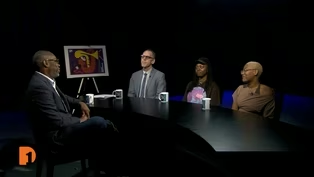
A preview of the 47th annual Detroit Jazz Festival
Video has Closed Captions
Clip: S11 Ep10 | 14m 30s | We’ll take a look at the lineup for the Detroit Jazz Festival and reveal this year’s poster design. (14m 30s)
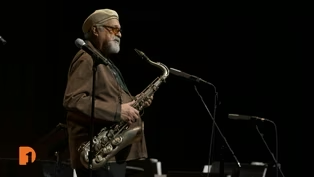
Sitting down with the Artist-in-Residence for this year’s Detroit Jazz Festival
Video has Closed Captions
Clip: S11 Ep10 | 6m 15s | Joe Lovano takes center stage as this year’s Artist-in-Residence for the Detroit Jazz Festival. (6m 15s)
Providing Support for PBS.org
Learn Moreabout PBS online sponsorship New Episode
- News and Public Affairs

Top journalists deliver compelling original analysis of the hour's headlines.
 New Episode
- News and Public Affairs

Today's top journalists discuss Washington's current political events and public affairs.
 New Season
 New Episode
 New Episode
 New Episode
 New Episode
 New Episode
 New Episode

 New Episode
 New Episode
Support for PBS provided by:
One Detroit is a local public television program presented by Detroit PBS