
Detroit NABJ 40th/Michigan Barber School 75th Anniversaries
Season 50 Episode 51 | 26m 46sVideo has Closed Captions
Comic author Saladin Ahmed, Soul Studio’s holiday market, and Artlab J’s winter gala.
The Detroit Chapter of the National Association of Black Journalists (NABJ) announced a yearlong slate of events to celebrate its 40th anniversary. Plus, the Michigan Barber School celebrates 75 years of teaching Black barbers and hairstylists.
Problems playing video? | Closed Captioning Feedback
Problems playing video? | Closed Captioning Feedback
American Black Journal is a local public television program presented by Detroit PBS
Detroit NABJ 40th/Michigan Barber School 75th Anniversaries
Season 50 Episode 51 | 26m 46sVideo has Closed Captions
The Detroit Chapter of the National Association of Black Journalists (NABJ) announced a yearlong slate of events to celebrate its 40th anniversary. Plus, the Michigan Barber School celebrates 75 years of teaching Black barbers and hairstylists.
Problems playing video? | Closed Captioning Feedback
How to Watch American Black Journal
American Black Journal is available to stream on pbs.org and the free PBS App, available on iPhone, Apple TV, Android TV, Android smartphones, Amazon Fire TV, Amazon Fire Tablet, Roku, Samsung Smart TV, and Vizio.
Providing Support for PBS.org
Learn Moreabout PBS online sponsorship- Just ahead on "American Black Journal," we're recognizing milestone anniversaries for two Detroit organizations.
I'll talk with a member of the local chapter of the National Association of Black Journalists about the big plans for its 40th year.
And the director of the Michigan Barber School is here to talk about 75 years of training barbers in Detroit.
Stay right there.
"American Black Journal" starts now.
- [Announcer] From Delta faucets to Behr paint, MASCO Corporation is proud to deliver products that enhance the way consumers all over the world experience and enjoy their living spaces.
MASCO, serving Michigan communities since 1929.
Support also provided by the Cynthia & Edsel Ford Fund for Journalism at Detroit Public TV.
- [Announcer] The DTE Foundation proudly supports 50 years of "American Black Journal," in covering African American history, culture and politics.
The DTE Foundation and "American Black Journal," partners in presenting African American perspectives about our communities and in our world.
- [Announcer] Also brought to you by Nissan Foundation, and viewers like you.
Thank you.
(upbeat music) (upbeat music) (upbeat music) - Welcome to "American Black Journal."
I'm Trudy Gallant-Stokes, sitting in for Stephen Henderson.
The Detroit chapter of the National Association of Black Journalists has kicked off a yearlong celebration for its 40th anniversary.
The chapter is one of the longest serving affiliates of the NABJ, which advocates for diversity in news rooms and news content.
The Detroit NABJ announced details for the commemoration during a press conference and reception at the historic William V. Banks Broadcast Museum and Media Center, site of the country's first Black owned and operated television station, WGPR, TV 62.
- Today, we stand in the museum that bears Mr. Banks' name, to celebrate our history, the history of the Detroit chapter of the National Association of Black Journalists, who have had the consummate job of covering a predominantly Black city for the past 40 years.
(audience applauding) - Through these 40 years, we have done wonderful things.
We've not only stayed true to our core mission of advocating for Black journalists and media professionals in metro Detroit, which has not only included offering them programming, but it's also included coming in to some of the newsrooms here to talk to management about issues affecting our members.
Sometimes those conversations have been tough, but they've been productive, and we like to think, fruitful.
- As you all know, in many cases, Black journalists have great passion for journalism itself, but they oftentimes have great passion for the community, and that comes through in your work, and it makes you the kind of person to be able to spend part of your career telling the story and part of your career shaping the story.
- The Detroit NABJ will hold a gala and silent auction as part of the anniversary festivities.
The organization also plans to award several scholarships to the next generation of journalists, as part of its commitment to Black excellence.
- We are a great organization that we are part of, we do a lot of internships, we do a lot of advocacy, we do a number of different things within the community and we are the front lines for journalism in the African American community.
- For diversity to be included in the media means so much to me.
When I go into the newsroom and I see people who look like me, it makes me feel comfortable.
- What I see the future of the NABJ is to continue to encourage us to celebrate who we are so we can tell the story that must be told from a unique perspective that comes from the richness of who we are as Black people.
- Nicole Avery Nichols is one of the co-chairs for the Detroit NABJ's 40th anniversary celebration.
I spoke to her about the organization's plans for the coming year, as well as its legacy providing services and programs for Black journalists.
Nicole, so great to see you.
This is exciting.
- Great to see you, also.
Great to see you, also.
So excited to have the opportunity to speak with you.
- So I don't even know if you know this, but I actually met Chuck, my husband, at a NABJ conference, a regional.
So this organization has long been near and dear to my heart.
So take us back 40 years.
How did things get started and then we'll come to the present and all the exciting things that are gonna be going on?
- Yes, so I just have to say, also, Trudy, that I met my husband, Darren Nichols, also through NABJ right here in Detroit on my first day of work at the Detroit News.
- Awesome.
- So we have that in common.
- A lot of media families in this community.
- Absolutely.
Absolutely.
So we are so thrilled and excited to be celebrating 40 years of Black media excellence here in Detroit.
The chapter was founded in 1982, right, so that's decades of really, really pouring in to this rich media landscape.
And it's one of the early, Detroit is one of the earlier chapters.
It's one of the biggest chapters across the country.
You know, we've had our ups and downs and our triumphs, but what we do have is just a legacy of folks who have come through this area, lots of African American firsts, lots of success stories have come through Detroit and those of us who came after, you know, I'm looking at myself in this market.
I said I met my husband on my first day of work in 1997, so that's mm, mm, two decades or so working in Detroit media.
Those of us who came to Detroit from other places have really benefited from the work of Detroit NABJ and its members all along in metro Detroit.
So we are so thrilled to share this year and next year more of our history.
- So who are some of the founding members, people that people may be familiar with from back in the day?
- Well, those are things that we're working on now, and doing some research and reconciling.
We are, Ken Coleman is our resident historian, and he's working on a project.
It's not that we're trying to keep it under wraps, but we would really like to roll this project out starting in September, where we highlight some of these key moments in Detroit NABJ history.
We wanna talk a little bit about the founders, we wanna talk a little bit about, you know, some of the first in this area.
We plan to do that twice a month, all the way from September until February, and we are working with, these things will be posted on our site, detroitnabj.org, and we are working with a local media partner on this, so you'll be hearing more about that as soon as we have that relationship formalized.
- Exciting.
That's something for everybody to look forward to.
People, you know, you hear about organizations like this, but I don't know if people understand the significance and the support that an organization like the National Association of Black Journalists, particularly going back 40 years ago, you know, there weren't that many African Americans in the business, so to have that camaraderie and that support, what would you say is the biggest impact in the early days?
- Right.
So I would say that I totally agree.
You know, with the framing of this question, and what you've shared there, and I think that that is something we should talk more about.
We all know that media is, you know, can be fickle, and it can be extremely hard for communities of color to make inroads into media.
After the murder of George Floyd, you know, we had what some might call a racial reckoning in this country, but those of us in media have seen this several times before, where we start talking about opportunity and diversity and equity and these things are on the top of everyone's mind.
You know, but those of us who worked in media for a long time, like those NABJ members who started 40 years ago, 30 years ago, know that these same conversations were happening back then and what an organization like Detroit NABJ does is make space, right?
So you have a built-in mentorship group, you have a built-in advocacy group, right?
A lot of time is spent advocating for African American journalists and Black communities, advocating to media companies for the recognition of issues that impact communities, or the way communities are portrayed in media.
You have mentoring, you have coaching, you have lifelong relationships through these organizations that enable and empower, right, and pour into its media members and give them the strength to walk into these spaces that, oftentimes, are not friendly, and are not really set up to accommodate or recognize, right, those journalists and their life experiences.
- Absolutely.
So as you mentioned, George Floyd is an example of a new story in recent years, but I'm thinking all the way back to Rodney King and things like that.
What were some of the other milestone news stories that really changed the way people looked at what journalists have do?
- Right.
So you know, you raised the touchstone for my generation, I'm a Generation X journalist, so before George Floyd, for me, it was Rodney King.
As a New Yorker, it was the teenagers, the young kids who were accused in Central Park, right, and just unpacking some of how the media swarmed on those children, right, and didn't tell a fuller story, or didn't attempt to.
Just, you know, took whatever the cops were saying and the people in power were saying at face value, that indicates, as things like Malice Green, et cetera, here in Detroit, the '67 riots in Detroit, and how, or the uprising, as we would say.
You know, those things indicate the need for, right, diversity of voice, diversity of lens, and oftentimes, what we see in media is when these things come to fore, come to bear, then you have doors opened, and more diversity, right?
But what happened in the 20 or so years between a Rodney King situation, right, and a George Floyd situation in media?
How I experienced it as a media member, first starting at the Detroit News, and then moving on over to the Free Press was a shrinking.
You know?
- Yeah.
- Yeah, a shrinking in terms of how diverse our staffs looked like.
- Absolutely.
So we're already into our last couple of minutes, and I wanna make sure that we highlight the wonderful things that are going to be happening throughout this yearlong celebration.
So just give us a few highlights.
You've already given us that one tidbit, which is exciting, that we'll be getting these historical pieces.
So what else will be going on?
- Yes, you're gonna wanna definitely plug in to our website, detroitnabj.org.
We will be doing the history facts there, as well, but starting on September 8th, we're launching what we call our If You Came Through, Come Through Campaign, right?
If you came through Detroit, come through for our scholarship fund, right?
This is all about, these efforts are all about celebrating but also giving back.
We plan to give an unprecedented amount of scholarship dollars this year.
Our target is 10.
We're seeking to raise $40,000.
So starting on the 8th, our t-shirt campaign will launch on our website.
It's $50 for any journalist whose come through Detroit, they have an opportunity to get their name on this commemorative garment, and we have a few more surprises in the fall.
However, the pinnacle, the marquee event that we're planning, we're thinking in spring 2023, is our gala roast, and we will be honoring and roasting the legendary Chuck Stokes.
- Awesome.
My hubby.
It's a wonderful.
- Absolutely.
- He's looking forward to it.
He's very excited about it, and I think it'll be a lot of fun for a fabulous cause.
- Absolutely, and you know, we are really serious about our journalism, we really pour into our newsrooms, broadcasts, our public relations business, et cetera, but we also like to laugh and have fun.
So we are just so thrilled that Chuck is gonna take this journey with us, and we are working on a date.
We're looking for sponsors.
All of that information will be up on our website.
- It's also a milestone year for the Michigan Barber School.
The school, located on Grand River Avenue in Detroit, is celebrating 75 years.
It was founded by businessman, Forrest Green, in 1947, as a place to prepare students for careers as barbers and stylists.
The school offers hands-on training, state of the art equipment, and access to some of the industry's top professionals.
I sat down with the founder's son and current director, Saul Green, to talk about the history and the future of the Michigan Barber School.
So let's go back to the beginning.
Started by your father, Forrest Green, and he came to Detroit, and he already had that heritage of the barber college from the South.
- That's correct, Trudy.
My dad is from East Point, Georgia, which is just outside of Atlanta, a suburb of Atlanta, and his father had a barbershop there in East Point as he was growing up.
And so, he learned the trade there in the barber shop.
My dad went on, went to Morehouse College there in Atlanta, and cut a lot of hair when he was in Atlanta, at Morehouse, cut a lot of the students' hair.
He often talked about the business he had going as a student, and so, there were very early roots.
And then, he was part of the Great Migration and came here in the mid-1930s to Detroit, after graduating Morehouse.
- So great opportunities in Detroit, I know, but still a lot of limitations back then.
What were the challenges that he faced when he came here?
- Well, first of all, his degree from Morehouse was in social work, so he worked for several different social work organizations in Detroit, found that it just wasn't quite what was exciting to him.
He still loved barbering and he was an entrepreneur, and so, he looked around, though, and he saw that the opportunities for Black men and women to become barbers was limited in Detroit.
To become even then a licensed barber, you had to go to barber school, you had to graduate from barber school, and then you had to pass a state examination.
When he started Michigan Barber School, the Black students, people who wanted to become barbers, Black persons, they could go to what was called the theory part of barber school, learning about the history of barbering, sanitation, that type of thing, but then you couldn't cut white people's hair in the barber school.
So then you were apprenticed out to barber shops in order to get that segment of the education.
He thought that was wrong, and actually had to go through a process with the state to get the barber school approved so that it could do both, that we could teach theory and have the practical portion, people coming in for barber services.
So it wasn't an easy start, but he was determined and clearly it has worked out.
- So that's excellent.
Talk about the first location and paint the picture of what Detroit was like back then, and what that neighborhood was like.
Well, as many Detroiters know, either based on, perhaps, having been around, or certainly the history of Detroit, that Detroit, of course, was highly segregated, both residentially and from a business perspective, and there were only certain places in Detroit that Black people could live, and there were only certain places that Black people could open businesses.
One of those areas was Black Bottom, where there was a large concentration of Black businesses from barbershops to cleaners to entertainment spots, to whatever the services and the needs of the Black community were, they were, for the most part, located there in Black Bottom.
So he, of course, ended up with his first location on Hastings Street, which was the renowned main street of Black Bottom and the Michigan Barber School had its beginnings there.
- Absolutely.
And not only is Hastings Street, like you said, so renowned before it was destroyed, that whole neighborhood, but then barber shops in the Black community have always, historically, been a place where people kinda gather.
So what was it like back then?
- Well, so in all honesty, 'cause they actually started- - A little bit before your time.
- Before me, but I did visit the school as a child, but don't have a lot of recollections of it.
I think there's some pictures that might be available for everybody to see, you know, give, I think, a real flavor of what it was like.
It was small in relationship to what we have now.
Now we've got about 50 chairs that we can accommodate people.
Back then, I think there was less 20, but the first, interestingly enough, the first class had one woman, and so, we were educating Black women in barbery even going back that far.
- Excellent.
- The next move over to Adams, the second location was on Adams Street, that I was more familiar with.
- Okay.
So Adams Street downtown?
- Yes, where Comerica Park is, essentially, is where the Michigan Barber School was until 1963, when it moved on to Grand River.
- Okay, and became an institute out there in Grand River and still there!
- Absolutely, absolutely.
- So do you have particular success stories that either you remember or that your dad told you about, about people who came through those doors, and I don't know, maybe started a barber shop of their own or maybe went on to other great things?
- Well, the number of people that we have impacted over 75 years, first of all, just the sheer number.
We're talking about thousands of people who have gone to Michigan Barber School, become licensed and are operating in Detroit and around Michigan, and really, around the country.
We get, we hear from our former students, who have moved on to places, to Florida, New York, other states where they are doing very well and they are extremely appreciative of what Michigan Barber School taught them.
They often say that the best barbers come from Michigan, and the best Michigan barbers from Michigan Barber School.
So we have spread our talents nationwide.
But it was a place where, you know, a lot of entertainers came, where, I mean, back in the '50s and '60s, the difference in hair styles was significant.
I mean, on a Friday or a Saturday night at the Michigan Barber School, half of the chairs would be filled with people getting, men getting their hair straightened, as it was called back then, comped, with the finger waves and so forth.
And so, I got a chance to watch all of that unfold because my dad really started taking me to, I started coming with my dad to barber school when I was around 12, 13 years old.
I would go down on Saturdays and just help out, whether it was sweeping up hair, or ringing the cash register, doing whatever is necessary.
So I've seen this transition over a long, long period of time, and it's been amazing.
- So now you're celebrating the 75th anniversary of Michigan Barber School.
So tell us about the event coming up in November.
- Well, again, when we thought about just how amazing it is to be in existence for 75 years, I often tell our students, particularly if we're bringing in a new class, I ask them, how long does the average business, small business last in the United States?
And they guess all sorts of different numbers, and I tell them that on the SBA, Small Business Administration website, they say the average length of time is eight and a half years.
And so, when you're approaching almost eight decades, you oughta do something significant, and so, we're having an event at the International Banquet Center in downtown Detroit at Monroe, where we will commemorate both the founding and all of the important contributions of the Michigan Barber School.
Also, we're going to take time to recognize a number of our recent graduates.
We have been doing graduations, but COVID kinda squelched that, and so, we're gonna also take the time to recognize recent graduates.
- Exciting, and we look forward to that.
And of course, you didn't become a barber, but you've had an incredible legal career in the community and a public servant, and from US Attorney to Deputy Mayor, representing Aretha Franklin at times.
So you have done it all, and we appreciate your support in this community, and I'm sure that was because of your dad's encouragement and laying that foundation.
- It, there's no question about it.
My dad and my mom, 'cause I have to say my mom worked there at the barber school, in an administrative capacity for a long period of time, but I also have to correct you to say, I am a barber.
- Oh, okay.
- There's no Green who doesn't become a barber, and so, I cut hair all through undergrad and law school, and I must admit, I tell people often that I think that maybe the qualities of being in the barber shop, and those kinda interactions that you have may be as important, too, having become a pretty good lawyer and some of the things that I've accomplished as anything else that I've experienced.
- Awesome.
- So the Michigan Barber School has played a big role in my life.
- That's gonna do it for us this week.
You can find out more about today's guests at americanblackjournal.org.
Connect with us any time on Facebook and Twitter.
Take care and we'll see you next time.
(upbeat music) - [Announcer] From Delta faucets to Behr paint, MASCO Corporation is proud to deliver products that enhance the way consumers all over the world experience and enjoy their living spaces.
MASCO, serving Michigan communities since 1929.
Support also provided by the Cynthia & Edsel Ford Fund for Journalism at Detroit Public TV.
- [Announcer] The DTE Foundation proudly supports 50 years of "American Black Journal," in covering African American history, culture and politics.
The DTE Foundation and "American Black Journal," partners in presenting African American perspectives about our communities and in our world.
- [Announcer] Also brought to you by Nissan Foundation, and viewers like you.
Thank you.
(bright music)
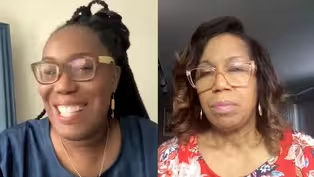
Detroit Chapter of NABJ celebrates 40th anniversary
Video has Closed Captions
Clip: S50 Ep51 | 10m 6s | Detroit Chapter of NABJ celebrates its 40th anniversary with a yearlong slate of events. (10m 6s)
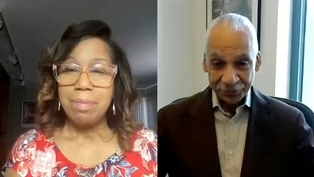
Michigan Barber Schools Reflects on 75 Years of Teaching
Video has Closed Captions
Clip: S50 Ep51 | 10m 36s | Michigan Barber School director on the barber school’s 75 years of teaching Black barbers. (10m 36s)
Providing Support for PBS.org
Learn Moreabout PBS online sponsorship
- News and Public Affairs

Top journalists deliver compelling original analysis of the hour's headlines.

- News and Public Affairs

FRONTLINE is investigative journalism that questions, explains and changes our world.












Support for PBS provided by:
American Black Journal is a local public television program presented by Detroit PBS